Understanding the NEC4 ECC Contract
As usage of the NEC family of contracts continues to grow worldwide, so does the
importance of understanding its clauses and nuances to everyone working in the
built environment. Understanding the NEC4 ECC Contract uses plain English to
lead the reader through the NEC4 Engineering and Construction Contract’s key
features. Chapters cover:
•
• The Contractor’s main responsibilities and the use of early warnings
•
• Contractor’s design
•
• Tendering
•
• Quality management
•
• Payment
•
• Liabilities and insurance
•
• Termination
•
• Avoiding and resolving disputes and much more.
Common problems experienced when using the Engineering and Construction
Contract are signalled to the reader throughout, and the correct way of reading
each clause is explained. The way the contract affects procurement processes,
dispute resolution, project management, and risk management are all addressed
in order to direct the user to best practice.
Written for construction professionals, by a practising international construc-
tion contract consultant, this handbook is the most straightforward, balanced
and practical guide to the NEC4 ECC available. It is an ideal companion for
clients, contractors, project managers, supervisors, engineers, architects, quantity
surveyors, subcontractors, and anyone else interested in working successfully with
the NEC4 ECC.
Kelvin Hughes spent 18 years in commercial management with major contrac-
tors, then the past 26 years as a consultant, including a four-year senior lectureship
at the University of Glamorgan (now the University of South Wales). He has
been a leading authority on the NEC since 1996, was Secretary of the NEC
Users’ Group for ten years and has run more than 1,600 NEC training courses.
Understanding Construction
Understanding Quality Assurance in Construction: A Practical Guide to
ISO 9000
H. W. Chung (1999)
Understanding Active Noise Cancellation
Colin H. Hansen (2001)
Understanding the CDM Regulations
Owen Griffiths (2006)
Understanding Building Failures, 4th edition
James Douglas and W. H. Ransom (2013)
Understanding NEC3: Professional Services Contract
Kelvin Hughes (2013)
Understanding NEC3: Engineering and Construction Short Contract
Kelvin Hughes (2014)
Understanding The Building Regulations, 6th edition
Simon Polley (2014)
Understanding JCT Standard Building Contracts, 10th edition
David Chappell (2017)
Understanding NEC4: Term Service Contract
Kelvin Hughes and Patrick Waterhouse (2018)
Understanding the NEC4 ECC Contract: A Practical Handbook
Kelvin Hughes (2018)
Understanding the NEC4
ECC Contract
A Practical Handbook
Kelvin Hughes
First published 2019
by Routledge
2 Park Square, Milton Park, Abingdon, Oxon OX14 4RN
and by Routledge
711 Third Avenue, New York, NY 10017
Routledge is an imprint of the Taylor & Francis Group, an informa business
 2019 Kelvin Hughes
The right of Kelvin Hughes to be identified as author of this work has
been asserted by him in accordance with sections 77 and 78 of the
Copyright, Designs and Patents Act 1988.
All rights reserved. No part of this book may be reprinted or reproduced or
utilised in any form or by any electronic, mechanical, or other means, now
known or hereafter invented, including photocopying and recording, or in
any information storage or retrieval system, without permission in writing
from the publishers.
Trademark notice: Product or corporate names may be trademarks or
registered trademarks, and are used only for identification and explanation
without intent to infringe.
British Library Cataloguing-in-Publication Data
A catalogue record for this book is available from the British Library
Library of Congress Cataloging-in-Publication Data
Names: Hughes, Kelvin (Engineering consultant) author.
Title: Understanding the NEC4 ECC contract : a practical handbook /
Kelvin Hughes. Other titles: Understanding the new engineering
contract fourth, engineering and construction contract
Description: New York, NY : Routledge, 2018. | Series: Understanding
construction | “Routledge is an imprint of the Taylor & Francis
Group, an Informa business.” | Includes bibliographical references and
index.
Identifiers: LCCN 2018006794| ISBN 9781138499706 (hardback : alk.
paper) | ISBN 9781138499720 (pbk. : alk. paper) |
ISBN 9781351014359 (ebook)
Subjects: LCSH: Civil engineering contracts—Great Britain. |
Construction contracts—Great Britain. | NEC Contracts.
Classification: LCC KD1641 .H8345 2018 | DDC 343.4107/8624—dc23
LC record available at https://lccn.loc.gov/2018006794
ISBN: 978-1-138-49970-6 (hbk)
ISBN: 978-1-138-49972-0 (pbk)
ISBN: 978-1-351-01435-9 (ebk)
Typeset in Goudy Oldstyle
by Swales & Willis Ltd, Exeter, Devon, UK
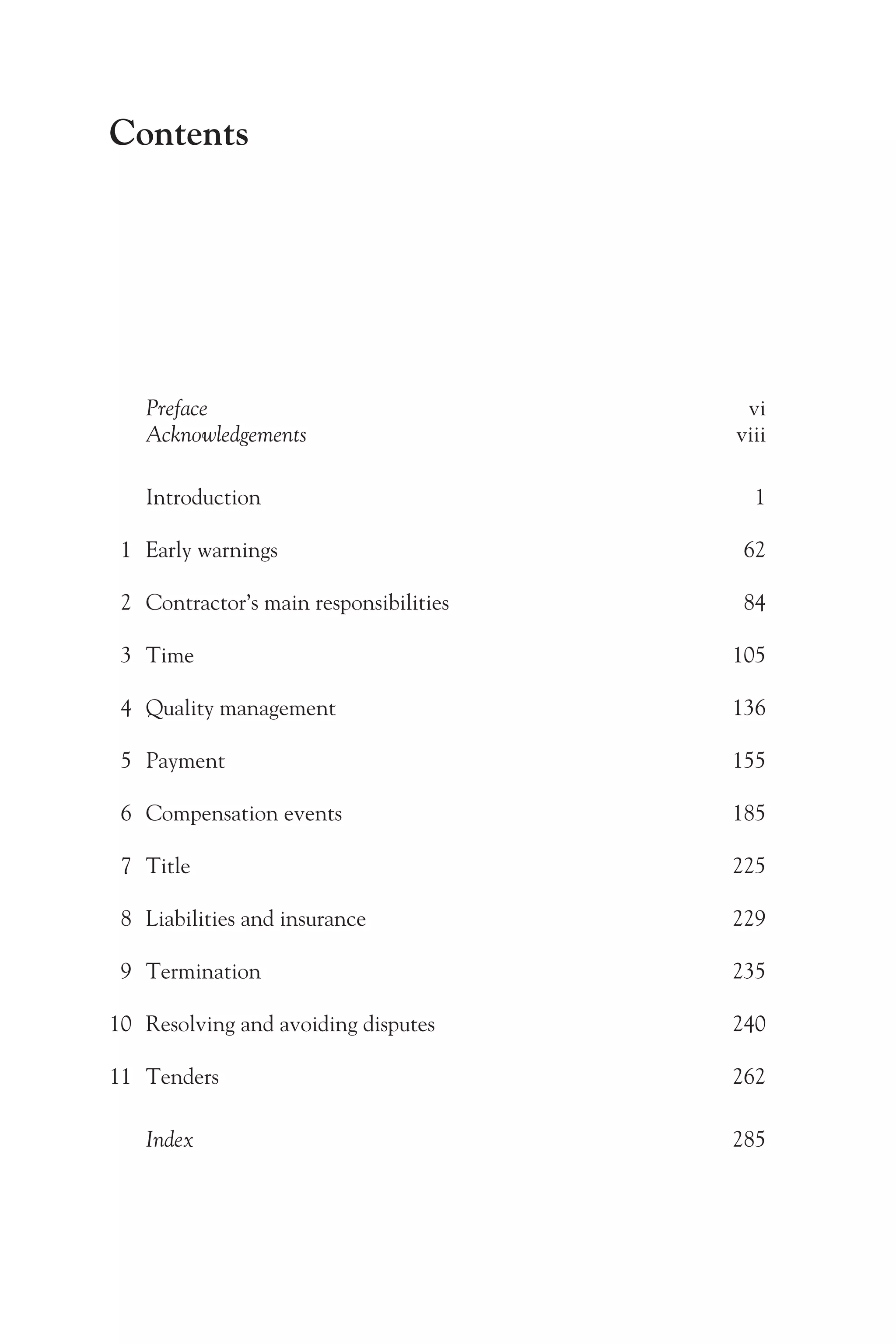
Contents
Preface vi
Acknowledgements viii
Introduction 1
1 Early warnings 62
2 Contractor’s main responsibilities 84
3 Time 105
4 Quality management 136
5 Payment 155
6 Compensation events 185
7 Title 225
8 Liabilities and insurance 229
9 Termination 235
10 Resolving and avoiding disputes 240
11 Tenders 262
Index 285
Preface
I have been involved with the NEC family of contracts since 1995, and in that
time have advised on numerous projects using the family of contracts and carried
out over 1,600 NEC-based training courses in the UK and abroad.
I was also Secretary of the NEC Users Group from 1996 to 2006, providing
support to users and potential users of the contracts including seminars and work-
shops, during which time I also ran the Users Group helpline answering queries
on the NEC contract from members of the Group.
During this involvement with the NEC, particularly with the Engineering and
Construction Contract (ECC), I have always felt there was a need for a practical
manual on the contract and its use, including worked examples and illustrations,
essentially a training course within a book. For example, what does an activity
schedule look like, how do time risk allowances and float work, how do you assess
compensation events for omissions of work, etc, which are not covered either by
the Guidance Notes, or by other textbooks?
The Guidance Notes that accompany the contract were written by the con-
tract drafters, whom I have known and always admired, and whilst they are
comprehensive and well written, I have always felt that they do not adequately
act as a practical handbook. Various books have also been developed that have in
many cases been written by people who may not be actively involved with NEC
contracts and training people to use them.
This book is intended to fill the gap, and to cover issues that may not have
been considered or covered previously.
It is intended to be of benefit to experienced professionals who are actually
using the contract, but also to students who need some awareness of the contract
as part of their studies.
Whilst a number of practitioners still use the NEC3 Engineering and
Construction Contract, the book is primarily aimed at giving guidance to NEC4
users, though the structure and content of the contracts are very similar and to
that end much of the advice given in this book is of use to all users.
As with the previous books, certain words are capitalised within the text for
clarity or emphasis, e.g. Main Options and Secondary Options.
Hopefully readers will not be confused in that, where referring to, say, “a con-
tractor” or “a client” lower case is used, but when referring to “the Contractor” or
“the Client” (i.e. the one in the contract), the initial letter is capitalised.
Preface vii
I have also not followed the contract drafting in consistently referring to “the
Contractor” as “the Contractor” and various other italicised words, as it was felt
that this would be confusing to readers, particularly those new to NEC.
I have occasionally mentioned within this book that a particular clause is “a
new clause” or “a new provision” within the NEC4 contracts, or in some cases a
reversal to how the contract was drafted within or prior to NEC3 (one fee per-
centage, early warning meetings, etc), but it is not my intention within this book
to provide a “clause by clause” comparison of the NEC3 vs NEC4 Engineering and
Construction Contract. That has already been done by the contract publishers.
As a general statement, apart from the additional members of the contract
family, the NEC4 contracts are not a radical restructure or redraft of the NEC3
contracts, but some fairly minor redrafting to include some additional provisions
or to provide additional clarity.
As I have always viewed the NEC contracts as a manual of good practice as
well as a contract, particularly in terms of the use of its Main and Secondary
Options, risk management through the early warning system, clear requirement
for a programme, and a disciplined procedure for change management, as with my
previous books on the subject, I have deliberately included within each chapter
an overview of the subject area covered by the ECC, and discussed how other
contracts deal with the issues, as well as detailing the contract provisions. I hope
that will give the readership a more rounded view of good project management
principles. Hopefully this will also be useful to student readers.
Readers may note the absence of case law within the text of the book. This is
a deliberate policy on my part, for three reasons.
Firstly, I am not a lawyer, my background being in senior commercial positions
with major building contractors, so I felt, and readers may concur, that I am not
qualified to quote and to attempt a detailed commentary on any case law.
Secondly, there has actually been very little case law on the NEC contracts
since they were first launched.
Thirdly, and probably the most important, as a contracts consultant with sig-
nificant overseas experience of all contracts including the NEC, it was always
my intention that the book should attract an international readership. NEC was
always conceived as an international contract, so including UK case law would
probably limit it to a UK readership.
I have included within the text many examples, as I have found when running
NEC training courses that delegates understand principles much better if they
can be given illustrated and worked examples, and where numbers are involved
using real calculations.
My personal motivation for writing this book is to collate into one volume a
significant quantity of material which I have gathered over many years, and to
share with others a substantial knowledge and experience of the contract.
Kelvin Hughes
February 2018
Acknowledgements
I would like to extend my love and thanks to the following people who have
supported me in life, and in writing this book:
•
• My wife Lesley, the love of my life, who continues to give me the time, the
inspiration and the support to fulfil my life’s ambitions;
•
• My parents, Maureen and Dennis, who made me who I am, and who con-
tinue to provide enthusiastic support for what I do. I hope that in return I
have made them proud; and
•
• Michael Hess, friend and colleague, for his keen perception, his wisdom, but
most of all, for being one of the nicest people I have ever known and worked
with.
Introduction
0.1 Background
The history of the New Engineering Contract stems from 1985, when the Council
of the Institution of Civil Engineers (ICE) approved a recommendation from its
Legal Affairs Committee “to lead a fundamental review of alternative contract
strategies for civil engineering design and construction with the objective of
identifying the needs for good practice”.
There had been a concern for many years that the policy of construction
contracts being sector specific, i.e. building, civil engineering, process, etc and
using a single procurement route was outdated. In addition there have been
concerns for many years, for example about the time taken to agree final
accounts.
In 1986 the specification for the new contract was submitted to the
Legal Affairs Committee and in 1991 the first consultation document was
issued, with consultation lasting a period of two years. It is perhaps worth
mentioning that all of the successive NEC contracts have gone through a
consultation process, including the NEC Users Group, so that potential
users can offer comments about the proposed new contracts.
The New Engineering Contract (now NEC4), is now being used substantially
and by many Clients in the public and private sectors in several countries, most
Clients having reported that the contract gives far greater control of time, cost
and quality issues combined with greatly improved relationships between the
contracting parties.
In July 1994, Sir Michael Latham’s report “Constructing the Team”
recommended that the New Engineering Contract should be adopted by Clients
in both the private and public sectors and suggested that it should become a
national standard contract across the whole of engineering and construction
work gener-ally. He stated that endlessly refining existing conditions of
contract would not solve adversarial problems, that a set of basic principles
is required on which modern contracts can be based, and a complete family of
interlocking documents is also required.
He stated that the New Engineering Contract (NEC) fulfils many of
these principles and requirements, but changes to it would be desirable and the
matrix is not yet complete.
2 Introduction
Also, public and private sector Clients should begin to use the NEC and phase
out their use of “bespoke” documents.
Latham also stated that the most effective form of contract should include:
1 A specific duty for all parties to deal fairly with each other and in an atmos-
phere of mutual co-operation.
2 Firm duties of teamwork, with shared financial motivation to pursue those
objectives.
3 A wholly interrelated package of documents suitable for all projects and any
procurement route.
4 Easily comprehensible language, with guidance notes attached.
5 Separation of the roles of contract administrator, project or lead manager
and adjudicator.
6 A choice of allocation of risks, to be decided as appropriate to each project.
7 Where variations occur, they should be priced in advance, with provision for
independent adjudication if agreement cannot be reached.
8 Provision for assessing interim payments by methods other than monthly
valuation, i.e. milestones, activity schedules or payment schedules.
9 Clearly setting out the period within which interim payments should be
made, failing which they there should be an automatic right to
compensation, involving payment of interest.
10 Providing for secure trust fund routes of payment.
11 While avoiding conflict, providing for speedy dispute resolution by an
impartial adjudicator/referee/expert.
12 Providing for incentives for exceptional performance.
13 Making provision where appropriate for advance mobilisation payments.
The NEC family provides for all of Latham’s recommendations.
In June 2005, NEC3 was launched as a complete review and update of the
whole NEC family, including the introduction of two new contracts, the Term
Service Contract and the Framework Contract. Since that date, the Framework
Contract and the Supply and Short Supply Contracts have also been introduced
into the family.
Alongside the launch of NEC3, the Office of Government Commerce (OGC)
announced that after extensive research, they identified NEC3 as the contract
which should be adopted by private and public Clients in commissioning their
projects.
This was reflected on the inside front cover of the NEC3 contracts
when they were launched in June 2005, which stated, “OGC advises public
sector procurers that the form of contract used has to be selected according to the
objectives of the project, aiming to satisfy the Achieving Excellence in
Construction (AEC) principles. This edition of the NEC (NEC3) complies fully
with the AEC principles. OGC recommends the use of NEC3 by public sector
construction procurers on their construction projects.”
Introduction 3
This note was changed in the 2010 reprint to “The Construction Clients’ Board
(formerly Public Sector Construction Clients Forum) recommends that public sector
organisations use the NEC3 contracts when procuring construction. Standardising use
of this comprehensive suite of contracts should help to deliver efficiencies across the
public sector and promote behaviours in line with the principles of Achieving Excellence
in Construction.”
In June 2017, NEC4 was launched which is the subject of this book.
Whilst articles written about NEC tend to give prominence to many of the
big “flagship” projects carried out using the contracts, of much more signifi-
cance are the very many more modest size and value projects being procured.
It is also in this area that many problems have arisen in the implementation of
the contract.
The original objectives of the NEC contracts, and more specifically the
Engineering and Construction Contract (ECC), which is the topic of this book,
were to make improvements under three headings:
Flexibility
The contract should be able to be used:
• For any engineering and/or construction work containing any or all of the
traditional disciplines such as civil engineering, building, electrical and
mechanical work, and also process engineering.
Previously, contracts had been written for use by specific sectors of the
industry, e.g. ICE civil engineering contracts, JCT building contracts,
IChemE process contracts.
• Whether the Contractor has full, partial or no design responsibility.
Previously, most contracts had provided for portions of the work to be
designed by the Contractor, but with separate design and build versions if
the Contractor was to design all or most of the works.
• To provide all the normal current options for types of contract such as lump
sum, remeasurement, cost reimbursable, target and management contracts.
Previously, contracts were written, primarily as either lump sum or
remeasurement contracts, so there was no choice of procurement method
when using a specific standard form.
• To allocate risks to suit each particular project.
Previously, contracts were written with risks allocated by the contract
drafters, and one had to be expert in contract drafting to amend the
conditions to suit each specific project on which it was used.
• Anywhere in the world.
Previously, contracts included country specific procedures and legislation
and therefore either could not be used or had to be amended to be used in
other countries. To that end, FIDIC contracts have been seen as the only
forms of contract which could be used in a wide range of countries.
4 Introduction
To date, NEC contracts have been used for projects as widely diverse as airports,
sports stadiums, water treatment works, housing projects, in many parts of the
world and even research projects in the Antarctic!
Clarity and simplicity
• The contract is written in ordinary language and in the present tense.
• As far as possible NEC only uses words which are in common use so that it is
easily understood, particularly where the user’s first language is not English.
Previously obscure words such as “whereinbeforesaid”, “hereinafter” and
“aforementioned” were commonplace in contracts. It has few sentences that
contain more than forty words and uses bullet points to subdivide longer
clauses.
• The number of clauses and the amount of text are also less than in most other
standard forms of contract and there is an avoidance of cross-referencing
found in more traditional standard forms.
• It is also arranged in a format which allows the user to gain familiarity with
its contents, and required actions are defined precisely, thereby reducing the
likelihood of disputes.
• Finally, subjective words like “fair” and “reasonable” have been used as little
as possible, as they can lead to ambiguity, so more objective words and state-
ments are used.
Some critics of NEC have commented that the “simple language” is actually a
disadvantage as certain clauses may lack definition and there are certain
recognised words that are commonly used in contracts. There is very little
case law in existence with NEC contracts, and whilst adjudications are
confidential and unreported, anecdotal evidence suggests that there does not
appear to be any more adjudications with NEC contracts than any other,
which would tend to suggest that the criticism may be unfounded.
Stimulus to good management
This is perhaps the most important objective of the ECC in that every procedure
has been designed so that its implementation should contribute to, rather than
detract from, the effective management of the work. In order to be effective in
this respect, contracts should motivate the parties to proactively want to
manage the outcome of the contract, not just to react to situations. NEC
intends the parties to be proactive and not reactive. It does also require the
parties and those that represent them to have the necessary experience (sadly
often lacking) and to be properly trained so that they understand how the NEC
works.
The philosophy is founded on two principles:
•
• “Foresight applied collaboratively mitigates problems and shrinks risk”
•
• “Clear division of function and responsibility helps accountability and
motivates people to play their part”
Introduction 5
Examples of foresight within the ECC are the early warning and compensation
event procedures, with the early warning provision requiring the Project Manager
and the Contractor each to notify the other upon becoming aware of any matter
which could have an impact on price, time or quality.
A view held by many Project Managers is that an early warning is something
that the Contractor would give, and is an early notice of a “claim”. This is an
erroneous view, as firstly, early warnings should be given by either the Project
Manager or the Contractor, whoever becomes aware of it first, the process being
designed to allow the Project Manager and Contractor to share knowledge of a
potential issue before it becomes a problem, and secondly, early warnings should
be notified regardless of whose fault the problem is – it is about raising and
resolving the problem, not compensating the affected party.
The compensation event procedure requires the Contractor, within three
weeks, to submit a quotation showing the time and cost effect of the event. The
Project Manager then responds to the quotation within two weeks, enabling the
matter to be properly resolved close to the time of the event rather than many
months or even years later.
The programme is also an important management document with the
contract clearly prescribing what the Contractor must include within its
programme and requiring the Project Manager to “buy into it” by formally
accepting (or not accepting) the programme. The Project Manager can use the
programme to decide the most appropriate way to implement change.
In total the ECC is designed to provide a modern method for Clients,
Contractors, Project Managers and others to work collaboratively and to
achieve their objectives more consistently than has been possible using
other traditional forms of contract. People will be motivated to play their
part in collaborative management if it is in their commercial and professional
interest to do so.
Uncertainty about what is to be done and the inherent risks can often lead to
disputes and confrontation but the ECC clearly allocates risks and the collabora-
tive approach will reduce those risks for all the parties so that uncertainty will
not arise.
The Preface to the NEC4 Engineering and Construction Contract states that
the key objectives in drafting NEC4 contracts were:
• to provide greater stimulus to good management;
• to support new approaches to procurement which improve contract
management; and
• to inspire increased use of NEC in new markets and sectors.
Essential differences between the ECC and other forms of contract:
The ECC is part of a matrix of contracts – Engineering and Construction
Contract, Engineering and Construction Short Contract, Term Service Contract,
Term Service Short Contract, Term Service Subcontract, Design Build and
Operate Contract, Alliance Contract, Supply Contract, Supply Short Contract,
6 Introduction
Framework Contract, Engineering and Construction Subcontract, Engineering
and Construction Short Subcontract, Professional Service Contract, Professional
Service Subcontract, Professional Service Short Contract, Dispute Resolution
Service Contract, allowing all parties, whatever the project or service to be
provided, to work under similar conditions.
Flexibility of use – the ECC is not sector specific, in terms of it being a
building, civil engineering, mechanical engineering, process contract, etc.;
it can be used for any form of engineering or construction. This is particu-
larly useful where a major project such as an airport or sports stadium can
be a combination of building, civil engineering and major mechanical and
electrical elements.
Flexibility of procurement – the ECC’s Main and Secondary Options,
together with flexibility in terms of Contractor design, allow it to be used for
any procurement method whether the Contractor is to design all, none, or part
of the works.
Early Warning – the ECC contains express provisions requiring the
Contractor and the Project Manager to notify and if required call “an early
warning meeting” when either becomes aware of any matter which could affect
price, time or quality.
Programme – there is a clear and objective requirement for a detailed pro-
gramme with method statements and regular updates which provides an essential
tool for the parties to manage the project and to notify and manage the effect of
any changes, problems, delays, etc.
Compensation events – this procedure requires the Contractor to price the
time and “Defined Cost” effect of a change within three weeks and for the
Project Manager to respond within two weeks. There is therefore a “rolling” Final
Account with early settlement and no later “end of job” claims for delay and/or
disruption. It is also more beneficial for the Contractor in terms of its cash flow as
the Contractor is paid agreed sums rather than reduced “on account” payments,
which are subject to later agreement and payment.
Disputes – the contract encourages better relationships and there is far less
tendency for disputes because of its provisions. If a dispute should arise there are
clear procedures as to how to deal with it, i.e. adjudication, tribunal.
Mutual trust and co-operation
The first clause of all the NEC contracts (Clause 10.1) has always required the
Parties, and their agents, e.g. Project Manager, Supervisor, and now Service
Manager, to act as stated in the contract, and to act in a spirit of mutual trust and
co-operation.
This mirrors Sir Michael Latham in his report “Constructing the Team” when
he recommended that the most effective form of contract should include “a
specific duty for all parties to deal fairly with each other and in an
atmosphere of mutual co-operation”.
Introduction 7
This has been slightly changed within the NEC4 contracts in that the former
Clause 10.1 has now been split into two separate clauses, Clauses 10.1 and 10.2:
•
• Clause 10.1: The Parties, the Project Manager and the Supervisor shall act as
stated in the contract.
•
• Clause 10.2: The Parties, the Project Manager and the Supervisor act in a spirit of
mutual trust and co-operation.
If we examine the clauses, firstly and rather curiously, Clause 10.1 is written
in the future tense, which is unusual for NEC contracts in that they are writ-
ten in the present tense. This notwithstanding, is it necessary to state that the
Parties, the Project Manager and the Supervisor are required to act as stated in
the contract? What difference does it make if that clause was absent or deleted?
Would they not have to act as stated in the contract?
Secondly, what does it mean that the Parties, the Project Manager and the
Supervisor are required to act in a spirit of mutual trust and co-operation?
This second requirement mirrors Sir Michael Latham in his report
“Constructing the Team” when he recommended that the most effective forms
of contract should include “a specific duty for all parties to deal fairly with each other
and in an atmosphere of mutual co-operation”.
This clause has often been viewed with some confusion, and for those who
have spent many years in the construction industry, with a degree of scepticism.
Most practitioners state that their understanding of the clause is that the parties
should be non-adversarial toward each other, acting in a collaborative way and
working for each other rather than against each other, and in reality that is what
the clause requires.
However, the difficulty is, that if a party does not act in a spirit of mutual
trust and co-operation what can another party do? The answer is that the clause
is almost unenforceable as it is virtually impossible to define and quantify the
breach or the ensuing damages that flow from the breach.
In addition, the Contractor is not contractually related to the Project Manager
or Supervisor, so either would be unable to take action directly against the other
for breach of contract other than through the Client.
To that end, as Clause 10.1 is a fairly redundant clause, and Clause 10.2 is
unenforceable, Clients have been seen to insert a Z clause to delete the require-
ments; however, it is recommended that it should remain in the contract, if
merely viewed as a statement of good intent.
In effect, a clause requiring parties to act in a certain spirit will probably not,
on its own, have any real effect. Within the ECC it is the clauses that follow
within the contract which require early warnings, clearly detailed programmes
which are submitted for acceptance, and a structured change management pro-
cess, that actually create and develop that level of mutual trust and co-operation
rather than simply inserting a statement within the contract requiring the parties
to do so.
8 Introduction
0.2 Structure of the ECC
The ECC includes the following sections:
Core clauses
1 General
2 The Contractor’s main responsibilities
3 Time
4 Quality management
5 Payment
6 Compensation events
7 Title
8 Liabilities and insurance
9 Termination
Main option clauses
Option A Priced contract with activity schedule
Option B Priced contract with bill of quantities
Option C Target contract with activity schedule
Option D Target contract with bill of quantities
Option E Cost reimbursable contract
Option F Management contract
Dispute resolution
Option W1 Used when Adjudication is the method of dispute resolution
and the United Kingdom Housing Grants, Construction and Regeneration
Act 1996* does not apply
Option W2 Used when Adjudication is the method of dispute resolution
and the United Kingdom Housing Grants, Construction and Regeneration
Act 1996* applies
*See amendment regarding the Local Democracy, Economic Development and
Construction Act 2009.
Option W3 Used when a Dispute Avoidance Board is the method of dis-
pute resolution and the United Kingdom Housing Grants, Construction and
Regeneration Act 1996* does not apply
Secondary option clauses
Option X1 Price adjustment for inflation
Option X2 Changes in the law
Introduction 9
Option X3 Multiple currencies
Option X4 Ultimate holding company guarantee
Option X5 Sectional Completion
Option X6 Bonus for early Completion
Option X7 Delay damages
Option X8 Undertakings to the Client or Others
Option X9 Transfer of rights
Option X10 Information Modelling
Option X11 Termination by the Client
Option X12 Multiparty collaboration
Option X13 Performance bond
Option X14 Advanced payment to the Contractor
Option X15 The Contractor’s design
Option X16 Retention
Option X17 Low performance damages
Option X18 Limitation of liability
Option X20 Key Performance Indicators
Option X21 Whole life cost
Option X22 Early Contractor involvement
Option Y(UK)1 Project Bank Account
Option Y(UK)2 Housing Grants, Construction & Regeneration Act 1996
Option Y(UK)3 Contracts (Rights of Third Parties) Act 1999
Option Z Additional conditions of contract
N.B. Option X19 is not used
Schedules of Cost Components
Contract Data
Other documents to be used with the ECC include
•
• the Scope
•
• the Site Information
•
• the Accepted Programme
•
• other documents resulting from choosing various Secondary Options,
e.g. Performance Bond
10 Introduction
Depending on the choice of Main Options the documents may also include:
•
• an activity schedule (Option A or C), or
•
• a bill of quantities (Option B or D)
The Main Options
The six Main Options A to F enable Clients to select a procurement strategy
and payment mechanism most appropriate to the project and the various risks
involved. Chapter 5 includes more details on payment mechanisms and require-
ments under each Main Option.
Option A Priced contract with activity schedule
Option B Priced contract with bill of quantities
Option C Target contract with activity schedule
Option D Target contract with bill of quantities
Option E Cost reimbursable contract
Option F Management contract
•
• Options A and B are priced contracts in which the risks of being able
to carry out the work at the agreed prices are largely borne by the
Contractor.
•
• Options C and D are target contracts in which the Client and Contractor
share the financial risks in an agreed proportion.
•
• Options E and F are two types of cost reimbursable contract in which
the financial risks of being able to carry out the work are largely borne
by the Client.
A
Contractor Risk
Client
Risk
B
Financial
risk of main
Options
F
E
D
C
Max
Max
Min
Figure 0.1 Financial risk of Main Options
Introduction 11
Essentially, the Main Options differ in the way the Contractor is paid. Whilst
many traditional contracts are based on bills of quantities, there has been a move-
ment away from the use of traditional bills and towards payment arrangements
such as milestone payments and activity schedules, with payment based on
progress achieved, rather than quantity of work done. There is also an
increasing use of target cost contracts which has been encouraged by the
increasing use of partnering arrangements, and the better sharing of risk.
To that end, it is perhaps not surprising that in surveys carried out by the RICS
(Contract in Use Surveys) Options A and C were found to be the most regularly
used NEC3 Main Options, with Option B in third place, but significantly behind
Options A and C, and Options D, E and F in the “very rarely used” category. It is
likely that this trend will continue as use of the NEC4 ECC continues.
Once the procurement strategy has been decided, the Main and Secondary
Options can be selected to suit that strategy.
Option A – Priced contract with activity schedule
Procurement using specification and drawings or activity schedules is still the way
the largest number of projects, particularly those lower in value, are procured. In
addition, many projects are procured on a design and build basis. In that respect,
Option A has always been the most commonly selected Main Option.
Option A is normally used where the Client knows exactly what it wants, and
is able to clearly define it through the Scope, which would comprise drawings
and specifications, but can alternatively be a performance specification, where
the Contractor is to design the works to meet specific performance objectives.
The Scope must be sufficiently defined for the Contractor to commit itself to a
lump sum price and prepare the Activity Schedule which will identify its payments.
Whilst the ECC is appropriate for all forms of engineering and construction,
Option A is particularly appropriate for building projects where the work can
more often be clearly defined.
The Activity Schedule is a list of activities, normally prepared by the
Contractor and can be used where the Client has provided all the Scope, or
where the Contractor is to design all or part of the works based on some
form of perfor-mance criteria, and therefore there is Scope provided by the
Contractor.
An Activity Schedule is a list of activities prepared by the Contractor which it
expects to carry out in Providing the Works. When the Contractor has priced it,
the lump sum for each activity is the Price to be paid by the Client in the
assessment following completion of that activity.
Option A is therefore a stage payment contract and as payment is linked to
completion of activities, the Contractor must plan and carry out its work
effectively with the cash flow requirements for both parties being clearly
visible. Administration of payment aspects is therefore fairly simple.
Establishing and taking off the quantities of work involved to achieve the
completion of each activity is the responsibility of the tendering Contractors.
The price for each activity is in effect a lump sum for that activity and must
include everything necessary to complete the activity. The sum of the tendered
12 Introduction
lump sums for each of the activities is the tendered prices (the total of the Prices)
for the whole of the Works.
Option A is ideally suited to Contractor’s design but can be used for Client’s
design or split design responsibility.
Under Option A, the Contractor prepares and submits an Activity Schedule
with its tender. The total of the Prices in the Activity Schedule is the Contractor’s
price for Providing the Works. The contract requires that the activities on the
Activity Schedule relate to operations on each programme.
It is important to recognise that the Activity Schedule has two primary
functions:
•
• it shows how the tendering Contractors have built up their price and can
therefore be used as part of the tender assessment process.
•
• it is used to calculate the Price for Work Done to Date.
The price for each activity is in effect a lump sum for carrying out and completing
that activity and must therefore include everything necessary to complete that
activity.
The Client does not provide a bill of quantities with Option A, the taking-off
of the quantities of work involved to achieve the completion of each activity and
the pricing activity being the responsibility of the tendering Contractors.
There are certain advantages to the Client with using Option A:
• there is no requirement for a bill of quantities to be prepared for
tendering Contractors to price. This will save time and money at the
pretender stage.
• the Contractor holds the risk of inaccuracies in the quantities, or of missing
an item of work stated within the Scope.
• the assessment of the Price for Work Done to Date is easier and quicker than
with the other Main Options. There is no requirement to remeasure the
work and apply quantities to rates and prices to calculate the amount due to
the Contractor.
• programme and activity schedule preparation are linked as integrated
activities which would tend to lead to a more comprehensive tender.
• payment is linked to completion of an activity or group of activities related
back to the programme, so cash flow requirements for both parties are more
visible.
• in order to receive payment, the Contractor has to complete an activity by
the assessment date, so it has to price and programme realistically and is
motivated to keep to that programme during construction.
• the assessment of the effects of compensation events is related back to the
activity schedules. Any change in resources or methods associated with an
activity can be compared with those stated in the Accepted Programme
before the compensation event occurred.
Introduction 13
The possible disadvantages to the Client are:
• as there is no specific document that all the tendering Contractors price to,
it is difficult to assess tenders on a “like for like” basis. Some clients cite that
as an advantage, saying that they do not require the facility to check tenders
on a line by line basis anyway, so that may be considered as an advantage!It
is not uncommon, to assist the assessment of tenders, for Clients to issue
templates for the Contractor to price covering the main construction elements
as part of the tender, with the tendering Contractors then inserting the activi-
ties within each element. In that way, each element will have been priced on
a “like for like” basis, but the activities within each element may have been
described and priced differently by each tenderer.
If a template is used, Clients should be wary of them being too prescriptive
and almost being seen by tenderers as a bill of quantities.
• The tendering Contractors have to spend time, and money, in taking
off the quantities of work in order to establish and populate the activity
schedule. In order to reduce the tenderers’ efforts in producing their own
quantities, some Clients issue quantities to tenders, but it must be stressed
that these are for indicative purposes only, and tenderers should not rely
on those quantities.
• The Client holds the risk of clearly defining the Scope in order that the
Contractor can prepare the Activity Schedule.
The author has seen many “hybrids” of Option A contracts (and all the other Main
Options), for example, as stated above, Clients preparing an outline activity
schedule in the form of a template for tenderers to develop and submit with their
tenders.
When using Option A, tenderers should not be restricted in terms of the
structure of their activity schedule. Option A gives the Contractor the greatest
risk of all the Main Options in terms of pricing tenders, but also in terms of
setting up their cash flow requirements, and therefore as far as possible, “hybrid”
versions of Option A which restrict pricing and cash flow should be
discouraged.
Option A, and the other Main Options are discussed further within this book,
primarily within Chapter 5 (Payment).
Option B – Priced contract with bill of quantities
Option B is essentially a remeasurement contract based on a Bill of Quantities
prepared by the Client with the Contractor pricing the items in the bill of
quantities including matters which are at its own risk. The Contractor is then
paid for the quantity completed to date at the rates and prices in the bill of
quantities.
In the early days of the New Engineering Contract, Clients would tend to
select Option B initially as it mirrored the traditional bills of quantities-based
contracts they were using at the time. Once Clients became more experienced in
the use of the contract, they tended to move toward other Main Options.
14 Introduction
It is important that, if selecting a remeasurement contract, one should consider
the merits of preparing and using bills of quantities against other procurement
methods.
A Client should not select remeasurement just because in the past, with other
forms of contract, it has always begun the procurement process by producing the
drawings and specification then measuring the work! Again this comes back to a
procurement strategy consideration.
It must be noted that changes which are compensation events are inserted
into the bill of quantities as lump sums rather than on a remeasurement basis
(see Chapter 6).
This option is normally used where the Client knows what it wants and is
able to clearly define it through the Scope, and measure it within the Bills of
Quantities, but there are likely to be changes in the quantities, which may or may
not be considered as compensation events.
Although there has been a general decline in the use of bills of quantities in
the past 25 years, the option is still quite widely used on civil engineering projects
where the final quantity of excavations, filling materials, etc. cannot be
reasonably forecast.
Option B does not work well when there is a significant amount of Contractor’s
design; in this case, a lump sum contract such as Option A or perhaps Option C
should be used rather than remeasurement, as the Contractor can then carry out
initial design calculations, price the work and include the various design stages
within its activity schedule rather than have the Client measuring the work,
which would not be practical.
A bill of quantities comprises a list of work items and quantities prepared by the
Client and priced by the Contractor. Standard methods of measurement are
published, which state the items to be included and how the quantities are
calculated.
Confusion can sometimes arise as to whether the tendering Contractors
should price the Bills of Quantities or the Scope. The Contractor Provides
the Works in accordance with the Scope (Clause 20.1), therefore it is assumed
that it programmes the Works in accordance with the Scope. Clause 31.2
(Programme) refers to “Providing the Works” and “Scope”.
Information in the Bill of Quantities is not Scope or Site Information
(Clause 56.1). It does not tell the Contractor what it has to do, but it must
clearly be a fair representation of the scope of the Works to allow the
Contractor to accurately price the Works. Although a Contractor will often
use the quantities within the Bill of Quantities as a guide to calculate time
scales, the bill is used as a basis for inviting and assessing tenders, so it is a
pricing and payment document, i.e. it deals with money. It is reasonable for
the Contractor to presume that the quanti-ties are a fair representation of what
is included in the Scope.
If there is an inconsistency between the documents which form part of
the contract either the Project Manager or the Contractor notifies the other as
soon as either becomes aware that it exists (Clause 17.1) and the Project
Manager cor-rects it. This may then be addressed as a compensation event
under Clause 60.6, with Clause 60.7 stating that in assessing a compensation
event resulting from the
Introduction 15
correction of an inconsistency between the Bill of Quantities and another
document, the Contractor is assumed to have taken the Bill of Quantities as
correct. This is in respect of the Contractor’s price, Completion Date and
programme, so the Price and, if appropriate, the Completion Date may then
be changed to accommodate the correction.
Clearly, if the Contractor notices the error during the tender period then it
should raise it as a query, then the matter can be dealt with and all tenderers
informed, however, while the Contractor should notify if and when it finds an
error, it is not under any obligation to look for the error!
Option C – Target contract with activity schedule
Option C is a target contract based on an activity schedule, again, as with Option A,
normally prepared by the Contractor. It must be emphasised that the activity
schedule is not used for payments in the same way as with an Option A contract.
In Option C, the activity schedule acts as a guide when assessing tenders, but
payments are based on Defined Cost incurred, not completion of activities.
Target contracts are a development of cost reimbursable contracts and are a
combination of a lump sum price and open-book cost reimbursable payments.
The advantages of target contracts are that the parties initially have certainty
of price, with the Contractor being incentivised to make cost savings for the
benefit of the Client and itself.
This option is normally used where the Client knows what it wants and is able
to clearly define it through the Scope, so that the Contractor can price and
prepare the activity schedule but it sees a benefit in sharing risk and opportunity
with the Contractor, thereby encouraging collaboration. Financial risks are
shared, proportionally between the Client and the Contractor through the
Contractor’s share percentages. Many wrongly call Option C the
“Partnering Option”, although it does lend itself to the principles of
partnering, collaborative work-ing and associated risk/opportunity sharing.
Coincidentally, there is a Partnering (multiparty collaboration) Secondary
Option X12 which may have given rise to the confusion. This option is
described in detail later within this chapter.
The Contractor tenders a price and includes an Activity Schedule in the same
way as it would under an Option A contract. This price, when accepted is then
referred to as the “target”. The Contractor also tenders its percentage for Fee.
The original target is referred to as the Total of the Prices at the Contract Date.
•
• the target price includes the Contractor’s estimate of Defined Cost plus other
costs, overheads and profit to be covered by its Fee.
•
• the Contractor tenders its Fee in terms of a percentage to be applied to
Defined Cost.
•
• during the course of the contract, the Contractor is paid Defined Cost plus
the Fee.
•
• the target is adjusted for compensation events and also for inflation (if
Option X1 is used).
16 Introduction
• on Completion, the Project Manager assesses the Contractor’s share in
accordance with Clause 54.1 which, it has to be said, is at best a confusing
clause, though the Guidance Notes clarify the clause! The Contractor then
pays or is paid its share of the difference between the final total of the Prices
and the final Payment for Work Done to Date according to a formula stated
in the Contract Data. This motivates the Contractor to decrease costs. Many
refer to this sharing of risk and opportunity as “pain and gain”. It often comes
as a surprise to NEC users that the terms “pain and gain” do not appear
anywhere within the NEC contracts, nor does the term “target price”!
The Contractor is required to submit forecasts at the intervals stated in
the Contract Data of the Total of the Prices from the starting date to the
Completion of the whole of the works, which advises the Client of its potential
outturn cost.
The Contractor is also required to advise the Project Manager on the practical
implications of the design of the works and on subcontracting arrangements.
Option D – target contract with bill of quantities
Option D is a target contract based on a Bill of Quantities. Again, as with Option B,
the Bills of Quantities are prepared by the Client.
This option is normally used where the Client knows what it wants and is
able to clearly define it through the Scope, and measure it within the Bills of
Quantities, but there are likely to be changes in the quantities, which may or may
not be considered as compensation events.
The Contractor tenders a price based on the Bills of Quantities. This price,
when accepted is then referred to as the “target”. The original target is referred to
as the Total of the Prices at the Contract Date.
The assessment of payments is again the same as for an Option C contract:
•
• the target price includes the Contractor’s estimate of Defined Cost plus other
costs, overheads and profit to be covered by its Fee.
•
• the Contractor tenders its Fee in terms of a percentage to be applied to
Defined Cost.
•
• during the course of the contract, the Contractor is paid Defined Cost plus
the Fee.
•
• the target is adjusted for compensation events and also for inflation (if
Option X1 is used).
•
• on Completion, the Contractor is paid (or pays) its share of the difference
between the final total of the Prices and the final Payment for Work Done
to Date according to a formula stated in the Contract Data. If the final
Payment for Work Done to Date is greater than the final total of the Prices,
the Contractor pays its share of the difference.
•
• as with Option B, the target is generated as a remeasurement, based on
the Bill of Quantities, though changes which are compensation events are
Introduction 17
inserted into the Bill of Quantities as lump sums rather than on a remeasure-
ment basis (see Chapter 6).
•
• the target is adjusted for compensation events and also for inflation (if
Option X1 is used).
Again, as with Option C, the Contractor is required to submit forecasts at the
intervals stated in the Contract Data of the Total of the Prices from the starting
date to the Completion of the whole of the works.
The Contractor is also required to advise the Project Manager on the practical
implications of the design of the works and on subcontracting arrangements.
Option E – cost reimbursable contract
Option E is a cost reimbursable contract with the Contractor being reimbursed
Defined Cost plus the Fee.
It should be used:
•
• where the scope of work is uncertain, e.g. some refurbishment projects;
•
• where extreme flexibility is required, e.g. for enabling work;
•
• where a high level of Client involvement is envisaged;
•
• for emergency work;
•
• where trials or work of an experimental nature are carried out.
The option allows development of the design as the works proceed and permits
maximum flexibility in allocation of design responsibility.
A cost reimbursable contract should be used where the definition of the work
to be done is inadequate even as a basis for a target price and yet an early start is
required. In such circumstances the Contractor cannot be expected to take risks.
It carries minimum risk and is reimbursed its Defined Cost plus Fee, subject only
to a number of constraints designed to motivate efficient working.
A criticism of cost reimbursable contracts such as Option E is that it gives
the Contractor very little incentive to reduce costs, however a cost reimbursable
contract should be used where the definition of the work to be done is
inadequate for the Contractor to price and yet an early start is required. In
such circumstances the Contractor cannot be expected to take financial risks.
It carries minimum risk and is reimbursed its Defined Cost plus Fee, subject
to any deduction for Disallowed Costs.
Under Option E of the ECC, the Contractor is reimbursed its Defined Cost
plus a Fee, basically covering its offsite overheads and profit. This Fee is calculated
by applying the fee percentage, given at tender by the Contractor in
Contract Data Part 2, to appropriate Defined Cost. Although Option E is a cost
reimbursable contract, there is an obligation on the Contractor to provide a
regular forecast of the Total of the Prices which advises the Client of its
potential outturn cost.
Another criticism of Option E is that the tendering Contractors do not
actually price the works; they just price their fee percentage together with any
18 Introduction
appropriate Equipment rates, manufacture and fabrication rates and overheads
percentages. In addition tenderers may be required to notionally agree to a cost
plan. This makes it difficult to assess cost reimbursable tenders, but again the
basis of cost reimbursable contracts is that the Client bears most of the risk.
The Contractor is required to submit forecasts at the intervals stated in the
Contract Data of the Total of the Prices from the starting date to the Completion
of the whole of the works.
The Contractor is also required to advise the Project Manager on the practical
implications of the design of the works and on subcontracting arrangements.
Option F – Management contract
Management contracting emerged as a procurement method for large projects in
the early 1980s, but its use declined in the 1990s and it is now rarely used, but the
ECC provides for it through Option F.
The principle with a management contract is that the Contractor focuses on
managing the contract rather than physically building the project and does not
normally carry out any construction work itself.
The Contractor’s responsibilities under a management contract normally cover:
(i) provision of site accommodation, and other common use facilities.
(ii) managing time-based deliverables such as programme, milestones and project
completion.
(iii) management of cost, normally in conjunction with the Client’s cost
consultant.
(iv) management of quality and defects related issues.
(v) managing the design, though in most cases, it is not responsible for carrying
out the design – “design and manage” is a procurement method where the
Contractor normally has full design responsibility.
(vi) assembling, tendering and managing subcontractor packages.
The amounts paid to the Subcontractors are reimbursed to the Contractor, plus
a management fee.
TheContractorholdsverylittleriskunderthisprocurementmethod,asapartfrom
any proven negligence on its part, it is reimbursed in full the subcontractor costs plus
its fee. Any further costs incurred, which cannot be recovered from a Subcontractor,
in respect of say, subcontractor insolvency, are reimbursed by the Client.
The Contractor’s work mainly applies to the construction phase though it can
be appointed for pre-construction services. All subcontracts are directly with the
Contractor.
The ECC specifically states under Option F that the Contractor’s
responsibility is to manage the design that has been assigned to him, the
provision of site services and the construction and installation of the works, all
of which are subcontracted. The Contractor is also required to advise the
Project Manager
Introduction 19
on the practical implications of the design of the works and on subcontracting
arrangements. It is also required to prepare forecasts of the total Defined Cost
for the whole of the works in consultation with the Project Manager at intervals
stated in the Contract Data.
The Contractor tenders a fee percentage and its estimated total of the prices
of the subcontracts. The subcontract prices plus any work carried out by the
Contractor itself are then paid to the Contractor as Defined Cost plus Fee. The
Contractor is responsible for supplying management services and completing or
advising on design if required. If the Contractor is responsible for design it will be
appointed on a design and manage basis.
Management contracts are generally suitable:
•
• where there is a need to co-ordinate a number of works contractors and
suppliers;
•
• when the Client does not have sufficient capability to manage the project;
•
• when the time scale of the project is tight, requiring an early start of
construction.
At this point the scope of the project is not fully developed. As the scope is
developed and construction progresses, successive works contracts can be
awarded, but the interfaces between these successive packages must be managed.
Again, as with Option E, the tendering Contractors do not actually price the
works, they just price their fee percentage, with further rates or percentages as
with the other options as the Schedule of Cost Components does not apply.
Again, this makes it difficult to assess management contract tenders, but again
the basis of this type of contract is that the Client bears most of the risk.
As with Options C, D and E, the Contractor is required to submit forecasts
at the intervals stated in the Contract Data of the Total of the Prices from the
starting date to the Completion of the whole of the works.
The Contractor is also required to manage the Contractor’s design, provision
of site services and the construction of the works. The Contractor subcontracts
all work except work which the Contract Data states that it will do.
Secondary Options
Note that Option X19 is not used, but as NEC4 has a common numbering system
for Main and Secondary Options, any missing Options are found in other
members of the NEC4 family, e.g. Option X19 is in the NEC4 Term Service
Contract.
This common numbering for the Main and Secondary Options provides a
consistency sadly lacking in many other families of standard contracts.
So, in NEC4, X1 will always be “Price adjustment for inflation”; that
option will be X1 and the wording will be almost identical.
This feature makes the NEC4 contracts very user friendly, particularly for
those who use a number of members of the family and more than one procurement
strategy.
20 Introduction
Option X1: Price adjustment for inflation (used only with
Options A, B, C and D)
The Client should make the decision at the time of preparing the tender documents
as to whether inflation for the duration of the contract is to be:
•
• The Contractor’s risk – in which case it should not select Option X1.
•
• The Client’s risk – in which case, it should select Option X1.
The default within the ECC is that the contract is “fixed price” in terms of inflation,
i.e. the Contractor has priced the work to include any inflation it may encounter
during the period of carrying it. If Option X1 is chosen, the Prices are adjusted for
inflation as the work progresses, by means of a formula.
Note that under Options C and D, whether Option X1 is selected or not, the
Price for Work Done to Date is the current cost at the time it is incurred. Option
X1 is then applied to the Total of the Prices (the target).
Option X1 is not applicable to Options E and F as the Client again pays
Defined Cost at the time that it is incurred.
The key components of the formula are:
•
• The “Base Date Index” (B) is the latest available index before the Base Date.
•
• The “Latest Index” (L) is the latest available index before the assessment
date of an amount due.
•
• The “Price Adjustment Factor” is the total of the products of each of the
proportions stated in the Contract Data multiplied by (L – B)/B for the index
linked to it.
Under Options A and B, the amount due includes an amount for price adjust-
ment which is the sum of:
•
• the change in the Price for Work Done to Date since the last assessment of
the amount due multiplied by the PAF, and
•
• the amount for price adjustment included in the previous amount due.
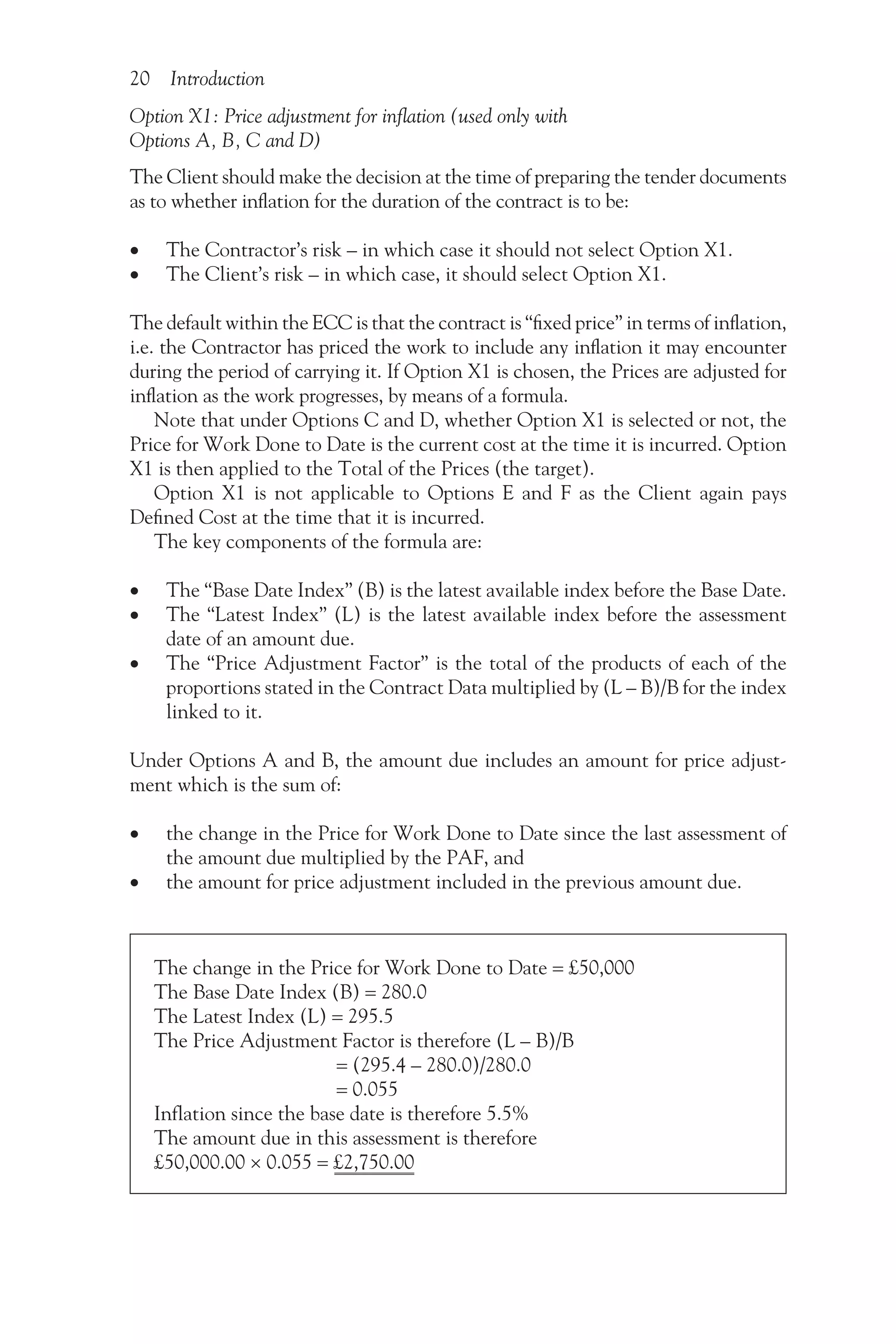
The change in the Price for Work Done to Date = £50,000
The Base Date Index (B) = 280.0
The Latest Index (L) = 295.5
The Price Adjustment Factor is therefore (L – B)/B
= (295.4 – 280.0)/280.0
= 0.055
Inflation since the base date is therefore 5.5%
The amount due in this assessment is therefore
£50,000.00 × 0.055 = £2,750.00
Introduction 21
Under Options C and D, the amount due includes an amount for price adjustment
which is the sum of:
•
• the change in the Price for Work Done to Date since the last assessment
of the amount due multiplied by (PAF/(1+PAF)) where PAF is the Price
Adjustment Factor for the date of the current assessment, and
•
• correcting amounts, not included elsewhere, which arise from changes to
indices used for assessing previous amounts for price adjustment.
This amount is then added to the Total of the Prices, i.e. the target.
Note that if Option X1 is chosen, then Defined Cost for compensation events
is assessed by adjusting current Defined Cost back to the base date.
Note that for compensation events the Defined Cost is assessed using
•
• the Defined Cost at base date levels for amounts in the Contract Data for
people and Equipment, and
•
• the Defined Cost current at the dividing date used in assessing the compen-
sation events adjusted to the base date by dividing by “one plus the PAF” for
the last assessment due before that dividing date for other amounts.
Aside from Clients favouring fixed price contracts, the rules of Option X1 are
probably one of the reasons why this Option is rarely chosen!
Option X2: Changes in the law
As with Option X1, the default is that the contract is “fixed price” in terms of
changes in the law, i.e. the Contractor has priced the work to include any changes
in the law it may encounter during the period of the contract.
If Option X2 is chosen, and a change in the law occurs after the Contract Date
the Project Manager notifies the Contractor of a compensation event. The Prices
may be increased or reduced in addition to providing for any delay to Completion.
Note that Option X2 refers to a change in the law of the country in which
the Site is located, so for example, a change in the law in another coun-
try where goods are being fabricated for delivery to the Site will not be a
compensation event.
Option X3: Multiple currencies (used only with Options A and B)
The currency of the contract is stated in Contract Data Part 1.
Option X3 provides for items or activities to be paid in an alternative cur-
rency, the items or activities, the currency and the total maximum payment in
this currency to be listed in the Contract Data, beyond which payments are made
in the currency of the contract.
The exchange rates, their source and date of publication are also referred to
in the Contract Data.
22 Introduction
Option X4: Ultimate holding company guarantee
This Option was referred to in the NEC3 contracts as Parent Company Guarantee.
This form of guarantee is given by an ultimate holding company (parent
company), to guarantee the proper performance of a contract by one of its
subsidiaries (the Contractor), who whilst having limited financial resources
itself, may be owned by a larger financially sound parent company. In most
cases it is the ultimate parent company that provides the guarantee, but some-
times, particularly when the ultimate parent company is in another country,
the parent company may just be a company further up the chain within the
group, perhaps the national parent who has sufficient assets to provide the
required guarantee.
If a parent company guarantee is required, it may either be provided by the
Contract Date or within four weeks of the Contract Date, and must be in the
form stated in the Scope.
The parent company guarantee should have an expiry date, which could be
completion of the project, the defects date or may even include the 6, 10 or
12-year limitation period following completion of the works to cover any liability
for potential latent defects, the expiry date being defined within the Scope.
Parent company guarantees are normally used as an alternative to a performance
bond (Option X13).
Such a guarantee is cheaper than a performance bond, as the Contractor will
normally just charge an administration fee rather than in the case of a perfor-
mance bond, where the Contractor is actually paying a premium for an insurance
policy, but it may give less certainty of redress because it is not supplied by an
independent third party so it is dependent on the survival, and the ability to pay,
of the parent company.
However, whilst accepting less independence, parent company guarantees
for the proper performance of the contract can be more advantageous than
bonds. Rather than receiving a fixed amount in compensation, the parent
company is normally obliged to either complete the works in accordance with
the Contractor’s original obligations on behalf of its subsidiary company, or
fund the completion of the contract by others, so effectively completion is
guaranteed.
In addition, further recompense can be sought for time delays in completion
through the normal clauses incorporated in the contract. In the case of perfor-
mance bonds the “guarantee” is that a sum of money is available to at least partly
compensate the Client in the event of the Contractor’s default.
Because the financial strength of the parent company may be linked to that
of the Contractor, a parent company guarantee will be acceptable only if the
parent company (or holding company) is financially strong and its financial
resources are largely independent of those of the Contractor. Obviously, if the
insolvency is not limited to the Contractor but also related to the parent group
a parent company guarantee will be virtually useless, save for any entitlement
under insolvency law.
Introduction 23
Option X5: Sectional Completion
If the Client requires sections of the works to be completed by the Contractor
before the whole of the works are completed, then Option X5 should be chosen.
References in the contract to the works, Completion and Completion Date
will then apply to either the whole of the works or a defined section in Contract
Data Part 1, which should give a description of each section and the date by
which it is to be completed.
Option X5 may be selected together with Option X6 (Bonus for Early
Completion) and/or Option X7 (Delay Damages).
Option X6: Bonus for early Completion
Often early completion would be of benefit to the Client, for example the
Contractor is building a shopping mall and early completion would allow tenants
to move in earlier which would provide early revenue for the Client.
Option X6 provides for the Client to pay a bonus to the Contractor for early
Completion.
The amount of the bonus is stated by the Client on a “per day” basis in
Contract Data Part 1 and is calculated from the earlier of Completion and when
the Client takes over the works, until the Completion Date.
Option X7: Delay damages
Delay damages in the ECC are normally referred to in other contracts as
“liquidated damages”.
Delay damages are pre-defined amounts inserted into Contract Data Part 1
and paid or withheld from the Contractor in the event that it fails to complete
the works by the Completion Date.
Within most legislation, the amount included within the contract for delay
damages should be a “genuine pre-estimate of likely losses” – not a penalty.
Many contracts require the contract administrator (Engineer, Architect,
etc) to issue some form of certificate confirming that the Contractor failed
to complete on time, and also for the Client to notify the Contractor in
writing that it will be withholding the relevant damages, but the ECC con-
tract provides for the Contractor to pay delay damages at the rate stated in
the Contract Data until Completion or the date on which the Client has
taken over the works, whichever is earlier, without having to certify that the
Contractor has defaulted.
Also, many contracts require the contract administrator to value the works
and the Client then deducts the liquidated damages from the amount due to
the Contractor, but the ECC contract requires the Project Manager to deduct
amounts to be paid or retained from the Contractor within its assessment and
certificate.
24 Introduction
Under Clause X7.3, if the Client takes over the works before Completion, the
Project Manager assesses the benefit to the Client of taking over that part of the
works as a proportion of taking over the whole of the works and the delay dam-
ages are reduced in this proportion.
Whilst it is probably the most correct way to assess remaining delay damages,
the Project Manager having to assess the benefit to the Client can at best be a
subjective exercise and may possibly lead to disputes with the Contractor.
Most other contracts state that the amount of liquidated damages is reduced
by the same proportion that the part that has been taken over bears to the value
of the whole of the works, so if a third of the value of the works has been taken
over, the amount of the liquidated damages is reduced by a third.
Option X8: Undertakings to the Client or Others
This is a new Option, not formerly included within the NEC3 ECC, but in the
NEC3 Professional Services Contract as “Collateral Warranty Agreements”,
and provides for the Contractor to give undertakings to Others as stated in the
Contract Data and, if required, in the form stated in the Scope.
This may also include undertakings between a Subcontractor and Others if
required by the Contractor. Typically such documents are often referred to as
collateral warranties.
The Client prepares the undertakings and sends them to the Contractor for
signature, the Contractor signs or arranges for the Subcontractor to sign them,
and returns them to the Client within three weeks.
Whilst stating that Option W8 was previously included in the NEC3
Professional Services Contract as “Collateral Warranty Agreements”, the Option
within the ECC does not specifically refer to collateral warranty agreements.
If parties wish to enter into collateral warranty agreements, then they need to
address that matter separately, with appropriate documentation to suit the parties
(see also Chapter 2).
Option X9: Transfer of rights
This is a new Option, again as with Option X8, not formerly included within the
NEC3 ECC, but in the NEC3 Professional Services Contract. The Client owns
the Contractor’s rights over materials prepared for the design of the works except
as stated otherwise in the Scope.
The Contractor obtains other rights for the Client as stated in the Scope and
also obtains from Subcontractors equivalent rights for the Client.
Option X10: Information modelling
This is a new Option, not formerly included within the NEC3 contract, which
provides for Building Information Modelling (BIM).
Some defined terms should be considered in reviewing Option X10.
Introduction 25
•
• The Information Plan is submitted by the Contractor to the Project Manager
who then accepts or does not accept within two weeks of receiving it. The
Information Execution Plan is then defined as the information execution
plan (identified within the Contract Data), or the latest submitted by the
Contractor and accepted by the Project Manager.
•
• Project Information is provided by the Contractor and used to create or
change the Information Model.
•
• The Information Model is the electronic integration of the Project
Information, and other information provided by the Client and other Infor­
mation Providers. The Client is liable for any fault or error in the Information
Model, unless there is a Defect in the Project Information provided by the
Contractor. The Contractor is required to provide insurance against claims
made in respect of failure to provide the Project Information using reason-
able skill and care.
•
• The Information Model Requirements are the requirements identified in the
Scope for creating or changing the Information Model.
•
• Information Providers are the people or organisations who contribute to the
Information Model.
There is also provision within the Option for early warnings where something
could affect the Information Model, and for the Contractor to include within
its quotation for a compensation event where the Information Execution Plan is
altered by a compensation event.
Option X11: Termination by the Client
This Option, not explicitly included within NEC3, though there was some provi-
sion for it, provides for the Client to terminate the Contractor’s employment for
a reason not stated in the Termination Table, by notifying the Project Manager
and Contractor.
If the Client does terminate, it may complete the service and use any Plant
and Materials provide by the Contractor (Procedure P1), and the Contractor
leaves the Service Areas and removes the Equipment (P4).
In respect of payments, the Contractor is entitled to payments as if it had
terminated:
Amount A1
•
• an amount due as for normal payments.
•
• the Defined Cost for Plant and Materials which have been delivered
and retained by the Client or which the Client owns and for which the
Contractor has to accept delivery.
•
• other Defined Cost in reasonable expectation of completing the whole
of the service (such as long-term supply contracts for consumables).
•
• any amounts retained by the Client.
26 Introduction
Amount A2
•
• the forecast cost of removing Equipment.
Amount A4
•
• for Options A and C, the fee percentage applied to the difference
between the original total of the Prices and the Price for Service
Provided to Date.
•
• for Option E, the fee percentage applied to the difference between the
first forecast of the Defined Cost for the service and the original total of
the Prices and the Price for Service Provided to Date less the Fee.
Option X12: Multiparty collaboration (not used with Option X20)
This Option, formerly called “Partnering” in NEC3, enables a multiparty partner-
ing agreement to be implemented.
In this case Option X12 is used as a Secondary Option common to the
contract which each party has with the body which is paying for the work.
The content of Option X12 is derived from the “Guide to Project Team
Partnering” published by the Construction Industry Council (CIC). It is estimated
that Option X12 is used on less than 10% of NEC3 contracts.
It must be stressed that no legal entity is created between the Partners, so it is
not a partnership as such.
Some definitions need to be explained:
(i) The Partners are those named in the Schedule of Partners.
(ii) An Own Contract is a contract between two Partners.
(iii) The Core Group comprises the Partners selected to take decisions on behalf
of the Partners.
(iv) The Schedule of Core Group Members is a list of Partners forming the Core
Group.
(v) Partnering Information is information which specifies how the Partners
work together.
(vi) A Key Performance Indicator is an aspect of performance for which a target
is attached in the Schedule of Partners.
Each Partner, represented by a single representative, is required to work with the
other Partners in accordance with the Partnering Information to achieve the
Promoter’s (normally their joint Client) objective stated in the Contract Data
and the objectives of every other Partner.
The Core Group acts and takes decisions on behalf of the Partners. The Core
Group also keeps up to date a Schedule of Core Group Members and a Schedule
of Partners.
The Partners are required to work together, using common information
systems, and a Partner may ask another Partner to provide information which it
needs to carry out the work in its Own Contract.
Introduction 27
The Core Group may give an instruction to the Partners to change the
Partnering Information, which is a compensation event.
The Core Group also maintain a timetable showing the Partners’ contri-
butions. If the Contractor needs to change its programme to comply with the
timetable then it is a compensation event.
Each Partner also gives advice, information and opinion to the Core Group
where required.
Each Partner must also notify the Core Group before subcontracting any
work, though it does not say that the Core Group is required to respond to the
notification.
Finally Option X12 provides for Key Performance Indicators (KPI) with
amounts paid as stated in the Schedule of Partners. The Promoter may add a KPI
to the Schedule of Partners but cannot delete or reduce a payment.
Option X13: Performance bond
A performance bond is an arrangement whereby the performance of a con-
tracting party (the Principal) is backed by a third party (the Surety), which
could be a bank, insurance company or other financial institution, that should
the Principal fail in its obligations under the contract, normally due to the
Principal’s insolvency, the Surety will pay a pre-agreed sum of money to the
other contracting party (the Beneficiary). Whilst bonds are not always linked to
insolvency, contracts normally give remedies in the event of default, e.g. defects
provisions, retention, withholding of payment, delay damages, etc. It is where
the defaulter is not able to provide a remedy because it is insolvent that bonds
normally provide the remedy.
This bond may be between any two contracting parties, Client and Contractor,
Client and Consultant, Contractor and Subcontractor, or any other contractual
relationship.
Note that as these are conditional bonds, it is normally a condition that
default has to have occurred, there is no other means of remedy or recompense
and the amount claimed is directly related to the default, before payment can be
made to the beneficiary.
Clearly, if a bank provides a bond there may be some implications with regard
to further credit as a safeguard should the bond be called, with the bank also pur-
suing any amount paid from their customer, whereas with an insurance company
the risk is accepted through the policy.
If a performance bond is required from the Contractor it should be provided by
the Contract Date or within four weeks of the Contract Date.
The amount of the bond, usually 10% of the contract value must be stated in
Contract Data Part 1 and the form of the bond must be in the form stated in the
Scope. In the event of the default by the Contractor the Client is not paid the full
amount of the bond, but the amount of the bond is the maximum amount avail-
able to meet the Client’s costs incurred as a direct result of the default.
Normally, the value of the performance bond does not reduce, but they should
have an expiry date, which could be completion of the project, the Defects Date
28 Introduction
or may even include the 6, 10 or 12-year limitation period following completion
of the works to cover any liability for potential latent defects, the expiry date
being defined within the Scope.
It is worth mentioning that payment of a performance bond is often very dif-
ficult and subject to a number of conditions, for example, clear evidence of the
Contractor’s inability to perform its obligations, and also unequivocal evidence
of the Client’s loss as a direct result of the Contractor’s default, which in truth
may not be fully known for some time after the Contractor’s insolvency. Clearly
the expiry date for the bond has to be kept in mind if it takes some time to ascer-
tain the Client’s actual loss, as the right to claim may have expired.
A performance bond may be provided by a bank, an insurance company or a
specialist bond provider. Clearly, if a bank provides a bond there may be some
implications with regard to further credit as a safeguard should the bond be called,
with the bank also pursuing any amount paid from their customer, whereas with
an insurance company the risk is accepted through the policy.
The bank or insurer which provides the performance bond must be accepted
by the Project Manager.
It is important to note the difference between an insurance policy and a bond,
in that an insurance policy is a contract between TWO parties, the insured and
the insurer, the insurer guaranteeing that it will pay a third party, who may not
be specifically named, should an event occur, whilst a bond is a contract between
THREE parties, the Contractor, the Client and the Surety, all of whom are named
within the agreement, with no other party being able to benefit from the bond.
A performance bond will not of itself ensure that contracts are carried out
efficiently and to time, but it will be one of the number of commercial pressures
on the Contractor to perform well. A performance bond can provide some com-
pensation if the Contractor defaults on its obligations.
The cost of the performance bond will normally be governed by:
(i) The technical ability of the Contractor.
(ii) The usual type of work undertaken by the Contractor.
(iii) The size of the project.
(iv) Contracts already bonded for the Contractor.
(v) The overall management of the Contractor’s business.
(vi) The financial stability of the Contractor.
There are other types of bond available:
(i) Advanced payment bond
This covers the Contractor’s repayment of an advanced payment from the
Client to the Contractor. This is covered in the contract by Option X14.
(ii) Payment bond
This covers the Client’s duty to pay the Contractor, or the Contractor’s
duty to pay its Subcontractors.
Introduction 29
(iii) Bid or tender bond
Very often on particularly large projects with a long lead-in time, a bond
may be required to ensure that the successful tenderer will not withdraw its
tender and is able to proceed when required, in terms of its other commit-
ments and its solvency.
In a similar vein, a scenario may be where a Contractor prices a tender
based on a Subcontractor’s price and finds upon acceptance of its tender
that the Subcontractor’s offer is no longer open for acceptance, and the
Contractor may find itself having to place orders with another Subcontractor
for a higher price.
It may be worthwhile in this event to bond the Subcontractor so that in
the event that the acceptance period expires, the Contractor can recover
monies through the bond.
(iv) Retention Bonds
Again, on particularly large projects it may be more practical to release
retention monies early with a bond in place to protect the parties in the
event of defects arising.
UNCONDITIONAL OR ON DEMAND BONDS
“Unconditional” or “on demand bonds” can be redeemed by the beneficiary,
whether or not there has been a default within the contract and whether or not
there has actually been a loss at all!
Most Clients will refrain from calling in bonds unnecessarily, but the entitle-
ment remains should they wish to.
The “knock on” effect of calling in these bonds without due cause is that
Contractors will price for that possibility within their tenders, as someone has to
pay, and the result will be escalating prices. Insurers are naturally very reluctant
to accept on demand bonds.
CREATION OF BONDS
Bonds have to be made in writing and will be in the form of a deed, signed and
sealed by the contracting parties.
The duration and financial limits of the Bond MUST be clarified and stated
within the deed.
RELEASE AND CANCELLATION OF BONDS
The deed executed will normally specify the course of action to be taken in the
event of failure of the Principal leading to the calling in of the Bond by the
Beneficiary.
Sometimes the Beneficiary has to give a form of notice to the Principal or it
may have to sue for non-performance.
30 Introduction
Only the Beneficiary can cancel the Bond, the Principal issuing a request to
him, once it has “performed”.
Option X14: Advanced payment to the Contractor
This Option is appropriate when the Contractor will incur significant “up front”
costs before it starts receiving payments, for example in pre-ordering specialist
materials, plant or equipment.
The payment is made within the first payment assessment or if an advanced
payment bond is required, at the next assessment after the Client receives
the bond.
If an advanced payment bond is required it is issued by a bank or insurer
which the Project Manager has accepted, the bond being in the amount that the
Contractor has not repaid.
Advance payment bonds are a helpful security when an advance payment
is made to a Contractor for works to be performed; the Project Manager must
accept the provider of that bond.
The amount of the repayment instalments is stated in Contract Data Part 1.
Option X15: The Contractor’s design
This is an Option, formerly in NEC3 called “Limitation of the Contractor’s liability
for his design to reasonable skill and care”. There are several items covered by this
Option.
Firstly, whilst the Scope defines what, if any design, is to be carried out by the
Contractor, the contract is silent on the standard of care to be exercised by
the Contractor when carrying out any design.
Two terms that relate to design liability are “fitness for purpose” and “reasonable
skill and care”.
Whilst this book is intended for international use, in defining the term “fit-
ness for purpose” one must look in English law to the Sale of Goods Act 1979,
which refers to the quality of goods supplied including their state and condition
complying in terms of “fitness for all the purposes for which goods of the kind in
question are commonly supplied”.
In construction, fitness for purpose means producing a finished project fit in
all respects for its intended purpose. This is an absolute duty independent of
negligence, and in the absence of any express terms within the contract to the
contrary, a Contractor who has a design responsibility will be required to design
and build the project “fit for purpose”.
Some contracts will limit the Contractor’s liability to that of a consultant, i.e.
reasonable skill and care.
The ECC does this through Option X15; if this Secondary Option is not cho-
sen, the Contractor’s liability for design is “fitness for purpose”. If the Contractor
corrects a Defect for which it is not liable, it is a compensation event.
Introduction 31
Contrast this with the level of liability of a consultant (whether acting for a
Client or a Contractor) in providing a design service, which is defined, again in
English law by the Supply of Goods and Services Act 1982, where there is an
implied term that the consultants will carry out the service, in this case design,
with reasonable care and skill, which means designing to the level of an ordinary,
but competent person exercising a particular skill.
So, in the absence of any express terms to the contrary, a designer will normally
be required to design using “reasonable skill and care”. This is normally achieved
by the designer following accepted practice and complying with national stand-
ards, codes of practice, etc.
Clearly, despite the Contractor believing that it has offset its design obliga-
tions and liability to its designing consultant has to be aware that it, and its
consultant, have differing levels of care and liability.
The remaining items covered by this Option are:
•
• The Contractor may use material provided to it under the contract, unless
the ownership of the material has been given to the Client.
•
• The Contractor retains copies of drawings, specifications, reports, etc in the
form stated in the Scope for the period of retention, normally 6 or 12 years
after Completion of the works.
•
• The Contractor may be required to provide Professional Indemnity (PI)
Insurance if required, and in the amount in the Contract Data.
Option X16: Retention (not used with Option F)
The Client may retain a proportion of the Price for Work Done to Date once it
has reached any retention free amount, the retention percentage and any reten-
tion free amount being stated in Contract Data Part 1.
Defined Cost does not include amounts deducted for retention, so, if the
Contractor deducts retention from a Subcontractor, the figure before the deduc-
tion is used in calculating Defined Cost, ensuring that there is no “double
deduction” of retention.
Following Completion of the whole of the works, or the date the Client takes
over the whole of the works, whichever happens earlier, the retention percentage
is halved, and then the final release is upon the issue of the Defects Certificate.
It is important to note that retention is held against undiscovered defects and
not incomplete work.
If stated in the Contract Data, or if agreed by the Client, the Contractor pro-
vides a retention band provided by a bank or insurer, accepted by the Project
Manager, and in the form stated in the Scope.
Option X17: Low performance damages
In the event that the Contractor produces defective work, the Client has three
options:
32 Introduction
(i) The Contractor corrects the Defect (Clause 44.1).
(ii) If the Contractor does not correct the Defect, the Project Manager assesses
the cost to the Client of having the Defect corrected by other people and
the Contractor pays this amount (Clause 46.1).
(iii) The Client can accept the Defect and a quotation from the Contractor for
reduced Prices and/or an earlier Completion Date (Clause 45).
Where the performance in use fails to reach the specified level within the con-
tract, the Client can take action against the Contractor to recover any damages
suffered as a result of the breach, but as an alternative can recover low performance
damages under Option X17 if it has been selected.
Example
The Scope requires the Contractor to design and install a HVAC system to
a major retail development.
There are specific and measurable performance criteria for the system
including temperature variations and energy efficiency. The system is
required to have a design life of 30 years (360 months).
The Scope states that the system will be tested at Completion and
includes a table showing how the performance of the system will be meas-
ured and acceptable levels of achievement.
The system is expected to perform to 98 – 100% of performance criteria.
If it falls within 90 – 98% the system will be accepted, but low performance
damages will be payable by the Contractor to the Client. If it falls below
90% it will not be accepted.
Contract Data Part 1 contains the following entries:
amount per month performance level
£50.00 96% – 98%
£150.00 94% – 96%
£200.00 92% – 94%
£250.00 90% – 92%
When tested, the system achieves 95% of the performance criteria.
Therefore, 360 months × £150.00 = £54,000 is payable by the Contractor
at the Defects Date.
Option X18: Limitation of liability
Under this Option, a limit may be placed on the Contractor’s liability for the
following:
Introduction 33
•
• liability for the Client’s indirect or consequential loss.
•
• liability for causing any loss of or damage to the Client’s property.
•
• liability to the Client for latent defects due to its design.
•
• total liability for all matters under the contract, other than excluded matters
in contract, tort or delict.
Excluded matters are:
•
• loss or damage to Client’s property.
•
• delay damages if Option X7 applies.
•
• low performance damages if Option X17 applies.
•
• Contractor’s share if Option C or D applies.
The Contractor is not liable for any matter unless it has been notified to the
Contractor before the end of liability date which is stated in the Contract Data
in terms of years after the Completion of the whole of the works.
In the UK, this may be 6 or 12 years, dependent on the type of contract; other
legislations set this at 10 years.
Option X20: Key Performance Indicators
Performance of the Contractor can be monitored and measured against Key
Performance Indicators (KPIs) using Option X20.
Targets may be stated for Key Performance Indicators in the Incentive Schedule.
From the starting date until the Defects Certificate is issued, the Contractor is
required to report its performance against KPIs to the Project Manager at inter-
vals stated in the Contract Data including the forecast final measurement. If the
forecast final measurement will not achieve the target stated in the Incentive
Schedule the Contractor is required to submit its proposals to the Project
Manager for improving performance.
The Contractor is paid the amount stated in the Incentive Schedule if the
target for a KPI is improved upon or achieved. Note that there is no payment due
from the Contractor if it fails to achieve a stated target.
The Client may add a new KPI and associated payment to the Incentive
Schedule but may not delete or reduce a payment.
Option X21: Whole life cost
This is a new Option, not formerly included within the NEC3 contract.
Under this Option, the Contractor may propose to the Project Manager that
the Scope is changed in order to reduce the cost of operating and maintaining
the asset.
If the Project Manager is prepared to consider the change, the Contractor
submits a quotation to the Project Manager which includes:
34 Introduction
•
• a detailed description,
•
• the forecast cost reduction to the Client of the asset over its whole life,
•
• an analysis of the resulting risks to the Client,
•
• the proposed change to the Prices, and
•
• a revised programme showing any changes to the Completion Date and Key
Dates.
The Project Manager consults with the Contractor about the quotation and
replies within the period for reply either accepting or not accepting the quotation.
If the quotation is accepted, the Project Manager changes the Scope, the Prices,
the Completion Date and any Key Dates and accepts the revised programme.
The change to the Scope is not a compensation event.
Option X22: Early Contractor involvement (used only with Options C and E)
This is a new Option, not formerly included within the NEC3 contract.
Option X22 commences with four identified and defined terms:
1 Budget – the items and amounts stated in the Contract Data.
2 Project Cost – the total paid by the Client for the items stated in the Budget.
3 Stages One and Two – as stated in the Scope.
4 Pricing Information – the information which specifies how the Contractor
prepares its assessment of the Prices for Stage Two.
The Contractor is required to provide detailed forecasts of the total Defined Cost
of the work to be done in Stage One for acceptance by the Project Manager.
These forecasts are prepared on a periodic basis commencing from the starting
date at intervals stated in the Contract Data.
The Project Manager has one week in which to accept/not accept each forecast.
The Contractor is required, in consultation with the Project Manager, to pro-
vide forecasts of the Project Cost and submit them to the Project Manager. These
forecasts are prepared on a periodic basis commencing from the starting date until
completion of the whole of the works at intervals stated in the Contract Data.
The Contractor submits its design proposals for Stage Two, including a fore-
cast of the effect of the design proposals on the Project Cost and the Accepted
Programme, to the Project Manager for acceptance as stated within the submis-
sion procedure within the Scope. If the Project Manager does not accept he gives
reasons and the Contractor resubmits.
The Project Manager issues a notice to proceed to Stage Two when the
Contractor has obtained approvals and consents from Others, changes to the
Budget have been agreed, the Project Manager and Contractor have agreed
the total of the Prices for Stage Two, and the Client has confirmed that the works
are to proceed.
If the Project Manager does not issue a notice to proceed to Stage Two, the
Client may appoint another Contractor to complete Stage Two.
Introduction 35
If the Project Manager issues an instruction changing the Client’s require-
ments, the Project Manager and the Contractor agree changes to the Budget
within four weeks.
A budget incentive is paid to the Contractor if the final Project Cost is less
than the Budget.
Option Y(UK)1: Project Bank Account
In 2008, the Office of Government Commerce (OGC) published a guide to fair
payment practices, following which the NEC Panel prepared a document in June
2008 to allow users to implement these fair payment practices into NEC contracts.
This is now Option Y(UK)1, which provides for a Project Bank Account to
be set up which receives payments from the Client which in turn is used to make
payments to the Contractor and Named Suppliers. The Project Bank Account is
established within three weeks of the Contract Date.
There is also a Trust Deed between the Client, the Contractor and Named
Suppliers containing the necessary provisions for administering the Project Bank
Account.
The Contractor should include in any subcontracts for Named Suppliers to
become party to the Project Bank Account through a Trust Deed via a Joining Deed.
The Contractor notifies the Named Suppliers of the details of the Project
Bank Account and the arrangements for payment of amounts due under their
contracts.
The Named Suppliers will be named within the Contractor’s tender, but also
additional Named Suppliers may be included subject to the Client’s acceptance by
means of a Joining Deed, which is executed by the Client, the Contractor and the new
Named Supplier. The new Named Supplier then becomes a party to the Trust Deed.
As the Project Bank Account is maintained by the Contractor, he pays any
bank charges and also is entitled to any interest earned on the account. The
Contractor is also required at tender stage to put forward his proposals for a
suitable bank or other entity which can offer the arrangements required under
the contract.
The process every month is that the Contractor submits an application for
payment including details of amounts due to Named Suppliers in accordance
with their contracts.
The Client makes payment to the Project Bank Account, the Contractor
makes payment to the Project Bank Account of any amounts which the Client
has notified the Contractor intends to withhold from the certified amount and
which is required to make payment to Named Suppliers.
The Contractor then prepares the Authorisation, setting out the sums due to
Named Suppliers. After signing the Authorisation, the Contractor submits it to
the Client for signature and submission to the project bank.
The Contractor and Named Suppliers then receive payment from the Project
Bank Account of the sums set out in the Authorisation after the Project Bank
Account receives payment.
36 Introduction
In the event of termination, no further payments are made into the Project
Bank Account.
Option Y(UK)2: The Housing Grants, Construction and
Regeneration Act 1996
This option is only applicable to UK contracts where the Housing Grants,
Construction and Regeneration Act 1996 (as amended by the Local Democracy,
Economic Development and Construction Act 2009) applies, and deals only with the
payment aspects of the Act, adjudication under the Act being covered by Option W2.
It is important to note that as the Local Democracy, Economic Development
and Construction Act 2009 amends the Housing Grants, Construction and
Regeneration Act 1996, you have to take into account both Acts to fully under-
stand how it applies to your contract, also that any Z clauses must comply, where
applicable, and particularly with respect to payment, must comply with the Act.
Although it is an “Option”, where the Act applies, it must be selected, failing
which the Parties are required to comply with the law anyway.
The main features of Option Y(UK)2 are as follows (time periods are mostly
stated in days, note that time periods within the core clauses and other Main
Options are mostly stated in weeks):
DATES FOR PAYMENT
The due date for payment is seven days after the assessment date.
The date on which the final payment becomes due is:
•
• if the Project Manager makes an assessment after the issue of a Defects
Certificate – five weeks after its issue.
•
• if the Project Manager does not make an assessment after the issue of the
Defects Certificate – one week after the Contractor issues its assessment.
•
• if the Project Manager has issued a termination certificate – fourteen weeks
after its issue.
The final date for payment is fourteen days after the payment becomes due, unless
there is a different period stated in the Contract Data.
The Project Manager’s certificate is the notice of payment (which may be
“zero”). If the Project Manager does not make an assessment after the issue of a
Defects Certificate the Contractor’s assessment is the notice of payment.
PAY LESS NOTIFICATION
If either Party intends to pay less than the notified sum, it notifies the other Party
not later than seven days before the final date of payment. This is a pre-condition
to paying less than the notified sum.
Introduction 37
If the Client terminates for reasons R1 to R15, R18 or R22, and a certified
payment has not been made at the date of the termination certificate, the Client
makes the payment unless:
•
• a pay less notice has been issued, or
•
• the termination is for reasons R1 to R10, and the reason occurred after the
last date on which it could have notified the Contractor of a pay less notice.
SUSPENSION OF PERFORMANCE
If the Contractor exercises its right under the Act to suspend performance it is a
compensation event.
Option Y(UK)3: Contracts (Rights of Third Parties) Act 1999
This option is only applicable to UK contracts where the Contracts (Rights of
Third Parties) Act 1999 applies.
The principle of privity of contract is that a person who is not a party to a
contract cannot enforce the terms of that contract.
The Contracts (Rights of Third Parties) Act 1999 effectively abolishes privity
of contract as an absolute principle, enabling a person who is not a party to a con-
tract, a “third party”, to enforce a term of the contract if the contract expressly
provides that it may. The third party must be expressly identified in the contract,
either by name or as a member of a class or by a particular description, but does
not need to be in existence at the date of the contract.
Under the Act, there is available to the third party any remedy that would
have been available to him in an action for breach of contract as if it had been a
party to the contract.
The parties to the contract are prohibited from making any agreement to vary
the contract in such a way as to adversely affect the third party’s entitlement to
enforce the contract without the third party’s consent.
The Act names two specific parties:
•
• “the promisor” means the party to the contract against whom the term is
enforceable by the third party, and
•
• “the promisee” means the party to the contract by whom the term is enforce-
able against the promisor.
While the Act is not specially aimed at the construction industry, it is an
industry which spends a lot of time and money in constructing collateral war-
ranties enabling a multitude of parties to have certain rights over specified
periods of time, so it is now possible to draft building contract documents to
confer benefits upon the parties who would have had the benefit of collateral
warranties.
38 Introduction
The construction industry has generally not been in favour of this act, pre-
ferring to use collateral warranties, but it must be said that the Act has several
advantages in terms of time and cost in that only one document needs to be
drafted, though it is fair to say that many parties prefer a warranty as specific evi-
dence of their rights. Banks and funders in particular like the comfort of a good
old-fashioned document.
Option Z: Additional conditions of contract
Option Z allows conditions to be added to or omitted from the core clauses.
All changes to the core clauses should be included as Z clauses rather than
amending the core clauses themselves, so in effect the clause remains in the
contract, but is amended within the Z clause.
It is also critical that when drafting a Z clause, it must be clearly stated
what happens to the original core clause, for example, if it is deleted. If the
original core clause is not deleted, then it is likely that an inconsistency will
arise which will be interpreted against the party who wrote or amended the
clause, i.e. the Client.
These conditions may modify or add to the core clause, to suit any risk alloca-
tion or other special requirements of the particular contract. However, changes
should be kept to a minimum, consistent with the objective of using industry
standard, impartially written contracts.
It must be remembered that if a Client amends a contract to allocate a risk
to the Contractor which may have been intended to be held by the Client, the
Contractor has a right to price it in terms of time and money, therefore the prac-
tice of Clients amending contracts to pass risk to Contractors without considering
who is best able to price, control and manage those risks can in many cases prove
to be unwise and uneconomical.
It is important to spend time considering whether a Z clause is appropriate in
each case, then when that decision has been made, that the clause is drafted cor-
rectly and aligned to the drafting principles of the original contract, in the case
of the ECC using ordinary language, present tense, correct capitalisation, correct
italics, short sentences and bullet pointing.
It is critical that whoever drafts Z clauses is fully aware of the NEC drafting
philosophy (see section above, Clarity and simplicity). It is not unusual to see Z
clauses in an ECC contract written in a legalistic language, in the future tense
and without punctuation, apart from full stops!
Some examples of Z clauses that have been used with the NEC3
Engineering and Construction Contract.
N.B. The author is not recommending the use of these Z clauses, but simply
quoting them as examples.
Introduction 39
2 The Contractor’s main responsibilities
Subcontracting 26
Reason for Z clause: Many Project Managers would like to give a reason for
not accepting a proposed Subcontractor, that his appointment “may not”
rather than “will not” allow the Contractor to Provide the Works, to allow
some subjectivity. Therefore it is sometimes amended:
Delete:
Second sentence of Clause 26.2
Insert:
A reason for not accepting the Subcontractor is that his appointment may
not allow the Contractor to Provide the Works.
4 Testing and Defects
Searching for and notifying Defects
Reason for Z clause: Why does the Supervisor need to know the Contractor
has found a Defect?
Clause 42.2
Delete:
The words “and the Contractor notifies the Supervisor of each Defect as
soon as he finds it”.
5 Payment
The Contractor’s share
Reason for Z clause: Most people (including me) believe that the
Contractor’s share should be calculated when the Price for Work Done
to Date reaches the current Total of the Prices (the target) rather than
on Completion, so that the Contractor is not paid monies that he will
have to pay back later. For that reason, users tend to amend the clause
as follows:
Delete:
Clause 53.3
Insert:
The Project Manager makes a preliminary assessment of the Contractor’s
share at any assessment date. If the forecast Price for Work Done to Date is
(continued)
40 Introduction
less than the final total of the Prices, this share is included in the amount
due following completion of the whole of the works (you can leave this sen-
tence in if you wish to give it balance so that the Contractor has the right
to early payment of a “gain” share as well as a “pain share”). If the forecast
Price for Work Done to Date is more than the forecast total of the Prices,
this share is deducted from the amount due.
For Options C, D, E and F only
Reason for Z clause: Many Clients and Project Managers do not accept
Clause 11.2(29), in that a forecast has to be made of the Defined Cost up to
the next assessment date. For that reason, users tend to amend the clause
to the previous clause under NEC2, as follows:
Delete Clause 11.2(29)
Insert:
The Price for Work Done to Date is the total Defined Cost which the
Contractor has paid plus the Fee.
Note NEC2 used the words “Actual Cost” rather than “Defined Cost”.
For Options C, D and E
Reason for Z clause: Many Clients and Project Managers do not accept
that if a Contractor corrects a Defect before Completion it is not a
Disallowed Cost, therefore it is payable. If this is not acceptable then
suggest:
Clause 11.2(25) 6th Bullet
Delete:
the words “after Completion”
Additional prompt payment clause
Prompt payment to Subcontractors
Where the Contractor enters into a subcontract with a Supplier or
Subcontractor he includes a term to be included in the subcontract which
requires payment to be made to the Supplier or Subcontractor within a
specified period not exceeding thirty days from receipt of a valid invoice as
defined by the subcontract requirements.
(continued)
Introduction 41
6 Compensation events
Assessing compensation events 63
Reason for Z clause: The default position with pricing compensation events
is that they are assessed as the effect of the compensation event upon
actual/forecast Defined Cost plus the resulting Fee (Clause 63.1), but if the
Project Manager and Contractor agree, rates and lump sum prices may be
used instead.
These clauses are sometimes reversed so that compensation events are based
on agreed rates and prices, e.g. bill rates, etc, unless the Project Manager
and Contractor agree to use Defined Cost plus the resulting Fee.
8 Risks and insurance
Insurance cover
Reason for Z clause: Professional Indemnity (PI) insurance is not spe-
cifically required under the contract, but especially in a design and build
contract, this may be required. Note that you would have to include refer-
ence to the amount of Professional Indemnity Insurance required within
the Contract Data.
Insert:
The Contractor maintains Professional Indemnity (PI) insurance for the
amount stated in the Contract Data for each and every claim, and with
exclusions and excesses in line with those normally applicable to contrac-
tors undertaking the design of works such as the works, for 12 years following
Completion of the whole of the works, provided that such insurance con-
tinues to be available generally to contractors such as the Contractor on
reasonable commercial rates.
0.3 The roles of the parties
There are a number of parties referred to in the contract:
•
• the Client
•
• the Contractor
•
• the Project Manager
•
• the Supervisor
•
• the Subcontractor
•
• the Adjudicator
42 Introduction
The Client
Although the contract is between the Client and the Contractor, the Client is
rarely mentioned in the contract.
The Client’s obligations are:
•
• to act as stated in the contract and in a spirit of mutual trust and co-operation
(Clause 10.2).
•
• to allow the Contractor access to and use of each part of the Site for the
Contractor to carry out the work included in the contract. This access must be
allowed on or before the later of the access date (the date in the Contract Data)
and the date for access shown on the Accepted Programme (Clause 33.1).
•
• to allow the Contractor access to and use of a part of the works which it has
taken over if they are needed for correcting a Defect (Clause 46.1).
•
• to make payment to the Contractor in accordance with the Project Manager’s
certificates (Clause 51.2).
•
• to take over the works at Completion (Clause 35.1).
The Contractor
The Contractor and the Client are the Parties to the contract, the Contractor’s
responsibility being to Provide the Works in accordance with the contract, the
Scope describing the works and any constraints on how it has to provide it.
There are also obligations in respect of complying with instructions, notifying
early warnings, submitting programmes for acceptance, and notifying and submit-
ting quotations for compensation events which are highlighted in later chapters.
The Project Manager
The Project Manager is appointed by the Client and manages the contract on its
behalf. Other forms of contract tend to name an Engineer or an Architect, who
acts for the Client, and in addition to having design responsibilities, also admin-
isters the contract. The Engineering & Construction Contract separates the role
of design from that of managing the project and administering the contract.
The Project Manager is named in Contract Data Part 1 and may be appointed
from the Client’s own staff or may be an external consultant. The Project
Manager is a named individual, not a company.
It is vital that the Client appoints a Project Manager who has the necessary
knowledge, skills and experience to carry out the role, which includes acceptance
of designs and programmes, certifying payments and dealing with compensation
events.
Disciplines which have carried out the Project Manager role to date include
Engineers from a civil engineering, structural or process background, Architects,
Building Surveyors and Quantity Surveyors in addition to Project Managers
themselves.
Introduction 43
It is also vital that the Client gives the Project Manager full authority to act
for him, particularly when considering the timescales imposed by the contract.
If the Project Manager has to seek approvals and consents from the Client,
then it must do so, and the appropriate authority must be given, in compliance
with the contractual timescales. If the approval process is likely to be lengthy,
it is critical that both the Client and its Project Manager set up an accelerated
process to comply with the contract or that the timescales in the contract are
amended. The former is the vastly preferred method in order that NEC4 will
work to its full effect.
Although the Project Manager manages the contract at the post-contract
stage, it is usually appointed pre-contract to deal with matters such as feasibility
issues, advising on design, procurement, cost planning, tendering and programme
matters. Note that, unlike many other contracts, the ECC does not name the
Quantity Surveyor, so this would need to be considered in dealing with financial
matters pre- and post-contract. Either the Project Manager may carry out the role
of the Quantity Surveyor itself or delegate to another.
The role of a Project Manager within the ECC is different to the usual concept
of a project manager and it is important that this difference is recognised as it is a
traditional area of misunderstanding amongst users of the contract.
There should only be one Project Manager for the project, though the Project
Manager can delegate responsibilities to others after notifying the Contractor
and may subsequently cancel that delegation (Clause 14.2). One assumes that
the Project Manager will also notify the Client, if he expects the Client to pay
for the delegate!
As with any other notification under the contract, if the Project Manager (or
the Supervisor) wishes to delegate, the notice to the Contractor must be in a
form which can be read, copied and recorded, i.e. by letter or email, not by verbal
communication such as a telephone call.
The delegation may be due to the Project Manager being absent for a period
due to holidays or illness, or because it wishes to appoint someone to assist him
in its duties.
Although the contract is not specific, the notice should identify who the
Project Manager is delegating to, what their authority is, and how long the del-
egation will last, so the Contractor is in no doubt as to who has authority under
the contract.
It is important to recognise that in delegating, the Project Manager is shar-
ing an authority with the delegate who will then represent him; it is not passing
responsibility on to them. The authority is shared, and the Project Manager may
still take an action which they have delegated, but ultimately responsibility will
remain with the Project Manager as the principal.
It is also important to note that one can only delegate outwards from the prin-
cipal, i.e. no-one can assume authority, possibly because, within an organisation,
they are senior to the Project Manager.
If the Client wishes to replace the Project Manager or the Supervisor it must
firstly notify the Contractor of the name of the replacement before doing so.
44 Introduction
Designers
Designers are not named parties in the ECC as the design may be carried out on
behalf of the Client and/or the Contractor. The Client is required to appoint
designers for its own design, and the Contractor for its design. The concept of
novation of designers is considered in Chapter 2. It is important to recognise that
the designer does not have the same authority as, say, an Architect under the
JCT contracts who has the dual role of Designer and Contract Administrator.
Under the ECC the Designer only designs, it does not administer the contract,
and therefore any issuing of drawings, other design information and associated
instructions must be done through the Project Manager.
The Supervisor
The Supervisor is appointed by the Client and manages issues regarding testing
and defects on its behalf. Again, as with the Project Manager, it is named in
Contract Data Part 1 and may be appointed from the Client’s own staff or may
be an external consultant. Again, as with the Project Manager, the Supervisor is
a named individual not a company. It is possible that, provided it has sufficient
expertise and time available, the Supervisor and the Project Manager could be
the same person. It is not unusual for the Client’s Designer and the Supervisor to
be the same person as it is well qualified, having done the design, to inspect the
works to make sure the Contractor has complied with it.
The title Supervisor is not found in other contracts, many seeing the role as
similar to that of a Clerk of Works or Resident Engineer, and in many ways the
role is similar, but it is important to recognise that those roles are usually del-
egated by others within their respective contracts, therefore giving the Clerk of
Works or Resident Engineer little or no ultimate responsibility.
Disciplines which have carried out the Supervisor role to date include
Engineers from a civil engineering, structural or process background; Architects
and other design disciplines; Building Surveyors and Clerks of Works.
It is important to recognise that the Supervisor does not act on behalf of the
Project Manager; it represents the Client and has its own responsibilities and
obligations within the contract which may be summarised as follows:
•
• the Supervisor carries out and/or witnesses tests being carried out by the
Contractor or some other party.
•
• the Supervisor may instruct the Contractor to search for a Defect.
This is a common to other contracts where it is referred to as “opening up”
or “uncovering”, the principle being if no Defect is found the matter is dealt
with as a compensation event.
•
• the Supervisor notifies the Contractor of each defect as soon as it finds it.
•
• the Supervisor issues the Defects Certificate.
This is a very important action as once the Defects Certificate has been
issued, the Contractor is no longer required to provide the insurances under
Introduction 45
the contract. Also dependent on which Secondary Options have been
selected, any retention (Clause X16) is released back to the Contractor,
if a Defect included in the Defects Certificate shows low performance,
the Contractor pays low performance damages (Clause X17), and the
Contractor no longer has to report performance against KPIs (Clause X20).
The Defects Certificate is used on the later of the defects date and the last
defect correction period, not when all defects have been corrected. In this
case, the Defects Certificate may show defects which the Contractor has
not corrected.
•
• the Supervisor marks Plant and Materials as for the contract if the contract
identifies them for payment.
Marking Plant and Materials can involve making a physical mark on
them to denote that it has seen them but can include compiling an inven-
tory, photographic records, etc. The Contractor is required to prepare the
Plant and Materials for marking as required by the Scope, which can include
setting them aside from other stock, protection, insurances and any vesting
requirements. Once they have been marked, any title the Contractor has to
them passes to the Client.
Again, as with the Project Manager, there should only be one Supervisor, who
may then delegate duties and authorities to others. On a large project it is com-
mon for various personnel to be responsible for checking mechanical, electrical,
structural, finishings, landscape elements, etc, but again there should be one
Supervisor who delegates duties to others in respect of these elements. Each then
reports back to the single Supervisor.
The Adjudicator
The Adjudicator can be chosen by one of three methods:
•
• By the Client specifically naming the individual in Contract Data Part 1.
The Contractor therefore knows at the time of tender who the Client has
named and can therefore confirm that it does not agree with the Client’s
choice. This has advantages in that the parties always know who will be the
Adjudicator if they have a dispute. The disadvantages are firstly that parties
have commented in the past that naming the individual within the Contract
Data assumes that there will be a dispute, and often the Adjudicator will
require payment for having its name in the contract and being available
should the parties have that dispute!
•
• By the Client naming an Adjudicator nominating body in Contract Data
Part 1. This would normally be a professional institution. This tends to be
the favoured method.
•
• By the parties agreeing who will be the Adjudicator at the time of the dis-
pute. The disadvantage of this method is that once the parties are in dispute
they probably would not readily agree with each other on anything!
46 Introduction
The Adjudicator becomes involved only when either contracting party refers
a dispute to him. As an impartial person it is required to give a decision on the
dispute within stated time limits. If either party does not accept its decision they
may refer the dispute to the tribunal (litigation or arbitration). The Adjudicator’s
Contract requires that payment of the Adjudicator’s fees is shared by the Parties
unless otherwise stated.
0.4 Some unique NEC4 features and terms
Italics and Capital Initials
New users of the NEC contracts often become confused by the use of italics and
Capital Initials within the contract.
This is referred to in Clause 11.1, in that terms identified in the Contract Data
are in italics and defined terms (defined within Clause 11.2) have Capital Initials.
An example of possible confusion is Clause 11.2(3):
“The Completion Date is the completion date unless later changed in accordance
with the contract.”
New users may question the duplication of the term “completion date”, but what
it means is that the Contractor completes the works by the date stated in the
contract (Contract Data Part 1) . . . but this date can change either through
compensation events, or acceleration.
Examples of other italicised terms include:
•
• Contractor
•
• Client
•
• Project Manager
•
• works
•
• starting date
•
• defect correction period
Examples of other Capital Initials include:
•
• Defect
•
• Early Warning Register
•
• Equipment
•
• Plant
•
• Scope
•
• Site Information
Corrupt Act
The NEC4 contracts now provide a definition of a Corrupt Act, defined in Clause
11.2(5) as:
Introduction 47
•
• the offering, promising, giving, accepting or soliciting of an advantage as an induce-
ment for an action which is illegal, unethical or a breach of trust, or
•
• abusing any entrusted power for private gain in connection with this contract or any
other contract with the Client.
There is a new termination provision under Clause 91.8, the Client may termi-
nate if the Contractor does a Corrupt Act (see also Chapter 9).
In addition, the Contractor must take action to stop a Corrupt Act of a
Subcontractor or a supplier of which it is, or should be, aware. The Contractor
is also required to include equivalent provisions within its subcontracts and con-
tracts for supply of Plant and Materials and Equipment.
Equipment and Plant
The ECC definitions of Equipment and Plant are different to many other contracts.
(I) EQUIPMENT – CLAUSE 11.2(9)
Equipment is defined in the contract as “items provided by the Contractor and
used by him to Provide the Works and which the Scope does not require the
Contractor to include in the works”. In that sense it includes anything which
is used to build the project, but not incorporated into the works, and does not
remain on site after Completion.
Specific examples of Equipment would include excavators, dumpers, lorries,
cranes, tools, scaffolding and temporary accommodation. These items are normally
referred to as “plant” in other contracts.
It also includes associated consumables such as fuel, lubricants, tyres and other
consumables.
Note that, if such items are provided by the Client for the Contractor to use
then they are “equipment” not “Equipment”.
(II) PLANT AND MATERIALS – CLAUSE 11.2(14)
Plant and Materials are “items intended to be included in the works”, specific
examples being mechanical and electrical installations.
It is critical that NEC practitioners recognise the difference between Equip­
ment and Plant, and not use the term “Contractor’s Plant” to describe excavators,
dumpers, cranes, temporary accommodation, tools, etc., as they are defined sep-
arately throughout the contract, and particularly within the Schedule of Cost
Components and the Short Schedule of Cost Components when considering
payments and compensation events.
Scope
Scope is defined by Clause 11.2(16) as
“information which
48 Introduction
•
• specifies and describes the Works or
•
• states any constraints on how the Contractor Provides the Works
and is either
•
• in the documents which the Contract Data states it is in or
•
• in an instruction given in accordance with this contract”.
The Contractor Provides the Works in accordance with the Scope.
Scope may include:
(i) Description of the works, including drawings, specifications, etc.
(ii) Any design to be carried out by the Contractor.
(iii) Specific requirements related to Completion.
(iv) Details of other Contractors and Others who will be occupying the Working
Areas.
(v) Testing requirements.
Scope is considered further in Chapter 11 (Tenders)
Site Information
Site Information is defined in Clause 11.2(18) as “information which describes
the Site and its surroundings and is in the documents which the Contract Data
states it is in”.
Site Information may include:
(i) Geotechnical information about the Site.
(ii) Information about existing buildings, structures and plant on or adjacent to
the Site.
(iii) Environmental issues, for example, nesting birds and protected species.
(iv) References to publicly available information.
(v) Information from utilities companies and historic records regarding plant,
pipes, cables and other services below the surface of the site.
Site Information is considered further in Chapter 11 (Tenders)
Others
The ECC uses the term “Others” to define parties who are “not the Client, the
Project Manager, the Supervisor, the Adjudicator or a member of the Dispute
Avoidance Board, the Contractor or any employee, Subcontractor or supplier of
the Contractor”.
Essentially Others are anyone outside the contract, for example other
Contractors, statutory bodies, regulatory authorities, utilities companies, etc.
Introduction 49
References to Others include the Contractor’s obligation to cooperate with
Others in obtaining and providing information, co-operating with Others and
sharing the Working Areas, obtaining approval of its design from Others. Where
necessary, the Contractor provides access to Plant and Materials being stored for
Others notified by the Project Manager (Contractor’s Obligations), the order
and timing of the work of Others (Time), loss or damage to Plant and Materials
supplied by Others (Risk and Insurance), if the Contractor has substantially
hindered Others (Termination).
Working Areas – Clause 11.2(20)
The term “Working Areas” needs a little explanation, as some confusion has
arisen amongst ECC users.
The contract defines the Working Areas under Clause 11.2(20) as those parts
of the working areas which are
•
• necessary for Providing the Works and
•
• used only for work in the contract.
The Working Areas are initially the Site, the boundaries of which are defined in
Contract Data Part 1, but also any additional Working Areas may be identified
by the Contractor in Contract Data Part 2 and submitted as part of its tender.
An example of an addition to the Working Areas could be where the footprint
of the project to be built fills the Site, in which case the Contractor may name
an additional area such as an adjacent field which it proposes to use for storage or
to locate its site compound. In doing so, in order to qualify as an addition to the
Working Areas, the Contractor should comply with Clause 11.2(20) in that this
additional area is necessary for Providing the Works and is used only for work in
this contract.
The Contractor may also submit a proposal to the Project Manager for adding
to the Working Areas (Clause 16.3) during the carrying out of the works. The
Project Manager may refuse acceptance because the Contractor has not complied
with Clause 11.2(20).
The implications of adding to the Working Areas depend on the Main Option
chosen:
Options A & B The Short Schedule of Cost Components refers to the cost of
resources used within the Working Areas, so these resources
if also used within the extended Working Areas would be
included as cost rather than within the fee percentage when
assessing compensation events.
Options C, D & E The Schedule of Cost Components refers to the cost of
resources used within the Working Areas, so these resources
if also used within the extended Working Areas would be
included as cost rather than within the fee percentage when
assessing compensation events.
50 Introduction
0.5 Communications
NEC4 has strict rules regarding communications under the contract, for example
under Clause 13:
•
• each communication which the contract requires, e.g. instructions, certifi-
cates, submissions, proposals, records, acceptances, notifications, replies and
other communications, must be communicated in a form which can be read,
copied and recorded. This may be by electronic means, for example email,
or via a project intranet, so the issue and receipt are simultaneous. Normally
the parties agree a protocol for project communications.
This requirement is particularly important in respect of instructions as
the contract does not recognise verbal/oral instructions and whereas under
other forms of contract a verbal/oral instruction can be confirmed by the
Contractor and if not dissented from, normally within seven or fourteen
days it becomes an instruction;, the NEC3 contracts do not have that provi-
sion. It is therefore incumbent upon the instructor to ensure that it is in the
correct format. The instruction may be in the form of a letter, a pro forma
instruction, email, or some other compliant medium.
•
• the Scope may require the use of a specific communication system, normally
computer based. If it does, a communication has effect at the last address
notified by the recipient.
•
• the communication has effect when it is received. If the Scope requires the
use of a specific communication system as stated above, a communication
has effect when it is communicated through that system.
•
• the Project Manager, Supervisor or Contractor replies within the period for
reply stated in Contract Data Part 1, unless the contract states otherwise.
Different periods for reply can be inserted into Contract Data Part 1 for
different communications, also they can be mutually extended by agreement
between the communicating parties.
•
• if the Project Manager is required to accept or not accept, it must state its
reasons for non-acceptance. Withholding acceptance for a reason stated in
the contract is not a compensation event; this is particularly in respect of:
1 Acceptance of Contractor’s design
2 Acceptance of a proposed Subcontractor
3 Acceptance of a Contractor’s programme.
•
• the Project Manager issues its certificates (Payment, Completion and
Termi­nation Certificates) to the Client and the Contractor, the Supervisor
issues the Defects Certificate to the Project Manager, the Client and the
Contractor.
•
• notifications and certificates should be communicated separately from
other communications, so for example, an early warning notice should not
be included as part of a set of meeting minutes, or a letter which includes
other subjects.
Introduction 51
0.6 Subcontracting
The ECC has been designed on the assumption that work may be subcontracted,
with Clause 26 dealing with the Contractor subcontracting work.
Note the ECC definition of a Subcontractor under Clause 11.2(19):
A Subcontractor is a person or organisation who has a contract with the
Contractor to:
•
• construct or install part of the works
•
• design all or part of the works, except the design of Plant and Materials
carried out by the supplier or
•
• provide a service in the Working Areas which is necessary to Provide the
Works, except for the
– hire of Equipment or
– supply of people paid for by the Contractor according to the time they
work
This definition has changed from NEC3 ECC, in that the previous definition
included a person or organisation which may be a supplier of Plant or Materials,
but has a design responsibility. This would include companies who, for example,
supply roof trusses, precast concrete bridge or floor units, joinery, or even purpose
made bricks because they have a design responsibility, even though they may
have no responsibility for fixing the items. This has now been expressly excluded
from the definition of a Subcontractor. In many contracts companies without
responsibility for fixing what they supply would be classed as suppliers.
If the Contractor proposes to subcontract work it is responsible for Providing
the Works as if it had not subcontracted, and also that the contract applies as if a
Subcontractor’s employees and equipment were its own, thus emphasising that the
Contractor is wholly liable to the Client regardless of any Subcontractors he may use.
Clause 26.2 is worth specific mention as the Contractor is obliged to submit
the name of each proposed Subcontractor to the Project Manager for acceptance.
Note again that the submission by the Contractor and the acceptance by the
Project Manager must both be in a form which can be read, copied and recorded
in order to comply with Clause 13.1.
No Subcontractor can be appointed until the Project Manager has given its
acceptance, so it is vital that the Contractor submits the name of its Subcontractors as
early as possible so that the Project Manager has a reasonable period in which to con-
sider them for acceptance. The Project Manager must accept, or give its reasons for
not accepting the Subcontractor within the “period for reply” stated in the contract.
A reason for the Project Manager not accepting the Subcontractor is that
“the appointment will not allow the Contractor to Provide the Works”. This
clause probably needs a word of caution to Project Managers who may give the
Contractor any one of several reasons for not accepting the Subcontractor, but if
the reason is not that “its appointment will not allow the Contractor to Provide
52 Introduction
the Works” then it is a compensation event under Clause 60.1(9), “the Project
Manager withholds acceptance for a reason not stated in the contract”.
Examples of non-acceptance of a Subcontractor which could give rise to a com-
pensation event are “I have never heard of your proposed Subcontractor”, or “I
have heard that it is not doing too well on one of your other sites”, neither of
which comply with the reason “its appointment will not allow the Contractor to
Provide the Works”.
As stated previously, some Clients have used a Z clause to change “will not
allow” to “may not allow” to allow the Project Manager to express an element of
doubt, without needing to justify it. The author’s view is that the original wording
should remain and allow the Contractor to make a judgement with the Client and
the Project Manager being protected by Clause 26.1, “if the Contractor subcon-
tracts work it is responsible for Providing the Works as if it had not subcontracted”.
Whilst the contract does not state as such, clearly, if the Project Manager has
concerns about a Subcontractor it should raise them with the Contractor who
should be expected to provide reasonable substantiation of their competence,
possibly in the form of examples of previous work and references. If, despite the
Contractor providing this substantiation, the Project Manager refuses to accept
the Subcontractor, then it is a compensation event.
Project Managers are often concerned about accepting a particular
Subcontractor, with probably the best advice being to ask the Contractor for
some substantiation and unless the substantiation proves the Project Manager’s
concerns, to accept the Subcontractor and remind the Contractor that under
Clause 26.1 responsibility for that Subcontractor remains with the Contractor.
Whilst the contract does not require the Contractor to use an NEC contract
for its Subcontractors under Clause 26.3 it is required to submit the proposed
conditions of contract for its Subcontractors to the Project Manager for accept-
ance unless an unamended NEC contract is used, or the Project Manager has
agreed that no submission is required. The reference to an unamended NEC con-
tract is an important new provision, as in the past Contractors used the NEC
Subcontract, but heavily amended in their favour!
As the Contractor cannot appoint the particular Subcontractor on the pro-
posed subcontract conditions until the Project Manager has accepted them the
Contractor should submit proposed conditions of contract as early as possible
so that the Project Manager has a reasonable period in which to consider them.
A reason that the Project Manager can give for not accepting the contract
conditions is that
•
• they will not allow the Contractor to Provide the Works or
•
• they do not include a statement that the parties to the subcontract act in a
spirit of mutual trust and co-operation.
In addition, Options C, D, E and F also require the Contractor to submit the pric-
ing information in the proposed subcontract documents and proposed contract
Introduction 53
data for each subcontract to the Project Manager unless the Project Manager has
agreed that no submission is required.
This is an important requirement as costs arising from the subcontracts will
likely become due for payment as Defined Cost.
The NEC4 Engineering and Construction Subcontract
The NEC4 Engineering and Construction Subcontract is almost identical to
the ECC, providing back to back provisions, but including a number of changes
appropriate to subcontracts.
GENERAL
•
• There is no Project Manager or Supervisor, so all actions are between the
Contractor and the Subcontractor.
•
• Option F does not exist in the subcontract; this is because under Option F all
the works are subcontracted by the Contractor, so a management contract
would not be applicable between a Contractor and a Subcontractor.
•
• “Contract Date” and “Completion Date” are replaced by “Subcontract Date”
and “Subcontract Completion Date”.
•
• “Scope” is replaced by “Subcontract Scope”, though the term “Site
Information” is not changed as it still relates to “the Site”.
THE SUBCONTRACTOR’S MAIN RESPONSIBILITIES
•
• Clause 26 related to “Subcontracting” refers to “Subsubcontracting”.
PAYMENT
•
• The Contractor certifies a payment within two weeks of each assessment
date; under the ECC, the Project Manager certified each payment within
one week of each assessment date.
•
• Each certified payment is made within four weeks of each assessment date.
COMPENSATION EVENTS
•
• The compensation events are the same except that the reference to the
Client, the Project Manager and the Supervisor in the ECC is replaced by
the Contractor, though Clause 60.1(5), (14) and (16) include the Client,
and Clause 60.1(11) refers to a test or inspection done by the Contractor or
the Supervisor causing unnecessary delay.
•
• The Subcontractor submits quotations within one week of being
instructed to do so by the Contractor, and the Contractor replies within
four weeks.
54 Introduction
RISKS AND INSURANCE
•
• Clause 80.1 lists the Client’s and the Contractor’s risks.
Where the subcontract works comprise straightforward work and impose
low risks on the Contractor and the Subcontractor, the Engineering and
Construction Short Subcontract may be used. Again, the NEC3 Engineering
and Construction Short Subcontract is identical to the Engineering and
Construction Short Contract, but includes a number of changes appropriate
to subcontracts.
NOMINATED SUBCONTRACTORS
Although some other contracts provide for Nominated Subcontractors, the NEC
contracts have never done so.
This is for a number of reasons:
•
• The Contractor should be responsible for managing all that it has contracted
to do. Nomination will often split responsibilities.
•
• The use of Prime Cost Sums in bills of quantities means that the Contractor
does not have to price that element of the work other than for profit and
attendances – the more Prime Cost Sums, the less the tenderers have to price
and thus there is less pricing competition between the tenderers.
•
• Contracts will often give the Contractor relief in the form of an extension
of time in the event of a default by the Nominated Subcontractor, provided
that Contractor has done all that would be reasonable or practicable to
manage the default.
•
• Contracts will often give the Contractor relief in the form of loss and expense
where it cannot be recovered from the Nominated Subcontractor, again pro-
vided the Contractor had done all that would be reasonable or practicable
to manage the default. This would include the insolvency of a Nominated
Subcontractor and a subsequent renomination.
0.7 Assignment
Under new Clause 28, either Party must notify the other Party if they intend to
transfer the benefit of the contract or any rights under it.
In addition, the Client cannot transfer a benefit or a right if the party receiv-
ing it does not intend to act in a spirit of mutual trust and cooperation.
See the earlier comments in the Introduction about the interpretation, and
difficulty of enforcing, mutual trust and cooperation provisions in a contract. In
this case, how would the Client prove (or someone else disprove) that the other
party intends to act in a spirit of mutual trust and cooperation? Also, one can
always “intend” to do something, but later fail to comply.
Introduction 55
0.8 Disclosure
New Clause 29 requires that the Parties must not disclose information obtained
in connection with the works except when necessary to carry out their duties
under the contract.
Also, the Contractor may only publicise the works with the Client’s agreement.
General disclosure restrictions in contracts are very difficult for both parties to
effectively control, administer and remedy. The use of a Non-Disclosure Agreement
(NDA) would give the issue some focus, with specific remedies if a Party is in breach.
Appendices
Project Manager Duties
The Project Manager
GENERAL
10.1 acts as stated in the contract
10.2 acts in a spirit of mutual trust and co-operation
13.3 replies to a communication within the period for reply
to
13.5
13.6 issues its certificates to the Client and Contractor
13.8 may withhold acceptance of a submission by the Contractor
14.2 may delegate any of its actions
14.3 may give an instruction which changes the Scope or a Key Date
15.1 gives an early warning
15.2 prepares a first Early Warning Register
15.2 instructs the Contractor to attend a first early warning meeting
15.2 may instruct the Contractor to attend an early warning meeting
15.4 revises the Risk Register at each early warning meeting
16.2 accepts or does not accept the Contractor’s proposal
17.1  
notifies the Contractor as soon as aware of an ambiguity or
inconsistency
17.1  
notifies the Contractor as soon as aware of any illegal or impossible
requirement
19.1  
gives an instruction to the Contractor stating how it is to deal with
the event
56 Introduction
CONTRACTOR’S MAIN RESPONSIBILITIES
21.2 accepts or does not accept the Contractor’s design
23.1 accepts or does not accept the Contractor’s design of Equipment
24.1 accepts or does not accept the Contractor’s replacement person
24.2 may instruct the Contractor to remove an employee
25.3  
assesses the additional cost incurred by the Client for Contractor
failing to meet a Key Date
26.2 accepts or does not accept the Contractor’s proposed Subcontractor
26.3 accepts or does not accept the proposed subcontract documents
TIME
30.2 decides the date of Completion
31.1 receives the Contractor’s first programme
31.3 accepts or does not accept the Contractor’s programme
32.2 accepts or does not accept the Contractor’s revised programme
34.1 may instruct the Contractor to stop or not to start any work
35.3  
certifies the date upon which the Client takes over a part of the
works
36.1 instructs the Contractor to submit a quotation for acceleration
TESTING AND DEFECTS
40.2  
accepts or does not accept the Contractor’s quality policy statement
and quality plan
41.6 assesses the cost of repeating a test after a Defect is found
44.4 
arranges for the Client to allow the Contractor access to any part of
the works
45.1 may change the Scope to accept a Defect
45.2  
accepts or does not accept the Contractor’s quotation for accepting
a Defect
46.1 assesses the cost of having a Defect corrected by other people
46.2 assesses the cost to the Contractor of correcting the Defect
Introduction 57
PAYMENT
50.1 assesses the amount due at each assessment date
50.2 considers any application for payment from the Contractor
50.6 corrects any wrongly assessed amount due
51.1 certifies a payment within one week of each assessment date
53.1 makes an assessment of the final amount due
COMPENSATION EVENTS
60.1(17) notifies a correction to an assumption
61.1    notifies the Contractor of a compensation event
61.3    is notified by the Contractor of a compensation event
61.4   
notifies the Contractor of its decision that the Prices, the
Completion Date and the Key Dates are not to be changed
61.5    notifies the Contractor that it did not give an early warning
61.6   
states assumptions about an event too uncertain to be forecast
reasonably
62.1    may instruct the Contractor to submit alternative quotations
62.3    replies within two weeks of receipt of a Contractor’s quotation
62.4    instructs the Contractor to submit a revised quotation
62.5    extends the time allowed for submitting or replying to a quotation
62.6    replies to the Contractor’s notification
63.2   
may agree with the Contractor rates and lump sums to assess the
change in Prices
63.7   
assesses a compensation event as if the Contractor had given
early warning
63.11    corrects the description of the Condition for a Key Date
64.1    assesses a compensation event
64.2    assesses the programme for remaining work
64.3    notifies the Contractor of its assessment of a compensation event
64.4    replies to the Contractor’s notification
65.1   
may instruct the Contractor to submit a quotation for a proposed
instruction
65.1    implements each compensation event by notifying the Contractor
58 Introduction
TITLE
70.2 permits the Contractor to remove Plant and Materials
72.1 allows the Contractor to leave Equipment in the works
73.1  
instructs the Contractor in respect of objects of value or historical
interest
LIABILITIES AND INSURANCE
84.1 receives the Contractor’s insurance policies and certificates
86.1  
submits the Client’s insurance policies and certificates to the
Contractor
TERMINATION
90.1  is notified of a reason for termination and issues termination certificate
92.2  informstheContractorwhentheClientnolongerrequiresEquipment
on the Site
MAIN OPTION CLAUSES
Option A
55.3  
receives the Contractor’s revision of the activity schedule
63.16 may agree a new rate with the Contractor
Option B
60.6 corrects mistakes in the bill of quantities
63.16 may agree a new rate with the Contractor
Option C
11.2(26) decides Disallowed Cost
20.3   
receives advice from the Contractor on practical implications of
design and subcontracting arrangements
20.4   
prepares with the Contractor forecasts of total Defined Cost for
the works
26.4   
accepts or does not accept the Contractor’s proposed pricing
information
50.9    reviews the records made available by the Contractor
Introduction 59
52.3    is allowed to inspect the Contractor’s accounts and records
54.1    assesses the Contractor’s share
54.3   
makes a preliminary assessment of the Contractor’s share at
Completion
54.4    makes a final assessment of the Contractor’s share
93.4    assesses the Contractor’s share after certifying termination
Option D
11.2(26) decides Disallowed Cost
20.3   
receives advice from the Contractor on practical implications of
design and subcontracting arrangements
20.4   
prepares with the Contractor forecasts of total Defined Cost for
the works
26.4   
accepts or does not accept the Contractor’s proposed pricing
information
52.3    is allowed to inspect the Contractor’s accounts and records
54.5    assesses the Contractor’s share
54.7   
makes a preliminary assessment of the Contractor’s share at
Completion
54.8    makes a final assessment of the Contractor’s share
60.6   
gives an instruction to correct a mistake in the Bill of
Quantities
93.5    assesses the Contractor’s share after certifying termination
Option E
11.2(26) decides Disallowed Cost
20.3   
receives advice from the Contractor on practical implications of
design and subcontracting arrangements
20.4   
prepares with the Contractor forecasts of total Defined Cost for
the works
26.4   
accepts or does not accept the Contractor’s proposed pricing
information
52.4    is allowed to inspect the Contractor’s accounts and records
60 Introduction
Option F
11.2(27) decides Disallowed Cost
20.3   
receives advice from the Contractor on practical implications of
design and subcontracting arrangements
20.4   
prepares with the Contractor forecasts of total Defined Cost for
the works
26.4   
accepts or does not accept the Contractor’s proposed pricing
information
52.4    is allowed to inspect the Contractor’s accounts and records
SECONDARY OPTIONS
X4     accepts or does not accept a proposed alternative guarantor
X10   
gives an early warning
     accepts or does not accept a first Information Execution Plan
X13    accepts or does not accept a performance bond
X14    accepts or does not accept a bank or insurer
X16    accepts or does not accept a bank or insurer
X20    receives Contractor’s report against KPIs
X20    receives Contractor’s proposals for improving performance
X21   
receives Contractor’s proposal that the Scope is changed and
consults with the Contractor
X22   
accepts or does not accept the Contractor’s forecasts of total
Defined Cost issues or does not issue a notice to proceed to Stage
Two
      
discusses with the Contractor ways of dealing with the change
to the Budget
     makes a preliminary and final assessment of the budget incentive
Y(UK)1  
accepts or does not accept details of the banking arrangements
receives the Authorisation
Supervisor duties
The Supervisor
10.1    acts as stated in the contract
10.2    acts in a spirit of mutual trust and co-operation
Introduction 61
13.3    replies to a communication within the period for reply
to
13.5
13.6   
issues certificates to the Project Manager, the Client and the
Contractor
14.2    may delegate any of its actions
41.3    notifies the Contractor of tests and inspections
41.5    does its tests without causing unnecessary delay
42.1    notifies the Contractor that Plant and Materials have passed tests
43.1    may instruct the Contractor to search for a Defect
43.2    notifies the Contractor of each Defect which it finds
44.3    issues the Defects Certificate
71.1    marks Equipment, plant and Materials outside the Working Areas

(Understanding construction) Hughes, Kelvin - Understanding the NEC4 ECC contract_ a practical handbook (2019)_1-70.pdf

  • 2.
    Understanding the NEC4ECC Contract As usage of the NEC family of contracts continues to grow worldwide, so does the importance of understanding its clauses and nuances to everyone working in the built environment. Understanding the NEC4 ECC Contract uses plain English to lead the reader through the NEC4 Engineering and Construction Contract’s key features. Chapters cover: • • The Contractor’s main responsibilities and the use of early warnings • • Contractor’s design • • Tendering • • Quality management • • Payment • • Liabilities and insurance • • Termination • • Avoiding and resolving disputes and much more. Common problems experienced when using the Engineering and Construction Contract are signalled to the reader throughout, and the correct way of reading each clause is explained. The way the contract affects procurement processes, dispute resolution, project management, and risk management are all addressed in order to direct the user to best practice. Written for construction professionals, by a practising international construc- tion contract consultant, this handbook is the most straightforward, balanced and practical guide to the NEC4 ECC available. It is an ideal companion for clients, contractors, project managers, supervisors, engineers, architects, quantity surveyors, subcontractors, and anyone else interested in working successfully with the NEC4 ECC. Kelvin Hughes spent 18 years in commercial management with major contrac- tors, then the past 26 years as a consultant, including a four-year senior lectureship at the University of Glamorgan (now the University of South Wales). He has been a leading authority on the NEC since 1996, was Secretary of the NEC Users’ Group for ten years and has run more than 1,600 NEC training courses.
  • 3.
    Understanding Construction Understanding QualityAssurance in Construction: A Practical Guide to ISO 9000 H. W. Chung (1999) Understanding Active Noise Cancellation Colin H. Hansen (2001) Understanding the CDM Regulations Owen Griffiths (2006) Understanding Building Failures, 4th edition James Douglas and W. H. Ransom (2013) Understanding NEC3: Professional Services Contract Kelvin Hughes (2013) Understanding NEC3: Engineering and Construction Short Contract Kelvin Hughes (2014) Understanding The Building Regulations, 6th edition Simon Polley (2014) Understanding JCT Standard Building Contracts, 10th edition David Chappell (2017) Understanding NEC4: Term Service Contract Kelvin Hughes and Patrick Waterhouse (2018) Understanding the NEC4 ECC Contract: A Practical Handbook Kelvin Hughes (2018)
  • 4.
    Understanding the NEC4 ECCContract A Practical Handbook Kelvin Hughes
  • 5.
    First published 2019 byRoutledge 2 Park Square, Milton Park, Abingdon, Oxon OX14 4RN and by Routledge 711 Third Avenue, New York, NY 10017 Routledge is an imprint of the Taylor & Francis Group, an informa business  2019 Kelvin Hughes The right of Kelvin Hughes to be identified as author of this work has been asserted by him in accordance with sections 77 and 78 of the Copyright, Designs and Patents Act 1988. All rights reserved. No part of this book may be reprinted or reproduced or utilised in any form or by any electronic, mechanical, or other means, now known or hereafter invented, including photocopying and recording, or in any information storage or retrieval system, without permission in writing from the publishers. Trademark notice: Product or corporate names may be trademarks or registered trademarks, and are used only for identification and explanation without intent to infringe. British Library Cataloguing-in-Publication Data A catalogue record for this book is available from the British Library Library of Congress Cataloging-in-Publication Data Names: Hughes, Kelvin (Engineering consultant) author. Title: Understanding the NEC4 ECC contract : a practical handbook / Kelvin Hughes. Other titles: Understanding the new engineering contract fourth, engineering and construction contract Description: New York, NY : Routledge, 2018. | Series: Understanding construction | “Routledge is an imprint of the Taylor & Francis Group, an Informa business.” | Includes bibliographical references and index. Identifiers: LCCN 2018006794| ISBN 9781138499706 (hardback : alk. paper) | ISBN 9781138499720 (pbk. : alk. paper) | ISBN 9781351014359 (ebook) Subjects: LCSH: Civil engineering contracts—Great Britain. | Construction contracts—Great Britain. | NEC Contracts. Classification: LCC KD1641 .H8345 2018 | DDC 343.4107/8624—dc23 LC record available at https://lccn.loc.gov/2018006794 ISBN: 978-1-138-49970-6 (hbk) ISBN: 978-1-138-49972-0 (pbk) ISBN: 978-1-351-01435-9 (ebk) Typeset in Goudy Oldstyle by Swales & Willis Ltd, Exeter, Devon, UK
  • 6.
    Contents Preface vi Acknowledgements viii Introduction1 1 Early warnings 62 2 Contractor’s main responsibilities 84 3 Time 105 4 Quality management 136 5 Payment 155 6 Compensation events 185 7 Title 225 8 Liabilities and insurance 229 9 Termination 235 10 Resolving and avoiding disputes 240 11 Tenders 262 Index 285
  • 7.
    Preface I have beeninvolved with the NEC family of contracts since 1995, and in that time have advised on numerous projects using the family of contracts and carried out over 1,600 NEC-based training courses in the UK and abroad. I was also Secretary of the NEC Users Group from 1996 to 2006, providing support to users and potential users of the contracts including seminars and work- shops, during which time I also ran the Users Group helpline answering queries on the NEC contract from members of the Group. During this involvement with the NEC, particularly with the Engineering and Construction Contract (ECC), I have always felt there was a need for a practical manual on the contract and its use, including worked examples and illustrations, essentially a training course within a book. For example, what does an activity schedule look like, how do time risk allowances and float work, how do you assess compensation events for omissions of work, etc, which are not covered either by the Guidance Notes, or by other textbooks? The Guidance Notes that accompany the contract were written by the con- tract drafters, whom I have known and always admired, and whilst they are comprehensive and well written, I have always felt that they do not adequately act as a practical handbook. Various books have also been developed that have in many cases been written by people who may not be actively involved with NEC contracts and training people to use them. This book is intended to fill the gap, and to cover issues that may not have been considered or covered previously. It is intended to be of benefit to experienced professionals who are actually using the contract, but also to students who need some awareness of the contract as part of their studies. Whilst a number of practitioners still use the NEC3 Engineering and Construction Contract, the book is primarily aimed at giving guidance to NEC4 users, though the structure and content of the contracts are very similar and to that end much of the advice given in this book is of use to all users. As with the previous books, certain words are capitalised within the text for clarity or emphasis, e.g. Main Options and Secondary Options. Hopefully readers will not be confused in that, where referring to, say, “a con- tractor” or “a client” lower case is used, but when referring to “the Contractor” or “the Client” (i.e. the one in the contract), the initial letter is capitalised.
  • 8.
    Preface vii I havealso not followed the contract drafting in consistently referring to “the Contractor” as “the Contractor” and various other italicised words, as it was felt that this would be confusing to readers, particularly those new to NEC. I have occasionally mentioned within this book that a particular clause is “a new clause” or “a new provision” within the NEC4 contracts, or in some cases a reversal to how the contract was drafted within or prior to NEC3 (one fee per- centage, early warning meetings, etc), but it is not my intention within this book to provide a “clause by clause” comparison of the NEC3 vs NEC4 Engineering and Construction Contract. That has already been done by the contract publishers. As a general statement, apart from the additional members of the contract family, the NEC4 contracts are not a radical restructure or redraft of the NEC3 contracts, but some fairly minor redrafting to include some additional provisions or to provide additional clarity. As I have always viewed the NEC contracts as a manual of good practice as well as a contract, particularly in terms of the use of its Main and Secondary Options, risk management through the early warning system, clear requirement for a programme, and a disciplined procedure for change management, as with my previous books on the subject, I have deliberately included within each chapter an overview of the subject area covered by the ECC, and discussed how other contracts deal with the issues, as well as detailing the contract provisions. I hope that will give the readership a more rounded view of good project management principles. Hopefully this will also be useful to student readers. Readers may note the absence of case law within the text of the book. This is a deliberate policy on my part, for three reasons. Firstly, I am not a lawyer, my background being in senior commercial positions with major building contractors, so I felt, and readers may concur, that I am not qualified to quote and to attempt a detailed commentary on any case law. Secondly, there has actually been very little case law on the NEC contracts since they were first launched. Thirdly, and probably the most important, as a contracts consultant with sig- nificant overseas experience of all contracts including the NEC, it was always my intention that the book should attract an international readership. NEC was always conceived as an international contract, so including UK case law would probably limit it to a UK readership. I have included within the text many examples, as I have found when running NEC training courses that delegates understand principles much better if they can be given illustrated and worked examples, and where numbers are involved using real calculations. My personal motivation for writing this book is to collate into one volume a significant quantity of material which I have gathered over many years, and to share with others a substantial knowledge and experience of the contract. Kelvin Hughes February 2018
  • 9.
    Acknowledgements I would liketo extend my love and thanks to the following people who have supported me in life, and in writing this book: • • My wife Lesley, the love of my life, who continues to give me the time, the inspiration and the support to fulfil my life’s ambitions; • • My parents, Maureen and Dennis, who made me who I am, and who con- tinue to provide enthusiastic support for what I do. I hope that in return I have made them proud; and • • Michael Hess, friend and colleague, for his keen perception, his wisdom, but most of all, for being one of the nicest people I have ever known and worked with.
  • 10.
    Introduction 0.1 Background The historyof the New Engineering Contract stems from 1985, when the Council of the Institution of Civil Engineers (ICE) approved a recommendation from its Legal Affairs Committee “to lead a fundamental review of alternative contract strategies for civil engineering design and construction with the objective of identifying the needs for good practice”. There had been a concern for many years that the policy of construction contracts being sector specific, i.e. building, civil engineering, process, etc and using a single procurement route was outdated. In addition there have been concerns for many years, for example about the time taken to agree final accounts. In 1986 the specification for the new contract was submitted to the Legal Affairs Committee and in 1991 the first consultation document was issued, with consultation lasting a period of two years. It is perhaps worth mentioning that all of the successive NEC contracts have gone through a consultation process, including the NEC Users Group, so that potential users can offer comments about the proposed new contracts. The New Engineering Contract (now NEC4), is now being used substantially and by many Clients in the public and private sectors in several countries, most Clients having reported that the contract gives far greater control of time, cost and quality issues combined with greatly improved relationships between the contracting parties. In July 1994, Sir Michael Latham’s report “Constructing the Team” recommended that the New Engineering Contract should be adopted by Clients in both the private and public sectors and suggested that it should become a national standard contract across the whole of engineering and construction work gener-ally. He stated that endlessly refining existing conditions of contract would not solve adversarial problems, that a set of basic principles is required on which modern contracts can be based, and a complete family of interlocking documents is also required. He stated that the New Engineering Contract (NEC) fulfils many of these principles and requirements, but changes to it would be desirable and the matrix is not yet complete.
  • 11.
    2 Introduction Also, publicand private sector Clients should begin to use the NEC and phase out their use of “bespoke” documents. Latham also stated that the most effective form of contract should include: 1 A specific duty for all parties to deal fairly with each other and in an atmos- phere of mutual co-operation. 2 Firm duties of teamwork, with shared financial motivation to pursue those objectives. 3 A wholly interrelated package of documents suitable for all projects and any procurement route. 4 Easily comprehensible language, with guidance notes attached. 5 Separation of the roles of contract administrator, project or lead manager and adjudicator. 6 A choice of allocation of risks, to be decided as appropriate to each project. 7 Where variations occur, they should be priced in advance, with provision for independent adjudication if agreement cannot be reached. 8 Provision for assessing interim payments by methods other than monthly valuation, i.e. milestones, activity schedules or payment schedules. 9 Clearly setting out the period within which interim payments should be made, failing which they there should be an automatic right to compensation, involving payment of interest. 10 Providing for secure trust fund routes of payment. 11 While avoiding conflict, providing for speedy dispute resolution by an impartial adjudicator/referee/expert. 12 Providing for incentives for exceptional performance. 13 Making provision where appropriate for advance mobilisation payments. The NEC family provides for all of Latham’s recommendations. In June 2005, NEC3 was launched as a complete review and update of the whole NEC family, including the introduction of two new contracts, the Term Service Contract and the Framework Contract. Since that date, the Framework Contract and the Supply and Short Supply Contracts have also been introduced into the family. Alongside the launch of NEC3, the Office of Government Commerce (OGC) announced that after extensive research, they identified NEC3 as the contract which should be adopted by private and public Clients in commissioning their projects. This was reflected on the inside front cover of the NEC3 contracts when they were launched in June 2005, which stated, “OGC advises public sector procurers that the form of contract used has to be selected according to the objectives of the project, aiming to satisfy the Achieving Excellence in Construction (AEC) principles. This edition of the NEC (NEC3) complies fully with the AEC principles. OGC recommends the use of NEC3 by public sector construction procurers on their construction projects.”
  • 12.
    Introduction 3 This notewas changed in the 2010 reprint to “The Construction Clients’ Board (formerly Public Sector Construction Clients Forum) recommends that public sector organisations use the NEC3 contracts when procuring construction. Standardising use of this comprehensive suite of contracts should help to deliver efficiencies across the public sector and promote behaviours in line with the principles of Achieving Excellence in Construction.” In June 2017, NEC4 was launched which is the subject of this book. Whilst articles written about NEC tend to give prominence to many of the big “flagship” projects carried out using the contracts, of much more signifi- cance are the very many more modest size and value projects being procured. It is also in this area that many problems have arisen in the implementation of the contract. The original objectives of the NEC contracts, and more specifically the Engineering and Construction Contract (ECC), which is the topic of this book, were to make improvements under three headings: Flexibility The contract should be able to be used: • For any engineering and/or construction work containing any or all of the traditional disciplines such as civil engineering, building, electrical and mechanical work, and also process engineering. Previously, contracts had been written for use by specific sectors of the industry, e.g. ICE civil engineering contracts, JCT building contracts, IChemE process contracts. • Whether the Contractor has full, partial or no design responsibility. Previously, most contracts had provided for portions of the work to be designed by the Contractor, but with separate design and build versions if the Contractor was to design all or most of the works. • To provide all the normal current options for types of contract such as lump sum, remeasurement, cost reimbursable, target and management contracts. Previously, contracts were written, primarily as either lump sum or remeasurement contracts, so there was no choice of procurement method when using a specific standard form. • To allocate risks to suit each particular project. Previously, contracts were written with risks allocated by the contract drafters, and one had to be expert in contract drafting to amend the conditions to suit each specific project on which it was used. • Anywhere in the world. Previously, contracts included country specific procedures and legislation and therefore either could not be used or had to be amended to be used in other countries. To that end, FIDIC contracts have been seen as the only forms of contract which could be used in a wide range of countries.
  • 13.
    4 Introduction To date,NEC contracts have been used for projects as widely diverse as airports, sports stadiums, water treatment works, housing projects, in many parts of the world and even research projects in the Antarctic! Clarity and simplicity • The contract is written in ordinary language and in the present tense. • As far as possible NEC only uses words which are in common use so that it is easily understood, particularly where the user’s first language is not English. Previously obscure words such as “whereinbeforesaid”, “hereinafter” and “aforementioned” were commonplace in contracts. It has few sentences that contain more than forty words and uses bullet points to subdivide longer clauses. • The number of clauses and the amount of text are also less than in most other standard forms of contract and there is an avoidance of cross-referencing found in more traditional standard forms. • It is also arranged in a format which allows the user to gain familiarity with its contents, and required actions are defined precisely, thereby reducing the likelihood of disputes. • Finally, subjective words like “fair” and “reasonable” have been used as little as possible, as they can lead to ambiguity, so more objective words and state- ments are used. Some critics of NEC have commented that the “simple language” is actually a disadvantage as certain clauses may lack definition and there are certain recognised words that are commonly used in contracts. There is very little case law in existence with NEC contracts, and whilst adjudications are confidential and unreported, anecdotal evidence suggests that there does not appear to be any more adjudications with NEC contracts than any other, which would tend to suggest that the criticism may be unfounded. Stimulus to good management This is perhaps the most important objective of the ECC in that every procedure has been designed so that its implementation should contribute to, rather than detract from, the effective management of the work. In order to be effective in this respect, contracts should motivate the parties to proactively want to manage the outcome of the contract, not just to react to situations. NEC intends the parties to be proactive and not reactive. It does also require the parties and those that represent them to have the necessary experience (sadly often lacking) and to be properly trained so that they understand how the NEC works. The philosophy is founded on two principles: • • “Foresight applied collaboratively mitigates problems and shrinks risk” • • “Clear division of function and responsibility helps accountability and motivates people to play their part”
  • 14.
    Introduction 5 Examples offoresight within the ECC are the early warning and compensation event procedures, with the early warning provision requiring the Project Manager and the Contractor each to notify the other upon becoming aware of any matter which could have an impact on price, time or quality. A view held by many Project Managers is that an early warning is something that the Contractor would give, and is an early notice of a “claim”. This is an erroneous view, as firstly, early warnings should be given by either the Project Manager or the Contractor, whoever becomes aware of it first, the process being designed to allow the Project Manager and Contractor to share knowledge of a potential issue before it becomes a problem, and secondly, early warnings should be notified regardless of whose fault the problem is – it is about raising and resolving the problem, not compensating the affected party. The compensation event procedure requires the Contractor, within three weeks, to submit a quotation showing the time and cost effect of the event. The Project Manager then responds to the quotation within two weeks, enabling the matter to be properly resolved close to the time of the event rather than many months or even years later. The programme is also an important management document with the contract clearly prescribing what the Contractor must include within its programme and requiring the Project Manager to “buy into it” by formally accepting (or not accepting) the programme. The Project Manager can use the programme to decide the most appropriate way to implement change. In total the ECC is designed to provide a modern method for Clients, Contractors, Project Managers and others to work collaboratively and to achieve their objectives more consistently than has been possible using other traditional forms of contract. People will be motivated to play their part in collaborative management if it is in their commercial and professional interest to do so. Uncertainty about what is to be done and the inherent risks can often lead to disputes and confrontation but the ECC clearly allocates risks and the collabora- tive approach will reduce those risks for all the parties so that uncertainty will not arise. The Preface to the NEC4 Engineering and Construction Contract states that the key objectives in drafting NEC4 contracts were: • to provide greater stimulus to good management; • to support new approaches to procurement which improve contract management; and • to inspire increased use of NEC in new markets and sectors. Essential differences between the ECC and other forms of contract: The ECC is part of a matrix of contracts – Engineering and Construction Contract, Engineering and Construction Short Contract, Term Service Contract, Term Service Short Contract, Term Service Subcontract, Design Build and Operate Contract, Alliance Contract, Supply Contract, Supply Short Contract,
  • 15.
    6 Introduction Framework Contract,Engineering and Construction Subcontract, Engineering and Construction Short Subcontract, Professional Service Contract, Professional Service Subcontract, Professional Service Short Contract, Dispute Resolution Service Contract, allowing all parties, whatever the project or service to be provided, to work under similar conditions. Flexibility of use – the ECC is not sector specific, in terms of it being a building, civil engineering, mechanical engineering, process contract, etc.; it can be used for any form of engineering or construction. This is particu- larly useful where a major project such as an airport or sports stadium can be a combination of building, civil engineering and major mechanical and electrical elements. Flexibility of procurement – the ECC’s Main and Secondary Options, together with flexibility in terms of Contractor design, allow it to be used for any procurement method whether the Contractor is to design all, none, or part of the works. Early Warning – the ECC contains express provisions requiring the Contractor and the Project Manager to notify and if required call “an early warning meeting” when either becomes aware of any matter which could affect price, time or quality. Programme – there is a clear and objective requirement for a detailed pro- gramme with method statements and regular updates which provides an essential tool for the parties to manage the project and to notify and manage the effect of any changes, problems, delays, etc. Compensation events – this procedure requires the Contractor to price the time and “Defined Cost” effect of a change within three weeks and for the Project Manager to respond within two weeks. There is therefore a “rolling” Final Account with early settlement and no later “end of job” claims for delay and/or disruption. It is also more beneficial for the Contractor in terms of its cash flow as the Contractor is paid agreed sums rather than reduced “on account” payments, which are subject to later agreement and payment. Disputes – the contract encourages better relationships and there is far less tendency for disputes because of its provisions. If a dispute should arise there are clear procedures as to how to deal with it, i.e. adjudication, tribunal. Mutual trust and co-operation The first clause of all the NEC contracts (Clause 10.1) has always required the Parties, and their agents, e.g. Project Manager, Supervisor, and now Service Manager, to act as stated in the contract, and to act in a spirit of mutual trust and co-operation. This mirrors Sir Michael Latham in his report “Constructing the Team” when he recommended that the most effective form of contract should include “a specific duty for all parties to deal fairly with each other and in an atmosphere of mutual co-operation”.
  • 16.
    Introduction 7 This hasbeen slightly changed within the NEC4 contracts in that the former Clause 10.1 has now been split into two separate clauses, Clauses 10.1 and 10.2: • • Clause 10.1: The Parties, the Project Manager and the Supervisor shall act as stated in the contract. • • Clause 10.2: The Parties, the Project Manager and the Supervisor act in a spirit of mutual trust and co-operation. If we examine the clauses, firstly and rather curiously, Clause 10.1 is written in the future tense, which is unusual for NEC contracts in that they are writ- ten in the present tense. This notwithstanding, is it necessary to state that the Parties, the Project Manager and the Supervisor are required to act as stated in the contract? What difference does it make if that clause was absent or deleted? Would they not have to act as stated in the contract? Secondly, what does it mean that the Parties, the Project Manager and the Supervisor are required to act in a spirit of mutual trust and co-operation? This second requirement mirrors Sir Michael Latham in his report “Constructing the Team” when he recommended that the most effective forms of contract should include “a specific duty for all parties to deal fairly with each other and in an atmosphere of mutual co-operation”. This clause has often been viewed with some confusion, and for those who have spent many years in the construction industry, with a degree of scepticism. Most practitioners state that their understanding of the clause is that the parties should be non-adversarial toward each other, acting in a collaborative way and working for each other rather than against each other, and in reality that is what the clause requires. However, the difficulty is, that if a party does not act in a spirit of mutual trust and co-operation what can another party do? The answer is that the clause is almost unenforceable as it is virtually impossible to define and quantify the breach or the ensuing damages that flow from the breach. In addition, the Contractor is not contractually related to the Project Manager or Supervisor, so either would be unable to take action directly against the other for breach of contract other than through the Client. To that end, as Clause 10.1 is a fairly redundant clause, and Clause 10.2 is unenforceable, Clients have been seen to insert a Z clause to delete the require- ments; however, it is recommended that it should remain in the contract, if merely viewed as a statement of good intent. In effect, a clause requiring parties to act in a certain spirit will probably not, on its own, have any real effect. Within the ECC it is the clauses that follow within the contract which require early warnings, clearly detailed programmes which are submitted for acceptance, and a structured change management pro- cess, that actually create and develop that level of mutual trust and co-operation rather than simply inserting a statement within the contract requiring the parties to do so.
  • 17.
    8 Introduction 0.2 Structureof the ECC The ECC includes the following sections: Core clauses 1 General 2 The Contractor’s main responsibilities 3 Time 4 Quality management 5 Payment 6 Compensation events 7 Title 8 Liabilities and insurance 9 Termination Main option clauses Option A Priced contract with activity schedule Option B Priced contract with bill of quantities Option C Target contract with activity schedule Option D Target contract with bill of quantities Option E Cost reimbursable contract Option F Management contract Dispute resolution Option W1 Used when Adjudication is the method of dispute resolution and the United Kingdom Housing Grants, Construction and Regeneration Act 1996* does not apply Option W2 Used when Adjudication is the method of dispute resolution and the United Kingdom Housing Grants, Construction and Regeneration Act 1996* applies *See amendment regarding the Local Democracy, Economic Development and Construction Act 2009. Option W3 Used when a Dispute Avoidance Board is the method of dis- pute resolution and the United Kingdom Housing Grants, Construction and Regeneration Act 1996* does not apply Secondary option clauses Option X1 Price adjustment for inflation Option X2 Changes in the law
  • 18.
    Introduction 9 Option X3Multiple currencies Option X4 Ultimate holding company guarantee Option X5 Sectional Completion Option X6 Bonus for early Completion Option X7 Delay damages Option X8 Undertakings to the Client or Others Option X9 Transfer of rights Option X10 Information Modelling Option X11 Termination by the Client Option X12 Multiparty collaboration Option X13 Performance bond Option X14 Advanced payment to the Contractor Option X15 The Contractor’s design Option X16 Retention Option X17 Low performance damages Option X18 Limitation of liability Option X20 Key Performance Indicators Option X21 Whole life cost Option X22 Early Contractor involvement Option Y(UK)1 Project Bank Account Option Y(UK)2 Housing Grants, Construction & Regeneration Act 1996 Option Y(UK)3 Contracts (Rights of Third Parties) Act 1999 Option Z Additional conditions of contract N.B. Option X19 is not used Schedules of Cost Components Contract Data Other documents to be used with the ECC include • • the Scope • • the Site Information • • the Accepted Programme • • other documents resulting from choosing various Secondary Options, e.g. Performance Bond
  • 19.
    10 Introduction Depending onthe choice of Main Options the documents may also include: • • an activity schedule (Option A or C), or • • a bill of quantities (Option B or D) The Main Options The six Main Options A to F enable Clients to select a procurement strategy and payment mechanism most appropriate to the project and the various risks involved. Chapter 5 includes more details on payment mechanisms and require- ments under each Main Option. Option A Priced contract with activity schedule Option B Priced contract with bill of quantities Option C Target contract with activity schedule Option D Target contract with bill of quantities Option E Cost reimbursable contract Option F Management contract • • Options A and B are priced contracts in which the risks of being able to carry out the work at the agreed prices are largely borne by the Contractor. • • Options C and D are target contracts in which the Client and Contractor share the financial risks in an agreed proportion. • • Options E and F are two types of cost reimbursable contract in which the financial risks of being able to carry out the work are largely borne by the Client. A Contractor Risk Client Risk B Financial risk of main Options F E D C Max Max Min Figure 0.1 Financial risk of Main Options
  • 20.
    Introduction 11 Essentially, theMain Options differ in the way the Contractor is paid. Whilst many traditional contracts are based on bills of quantities, there has been a move- ment away from the use of traditional bills and towards payment arrangements such as milestone payments and activity schedules, with payment based on progress achieved, rather than quantity of work done. There is also an increasing use of target cost contracts which has been encouraged by the increasing use of partnering arrangements, and the better sharing of risk. To that end, it is perhaps not surprising that in surveys carried out by the RICS (Contract in Use Surveys) Options A and C were found to be the most regularly used NEC3 Main Options, with Option B in third place, but significantly behind Options A and C, and Options D, E and F in the “very rarely used” category. It is likely that this trend will continue as use of the NEC4 ECC continues. Once the procurement strategy has been decided, the Main and Secondary Options can be selected to suit that strategy. Option A – Priced contract with activity schedule Procurement using specification and drawings or activity schedules is still the way the largest number of projects, particularly those lower in value, are procured. In addition, many projects are procured on a design and build basis. In that respect, Option A has always been the most commonly selected Main Option. Option A is normally used where the Client knows exactly what it wants, and is able to clearly define it through the Scope, which would comprise drawings and specifications, but can alternatively be a performance specification, where the Contractor is to design the works to meet specific performance objectives. The Scope must be sufficiently defined for the Contractor to commit itself to a lump sum price and prepare the Activity Schedule which will identify its payments. Whilst the ECC is appropriate for all forms of engineering and construction, Option A is particularly appropriate for building projects where the work can more often be clearly defined. The Activity Schedule is a list of activities, normally prepared by the Contractor and can be used where the Client has provided all the Scope, or where the Contractor is to design all or part of the works based on some form of perfor-mance criteria, and therefore there is Scope provided by the Contractor. An Activity Schedule is a list of activities prepared by the Contractor which it expects to carry out in Providing the Works. When the Contractor has priced it, the lump sum for each activity is the Price to be paid by the Client in the assessment following completion of that activity. Option A is therefore a stage payment contract and as payment is linked to completion of activities, the Contractor must plan and carry out its work effectively with the cash flow requirements for both parties being clearly visible. Administration of payment aspects is therefore fairly simple. Establishing and taking off the quantities of work involved to achieve the completion of each activity is the responsibility of the tendering Contractors. The price for each activity is in effect a lump sum for that activity and must include everything necessary to complete the activity. The sum of the tendered
  • 21.
    12 Introduction lump sumsfor each of the activities is the tendered prices (the total of the Prices) for the whole of the Works. Option A is ideally suited to Contractor’s design but can be used for Client’s design or split design responsibility. Under Option A, the Contractor prepares and submits an Activity Schedule with its tender. The total of the Prices in the Activity Schedule is the Contractor’s price for Providing the Works. The contract requires that the activities on the Activity Schedule relate to operations on each programme. It is important to recognise that the Activity Schedule has two primary functions: • • it shows how the tendering Contractors have built up their price and can therefore be used as part of the tender assessment process. • • it is used to calculate the Price for Work Done to Date. The price for each activity is in effect a lump sum for carrying out and completing that activity and must therefore include everything necessary to complete that activity. The Client does not provide a bill of quantities with Option A, the taking-off of the quantities of work involved to achieve the completion of each activity and the pricing activity being the responsibility of the tendering Contractors. There are certain advantages to the Client with using Option A: • there is no requirement for a bill of quantities to be prepared for tendering Contractors to price. This will save time and money at the pretender stage. • the Contractor holds the risk of inaccuracies in the quantities, or of missing an item of work stated within the Scope. • the assessment of the Price for Work Done to Date is easier and quicker than with the other Main Options. There is no requirement to remeasure the work and apply quantities to rates and prices to calculate the amount due to the Contractor. • programme and activity schedule preparation are linked as integrated activities which would tend to lead to a more comprehensive tender. • payment is linked to completion of an activity or group of activities related back to the programme, so cash flow requirements for both parties are more visible. • in order to receive payment, the Contractor has to complete an activity by the assessment date, so it has to price and programme realistically and is motivated to keep to that programme during construction. • the assessment of the effects of compensation events is related back to the activity schedules. Any change in resources or methods associated with an activity can be compared with those stated in the Accepted Programme before the compensation event occurred.
  • 22.
    Introduction 13 The possibledisadvantages to the Client are: • as there is no specific document that all the tendering Contractors price to, it is difficult to assess tenders on a “like for like” basis. Some clients cite that as an advantage, saying that they do not require the facility to check tenders on a line by line basis anyway, so that may be considered as an advantage!It is not uncommon, to assist the assessment of tenders, for Clients to issue templates for the Contractor to price covering the main construction elements as part of the tender, with the tendering Contractors then inserting the activi- ties within each element. In that way, each element will have been priced on a “like for like” basis, but the activities within each element may have been described and priced differently by each tenderer. If a template is used, Clients should be wary of them being too prescriptive and almost being seen by tenderers as a bill of quantities. • The tendering Contractors have to spend time, and money, in taking off the quantities of work in order to establish and populate the activity schedule. In order to reduce the tenderers’ efforts in producing their own quantities, some Clients issue quantities to tenders, but it must be stressed that these are for indicative purposes only, and tenderers should not rely on those quantities. • The Client holds the risk of clearly defining the Scope in order that the Contractor can prepare the Activity Schedule. The author has seen many “hybrids” of Option A contracts (and all the other Main Options), for example, as stated above, Clients preparing an outline activity schedule in the form of a template for tenderers to develop and submit with their tenders. When using Option A, tenderers should not be restricted in terms of the structure of their activity schedule. Option A gives the Contractor the greatest risk of all the Main Options in terms of pricing tenders, but also in terms of setting up their cash flow requirements, and therefore as far as possible, “hybrid” versions of Option A which restrict pricing and cash flow should be discouraged. Option A, and the other Main Options are discussed further within this book, primarily within Chapter 5 (Payment). Option B – Priced contract with bill of quantities Option B is essentially a remeasurement contract based on a Bill of Quantities prepared by the Client with the Contractor pricing the items in the bill of quantities including matters which are at its own risk. The Contractor is then paid for the quantity completed to date at the rates and prices in the bill of quantities. In the early days of the New Engineering Contract, Clients would tend to select Option B initially as it mirrored the traditional bills of quantities-based contracts they were using at the time. Once Clients became more experienced in the use of the contract, they tended to move toward other Main Options.
  • 23.
    14 Introduction It isimportant that, if selecting a remeasurement contract, one should consider the merits of preparing and using bills of quantities against other procurement methods. A Client should not select remeasurement just because in the past, with other forms of contract, it has always begun the procurement process by producing the drawings and specification then measuring the work! Again this comes back to a procurement strategy consideration. It must be noted that changes which are compensation events are inserted into the bill of quantities as lump sums rather than on a remeasurement basis (see Chapter 6). This option is normally used where the Client knows what it wants and is able to clearly define it through the Scope, and measure it within the Bills of Quantities, but there are likely to be changes in the quantities, which may or may not be considered as compensation events. Although there has been a general decline in the use of bills of quantities in the past 25 years, the option is still quite widely used on civil engineering projects where the final quantity of excavations, filling materials, etc. cannot be reasonably forecast. Option B does not work well when there is a significant amount of Contractor’s design; in this case, a lump sum contract such as Option A or perhaps Option C should be used rather than remeasurement, as the Contractor can then carry out initial design calculations, price the work and include the various design stages within its activity schedule rather than have the Client measuring the work, which would not be practical. A bill of quantities comprises a list of work items and quantities prepared by the Client and priced by the Contractor. Standard methods of measurement are published, which state the items to be included and how the quantities are calculated. Confusion can sometimes arise as to whether the tendering Contractors should price the Bills of Quantities or the Scope. The Contractor Provides the Works in accordance with the Scope (Clause 20.1), therefore it is assumed that it programmes the Works in accordance with the Scope. Clause 31.2 (Programme) refers to “Providing the Works” and “Scope”. Information in the Bill of Quantities is not Scope or Site Information (Clause 56.1). It does not tell the Contractor what it has to do, but it must clearly be a fair representation of the scope of the Works to allow the Contractor to accurately price the Works. Although a Contractor will often use the quantities within the Bill of Quantities as a guide to calculate time scales, the bill is used as a basis for inviting and assessing tenders, so it is a pricing and payment document, i.e. it deals with money. It is reasonable for the Contractor to presume that the quanti-ties are a fair representation of what is included in the Scope. If there is an inconsistency between the documents which form part of the contract either the Project Manager or the Contractor notifies the other as soon as either becomes aware that it exists (Clause 17.1) and the Project Manager cor-rects it. This may then be addressed as a compensation event under Clause 60.6, with Clause 60.7 stating that in assessing a compensation event resulting from the
  • 24.
    Introduction 15 correction ofan inconsistency between the Bill of Quantities and another document, the Contractor is assumed to have taken the Bill of Quantities as correct. This is in respect of the Contractor’s price, Completion Date and programme, so the Price and, if appropriate, the Completion Date may then be changed to accommodate the correction. Clearly, if the Contractor notices the error during the tender period then it should raise it as a query, then the matter can be dealt with and all tenderers informed, however, while the Contractor should notify if and when it finds an error, it is not under any obligation to look for the error! Option C – Target contract with activity schedule Option C is a target contract based on an activity schedule, again, as with Option A, normally prepared by the Contractor. It must be emphasised that the activity schedule is not used for payments in the same way as with an Option A contract. In Option C, the activity schedule acts as a guide when assessing tenders, but payments are based on Defined Cost incurred, not completion of activities. Target contracts are a development of cost reimbursable contracts and are a combination of a lump sum price and open-book cost reimbursable payments. The advantages of target contracts are that the parties initially have certainty of price, with the Contractor being incentivised to make cost savings for the benefit of the Client and itself. This option is normally used where the Client knows what it wants and is able to clearly define it through the Scope, so that the Contractor can price and prepare the activity schedule but it sees a benefit in sharing risk and opportunity with the Contractor, thereby encouraging collaboration. Financial risks are shared, proportionally between the Client and the Contractor through the Contractor’s share percentages. Many wrongly call Option C the “Partnering Option”, although it does lend itself to the principles of partnering, collaborative work-ing and associated risk/opportunity sharing. Coincidentally, there is a Partnering (multiparty collaboration) Secondary Option X12 which may have given rise to the confusion. This option is described in detail later within this chapter. The Contractor tenders a price and includes an Activity Schedule in the same way as it would under an Option A contract. This price, when accepted is then referred to as the “target”. The Contractor also tenders its percentage for Fee. The original target is referred to as the Total of the Prices at the Contract Date. • • the target price includes the Contractor’s estimate of Defined Cost plus other costs, overheads and profit to be covered by its Fee. • • the Contractor tenders its Fee in terms of a percentage to be applied to Defined Cost. • • during the course of the contract, the Contractor is paid Defined Cost plus the Fee. • • the target is adjusted for compensation events and also for inflation (if Option X1 is used).
  • 25.
    16 Introduction • onCompletion, the Project Manager assesses the Contractor’s share in accordance with Clause 54.1 which, it has to be said, is at best a confusing clause, though the Guidance Notes clarify the clause! The Contractor then pays or is paid its share of the difference between the final total of the Prices and the final Payment for Work Done to Date according to a formula stated in the Contract Data. This motivates the Contractor to decrease costs. Many refer to this sharing of risk and opportunity as “pain and gain”. It often comes as a surprise to NEC users that the terms “pain and gain” do not appear anywhere within the NEC contracts, nor does the term “target price”! The Contractor is required to submit forecasts at the intervals stated in the Contract Data of the Total of the Prices from the starting date to the Completion of the whole of the works, which advises the Client of its potential outturn cost. The Contractor is also required to advise the Project Manager on the practical implications of the design of the works and on subcontracting arrangements. Option D – target contract with bill of quantities Option D is a target contract based on a Bill of Quantities. Again, as with Option B, the Bills of Quantities are prepared by the Client. This option is normally used where the Client knows what it wants and is able to clearly define it through the Scope, and measure it within the Bills of Quantities, but there are likely to be changes in the quantities, which may or may not be considered as compensation events. The Contractor tenders a price based on the Bills of Quantities. This price, when accepted is then referred to as the “target”. The original target is referred to as the Total of the Prices at the Contract Date. The assessment of payments is again the same as for an Option C contract: • • the target price includes the Contractor’s estimate of Defined Cost plus other costs, overheads and profit to be covered by its Fee. • • the Contractor tenders its Fee in terms of a percentage to be applied to Defined Cost. • • during the course of the contract, the Contractor is paid Defined Cost plus the Fee. • • the target is adjusted for compensation events and also for inflation (if Option X1 is used). • • on Completion, the Contractor is paid (or pays) its share of the difference between the final total of the Prices and the final Payment for Work Done to Date according to a formula stated in the Contract Data. If the final Payment for Work Done to Date is greater than the final total of the Prices, the Contractor pays its share of the difference. • • as with Option B, the target is generated as a remeasurement, based on the Bill of Quantities, though changes which are compensation events are
  • 26.
    Introduction 17 inserted intothe Bill of Quantities as lump sums rather than on a remeasure- ment basis (see Chapter 6). • • the target is adjusted for compensation events and also for inflation (if Option X1 is used). Again, as with Option C, the Contractor is required to submit forecasts at the intervals stated in the Contract Data of the Total of the Prices from the starting date to the Completion of the whole of the works. The Contractor is also required to advise the Project Manager on the practical implications of the design of the works and on subcontracting arrangements. Option E – cost reimbursable contract Option E is a cost reimbursable contract with the Contractor being reimbursed Defined Cost plus the Fee. It should be used: • • where the scope of work is uncertain, e.g. some refurbishment projects; • • where extreme flexibility is required, e.g. for enabling work; • • where a high level of Client involvement is envisaged; • • for emergency work; • • where trials or work of an experimental nature are carried out. The option allows development of the design as the works proceed and permits maximum flexibility in allocation of design responsibility. A cost reimbursable contract should be used where the definition of the work to be done is inadequate even as a basis for a target price and yet an early start is required. In such circumstances the Contractor cannot be expected to take risks. It carries minimum risk and is reimbursed its Defined Cost plus Fee, subject only to a number of constraints designed to motivate efficient working. A criticism of cost reimbursable contracts such as Option E is that it gives the Contractor very little incentive to reduce costs, however a cost reimbursable contract should be used where the definition of the work to be done is inadequate for the Contractor to price and yet an early start is required. In such circumstances the Contractor cannot be expected to take financial risks. It carries minimum risk and is reimbursed its Defined Cost plus Fee, subject to any deduction for Disallowed Costs. Under Option E of the ECC, the Contractor is reimbursed its Defined Cost plus a Fee, basically covering its offsite overheads and profit. This Fee is calculated by applying the fee percentage, given at tender by the Contractor in Contract Data Part 2, to appropriate Defined Cost. Although Option E is a cost reimbursable contract, there is an obligation on the Contractor to provide a regular forecast of the Total of the Prices which advises the Client of its potential outturn cost. Another criticism of Option E is that the tendering Contractors do not actually price the works; they just price their fee percentage together with any
  • 27.
    18 Introduction appropriate Equipmentrates, manufacture and fabrication rates and overheads percentages. In addition tenderers may be required to notionally agree to a cost plan. This makes it difficult to assess cost reimbursable tenders, but again the basis of cost reimbursable contracts is that the Client bears most of the risk. The Contractor is required to submit forecasts at the intervals stated in the Contract Data of the Total of the Prices from the starting date to the Completion of the whole of the works. The Contractor is also required to advise the Project Manager on the practical implications of the design of the works and on subcontracting arrangements. Option F – Management contract Management contracting emerged as a procurement method for large projects in the early 1980s, but its use declined in the 1990s and it is now rarely used, but the ECC provides for it through Option F. The principle with a management contract is that the Contractor focuses on managing the contract rather than physically building the project and does not normally carry out any construction work itself. The Contractor’s responsibilities under a management contract normally cover: (i) provision of site accommodation, and other common use facilities. (ii) managing time-based deliverables such as programme, milestones and project completion. (iii) management of cost, normally in conjunction with the Client’s cost consultant. (iv) management of quality and defects related issues. (v) managing the design, though in most cases, it is not responsible for carrying out the design – “design and manage” is a procurement method where the Contractor normally has full design responsibility. (vi) assembling, tendering and managing subcontractor packages. The amounts paid to the Subcontractors are reimbursed to the Contractor, plus a management fee. TheContractorholdsverylittleriskunderthisprocurementmethod,asapartfrom any proven negligence on its part, it is reimbursed in full the subcontractor costs plus its fee. Any further costs incurred, which cannot be recovered from a Subcontractor, in respect of say, subcontractor insolvency, are reimbursed by the Client. The Contractor’s work mainly applies to the construction phase though it can be appointed for pre-construction services. All subcontracts are directly with the Contractor. The ECC specifically states under Option F that the Contractor’s responsibility is to manage the design that has been assigned to him, the provision of site services and the construction and installation of the works, all of which are subcontracted. The Contractor is also required to advise the Project Manager
  • 28.
    Introduction 19 on thepractical implications of the design of the works and on subcontracting arrangements. It is also required to prepare forecasts of the total Defined Cost for the whole of the works in consultation with the Project Manager at intervals stated in the Contract Data. The Contractor tenders a fee percentage and its estimated total of the prices of the subcontracts. The subcontract prices plus any work carried out by the Contractor itself are then paid to the Contractor as Defined Cost plus Fee. The Contractor is responsible for supplying management services and completing or advising on design if required. If the Contractor is responsible for design it will be appointed on a design and manage basis. Management contracts are generally suitable: • • where there is a need to co-ordinate a number of works contractors and suppliers; • • when the Client does not have sufficient capability to manage the project; • • when the time scale of the project is tight, requiring an early start of construction. At this point the scope of the project is not fully developed. As the scope is developed and construction progresses, successive works contracts can be awarded, but the interfaces between these successive packages must be managed. Again, as with Option E, the tendering Contractors do not actually price the works, they just price their fee percentage, with further rates or percentages as with the other options as the Schedule of Cost Components does not apply. Again, this makes it difficult to assess management contract tenders, but again the basis of this type of contract is that the Client bears most of the risk. As with Options C, D and E, the Contractor is required to submit forecasts at the intervals stated in the Contract Data of the Total of the Prices from the starting date to the Completion of the whole of the works. The Contractor is also required to manage the Contractor’s design, provision of site services and the construction of the works. The Contractor subcontracts all work except work which the Contract Data states that it will do. Secondary Options Note that Option X19 is not used, but as NEC4 has a common numbering system for Main and Secondary Options, any missing Options are found in other members of the NEC4 family, e.g. Option X19 is in the NEC4 Term Service Contract. This common numbering for the Main and Secondary Options provides a consistency sadly lacking in many other families of standard contracts. So, in NEC4, X1 will always be “Price adjustment for inflation”; that option will be X1 and the wording will be almost identical. This feature makes the NEC4 contracts very user friendly, particularly for those who use a number of members of the family and more than one procurement strategy.
  • 29.
    20 Introduction Option X1:Price adjustment for inflation (used only with Options A, B, C and D) The Client should make the decision at the time of preparing the tender documents as to whether inflation for the duration of the contract is to be: • • The Contractor’s risk – in which case it should not select Option X1. • • The Client’s risk – in which case, it should select Option X1. The default within the ECC is that the contract is “fixed price” in terms of inflation, i.e. the Contractor has priced the work to include any inflation it may encounter during the period of carrying it. If Option X1 is chosen, the Prices are adjusted for inflation as the work progresses, by means of a formula. Note that under Options C and D, whether Option X1 is selected or not, the Price for Work Done to Date is the current cost at the time it is incurred. Option X1 is then applied to the Total of the Prices (the target). Option X1 is not applicable to Options E and F as the Client again pays Defined Cost at the time that it is incurred. The key components of the formula are: • • The “Base Date Index” (B) is the latest available index before the Base Date. • • The “Latest Index” (L) is the latest available index before the assessment date of an amount due. • • The “Price Adjustment Factor” is the total of the products of each of the proportions stated in the Contract Data multiplied by (L – B)/B for the index linked to it. Under Options A and B, the amount due includes an amount for price adjust- ment which is the sum of: • • the change in the Price for Work Done to Date since the last assessment of the amount due multiplied by the PAF, and • • the amount for price adjustment included in the previous amount due. The change in the Price for Work Done to Date = £50,000 The Base Date Index (B) = 280.0 The Latest Index (L) = 295.5 The Price Adjustment Factor is therefore (L – B)/B = (295.4 – 280.0)/280.0 = 0.055 Inflation since the base date is therefore 5.5% The amount due in this assessment is therefore £50,000.00 × 0.055 = £2,750.00
  • 30.
    Introduction 21 Under OptionsC and D, the amount due includes an amount for price adjustment which is the sum of: • • the change in the Price for Work Done to Date since the last assessment of the amount due multiplied by (PAF/(1+PAF)) where PAF is the Price Adjustment Factor for the date of the current assessment, and • • correcting amounts, not included elsewhere, which arise from changes to indices used for assessing previous amounts for price adjustment. This amount is then added to the Total of the Prices, i.e. the target. Note that if Option X1 is chosen, then Defined Cost for compensation events is assessed by adjusting current Defined Cost back to the base date. Note that for compensation events the Defined Cost is assessed using • • the Defined Cost at base date levels for amounts in the Contract Data for people and Equipment, and • • the Defined Cost current at the dividing date used in assessing the compen- sation events adjusted to the base date by dividing by “one plus the PAF” for the last assessment due before that dividing date for other amounts. Aside from Clients favouring fixed price contracts, the rules of Option X1 are probably one of the reasons why this Option is rarely chosen! Option X2: Changes in the law As with Option X1, the default is that the contract is “fixed price” in terms of changes in the law, i.e. the Contractor has priced the work to include any changes in the law it may encounter during the period of the contract. If Option X2 is chosen, and a change in the law occurs after the Contract Date the Project Manager notifies the Contractor of a compensation event. The Prices may be increased or reduced in addition to providing for any delay to Completion. Note that Option X2 refers to a change in the law of the country in which the Site is located, so for example, a change in the law in another coun- try where goods are being fabricated for delivery to the Site will not be a compensation event. Option X3: Multiple currencies (used only with Options A and B) The currency of the contract is stated in Contract Data Part 1. Option X3 provides for items or activities to be paid in an alternative cur- rency, the items or activities, the currency and the total maximum payment in this currency to be listed in the Contract Data, beyond which payments are made in the currency of the contract. The exchange rates, their source and date of publication are also referred to in the Contract Data.
  • 31.
    22 Introduction Option X4:Ultimate holding company guarantee This Option was referred to in the NEC3 contracts as Parent Company Guarantee. This form of guarantee is given by an ultimate holding company (parent company), to guarantee the proper performance of a contract by one of its subsidiaries (the Contractor), who whilst having limited financial resources itself, may be owned by a larger financially sound parent company. In most cases it is the ultimate parent company that provides the guarantee, but some- times, particularly when the ultimate parent company is in another country, the parent company may just be a company further up the chain within the group, perhaps the national parent who has sufficient assets to provide the required guarantee. If a parent company guarantee is required, it may either be provided by the Contract Date or within four weeks of the Contract Date, and must be in the form stated in the Scope. The parent company guarantee should have an expiry date, which could be completion of the project, the defects date or may even include the 6, 10 or 12-year limitation period following completion of the works to cover any liability for potential latent defects, the expiry date being defined within the Scope. Parent company guarantees are normally used as an alternative to a performance bond (Option X13). Such a guarantee is cheaper than a performance bond, as the Contractor will normally just charge an administration fee rather than in the case of a perfor- mance bond, where the Contractor is actually paying a premium for an insurance policy, but it may give less certainty of redress because it is not supplied by an independent third party so it is dependent on the survival, and the ability to pay, of the parent company. However, whilst accepting less independence, parent company guarantees for the proper performance of the contract can be more advantageous than bonds. Rather than receiving a fixed amount in compensation, the parent company is normally obliged to either complete the works in accordance with the Contractor’s original obligations on behalf of its subsidiary company, or fund the completion of the contract by others, so effectively completion is guaranteed. In addition, further recompense can be sought for time delays in completion through the normal clauses incorporated in the contract. In the case of perfor- mance bonds the “guarantee” is that a sum of money is available to at least partly compensate the Client in the event of the Contractor’s default. Because the financial strength of the parent company may be linked to that of the Contractor, a parent company guarantee will be acceptable only if the parent company (or holding company) is financially strong and its financial resources are largely independent of those of the Contractor. Obviously, if the insolvency is not limited to the Contractor but also related to the parent group a parent company guarantee will be virtually useless, save for any entitlement under insolvency law.
  • 32.
    Introduction 23 Option X5:Sectional Completion If the Client requires sections of the works to be completed by the Contractor before the whole of the works are completed, then Option X5 should be chosen. References in the contract to the works, Completion and Completion Date will then apply to either the whole of the works or a defined section in Contract Data Part 1, which should give a description of each section and the date by which it is to be completed. Option X5 may be selected together with Option X6 (Bonus for Early Completion) and/or Option X7 (Delay Damages). Option X6: Bonus for early Completion Often early completion would be of benefit to the Client, for example the Contractor is building a shopping mall and early completion would allow tenants to move in earlier which would provide early revenue for the Client. Option X6 provides for the Client to pay a bonus to the Contractor for early Completion. The amount of the bonus is stated by the Client on a “per day” basis in Contract Data Part 1 and is calculated from the earlier of Completion and when the Client takes over the works, until the Completion Date. Option X7: Delay damages Delay damages in the ECC are normally referred to in other contracts as “liquidated damages”. Delay damages are pre-defined amounts inserted into Contract Data Part 1 and paid or withheld from the Contractor in the event that it fails to complete the works by the Completion Date. Within most legislation, the amount included within the contract for delay damages should be a “genuine pre-estimate of likely losses” – not a penalty. Many contracts require the contract administrator (Engineer, Architect, etc) to issue some form of certificate confirming that the Contractor failed to complete on time, and also for the Client to notify the Contractor in writing that it will be withholding the relevant damages, but the ECC con- tract provides for the Contractor to pay delay damages at the rate stated in the Contract Data until Completion or the date on which the Client has taken over the works, whichever is earlier, without having to certify that the Contractor has defaulted. Also, many contracts require the contract administrator to value the works and the Client then deducts the liquidated damages from the amount due to the Contractor, but the ECC contract requires the Project Manager to deduct amounts to be paid or retained from the Contractor within its assessment and certificate.
  • 33.
    24 Introduction Under ClauseX7.3, if the Client takes over the works before Completion, the Project Manager assesses the benefit to the Client of taking over that part of the works as a proportion of taking over the whole of the works and the delay dam- ages are reduced in this proportion. Whilst it is probably the most correct way to assess remaining delay damages, the Project Manager having to assess the benefit to the Client can at best be a subjective exercise and may possibly lead to disputes with the Contractor. Most other contracts state that the amount of liquidated damages is reduced by the same proportion that the part that has been taken over bears to the value of the whole of the works, so if a third of the value of the works has been taken over, the amount of the liquidated damages is reduced by a third. Option X8: Undertakings to the Client or Others This is a new Option, not formerly included within the NEC3 ECC, but in the NEC3 Professional Services Contract as “Collateral Warranty Agreements”, and provides for the Contractor to give undertakings to Others as stated in the Contract Data and, if required, in the form stated in the Scope. This may also include undertakings between a Subcontractor and Others if required by the Contractor. Typically such documents are often referred to as collateral warranties. The Client prepares the undertakings and sends them to the Contractor for signature, the Contractor signs or arranges for the Subcontractor to sign them, and returns them to the Client within three weeks. Whilst stating that Option W8 was previously included in the NEC3 Professional Services Contract as “Collateral Warranty Agreements”, the Option within the ECC does not specifically refer to collateral warranty agreements. If parties wish to enter into collateral warranty agreements, then they need to address that matter separately, with appropriate documentation to suit the parties (see also Chapter 2). Option X9: Transfer of rights This is a new Option, again as with Option X8, not formerly included within the NEC3 ECC, but in the NEC3 Professional Services Contract. The Client owns the Contractor’s rights over materials prepared for the design of the works except as stated otherwise in the Scope. The Contractor obtains other rights for the Client as stated in the Scope and also obtains from Subcontractors equivalent rights for the Client. Option X10: Information modelling This is a new Option, not formerly included within the NEC3 contract, which provides for Building Information Modelling (BIM). Some defined terms should be considered in reviewing Option X10.
  • 34.
    Introduction 25 • • TheInformation Plan is submitted by the Contractor to the Project Manager who then accepts or does not accept within two weeks of receiving it. The Information Execution Plan is then defined as the information execution plan (identified within the Contract Data), or the latest submitted by the Contractor and accepted by the Project Manager. • • Project Information is provided by the Contractor and used to create or change the Information Model. • • The Information Model is the electronic integration of the Project Information, and other information provided by the Client and other Infor­ mation Providers. The Client is liable for any fault or error in the Information Model, unless there is a Defect in the Project Information provided by the Contractor. The Contractor is required to provide insurance against claims made in respect of failure to provide the Project Information using reason- able skill and care. • • The Information Model Requirements are the requirements identified in the Scope for creating or changing the Information Model. • • Information Providers are the people or organisations who contribute to the Information Model. There is also provision within the Option for early warnings where something could affect the Information Model, and for the Contractor to include within its quotation for a compensation event where the Information Execution Plan is altered by a compensation event. Option X11: Termination by the Client This Option, not explicitly included within NEC3, though there was some provi- sion for it, provides for the Client to terminate the Contractor’s employment for a reason not stated in the Termination Table, by notifying the Project Manager and Contractor. If the Client does terminate, it may complete the service and use any Plant and Materials provide by the Contractor (Procedure P1), and the Contractor leaves the Service Areas and removes the Equipment (P4). In respect of payments, the Contractor is entitled to payments as if it had terminated: Amount A1 • • an amount due as for normal payments. • • the Defined Cost for Plant and Materials which have been delivered and retained by the Client or which the Client owns and for which the Contractor has to accept delivery. • • other Defined Cost in reasonable expectation of completing the whole of the service (such as long-term supply contracts for consumables). • • any amounts retained by the Client.
  • 35.
    26 Introduction Amount A2 • •the forecast cost of removing Equipment. Amount A4 • • for Options A and C, the fee percentage applied to the difference between the original total of the Prices and the Price for Service Provided to Date. • • for Option E, the fee percentage applied to the difference between the first forecast of the Defined Cost for the service and the original total of the Prices and the Price for Service Provided to Date less the Fee. Option X12: Multiparty collaboration (not used with Option X20) This Option, formerly called “Partnering” in NEC3, enables a multiparty partner- ing agreement to be implemented. In this case Option X12 is used as a Secondary Option common to the contract which each party has with the body which is paying for the work. The content of Option X12 is derived from the “Guide to Project Team Partnering” published by the Construction Industry Council (CIC). It is estimated that Option X12 is used on less than 10% of NEC3 contracts. It must be stressed that no legal entity is created between the Partners, so it is not a partnership as such. Some definitions need to be explained: (i) The Partners are those named in the Schedule of Partners. (ii) An Own Contract is a contract between two Partners. (iii) The Core Group comprises the Partners selected to take decisions on behalf of the Partners. (iv) The Schedule of Core Group Members is a list of Partners forming the Core Group. (v) Partnering Information is information which specifies how the Partners work together. (vi) A Key Performance Indicator is an aspect of performance for which a target is attached in the Schedule of Partners. Each Partner, represented by a single representative, is required to work with the other Partners in accordance with the Partnering Information to achieve the Promoter’s (normally their joint Client) objective stated in the Contract Data and the objectives of every other Partner. The Core Group acts and takes decisions on behalf of the Partners. The Core Group also keeps up to date a Schedule of Core Group Members and a Schedule of Partners. The Partners are required to work together, using common information systems, and a Partner may ask another Partner to provide information which it needs to carry out the work in its Own Contract.
  • 36.
    Introduction 27 The CoreGroup may give an instruction to the Partners to change the Partnering Information, which is a compensation event. The Core Group also maintain a timetable showing the Partners’ contri- butions. If the Contractor needs to change its programme to comply with the timetable then it is a compensation event. Each Partner also gives advice, information and opinion to the Core Group where required. Each Partner must also notify the Core Group before subcontracting any work, though it does not say that the Core Group is required to respond to the notification. Finally Option X12 provides for Key Performance Indicators (KPI) with amounts paid as stated in the Schedule of Partners. The Promoter may add a KPI to the Schedule of Partners but cannot delete or reduce a payment. Option X13: Performance bond A performance bond is an arrangement whereby the performance of a con- tracting party (the Principal) is backed by a third party (the Surety), which could be a bank, insurance company or other financial institution, that should the Principal fail in its obligations under the contract, normally due to the Principal’s insolvency, the Surety will pay a pre-agreed sum of money to the other contracting party (the Beneficiary). Whilst bonds are not always linked to insolvency, contracts normally give remedies in the event of default, e.g. defects provisions, retention, withholding of payment, delay damages, etc. It is where the defaulter is not able to provide a remedy because it is insolvent that bonds normally provide the remedy. This bond may be between any two contracting parties, Client and Contractor, Client and Consultant, Contractor and Subcontractor, or any other contractual relationship. Note that as these are conditional bonds, it is normally a condition that default has to have occurred, there is no other means of remedy or recompense and the amount claimed is directly related to the default, before payment can be made to the beneficiary. Clearly, if a bank provides a bond there may be some implications with regard to further credit as a safeguard should the bond be called, with the bank also pur- suing any amount paid from their customer, whereas with an insurance company the risk is accepted through the policy. If a performance bond is required from the Contractor it should be provided by the Contract Date or within four weeks of the Contract Date. The amount of the bond, usually 10% of the contract value must be stated in Contract Data Part 1 and the form of the bond must be in the form stated in the Scope. In the event of the default by the Contractor the Client is not paid the full amount of the bond, but the amount of the bond is the maximum amount avail- able to meet the Client’s costs incurred as a direct result of the default. Normally, the value of the performance bond does not reduce, but they should have an expiry date, which could be completion of the project, the Defects Date
  • 37.
    28 Introduction or mayeven include the 6, 10 or 12-year limitation period following completion of the works to cover any liability for potential latent defects, the expiry date being defined within the Scope. It is worth mentioning that payment of a performance bond is often very dif- ficult and subject to a number of conditions, for example, clear evidence of the Contractor’s inability to perform its obligations, and also unequivocal evidence of the Client’s loss as a direct result of the Contractor’s default, which in truth may not be fully known for some time after the Contractor’s insolvency. Clearly the expiry date for the bond has to be kept in mind if it takes some time to ascer- tain the Client’s actual loss, as the right to claim may have expired. A performance bond may be provided by a bank, an insurance company or a specialist bond provider. Clearly, if a bank provides a bond there may be some implications with regard to further credit as a safeguard should the bond be called, with the bank also pursuing any amount paid from their customer, whereas with an insurance company the risk is accepted through the policy. The bank or insurer which provides the performance bond must be accepted by the Project Manager. It is important to note the difference between an insurance policy and a bond, in that an insurance policy is a contract between TWO parties, the insured and the insurer, the insurer guaranteeing that it will pay a third party, who may not be specifically named, should an event occur, whilst a bond is a contract between THREE parties, the Contractor, the Client and the Surety, all of whom are named within the agreement, with no other party being able to benefit from the bond. A performance bond will not of itself ensure that contracts are carried out efficiently and to time, but it will be one of the number of commercial pressures on the Contractor to perform well. A performance bond can provide some com- pensation if the Contractor defaults on its obligations. The cost of the performance bond will normally be governed by: (i) The technical ability of the Contractor. (ii) The usual type of work undertaken by the Contractor. (iii) The size of the project. (iv) Contracts already bonded for the Contractor. (v) The overall management of the Contractor’s business. (vi) The financial stability of the Contractor. There are other types of bond available: (i) Advanced payment bond This covers the Contractor’s repayment of an advanced payment from the Client to the Contractor. This is covered in the contract by Option X14. (ii) Payment bond This covers the Client’s duty to pay the Contractor, or the Contractor’s duty to pay its Subcontractors.
  • 38.
    Introduction 29 (iii) Bidor tender bond Very often on particularly large projects with a long lead-in time, a bond may be required to ensure that the successful tenderer will not withdraw its tender and is able to proceed when required, in terms of its other commit- ments and its solvency. In a similar vein, a scenario may be where a Contractor prices a tender based on a Subcontractor’s price and finds upon acceptance of its tender that the Subcontractor’s offer is no longer open for acceptance, and the Contractor may find itself having to place orders with another Subcontractor for a higher price. It may be worthwhile in this event to bond the Subcontractor so that in the event that the acceptance period expires, the Contractor can recover monies through the bond. (iv) Retention Bonds Again, on particularly large projects it may be more practical to release retention monies early with a bond in place to protect the parties in the event of defects arising. UNCONDITIONAL OR ON DEMAND BONDS “Unconditional” or “on demand bonds” can be redeemed by the beneficiary, whether or not there has been a default within the contract and whether or not there has actually been a loss at all! Most Clients will refrain from calling in bonds unnecessarily, but the entitle- ment remains should they wish to. The “knock on” effect of calling in these bonds without due cause is that Contractors will price for that possibility within their tenders, as someone has to pay, and the result will be escalating prices. Insurers are naturally very reluctant to accept on demand bonds. CREATION OF BONDS Bonds have to be made in writing and will be in the form of a deed, signed and sealed by the contracting parties. The duration and financial limits of the Bond MUST be clarified and stated within the deed. RELEASE AND CANCELLATION OF BONDS The deed executed will normally specify the course of action to be taken in the event of failure of the Principal leading to the calling in of the Bond by the Beneficiary. Sometimes the Beneficiary has to give a form of notice to the Principal or it may have to sue for non-performance.
  • 39.
    30 Introduction Only theBeneficiary can cancel the Bond, the Principal issuing a request to him, once it has “performed”. Option X14: Advanced payment to the Contractor This Option is appropriate when the Contractor will incur significant “up front” costs before it starts receiving payments, for example in pre-ordering specialist materials, plant or equipment. The payment is made within the first payment assessment or if an advanced payment bond is required, at the next assessment after the Client receives the bond. If an advanced payment bond is required it is issued by a bank or insurer which the Project Manager has accepted, the bond being in the amount that the Contractor has not repaid. Advance payment bonds are a helpful security when an advance payment is made to a Contractor for works to be performed; the Project Manager must accept the provider of that bond. The amount of the repayment instalments is stated in Contract Data Part 1. Option X15: The Contractor’s design This is an Option, formerly in NEC3 called “Limitation of the Contractor’s liability for his design to reasonable skill and care”. There are several items covered by this Option. Firstly, whilst the Scope defines what, if any design, is to be carried out by the Contractor, the contract is silent on the standard of care to be exercised by the Contractor when carrying out any design. Two terms that relate to design liability are “fitness for purpose” and “reasonable skill and care”. Whilst this book is intended for international use, in defining the term “fit- ness for purpose” one must look in English law to the Sale of Goods Act 1979, which refers to the quality of goods supplied including their state and condition complying in terms of “fitness for all the purposes for which goods of the kind in question are commonly supplied”. In construction, fitness for purpose means producing a finished project fit in all respects for its intended purpose. This is an absolute duty independent of negligence, and in the absence of any express terms within the contract to the contrary, a Contractor who has a design responsibility will be required to design and build the project “fit for purpose”. Some contracts will limit the Contractor’s liability to that of a consultant, i.e. reasonable skill and care. The ECC does this through Option X15; if this Secondary Option is not cho- sen, the Contractor’s liability for design is “fitness for purpose”. If the Contractor corrects a Defect for which it is not liable, it is a compensation event.
  • 40.
    Introduction 31 Contrast thiswith the level of liability of a consultant (whether acting for a Client or a Contractor) in providing a design service, which is defined, again in English law by the Supply of Goods and Services Act 1982, where there is an implied term that the consultants will carry out the service, in this case design, with reasonable care and skill, which means designing to the level of an ordinary, but competent person exercising a particular skill. So, in the absence of any express terms to the contrary, a designer will normally be required to design using “reasonable skill and care”. This is normally achieved by the designer following accepted practice and complying with national stand- ards, codes of practice, etc. Clearly, despite the Contractor believing that it has offset its design obliga- tions and liability to its designing consultant has to be aware that it, and its consultant, have differing levels of care and liability. The remaining items covered by this Option are: • • The Contractor may use material provided to it under the contract, unless the ownership of the material has been given to the Client. • • The Contractor retains copies of drawings, specifications, reports, etc in the form stated in the Scope for the period of retention, normally 6 or 12 years after Completion of the works. • • The Contractor may be required to provide Professional Indemnity (PI) Insurance if required, and in the amount in the Contract Data. Option X16: Retention (not used with Option F) The Client may retain a proportion of the Price for Work Done to Date once it has reached any retention free amount, the retention percentage and any reten- tion free amount being stated in Contract Data Part 1. Defined Cost does not include amounts deducted for retention, so, if the Contractor deducts retention from a Subcontractor, the figure before the deduc- tion is used in calculating Defined Cost, ensuring that there is no “double deduction” of retention. Following Completion of the whole of the works, or the date the Client takes over the whole of the works, whichever happens earlier, the retention percentage is halved, and then the final release is upon the issue of the Defects Certificate. It is important to note that retention is held against undiscovered defects and not incomplete work. If stated in the Contract Data, or if agreed by the Client, the Contractor pro- vides a retention band provided by a bank or insurer, accepted by the Project Manager, and in the form stated in the Scope. Option X17: Low performance damages In the event that the Contractor produces defective work, the Client has three options:
  • 41.
    32 Introduction (i) TheContractor corrects the Defect (Clause 44.1). (ii) If the Contractor does not correct the Defect, the Project Manager assesses the cost to the Client of having the Defect corrected by other people and the Contractor pays this amount (Clause 46.1). (iii) The Client can accept the Defect and a quotation from the Contractor for reduced Prices and/or an earlier Completion Date (Clause 45). Where the performance in use fails to reach the specified level within the con- tract, the Client can take action against the Contractor to recover any damages suffered as a result of the breach, but as an alternative can recover low performance damages under Option X17 if it has been selected. Example The Scope requires the Contractor to design and install a HVAC system to a major retail development. There are specific and measurable performance criteria for the system including temperature variations and energy efficiency. The system is required to have a design life of 30 years (360 months). The Scope states that the system will be tested at Completion and includes a table showing how the performance of the system will be meas- ured and acceptable levels of achievement. The system is expected to perform to 98 – 100% of performance criteria. If it falls within 90 – 98% the system will be accepted, but low performance damages will be payable by the Contractor to the Client. If it falls below 90% it will not be accepted. Contract Data Part 1 contains the following entries: amount per month performance level £50.00 96% – 98% £150.00 94% – 96% £200.00 92% – 94% £250.00 90% – 92% When tested, the system achieves 95% of the performance criteria. Therefore, 360 months × £150.00 = £54,000 is payable by the Contractor at the Defects Date. Option X18: Limitation of liability Under this Option, a limit may be placed on the Contractor’s liability for the following:
  • 42.
    Introduction 33 • • liabilityfor the Client’s indirect or consequential loss. • • liability for causing any loss of or damage to the Client’s property. • • liability to the Client for latent defects due to its design. • • total liability for all matters under the contract, other than excluded matters in contract, tort or delict. Excluded matters are: • • loss or damage to Client’s property. • • delay damages if Option X7 applies. • • low performance damages if Option X17 applies. • • Contractor’s share if Option C or D applies. The Contractor is not liable for any matter unless it has been notified to the Contractor before the end of liability date which is stated in the Contract Data in terms of years after the Completion of the whole of the works. In the UK, this may be 6 or 12 years, dependent on the type of contract; other legislations set this at 10 years. Option X20: Key Performance Indicators Performance of the Contractor can be monitored and measured against Key Performance Indicators (KPIs) using Option X20. Targets may be stated for Key Performance Indicators in the Incentive Schedule. From the starting date until the Defects Certificate is issued, the Contractor is required to report its performance against KPIs to the Project Manager at inter- vals stated in the Contract Data including the forecast final measurement. If the forecast final measurement will not achieve the target stated in the Incentive Schedule the Contractor is required to submit its proposals to the Project Manager for improving performance. The Contractor is paid the amount stated in the Incentive Schedule if the target for a KPI is improved upon or achieved. Note that there is no payment due from the Contractor if it fails to achieve a stated target. The Client may add a new KPI and associated payment to the Incentive Schedule but may not delete or reduce a payment. Option X21: Whole life cost This is a new Option, not formerly included within the NEC3 contract. Under this Option, the Contractor may propose to the Project Manager that the Scope is changed in order to reduce the cost of operating and maintaining the asset. If the Project Manager is prepared to consider the change, the Contractor submits a quotation to the Project Manager which includes:
  • 43.
    34 Introduction • • adetailed description, • • the forecast cost reduction to the Client of the asset over its whole life, • • an analysis of the resulting risks to the Client, • • the proposed change to the Prices, and • • a revised programme showing any changes to the Completion Date and Key Dates. The Project Manager consults with the Contractor about the quotation and replies within the period for reply either accepting or not accepting the quotation. If the quotation is accepted, the Project Manager changes the Scope, the Prices, the Completion Date and any Key Dates and accepts the revised programme. The change to the Scope is not a compensation event. Option X22: Early Contractor involvement (used only with Options C and E) This is a new Option, not formerly included within the NEC3 contract. Option X22 commences with four identified and defined terms: 1 Budget – the items and amounts stated in the Contract Data. 2 Project Cost – the total paid by the Client for the items stated in the Budget. 3 Stages One and Two – as stated in the Scope. 4 Pricing Information – the information which specifies how the Contractor prepares its assessment of the Prices for Stage Two. The Contractor is required to provide detailed forecasts of the total Defined Cost of the work to be done in Stage One for acceptance by the Project Manager. These forecasts are prepared on a periodic basis commencing from the starting date at intervals stated in the Contract Data. The Project Manager has one week in which to accept/not accept each forecast. The Contractor is required, in consultation with the Project Manager, to pro- vide forecasts of the Project Cost and submit them to the Project Manager. These forecasts are prepared on a periodic basis commencing from the starting date until completion of the whole of the works at intervals stated in the Contract Data. The Contractor submits its design proposals for Stage Two, including a fore- cast of the effect of the design proposals on the Project Cost and the Accepted Programme, to the Project Manager for acceptance as stated within the submis- sion procedure within the Scope. If the Project Manager does not accept he gives reasons and the Contractor resubmits. The Project Manager issues a notice to proceed to Stage Two when the Contractor has obtained approvals and consents from Others, changes to the Budget have been agreed, the Project Manager and Contractor have agreed the total of the Prices for Stage Two, and the Client has confirmed that the works are to proceed. If the Project Manager does not issue a notice to proceed to Stage Two, the Client may appoint another Contractor to complete Stage Two.
  • 44.
    Introduction 35 If theProject Manager issues an instruction changing the Client’s require- ments, the Project Manager and the Contractor agree changes to the Budget within four weeks. A budget incentive is paid to the Contractor if the final Project Cost is less than the Budget. Option Y(UK)1: Project Bank Account In 2008, the Office of Government Commerce (OGC) published a guide to fair payment practices, following which the NEC Panel prepared a document in June 2008 to allow users to implement these fair payment practices into NEC contracts. This is now Option Y(UK)1, which provides for a Project Bank Account to be set up which receives payments from the Client which in turn is used to make payments to the Contractor and Named Suppliers. The Project Bank Account is established within three weeks of the Contract Date. There is also a Trust Deed between the Client, the Contractor and Named Suppliers containing the necessary provisions for administering the Project Bank Account. The Contractor should include in any subcontracts for Named Suppliers to become party to the Project Bank Account through a Trust Deed via a Joining Deed. The Contractor notifies the Named Suppliers of the details of the Project Bank Account and the arrangements for payment of amounts due under their contracts. The Named Suppliers will be named within the Contractor’s tender, but also additional Named Suppliers may be included subject to the Client’s acceptance by means of a Joining Deed, which is executed by the Client, the Contractor and the new Named Supplier. The new Named Supplier then becomes a party to the Trust Deed. As the Project Bank Account is maintained by the Contractor, he pays any bank charges and also is entitled to any interest earned on the account. The Contractor is also required at tender stage to put forward his proposals for a suitable bank or other entity which can offer the arrangements required under the contract. The process every month is that the Contractor submits an application for payment including details of amounts due to Named Suppliers in accordance with their contracts. The Client makes payment to the Project Bank Account, the Contractor makes payment to the Project Bank Account of any amounts which the Client has notified the Contractor intends to withhold from the certified amount and which is required to make payment to Named Suppliers. The Contractor then prepares the Authorisation, setting out the sums due to Named Suppliers. After signing the Authorisation, the Contractor submits it to the Client for signature and submission to the project bank. The Contractor and Named Suppliers then receive payment from the Project Bank Account of the sums set out in the Authorisation after the Project Bank Account receives payment.
  • 45.
    36 Introduction In theevent of termination, no further payments are made into the Project Bank Account. Option Y(UK)2: The Housing Grants, Construction and Regeneration Act 1996 This option is only applicable to UK contracts where the Housing Grants, Construction and Regeneration Act 1996 (as amended by the Local Democracy, Economic Development and Construction Act 2009) applies, and deals only with the payment aspects of the Act, adjudication under the Act being covered by Option W2. It is important to note that as the Local Democracy, Economic Development and Construction Act 2009 amends the Housing Grants, Construction and Regeneration Act 1996, you have to take into account both Acts to fully under- stand how it applies to your contract, also that any Z clauses must comply, where applicable, and particularly with respect to payment, must comply with the Act. Although it is an “Option”, where the Act applies, it must be selected, failing which the Parties are required to comply with the law anyway. The main features of Option Y(UK)2 are as follows (time periods are mostly stated in days, note that time periods within the core clauses and other Main Options are mostly stated in weeks): DATES FOR PAYMENT The due date for payment is seven days after the assessment date. The date on which the final payment becomes due is: • • if the Project Manager makes an assessment after the issue of a Defects Certificate – five weeks after its issue. • • if the Project Manager does not make an assessment after the issue of the Defects Certificate – one week after the Contractor issues its assessment. • • if the Project Manager has issued a termination certificate – fourteen weeks after its issue. The final date for payment is fourteen days after the payment becomes due, unless there is a different period stated in the Contract Data. The Project Manager’s certificate is the notice of payment (which may be “zero”). If the Project Manager does not make an assessment after the issue of a Defects Certificate the Contractor’s assessment is the notice of payment. PAY LESS NOTIFICATION If either Party intends to pay less than the notified sum, it notifies the other Party not later than seven days before the final date of payment. This is a pre-condition to paying less than the notified sum.
  • 46.
    Introduction 37 If theClient terminates for reasons R1 to R15, R18 or R22, and a certified payment has not been made at the date of the termination certificate, the Client makes the payment unless: • • a pay less notice has been issued, or • • the termination is for reasons R1 to R10, and the reason occurred after the last date on which it could have notified the Contractor of a pay less notice. SUSPENSION OF PERFORMANCE If the Contractor exercises its right under the Act to suspend performance it is a compensation event. Option Y(UK)3: Contracts (Rights of Third Parties) Act 1999 This option is only applicable to UK contracts where the Contracts (Rights of Third Parties) Act 1999 applies. The principle of privity of contract is that a person who is not a party to a contract cannot enforce the terms of that contract. The Contracts (Rights of Third Parties) Act 1999 effectively abolishes privity of contract as an absolute principle, enabling a person who is not a party to a con- tract, a “third party”, to enforce a term of the contract if the contract expressly provides that it may. The third party must be expressly identified in the contract, either by name or as a member of a class or by a particular description, but does not need to be in existence at the date of the contract. Under the Act, there is available to the third party any remedy that would have been available to him in an action for breach of contract as if it had been a party to the contract. The parties to the contract are prohibited from making any agreement to vary the contract in such a way as to adversely affect the third party’s entitlement to enforce the contract without the third party’s consent. The Act names two specific parties: • • “the promisor” means the party to the contract against whom the term is enforceable by the third party, and • • “the promisee” means the party to the contract by whom the term is enforce- able against the promisor. While the Act is not specially aimed at the construction industry, it is an industry which spends a lot of time and money in constructing collateral war- ranties enabling a multitude of parties to have certain rights over specified periods of time, so it is now possible to draft building contract documents to confer benefits upon the parties who would have had the benefit of collateral warranties.
  • 47.
    38 Introduction The constructionindustry has generally not been in favour of this act, pre- ferring to use collateral warranties, but it must be said that the Act has several advantages in terms of time and cost in that only one document needs to be drafted, though it is fair to say that many parties prefer a warranty as specific evi- dence of their rights. Banks and funders in particular like the comfort of a good old-fashioned document. Option Z: Additional conditions of contract Option Z allows conditions to be added to or omitted from the core clauses. All changes to the core clauses should be included as Z clauses rather than amending the core clauses themselves, so in effect the clause remains in the contract, but is amended within the Z clause. It is also critical that when drafting a Z clause, it must be clearly stated what happens to the original core clause, for example, if it is deleted. If the original core clause is not deleted, then it is likely that an inconsistency will arise which will be interpreted against the party who wrote or amended the clause, i.e. the Client. These conditions may modify or add to the core clause, to suit any risk alloca- tion or other special requirements of the particular contract. However, changes should be kept to a minimum, consistent with the objective of using industry standard, impartially written contracts. It must be remembered that if a Client amends a contract to allocate a risk to the Contractor which may have been intended to be held by the Client, the Contractor has a right to price it in terms of time and money, therefore the prac- tice of Clients amending contracts to pass risk to Contractors without considering who is best able to price, control and manage those risks can in many cases prove to be unwise and uneconomical. It is important to spend time considering whether a Z clause is appropriate in each case, then when that decision has been made, that the clause is drafted cor- rectly and aligned to the drafting principles of the original contract, in the case of the ECC using ordinary language, present tense, correct capitalisation, correct italics, short sentences and bullet pointing. It is critical that whoever drafts Z clauses is fully aware of the NEC drafting philosophy (see section above, Clarity and simplicity). It is not unusual to see Z clauses in an ECC contract written in a legalistic language, in the future tense and without punctuation, apart from full stops! Some examples of Z clauses that have been used with the NEC3 Engineering and Construction Contract. N.B. The author is not recommending the use of these Z clauses, but simply quoting them as examples.
  • 48.
    Introduction 39 2 TheContractor’s main responsibilities Subcontracting 26 Reason for Z clause: Many Project Managers would like to give a reason for not accepting a proposed Subcontractor, that his appointment “may not” rather than “will not” allow the Contractor to Provide the Works, to allow some subjectivity. Therefore it is sometimes amended: Delete: Second sentence of Clause 26.2 Insert: A reason for not accepting the Subcontractor is that his appointment may not allow the Contractor to Provide the Works. 4 Testing and Defects Searching for and notifying Defects Reason for Z clause: Why does the Supervisor need to know the Contractor has found a Defect? Clause 42.2 Delete: The words “and the Contractor notifies the Supervisor of each Defect as soon as he finds it”. 5 Payment The Contractor’s share Reason for Z clause: Most people (including me) believe that the Contractor’s share should be calculated when the Price for Work Done to Date reaches the current Total of the Prices (the target) rather than on Completion, so that the Contractor is not paid monies that he will have to pay back later. For that reason, users tend to amend the clause as follows: Delete: Clause 53.3 Insert: The Project Manager makes a preliminary assessment of the Contractor’s share at any assessment date. If the forecast Price for Work Done to Date is (continued)
  • 49.
    40 Introduction less thanthe final total of the Prices, this share is included in the amount due following completion of the whole of the works (you can leave this sen- tence in if you wish to give it balance so that the Contractor has the right to early payment of a “gain” share as well as a “pain share”). If the forecast Price for Work Done to Date is more than the forecast total of the Prices, this share is deducted from the amount due. For Options C, D, E and F only Reason for Z clause: Many Clients and Project Managers do not accept Clause 11.2(29), in that a forecast has to be made of the Defined Cost up to the next assessment date. For that reason, users tend to amend the clause to the previous clause under NEC2, as follows: Delete Clause 11.2(29) Insert: The Price for Work Done to Date is the total Defined Cost which the Contractor has paid plus the Fee. Note NEC2 used the words “Actual Cost” rather than “Defined Cost”. For Options C, D and E Reason for Z clause: Many Clients and Project Managers do not accept that if a Contractor corrects a Defect before Completion it is not a Disallowed Cost, therefore it is payable. If this is not acceptable then suggest: Clause 11.2(25) 6th Bullet Delete: the words “after Completion” Additional prompt payment clause Prompt payment to Subcontractors Where the Contractor enters into a subcontract with a Supplier or Subcontractor he includes a term to be included in the subcontract which requires payment to be made to the Supplier or Subcontractor within a specified period not exceeding thirty days from receipt of a valid invoice as defined by the subcontract requirements. (continued)
  • 50.
    Introduction 41 6 Compensationevents Assessing compensation events 63 Reason for Z clause: The default position with pricing compensation events is that they are assessed as the effect of the compensation event upon actual/forecast Defined Cost plus the resulting Fee (Clause 63.1), but if the Project Manager and Contractor agree, rates and lump sum prices may be used instead. These clauses are sometimes reversed so that compensation events are based on agreed rates and prices, e.g. bill rates, etc, unless the Project Manager and Contractor agree to use Defined Cost plus the resulting Fee. 8 Risks and insurance Insurance cover Reason for Z clause: Professional Indemnity (PI) insurance is not spe- cifically required under the contract, but especially in a design and build contract, this may be required. Note that you would have to include refer- ence to the amount of Professional Indemnity Insurance required within the Contract Data. Insert: The Contractor maintains Professional Indemnity (PI) insurance for the amount stated in the Contract Data for each and every claim, and with exclusions and excesses in line with those normally applicable to contrac- tors undertaking the design of works such as the works, for 12 years following Completion of the whole of the works, provided that such insurance con- tinues to be available generally to contractors such as the Contractor on reasonable commercial rates. 0.3 The roles of the parties There are a number of parties referred to in the contract: • • the Client • • the Contractor • • the Project Manager • • the Supervisor • • the Subcontractor • • the Adjudicator
  • 51.
    42 Introduction The Client Althoughthe contract is between the Client and the Contractor, the Client is rarely mentioned in the contract. The Client’s obligations are: • • to act as stated in the contract and in a spirit of mutual trust and co-operation (Clause 10.2). • • to allow the Contractor access to and use of each part of the Site for the Contractor to carry out the work included in the contract. This access must be allowed on or before the later of the access date (the date in the Contract Data) and the date for access shown on the Accepted Programme (Clause 33.1). • • to allow the Contractor access to and use of a part of the works which it has taken over if they are needed for correcting a Defect (Clause 46.1). • • to make payment to the Contractor in accordance with the Project Manager’s certificates (Clause 51.2). • • to take over the works at Completion (Clause 35.1). The Contractor The Contractor and the Client are the Parties to the contract, the Contractor’s responsibility being to Provide the Works in accordance with the contract, the Scope describing the works and any constraints on how it has to provide it. There are also obligations in respect of complying with instructions, notifying early warnings, submitting programmes for acceptance, and notifying and submit- ting quotations for compensation events which are highlighted in later chapters. The Project Manager The Project Manager is appointed by the Client and manages the contract on its behalf. Other forms of contract tend to name an Engineer or an Architect, who acts for the Client, and in addition to having design responsibilities, also admin- isters the contract. The Engineering & Construction Contract separates the role of design from that of managing the project and administering the contract. The Project Manager is named in Contract Data Part 1 and may be appointed from the Client’s own staff or may be an external consultant. The Project Manager is a named individual, not a company. It is vital that the Client appoints a Project Manager who has the necessary knowledge, skills and experience to carry out the role, which includes acceptance of designs and programmes, certifying payments and dealing with compensation events. Disciplines which have carried out the Project Manager role to date include Engineers from a civil engineering, structural or process background, Architects, Building Surveyors and Quantity Surveyors in addition to Project Managers themselves.
  • 52.
    Introduction 43 It isalso vital that the Client gives the Project Manager full authority to act for him, particularly when considering the timescales imposed by the contract. If the Project Manager has to seek approvals and consents from the Client, then it must do so, and the appropriate authority must be given, in compliance with the contractual timescales. If the approval process is likely to be lengthy, it is critical that both the Client and its Project Manager set up an accelerated process to comply with the contract or that the timescales in the contract are amended. The former is the vastly preferred method in order that NEC4 will work to its full effect. Although the Project Manager manages the contract at the post-contract stage, it is usually appointed pre-contract to deal with matters such as feasibility issues, advising on design, procurement, cost planning, tendering and programme matters. Note that, unlike many other contracts, the ECC does not name the Quantity Surveyor, so this would need to be considered in dealing with financial matters pre- and post-contract. Either the Project Manager may carry out the role of the Quantity Surveyor itself or delegate to another. The role of a Project Manager within the ECC is different to the usual concept of a project manager and it is important that this difference is recognised as it is a traditional area of misunderstanding amongst users of the contract. There should only be one Project Manager for the project, though the Project Manager can delegate responsibilities to others after notifying the Contractor and may subsequently cancel that delegation (Clause 14.2). One assumes that the Project Manager will also notify the Client, if he expects the Client to pay for the delegate! As with any other notification under the contract, if the Project Manager (or the Supervisor) wishes to delegate, the notice to the Contractor must be in a form which can be read, copied and recorded, i.e. by letter or email, not by verbal communication such as a telephone call. The delegation may be due to the Project Manager being absent for a period due to holidays or illness, or because it wishes to appoint someone to assist him in its duties. Although the contract is not specific, the notice should identify who the Project Manager is delegating to, what their authority is, and how long the del- egation will last, so the Contractor is in no doubt as to who has authority under the contract. It is important to recognise that in delegating, the Project Manager is shar- ing an authority with the delegate who will then represent him; it is not passing responsibility on to them. The authority is shared, and the Project Manager may still take an action which they have delegated, but ultimately responsibility will remain with the Project Manager as the principal. It is also important to note that one can only delegate outwards from the prin- cipal, i.e. no-one can assume authority, possibly because, within an organisation, they are senior to the Project Manager. If the Client wishes to replace the Project Manager or the Supervisor it must firstly notify the Contractor of the name of the replacement before doing so.
  • 53.
    44 Introduction Designers Designers arenot named parties in the ECC as the design may be carried out on behalf of the Client and/or the Contractor. The Client is required to appoint designers for its own design, and the Contractor for its design. The concept of novation of designers is considered in Chapter 2. It is important to recognise that the designer does not have the same authority as, say, an Architect under the JCT contracts who has the dual role of Designer and Contract Administrator. Under the ECC the Designer only designs, it does not administer the contract, and therefore any issuing of drawings, other design information and associated instructions must be done through the Project Manager. The Supervisor The Supervisor is appointed by the Client and manages issues regarding testing and defects on its behalf. Again, as with the Project Manager, it is named in Contract Data Part 1 and may be appointed from the Client’s own staff or may be an external consultant. Again, as with the Project Manager, the Supervisor is a named individual not a company. It is possible that, provided it has sufficient expertise and time available, the Supervisor and the Project Manager could be the same person. It is not unusual for the Client’s Designer and the Supervisor to be the same person as it is well qualified, having done the design, to inspect the works to make sure the Contractor has complied with it. The title Supervisor is not found in other contracts, many seeing the role as similar to that of a Clerk of Works or Resident Engineer, and in many ways the role is similar, but it is important to recognise that those roles are usually del- egated by others within their respective contracts, therefore giving the Clerk of Works or Resident Engineer little or no ultimate responsibility. Disciplines which have carried out the Supervisor role to date include Engineers from a civil engineering, structural or process background; Architects and other design disciplines; Building Surveyors and Clerks of Works. It is important to recognise that the Supervisor does not act on behalf of the Project Manager; it represents the Client and has its own responsibilities and obligations within the contract which may be summarised as follows: • • the Supervisor carries out and/or witnesses tests being carried out by the Contractor or some other party. • • the Supervisor may instruct the Contractor to search for a Defect. This is a common to other contracts where it is referred to as “opening up” or “uncovering”, the principle being if no Defect is found the matter is dealt with as a compensation event. • • the Supervisor notifies the Contractor of each defect as soon as it finds it. • • the Supervisor issues the Defects Certificate. This is a very important action as once the Defects Certificate has been issued, the Contractor is no longer required to provide the insurances under
  • 54.
    Introduction 45 the contract.Also dependent on which Secondary Options have been selected, any retention (Clause X16) is released back to the Contractor, if a Defect included in the Defects Certificate shows low performance, the Contractor pays low performance damages (Clause X17), and the Contractor no longer has to report performance against KPIs (Clause X20). The Defects Certificate is used on the later of the defects date and the last defect correction period, not when all defects have been corrected. In this case, the Defects Certificate may show defects which the Contractor has not corrected. • • the Supervisor marks Plant and Materials as for the contract if the contract identifies them for payment. Marking Plant and Materials can involve making a physical mark on them to denote that it has seen them but can include compiling an inven- tory, photographic records, etc. The Contractor is required to prepare the Plant and Materials for marking as required by the Scope, which can include setting them aside from other stock, protection, insurances and any vesting requirements. Once they have been marked, any title the Contractor has to them passes to the Client. Again, as with the Project Manager, there should only be one Supervisor, who may then delegate duties and authorities to others. On a large project it is com- mon for various personnel to be responsible for checking mechanical, electrical, structural, finishings, landscape elements, etc, but again there should be one Supervisor who delegates duties to others in respect of these elements. Each then reports back to the single Supervisor. The Adjudicator The Adjudicator can be chosen by one of three methods: • • By the Client specifically naming the individual in Contract Data Part 1. The Contractor therefore knows at the time of tender who the Client has named and can therefore confirm that it does not agree with the Client’s choice. This has advantages in that the parties always know who will be the Adjudicator if they have a dispute. The disadvantages are firstly that parties have commented in the past that naming the individual within the Contract Data assumes that there will be a dispute, and often the Adjudicator will require payment for having its name in the contract and being available should the parties have that dispute! • • By the Client naming an Adjudicator nominating body in Contract Data Part 1. This would normally be a professional institution. This tends to be the favoured method. • • By the parties agreeing who will be the Adjudicator at the time of the dis- pute. The disadvantage of this method is that once the parties are in dispute they probably would not readily agree with each other on anything!
  • 55.
    46 Introduction The Adjudicatorbecomes involved only when either contracting party refers a dispute to him. As an impartial person it is required to give a decision on the dispute within stated time limits. If either party does not accept its decision they may refer the dispute to the tribunal (litigation or arbitration). The Adjudicator’s Contract requires that payment of the Adjudicator’s fees is shared by the Parties unless otherwise stated. 0.4 Some unique NEC4 features and terms Italics and Capital Initials New users of the NEC contracts often become confused by the use of italics and Capital Initials within the contract. This is referred to in Clause 11.1, in that terms identified in the Contract Data are in italics and defined terms (defined within Clause 11.2) have Capital Initials. An example of possible confusion is Clause 11.2(3): “The Completion Date is the completion date unless later changed in accordance with the contract.” New users may question the duplication of the term “completion date”, but what it means is that the Contractor completes the works by the date stated in the contract (Contract Data Part 1) . . . but this date can change either through compensation events, or acceleration. Examples of other italicised terms include: • • Contractor • • Client • • Project Manager • • works • • starting date • • defect correction period Examples of other Capital Initials include: • • Defect • • Early Warning Register • • Equipment • • Plant • • Scope • • Site Information Corrupt Act The NEC4 contracts now provide a definition of a Corrupt Act, defined in Clause 11.2(5) as:
  • 56.
    Introduction 47 • • theoffering, promising, giving, accepting or soliciting of an advantage as an induce- ment for an action which is illegal, unethical or a breach of trust, or • • abusing any entrusted power for private gain in connection with this contract or any other contract with the Client. There is a new termination provision under Clause 91.8, the Client may termi- nate if the Contractor does a Corrupt Act (see also Chapter 9). In addition, the Contractor must take action to stop a Corrupt Act of a Subcontractor or a supplier of which it is, or should be, aware. The Contractor is also required to include equivalent provisions within its subcontracts and con- tracts for supply of Plant and Materials and Equipment. Equipment and Plant The ECC definitions of Equipment and Plant are different to many other contracts. (I) EQUIPMENT – CLAUSE 11.2(9) Equipment is defined in the contract as “items provided by the Contractor and used by him to Provide the Works and which the Scope does not require the Contractor to include in the works”. In that sense it includes anything which is used to build the project, but not incorporated into the works, and does not remain on site after Completion. Specific examples of Equipment would include excavators, dumpers, lorries, cranes, tools, scaffolding and temporary accommodation. These items are normally referred to as “plant” in other contracts. It also includes associated consumables such as fuel, lubricants, tyres and other consumables. Note that, if such items are provided by the Client for the Contractor to use then they are “equipment” not “Equipment”. (II) PLANT AND MATERIALS – CLAUSE 11.2(14) Plant and Materials are “items intended to be included in the works”, specific examples being mechanical and electrical installations. It is critical that NEC practitioners recognise the difference between Equip­ ment and Plant, and not use the term “Contractor’s Plant” to describe excavators, dumpers, cranes, temporary accommodation, tools, etc., as they are defined sep- arately throughout the contract, and particularly within the Schedule of Cost Components and the Short Schedule of Cost Components when considering payments and compensation events. Scope Scope is defined by Clause 11.2(16) as “information which
  • 57.
    48 Introduction • • specifiesand describes the Works or • • states any constraints on how the Contractor Provides the Works and is either • • in the documents which the Contract Data states it is in or • • in an instruction given in accordance with this contract”. The Contractor Provides the Works in accordance with the Scope. Scope may include: (i) Description of the works, including drawings, specifications, etc. (ii) Any design to be carried out by the Contractor. (iii) Specific requirements related to Completion. (iv) Details of other Contractors and Others who will be occupying the Working Areas. (v) Testing requirements. Scope is considered further in Chapter 11 (Tenders) Site Information Site Information is defined in Clause 11.2(18) as “information which describes the Site and its surroundings and is in the documents which the Contract Data states it is in”. Site Information may include: (i) Geotechnical information about the Site. (ii) Information about existing buildings, structures and plant on or adjacent to the Site. (iii) Environmental issues, for example, nesting birds and protected species. (iv) References to publicly available information. (v) Information from utilities companies and historic records regarding plant, pipes, cables and other services below the surface of the site. Site Information is considered further in Chapter 11 (Tenders) Others The ECC uses the term “Others” to define parties who are “not the Client, the Project Manager, the Supervisor, the Adjudicator or a member of the Dispute Avoidance Board, the Contractor or any employee, Subcontractor or supplier of the Contractor”. Essentially Others are anyone outside the contract, for example other Contractors, statutory bodies, regulatory authorities, utilities companies, etc.
  • 58.
    Introduction 49 References toOthers include the Contractor’s obligation to cooperate with Others in obtaining and providing information, co-operating with Others and sharing the Working Areas, obtaining approval of its design from Others. Where necessary, the Contractor provides access to Plant and Materials being stored for Others notified by the Project Manager (Contractor’s Obligations), the order and timing of the work of Others (Time), loss or damage to Plant and Materials supplied by Others (Risk and Insurance), if the Contractor has substantially hindered Others (Termination). Working Areas – Clause 11.2(20) The term “Working Areas” needs a little explanation, as some confusion has arisen amongst ECC users. The contract defines the Working Areas under Clause 11.2(20) as those parts of the working areas which are • • necessary for Providing the Works and • • used only for work in the contract. The Working Areas are initially the Site, the boundaries of which are defined in Contract Data Part 1, but also any additional Working Areas may be identified by the Contractor in Contract Data Part 2 and submitted as part of its tender. An example of an addition to the Working Areas could be where the footprint of the project to be built fills the Site, in which case the Contractor may name an additional area such as an adjacent field which it proposes to use for storage or to locate its site compound. In doing so, in order to qualify as an addition to the Working Areas, the Contractor should comply with Clause 11.2(20) in that this additional area is necessary for Providing the Works and is used only for work in this contract. The Contractor may also submit a proposal to the Project Manager for adding to the Working Areas (Clause 16.3) during the carrying out of the works. The Project Manager may refuse acceptance because the Contractor has not complied with Clause 11.2(20). The implications of adding to the Working Areas depend on the Main Option chosen: Options A & B The Short Schedule of Cost Components refers to the cost of resources used within the Working Areas, so these resources if also used within the extended Working Areas would be included as cost rather than within the fee percentage when assessing compensation events. Options C, D & E The Schedule of Cost Components refers to the cost of resources used within the Working Areas, so these resources if also used within the extended Working Areas would be included as cost rather than within the fee percentage when assessing compensation events.
  • 59.
    50 Introduction 0.5 Communications NEC4has strict rules regarding communications under the contract, for example under Clause 13: • • each communication which the contract requires, e.g. instructions, certifi- cates, submissions, proposals, records, acceptances, notifications, replies and other communications, must be communicated in a form which can be read, copied and recorded. This may be by electronic means, for example email, or via a project intranet, so the issue and receipt are simultaneous. Normally the parties agree a protocol for project communications. This requirement is particularly important in respect of instructions as the contract does not recognise verbal/oral instructions and whereas under other forms of contract a verbal/oral instruction can be confirmed by the Contractor and if not dissented from, normally within seven or fourteen days it becomes an instruction;, the NEC3 contracts do not have that provi- sion. It is therefore incumbent upon the instructor to ensure that it is in the correct format. The instruction may be in the form of a letter, a pro forma instruction, email, or some other compliant medium. • • the Scope may require the use of a specific communication system, normally computer based. If it does, a communication has effect at the last address notified by the recipient. • • the communication has effect when it is received. If the Scope requires the use of a specific communication system as stated above, a communication has effect when it is communicated through that system. • • the Project Manager, Supervisor or Contractor replies within the period for reply stated in Contract Data Part 1, unless the contract states otherwise. Different periods for reply can be inserted into Contract Data Part 1 for different communications, also they can be mutually extended by agreement between the communicating parties. • • if the Project Manager is required to accept or not accept, it must state its reasons for non-acceptance. Withholding acceptance for a reason stated in the contract is not a compensation event; this is particularly in respect of: 1 Acceptance of Contractor’s design 2 Acceptance of a proposed Subcontractor 3 Acceptance of a Contractor’s programme. • • the Project Manager issues its certificates (Payment, Completion and Termi­nation Certificates) to the Client and the Contractor, the Supervisor issues the Defects Certificate to the Project Manager, the Client and the Contractor. • • notifications and certificates should be communicated separately from other communications, so for example, an early warning notice should not be included as part of a set of meeting minutes, or a letter which includes other subjects.
  • 60.
    Introduction 51 0.6 Subcontracting TheECC has been designed on the assumption that work may be subcontracted, with Clause 26 dealing with the Contractor subcontracting work. Note the ECC definition of a Subcontractor under Clause 11.2(19): A Subcontractor is a person or organisation who has a contract with the Contractor to: • • construct or install part of the works • • design all or part of the works, except the design of Plant and Materials carried out by the supplier or • • provide a service in the Working Areas which is necessary to Provide the Works, except for the – hire of Equipment or – supply of people paid for by the Contractor according to the time they work This definition has changed from NEC3 ECC, in that the previous definition included a person or organisation which may be a supplier of Plant or Materials, but has a design responsibility. This would include companies who, for example, supply roof trusses, precast concrete bridge or floor units, joinery, or even purpose made bricks because they have a design responsibility, even though they may have no responsibility for fixing the items. This has now been expressly excluded from the definition of a Subcontractor. In many contracts companies without responsibility for fixing what they supply would be classed as suppliers. If the Contractor proposes to subcontract work it is responsible for Providing the Works as if it had not subcontracted, and also that the contract applies as if a Subcontractor’s employees and equipment were its own, thus emphasising that the Contractor is wholly liable to the Client regardless of any Subcontractors he may use. Clause 26.2 is worth specific mention as the Contractor is obliged to submit the name of each proposed Subcontractor to the Project Manager for acceptance. Note again that the submission by the Contractor and the acceptance by the Project Manager must both be in a form which can be read, copied and recorded in order to comply with Clause 13.1. No Subcontractor can be appointed until the Project Manager has given its acceptance, so it is vital that the Contractor submits the name of its Subcontractors as early as possible so that the Project Manager has a reasonable period in which to con- sider them for acceptance. The Project Manager must accept, or give its reasons for not accepting the Subcontractor within the “period for reply” stated in the contract. A reason for the Project Manager not accepting the Subcontractor is that “the appointment will not allow the Contractor to Provide the Works”. This clause probably needs a word of caution to Project Managers who may give the Contractor any one of several reasons for not accepting the Subcontractor, but if the reason is not that “its appointment will not allow the Contractor to Provide
  • 61.
    52 Introduction the Works”then it is a compensation event under Clause 60.1(9), “the Project Manager withholds acceptance for a reason not stated in the contract”. Examples of non-acceptance of a Subcontractor which could give rise to a com- pensation event are “I have never heard of your proposed Subcontractor”, or “I have heard that it is not doing too well on one of your other sites”, neither of which comply with the reason “its appointment will not allow the Contractor to Provide the Works”. As stated previously, some Clients have used a Z clause to change “will not allow” to “may not allow” to allow the Project Manager to express an element of doubt, without needing to justify it. The author’s view is that the original wording should remain and allow the Contractor to make a judgement with the Client and the Project Manager being protected by Clause 26.1, “if the Contractor subcon- tracts work it is responsible for Providing the Works as if it had not subcontracted”. Whilst the contract does not state as such, clearly, if the Project Manager has concerns about a Subcontractor it should raise them with the Contractor who should be expected to provide reasonable substantiation of their competence, possibly in the form of examples of previous work and references. If, despite the Contractor providing this substantiation, the Project Manager refuses to accept the Subcontractor, then it is a compensation event. Project Managers are often concerned about accepting a particular Subcontractor, with probably the best advice being to ask the Contractor for some substantiation and unless the substantiation proves the Project Manager’s concerns, to accept the Subcontractor and remind the Contractor that under Clause 26.1 responsibility for that Subcontractor remains with the Contractor. Whilst the contract does not require the Contractor to use an NEC contract for its Subcontractors under Clause 26.3 it is required to submit the proposed conditions of contract for its Subcontractors to the Project Manager for accept- ance unless an unamended NEC contract is used, or the Project Manager has agreed that no submission is required. The reference to an unamended NEC con- tract is an important new provision, as in the past Contractors used the NEC Subcontract, but heavily amended in their favour! As the Contractor cannot appoint the particular Subcontractor on the pro- posed subcontract conditions until the Project Manager has accepted them the Contractor should submit proposed conditions of contract as early as possible so that the Project Manager has a reasonable period in which to consider them. A reason that the Project Manager can give for not accepting the contract conditions is that • • they will not allow the Contractor to Provide the Works or • • they do not include a statement that the parties to the subcontract act in a spirit of mutual trust and co-operation. In addition, Options C, D, E and F also require the Contractor to submit the pric- ing information in the proposed subcontract documents and proposed contract
  • 62.
    Introduction 53 data foreach subcontract to the Project Manager unless the Project Manager has agreed that no submission is required. This is an important requirement as costs arising from the subcontracts will likely become due for payment as Defined Cost. The NEC4 Engineering and Construction Subcontract The NEC4 Engineering and Construction Subcontract is almost identical to the ECC, providing back to back provisions, but including a number of changes appropriate to subcontracts. GENERAL • • There is no Project Manager or Supervisor, so all actions are between the Contractor and the Subcontractor. • • Option F does not exist in the subcontract; this is because under Option F all the works are subcontracted by the Contractor, so a management contract would not be applicable between a Contractor and a Subcontractor. • • “Contract Date” and “Completion Date” are replaced by “Subcontract Date” and “Subcontract Completion Date”. • • “Scope” is replaced by “Subcontract Scope”, though the term “Site Information” is not changed as it still relates to “the Site”. THE SUBCONTRACTOR’S MAIN RESPONSIBILITIES • • Clause 26 related to “Subcontracting” refers to “Subsubcontracting”. PAYMENT • • The Contractor certifies a payment within two weeks of each assessment date; under the ECC, the Project Manager certified each payment within one week of each assessment date. • • Each certified payment is made within four weeks of each assessment date. COMPENSATION EVENTS • • The compensation events are the same except that the reference to the Client, the Project Manager and the Supervisor in the ECC is replaced by the Contractor, though Clause 60.1(5), (14) and (16) include the Client, and Clause 60.1(11) refers to a test or inspection done by the Contractor or the Supervisor causing unnecessary delay. • • The Subcontractor submits quotations within one week of being instructed to do so by the Contractor, and the Contractor replies within four weeks.
  • 63.
    54 Introduction RISKS ANDINSURANCE • • Clause 80.1 lists the Client’s and the Contractor’s risks. Where the subcontract works comprise straightforward work and impose low risks on the Contractor and the Subcontractor, the Engineering and Construction Short Subcontract may be used. Again, the NEC3 Engineering and Construction Short Subcontract is identical to the Engineering and Construction Short Contract, but includes a number of changes appropriate to subcontracts. NOMINATED SUBCONTRACTORS Although some other contracts provide for Nominated Subcontractors, the NEC contracts have never done so. This is for a number of reasons: • • The Contractor should be responsible for managing all that it has contracted to do. Nomination will often split responsibilities. • • The use of Prime Cost Sums in bills of quantities means that the Contractor does not have to price that element of the work other than for profit and attendances – the more Prime Cost Sums, the less the tenderers have to price and thus there is less pricing competition between the tenderers. • • Contracts will often give the Contractor relief in the form of an extension of time in the event of a default by the Nominated Subcontractor, provided that Contractor has done all that would be reasonable or practicable to manage the default. • • Contracts will often give the Contractor relief in the form of loss and expense where it cannot be recovered from the Nominated Subcontractor, again pro- vided the Contractor had done all that would be reasonable or practicable to manage the default. This would include the insolvency of a Nominated Subcontractor and a subsequent renomination. 0.7 Assignment Under new Clause 28, either Party must notify the other Party if they intend to transfer the benefit of the contract or any rights under it. In addition, the Client cannot transfer a benefit or a right if the party receiv- ing it does not intend to act in a spirit of mutual trust and cooperation. See the earlier comments in the Introduction about the interpretation, and difficulty of enforcing, mutual trust and cooperation provisions in a contract. In this case, how would the Client prove (or someone else disprove) that the other party intends to act in a spirit of mutual trust and cooperation? Also, one can always “intend” to do something, but later fail to comply.
  • 64.
    Introduction 55 0.8 Disclosure NewClause 29 requires that the Parties must not disclose information obtained in connection with the works except when necessary to carry out their duties under the contract. Also, the Contractor may only publicise the works with the Client’s agreement. General disclosure restrictions in contracts are very difficult for both parties to effectively control, administer and remedy. The use of a Non-Disclosure Agreement (NDA) would give the issue some focus, with specific remedies if a Party is in breach. Appendices Project Manager Duties The Project Manager GENERAL 10.1 acts as stated in the contract 10.2 acts in a spirit of mutual trust and co-operation 13.3 replies to a communication within the period for reply to 13.5 13.6 issues its certificates to the Client and Contractor 13.8 may withhold acceptance of a submission by the Contractor 14.2 may delegate any of its actions 14.3 may give an instruction which changes the Scope or a Key Date 15.1 gives an early warning 15.2 prepares a first Early Warning Register 15.2 instructs the Contractor to attend a first early warning meeting 15.2 may instruct the Contractor to attend an early warning meeting 15.4 revises the Risk Register at each early warning meeting 16.2 accepts or does not accept the Contractor’s proposal 17.1   notifies the Contractor as soon as aware of an ambiguity or inconsistency 17.1   notifies the Contractor as soon as aware of any illegal or impossible requirement 19.1   gives an instruction to the Contractor stating how it is to deal with the event
  • 65.
    56 Introduction CONTRACTOR’S MAINRESPONSIBILITIES 21.2 accepts or does not accept the Contractor’s design 23.1 accepts or does not accept the Contractor’s design of Equipment 24.1 accepts or does not accept the Contractor’s replacement person 24.2 may instruct the Contractor to remove an employee 25.3   assesses the additional cost incurred by the Client for Contractor failing to meet a Key Date 26.2 accepts or does not accept the Contractor’s proposed Subcontractor 26.3 accepts or does not accept the proposed subcontract documents TIME 30.2 decides the date of Completion 31.1 receives the Contractor’s first programme 31.3 accepts or does not accept the Contractor’s programme 32.2 accepts or does not accept the Contractor’s revised programme 34.1 may instruct the Contractor to stop or not to start any work 35.3   certifies the date upon which the Client takes over a part of the works 36.1 instructs the Contractor to submit a quotation for acceleration TESTING AND DEFECTS 40.2   accepts or does not accept the Contractor’s quality policy statement and quality plan 41.6 assesses the cost of repeating a test after a Defect is found 44.4 arranges for the Client to allow the Contractor access to any part of the works 45.1 may change the Scope to accept a Defect 45.2   accepts or does not accept the Contractor’s quotation for accepting a Defect 46.1 assesses the cost of having a Defect corrected by other people 46.2 assesses the cost to the Contractor of correcting the Defect
  • 66.
    Introduction 57 PAYMENT 50.1 assessesthe amount due at each assessment date 50.2 considers any application for payment from the Contractor 50.6 corrects any wrongly assessed amount due 51.1 certifies a payment within one week of each assessment date 53.1 makes an assessment of the final amount due COMPENSATION EVENTS 60.1(17) notifies a correction to an assumption 61.1    notifies the Contractor of a compensation event 61.3    is notified by the Contractor of a compensation event 61.4    notifies the Contractor of its decision that the Prices, the Completion Date and the Key Dates are not to be changed 61.5    notifies the Contractor that it did not give an early warning 61.6    states assumptions about an event too uncertain to be forecast reasonably 62.1    may instruct the Contractor to submit alternative quotations 62.3    replies within two weeks of receipt of a Contractor’s quotation 62.4    instructs the Contractor to submit a revised quotation 62.5    extends the time allowed for submitting or replying to a quotation 62.6    replies to the Contractor’s notification 63.2    may agree with the Contractor rates and lump sums to assess the change in Prices 63.7    assesses a compensation event as if the Contractor had given early warning 63.11    corrects the description of the Condition for a Key Date 64.1    assesses a compensation event 64.2    assesses the programme for remaining work 64.3    notifies the Contractor of its assessment of a compensation event 64.4    replies to the Contractor’s notification 65.1    may instruct the Contractor to submit a quotation for a proposed instruction 65.1    implements each compensation event by notifying the Contractor
  • 67.
    58 Introduction TITLE 70.2 permitsthe Contractor to remove Plant and Materials 72.1 allows the Contractor to leave Equipment in the works 73.1   instructs the Contractor in respect of objects of value or historical interest LIABILITIES AND INSURANCE 84.1 receives the Contractor’s insurance policies and certificates 86.1   submits the Client’s insurance policies and certificates to the Contractor TERMINATION 90.1  is notified of a reason for termination and issues termination certificate 92.2  informstheContractorwhentheClientnolongerrequiresEquipment on the Site MAIN OPTION CLAUSES Option A 55.3   receives the Contractor’s revision of the activity schedule 63.16 may agree a new rate with the Contractor Option B 60.6 corrects mistakes in the bill of quantities 63.16 may agree a new rate with the Contractor Option C 11.2(26) decides Disallowed Cost 20.3    receives advice from the Contractor on practical implications of design and subcontracting arrangements 20.4    prepares with the Contractor forecasts of total Defined Cost for the works 26.4    accepts or does not accept the Contractor’s proposed pricing information 50.9    reviews the records made available by the Contractor
  • 68.
    Introduction 59 52.3    isallowed to inspect the Contractor’s accounts and records 54.1    assesses the Contractor’s share 54.3    makes a preliminary assessment of the Contractor’s share at Completion 54.4    makes a final assessment of the Contractor’s share 93.4    assesses the Contractor’s share after certifying termination Option D 11.2(26) decides Disallowed Cost 20.3    receives advice from the Contractor on practical implications of design and subcontracting arrangements 20.4    prepares with the Contractor forecasts of total Defined Cost for the works 26.4    accepts or does not accept the Contractor’s proposed pricing information 52.3    is allowed to inspect the Contractor’s accounts and records 54.5    assesses the Contractor’s share 54.7    makes a preliminary assessment of the Contractor’s share at Completion 54.8    makes a final assessment of the Contractor’s share 60.6    gives an instruction to correct a mistake in the Bill of Quantities 93.5    assesses the Contractor’s share after certifying termination Option E 11.2(26) decides Disallowed Cost 20.3    receives advice from the Contractor on practical implications of design and subcontracting arrangements 20.4    prepares with the Contractor forecasts of total Defined Cost for the works 26.4    accepts or does not accept the Contractor’s proposed pricing information 52.4    is allowed to inspect the Contractor’s accounts and records
  • 69.
    60 Introduction Option F 11.2(27)decides Disallowed Cost 20.3    receives advice from the Contractor on practical implications of design and subcontracting arrangements 20.4    prepares with the Contractor forecasts of total Defined Cost for the works 26.4    accepts or does not accept the Contractor’s proposed pricing information 52.4    is allowed to inspect the Contractor’s accounts and records SECONDARY OPTIONS X4     accepts or does not accept a proposed alternative guarantor X10    gives an early warning      accepts or does not accept a first Information Execution Plan X13    accepts or does not accept a performance bond X14    accepts or does not accept a bank or insurer X16    accepts or does not accept a bank or insurer X20    receives Contractor’s report against KPIs X20    receives Contractor’s proposals for improving performance X21    receives Contractor’s proposal that the Scope is changed and consults with the Contractor X22    accepts or does not accept the Contractor’s forecasts of total Defined Cost issues or does not issue a notice to proceed to Stage Two        discusses with the Contractor ways of dealing with the change to the Budget      makes a preliminary and final assessment of the budget incentive Y(UK)1   accepts or does not accept details of the banking arrangements receives the Authorisation Supervisor duties The Supervisor 10.1    acts as stated in the contract 10.2    acts in a spirit of mutual trust and co-operation
  • 70.
    Introduction 61 13.3    repliesto a communication within the period for reply to 13.5 13.6    issues certificates to the Project Manager, the Client and the Contractor 14.2    may delegate any of its actions 41.3    notifies the Contractor of tests and inspections 41.5    does its tests without causing unnecessary delay 42.1    notifies the Contractor that Plant and Materials have passed tests 43.1    may instruct the Contractor to search for a Defect 43.2    notifies the Contractor of each Defect which it finds 44.3    issues the Defects Certificate 71.1    marks Equipment, plant and Materials outside the Working Areas