NEC4 overview: key changes and impacts
Nottingham, September 2017
Today Martin Cannon of Browne Jacobson and Eugene
Lenehan of Driver Trett will be speaking on:
(i) Changes to the NEC Structure (Contract and
Suite);
(ii) Changes in Approach following the change to the
structure; and
(iii)The introduction of 2 new contracts to the Suite
(the “DBO” and “Alliancing” contracts).
NEC4 – What’s new?
Overview and new contracts
Martin Cannon
Partner, construction team
NEC4 – What was the key focus?
• “Evolution” not “Revolution”.
• To provide greater stimulus to good management;
• Support new approaches to procurement which
improve contract management; and
• Inspire increased use of NEC in new markets and
sectors.
New additions to the NEC Suite
• Following the NEC4 Suite having been published
and the objective of supporting new approaches to
procurement we have seen the introduction of:
(i) NEC4 Design, Build, and Operate contract;
and
(ii) NEC4 Alliance Contract
NEC4 Suite structure
• The NEC4 Suite retains:
(a) Engineering and Construction Contract
(b) Framework Contract
(c) Professional Service Contract
(d) Supply Contract
(e) Term Service Contract
• The previous NEC3 Adjudicator’s Contract has been replaced by
the NEC4 Dispute Resolution Contract
Structure
• The key model sections of the NEC3 have been
retained (with the uniform change in language
across the suite), namely the:
(a) Core Clauses;
(b) Secondary Option Clauses; and
(c) X and Y Clauses.
A change in process…
• New provisions confirming that the programme is deemed as
accepted in the event that the Project Manager fails to respond
within the necessary time period.
• Change to the payment regime where the contractor is to submit
an application for payment prior to the “assessment date”,
together with a final payment mechanism.
• Changes to the CE mechanism – allowance for an additional CE
where the Contractor has priced for a proposed instruction and it
is not accepted, provision in the Contract Data to include further
bespoke CE’s.
A change in process…
• Changes to the dispute resolution procedure within the contract,
the introduction of a new tiered process.
• Changes in terminology with the introduction of gender neutral
wording, “client” instead of “employer”, change from “Risk
Register” to “Early Warning Register”, and the introduction of
“Scope” instead of “Works Information”/”Service Information”.
• Changes to include clauses dealing with the transfer of benefits
(i.e. assignment), confidentiality and publicity, and bribery and
corruption.
Design, Build, and Operate Contract
• Broadly the overall structure of the contract is the same as the
NEC4 model retaining the key core and secondary clauses.
• A number of the “X” clauses have, however, been removed
(options X1, X2, X5 – 7, X11 – 12, X15- 17 and X19 – 22 are not
used).
• In very broad terms the contract is similar to the PFI model as it
governs both the construction of the building and the subsequent
operational phase once the works have been completed.
Structure: a “walkthrough"
The contract follows the standard structure of the NEC4 model (albeit
in a shortened form). Key provisions to note as follows:
• Definitions:- some key terms;
• Design;
• The “Service”; and
• Time.
Definitions: some key terms
• There is a “Service Manager” (in lieu of the “Project Manager” as
referred to in the ECC).
• The “Service Period” is the period during which the Service is
carried out (this includes both the construction and operational
phase).
• The Contractor is to carry out the “Service” as defined in the
“Scope” for the “Service Period”.
Design
• The Contractor has design responsibility – the Contractor is to carry
out the design necessary for the provision of the “Service”.
• The Contractor is required to submit the “particulars of its design”
for approval to the Service Manager.
• The Contractor cannot proceed with its works unless and to the
extent that the Service Manager has accepted the design.
The Service
• The Service is set out in the Scope.
• Similar to the PFI model the Contractor is to operate a quality
management system.
• Within the period stated in the Contract Data the Contractor is to
provide to the Service Manager a “Quality Plan” and “Quality
Policy Statement”.
• Any instruction from the Service Manager to correct a failure to
comply with the Quality Plan does not operate as a CE under the
Contract.
Time
• Where a plan has not been identified in the Contract Data, the
Contractor submits a first plan to the Service Manager for
acceptance within the period stated in the Contract Data.
• Within 2 weeks of the Contractor submitting a plan for acceptance,
the Service Manager notifies the Contractor of the acceptance of
the Plan or the reasons for not accepting it.
• If the Service Manager does not notify acceptance or non –
acceptance within the time allowed the Contractor notifies the
Service Manager of the failure. If the failure continues for one
week after the notification the plan is deemed accepted.
Time: The Plan
The Plan includes provisions for:
(i) float, time risk allowances, H&S
requirements;
(ii) access dates, dates for (a) acceptances,
(b) Plant and Materials, (c) information; and
(iii) details of how each operation is to be
carried out (including dates, equipment,
resources to be used).
Conclusion
The NEC says that “The Design Build and Operate
Contract allows for a much more integrated method
of procurement”.
Alliance Contract
• The Alliance Contract has initially been published in consultation
form and can be downloaded only at present from the NEC Website
by request.
• The Alliance Contract is a multi – party contract with a risk and
reward model “built in”.
• The liabilities are shared/managed by the Alliance (save in
circumstances where there has been a wilful default by one of the
alliance partners).
Management of the Contract
• The Contract is managed by the Alliance Manager (who leads the
Alliance delivery team).
• All decisions under the contract are to be taken by the Alliance
Board (made up of representatives from each of the Alliance
members and the client). The decisions of the Alliance Board have
to be unanimous and bind all the parties that make up the
Alliance.
• The Alliance Manager reports to the Alliance Board.
Payment
• The basis of payment is Defined cost plus Fee (the same as Option
E of the NEC4 ECC). Payment is to be made via a Project Bank
Account.
• The Alliance Manager assesses the amount due and the Client’s
representative certifies.
• Alliance Objectives form the basis of the performance targets
against which the Alliance will be incentivised, this means that
work allocation will be based around what’s best for the project
(this should have the effect of reducing the likelihood of the
partners seeking to hold onto one or more of the works packages).
Compensation Events/Disputes
• Alliance Manager assesses CE’s and the Alliance Board assesses the
quotations.
• Where there is no unanimous decision of the Alliance Board the
matter is referred to the named senior representatives under the
contract.
• The Contract can be found at www.neccontract.com.
NEC4 – What’s new?
Core clauses, main options and
secondary options
Eugene Lenehan, Driver Trett
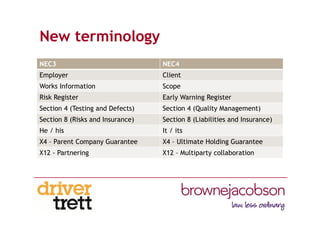
New terminology
NEC3 NEC4
Employer Client
Works Information Scope
Risk Register Early Warning Register
Section 4 (Testing and Defects) Section 4 (Quality Management)
Section 8 (Risks and Insurance) Section 8 (Liabilities and Insurance)
He / his It / its
X4 – Parent Company Guarantee X4 – Ultimate Holding Guarantee
X12 - Partnering X12 – Multiparty collaboration
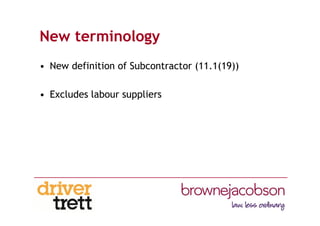
New terminology
• New definition of Subcontractor (11.1(19))
• Excludes labour suppliers
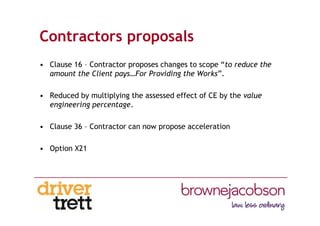
Contractors proposals
• Clause 16 – Contractor proposes changes to scope “to reduce the
amount the Client pays…For Providing the Works”.
• Reduced by multiplying the assessed effect of CE by the value
engineering percentage.
• Clause 36 – Contractor can now propose acceleration
• Option X21
Other Core Clause 1 changes
• Clause 10.0 now split in two
• PM rejections “in sufficient detail to enable the Contractor to
correct the matter” (clause 13.4)
• New clause 18: the Contractor does not do a Corrupt Act. Client
may terminate (clause 91.8)
• Prevention event – must stop “the whole of” the works (clause 19)
Confidentiality
• New clause 29 – “disclosure”
• Restrictions on disclosing information
• Contractor needs Client’s agreement to publicise
the works
Programme – deemed acceptance
• Clause 31.3 amended
• If PM fails to respond within 2 weeks Contractor
can issue a reminder
• If PM continues not to respond for 1 week the
programme is deemed accepted
Updating the programme
• Clause 32 amended
• “Implemented compensation events” deleted
Quality management
• New requirement for a quality management system (Clause 40)
• QMS to comply with the Scope
• Contractor submits for acceptance a quality policy statement and
quality plan
• Contractor can change quality plan with PM’s acceptance
Payment applications
• Contractor submits application for payment (clause
50.2)
• “In the form stated in the Scope”
• If no application issued before the assessment date the
amount due is the lesser of
– Amount PM assess as due; and
– Amount as previous assessment date
Review of Defined Costs (options C, D, E & F)
• New clause 50.9
• Contractor can instigate review & acceptance of its
Defined Cost by PM
• If PM does not respond within 13 weeks (or four
weeks of providing further information)
Contractor’s Defined Costs and Disallowed Cost are
treated as accepted
Final assessment
• New clause 53
• PM obliged to issue final assessment within four weeks of Defects
Certificate (clause 53.1)
• If PM fails to do this, Contractor may issues its own assessment
• Final assessment becomes conclusive if not challenged by either
party referring it to dispute resolution within four weeks
SCC and Fee
• Schedule of Cost Components
– Subcontract costs moved to SCC. Payment of them
made consistent across all Options.
– ‘Working Areas overheads’ removed from SCC.
– ‘Design overheads’ and ‘manufacturing and
fabrication overheads’ also removed
• The Fee
– Now only one fee percentage
Defined Cost and Disallowed Cost
• Options A & B
– Cost of preparing quotations is no longer excluded
• Options C, D, E & F
– New type of Disallowed Cost – adjudication costs
between Contractor and Subcontractor where
Contractor did not notify PM
Compensation Events
• Clause 60.1(20): Quotation for proposed instruction that is not
accepted
• Clause 60.1(21): Additional compensation events can be included
• Clause 63.1: “dividing date” for forecast/actual costs
• Clause 63.5: Delay based on Accepted Programme “current at the
dividing date”
Core Clause 8
• Liabilities and insurance
• Clause 81: Contractor’s liabilities now expressly stated
• Recovery of costs
• Clause 84.2: Waiver of subrogation rights against
Parties
Amendments to secondary options
• X4 – Ultimate holding company guarantees
• X12 – Multi Party Collaboration
• X15 – Contractor’s design
New secondary options
• X8 – Undertakings to the Client or Others
• X9 – Transfer of Rights
• X10 – Information Modelling
• X11 – Termination by Client
• X21 – Whole Life Cost
• X22 – Early Contractor Involvement (C&E)
Any questions?
Martin Cannon
E: martin.cannon@brownejacobson.com
T: +44 (0)121 296 0710
Eugene Lenehan
E: eugene.lenehan@drivertrett.com
T: +44 (0)2476 697 977
All information correct at time of production.
The information and opinions expressed within this document are
no substitute for full legal advice. It is for guidance only and
illustrates the law as at the published date. If in doubt, please
telephone us on 0370 270 6000.
© Browne Jacobson LLP 2017 – The information contained within
this document is and shall remain the property of Browne
Jacobson. This document may not be reproduced without the prior
consent of Browne Jacobson.
41

NEC4 overview: key changes and impacts - Nottingham, September 2017

  • 1.
    NEC4 overview: keychanges and impacts Nottingham, September 2017
  • 2.
    Today Martin Cannonof Browne Jacobson and Eugene Lenehan of Driver Trett will be speaking on: (i) Changes to the NEC Structure (Contract and Suite); (ii) Changes in Approach following the change to the structure; and (iii)The introduction of 2 new contracts to the Suite (the “DBO” and “Alliancing” contracts).
  • 3.
    NEC4 – What’snew? Overview and new contracts Martin Cannon Partner, construction team
  • 4.
    NEC4 – Whatwas the key focus? • “Evolution” not “Revolution”. • To provide greater stimulus to good management; • Support new approaches to procurement which improve contract management; and • Inspire increased use of NEC in new markets and sectors.
  • 5.
    New additions tothe NEC Suite • Following the NEC4 Suite having been published and the objective of supporting new approaches to procurement we have seen the introduction of: (i) NEC4 Design, Build, and Operate contract; and (ii) NEC4 Alliance Contract
  • 6.
    NEC4 Suite structure •The NEC4 Suite retains: (a) Engineering and Construction Contract (b) Framework Contract (c) Professional Service Contract (d) Supply Contract (e) Term Service Contract • The previous NEC3 Adjudicator’s Contract has been replaced by the NEC4 Dispute Resolution Contract
  • 7.
    Structure • The keymodel sections of the NEC3 have been retained (with the uniform change in language across the suite), namely the: (a) Core Clauses; (b) Secondary Option Clauses; and (c) X and Y Clauses.
  • 8.
    A change inprocess… • New provisions confirming that the programme is deemed as accepted in the event that the Project Manager fails to respond within the necessary time period. • Change to the payment regime where the contractor is to submit an application for payment prior to the “assessment date”, together with a final payment mechanism. • Changes to the CE mechanism – allowance for an additional CE where the Contractor has priced for a proposed instruction and it is not accepted, provision in the Contract Data to include further bespoke CE’s.
  • 9.
    A change inprocess… • Changes to the dispute resolution procedure within the contract, the introduction of a new tiered process. • Changes in terminology with the introduction of gender neutral wording, “client” instead of “employer”, change from “Risk Register” to “Early Warning Register”, and the introduction of “Scope” instead of “Works Information”/”Service Information”. • Changes to include clauses dealing with the transfer of benefits (i.e. assignment), confidentiality and publicity, and bribery and corruption.
  • 10.
    Design, Build, andOperate Contract • Broadly the overall structure of the contract is the same as the NEC4 model retaining the key core and secondary clauses. • A number of the “X” clauses have, however, been removed (options X1, X2, X5 – 7, X11 – 12, X15- 17 and X19 – 22 are not used). • In very broad terms the contract is similar to the PFI model as it governs both the construction of the building and the subsequent operational phase once the works have been completed.
  • 11.
    Structure: a “walkthrough" Thecontract follows the standard structure of the NEC4 model (albeit in a shortened form). Key provisions to note as follows: • Definitions:- some key terms; • Design; • The “Service”; and • Time.
  • 12.
    Definitions: some keyterms • There is a “Service Manager” (in lieu of the “Project Manager” as referred to in the ECC). • The “Service Period” is the period during which the Service is carried out (this includes both the construction and operational phase). • The Contractor is to carry out the “Service” as defined in the “Scope” for the “Service Period”.
  • 13.
    Design • The Contractorhas design responsibility – the Contractor is to carry out the design necessary for the provision of the “Service”. • The Contractor is required to submit the “particulars of its design” for approval to the Service Manager. • The Contractor cannot proceed with its works unless and to the extent that the Service Manager has accepted the design.
  • 14.
    The Service • TheService is set out in the Scope. • Similar to the PFI model the Contractor is to operate a quality management system. • Within the period stated in the Contract Data the Contractor is to provide to the Service Manager a “Quality Plan” and “Quality Policy Statement”. • Any instruction from the Service Manager to correct a failure to comply with the Quality Plan does not operate as a CE under the Contract.
  • 15.
    Time • Where aplan has not been identified in the Contract Data, the Contractor submits a first plan to the Service Manager for acceptance within the period stated in the Contract Data. • Within 2 weeks of the Contractor submitting a plan for acceptance, the Service Manager notifies the Contractor of the acceptance of the Plan or the reasons for not accepting it. • If the Service Manager does not notify acceptance or non – acceptance within the time allowed the Contractor notifies the Service Manager of the failure. If the failure continues for one week after the notification the plan is deemed accepted.
  • 16.
    Time: The Plan ThePlan includes provisions for: (i) float, time risk allowances, H&S requirements; (ii) access dates, dates for (a) acceptances, (b) Plant and Materials, (c) information; and (iii) details of how each operation is to be carried out (including dates, equipment, resources to be used).
  • 17.
    Conclusion The NEC saysthat “The Design Build and Operate Contract allows for a much more integrated method of procurement”.
  • 18.
    Alliance Contract • TheAlliance Contract has initially been published in consultation form and can be downloaded only at present from the NEC Website by request. • The Alliance Contract is a multi – party contract with a risk and reward model “built in”. • The liabilities are shared/managed by the Alliance (save in circumstances where there has been a wilful default by one of the alliance partners).
  • 19.
    Management of theContract • The Contract is managed by the Alliance Manager (who leads the Alliance delivery team). • All decisions under the contract are to be taken by the Alliance Board (made up of representatives from each of the Alliance members and the client). The decisions of the Alliance Board have to be unanimous and bind all the parties that make up the Alliance. • The Alliance Manager reports to the Alliance Board.
  • 20.
    Payment • The basisof payment is Defined cost plus Fee (the same as Option E of the NEC4 ECC). Payment is to be made via a Project Bank Account. • The Alliance Manager assesses the amount due and the Client’s representative certifies. • Alliance Objectives form the basis of the performance targets against which the Alliance will be incentivised, this means that work allocation will be based around what’s best for the project (this should have the effect of reducing the likelihood of the partners seeking to hold onto one or more of the works packages).
  • 21.
    Compensation Events/Disputes • AllianceManager assesses CE’s and the Alliance Board assesses the quotations. • Where there is no unanimous decision of the Alliance Board the matter is referred to the named senior representatives under the contract. • The Contract can be found at www.neccontract.com.
  • 22.
    NEC4 – What’snew? Core clauses, main options and secondary options Eugene Lenehan, Driver Trett
  • 23.
    New terminology NEC3 NEC4 EmployerClient Works Information Scope Risk Register Early Warning Register Section 4 (Testing and Defects) Section 4 (Quality Management) Section 8 (Risks and Insurance) Section 8 (Liabilities and Insurance) He / his It / its X4 – Parent Company Guarantee X4 – Ultimate Holding Guarantee X12 - Partnering X12 – Multiparty collaboration
  • 24.
    New terminology • Newdefinition of Subcontractor (11.1(19)) • Excludes labour suppliers
  • 25.
    Contractors proposals • Clause16 – Contractor proposes changes to scope “to reduce the amount the Client pays…For Providing the Works”. • Reduced by multiplying the assessed effect of CE by the value engineering percentage. • Clause 36 – Contractor can now propose acceleration • Option X21
  • 26.
    Other Core Clause1 changes • Clause 10.0 now split in two • PM rejections “in sufficient detail to enable the Contractor to correct the matter” (clause 13.4) • New clause 18: the Contractor does not do a Corrupt Act. Client may terminate (clause 91.8) • Prevention event – must stop “the whole of” the works (clause 19)
  • 27.
    Confidentiality • New clause29 – “disclosure” • Restrictions on disclosing information • Contractor needs Client’s agreement to publicise the works
  • 28.
    Programme – deemedacceptance • Clause 31.3 amended • If PM fails to respond within 2 weeks Contractor can issue a reminder • If PM continues not to respond for 1 week the programme is deemed accepted
  • 29.
    Updating the programme •Clause 32 amended • “Implemented compensation events” deleted
  • 30.
    Quality management • Newrequirement for a quality management system (Clause 40) • QMS to comply with the Scope • Contractor submits for acceptance a quality policy statement and quality plan • Contractor can change quality plan with PM’s acceptance
  • 31.
    Payment applications • Contractorsubmits application for payment (clause 50.2) • “In the form stated in the Scope” • If no application issued before the assessment date the amount due is the lesser of – Amount PM assess as due; and – Amount as previous assessment date
  • 32.
    Review of DefinedCosts (options C, D, E & F) • New clause 50.9 • Contractor can instigate review & acceptance of its Defined Cost by PM • If PM does not respond within 13 weeks (or four weeks of providing further information) Contractor’s Defined Costs and Disallowed Cost are treated as accepted
  • 33.
    Final assessment • Newclause 53 • PM obliged to issue final assessment within four weeks of Defects Certificate (clause 53.1) • If PM fails to do this, Contractor may issues its own assessment • Final assessment becomes conclusive if not challenged by either party referring it to dispute resolution within four weeks
  • 34.
    SCC and Fee •Schedule of Cost Components – Subcontract costs moved to SCC. Payment of them made consistent across all Options. – ‘Working Areas overheads’ removed from SCC. – ‘Design overheads’ and ‘manufacturing and fabrication overheads’ also removed • The Fee – Now only one fee percentage
  • 35.
    Defined Cost andDisallowed Cost • Options A & B – Cost of preparing quotations is no longer excluded • Options C, D, E & F – New type of Disallowed Cost – adjudication costs between Contractor and Subcontractor where Contractor did not notify PM
  • 36.
    Compensation Events • Clause60.1(20): Quotation for proposed instruction that is not accepted • Clause 60.1(21): Additional compensation events can be included • Clause 63.1: “dividing date” for forecast/actual costs • Clause 63.5: Delay based on Accepted Programme “current at the dividing date”
  • 37.
    Core Clause 8 •Liabilities and insurance • Clause 81: Contractor’s liabilities now expressly stated • Recovery of costs • Clause 84.2: Waiver of subrogation rights against Parties
  • 38.
    Amendments to secondaryoptions • X4 – Ultimate holding company guarantees • X12 – Multi Party Collaboration • X15 – Contractor’s design
  • 39.
    New secondary options •X8 – Undertakings to the Client or Others • X9 – Transfer of Rights • X10 – Information Modelling • X11 – Termination by Client • X21 – Whole Life Cost • X22 – Early Contractor Involvement (C&E)
  • 40.
    Any questions? Martin Cannon E:martin.cannon@brownejacobson.com T: +44 (0)121 296 0710 Eugene Lenehan E: eugene.lenehan@drivertrett.com T: +44 (0)2476 697 977
  • 41.
    All information correctat time of production. The information and opinions expressed within this document are no substitute for full legal advice. It is for guidance only and illustrates the law as at the published date. If in doubt, please telephone us on 0370 270 6000. © Browne Jacobson LLP 2017 – The information contained within this document is and shall remain the property of Browne Jacobson. This document may not be reproduced without the prior consent of Browne Jacobson. 41