Microservice  Ecosystems    
at  Scale    	
Randy Shoup
@randyshoup
linkedin.com/in/randyshoup
Architecture  
Evolution	
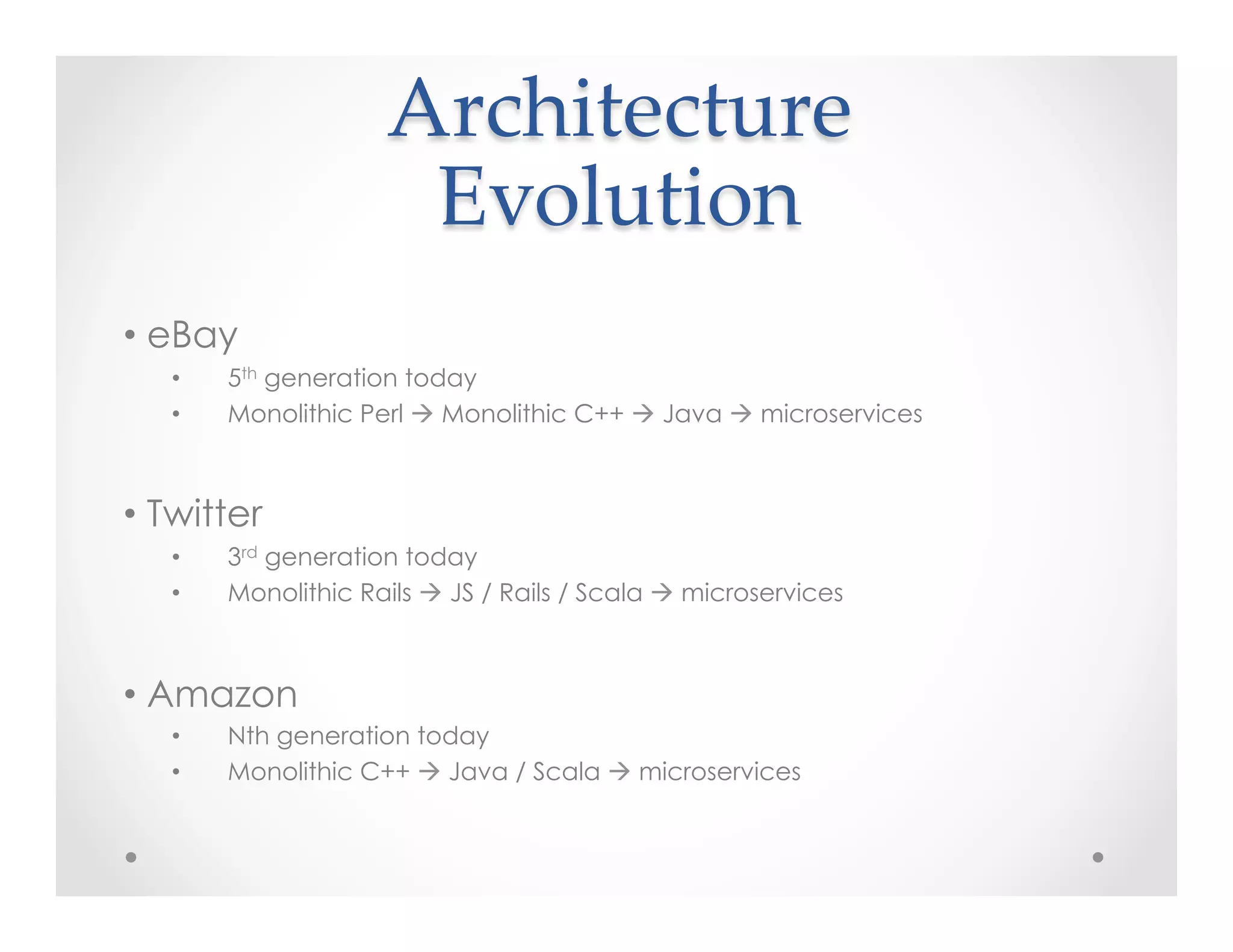
• eBay
•  5th generation today
•  Monolithic Perl à Monolithic C++ à Java à microservices
• Twitter
•  3rd generation today
•  Monolithic Rails à JS / Rails / Scala à microservices
• Amazon
•  Nth generation today
•  Monolithic C++ à Java / Scala à microservices
Microservice  Ecosystems  
at  Scale	
•  Ecosystem of Services
•  Designing a Service
•  Building and Operating a Service
Microservice  Ecosystems  
at  Scale	
•  Ecosystem of Services
•  Designing a Service
•  Building and Operating a Service
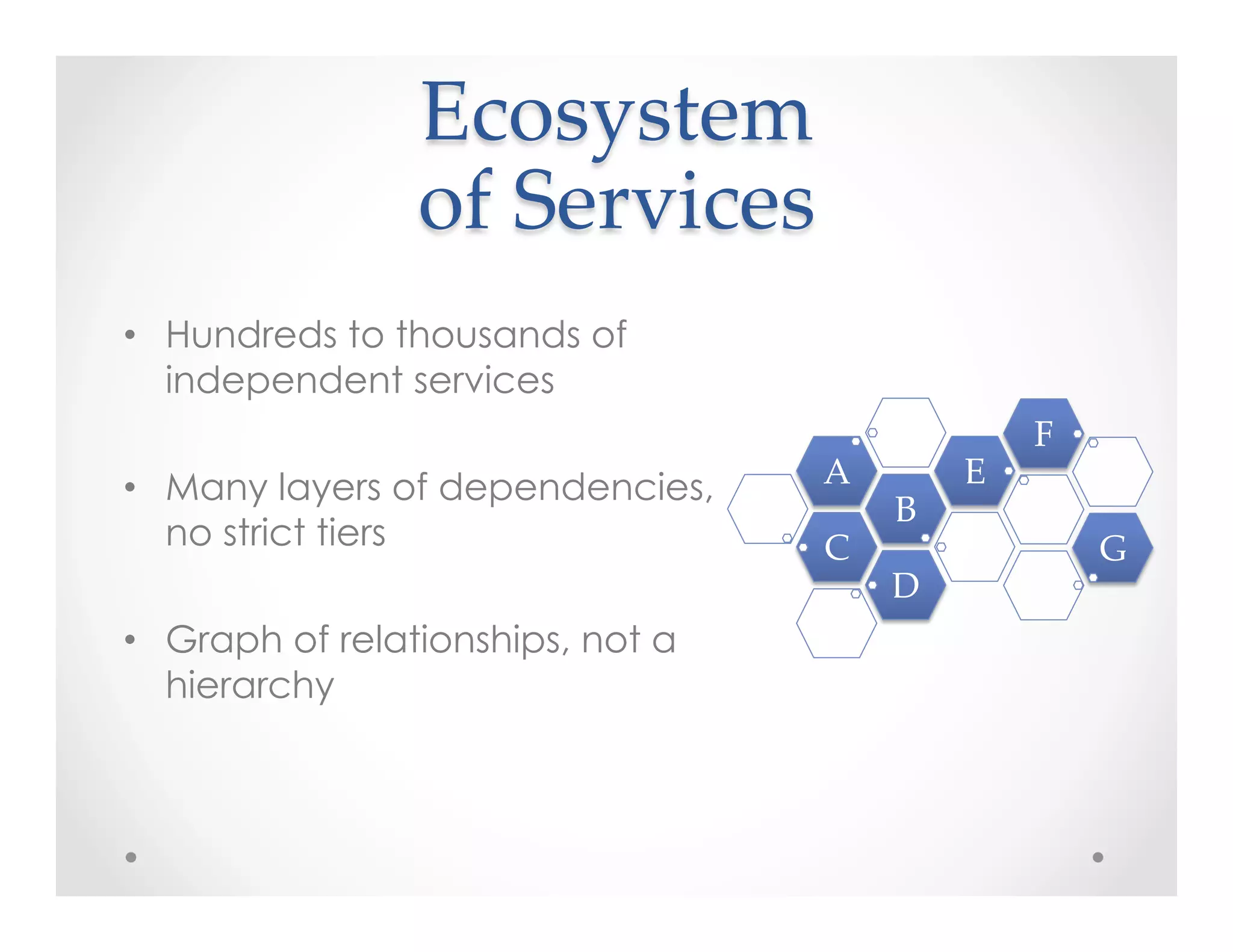
Ecosystem    
of  Services	
•  Hundreds to thousands of
independent services
•  Many layers of dependencies,
no strict tiers
•  Graph of relationships, not a
hierarchy
C	
B	
A	
 E	
F	
G	
D
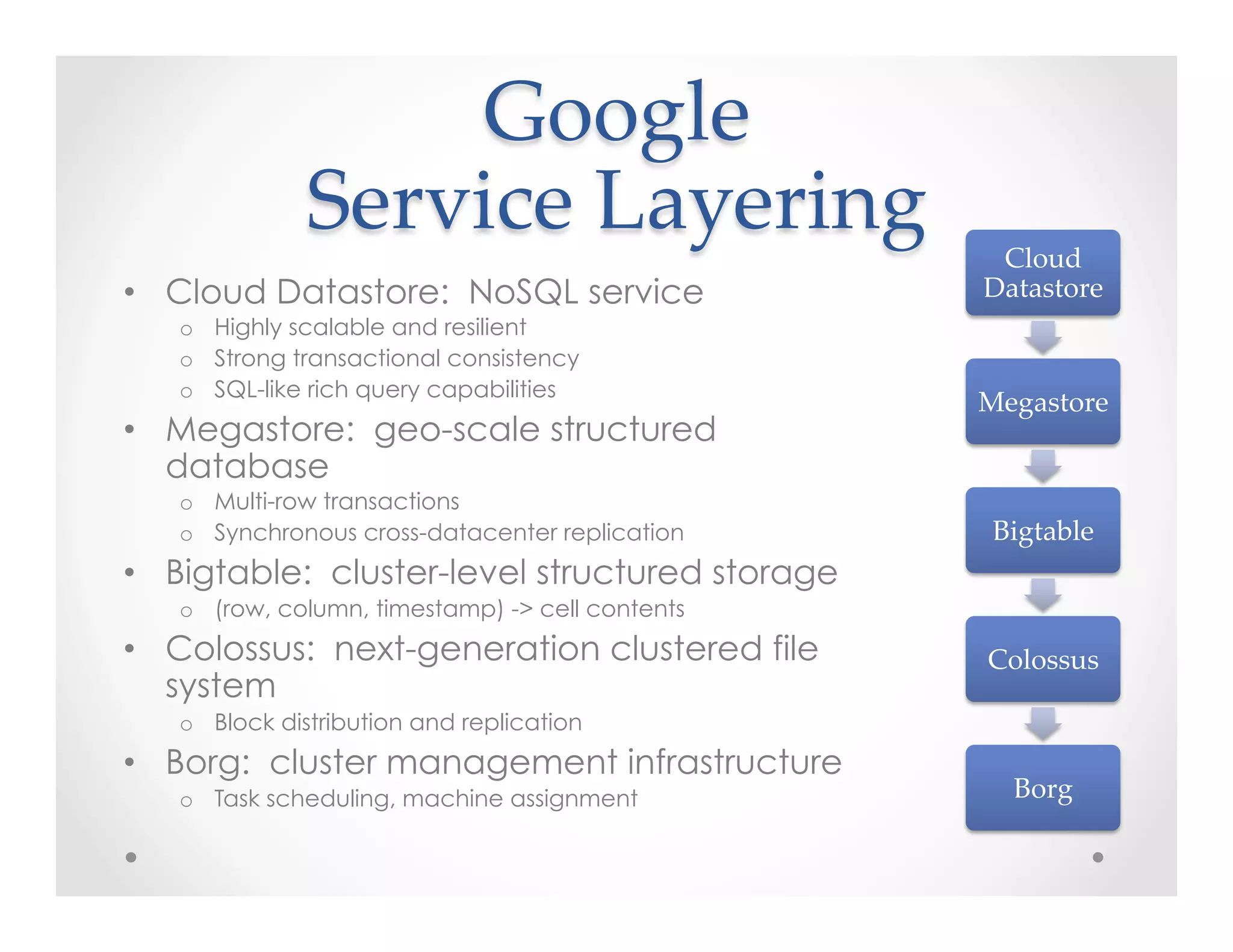
Google    
Service  Layering	
•  Cloud Datastore: NoSQL service
o  Highly scalable and resilient
o  Strong transactional consistency
o  SQL-like rich query capabilities
•  Megastore: geo-scale structured
database
o  Multi-row transactions
o  Synchronous cross-datacenter replication
•  Bigtable: cluster-level structured storage
o  (row, column, timestamp) -> cell contents
•  Colossus: next-generation clustered file
system
o  Block distribution and replication
•  Borg: cluster management infrastructure
o  Task scheduling, machine assignment
Cloud  
Datastore	
Megastore	
Bigtable	
Colossus	
Borg
Evolution,    
not  Intelligent  Design	
•  No centralized, top-down design of the system
•  Variation and Natural selection
o  Create / extract new services when needed to solve a problem
o  Services justify their continued existence through usage
o  Deprecate services when no longer used
“Every  service  at  Google  is  
either  deprecated  or  not  ready  
yet.”  


-­‐‑-­‐‑  Google  engineering  proverb
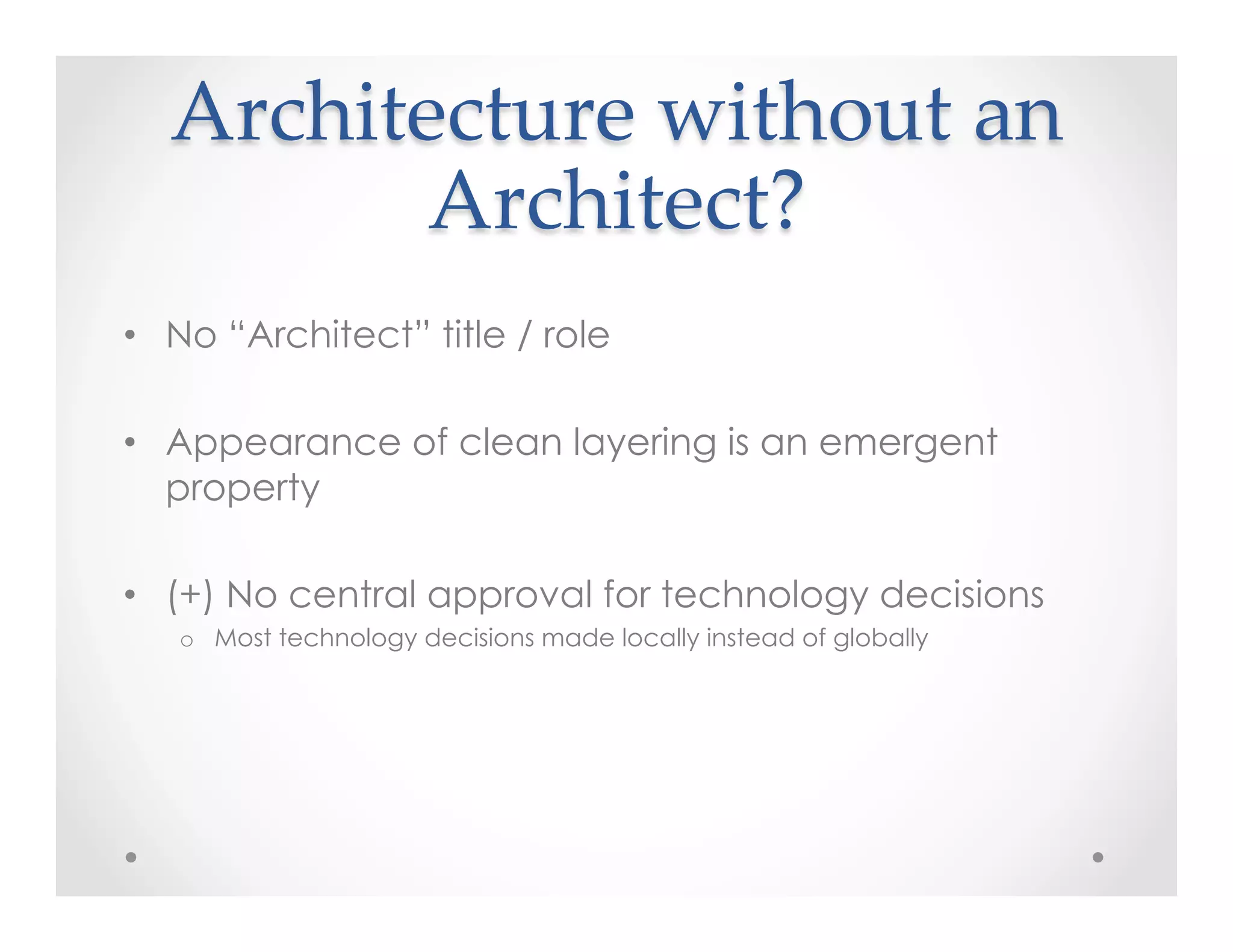
Architecture  without  an  
Architect?	
•  No “Architect” title / role
•  Appearance of clean layering is an emergent
property
•  (+) No central approval for technology decisions
o  Most technology decisions made locally instead of globally
Microservice  Ecosystems  
at  Scale	
•  Ecosystem of Services
•  Designing a Service
•  Building and Operating a Service
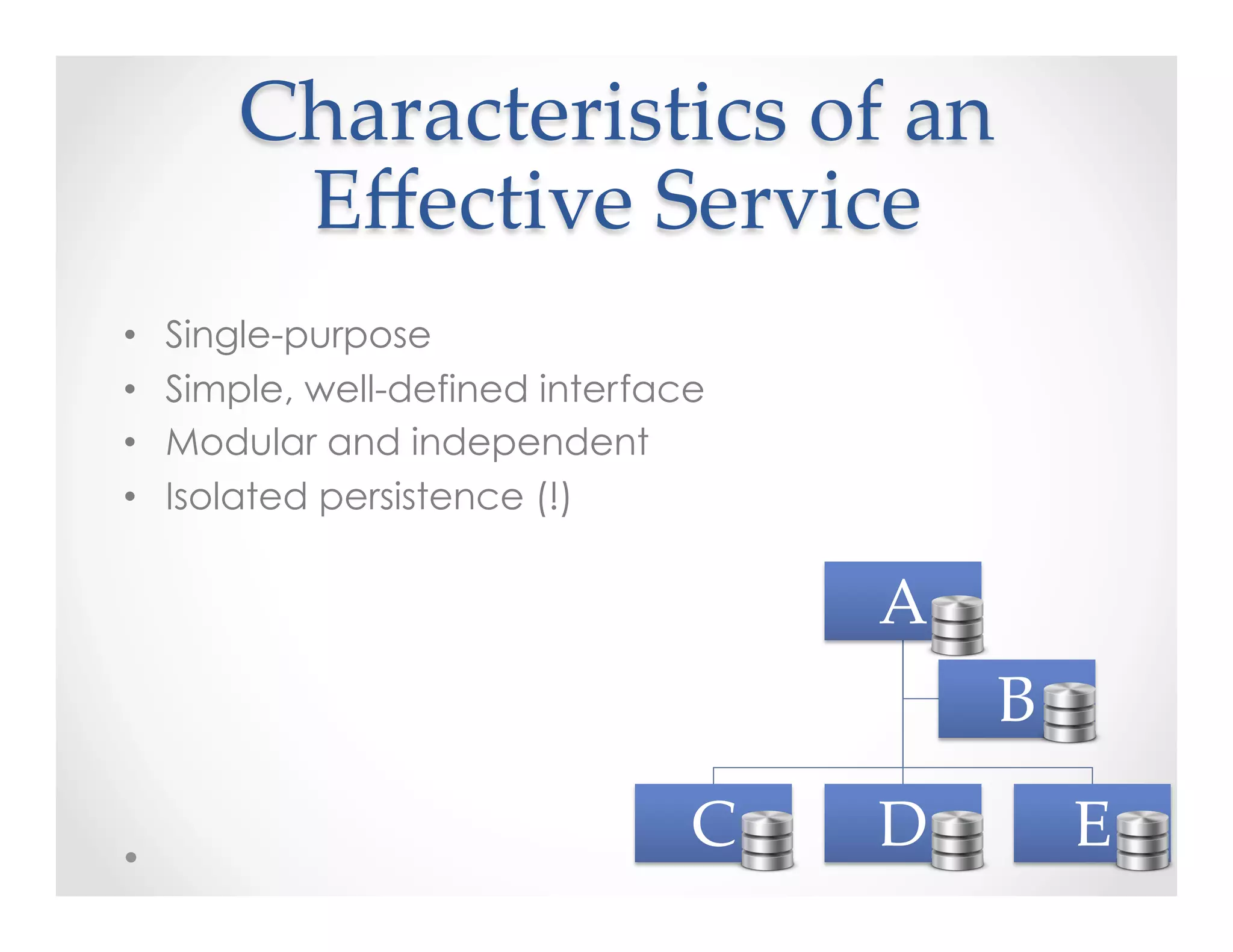
Characteristics  of  an  
Effective  Service	
•  Single-purpose
•  Simple, well-defined interface
•  Modular and independent
•  Isolated persistence (!)
A	
C	
 D	
 E	
B
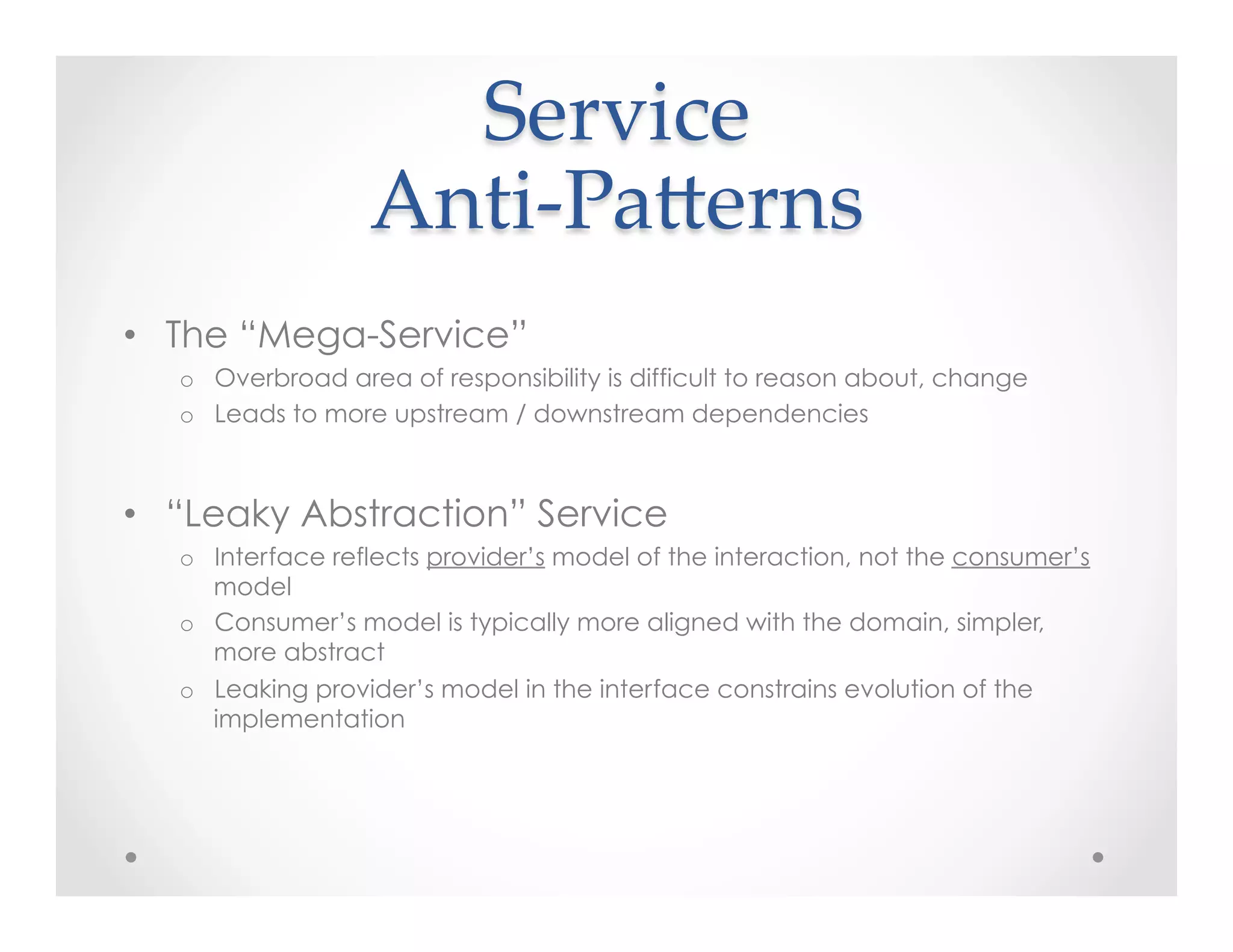
Service  
Anti-­‐‑PaKerns	
•  The “Mega-Service”
o  Overbroad area of responsibility is difficult to reason about, change
o  Leads to more upstream / downstream dependencies
•  “Leaky Abstraction” Service
o  Interface reflects provider’s model of the interaction, not the consumer’s
model
o  Consumer’s model is typically more aligned with the domain, simpler,
more abstract
o  Leaking provider’s model in the interface constrains evolution of the
implementation
Service  
Anti-­‐‑PaKerns	
•  Shared persistence
o  Breaks encapsulation, encourages “backdoor” interface violations
o  Unhealthy and near-invisible coupling of services
o  (-) Initial eBay SOA efforts
Service    
Persistence	
•  Option 1: Operate your own data store
o  Store to your own instance(s) of MySQL, etc., owned and operated by the
service
•  Option 2: Use a persistence service
o  Store to your own partition(s) of Dynamo, Bigtable, etc., operated as a
service by another team
•  è Only external access to data store is through
published service interface
Maintaining    
Interface  Stability	
•  Backward / forward compatibility of interfaces
o  Can *never* break your clients’ code
o  Often multiple interface versions
o  Sometimes multiple deployments
o  Majority of changes don’t impact the interface in any way
•  Explicit deprecation policy
o  Strong incentive to wean customers off old versions (!)
Microservice  Ecosystems  
at  Scale	
•  Ecosystem of Services
•  Designing a Service
•  Building and Operating a Service
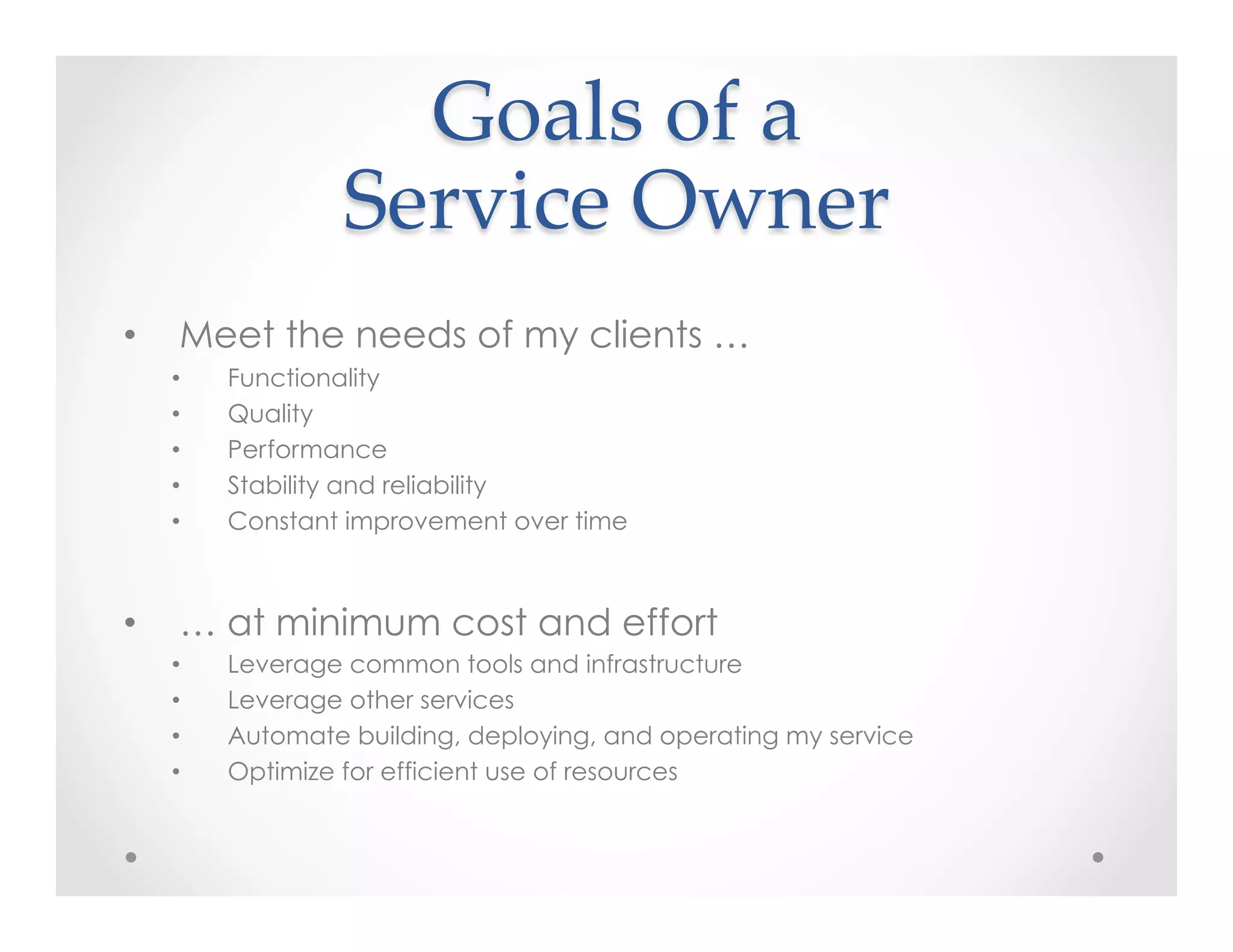
Goals  of  a    
Service  Owner	
•  Meet the needs of my clients …
•  Functionality
•  Quality
•  Performance
•  Stability and reliability
•  Constant improvement over time
•  … at minimum cost and effort
•  Leverage common tools and infrastructure
•  Leverage other services
•  Automate building, deploying, and operating my service
•  Optimize for efficient use of resources
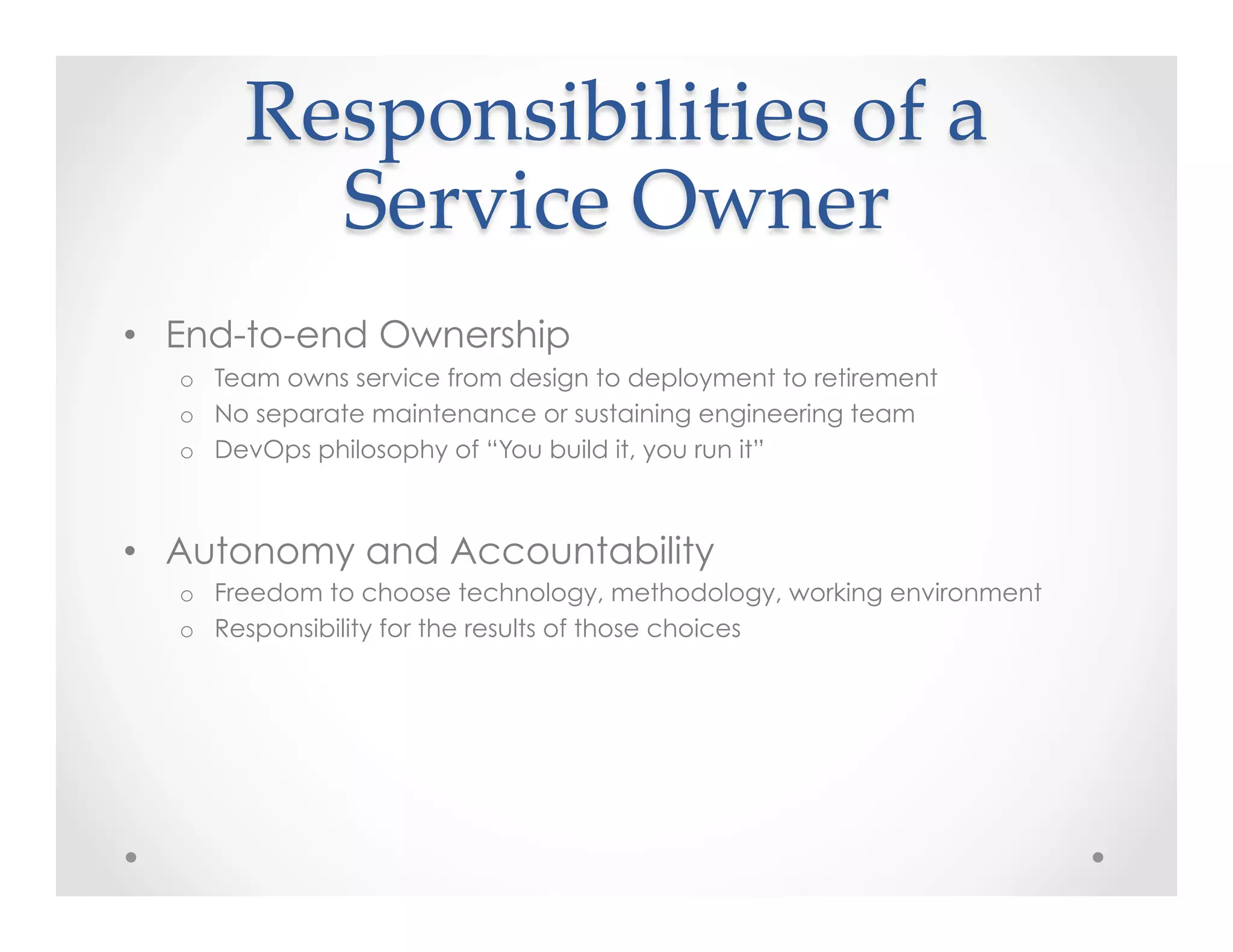
Responsibilities  of  a  
Service  Owner	
•  End-to-end Ownership
o  Team owns service from design to deployment to retirement
o  No separate maintenance or sustaining engineering team
o  DevOps philosophy of “You build it, you run it”
•  Autonomy and Accountability
o  Freedom to choose technology, methodology, working environment
o  Responsibility for the results of those choices
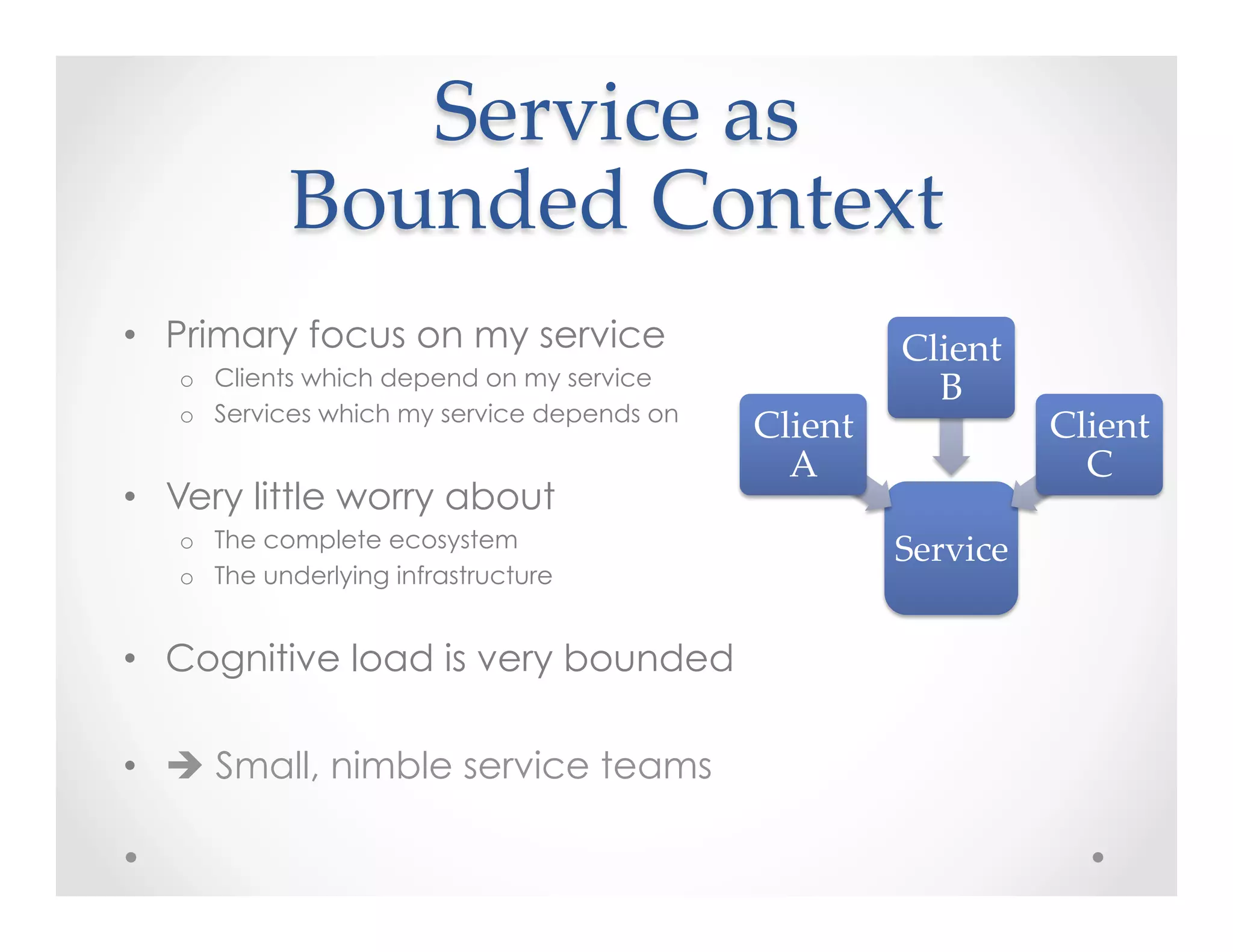
Service  as    
Bounded  Context	
•  Primary focus on my service
o  Clients which depend on my service
o  Services which my service depends on
•  Very little worry about
o  The complete ecosystem
o  The underlying infrastructure
•  Cognitive load is very bounded
•  è Small, nimble service teams
Service	
Client  
A	
Client  
B	
Client  
C
Service-­‐‑Service    
Relationships	
•  Vendor – Customer Relationship
o  Friendly and cooperative, but structured
o  Clear ownership and division of responsibility
•  Customer can choose to use service or not (!)
o  Must be strictly better than the alternatives of build, buy, borrow
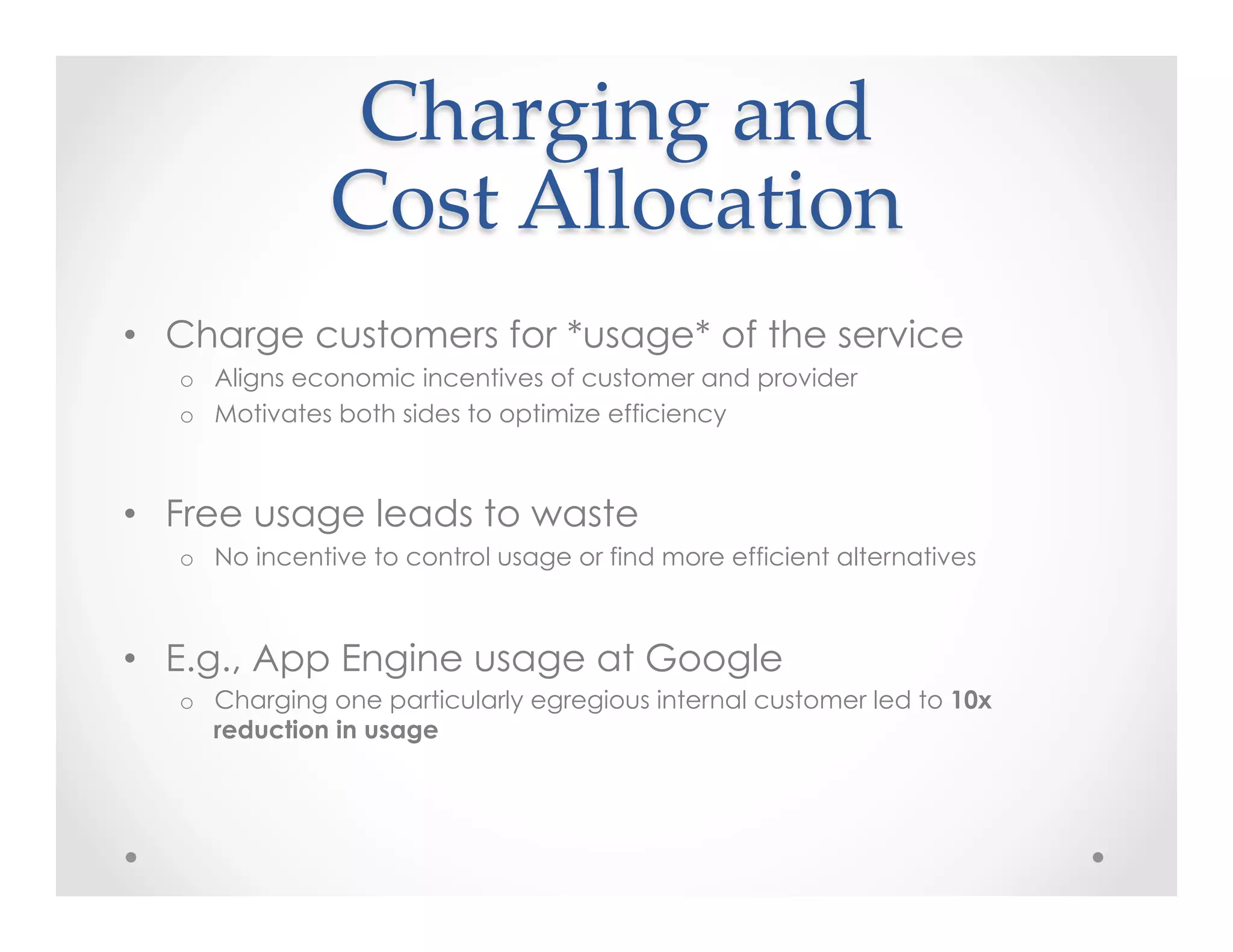
Charging  and    
Cost  Allocation	
•  Charge customers for *usage* of the service
o  Aligns economic incentives of customer and provider
o  Motivates both sides to optimize efficiency
•  Free usage leads to waste
o  No incentive to control usage or find more efficient alternatives
•  E.g., App Engine usage at Google
o  Charging one particularly egregious internal customer led to 10x
reduction in usage
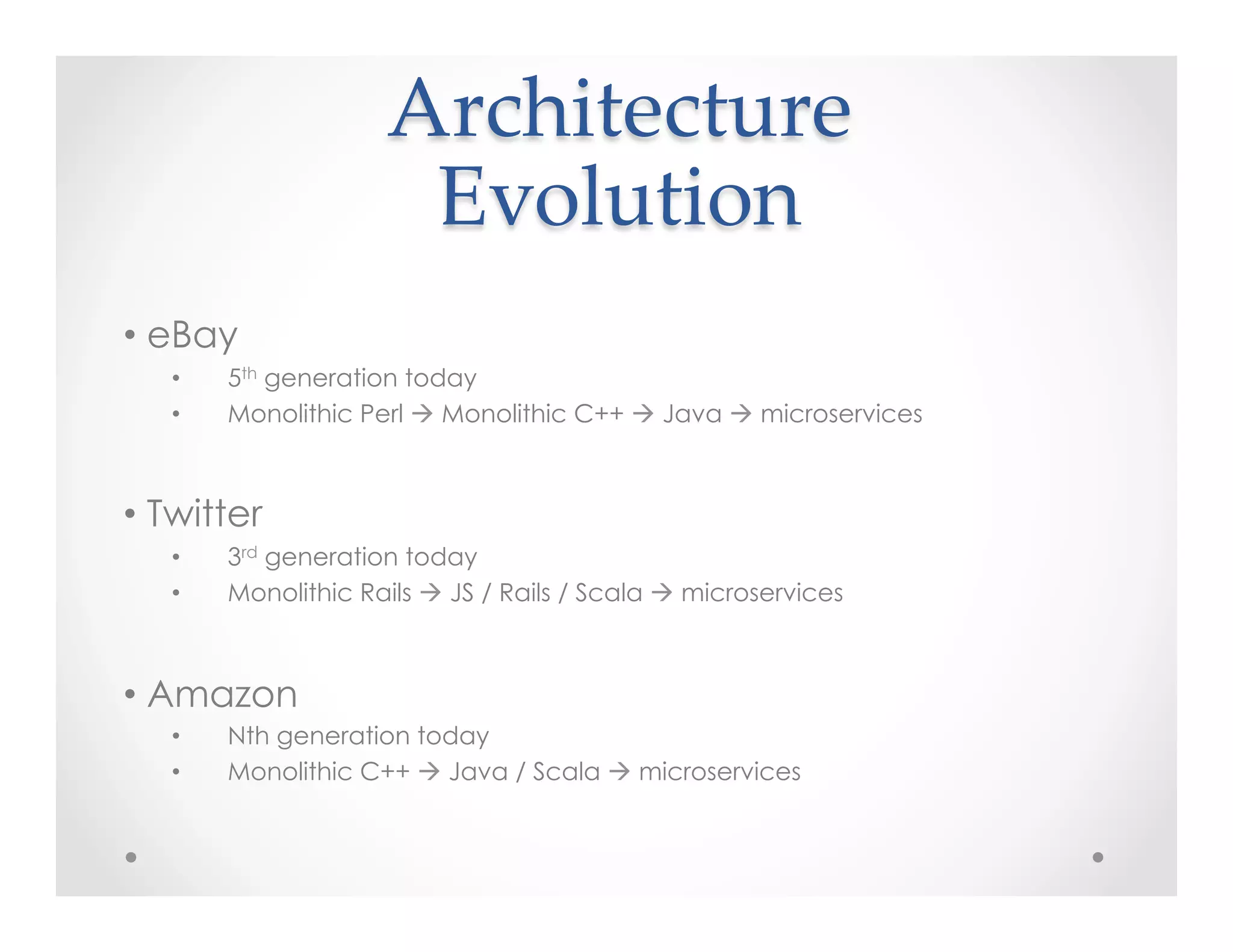
Architecture  
Evolution	
• eBay
•  5th generation today
•  Monolithic Perl à Monolithic C++ à Java à microservices
• Twitter
•  3rd generation today
•  Monolithic Rails à JS / Rails / Scala à microservices
• Amazon
•  Nth generation today
•  Monolithic C++ à Java / Scala à microservices
“If  you  don’t  end  up  regreKing  
your  early  technology  
decisions,  you  probably  over-­‐‑
engineered.”	
-- me
Thank  You!	
•  @randyshoup
•  linkedin.com/in/randyshoup

Microservices Practitioner Summit Jan '15 - Microservice Ecosystems At Scale - Randy Shoup

  • 1.
    Microservice  Ecosystems    at  Scale     Randy Shoup @randyshoup linkedin.com/in/randyshoup
  • 2.
    Architecture   Evolution • eBay •  5thgeneration today •  Monolithic Perl à Monolithic C++ à Java à microservices • Twitter •  3rd generation today •  Monolithic Rails à JS / Rails / Scala à microservices • Amazon •  Nth generation today •  Monolithic C++ à Java / Scala à microservices
  • 3.
    Microservice  Ecosystems   at Scale •  Ecosystem of Services •  Designing a Service •  Building and Operating a Service
  • 4.
    Microservice  Ecosystems   at Scale •  Ecosystem of Services •  Designing a Service •  Building and Operating a Service
  • 5.
    Ecosystem     of Services •  Hundreds to thousands of independent services •  Many layers of dependencies, no strict tiers •  Graph of relationships, not a hierarchy C B A E F G D
  • 6.
    Google     Service Layering •  Cloud Datastore: NoSQL service o  Highly scalable and resilient o  Strong transactional consistency o  SQL-like rich query capabilities •  Megastore: geo-scale structured database o  Multi-row transactions o  Synchronous cross-datacenter replication •  Bigtable: cluster-level structured storage o  (row, column, timestamp) -> cell contents •  Colossus: next-generation clustered file system o  Block distribution and replication •  Borg: cluster management infrastructure o  Task scheduling, machine assignment Cloud   Datastore Megastore Bigtable Colossus Borg
  • 7.
    Evolution,     not Intelligent  Design •  No centralized, top-down design of the system •  Variation and Natural selection o  Create / extract new services when needed to solve a problem o  Services justify their continued existence through usage o  Deprecate services when no longer used
  • 8.
    “Every  service  at Google  is   either  deprecated  or  not  ready   yet.”   -­‐‑-­‐‑  Google  engineering  proverb
  • 9.
    Architecture  without  an  Architect? •  No “Architect” title / role •  Appearance of clean layering is an emergent property •  (+) No central approval for technology decisions o  Most technology decisions made locally instead of globally
  • 10.
    Microservice  Ecosystems   at Scale •  Ecosystem of Services •  Designing a Service •  Building and Operating a Service
  • 11.
    Characteristics  of  an  Effective  Service •  Single-purpose •  Simple, well-defined interface •  Modular and independent •  Isolated persistence (!) A C D E B
  • 12.
    Service   Anti-­‐‑PaKerns •  The“Mega-Service” o  Overbroad area of responsibility is difficult to reason about, change o  Leads to more upstream / downstream dependencies •  “Leaky Abstraction” Service o  Interface reflects provider’s model of the interaction, not the consumer’s model o  Consumer’s model is typically more aligned with the domain, simpler, more abstract o  Leaking provider’s model in the interface constrains evolution of the implementation
  • 13.
    Service   Anti-­‐‑PaKerns •  Sharedpersistence o  Breaks encapsulation, encourages “backdoor” interface violations o  Unhealthy and near-invisible coupling of services o  (-) Initial eBay SOA efforts
  • 14.
    Service     Persistence • Option 1: Operate your own data store o  Store to your own instance(s) of MySQL, etc., owned and operated by the service •  Option 2: Use a persistence service o  Store to your own partition(s) of Dynamo, Bigtable, etc., operated as a service by another team •  è Only external access to data store is through published service interface
  • 15.
    Maintaining     Interface Stability •  Backward / forward compatibility of interfaces o  Can *never* break your clients’ code o  Often multiple interface versions o  Sometimes multiple deployments o  Majority of changes don’t impact the interface in any way •  Explicit deprecation policy o  Strong incentive to wean customers off old versions (!)
  • 16.
    Microservice  Ecosystems   at Scale •  Ecosystem of Services •  Designing a Service •  Building and Operating a Service
  • 17.
    Goals  of  a    Service  Owner •  Meet the needs of my clients … •  Functionality •  Quality •  Performance •  Stability and reliability •  Constant improvement over time •  … at minimum cost and effort •  Leverage common tools and infrastructure •  Leverage other services •  Automate building, deploying, and operating my service •  Optimize for efficient use of resources
  • 18.
    Responsibilities  of  a  Service  Owner •  End-to-end Ownership o  Team owns service from design to deployment to retirement o  No separate maintenance or sustaining engineering team o  DevOps philosophy of “You build it, you run it” •  Autonomy and Accountability o  Freedom to choose technology, methodology, working environment o  Responsibility for the results of those choices
  • 19.
    Service  as    Bounded  Context •  Primary focus on my service o  Clients which depend on my service o  Services which my service depends on •  Very little worry about o  The complete ecosystem o  The underlying infrastructure •  Cognitive load is very bounded •  è Small, nimble service teams Service Client   A Client   B Client   C
  • 20.
    Service-­‐‑Service     Relationships • Vendor – Customer Relationship o  Friendly and cooperative, but structured o  Clear ownership and division of responsibility •  Customer can choose to use service or not (!) o  Must be strictly better than the alternatives of build, buy, borrow
  • 21.
    Charging  and    Cost  Allocation •  Charge customers for *usage* of the service o  Aligns economic incentives of customer and provider o  Motivates both sides to optimize efficiency •  Free usage leads to waste o  No incentive to control usage or find more efficient alternatives •  E.g., App Engine usage at Google o  Charging one particularly egregious internal customer led to 10x reduction in usage
  • 22.
    Architecture   Evolution • eBay •  5thgeneration today •  Monolithic Perl à Monolithic C++ à Java à microservices • Twitter •  3rd generation today •  Monolithic Rails à JS / Rails / Scala à microservices • Amazon •  Nth generation today •  Monolithic C++ à Java / Scala à microservices
  • 23.
    “If  you  don’t end  up  regreKing   your  early  technology   decisions,  you  probably  over-­‐‑ engineered.” -- me
  • 24.
    Thank  You! •  @randyshoup • linkedin.com/in/randyshoup