From Human Intelligence
To Machine Intelligence
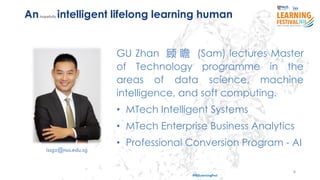
GU Zhan 顾 瞻 (Sam)
zhan.gu@nus.edu.sg
#ISSLearningFest
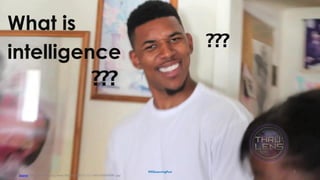
What is
intelligence
#ISSLearningFest 2
Source https://i.warosu.org/data/biz/img/0012/12/1461543092681.jpg
3
#ISSLearningFest
What’s intelligence?
“Intelligence measures a human/AI’s ability to achieve
goals in a wide range of environments.”
A Universal Measure of Intelligence for Artificial Agents, Legg & Hutter 2007
Examples?
• Goals in school environment?
• Goals in work environment?
• Goals in home environment?
4
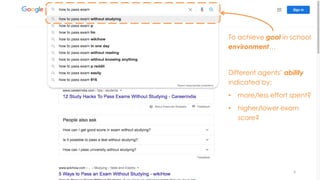
To achieve goal in school
environment…
Different agents’ ability
indicated by:
• more/less effort spent?
• higher/lower exam
score?
5
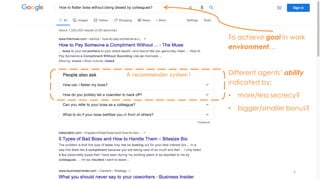
To achieve goal in work
environment…
Different agents’ ability
indicated by:
• more/less secrecy?
• bigger/smaller bonus?
A recommender system !
6
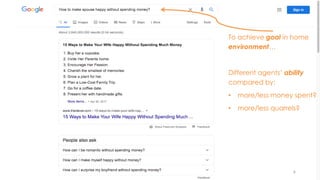
To achieve goal in home
environment…
Different agents’ ability
compared by:
• more/less money spent?
• more/less quarrels?
7
#ISSLearningFest
We all are intelligent agents in daily life...
• The environment is analogical to industry domain:
E.g. Retail; Education; Finance;
• The goal is analogical to perform job role:
E.g. Salesperson; Lecturer; Ah Long (Loan shark);
• The ability is analogical to KPI (for the job role):
E.g. Larger sales volume; Better student feedback; More graffiti & interest $;
Creating an AI is analogical to defining goal & designing KPIs for an
employee to behave autonomously (through learning and reasoning
using domain knowledge) without the boss/designer’s micro-
management (explicitly programmed).
8
#ISSLearningFest
GU Zhan 顾 瞻 (Sam) lectures Master
of Technology programme in the
areas of data science, machine
intelligence, and soft computing.
• MTech Intelligent Systems
• MTech Enterprise Business Analytics
• Professional Conversion Program - AI
Anhopefully intelligent lifelong learning human
issgz@nus.edu.sg
10
Source https://youtu.be/JlcGfwb6CDE
11
Source https://youtu.be/JlcGfwb6CDE
#ISSLearningFest 12
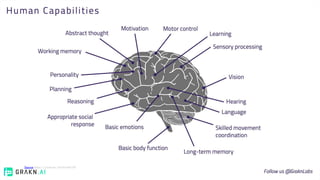
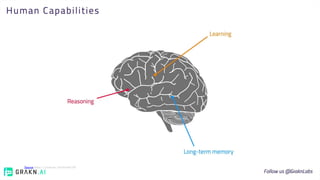
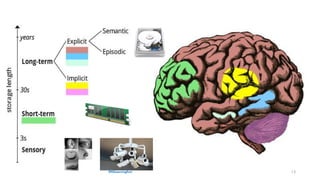
Human Memory
to store data, e.g. abstract knowledge, sensory information, experiences, etc.
and this ISS learning festival session as well.
#ISSLearningFest 13
#ISSLearningFest 14
Human Learning
to generate new knowledge
E.g. acquired understanding, behaviours, skills, values, useful to memorize & reuse
Model:
Learn
Model:
Recognize
15
#ISSLearningFest
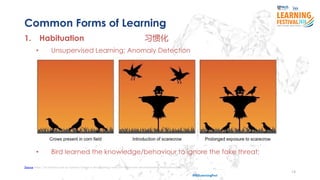
Common Forms of Learning
1. Habituation 习惯化
• Unsupervised Learning; Anomaly Detection
• Bird learned the knowledge/behaviour to ignore the fake threat;
Source https://ib.bioninja.com.au/options/option-a-neurobiology-and/a4-innate-and-learned-behav/habituation.html
16
#ISSLearningFest
Common Forms of Learning
Source https://ib.bioninja.com.au/options/option-a-neurobiology-and/a4-innate-and-learned-behav/conditioning.html
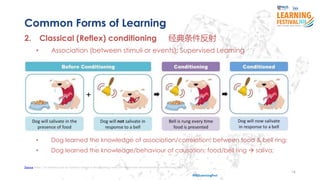
2. Classical (Reflex) conditioning 经典条件反射
• Association (between stimuli or events); Supervised Learning
• Dog learned the knowledge of association/correlation: between food & bell ring;
• Dog learned the knowledge/behaviour of causation: food/bell ring  saliva;
17
#ISSLearningFest
Common Forms of Learning
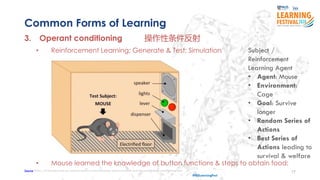
3. Operant conditioning 操作性条件反射
• Reinforcement Learning; Generate & Test; Simulation
• Mouse learned the knowledge of button functions & steps to obtain food;
Source https://ib.bioninja.com.au/options/option-a-neurobiology-and/a4-innate-and-learned-behav/conditioning.html
Subject /
Reinforcement
Learning Agent
• Agent: Mouse
• Environment:
Cage
• Goal: Survive
longer
• Random Series of
Actions
• Best Series of
Actions leading to
survival & welfare
18
#ISSLearningFest
Common Forms of Learning
3. Operant conditioning 操作性条件反射
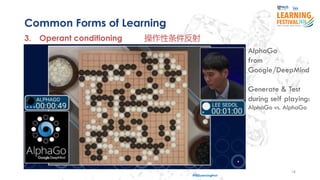
AlphaGo
from
Google/DeepMind
Generate & Test
during self playing:
AlphaGo vs. AlphaGo
19
#ISSLearningFest
Common Forms of Learning
3. Operant conditioning 操作性条件反射
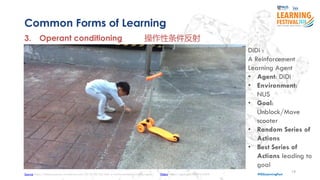
DiDi :
A Reinforcement
Learning Agent
• Agent: DiDi
• Environment:
NUS
• Goal:
Unblock/Move
scooter
• Random Series of
Actions
• Best Series of
Actions leading to
goal
Source https://telescopeuser.wordpress.com/2018/08/20/didi-a-reinforcement-learning-agent/ Video https://youtu.be/8K-fNcJU0nk
20
#ISSLearningFest
Common Forms of Learning
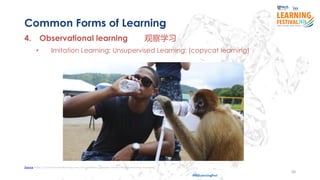
4. Observational learning 观察学习
• Imitation Learning; Unsupervised Learning; (copycat learning)
Source https://courses.lumenlearning.com/wsu-sandbox/chapter/observational-learning-modeling/
#ISSLearningFest 21
Human Reasoning
to use existing knowledge
Model:
Reason/Think
22
#ISSLearningFest
Common Forms of Reasoning
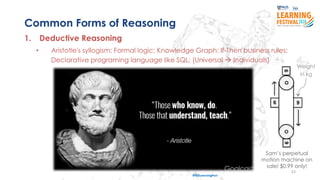
1. Deductive Reasoning
• Aristotle's syllogism; Formal logic; Knowledge Graph; If-Then business rules;
Declarative programing language like SQL; (Universal  Individuals)
Sam’s perpetual
motion machine on
sale! $0.99 only!
Weight
in kg
23
#ISSLearningFest
Common Forms of Reasoning
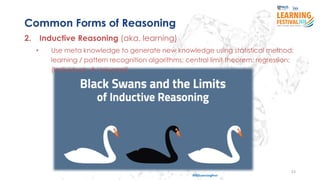
2. Inductive Reasoning (aka. learning)
• Use meta knowledge to generate new knowledge using statistical method:
learning / pattern recognition algorithms; central limit theorem; regression;
(Individuals  Universal)
24
#ISSLearningFest
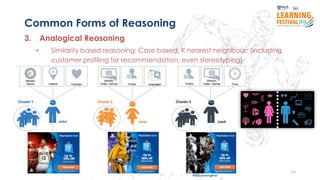
Common Forms of Reasoning
3. Analogical Reasoning
• Similarity based reasoning; Case based; K nearest neighbour; (including
customer profiling for recommendation; even stereotyping)
25
#ISSLearningFest
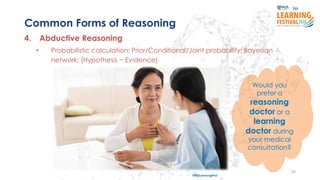
Common Forms of Reasoning
4. Abductive Reasoning
• Probabilistic calculation; Prior/Conditional/Joint probability; Bayesian
network; (Hypothesis ~ Evidence)
Would you
prefer a
reasoning
doctor or a
learning
doctor during
your medical
consultation?
26
#ISSLearningFest
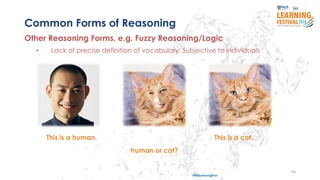
Common Forms of Reasoning
Other Reasoning Forms, e.g. Fuzzy Reasoning/Logic
• Lack of precise definition of vocabulary; Subjective to individuals
This is a human. This is a cat.
human or cat?
27
#ISSLearningFest
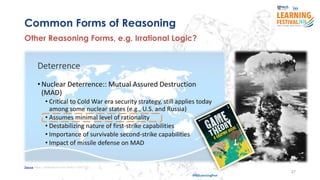
Common Forms of Reasoning
Other Reasoning Forms, e.g. Irrational Logic?
Source https://slideplayer.com/slide/13367531/
Machine / Artificial Intelligence
#ISSLearningFest 28
Major Sub-fields
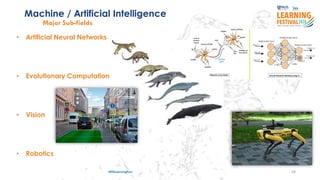
• Artificial Neural Networks
• Evolutionary Computation
• Vision
• Robotics
Machine / Artificial Intelligence
#ISSLearningFest 29
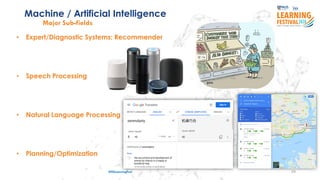
Major Sub-fields
• Expert/Diagnostic Systems; Recommender
• Speech Processing
• Natural Language Processing
• Planning/Optimization
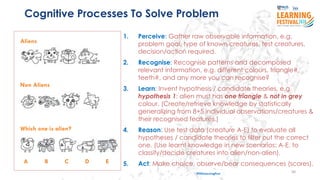
Cognitive Processes To Solve Problem
#ISSLearningFest 30
Aliens
Non Aliens
Which one is alien?
A B C D E
1. Perceive: Gather raw observable information, e.g.
problem goal, type of known creatures, test creatures,
decision/action required.
2. Recognise: Recognise patterns and decomposed
relevant information, e.g. different colours, triangle#,
teeth#, and any more you can recognise?
3. Learn: Invent hypothesis / candidate theories, e.g.
hypothesis 1: alien must has one triangle & not in grey
colour. (Create/retrieve knowledge by statistically
generalizing from 8+5 individual observations/creatures &
their recognised features.)
4. Reason: Use test data (creature A-E) to evaluate all
hypotheses / candidate theories to filter out the correct
one. (Use learnt knowledge in new scenarios: A-E, to
classify/decide creatures into alien/non-alien).
5. Act: Make choice, observe/bear consequences (scores).
Functions/Models: Perceive 受; Think/Reason 想; Act 行; Recognize/Learn 识;
31
#ISSLearningFest
Cognitive Processes/Functions/Models
[ Patterns & Exp ]
[ Percepts ]
[ Representations ]
[ Solutions ]Model:
Reason/Think
Model:
Learn
Model:
Recognize
Model:
Act
Model:
Perceive
[ Sensors ]
Rule based learning:
Mom told me
never to touch !
Similarity
based
recognition
Logic based reasoning
(Use/Apply knowledge
in new/SG scenario)
Act: Avoid touching !
Functions/Models: Perceive 受; Think/Reason 想; Act 行; Recognize/Learn 识;
32
#ISSLearningFest
Cognitive Processes/Functions/Models
[ Patterns & Exp ]
[ Percepts ]
[ Representations ]
[ Solutions ]Model:
Reason/Think
Model:
Learn
Model:
Recognize
Model:
Act
Model:
Perceive
[ Sensors ]
33
#ISSLearningFest
Capstone
Project
4
Certificates
Courses
MTech
Degree
Flexible
pathways to NUS
master degree in
Intelligent
Systems (AI) :
• Stackable (up
to 7 years)
• Thru-Train (full-
timer 1 or part-
timer 2 years)
#ISSLearningFest 34
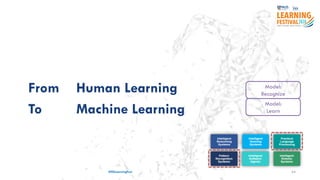
From Human Learning
To Machine Learning
Model:
Learn
Model:
Recognize
35
#ISSLearningFest
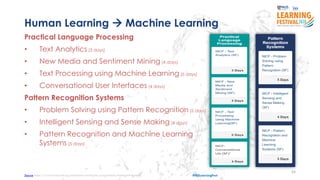
Human Learning  Machine Learning
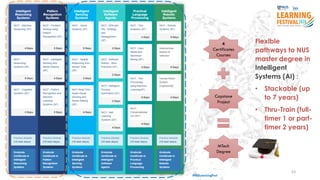
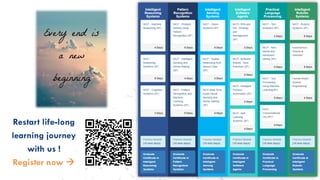
Practical Language Processing
• Text Analytics (3 days)
• New Media and Sentiment Mining (4 days)
• Text Processing using Machine Learning (5 days)
• Conversational User Interfaces (4 days)
Pattern Recognition Systems
• Problem Solving using Pattern Recognition (5 days)
• Intelligent Sensing and Sense Making (4 days)
• Pattern Recognition and Machine Learning
Systems (5 days)
Source https://www.iss.nus.edu.sg/stackable-certificate-programmes/Intelligent-systems
#ISSLearningFest 36
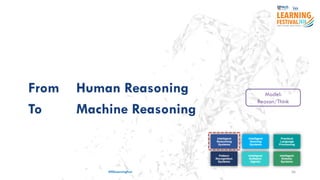
From Human Reasoning
To Machine Reasoning
Model:
Reason/Think
37
#ISSLearningFest
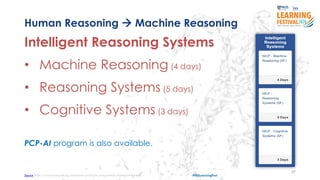
Human Reasoning  Machine Reasoning
Intelligent Reasoning Systems
• Machine Reasoning (4 days)
• Reasoning Systems (5 days)
• Cognitive Systems (3 days)
PCP-AI program is also available.
Source https://www.iss.nus.edu.sg/stackable-certificate-programmes/Intelligent-systems
#ISSLearningFest 38
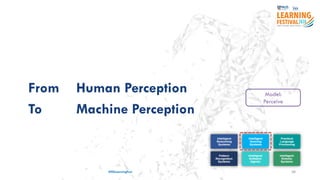
From Human Perception
To Machine Perception
Model:
Perceive
39
#ISSLearningFest
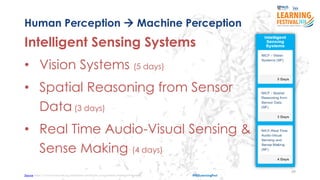
Human Perception  Machine Perception
Intelligent Sensing Systems
• Vision Systems (5 days)
• Spatial Reasoning from Sensor
Data (3 days)
• Real Time Audio-Visual Sensing &
Sense Making (4 days)
Source https://www.iss.nus.edu.sg/stackable-certificate-programmes/Intelligent-systems
#ISSLearningFest 40
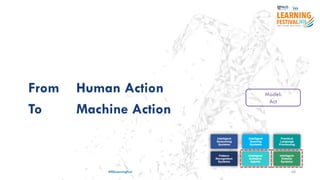
From Human Action
To Machine Action
Model:
Act
41
#ISSLearningFest
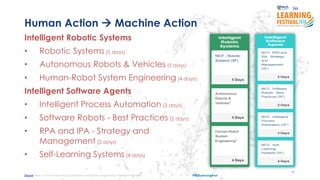
Human Action  Machine Action
Intelligent Robotic Systems
• Robotic Systems (5 days)
• Autonomous Robots & Vehicles (5 days)
• Human-Robot System Engineering (4 days)
Intelligent Software Agents
• Intelligent Process Automation (3 days)
• Software Robots - Best Practices (2 days)
• RPA and IPA - Strategy and
Management (2 days)
• Self-Learning Systems (4 days)
Source https://www.iss.nus.edu.sg/stackable-certificate-programmes/Intelligent-systems
42#ISSLearningFest
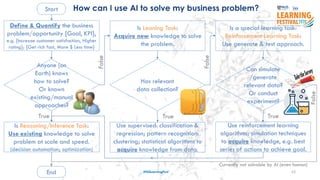
Start
End
Define & Quantify the business
problem/opportunity {Goal, KPI},
e.g. {Increase customer satisfaction, Higher
rating}; {Get rich fast, More $ Less time}
Is Reasoning/Inference Task:
Use existing knowledge to solve
problem at scale and speed.
(decision automation; optimization)
Anyone (on
Earth) knows
how to solve?
Or known
existing/manual
approaches?
Use supervised: classification &
regression; pattern recognition:
clustering; statistical algorithms to
acquire knowledge from data.
Has relevant
data collection?
Use reinforcement learning
algorithms; simulation techniques
to acquire knowledge, e.g. best
series of actions to achieve goal.
Can simulate
/generate
relevant data?
Or conduct
experiment?
Is Leaning Task:
Acquire new knowledge to solve
the problem.
Is a special learning task:
Reinforcement Learning Task:
Use generate & test approach.
False
True True True
False
False
How can I use AI to solve my business problem?
Currently not solvable by AI (even human)
43
Restart life-long
learning journey
with us !
Register now 
44
#ISSLearningFest
www www.iss.nus.edu.sg
facebook.com/ISS.NUS
twitter.com/ISSNUS
@iss.nus
linkedin.com/company/iss_nus
youtube.com/user/TheISSNUS/

From Human Intelligence to Machine Intelligence

  • 1.
    From Human Intelligence ToMachine Intelligence GU Zhan 顾 瞻 (Sam) zhan.gu@nus.edu.sg #ISSLearningFest
  • 2.
    What is intelligence #ISSLearningFest 2 Sourcehttps://i.warosu.org/data/biz/img/0012/12/1461543092681.jpg
  • 3.
    3 #ISSLearningFest What’s intelligence? “Intelligence measuresa human/AI’s ability to achieve goals in a wide range of environments.” A Universal Measure of Intelligence for Artificial Agents, Legg & Hutter 2007 Examples? • Goals in school environment? • Goals in work environment? • Goals in home environment?
  • 4.
    4 To achieve goalin school environment… Different agents’ ability indicated by: • more/less effort spent? • higher/lower exam score?
  • 5.
    5 To achieve goalin work environment… Different agents’ ability indicated by: • more/less secrecy? • bigger/smaller bonus? A recommender system !
  • 6.
    6 To achieve goalin home environment… Different agents’ ability compared by: • more/less money spent? • more/less quarrels?
  • 7.
    7 #ISSLearningFest We all areintelligent agents in daily life... • The environment is analogical to industry domain: E.g. Retail; Education; Finance; • The goal is analogical to perform job role: E.g. Salesperson; Lecturer; Ah Long (Loan shark); • The ability is analogical to KPI (for the job role): E.g. Larger sales volume; Better student feedback; More graffiti & interest $; Creating an AI is analogical to defining goal & designing KPIs for an employee to behave autonomously (through learning and reasoning using domain knowledge) without the boss/designer’s micro- management (explicitly programmed).
  • 8.
    8 #ISSLearningFest GU Zhan 顾瞻 (Sam) lectures Master of Technology programme in the areas of data science, machine intelligence, and soft computing. • MTech Intelligent Systems • MTech Enterprise Business Analytics • Professional Conversion Program - AI Anhopefully intelligent lifelong learning human issgz@nus.edu.sg
  • 10.
  • 11.
  • 12.
    #ISSLearningFest 12 Human Memory tostore data, e.g. abstract knowledge, sensory information, experiences, etc. and this ISS learning festival session as well.
  • 13.
  • 14.
    #ISSLearningFest 14 Human Learning togenerate new knowledge E.g. acquired understanding, behaviours, skills, values, useful to memorize & reuse Model: Learn Model: Recognize
  • 15.
    15 #ISSLearningFest Common Forms ofLearning 1. Habituation 习惯化 • Unsupervised Learning; Anomaly Detection • Bird learned the knowledge/behaviour to ignore the fake threat; Source https://ib.bioninja.com.au/options/option-a-neurobiology-and/a4-innate-and-learned-behav/habituation.html
  • 16.
    16 #ISSLearningFest Common Forms ofLearning Source https://ib.bioninja.com.au/options/option-a-neurobiology-and/a4-innate-and-learned-behav/conditioning.html 2. Classical (Reflex) conditioning 经典条件反射 • Association (between stimuli or events); Supervised Learning • Dog learned the knowledge of association/correlation: between food & bell ring; • Dog learned the knowledge/behaviour of causation: food/bell ring  saliva;
  • 17.
    17 #ISSLearningFest Common Forms ofLearning 3. Operant conditioning 操作性条件反射 • Reinforcement Learning; Generate & Test; Simulation • Mouse learned the knowledge of button functions & steps to obtain food; Source https://ib.bioninja.com.au/options/option-a-neurobiology-and/a4-innate-and-learned-behav/conditioning.html Subject / Reinforcement Learning Agent • Agent: Mouse • Environment: Cage • Goal: Survive longer • Random Series of Actions • Best Series of Actions leading to survival & welfare
  • 18.
    18 #ISSLearningFest Common Forms ofLearning 3. Operant conditioning 操作性条件反射 AlphaGo from Google/DeepMind Generate & Test during self playing: AlphaGo vs. AlphaGo
  • 19.
    19 #ISSLearningFest Common Forms ofLearning 3. Operant conditioning 操作性条件反射 DiDi : A Reinforcement Learning Agent • Agent: DiDi • Environment: NUS • Goal: Unblock/Move scooter • Random Series of Actions • Best Series of Actions leading to goal Source https://telescopeuser.wordpress.com/2018/08/20/didi-a-reinforcement-learning-agent/ Video https://youtu.be/8K-fNcJU0nk
  • 20.
    20 #ISSLearningFest Common Forms ofLearning 4. Observational learning 观察学习 • Imitation Learning; Unsupervised Learning; (copycat learning) Source https://courses.lumenlearning.com/wsu-sandbox/chapter/observational-learning-modeling/
  • 21.
    #ISSLearningFest 21 Human Reasoning touse existing knowledge Model: Reason/Think
  • 22.
    22 #ISSLearningFest Common Forms ofReasoning 1. Deductive Reasoning • Aristotle's syllogism; Formal logic; Knowledge Graph; If-Then business rules; Declarative programing language like SQL; (Universal  Individuals) Sam’s perpetual motion machine on sale! $0.99 only! Weight in kg
  • 23.
    23 #ISSLearningFest Common Forms ofReasoning 2. Inductive Reasoning (aka. learning) • Use meta knowledge to generate new knowledge using statistical method: learning / pattern recognition algorithms; central limit theorem; regression; (Individuals  Universal)
  • 24.
    24 #ISSLearningFest Common Forms ofReasoning 3. Analogical Reasoning • Similarity based reasoning; Case based; K nearest neighbour; (including customer profiling for recommendation; even stereotyping)
  • 25.
    25 #ISSLearningFest Common Forms ofReasoning 4. Abductive Reasoning • Probabilistic calculation; Prior/Conditional/Joint probability; Bayesian network; (Hypothesis ~ Evidence) Would you prefer a reasoning doctor or a learning doctor during your medical consultation?
  • 26.
    26 #ISSLearningFest Common Forms ofReasoning Other Reasoning Forms, e.g. Fuzzy Reasoning/Logic • Lack of precise definition of vocabulary; Subjective to individuals This is a human. This is a cat. human or cat?
  • 27.
    27 #ISSLearningFest Common Forms ofReasoning Other Reasoning Forms, e.g. Irrational Logic? Source https://slideplayer.com/slide/13367531/
  • 28.
    Machine / ArtificialIntelligence #ISSLearningFest 28 Major Sub-fields • Artificial Neural Networks • Evolutionary Computation • Vision • Robotics
  • 29.
    Machine / ArtificialIntelligence #ISSLearningFest 29 Major Sub-fields • Expert/Diagnostic Systems; Recommender • Speech Processing • Natural Language Processing • Planning/Optimization
  • 30.
    Cognitive Processes ToSolve Problem #ISSLearningFest 30 Aliens Non Aliens Which one is alien? A B C D E 1. Perceive: Gather raw observable information, e.g. problem goal, type of known creatures, test creatures, decision/action required. 2. Recognise: Recognise patterns and decomposed relevant information, e.g. different colours, triangle#, teeth#, and any more you can recognise? 3. Learn: Invent hypothesis / candidate theories, e.g. hypothesis 1: alien must has one triangle & not in grey colour. (Create/retrieve knowledge by statistically generalizing from 8+5 individual observations/creatures & their recognised features.) 4. Reason: Use test data (creature A-E) to evaluate all hypotheses / candidate theories to filter out the correct one. (Use learnt knowledge in new scenarios: A-E, to classify/decide creatures into alien/non-alien). 5. Act: Make choice, observe/bear consequences (scores).
  • 31.
    Functions/Models: Perceive 受;Think/Reason 想; Act 行; Recognize/Learn 识; 31 #ISSLearningFest Cognitive Processes/Functions/Models [ Patterns & Exp ] [ Percepts ] [ Representations ] [ Solutions ]Model: Reason/Think Model: Learn Model: Recognize Model: Act Model: Perceive [ Sensors ] Rule based learning: Mom told me never to touch ! Similarity based recognition Logic based reasoning (Use/Apply knowledge in new/SG scenario) Act: Avoid touching !
  • 32.
    Functions/Models: Perceive 受;Think/Reason 想; Act 行; Recognize/Learn 识; 32 #ISSLearningFest Cognitive Processes/Functions/Models [ Patterns & Exp ] [ Percepts ] [ Representations ] [ Solutions ]Model: Reason/Think Model: Learn Model: Recognize Model: Act Model: Perceive [ Sensors ]
  • 33.
    33 #ISSLearningFest Capstone Project 4 Certificates Courses MTech Degree Flexible pathways to NUS masterdegree in Intelligent Systems (AI) : • Stackable (up to 7 years) • Thru-Train (full- timer 1 or part- timer 2 years)
  • 34.
    #ISSLearningFest 34 From HumanLearning To Machine Learning Model: Learn Model: Recognize
  • 35.
    35 #ISSLearningFest Human Learning Machine Learning Practical Language Processing • Text Analytics (3 days) • New Media and Sentiment Mining (4 days) • Text Processing using Machine Learning (5 days) • Conversational User Interfaces (4 days) Pattern Recognition Systems • Problem Solving using Pattern Recognition (5 days) • Intelligent Sensing and Sense Making (4 days) • Pattern Recognition and Machine Learning Systems (5 days) Source https://www.iss.nus.edu.sg/stackable-certificate-programmes/Intelligent-systems
  • 36.
    #ISSLearningFest 36 From HumanReasoning To Machine Reasoning Model: Reason/Think
  • 37.
    37 #ISSLearningFest Human Reasoning Machine Reasoning Intelligent Reasoning Systems • Machine Reasoning (4 days) • Reasoning Systems (5 days) • Cognitive Systems (3 days) PCP-AI program is also available. Source https://www.iss.nus.edu.sg/stackable-certificate-programmes/Intelligent-systems
  • 38.
    #ISSLearningFest 38 From HumanPerception To Machine Perception Model: Perceive
  • 39.
    39 #ISSLearningFest Human Perception Machine Perception Intelligent Sensing Systems • Vision Systems (5 days) • Spatial Reasoning from Sensor Data (3 days) • Real Time Audio-Visual Sensing & Sense Making (4 days) Source https://www.iss.nus.edu.sg/stackable-certificate-programmes/Intelligent-systems
  • 40.
    #ISSLearningFest 40 From HumanAction To Machine Action Model: Act
  • 41.
    41 #ISSLearningFest Human Action Machine Action Intelligent Robotic Systems • Robotic Systems (5 days) • Autonomous Robots & Vehicles (5 days) • Human-Robot System Engineering (4 days) Intelligent Software Agents • Intelligent Process Automation (3 days) • Software Robots - Best Practices (2 days) • RPA and IPA - Strategy and Management (2 days) • Self-Learning Systems (4 days) Source https://www.iss.nus.edu.sg/stackable-certificate-programmes/Intelligent-systems
  • 42.
    42#ISSLearningFest Start End Define & Quantifythe business problem/opportunity {Goal, KPI}, e.g. {Increase customer satisfaction, Higher rating}; {Get rich fast, More $ Less time} Is Reasoning/Inference Task: Use existing knowledge to solve problem at scale and speed. (decision automation; optimization) Anyone (on Earth) knows how to solve? Or known existing/manual approaches? Use supervised: classification & regression; pattern recognition: clustering; statistical algorithms to acquire knowledge from data. Has relevant data collection? Use reinforcement learning algorithms; simulation techniques to acquire knowledge, e.g. best series of actions to achieve goal. Can simulate /generate relevant data? Or conduct experiment? Is Leaning Task: Acquire new knowledge to solve the problem. Is a special learning task: Reinforcement Learning Task: Use generate & test approach. False True True True False False How can I use AI to solve my business problem? Currently not solvable by AI (even human)
  • 43.
  • 44.