• The psychoanalytic perspective on personality originated with
Sigmund Freud. We introduced his approach to understanding
behavior .
Recall that Freud was not a psychologist.
• He practiced medicine, specializing in nervous diseases.
• However, soon after beginning private practice, Freud moved away
from physical explanations of nervous disorders and focused more on
investigating psychological causes of these disorders.
• His ideas about personality were based on case studies of his patients,
his reading of literature, and his own self-analysis.
• Freud saw personality as the product of driving forces within a person
that were often conflicting and sometimes unconscious.
• . Freud’s theory is unique from all the other approaches in that it
strongly emphasizes unconscious aspects of personality.
Level of awareness
• Freud (1940/1964) proposed that human personality operates at three
different levels of awareness. A person’s awareness at each level of
consciousness differs, and Freud believed that each level of awareness
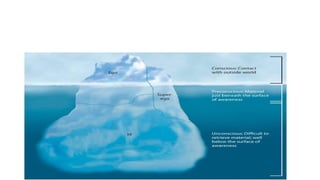
influences behavior. Freud viewed consciousness like an ice berg (Figure
14.1).
• For Freud, when we look at behavior, all we usually see is the tip of the
iceberg, or the conscious level: the thoughts, perceptions, and
explanations of behavior of which the person is aware.
• The major portion of the iceberg is below the sur face of the water. The
impulses, memories, and thoughts below are unseen but have a huge
impact on personality.
Preconscious level
• Below the surface of the conscious level are the preconscious and
unconscious levels.
• The preconscious level comes right before your conscious level. Your
conscious level, as previously stated, includes any memories,
thoughts, or urges of which you are currently aware.
• You know you want the new Usher CD, or you know that it is
important to read this chapter and study for the test next week. But
the things that you could potentially be aware of at any one time are
infinite, and you cannot hold more than a couple of thoughts, urges,
and memories in consciousness at any one time.
• So according to Freud, it is necessary to have a holding place for easily
accessible memories, thoughts, or impulses of which you could
potentially be aware.
• This is the role of the preconscious level. Think about what you had
for breakfast this morning. Were you thinking about breakfast prior to
being asked this question?
• Probably not, yet it probably wasn’t too difficult or traumatic for you
to remember. This information was stored in your preconscious. You
readily became aware of it—it was in your conscious level—when you
answered the question.
unconscious level
• The unconscious level contains all those thoughts, impulses,
memories, and behaviors of which you are unaware. However,
although you are unaware of them, they always influence your
behavior.
• Consider the 4-year-old boy who stops his parents from hugging or
inserts himself between them to prevent them from kissing.
• He is not aware that this behavior stems from a need or wish to bond
with his mother, yet it is still influencing his behavior.
THE STRUCTURE OF PERSONALITY
• How did Freud believe that the energy of one’s personality is
distributed?
• To Freud human personality is an energy system that is comprised of
three major personality structures: the id, the ego, and the
superego.
• At birth, all of the energy of the personality is contained within a
structure called the id. The id is an unconscious energy force that
seeks pleasure and gratification.
ID
• The id is the innermost core of the personality, the only structure
present at birth, and the source of all psychic energy. It exists totally
within the unconscious mind (Figure 13.4).
• Freud described the id as “a chaos, a cauldron of seething excitations”
(Freud, 1900/1965, p. 73).
• The id has no direct contact with reality and functions in a totally
irra tional manner. Operating according to the plea sure principle, it
seeks immediate gratification or release, regardless of rational
considerations and environmental realities. Its dictum: “Want . . .
take!”
• Hungry infants cry for food or because they are wet or tired. The id operates
according to the pleasure principle; it drives people to feel good and to
maximize pleasure and gratification. Freud saw the impulses driving the id as
sexual and aggressive in nature.
• In this way, he viewed humans as very similar to animals—unconsciously and
selfishly motivated by basic sexual and aggressive instincts. Such basic instincts
ensure and promote the survival of the individual, and therefore, the survival of
the species as a whole.
• When we grow and begin to interact with our environment, we realize that our
demands cannot always be immediately fulfilled. For example, when a baby’s
cry for food is not met every time, the baby has encountered reality. As such,
part of the energy of the id becomes directed to the ego.
Ego
• The ego, the second personality structure, acts as a negotiator
between the instinctual needs of the id and the demands of
membership in human society.
• Children learn that their id demands can be fulfilled only in a socially
appropriate manner.
• The ego operates according to the reality principle. It realizes that
the desires of the id can be met only by successfully dealing with the
environment, by finding appropriate or attainable means by which to
fulfill id impulses.
• Suppose a 4-year-old wants something to eat.
• Does he immediately cry like a baby? Not typically. The 4-year-old
with a functioning ego knows that there are more appropriate and
acceptable ways of getting something to eat.
• He will probably ask for something to eat and be willing to wait (at
least for a little while) for his caregiver to prepare it for him. We see
the ego functioning in the child’s ability to delay his desire for food,
for example.
• But the ego’s job is still to fulfill the instinctual demands of the id—
the unseen force beneath the tip of the ice berg.
Iceberg model of personality
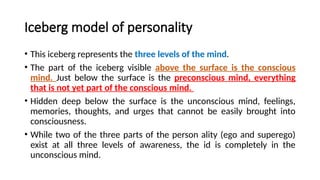
• This iceberg represents the three levels of the mind.
• The part of the iceberg visible above the surface is the conscious
mind. Just below the surface is the preconscious mind, everything
that is not yet part of the conscious mind.
• Hidden deep below the surface is the unconscious mind, feelings,
memories, thoughts, and urges that cannot be easily brought into
consciousness.
• While two of the three parts of the person ality (ego and superego)
exist at all three levels of awareness, the id is completely in the
unconscious mind.
Superego
• As the child continues to grow, parents and other important people impart their
values and standards of behavior to the child. Parents convey the right and wrong
ways to feel, think, and behave.
• The child incorporates these standards as the energy of the personality further
divides into a third personality structure. The superego typically emerges during
the resolution of the phallic stage (discussed shortly) and represents your moral
conscience.
• Your superego judges the rightness or wrongness of your actions.
• When you have the sense that you did something wrong, your superego is talking.
The moral directives of the superego must also be taken into account by the ego.
Just like id demands, superego demands must be met realistically by the ego after
it has considered what the environment offers.
• The energy that these three personality components use cannot be cut apart. For
Freud, personality is a dynamic, or active, process. The id, ego, and superego are
not fixed entities but rather parts of our personality that serve different
functions.
• A healthy personality will have developed a strong ego that appropriately
releases and controls instinctual energy.
• However, problems may arise in personality functioning if id energy or superego
energy overwhelm the functioning of the ego.
• All adult behaviors then, to Freud, are a reflection of the interplay between
these three structures. When examining behavior, we see only the functioning of
the ego, but this ego is simultaneously being influenced by the unconscious
demands of the id and superego.
Stages of personality development
• For Freud,the three parts of the personality develop in a series of
stages.
• Because he focused heavily on the sex drive,he believed that the
stages were determined by the developing sexuality of the child.
• At each stage,a different erogenous zone,or area of the body that
produces pleasurable feelings,becomes important and can become
the source of conflicts.
PSYCHOSEXUAL
• The term psychosexual reflects Freud’s belief that children experience
sexual feelings from birth (in different forms from those of
adolescents or adults).
• Freud held that if a child’s needs are not met or are overindulged at
one particular psychosexual stage, the child may become fixated, and
a part of his or her personality will remain stuck at that stage.
• Furthermore, under stress, individuals may return (or regress) to a
stage at which earlier needs were frustrated or overly gratified
Psychosexual Development
• Freud’s clinical experiences convinced him that adult personality traits
are powerfully influenced by experiences in the first years of life.
• He proposed that children pass through a series of psychosexual
stages during which the id’s pleasure-seeking tendencies are focused
on specific pleasure-sensitive areas of the body––the erogenous
zones.
• Potential deprivations or overindulgences can arise during any of
these stages, resulting in fixation, a state of arrested psychosexual
development in which instincts are focused on a particular psychic
theme.
Fixation
• Conflicts that are not fully resolved can result in fixation,or getting
“stuck” to some degree in a stage of development.
• The child may grow into an adult but will still carry emotional and
psychological “baggage”from that earlier fixated stage.
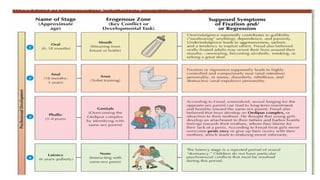
Oral stage
• The first of these stages is the oral stage, which occurs during infancy.
Infants gain primary satisfaction from taking in food
• and from sucking on a breast, a thumb, or some other object.
• Freud proposed that either excessive gratification or frustration of
oral needs can result in fixation on oral themes of self-indulgence or
de pendency as an adult.
ORAL RECEPTIVE
During this oral-receptive phase, infants feel no ambivalence toward the
pleasurable object and their needs are usually satisfied with a minimum
of frustration and anxiety.
As they grow older, however, they are more likely to experience feelings
of frustration and anxiety as a result of scheduled feedings, increased
time lapses between feedings, and eventual weaning.(MANAGE
WITHOUT SOMETHING ON WHICH THEY ARE DEPENDENT)
These anxieties are generally accompanied by feelings of ambivalence
toward their love object (mother), and by the increased ability of their
budding ego to defend itself against the environment and against anxiety.
Oral sadistic phase
• During this phase, infants respond to others through biting, cooing,
closing their mouth, smiling, and crying.
• Their first autoerotic experience is thumb sucking, a defense against
anxiety that satisfies their sexual but not their nutritional needs.
ANAL STAGE
• In the second and third years of life, children enter the anal stage, and
pleasure becomes focused on the process of elimination.
• During toilet training, the child is faced with society’s first attempt to
control a biological urge.
• According to Freud, harsh toilet training can produce compulsions,
overemphasis on cleanliness, obsessive concerns with orderliness,
and insistence on rigid rules and rituals.
• In contrast, Freud speculated that extremely lax toilet training results
in a messy, negative, and dominant adult personality.
Phallic stage
• The most controversial of Freud’s stages is the phallic stage, which
begins at 4 to 5 years of age.
• This is the time when children begin to derive pleasure from their
sexual organs.
• Freud believed that during this stage of early sexual awakenings, the
male child experiences erotic feelings toward his mother, desires to
possess her sexually, and views his father as a rival.
• At the same time, how ever, these feelings arouse strong guilt and a
fear that the father might find out and castrate him, hence the term
castration anxiety.
• This conflictual situation involving love for the mother and hostility to
ward the father is the Oedipus complex, named for the Greek
character Oedipus, who unknowingly killed his father and married
his mother.
• Girls, meanwhile, discover that they lack a penis, blame the mother
for their lack of what Freud considered the more desirable sex organ,
and wish to bear their father’s child as a substitute for the pe nis they
lack.
• The female counterpart of the Oedipus complex was termed the
Electra complex.
• Freud believed that the phallic stage is a major milestone in the
development of gender identity, for children normally resolve these
conflicts by repressing their sexual impulses and moving from a sexual
attachment to the opposite-sex parent to identification with the
same-sex parent.
• Boys take on the traits of their fathers and girls those of their
mothers.
• Identification allows the child to possess the opposite-sex parent
indirectly, or vicariously, and also helps form the superego as the
child internalizes the parent’s values and moral beliefs.
• As the phallic stage draws to a close at about 6 years of age, children
enter the latency stage, during which sexuality becomes dormant for
about six years.
• Sexuality normally reemerges in adolescence as the beginning of a
lifelong genital stage, in which erotic impulses find direct expression
in sexual relationships.
latency
• Remember that by the end of the phallic stage, children have pushed
their sexual feelings for the opposite sex into the unconscious in
another defensive reaction, repression.
• From age 6 to the onset of puberty, children will remain in this stage
of hidden, or latent, sexual feelings, so this stage is called latency. In
this stage, children grow and develop intellectually, physi cally, and
socially but not sexually.
• This is the age at which boys play with other boys, girls play only with
girls, and each thinks the opposite sex is pretty awful.
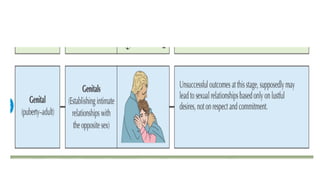
genital
• GENITAL STAGE
• When puberty does begin, the sexual feelings that were once repressed can no
longer be ignored. Bodies are changing and sexual urges are once more allowed
into consciousness, but these urges will no longer have the parents as their targets.
• When children are 3, their parents are their whole world. When they are 13, their
parents have to walk 20 paces behind them in the mall so none of the 13-year-olds’
friends will see them.
• Instead, the focus of sexual curiosity and attraction will become other adolescents
or music stars, movie stars, and other objects of adora tion. Since Freud tied
personality development into sexual development, the genital stage represented
the final process in Freud’s personality theory, as well as the entry into adult social
and sexual behavior.
FIXATION
• Obviously,Freud thought that the main area of conflict here is toilet
training, the demand that the child use the toilet at a particular time
and in a particular way.
• This invasion of reality is part of the process that stimulates the
development of the ego during this stage.
• How the parent then responds to this or how the parent attempts to
control this production through toilet-training practices is the key to
adequately resolving this stage
Fixation in the anal stage,from toilet training that is too
harsh, can take one of two forms.
• The child who rebels openly against the demands of the parents and
other adults will refuse to go in the toilet, instead defecating where
and when he or she feels like doing it.
• According to Freud,this translates in the adult as a person who sees
messiness as a statement of personal control and who is somewhat
destructive and hostile.
• These anal expulsive personalities(so called because as children they
expelled their feces purposefully) are what most people would call
“slobs.”
• Some children,however,are terrified of making a mess and rebel
passively—refusing to go at all or retaining the feces.No mess,no
punishment.As adults,they are stingy,stubborn, and excessively
neat.This type is called the anal retentive personality.

PSYCHOANALYTIC THEORY GIVEN BY SIGMUND FREUD

  • 1.
    • The psychoanalyticperspective on personality originated with Sigmund Freud. We introduced his approach to understanding behavior . Recall that Freud was not a psychologist. • He practiced medicine, specializing in nervous diseases. • However, soon after beginning private practice, Freud moved away from physical explanations of nervous disorders and focused more on investigating psychological causes of these disorders.
  • 2.
    • His ideasabout personality were based on case studies of his patients, his reading of literature, and his own self-analysis. • Freud saw personality as the product of driving forces within a person that were often conflicting and sometimes unconscious. • . Freud’s theory is unique from all the other approaches in that it strongly emphasizes unconscious aspects of personality.

  • 3.
    Level of awareness •Freud (1940/1964) proposed that human personality operates at three different levels of awareness. A person’s awareness at each level of consciousness differs, and Freud believed that each level of awareness influences behavior. Freud viewed consciousness like an ice berg (Figure 14.1). • For Freud, when we look at behavior, all we usually see is the tip of the iceberg, or the conscious level: the thoughts, perceptions, and explanations of behavior of which the person is aware. • The major portion of the iceberg is below the sur face of the water. The impulses, memories, and thoughts below are unseen but have a huge impact on personality.

  • 4.
    Preconscious level • Belowthe surface of the conscious level are the preconscious and unconscious levels. • The preconscious level comes right before your conscious level. Your conscious level, as previously stated, includes any memories, thoughts, or urges of which you are currently aware. • You know you want the new Usher CD, or you know that it is important to read this chapter and study for the test next week. But the things that you could potentially be aware of at any one time are infinite, and you cannot hold more than a couple of thoughts, urges, and memories in consciousness at any one time.
  • 5.
    • So accordingto Freud, it is necessary to have a holding place for easily accessible memories, thoughts, or impulses of which you could potentially be aware. • This is the role of the preconscious level. Think about what you had for breakfast this morning. Were you thinking about breakfast prior to being asked this question? • Probably not, yet it probably wasn’t too difficult or traumatic for you to remember. This information was stored in your preconscious. You readily became aware of it—it was in your conscious level—when you answered the question.
  • 6.
    unconscious level • Theunconscious level contains all those thoughts, impulses, memories, and behaviors of which you are unaware. However, although you are unaware of them, they always influence your behavior. • Consider the 4-year-old boy who stops his parents from hugging or inserts himself between them to prevent them from kissing. • He is not aware that this behavior stems from a need or wish to bond with his mother, yet it is still influencing his behavior.
  • 7.
    THE STRUCTURE OFPERSONALITY • How did Freud believe that the energy of one’s personality is distributed? • To Freud human personality is an energy system that is comprised of three major personality structures: the id, the ego, and the superego. • At birth, all of the energy of the personality is contained within a structure called the id. The id is an unconscious energy force that seeks pleasure and gratification.
  • 8.
    ID • The idis the innermost core of the personality, the only structure present at birth, and the source of all psychic energy. It exists totally within the unconscious mind (Figure 13.4). • Freud described the id as “a chaos, a cauldron of seething excitations” (Freud, 1900/1965, p. 73). • The id has no direct contact with reality and functions in a totally irra tional manner. Operating according to the plea sure principle, it seeks immediate gratification or release, regardless of rational considerations and environmental realities. Its dictum: “Want . . . take!”
  • 9.
    • Hungry infantscry for food or because they are wet or tired. The id operates according to the pleasure principle; it drives people to feel good and to maximize pleasure and gratification. Freud saw the impulses driving the id as sexual and aggressive in nature. • In this way, he viewed humans as very similar to animals—unconsciously and selfishly motivated by basic sexual and aggressive instincts. Such basic instincts ensure and promote the survival of the individual, and therefore, the survival of the species as a whole. • When we grow and begin to interact with our environment, we realize that our demands cannot always be immediately fulfilled. For example, when a baby’s cry for food is not met every time, the baby has encountered reality. As such, part of the energy of the id becomes directed to the ego.
  • 10.
    Ego • The ego,the second personality structure, acts as a negotiator between the instinctual needs of the id and the demands of membership in human society. • Children learn that their id demands can be fulfilled only in a socially appropriate manner. • The ego operates according to the reality principle. It realizes that the desires of the id can be met only by successfully dealing with the environment, by finding appropriate or attainable means by which to fulfill id impulses.
  • 11.
    • Suppose a4-year-old wants something to eat. • Does he immediately cry like a baby? Not typically. The 4-year-old with a functioning ego knows that there are more appropriate and acceptable ways of getting something to eat. • He will probably ask for something to eat and be willing to wait (at least for a little while) for his caregiver to prepare it for him. We see the ego functioning in the child’s ability to delay his desire for food, for example. • But the ego’s job is still to fulfill the instinctual demands of the id— the unseen force beneath the tip of the ice berg.
  • 13.
    Iceberg model ofpersonality • This iceberg represents the three levels of the mind. • The part of the iceberg visible above the surface is the conscious mind. Just below the surface is the preconscious mind, everything that is not yet part of the conscious mind. • Hidden deep below the surface is the unconscious mind, feelings, memories, thoughts, and urges that cannot be easily brought into consciousness. • While two of the three parts of the person ality (ego and superego) exist at all three levels of awareness, the id is completely in the unconscious mind.
  • 14.
    Superego • As thechild continues to grow, parents and other important people impart their values and standards of behavior to the child. Parents convey the right and wrong ways to feel, think, and behave. • The child incorporates these standards as the energy of the personality further divides into a third personality structure. The superego typically emerges during the resolution of the phallic stage (discussed shortly) and represents your moral conscience. • Your superego judges the rightness or wrongness of your actions. • When you have the sense that you did something wrong, your superego is talking. The moral directives of the superego must also be taken into account by the ego. Just like id demands, superego demands must be met realistically by the ego after it has considered what the environment offers.
  • 15.
    • The energythat these three personality components use cannot be cut apart. For Freud, personality is a dynamic, or active, process. The id, ego, and superego are not fixed entities but rather parts of our personality that serve different functions. • A healthy personality will have developed a strong ego that appropriately releases and controls instinctual energy. • However, problems may arise in personality functioning if id energy or superego energy overwhelm the functioning of the ego. • All adult behaviors then, to Freud, are a reflection of the interplay between these three structures. When examining behavior, we see only the functioning of the ego, but this ego is simultaneously being influenced by the unconscious demands of the id and superego.
  • 16.
    Stages of personalitydevelopment • For Freud,the three parts of the personality develop in a series of stages. • Because he focused heavily on the sex drive,he believed that the stages were determined by the developing sexuality of the child. • At each stage,a different erogenous zone,or area of the body that produces pleasurable feelings,becomes important and can become the source of conflicts.
  • 17.
    PSYCHOSEXUAL • The termpsychosexual reflects Freud’s belief that children experience sexual feelings from birth (in different forms from those of adolescents or adults). • Freud held that if a child’s needs are not met or are overindulged at one particular psychosexual stage, the child may become fixated, and a part of his or her personality will remain stuck at that stage. • Furthermore, under stress, individuals may return (or regress) to a stage at which earlier needs were frustrated or overly gratified
  • 18.
    Psychosexual Development • Freud’sclinical experiences convinced him that adult personality traits are powerfully influenced by experiences in the first years of life. • He proposed that children pass through a series of psychosexual stages during which the id’s pleasure-seeking tendencies are focused on specific pleasure-sensitive areas of the body––the erogenous zones. • Potential deprivations or overindulgences can arise during any of these stages, resulting in fixation, a state of arrested psychosexual development in which instincts are focused on a particular psychic theme.
  • 19.
    Fixation • Conflicts thatare not fully resolved can result in fixation,or getting “stuck” to some degree in a stage of development. • The child may grow into an adult but will still carry emotional and psychological “baggage”from that earlier fixated stage.
  • 22.
    Oral stage • Thefirst of these stages is the oral stage, which occurs during infancy. Infants gain primary satisfaction from taking in food • and from sucking on a breast, a thumb, or some other object. • Freud proposed that either excessive gratification or frustration of oral needs can result in fixation on oral themes of self-indulgence or de pendency as an adult.
  • 23.
    ORAL RECEPTIVE During thisoral-receptive phase, infants feel no ambivalence toward the pleasurable object and their needs are usually satisfied with a minimum of frustration and anxiety. As they grow older, however, they are more likely to experience feelings of frustration and anxiety as a result of scheduled feedings, increased time lapses between feedings, and eventual weaning.(MANAGE WITHOUT SOMETHING ON WHICH THEY ARE DEPENDENT) These anxieties are generally accompanied by feelings of ambivalence toward their love object (mother), and by the increased ability of their budding ego to defend itself against the environment and against anxiety.
  • 24.
    Oral sadistic phase •During this phase, infants respond to others through biting, cooing, closing their mouth, smiling, and crying. • Their first autoerotic experience is thumb sucking, a defense against anxiety that satisfies their sexual but not their nutritional needs.
  • 25.
    ANAL STAGE • Inthe second and third years of life, children enter the anal stage, and pleasure becomes focused on the process of elimination. • During toilet training, the child is faced with society’s first attempt to control a biological urge. • According to Freud, harsh toilet training can produce compulsions, overemphasis on cleanliness, obsessive concerns with orderliness, and insistence on rigid rules and rituals. • In contrast, Freud speculated that extremely lax toilet training results in a messy, negative, and dominant adult personality.
  • 28.
    Phallic stage • Themost controversial of Freud’s stages is the phallic stage, which begins at 4 to 5 years of age. • This is the time when children begin to derive pleasure from their sexual organs. • Freud believed that during this stage of early sexual awakenings, the male child experiences erotic feelings toward his mother, desires to possess her sexually, and views his father as a rival. • At the same time, how ever, these feelings arouse strong guilt and a fear that the father might find out and castrate him, hence the term castration anxiety.
  • 29.
    • This conflictualsituation involving love for the mother and hostility to ward the father is the Oedipus complex, named for the Greek character Oedipus, who unknowingly killed his father and married his mother. • Girls, meanwhile, discover that they lack a penis, blame the mother for their lack of what Freud considered the more desirable sex organ, and wish to bear their father’s child as a substitute for the pe nis they lack. • The female counterpart of the Oedipus complex was termed the Electra complex.
  • 30.
    • Freud believedthat the phallic stage is a major milestone in the development of gender identity, for children normally resolve these conflicts by repressing their sexual impulses and moving from a sexual attachment to the opposite-sex parent to identification with the same-sex parent. • Boys take on the traits of their fathers and girls those of their mothers. • Identification allows the child to possess the opposite-sex parent indirectly, or vicariously, and also helps form the superego as the child internalizes the parent’s values and moral beliefs.
  • 31.
    • As thephallic stage draws to a close at about 6 years of age, children enter the latency stage, during which sexuality becomes dormant for about six years. • Sexuality normally reemerges in adolescence as the beginning of a lifelong genital stage, in which erotic impulses find direct expression in sexual relationships.
  • 32.
    latency • Remember thatby the end of the phallic stage, children have pushed their sexual feelings for the opposite sex into the unconscious in another defensive reaction, repression. • From age 6 to the onset of puberty, children will remain in this stage of hidden, or latent, sexual feelings, so this stage is called latency. In this stage, children grow and develop intellectually, physi cally, and socially but not sexually. • This is the age at which boys play with other boys, girls play only with girls, and each thinks the opposite sex is pretty awful.
  • 33.
    genital • GENITAL STAGE •When puberty does begin, the sexual feelings that were once repressed can no longer be ignored. Bodies are changing and sexual urges are once more allowed into consciousness, but these urges will no longer have the parents as their targets. • When children are 3, their parents are their whole world. When they are 13, their parents have to walk 20 paces behind them in the mall so none of the 13-year-olds’ friends will see them. • Instead, the focus of sexual curiosity and attraction will become other adolescents or music stars, movie stars, and other objects of adora tion. Since Freud tied personality development into sexual development, the genital stage represented the final process in Freud’s personality theory, as well as the entry into adult social and sexual behavior.
  • 34.
    FIXATION • Obviously,Freud thoughtthat the main area of conflict here is toilet training, the demand that the child use the toilet at a particular time and in a particular way. • This invasion of reality is part of the process that stimulates the development of the ego during this stage. • How the parent then responds to this or how the parent attempts to control this production through toilet-training practices is the key to adequately resolving this stage
  • 35.
    Fixation in theanal stage,from toilet training that is too harsh, can take one of two forms. • The child who rebels openly against the demands of the parents and other adults will refuse to go in the toilet, instead defecating where and when he or she feels like doing it.
  • 36.
    • According toFreud,this translates in the adult as a person who sees messiness as a statement of personal control and who is somewhat destructive and hostile. • These anal expulsive personalities(so called because as children they expelled their feces purposefully) are what most people would call “slobs.” • Some children,however,are terrified of making a mess and rebel passively—refusing to go at all or retaining the feces.No mess,no punishment.As adults,they are stingy,stubborn, and excessively neat.This type is called the anal retentive personality.