Introducing to music production

           Audio Basics
Audio Basic

My name is David,

I am from Republic of Serbia, based in Belgrade. I am student of Audio and Video
Technology in my city.
Audio Basic

This is the lesson for week 1. I will be teaching you about
Audio Basics, in fact- this presentation is especially about
“Frequency”
Audio Basic

Basic parameters in audio are:

 Propagation

 Amplitude

 Frequency

 Timbre
Frequency
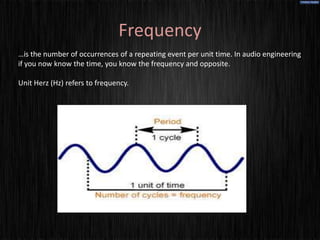
…is the number of occurrences of a repeating event per unit time. In audio engineering
if you now know the time, you know the frequency and opposite.

Unit Herz (Hz) refers to frequency.
Frequency

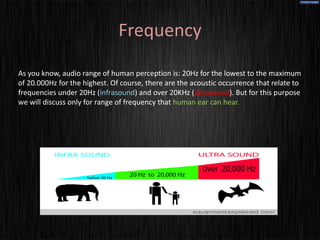
As you know, audio range of human perception is: 20Hz for the lowest to the maximum
of 20.000Hz for the highest. Of course, there are the acoustic occurrence that relate to
frequencies under 20Hz (infrasound) and over 20KHz (ultrasound). But for this purpose
we will discuss only for range of frequency that human ear can hear.
Frequency

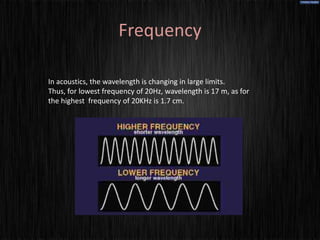
In acoustics, the wavelength is changing in large limits.
Thus, for lowest frequency of 20Hz, wavelength is 17 m, as for
the highest frequency of 20KHz is 1.7 cm.
Frequency
Simple sound means the sound in its spectrum has only one
component at a specific frequency and intensity (level).
In the nature simple sound is a very rare. The whistle is the closest to
simple sound. Although, we can get a simple sound of the tone-
generator.

   Example, 420Hz sine tone.


Complex sound has two or more components. Separate two different complex
sounds: one is from music instruments were we hear native tones, and another is
noise (continuity among two frequency, such as traffic jam or white/pink noise)


   Frequency of 1KHz is taken as the central to audio range.
Frequency

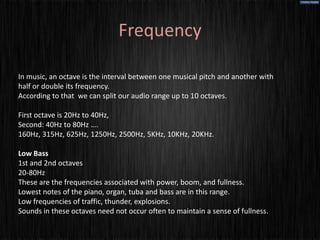
In music, an octave is the interval between one musical pitch and another with
half or double its frequency.
According to that we can split our audio range up to 10 octaves.

First octave is 20Hz to 40Hz,
Second: 40Hz to 80Hz ….
160Hz, 315Hz, 625Hz, 1250Hz, 2500Hz, 5KHz, 10KHz, 20KHz.

Low Bass
1st and 2nd octaves
20-80Hz
These are the frequencies associated with power, boom, and fullness.
Lowest notes of the piano, organ, tuba and bass are in this range.
Low frequencies of traffic, thunder, explosions.
Sounds in these octaves need not occur often to maintain a sense of fullness.
Frequency
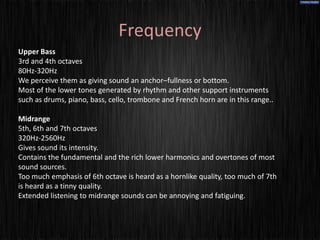
Upper Bass
3rd and 4th octaves
80Hz-320Hz
We perceive them as giving sound an anchor–fullness or bottom.
Most of the lower tones generated by rhythm and other support instruments
such as drums, piano, bass, cello, trombone and French horn are in this range..

Midrange
5th, 6th and 7th octaves
320Hz-2560Hz
Gives sound its intensity.
Contains the fundamental and the rich lower harmonics and overtones of most
sound sources.
Too much emphasis of 6th octave is heard as a hornlike quality, too much of 7th
is heard as a tinny quality.
Extended listening to midrange sounds can be annoying and fatiguing.
Frequency
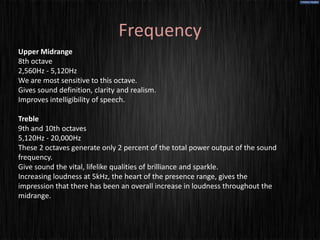
Upper Midrange
8th octave
2,560Hz - 5,120Hz
We are most sensitive to this octave.
Gives sound definition, clarity and realism.
Improves intelligibility of speech.

Treble
9th and 10th octaves
5,120Hz - 20,000Hz
These 2 octaves generate only 2 percent of the total power output of the sound
frequency.
Give sound the vital, lifelike qualities of brilliance and sparkle.
Increasing loudness at 5kHz, the heart of the presence range, gives the
impression that there has been an overall increase in loudness throughout the
midrange.
Frequency
Reverberation time depends on frequency as well.
In general, at the lowest frequency is good to have more reverb on it, especially in the
music, because that gives sound certain fullness.

                      Room                  Optimal reverb
                                            time on 1KHz [s]
1.    Speech Studio                         0.2 – 0.4
2.    Auditoriums Conference Rooms          0.7 – 0.9
3.    Cinema                                1.0 – 1.1
4.    Opera House                           1.2 – 1.4
5.    Concert Hall                          1.7- 2.0
6.    Church                                3.0 – 4.0
Thank you

Frequency

  • 1.
    Introducing to musicproduction Audio Basics
  • 2.
    Audio Basic My nameis David, I am from Republic of Serbia, based in Belgrade. I am student of Audio and Video Technology in my city.
  • 3.
    Audio Basic This isthe lesson for week 1. I will be teaching you about Audio Basics, in fact- this presentation is especially about “Frequency”
  • 4.
    Audio Basic Basic parametersin audio are:  Propagation  Amplitude  Frequency  Timbre
  • 5.
    Frequency …is the numberof occurrences of a repeating event per unit time. In audio engineering if you now know the time, you know the frequency and opposite. Unit Herz (Hz) refers to frequency.
  • 6.
    Frequency As you know,audio range of human perception is: 20Hz for the lowest to the maximum of 20.000Hz for the highest. Of course, there are the acoustic occurrence that relate to frequencies under 20Hz (infrasound) and over 20KHz (ultrasound). But for this purpose we will discuss only for range of frequency that human ear can hear.
  • 7.
    Frequency In acoustics, thewavelength is changing in large limits. Thus, for lowest frequency of 20Hz, wavelength is 17 m, as for the highest frequency of 20KHz is 1.7 cm.
  • 8.
    Frequency Simple sound meansthe sound in its spectrum has only one component at a specific frequency and intensity (level). In the nature simple sound is a very rare. The whistle is the closest to simple sound. Although, we can get a simple sound of the tone- generator. Example, 420Hz sine tone. Complex sound has two or more components. Separate two different complex sounds: one is from music instruments were we hear native tones, and another is noise (continuity among two frequency, such as traffic jam or white/pink noise) Frequency of 1KHz is taken as the central to audio range.
  • 9.
    Frequency In music, anoctave is the interval between one musical pitch and another with half or double its frequency. According to that we can split our audio range up to 10 octaves. First octave is 20Hz to 40Hz, Second: 40Hz to 80Hz …. 160Hz, 315Hz, 625Hz, 1250Hz, 2500Hz, 5KHz, 10KHz, 20KHz. Low Bass 1st and 2nd octaves 20-80Hz These are the frequencies associated with power, boom, and fullness. Lowest notes of the piano, organ, tuba and bass are in this range. Low frequencies of traffic, thunder, explosions. Sounds in these octaves need not occur often to maintain a sense of fullness.
  • 10.
    Frequency Upper Bass 3rd and4th octaves 80Hz-320Hz We perceive them as giving sound an anchor–fullness or bottom. Most of the lower tones generated by rhythm and other support instruments such as drums, piano, bass, cello, trombone and French horn are in this range.. Midrange 5th, 6th and 7th octaves 320Hz-2560Hz Gives sound its intensity. Contains the fundamental and the rich lower harmonics and overtones of most sound sources. Too much emphasis of 6th octave is heard as a hornlike quality, too much of 7th is heard as a tinny quality. Extended listening to midrange sounds can be annoying and fatiguing.
  • 11.
    Frequency Upper Midrange 8th octave 2,560Hz- 5,120Hz We are most sensitive to this octave. Gives sound definition, clarity and realism. Improves intelligibility of speech. Treble 9th and 10th octaves 5,120Hz - 20,000Hz These 2 octaves generate only 2 percent of the total power output of the sound frequency. Give sound the vital, lifelike qualities of brilliance and sparkle. Increasing loudness at 5kHz, the heart of the presence range, gives the impression that there has been an overall increase in loudness throughout the midrange.
  • 12.
    Frequency Reverberation time dependson frequency as well. In general, at the lowest frequency is good to have more reverb on it, especially in the music, because that gives sound certain fullness. Room Optimal reverb time on 1KHz [s] 1. Speech Studio 0.2 – 0.4 2. Auditoriums Conference Rooms 0.7 – 0.9 3. Cinema 1.0 – 1.1 4. Opera House 1.2 – 1.4 5. Concert Hall 1.7- 2.0 6. Church 3.0 – 4.0
  • 13.