Frequency and Phase
Sound and Audio Engineering
Frequency
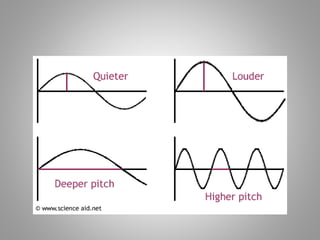
• Frequency: what we perceive as the pitch of a
sound. Frequency is measured in Hertz. The
faster the rate, the higher the frequency.
• Hertz (Hz): cycles per second (measurement of
frequency).
The Range of Human Hearing
• Range of Human Hearing: the frequencies that
humans are capable of perceiving, or hearing
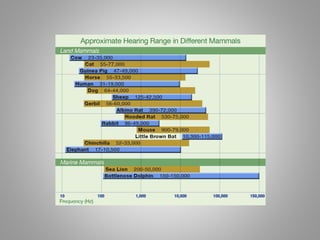
– 20 Hz to 20 kHz (20,000 Hz)
– Most people don’t hear more than 16kHz, gets
worse the older you get.
• LOWS (Bass Frequencies): 20Hz – 250Hz
• MIDS: 250Hz – 6kHz (6,000Hz)
• HIGHS (Treble Frequencies): 5kHz – 20kHz
(5,000Hz – 20,000Hz)
Frequency Response
• Range in which a uniform, undistorted signal
can be produced.
• Sensitivity to different frequencies varies in…
– People
– Microphones
– Speakers
Phase
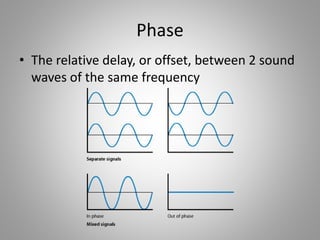
• The relative delay, or offset, between 2 sound
waves of the same frequency
• What the image in the previous slide represents
is that when sound waves with the same
frequency are in phase, the amplitude and
subsequent loudness of the wave are increased,
while when they are out of phase the amplitude
and loudness of the wave are decreased.
• Why might this be important to keep in mind
when using multiple microphones to record one
instrument?

Frequency and phase

  • 1.
    Frequency and Phase Soundand Audio Engineering
  • 2.
    Frequency • Frequency: whatwe perceive as the pitch of a sound. Frequency is measured in Hertz. The faster the rate, the higher the frequency. • Hertz (Hz): cycles per second (measurement of frequency).
  • 4.
    The Range ofHuman Hearing • Range of Human Hearing: the frequencies that humans are capable of perceiving, or hearing – 20 Hz to 20 kHz (20,000 Hz) – Most people don’t hear more than 16kHz, gets worse the older you get. • LOWS (Bass Frequencies): 20Hz – 250Hz • MIDS: 250Hz – 6kHz (6,000Hz) • HIGHS (Treble Frequencies): 5kHz – 20kHz (5,000Hz – 20,000Hz)
  • 6.
    Frequency Response • Rangein which a uniform, undistorted signal can be produced. • Sensitivity to different frequencies varies in… – People – Microphones – Speakers
  • 7.
    Phase • The relativedelay, or offset, between 2 sound waves of the same frequency
  • 8.
    • What theimage in the previous slide represents is that when sound waves with the same frequency are in phase, the amplitude and subsequent loudness of the wave are increased, while when they are out of phase the amplitude and loudness of the wave are decreased. • Why might this be important to keep in mind when using multiple microphones to record one instrument?