FUNDAMENTALS
of
ACOUSTICS
2.1 FREQUENCY AND WAVELENGTH
Frequency
A steady sound is produced by the repeated back and forth movement of an object at regular
intervals. The time interval over which the motion recurs is called the period. For example
if our hearts beat 72 times per minute, the period is the total time (60 seconds) divided by
the number of beats (72), which is 0.83 seconds per beat. We can invert the period to obtain
the number of complete cycles of motion in one time interval, which is called the frequency.
f =
1
T
(2.1)
where f = frequency (cycles per second or Hz)
T = time period per cycle (s)
The frequency is expressed in units of cycles per second, or Hertz (Hz), in honor of the
physicist Heinrich Hertz (1857–1894).
Wavelength
Among the earliest sources of musical sounds were instruments made using stretched strings.
When a string is plucked it vibrates back and forth and the initial displacement travels in
each direction along the string at a given velocity. The time required for the displacement to
travel twice the length of the string is
T =
2 L
c
(2.2)
38 Architectural Acoustics
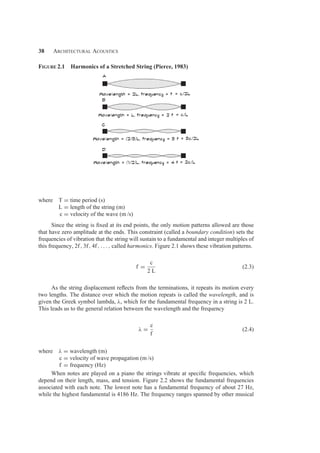
Figure 2.1 Harmonics of a Stretched String (Pierce, 1983)
where T = time period (s)
L = length of the string (m)
c = velocity of the wave (m /s)
Since the string is fixed at its end points, the only motion patterns allowed are those
that have zero amplitude at the ends. This constraint (called a boundary condition) sets the
frequencies of vibration that the string will sustain to a fundamental and integer multiples of
this frequency, 2f, 3f, 4f, . . . , called harmonics. Figure 2.1 shows these vibration patterns.
f =
c
2 L
(2.3)
As the string displacement reflects from the terminations, it repeats its motion every
two lengths. The distance over which the motion repeats is called the wavelength, and is
given the Greek symbol lambda, λ, which for the fundamental frequency in a string is 2 L.
This leads us to the general relation between the wavelength and the frequency
λ =
c
f
(2.4)
where λ = wavelength (m)
c = velocity of wave propagation (m /s)
f = frequency (Hz)
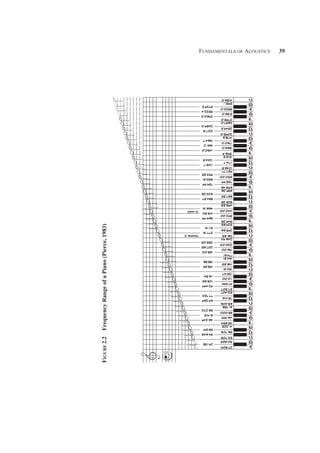
When notes are played on a piano the strings vibrate at specific frequencies, which
depend on their length, mass, and tension. Figure 2.2 shows the fundamental frequencies
associated with each note. The lowest note has a fundamental frequency of about 27 Hz,
while the highest fundamental is 4186 Hz. The frequency ranges spanned by other musical
Fundamentals of Acoustics 39
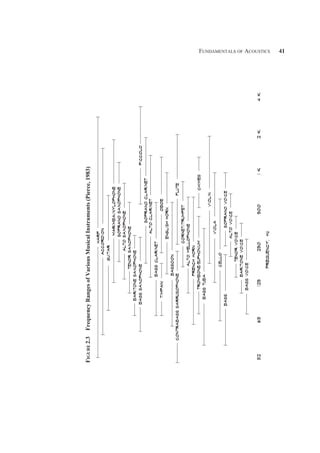
Figure
2.2
Frequency
Range
of
a
Piano
(Pierce,
1983)
40 Architectural Acoustics
instruments, including the human voice, are given in Fig. 2.3. If a piano string is vibrating
at its fundamental mode, the maximum excursion occurs at the middle of the string. When a
piano key is played, the hammer does not strike precisely in the center of the string and thus
it excites a large number of additional modes. These harmonics contribute to the beauty and
complexity of the sound.
Frequency Spectrum
If we were to measure the strength of the sound produced by a particular note and make a plot
of sound level versus frequency we would have a graph called a spectrum. When the sound
has only one frequency, it is called a pure tone and its spectrum consists of a single straight
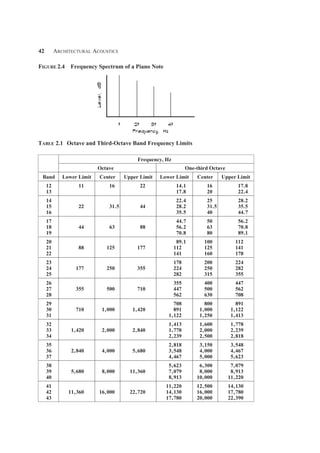
line whose height depends on its strength. The spectrum of a piano note, shown in Fig. 2.4,
is a line at the fundamental frequency and additional lines at each harmonic frequency.
For most notes the fundamental has the highest amplitude, followed by the harmonics in
descending order. For piano notes in the lowest octave the second harmonic may have a
higher amplitude than the fundamental if the strings are not long enough to sustain the lowest
frequency.
Sources such as waterfalls produce sounds at many frequencies, rather than only a few,
and yield a flat spectrum. Interestingly an impulsive sound such as a hand clap also yields
a flat spectrum. This is so because in order to construct an impulsive sound, we add up a
very large number of waves of higher and higher frequencies in such a way that their peaks
all occur at one time. At other times they cancel each other out so we are left with just the
impulse spike. Since the two forms are equivalent, a sharp impulse generates a large number
of waves at different frequencies, which is a flat spectrum. A clap often is used to listen for
acoustical defects in rooms.
Electronic signal generators, which produce all frequencies within a given bandwidth,
are used as test sources. The most commonly encountered are the pink-noise (equal energy
per octave or third octave) or white-noise (equal energy per cycle) generators.
Filters
In analyzing the spectral content of a sound we might use a meter that includes electronic
filters to eliminate all signals except those of interest to us. Filters have a center frequency
and a bandwidth, which determines the limits of the filter. By international agreement certain
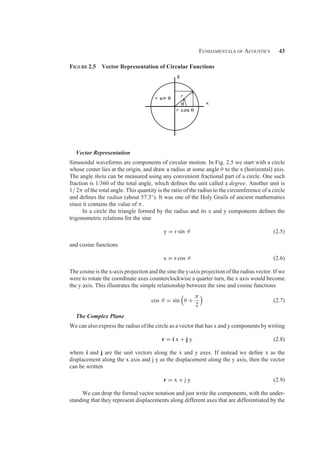
standard center frequencies and bandwidths are specified, which are set forth in Table 2.1. The
most commonly used filters in architectural acoustics have octave or third-octave bandwidths.
Three one-third octaves are contained in each octave, but these do not correspond to any given
set of notes. Narrow bandwidth filters, 1/10 octave or even 1 Hz wide, are sometimes used
in the study of vibration or the details of reverberant falloff in rooms.
2.2 SIMPLE HARMONIC MOTION
Periodic motions need not be smooth. The beat of a human heart, for example, is periodic
but very complicated. It is easiest, however to begin with a simple motion and then to move
on to more complicated wave shapes. If we examine the vibration of a stretched string it is
quite regular. Such behavior is called simple harmonic motion and can be written in terms
of a sinusoidal function.
Fundamentals of Acoustics 41
Figure
2.3
Frequency
Ranges
of
Various
Musical
Instruments
(Pierce,
1983)
42 Architectural Acoustics
Figure 2.4 Frequency Spectrum of a Piano Note
Table 2.1 Octave and Third-Octave Band Frequency Limits
Frequency, Hz
Octave One-third Octave
Band Lower Limit Center Upper Limit Lower Limit Center Upper Limit
12 11 16 22 14.1 16 17.8
13 17.8 20 22.4
14 22.4 25 28.2
15 22 31.5 44 28.2 31.5 35.5
16 35.5 40 44.7
17 44.7 50 56.2
18 44 63 88 56.2 63 70.8
19 70.8 80 89.1
20 89.1 100 112
21 88 125 177 112 125 141
22 141 160 178
23 178 200 224
24 177 250 355 224 250 282
25 282 315 355
26 355 400 447
27 355 500 710 447 500 562
28 562 630 708
29 708 800 891
30 710 1,000 1,420 891 1,000 1,122
31 1,122 1,250 1,413
32 1,413 1,600 1,778
33 1,420 2,000 2,840 1,778 2,000 2,239
34 2,239 2,500 2,818
35 2,818 3,150 3,548
36 2,840 4,000 5,680 3,548 4,000 4,467
37 4,467 5,000 5,623
38 5,623 6,300 7,079
39 5,680 8,000 11,360 7,079 8,000 8,913
40 8,913 10,000 11,220
41 11,220 12,500 14,130
42 11,360 16,000 22,720 14,130 16,000 17,780
43 17,780 20,000 22,390
Fundamentals of Acoustics 43
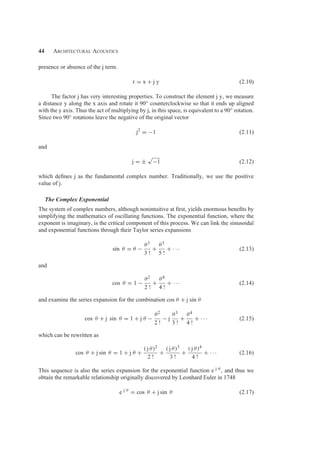
Figure 2.5 Vector Representation of Circular Functions
Vector Representation
Sinusoidal waveforms are components of circular motion. In Fig. 2.5 we start with a circle
whose center lies at the origin, and draw a radius at some angle θ to the x (horizontal) axis.
The angle theta can be measured using any convenient fractional part of a circle. One such
fraction is 1/360 of the total angle, which defines the unit called a degree. Another unit is
1/ 2π of the total angle. This quantity is the ratio of the radius to the circumference of a circle
and defines the radian (about 57.3◦). It was one of the Holy Grails of ancient mathematics
since it contains the value of π.
In a circle the triangle formed by the radius and its x and y components defines the
trigonometric relations for the sine
y = r sin θ (2.5)
and cosine functions
x = r cos θ (2.6)
The cosine is the x-axis projection and the sine the y-axis projection of the radius vector. If we
were to rotate the coordinate axes counterclockwise a quarter turn, the x axis would become
the y axis. This illustrates the simple relationship between the sine and cosine functions
cos θ = sin

θ +
π
2

(2.7)
The Complex Plane
We can also express the radius of the circle as a vector that has x and y components by writing
r = i x + j y (2.8)
where i and j are the unit vectors along the x and y axes. If instead we define x as the
displacement along the x axis and j y as the displacement along the y axis, then the vector
can be written
r = x + j y (2.9)
We can drop the formal vector notation and just write the components, with the under-
standing that they represent displacements along different axes that are differentiated by the
44 Architectural Acoustics
presence or absence of the j term.
r = x + j y (2.10)
The factor j has very interesting properties. To construct the element j y, we measure
a distance y along the x axis and rotate it 90◦ counterclockwise so that it ends up aligned
with the y axis. Thus the act of multiplying by j, in this space, is equivalent to a 90◦ rotation.
Since two 90◦ rotations leave the negative of the original vector
j2
= −1 (2.11)
and
j = ±
√
−1 (2.12)
which defines j as the fundamental complex number. Traditionally, we use the positive
value of j.
The Complex Exponential
The system of complex numbers, although nonintuitive at first, yields enormous benefits by
simplifying the mathematics of oscillating functions. The exponential function, where the
exponent is imaginary, is the critical component of this process. We can link the sinusoidal
and exponential functions through their Taylor series expansions
sin θ = θ −
θ3
3 !
+
θ5
5 !
+ · · · (2.13)
and
cos θ = 1 −
θ2
2 !
+
θ4
4 !
+ · · · (2.14)
and examine the series expansion for the combination cos θ + j sin θ
cos θ + j sin θ = 1 + j θ −
θ2
2 !
− j
θ3
3 !
+
θ4
4 !
+ · · · (2.15)
which can be rewritten as
cos θ + j sin θ = 1 + j θ +
( j θ)2
2 !
+
( j θ)3
3 !
+
( j θ)4
4 !
+ · · · (2.16)
This sequence is also the series expansion for the exponential function e j θ , and thus we
obtain the remarkable relationship originally discovered by Leonhard Euler in 1748
e j θ
= cos θ + j sin θ (2.17)
Fundamentals of Acoustics 45
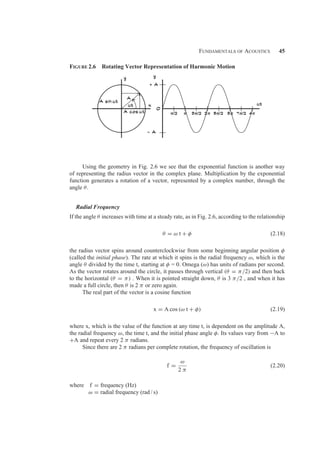
Figure 2.6 Rotating Vector Representation of Harmonic Motion
Using the geometry in Fig. 2.6 we see that the exponential function is another way
of representing the radius vector in the complex plane. Multiplication by the exponential
function generates a rotation of a vector, represented by a complex number, through the
angle θ.
Radial Frequency
If the angle θ increases with time at a steady rate, as in Fig. 2.6, according to the relationship
θ = ω t + φ (2.18)
the radius vector spins around counterclockwise from some beginning angular position φ
(called the initial phase). The rate at which it spins is the radial frequency ω, which is the
angle θ divided by the time t, starting at φ = 0. Omega (ω) has units of radians per second.
As the vector rotates around the circle, it passes through vertical (θ = π/2) and then back
to the horizontal (θ = π) . When it is pointed straight down, θ is 3 π/2 , and when it has
made a full circle, then θ is 2 π or zero again.
The real part of the vector is a cosine function
x = A cos (ω t + φ) (2.19)
where x, which is the value of the function at any time t, is dependent on the amplitude A,
the radial frequency ω, the time t, and the initial phase angle φ. Its values vary from −A to
+A and repeat every 2 π radians.
Since there are 2 π radians per complete rotation, the frequency of oscillation is
f =
ω
2 π
(2.20)
where f = frequency (Hz)
ω = radial frequency (rad / s)
46 Architectural Acoustics
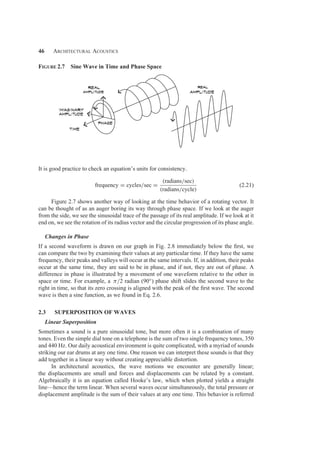
Figure 2.7 Sine Wave in Time and Phase Space
It is good practice to check an equation’s units for consistency.
frequency = cycles/sec =
(radians/sec)
(radians/cycle)
(2.21)
Figure 2.7 shows another way of looking at the time behavior of a rotating vector. It
can be thought of as an auger boring its way through phase space. If we look at the auger
from the side, we see the sinusoidal trace of the passage of its real amplitude. If we look at it
end on, we see the rotation of its radius vector and the circular progression of its phase angle.
Changes in Phase
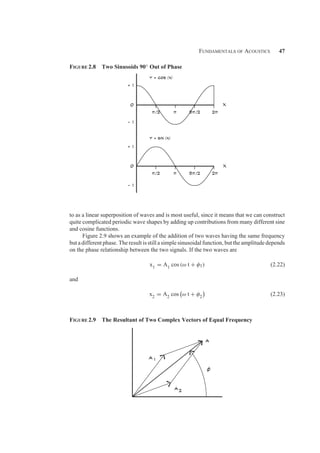
If a second waveform is drawn on our graph in Fig. 2.8 immediately below the first, we
can compare the two by examining their values at any particular time. If they have the same
frequency, their peaks and valleys will occur at the same intervals. If, in addition, their peaks
occur at the same time, they are said to be in phase, and if not, they are out of phase. A
difference in phase is illustrated by a movement of one waveform relative to the other in
space or time. For example, a π/2 radian (90◦) phase shift slides the second wave to the
right in time, so that its zero crossing is aligned with the peak of the first wave. The second
wave is then a sine function, as we found in Eq. 2.6.
2.3 SUPERPOSITION OF WAVES
Linear Superposition
Sometimes a sound is a pure sinusoidal tone, but more often it is a combination of many
tones. Even the simple dial tone on a telephone is the sum of two single frequency tones, 350
and 440 Hz. Our daily acoustical environment is quite complicated, with a myriad of sounds
striking our ear drums at any one time. One reason we can interpret these sounds is that they
add together in a linear way without creating appreciable distortion.
In architectural acoustics, the wave motions we encounter are generally linear;
the displacements are small and forces and displacements can be related by a constant.
Algebraically it is an equation called Hooke’s law, which when plotted yields a straight
line—hence the term linear. When several waves occur simultaneously, the total pressure or
displacement amplitude is the sum of their values at any one time. This behavior is referred
Fundamentals of Acoustics 47
Figure 2.8 Two Sinusoids 90◦ Out of Phase
to as a linear superposition of waves and is most useful, since it means that we can construct
quite complicated periodic wave shapes by adding up contributions from many different sine
and cosine functions.
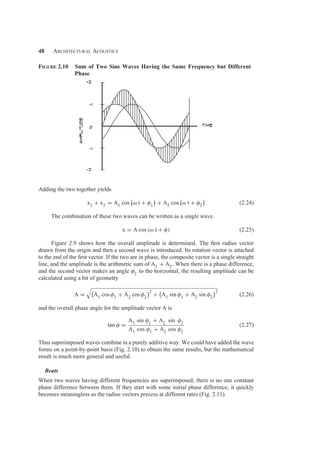
Figure 2.9 shows an example of the addition of two waves having the same frequency
but a different phase. The result is still a simple sinusoidal function, but the amplitude depends
on the phase relationship between the two signals. If the two waves are
x1 = A1 cos (ω t + φ1) (2.22)
and
x2 = A2 cos

ω t + φ2

(2.23)
Figure 2.9 The Resultant of Two Complex Vectors of Equal Frequency
48 Architectural Acoustics
Figure 2.10 Sum of Two Sine Waves Having the Same Frequency but Different
Phase
Adding the two together yields
x1 + x2 = A1 cos

ω t + φ1

+ A2 cos

ω t + φ2

(2.24)
The combination of these two waves can be written as a single wave.
x = A cos (ω t + φ) (2.25)
Figure 2.9 shows how the overall amplitude is determined. The first radius vector
drawn from the origin and then a second wave is introduced. Its rotation vector is attached
to the end of the first vector. If the two are in phase, the composite vector is a single straight
line, and the amplitude is the arithmetic sum of A1 + A2. When there is a phase difference,
and the second vector makes an angle φ2 to the horizontal, the resulting amplitude can be
calculated using a bit of geometry
A =

A1 cos φ1 + A2 cos φ2
2
+

A1 sin φ1 + A2 sin φ2
2
(2.26)
and the overall phase angle for the amplitude vector A is
tan φ =
A1 sin φ1 + A2 sin φ2
A1 cos φ1 + A2 cos φ2
(2.27)
Thus superimposed waves combine in a purely additive way. We could have added the wave
forms on a point-by-point basis (Fig. 2.10) to obtain the same results, but the mathematical
result is much more general and useful.
Beats
When two waves having different frequencies are superimposed, there is no one constant
phase difference between them. If they start with some initial phase difference, it quickly
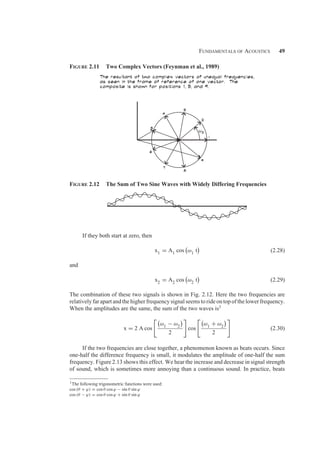
becomes meaningless as the radius vectors precess at different rates (Fig. 2.11).
Fundamentals of Acoustics 49
Figure 2.11 Two Complex Vectors (Feynman et al., 1989)
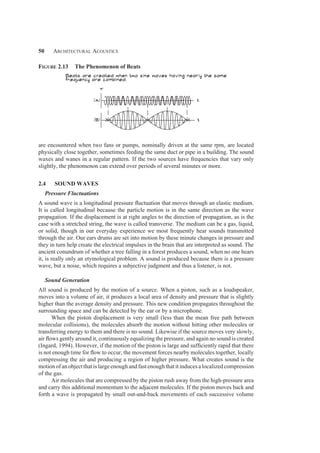
Figure 2.12 The Sum of Two Sine Waves with Widely Differing Frequencies
If they both start at zero, then
x1 = A1 cos

ω1 t

(2.28)
and
x2 = A2 cos

ω2 t

(2.29)
The combination of these two signals is shown in Fig. 2.12. Here the two frequencies are
relatively far apart and the higher frequency signal seems to ride on top of the lower frequency.
When the amplitudes are the same, the sum of the two waves is1
x = 2 A cos

ω1 − ω2

2

cos

ω1 + ω2

2

(2.30)
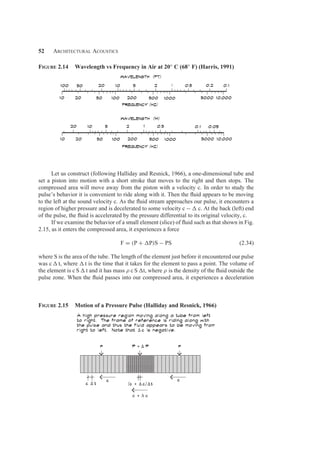
If the two frequencies are close together, a phenomenon known as beats occurs. Since
one-half the difference frequency is small, it modulates the amplitude of one-half the sum
frequency. Figure 2.13 shows this effect. We hear the increase and decrease in signal strength
of sound, which is sometimes more annoying than a continuous sound. In practice, beats
1The following trigonometric functions were used:
cos (θ + ϕ) = cos θ cos ϕ − sin θ sin ϕ
cos (θ − ϕ) = cos θ cos ϕ + sin θ sin ϕ
50 Architectural Acoustics
Figure 2.13 The Phenomenon of Beats
are encountered when two fans or pumps, nominally driven at the same rpm, are located
physically close together, sometimes feeding the same duct or pipe in a building. The sound
waxes and wanes in a regular pattern. If the two sources have frequencies that vary only
slightly, the phenomenon can extend over periods of several minutes or more.
2.4 SOUND WAVES
Pressure Fluctuations
A sound wave is a longitudinal pressure fluctuation that moves through an elastic medium.
It is called longitudinal because the particle motion is in the same direction as the wave
propagation. If the displacement is at right angles to the direction of propagation, as is the
case with a stretched string, the wave is called transverse. The medium can be a gas, liquid,
or solid, though in our everyday experience we most frequently hear sounds transmitted
through the air. Our ears drums are set into motion by these minute changes in pressure and
they in turn help create the electrical impulses in the brain that are interpreted as sound. The
ancient conundrum of whether a tree falling in a forest produces a sound, when no one hears
it, is really only an etymological problem. A sound is produced because there is a pressure
wave, but a noise, which requires a subjective judgment and thus a listener, is not.
Sound Generation
All sound is produced by the motion of a source. When a piston, such as a loudspeaker,
moves into a volume of air, it produces a local area of density and pressure that is slightly
higher than the average density and pressure. This new condition propagates throughout the
surrounding space and can be detected by the ear or by a microphone.
When the piston displacement is very small (less than the mean free path between
molecular collisions), the molecules absorb the motion without hitting other molecules or
transferring energy to them and there is no sound. Likewise if the source moves very slowly,
air flows gently around it, continuously equalizing the pressure, and again no sound is created
(Ingard, 1994). However, if the motion of the piston is large and sufficiently rapid that there
is not enough time for flow to occur, the movement forces nearby molecules together, locally
compressing the air and producing a region of higher pressure. What creates sound is the
motionofanobjectthatislargeenoughandfastenoughthatitinducesalocalizedcompression
of the gas.
Air molecules that are compressed by the piston rush away from the high-pressure area
and carry this additional momentum to the adjacent molecules. If the piston moves back and
forth a wave is propagated by small out-and-back movements of each successive volume
Fundamentals of Acoustics 51
element in the direction of propagation, which transfer energy through alternations of high
pressure and low velocity with low pressure and high velocity. It is the material properties
of mass and elasticity that ensure the propagation of the wave.
As a wave propagates through a medium such as air, the particles oscillate back and
forth when the wave passes. We can write an equation for the functional behavior of the
displacement y of a small volume of air away from its equilibrium position, caused by a
wave moving along the positive x axis (to the right) at some velocity c.
y = f(x − c t) (2.31)
Implicit in this equation is the notion that the displacement, or any other property of the
wave, will be the same for a given value of (x − c t). If the wave is sinusoidal then
y = A sin [k (x − c t)] (2.32)
where k is called the wave number and has units of radians per length. By comparison to
Eq. 2.19 the term (k c) is equal to the radial frequency omega.
k =
2 π
λ
=
ω
c
(2.33)
Wavelength of Sound
The wavelength of a sound wave is a particularly important measure. Much of the behavior
of a sound wave relates to the wavelength, so that it becomes the scale by which we judge
the physical size of objects. For example, sound will scatter (bounce) off a flat object that is
several wavelengths long in a specular (mirror-like) manner. If the object is much smaller
than a wavelength, the sound will simply flow around it as if it were not there. If we observe
the behavior of water waves we can clearly see this behavior. Ocean waves will pass by small
rocks in their path with little change, but will reflect off a long breakwater or similar barrier.
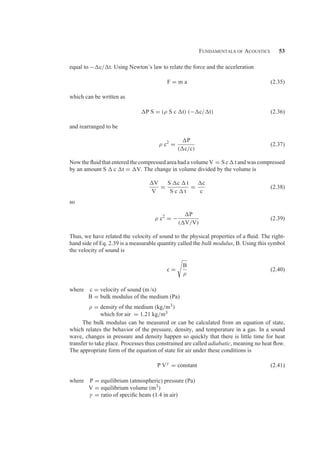
Figure2.14showstypicalvaluesofthewavelengthofsoundinairatvariousfrequencies.
At 1000 Hz, which is in the middle of the speech frequency range, the wavelength is about
0.3 m (1 ft) while for the lowest note on the piano the wavelength is about 13 m (42 ft). The
lowest note on a large pipe organ might be produced by a 10 m (32 ft) pipe that is half the
wavelength of the note. The highest frequency audible to humans is about 20,000 Hz and has
a wavelength of around half an inch. Bats, which use echolocation to find their prey, must
transmit frequencies as high as 100,000 Hz to scatter off a 2 mm (0.1 in) mosquito.
Velocity of Sound
The mathematical description of the changes in pressure and density induced by a sound
wave, which is called the wave equation, requires that certain assumptions be made about
the medium. In general we examine an element of volume (say a cube) small enough to
smoothly represent the local changes in pressure and density, but large enough to contain
very many molecules. When we mathematically describe physical phenomena created by a
sound wave, we are talking about the average properties associated with such a small volume
element.
52 Architectural Acoustics
Figure 2.14 Wavelength vs Frequency in Air at 20◦ C (68◦ F) (Harris, 1991)
Let us construct (following Halliday and Resnick, 1966), a one-dimensional tube and
set a piston into motion with a short stroke that moves to the right and then stops. The
compressed area will move away from the piston with a velocity c. In order to study the
pulse’s behavior it is convenient to ride along with it. Then the fluid appears to be moving
to the left at the sound velocity c. As the fluid stream approaches our pulse, it encounters a
region of higher pressure and is decelerated to some velocity c −  c. At the back (left) end
of the pulse, the fluid is accelerated by the pressure differential to its original velocity, c.
If we examine the behavior of a small element (slice) of fluid such as that shown in Fig.
2.15, as it enters the compressed area, it experiences a force
F = (P + P)S − PS (2.34)
where S is the area of the tube. The length of the element just before it encountered our pulse
was c  t, where  t is the time that it takes for the element to pass a point. The volume of
the element is c S  t and it has mass ρ c S t, where ρ is the density of the fluid outside the
pulse zone. When the fluid passes into our compressed area, it experiences a deceleration
Figure 2.15 Motion of a Pressure Pulse (Halliday and Resnick, 1966)
Fundamentals of Acoustics 53
equal to −c/t. Using Newton’s law to relate the force and the acceleration
F = m a (2.35)
which can be written as
P S = (ρ S c t) (−c/t) (2.36)
and rearranged to be
ρ c2
=
P
(c/c)
(2.37)
Now the fluid that entered the compressed area had a volume V = S c  t and was compressed
by an amount S  c t = V. The change in volume divided by the volume is
V
V
=
S c  t
S c  t
=
c
c
(2.38)
so
ρ c2
= −
P
(V/V)
(2.39)
Thus, we have related the velocity of sound to the physical properties of a fluid. The right-
hand side of Eq. 2.39 is a measurable quantity called the bulk modulus, B. Using this symbol
the velocity of sound is
c =
B
ρ
(2.40)
where c = velocity of sound (m /s)
B = bulk modulus of the medium (Pa)
ρ = density of the medium (kg/m3)
which for air = 1.21 kg/m3
The bulk modulus can be measured or can be calculated from an equation of state,
which relates the behavior of the pressure, density, and temperature in a gas. In a sound
wave, changes in pressure and density happen so quickly that there is little time for heat
transfer to take place. Processes thus constrained are called adiabatic, meaning no heat flow.
The appropriate form of the equation of state for air under these conditions is
P Vγ
= constant (2.41)
where P = equilibrium (atmospheric) pressure (Pa)
V = equilibrium volume (m3)
γ = ratio of specific heats (1.4 in air)
54 Architectural Acoustics
Under adiabatic conditions the bulk modulus is γ P, so the speed of sound is
c =

γ P/ρ0 (2.42)
Using the relationship known as Boyle’s Law (P V = μR T where μ is the number of moles
of the gas and R = 8.314 joules/mole ◦K is the gas constant), the velocity of sound in air
(which in this text is given the symbol c0) can be shown to be
c0 = 20.05

TC + 273.2 (2.43)
where TC is the temperature in degrees centigrade. In FP (foot-pound) units the result is
c0 = 49.03

TF + 459.7 (2.44)
where TF is the temperature in degrees Fahrenheit.
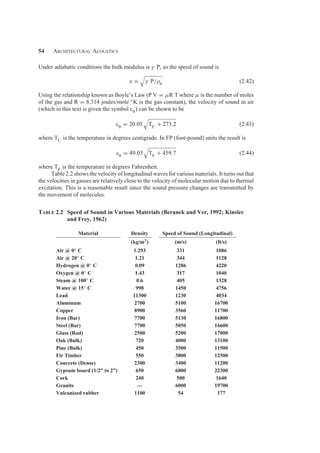
Table 2.2 shows the velocity of longitudinal waves for various materials. It turns out that
the velocities in gasses are relatively close to the velocity of molecular motion due to thermal
excitation. This is a reasonable result since the sound pressure changes are transmitted by
the movement of molecules.
Table 2.2 Speed of Sound in Various Materials (Beranek and Ver, 1992; Kinsler
and Frey, 1962)
Material Density Speed of Sound (Longitudinal)
(kg/m3) (m/s) (ft/s)
Air @ 0◦ C 1.293 331 1086
Air @ 20◦ C 1.21 344 1128
Hydrogen @ 0◦ C 0.09 1286 4220
Oxygen @ 0◦ C 1.43 317 1040
Steam @ 100◦ C 0.6 405 1328
Water @ 15◦ C 998 1450 4756
Lead 11300 1230 4034
Aluminum 2700 5100 16700
Copper 8900 3560 11700
Iron (Bar) 7700 5130 16800
Steel (Bar) 7700 5050 16600
Glass (Rod) 2500 5200 17000
Oak (Bulk) 720 4000 13100
Pine (Bulk) 450 3500 11500
Fir Timber 550 3800 12500
Concrete (Dense) 2300 3400 11200
Gypsum board (1/2” to 2”) 650 6800 22300
Cork 240 500 1640
Granite — 6000 19700
Vulcanized rubber 1100 54 177
Fundamentals of Acoustics 55
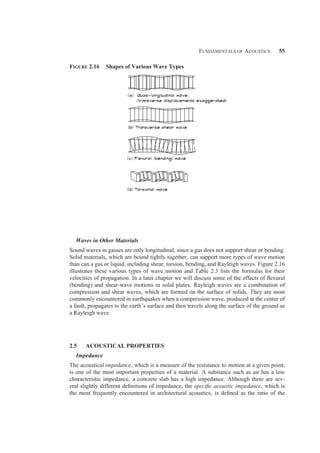
Figure 2.16 Shapes of Various Wave Types
Waves in Other Materials
Sound waves in gasses are only longitudinal, since a gas does not support shear or bending.
Solid materials, which are bound tightly together, can support more types of wave motion
than can a gas or liquid, including shear, torsion, bending, and Rayleigh waves. Figure 2.16
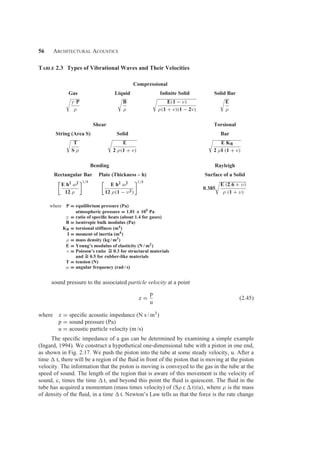
illustrates these various types of wave motion and Table 2.3 lists the formulas for their
velocities of propagation. In a later chapter we will discuss some of the effects of flexural
(bending) and shear-wave motions in solid plates. Rayleigh waves are a combination of
compression and shear waves, which are formed on the surface of solids. They are most
commonly encountered in earthquakes when a compression wave, produced at the center of
a fault, propagates to the earth’s surface and then travels along the surface of the ground as
a Rayleigh wave.
2.5 ACOUSTICAL PROPERTIES
Impedance
The acoustical impedance, which is a measure of the resistance to motion at a given point,
is one of the most important properties of a material. A substance such as air has a low
characteristic impedance, a concrete slab has a high impedance. Although there are sev-
eral slightly different definitions of impedance, the specific acoustic impedance, which is
the most frequently encountered in architectural acoustics, is defined as the ratio of the
56 Architectural Acoustics
Table 2.3 Types of Vibrational Waves and Their Velocities
Compressional
Gas Liquid Infinite Solid Solid Bar
γ P
ρ
B
ρ
E(1 − ν)
ρ(1 + ν)(1 − 2ν)
E
ρ
Shear Torsional
String (Area S) Solid Bar
T
S ρ
E
2 ρ(1 + ν)
E KB
2 ρI (1 + ν)
Bending Rayleigh
Rectangular Bar Plate (Thickness – h) Surface of a Solid
E h2 ω2
12 ρ
1/4
E h2 ω2
12 ρ(1 − υ2)
1/4
0.385
E (2.6 + υ)
ρ (1 + υ)
where P = equilibrium pressure (Pa)
atmospheric pressure = 1.01 × 10⁵ Pa
γ = ratio of specific heats (about 1.4 for gases)
B = isentropic bulk modulus (Pa)
KB = torsional stiffness (m4)
I = moment of inertia (m4)
ρ = mass density (kg / m3)
E = Young’s modulus of elasticity (N / m2)
ν = Poisson’s ratio ∼
= 0.3 for structural materials
and ∼
= 0.5 for rubber-like materials
T = tension (N)
ω = angular frequency (rad / s)
sound pressure to the associated particle velocity at a point
z =
p
u
(2.45)
where z = specific acoustic impedance (N s / m3)
p = sound pressure (Pa)
u = acoustic particle velocity (m /s)
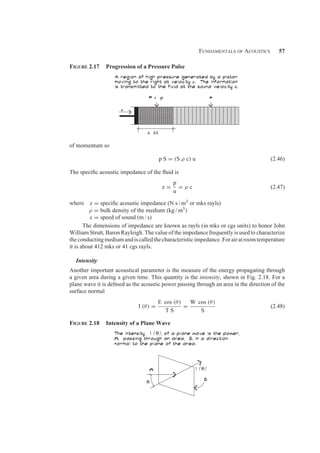
The specific impedance of a gas can be determined by examining a simple example
(Ingard, 1994). We construct a hypothetical one-dimensional tube with a piston in one end,
as shown in Fig. 2.17. We push the piston into the tube at some steady velocity, u. After a
time  t, there will be a region of the fluid in front of the piston that is moving at the piston
velocity. The information that the piston is moving is conveyed to the gas in the tube at the
speed of sound. The length of the region that is aware of this movement is the velocity of
sound, c, times the time  t, and beyond this point the fluid is quiescent. The fluid in the
tube has acquired a momentum (mass times velocity) of (Sρ c  t)(u), where ρ is the mass
of density of the fluid, in a time  t. Newton’s Law tells us that the force is the rate change
Fundamentals of Acoustics 57
Figure 2.17 Progression of a Pressure Pulse
of momentum so
p S = (S ρ c) u (2.46)
The specific acoustic impedance of the fluid is
z =
p
u
= ρ c (2.47)
where z = specific acoustic impedance (N s / m3 or mks rayls)
ρ = bulk density of the medium (kg / m3)
c = speed of sound (m / s)
The dimensions of impedance are known as rayls (in mks or cgs units) to honor John
William Strutt, Baron Rayleigh. The value of the impedance frequently is used to characterize
theconductingmediumandiscalledthecharacteristicimpedance. Forairatroomtemperature
it is about 412 mks or 41 cgs rayls.
Intensity
Another important acoustical parameter is the measure of the energy propagating through
a given area during a given time. This quantity is the intensity, shown in Fig. 2.18. For a
plane wave it is defined as the acoustic power passing through an area in the direction of the
surface normal
I (θ) =
E cos (θ)
T S
=
W cos (θ)
S
(2.48)
Figure 2.18 Intensity of a Plane Wave
58 Architectural Acoustics
where E = energy contained in the sound wave (N m / s)
W = sound power (W)
I (θ) = intensity (W / m2) passing through an area in the direction of its normal
S = measurement area (m2)
T = period of the wave (s)
θ = angle between the direction of propagation and the area normal
The maximum intensity, I, is obtained when the direction of propagation coincides
with the normal to the planar surface, when the angle θ = 0.
I =
W
S
(2.49)
Plane waves are the most commonly analyzed waveform because the mathematics
are simple and the form ubiquitous. A wave is considered planar when its properties do
not change in the plane whose normal is the direction of propagation. Intensity is a vector
quantity. Its direction is defined by the direction of the normal of the measurement area. When
the normal is oriented along the direction of propagation of the sound wave, the intensity has
its maximum value, which is not a vector quantity.
Sound power is the sound energy being emitted by a source each cycle. The energy,
which is the mechanical work done by a wave, is the force moving through a distance
E = p S dx (2.50)
where p is the root-mean-square acoustic pressure, and S is the area. The power, W, is the
rate of energy flow so
W =
p S d x
d t
= p S u (2.51)
where u is the velocity of a small region of the fluid, and is called the particle velocity. It is
not the thermal velocity of individual molecules but rather the velocity of a small volume of
fluid caused by the passage of the sound wave. For a plane wave
I = p u (2.52)
where I = maximum acoustic intensity (W / m2)
p = root-mean-square (rms) acoustic pressure (Pa)
u = acoustic rms particle velocity (m / s)
Using the definition of the specific acoustic impedance from Eq. 2.37
z =
p
u
= ρ c (2.53)
we can obtain for a plane wave
I =
p2
ρ c
(2.54)
Fundamentals of Acoustics 59
where I = maximum acoustic intensity (W / m2)
p = rms acoustic pressure (Pa)
ρ = bulk density (kg / m3)
c = velocity of sound (m / s)
The acoustic pressure shown in Eq. 2.44 is the root-mean-square (rms) sound pressure
averaged over a cycle
p = prms =
⎡
⎣ 1
T
T

0
P2
sin 2
ω t dt
⎤
⎦
1
2
=
P
√
2
(2.55)
which, for a sine wave, is 0.707 times the maximum value. The average acoustic pressure
is zero because its value swings an equal amount above and below normal atmospheric
pressure. The energy is not zero but must be obtained by averaging the square of the pressure.
Interestingly, the rms pressure of the combination of random waveforms is independent of
the phase relationship between the waves.
The intensity (generally taken to be the maximum intensity) is a particularly important
property. It is directly measurable using a sound level meter and is audible. It is proportional
to power so that when waves are combined, their intensities may be added arithmetically.
The combined intensity of several sounds is the simple sum of their individual intensities.
The lowest intensity that we are likely to experience is the threshold of human hearing,
which is about 10−12W/m2. A normal conversation between two people might take place
at about 10−6W/m2 and a jet aircraft could produce 1W/m2. Thus the acoustic intensities
encountered in daily life span a very large range, nearly 12 orders of magnitude. Dealing
with numbers of this size is cumbersome, and has lead to the adoption of the decibel notation
as a convenience.
Energy Density
In certain instances, the energy density contained within a region of space is of interest. For
a plane wave if a certain power passes through an area in a given time, the volume enclosing
the energy is the area times the distance the sound has traveled, or c t. The energy density is
the total energy contained within the volume divided by the volume
D =
E
S c t
=
W
S c
=
p2
ρ c2
(2.56)
2.6 LEVELS
Sound Levels — Decibels
Since the range of intensities is so large, the common practice is to express values in terms
of levels. A level is basically a fraction, expressed as 10 times the logarithm of the ratio of
two numbers.
Level = 10 log
Number of interest
Reference number
(2.57)
Since a logarithm can be taken of any dimensionless number, and all levels are the logarithm
of some fraction, it is useful to think of them as simple fractions. Even when the denominator
60 Architectural Acoustics
Table 2.4 Reference Quantities for Sound Levels (Beranek and Ver, 1992)
Level (dB) Formula Reference (SI)
Sound Intensity LI = 10 log (I/Io) Io = 10−12 W/ m2
Sound Pressure Lp = 20 log (p/po)
po = 20 μ Pa
= 2×10⁻⁵ N/ m2
Sound Power LW = 10 log (W/ Wo) Wo = 10−12 W
Sound Exposure LE = 10 log (E/Eo)
Eo = (20 μ Pa)2 s
= (2×10⁻⁵ Pa)2 s
Note: Decimal multiples are: 10−1 = deci (d), 10−2 = centi (c), 10−3 = milli (m),
10−6 = micro (μ), 10−9 = nano (n), and 10−12 = pico ( p).
has a numeric value of 1, such as 1 second or 1 square meter, there must always be a reference
quantity to keep the ratio dimensionless.
The logarithm of a number divided by a reference quantity is given the unit of bels, in
honor of Alexander Graham Bell, the inventor of the telephone. The multiplication by 10
has become common practice, in order to achieve numbers that have a convenient size. The
quantities thus obtained have units of decibels, which is one tenth of a bel. Typical levels
and their reference quantities are shown in Table 2.4. Levels are denoted by a capital L with
a subscript that indicates the type of level. For example, the sound power level is shown as
Lw, while the sound intensity level would be LI, and the sound pressure level, Lp.
Recalling that quantities proportional to power or energy can be combined arithmeti-
cally we can combine two or more levels by adding their intensities.
ITotal
= I1 + I2 + · · · + In (2.58)
If we are given the intensity level of a sound, expressed in decibels, then we can find
its intensity by using the definition
LI = 10 log
I
Iref
(2.59)
and the definition of the antilogarithm
I
Iref
= 100.1 LI (2.60)
When the intensities from several signals are combined the total overall intensity ratio is
ITotal
Iref
=
n

i=1
100.1 Li (2.61)
and the resultant overall level is
LTotal
= 10 log
ITotal
Iref
= 10 log
n

i=1
100.1 Li (2.62)
Fundamentals of Acoustics 61
As an example, we can take two sounds, each producing an intensity level of 70 dB,
and ask what the level would be if we combined the two sounds. The problem can be
formulated as
L1 = L2 = 70 dB (2.63)
which, if combined, would yield
L1 + 2 = 10 log

107
+ 107

= 73 dB (2.64)
Thus when two levels of equal value are combined the resultant level is 3 dB greater
than the original level. By doing similar calculations we learn that when two widely varying
levels are combined the result is nearly equal to the larger level. For example, if two levels
differ by 6 dB, the combination is about 1 dB higher than the larger level. If the two differ
by 10 or more the result is essentially the same as the larger level.
When there are a number of equal sources, the combination process can be simplified
LTotal
= Li
+ 10 log n (2.65)
where Li
is the level produced by one source and n is the total number of like sources.
Sound Pressure Level
The sound pressure level is the most commonly used indicator of the acoustic wave strength.
It correlates well with human perception of loudness and is measured easily with rela-
tively inexpensive instrumentation. A compilation of the sound pressure levels generated
by representative sources is given in Table 2.5 at the location or distance indicated.
The reference sound pressure, like that of the intensity, is set to the threshold of human
hearing at about 1000 Hz for a young person. When the sound pressure is equal to the
reference pressure the resultant level is 0 dB. The sound pressure level is defined as
Lp = 10 log
p2
p2
ref
(2.66)
where p = root-mean-square sound pressure (Pa)
pref
= reference pressure, 2 × 10⁻⁵ Pa
Since the intensity is proportional to the square of the sound pressure as shown in
Eq. 2.44 the intensity level and the sound pressure level are almost equal, differing only by
a small number due to the actual value versus the reference value of the air’s characteristic
impedance. This fact is most useful since we both measure and hear the sound pressure, but
we use the intensity to do most of our calculations.
It is relatively straightforward (Beranek and Ver, 1992) to work out the relation-
ship between the sound pressure level and the sound intensity level to calculate the actual
difference
Lp = LI + 10 log (ρ0 c0/ 400) (2.67)
For a typical value of ρ0 c0 of 412 mks rayls the correction is 0.13 dB, which is ignored in
most calculations.
62 Architectural Acoustics
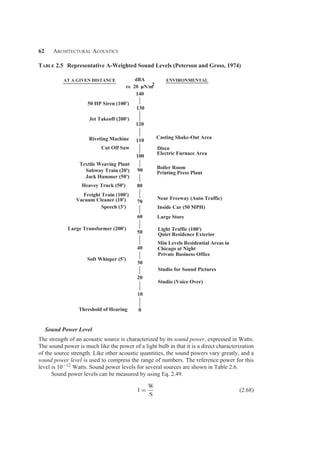
Table 2.5 Representative A-Weighted Sound Levels (Peterson and Gross, 1974)
Sound Power Level
The strength of an acoustic source is characterized by its sound power, expressed in Watts.
The sound power is much like the power of a light bulb in that it is a direct characterization
of the source strength. Like other acoustic quantities, the sound powers vary greatly, and a
sound power level is used to compress the range of numbers. The reference power for this
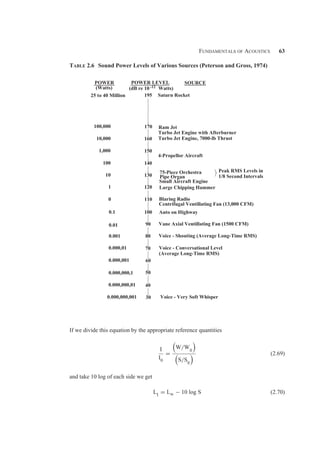
level is 10−12 Watts. Sound power levels for several sources are shown in Table 2.6.
Sound power levels can be measured by using Eq. 2.49.
I =
W
S
(2.68)
Fundamentals of Acoustics 63
Table 2.6 Sound Power Levels of Various Sources (Peterson and Gross, 1974)
If we divide this equation by the appropriate reference quantities
I
I0
=

W/W0


S/S0
 (2.69)
and take 10 log of each side we get
LI = Lw − 10 log S (2.70)
64 Architectural Acoustics
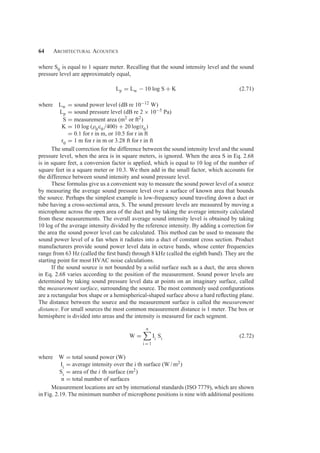
where S0 is equal to 1 square meter. Recalling that the sound intensity level and the sound
pressure level are approximately equal,
Lp = Lw − 10 log S + K (2.71)
where Lw = sound power level (dB re 10−12 W)
Lp = sound pressure level (dB re 2 × 10⁻⁵ Pa)
S = measurement area (m2 or ft2)
K = 10 log (ρ0c0/400) + 20 log(r0)
= 0.1 for r in m, or 10.5 for r in ft
r0 = 1 m for r in m or 3.28 ft for r in ft
The small correction for the difference between the sound intensity level and the sound
pressure level, when the area is in square meters, is ignored. When the area S in Eq. 2.68
is in square feet, a conversion factor is applied, which is equal to 10 log of the number of
square feet in a square meter or 10.3. We then add in the small factor, which accounts for
the difference between sound intensity and sound pressure level.
These formulas give us a convenient way to measure the sound power level of a source
by measuring the average sound pressure level over a surface of known area that bounds
the source. Perhaps the simplest example is low-frequency sound traveling down a duct or
tube having a cross-sectional area, S. The sound pressure levels are measured by moving a
microphone across the open area of the duct and by taking the average intensity calculated
from these measurements. The overall average sound intensity level is obtained by taking
10 log of the average intensity divided by the reference intensity. By adding a correction for
the area the sound power level can be calculated. This method can be used to measure the
sound power level of a fan when it radiates into a duct of constant cross section. Product
manufacturers provide sound power level data in octave bands, whose center frequencies
range from 63 Hz (called the first band) through 8 kHz (called the eighth band). They are the
starting point for most HVAC noise calculations.
If the sound source is not bounded by a solid surface such as a duct, the area shown
in Eq. 2.68 varies according to the position of the measurement. Sound power levels are
determined by taking sound pressure level data at points on an imaginary surface, called
the measurement surface, surrounding the source. The most commonly used configurations
are a rectangular box shape or a hemispherical-shaped surface above a hard reflecting plane.
The distance between the source and the measurement surface is called the measurement
distance. For small sources the most common measurement distance is 1 meter. The box or
hemisphere is divided into areas and the intensity is measured for each segment.
W =
n

i = 1
Ii
Si
(2.72)
where W = total sound power (W)
Ii
= average intensity over the i th surface (W / m2)
Si
= area of the i th surface (m2)
n = total number of surfaces
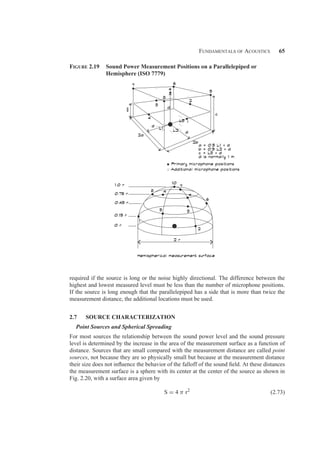
Measurement locations are set by international standards (ISO 7779), which are shown
in Fig. 2.19. The minimum number of microphone positions is nine with additional positions
Fundamentals of Acoustics 65
Figure 2.19 Sound Power Measurement Positions on a Parallelepiped or
Hemisphere (ISO 7779)
required if the source is long or the noise highly directional. The difference between the
highest and lowest measured level must be less than the number of microphone positions.
If the source is long enough that the parallelepiped has a side that is more than twice the
measurement distance, the additional locations must be used.
2.7 SOURCE CHARACTERIZATION
Point Sources and Spherical Spreading
For most sources the relationship between the sound power level and the sound pressure
level is determined by the increase in the area of the measurement surface as a function of
distance. Sources that are small compared with the measurement distance are called point
sources, not because they are so physically small but because at the measurement distance
their size does not influence the behavior of the falloff of the sound field. At these distances
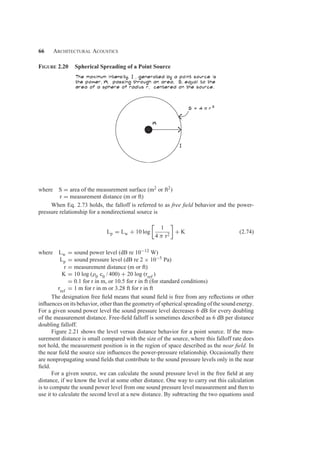
the measurement surface is a sphere with its center at the center of the source as shown in
Fig. 2.20, with a surface area given by
S = 4 π r2
(2.73)
66 Architectural Acoustics
Figure 2.20 Spherical Spreading of a Point Source
where S = area of the measurement surface (m2 or ft2)
r = measurement distance (m or ft)
When Eq. 2.73 holds, the falloff is referred to as free field behavior and the power-
pressure relationship for a nondirectional source is
Lp = Lw + 10 log
1
4 π r2
+ K (2.74)
where Lw = sound power level (dB re 10−12 W)
Lp = sound pressure level (dB re 2 × 10⁻⁵ Pa)
r = measurement distance (m or ft)
K = 10 log (ρ0 c0 / 400) + 20 log (rref
)
= 0.1 for r in m, or 10.5 for r in ft (for standard conditions)
rref
= 1 m for r in m or 3.28 ft for r in ft
The designation free field means that sound field is free from any reflections or other
influences on its behavior, other than the geometry of spherical spreading of the sound energy.
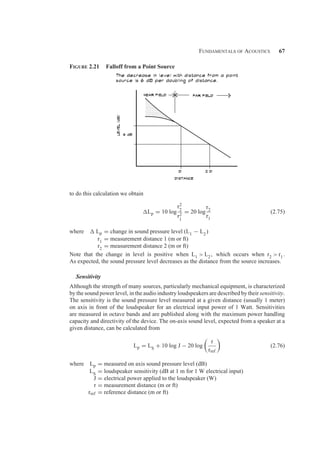
For a given sound power level the sound pressure level decreases 6 dB for every doubling
of the measurement distance. Free-field falloff is sometimes described as 6 dB per distance
doubling falloff.
Figure 2.21 shows the level versus distance behavior for a point source. If the mea-
surement distance is small compared with the size of the source, where this falloff rate does
not hold, the measurement position is in the region of space described as the near field. In
the near field the source size influences the power-pressure relationship. Occasionally there
are nonpropagating sound fields that contribute to the sound pressure levels only in the near
field.
For a given source, we can calculate the sound pressure level in the free field at any
distance, if we know the level at some other distance. One way to carry out this calculation
is to compute the sound power level from one sound pressure level measurement and then to
use it to calculate the second level at a new distance. By subtracting the two equations used
Fundamentals of Acoustics 67
Figure 2.21 Falloff from a Point Source
to do this calculation we obtain
Lp = 10 log
r2
2
r2
1
= 20 log
r2
r1
(2.75)
where  Lp = change in sound pressure level (L1 − L2)
r1 = measurement distance 1 (m or ft)
r2 = measurement distance 2 (m or ft)
Note that the change in level is positive when L1  L2, which occurs when r2  r1.
As expected, the sound pressure level decreases as the distance from the source increases.
Sensitivity
Although the strength of many sources, particularly mechanical equipment, is characterized
by the sound power level, in the audio industry loudspeakers are described by their sensitivity.
The sensitivity is the sound pressure level measured at a given distance (usually 1 meter)
on axis in front of the loudspeaker for an electrical input power of 1 Watt. Sensitivities
are measured in octave bands and are published along with the maximum power handling
capacity and directivity of the device. The on-axis sound level, expected from a speaker at a
given distance, can be calculated from
Lp = LS + 10 log J − 20 log

r
rref

(2.76)
where Lp = measured on axis sound pressure level (dB)
LS = loudspeaker sensitivity (dB at 1 m for 1 W electrical input)
J = electrical power applied to the loudspeaker (W)
r = measurement distance (m or ft)
rref = reference distance (m or ft)
68 Architectural Acoustics
Figure 2.22 Source Directivity Shown as a Polar Plot
Directionality, Directivity, and Directivity Index
For many sources the sound pressure level at a given distance from its center is not the
same in all directions. This property is called directionality, and the changes in level with
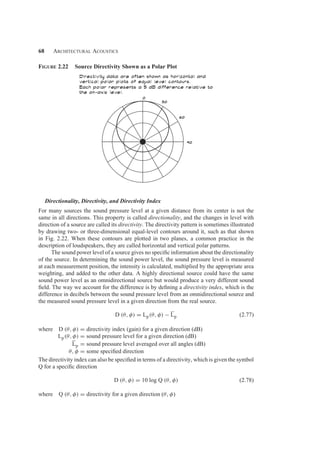
direction of a source are called its directivity. The directivity pattern is sometimes illustrated
by drawing two- or three-dimensional equal-level contours around it, such as that shown
in Fig. 2.22. When these contours are plotted in two planes, a common practice in the
description of loudspeakers, they are called horizontal and vertical polar patterns.
The sound power level of a source gives no specific information about the directionality
of the source. In determining the sound power level, the sound pressure level is measured
at each measurement position, the intensity is calculated, multiplied by the appropriate area
weighting, and added to the other data. A highly directional source could have the same
sound power level as an omnidirectional source but would produce a very different sound
field. The way we account for the difference is by defining a directivity index, which is the
difference in decibels between the sound pressure level from an omnidirectional source and
the measured sound pressure level in a given direction from the real source.
D (θ, φ) = Lp(θ, φ) − Lp (2.77)
where D (θ, φ) = directivity index (gain) for a given direction (dB)
Lp(θ, φ) = sound pressure level for a given direction (dB)
Lp = sound pressure level averaged over all angles (dB)
θ, φ = some specified direction
The directivity index can also be specified in terms of a directivity, which is given the symbol
Q for a specific direction
D (θ, φ) = 10 log Q (θ, φ) (2.78)
where Q (θ, φ) = directivity for a given direction (θ, φ)
Fundamentals of Acoustics 69
The directivity can be expressed in terms of the intensity in a given direction compared with
the average intensity
Q (θ, φ) =
I (θ, φ)
IAve
(2.79)
The average intensity is given by
IAve =
W
4 π r2
(2.80)
and the intensity in a particular direction by
I (θ, φ) =
Q (θ, φ)W
4 π r2
(2.81)
When the directivity is included in the relationship between the sound power level and
the sound pressure level in a given direction, the result for a point source is
Lp(θ, φ) = Lw + 10 log
Q (θ, φ)
4 π r2
+ K (2.82)
In the audio industry the Q of a loudspeaker is understood to mean the on-axis directivity,
Q (0, 0) = Q0.
The sound power level of a loudspeaker can be calculated from its sensitivity and its
Q0 for any input power J
Lw = LS − 10 log
Q0
4 π r2
+ 10 log J − K (2.83)
where LS = loudspeaker sensitivity (dB at 1 m for 1 W input)
r = standard measurement distance (usually = 1 m)
J = input electrical power (W)
The sound pressure level emitted by the loudspeaker at a given angle can then be calculated
from the sound power level
Lp = Lw + 10 log
Q (θ, φ)
4 π r2
+ K (2.84)
where Q (θ, φ) = loudspeaker directivity for a given direction
Q (θ, φ) = Q0 Qrel (θ, φ)
Q0 = on - axis directivity
Qrel
(θ, φ) = directivity relative to on - axis
θ, φ = latitude and longitude angles with respect to the aim
point direction and the horizontal axis of the loudspeaker
Normally Q0  1 and Qrel
(θ, φ)  1. These relationships will be discussed in greater detail
in Chap. 18.
70 Architectural Acoustics
Figure 2.23 Falloff of a Line Source
Line Sources
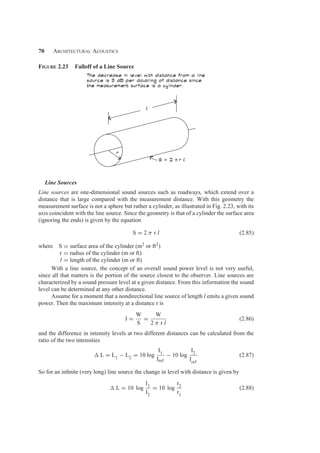
Line sources are one-dimensional sound sources such as roadways, which extend over a
distance that is large compared with the measurement distance. With this geometry the
measurement surface is not a sphere but rather a cylinder, as illustrated in Fig. 2.23, with its
axis coincident with the line source. Since the geometry is that of a cylinder the surface area
(ignoring the ends) is given by the equation
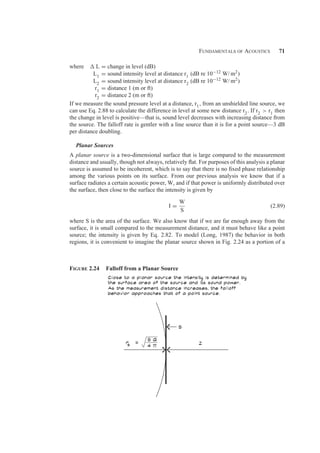
S = 2 π r l (2.85)
where S = surface area of the cylinder (m2 or ft2)
r = radius of the cylinder (m or ft)
l = length of the cylinder (m or ft)
With a line source, the concept of an overall sound power level is not very useful,
since all that matters is the portion of the source closest to the observer. Line sources are
characterized by a sound pressure level at a given distance. From this information the sound
level can be determined at any other distance.
Assume for a moment that a nondirectional line source of length l emits a given sound
power. Then the maximum intensity at a distance r is
I =
W
S
=
W
2 π r l
(2.86)
and the difference in intensity levels at two different distances can be calculated from the
ratio of the two intensities
 L = L1 − L2 = 10 log
I1
Iref
− 10 log
I2
Iref
(2.87)
So for an infinite (very long) line source the change in level with distance is given by
 L = 10 log
I1
I2
= 10 log
r2
r1
(2.88)
Fundamentals of Acoustics 71
where  L = change in level (dB)
L1 = sound intensity level at distance r1 (dB re 10−12 W/ m2)
L2 = sound intensity level at distance r2 (dB re 10−12 W/ m2)
r1 = distance 1 (m or ft)
r2 = distance 2 (m or ft)
If we measure the sound pressure level at a distance, r1, from an unshielded line source, we
can use Eq. 2.88 to calculate the difference in level at some new distance r2. If r2  r1 then
the change in level is positive—that is, sound level decreases with increasing distance from
the source. The falloff rate is gentler with a line source than it is for a point source—3 dB
per distance doubling.
Planar Sources
A planar source is a two-dimensional surface that is large compared to the measurement
distance and usually, though not always, relatively flat. For purposes of this analysis a planar
source is assumed to be incoherent, which is to say that there is no fixed phase relationship
among the various points on its surface. From our previous analysis we know that if a
surface radiates a certain acoustic power, W, and if that power is uniformly distributed over
the surface, then close to the surface the intensity is given by
I =
W
S
(2.89)
where S is the area of the surface. We also know that if we are far enough away from the
surface, it is small compared to the measurement distance, and it must behave like a point
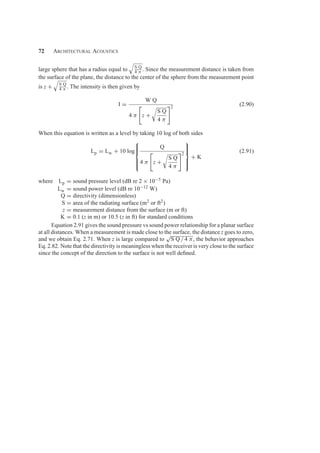
source; the intensity is given by Eq. 2.82. To model (Long, 1987) the behavior in both
regions, it is convenient to imagine the planar source shown in Fig. 2.24 as a portion of a
Figure 2.24 Falloff from a Planar Source
72 Architectural Acoustics
large sphere that has a radius equal to

S Q
4 π . Since the measurement distance is taken from
the surface of the plane, the distance to the center of the sphere from the measurement point
is z +

S Q
4 π . The intensity is then given by
I =
W Q
4 π

z +
S Q
4 π
2
(2.90)
When this equation is written as a level by taking 10 log of both sides
Lp = Lw + 10 log
⎧
⎪
⎪
⎨
⎪
⎪
⎩
Q
4 π

z +
S Q
4 π
2
⎫
⎪
⎪
⎬
⎪
⎪
⎭
+ K
(2.91)
where Lp = sound pressure level (dB re 2 × 10⁻⁵ Pa)
Lw = sound power level (dB re 10−12 W)
Q = directivity (dimensionless)
S = area of the radiating surface (m2 or ft2)
z = measurement distance from the surface (m or ft)
K = 0.1 (z in m) or 10.5 (z in ft) for standard conditions
Equation 2.91 gives the sound pressure vs sound power relationship for a planar surface
at all distances. When a measurement is made close to the surface, the distance z goes to zero,
and we obtain Eq. 2.71. When z is large compared to
√
S Q / 4 π, the behavior approaches
Eq. 2.82. Note that the directivity is meaningless when the receiver is very close to the surface
since the concept of the direction to the surface is not well defined.

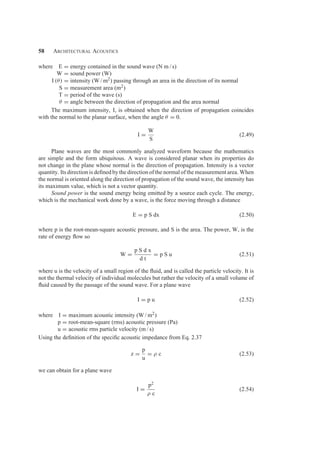
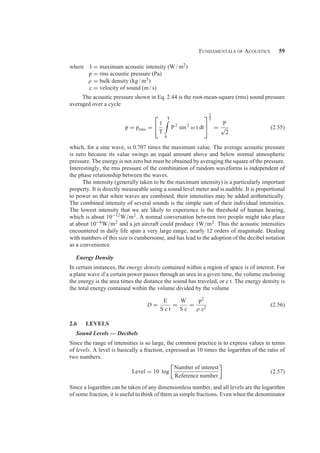
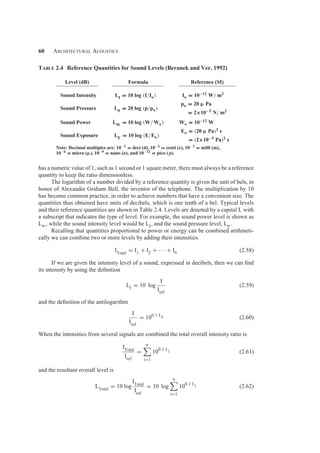
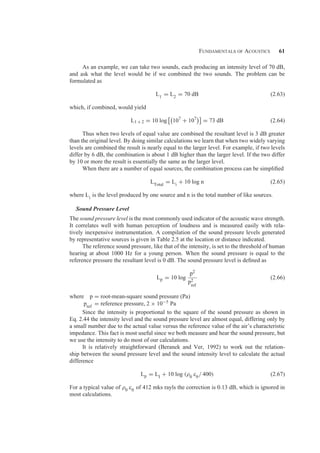
fundamental of engineering Acoustics_notes1.pdf

  • 1.
    FUNDAMENTALS of ACOUSTICS 2.1 FREQUENCY ANDWAVELENGTH Frequency A steady sound is produced by the repeated back and forth movement of an object at regular intervals. The time interval over which the motion recurs is called the period. For example if our hearts beat 72 times per minute, the period is the total time (60 seconds) divided by the number of beats (72), which is 0.83 seconds per beat. We can invert the period to obtain the number of complete cycles of motion in one time interval, which is called the frequency. f = 1 T (2.1) where f = frequency (cycles per second or Hz) T = time period per cycle (s) The frequency is expressed in units of cycles per second, or Hertz (Hz), in honor of the physicist Heinrich Hertz (1857–1894). Wavelength Among the earliest sources of musical sounds were instruments made using stretched strings. When a string is plucked it vibrates back and forth and the initial displacement travels in each direction along the string at a given velocity. The time required for the displacement to travel twice the length of the string is T = 2 L c (2.2)
  • 2.
    38 Architectural Acoustics Figure2.1 Harmonics of a Stretched String (Pierce, 1983) where T = time period (s) L = length of the string (m) c = velocity of the wave (m /s) Since the string is fixed at its end points, the only motion patterns allowed are those that have zero amplitude at the ends. This constraint (called a boundary condition) sets the frequencies of vibration that the string will sustain to a fundamental and integer multiples of this frequency, 2f, 3f, 4f, . . . , called harmonics. Figure 2.1 shows these vibration patterns. f = c 2 L (2.3) As the string displacement reflects from the terminations, it repeats its motion every two lengths. The distance over which the motion repeats is called the wavelength, and is given the Greek symbol lambda, λ, which for the fundamental frequency in a string is 2 L. This leads us to the general relation between the wavelength and the frequency λ = c f (2.4) where λ = wavelength (m) c = velocity of wave propagation (m /s) f = frequency (Hz) When notes are played on a piano the strings vibrate at specific frequencies, which depend on their length, mass, and tension. Figure 2.2 shows the fundamental frequencies associated with each note. The lowest note has a fundamental frequency of about 27 Hz, while the highest fundamental is 4186 Hz. The frequency ranges spanned by other musical
  • 3.
    Fundamentals of Acoustics39 Figure 2.2 Frequency Range of a Piano (Pierce, 1983)
  • 4.
    40 Architectural Acoustics instruments,including the human voice, are given in Fig. 2.3. If a piano string is vibrating at its fundamental mode, the maximum excursion occurs at the middle of the string. When a piano key is played, the hammer does not strike precisely in the center of the string and thus it excites a large number of additional modes. These harmonics contribute to the beauty and complexity of the sound. Frequency Spectrum If we were to measure the strength of the sound produced by a particular note and make a plot of sound level versus frequency we would have a graph called a spectrum. When the sound has only one frequency, it is called a pure tone and its spectrum consists of a single straight line whose height depends on its strength. The spectrum of a piano note, shown in Fig. 2.4, is a line at the fundamental frequency and additional lines at each harmonic frequency. For most notes the fundamental has the highest amplitude, followed by the harmonics in descending order. For piano notes in the lowest octave the second harmonic may have a higher amplitude than the fundamental if the strings are not long enough to sustain the lowest frequency. Sources such as waterfalls produce sounds at many frequencies, rather than only a few, and yield a flat spectrum. Interestingly an impulsive sound such as a hand clap also yields a flat spectrum. This is so because in order to construct an impulsive sound, we add up a very large number of waves of higher and higher frequencies in such a way that their peaks all occur at one time. At other times they cancel each other out so we are left with just the impulse spike. Since the two forms are equivalent, a sharp impulse generates a large number of waves at different frequencies, which is a flat spectrum. A clap often is used to listen for acoustical defects in rooms. Electronic signal generators, which produce all frequencies within a given bandwidth, are used as test sources. The most commonly encountered are the pink-noise (equal energy per octave or third octave) or white-noise (equal energy per cycle) generators. Filters In analyzing the spectral content of a sound we might use a meter that includes electronic filters to eliminate all signals except those of interest to us. Filters have a center frequency and a bandwidth, which determines the limits of the filter. By international agreement certain standard center frequencies and bandwidths are specified, which are set forth in Table 2.1. The most commonly used filters in architectural acoustics have octave or third-octave bandwidths. Three one-third octaves are contained in each octave, but these do not correspond to any given set of notes. Narrow bandwidth filters, 1/10 octave or even 1 Hz wide, are sometimes used in the study of vibration or the details of reverberant falloff in rooms. 2.2 SIMPLE HARMONIC MOTION Periodic motions need not be smooth. The beat of a human heart, for example, is periodic but very complicated. It is easiest, however to begin with a simple motion and then to move on to more complicated wave shapes. If we examine the vibration of a stretched string it is quite regular. Such behavior is called simple harmonic motion and can be written in terms of a sinusoidal function.
  • 5.
    Fundamentals of Acoustics41 Figure 2.3 Frequency Ranges of Various Musical Instruments (Pierce, 1983)
  • 6.
    42 Architectural Acoustics Figure2.4 Frequency Spectrum of a Piano Note Table 2.1 Octave and Third-Octave Band Frequency Limits Frequency, Hz Octave One-third Octave Band Lower Limit Center Upper Limit Lower Limit Center Upper Limit 12 11 16 22 14.1 16 17.8 13 17.8 20 22.4 14 22.4 25 28.2 15 22 31.5 44 28.2 31.5 35.5 16 35.5 40 44.7 17 44.7 50 56.2 18 44 63 88 56.2 63 70.8 19 70.8 80 89.1 20 89.1 100 112 21 88 125 177 112 125 141 22 141 160 178 23 178 200 224 24 177 250 355 224 250 282 25 282 315 355 26 355 400 447 27 355 500 710 447 500 562 28 562 630 708 29 708 800 891 30 710 1,000 1,420 891 1,000 1,122 31 1,122 1,250 1,413 32 1,413 1,600 1,778 33 1,420 2,000 2,840 1,778 2,000 2,239 34 2,239 2,500 2,818 35 2,818 3,150 3,548 36 2,840 4,000 5,680 3,548 4,000 4,467 37 4,467 5,000 5,623 38 5,623 6,300 7,079 39 5,680 8,000 11,360 7,079 8,000 8,913 40 8,913 10,000 11,220 41 11,220 12,500 14,130 42 11,360 16,000 22,720 14,130 16,000 17,780 43 17,780 20,000 22,390
  • 7.
    Fundamentals of Acoustics43 Figure 2.5 Vector Representation of Circular Functions Vector Representation Sinusoidal waveforms are components of circular motion. In Fig. 2.5 we start with a circle whose center lies at the origin, and draw a radius at some angle θ to the x (horizontal) axis. The angle theta can be measured using any convenient fractional part of a circle. One such fraction is 1/360 of the total angle, which defines the unit called a degree. Another unit is 1/ 2π of the total angle. This quantity is the ratio of the radius to the circumference of a circle and defines the radian (about 57.3◦). It was one of the Holy Grails of ancient mathematics since it contains the value of π. In a circle the triangle formed by the radius and its x and y components defines the trigonometric relations for the sine y = r sin θ (2.5) and cosine functions x = r cos θ (2.6) The cosine is the x-axis projection and the sine the y-axis projection of the radius vector. If we were to rotate the coordinate axes counterclockwise a quarter turn, the x axis would become the y axis. This illustrates the simple relationship between the sine and cosine functions cos θ = sin θ + π 2 (2.7) The Complex Plane We can also express the radius of the circle as a vector that has x and y components by writing r = i x + j y (2.8) where i and j are the unit vectors along the x and y axes. If instead we define x as the displacement along the x axis and j y as the displacement along the y axis, then the vector can be written r = x + j y (2.9) We can drop the formal vector notation and just write the components, with the under- standing that they represent displacements along different axes that are differentiated by the
  • 8.
    44 Architectural Acoustics presenceor absence of the j term. r = x + j y (2.10) The factor j has very interesting properties. To construct the element j y, we measure a distance y along the x axis and rotate it 90◦ counterclockwise so that it ends up aligned with the y axis. Thus the act of multiplying by j, in this space, is equivalent to a 90◦ rotation. Since two 90◦ rotations leave the negative of the original vector j2 = −1 (2.11) and j = ± √ −1 (2.12) which defines j as the fundamental complex number. Traditionally, we use the positive value of j. The Complex Exponential The system of complex numbers, although nonintuitive at first, yields enormous benefits by simplifying the mathematics of oscillating functions. The exponential function, where the exponent is imaginary, is the critical component of this process. We can link the sinusoidal and exponential functions through their Taylor series expansions sin θ = θ − θ3 3 ! + θ5 5 ! + · · · (2.13) and cos θ = 1 − θ2 2 ! + θ4 4 ! + · · · (2.14) and examine the series expansion for the combination cos θ + j sin θ cos θ + j sin θ = 1 + j θ − θ2 2 ! − j θ3 3 ! + θ4 4 ! + · · · (2.15) which can be rewritten as cos θ + j sin θ = 1 + j θ + ( j θ)2 2 ! + ( j θ)3 3 ! + ( j θ)4 4 ! + · · · (2.16) This sequence is also the series expansion for the exponential function e j θ , and thus we obtain the remarkable relationship originally discovered by Leonhard Euler in 1748 e j θ = cos θ + j sin θ (2.17)
  • 9.
    Fundamentals of Acoustics45 Figure 2.6 Rotating Vector Representation of Harmonic Motion Using the geometry in Fig. 2.6 we see that the exponential function is another way of representing the radius vector in the complex plane. Multiplication by the exponential function generates a rotation of a vector, represented by a complex number, through the angle θ. Radial Frequency If the angle θ increases with time at a steady rate, as in Fig. 2.6, according to the relationship θ = ω t + φ (2.18) the radius vector spins around counterclockwise from some beginning angular position φ (called the initial phase). The rate at which it spins is the radial frequency ω, which is the angle θ divided by the time t, starting at φ = 0. Omega (ω) has units of radians per second. As the vector rotates around the circle, it passes through vertical (θ = π/2) and then back to the horizontal (θ = π) . When it is pointed straight down, θ is 3 π/2 , and when it has made a full circle, then θ is 2 π or zero again. The real part of the vector is a cosine function x = A cos (ω t + φ) (2.19) where x, which is the value of the function at any time t, is dependent on the amplitude A, the radial frequency ω, the time t, and the initial phase angle φ. Its values vary from −A to +A and repeat every 2 π radians. Since there are 2 π radians per complete rotation, the frequency of oscillation is f = ω 2 π (2.20) where f = frequency (Hz) ω = radial frequency (rad / s)
  • 10.
    46 Architectural Acoustics Figure2.7 Sine Wave in Time and Phase Space It is good practice to check an equation’s units for consistency. frequency = cycles/sec = (radians/sec) (radians/cycle) (2.21) Figure 2.7 shows another way of looking at the time behavior of a rotating vector. It can be thought of as an auger boring its way through phase space. If we look at the auger from the side, we see the sinusoidal trace of the passage of its real amplitude. If we look at it end on, we see the rotation of its radius vector and the circular progression of its phase angle. Changes in Phase If a second waveform is drawn on our graph in Fig. 2.8 immediately below the first, we can compare the two by examining their values at any particular time. If they have the same frequency, their peaks and valleys will occur at the same intervals. If, in addition, their peaks occur at the same time, they are said to be in phase, and if not, they are out of phase. A difference in phase is illustrated by a movement of one waveform relative to the other in space or time. For example, a π/2 radian (90◦) phase shift slides the second wave to the right in time, so that its zero crossing is aligned with the peak of the first wave. The second wave is then a sine function, as we found in Eq. 2.6. 2.3 SUPERPOSITION OF WAVES Linear Superposition Sometimes a sound is a pure sinusoidal tone, but more often it is a combination of many tones. Even the simple dial tone on a telephone is the sum of two single frequency tones, 350 and 440 Hz. Our daily acoustical environment is quite complicated, with a myriad of sounds striking our ear drums at any one time. One reason we can interpret these sounds is that they add together in a linear way without creating appreciable distortion. In architectural acoustics, the wave motions we encounter are generally linear; the displacements are small and forces and displacements can be related by a constant. Algebraically it is an equation called Hooke’s law, which when plotted yields a straight line—hence the term linear. When several waves occur simultaneously, the total pressure or displacement amplitude is the sum of their values at any one time. This behavior is referred
  • 11.
    Fundamentals of Acoustics47 Figure 2.8 Two Sinusoids 90◦ Out of Phase to as a linear superposition of waves and is most useful, since it means that we can construct quite complicated periodic wave shapes by adding up contributions from many different sine and cosine functions. Figure 2.9 shows an example of the addition of two waves having the same frequency but a different phase. The result is still a simple sinusoidal function, but the amplitude depends on the phase relationship between the two signals. If the two waves are x1 = A1 cos (ω t + φ1) (2.22) and x2 = A2 cos ω t + φ2 (2.23) Figure 2.9 The Resultant of Two Complex Vectors of Equal Frequency
  • 12.
    48 Architectural Acoustics Figure2.10 Sum of Two Sine Waves Having the Same Frequency but Different Phase Adding the two together yields x1 + x2 = A1 cos ω t + φ1 + A2 cos ω t + φ2 (2.24) The combination of these two waves can be written as a single wave. x = A cos (ω t + φ) (2.25) Figure 2.9 shows how the overall amplitude is determined. The first radius vector drawn from the origin and then a second wave is introduced. Its rotation vector is attached to the end of the first vector. If the two are in phase, the composite vector is a single straight line, and the amplitude is the arithmetic sum of A1 + A2. When there is a phase difference, and the second vector makes an angle φ2 to the horizontal, the resulting amplitude can be calculated using a bit of geometry A = A1 cos φ1 + A2 cos φ2 2 + A1 sin φ1 + A2 sin φ2 2 (2.26) and the overall phase angle for the amplitude vector A is tan φ = A1 sin φ1 + A2 sin φ2 A1 cos φ1 + A2 cos φ2 (2.27) Thus superimposed waves combine in a purely additive way. We could have added the wave forms on a point-by-point basis (Fig. 2.10) to obtain the same results, but the mathematical result is much more general and useful. Beats When two waves having different frequencies are superimposed, there is no one constant phase difference between them. If they start with some initial phase difference, it quickly becomes meaningless as the radius vectors precess at different rates (Fig. 2.11).
  • 13.
    Fundamentals of Acoustics49 Figure 2.11 Two Complex Vectors (Feynman et al., 1989) Figure 2.12 The Sum of Two Sine Waves with Widely Differing Frequencies If they both start at zero, then x1 = A1 cos ω1 t (2.28) and x2 = A2 cos ω2 t (2.29) The combination of these two signals is shown in Fig. 2.12. Here the two frequencies are relatively far apart and the higher frequency signal seems to ride on top of the lower frequency. When the amplitudes are the same, the sum of the two waves is1 x = 2 A cos ω1 − ω2 2 cos ω1 + ω2 2 (2.30) If the two frequencies are close together, a phenomenon known as beats occurs. Since one-half the difference frequency is small, it modulates the amplitude of one-half the sum frequency. Figure 2.13 shows this effect. We hear the increase and decrease in signal strength of sound, which is sometimes more annoying than a continuous sound. In practice, beats 1The following trigonometric functions were used: cos (θ + ϕ) = cos θ cos ϕ − sin θ sin ϕ cos (θ − ϕ) = cos θ cos ϕ + sin θ sin ϕ
  • 14.
    50 Architectural Acoustics Figure2.13 The Phenomenon of Beats are encountered when two fans or pumps, nominally driven at the same rpm, are located physically close together, sometimes feeding the same duct or pipe in a building. The sound waxes and wanes in a regular pattern. If the two sources have frequencies that vary only slightly, the phenomenon can extend over periods of several minutes or more. 2.4 SOUND WAVES Pressure Fluctuations A sound wave is a longitudinal pressure fluctuation that moves through an elastic medium. It is called longitudinal because the particle motion is in the same direction as the wave propagation. If the displacement is at right angles to the direction of propagation, as is the case with a stretched string, the wave is called transverse. The medium can be a gas, liquid, or solid, though in our everyday experience we most frequently hear sounds transmitted through the air. Our ears drums are set into motion by these minute changes in pressure and they in turn help create the electrical impulses in the brain that are interpreted as sound. The ancient conundrum of whether a tree falling in a forest produces a sound, when no one hears it, is really only an etymological problem. A sound is produced because there is a pressure wave, but a noise, which requires a subjective judgment and thus a listener, is not. Sound Generation All sound is produced by the motion of a source. When a piston, such as a loudspeaker, moves into a volume of air, it produces a local area of density and pressure that is slightly higher than the average density and pressure. This new condition propagates throughout the surrounding space and can be detected by the ear or by a microphone. When the piston displacement is very small (less than the mean free path between molecular collisions), the molecules absorb the motion without hitting other molecules or transferring energy to them and there is no sound. Likewise if the source moves very slowly, air flows gently around it, continuously equalizing the pressure, and again no sound is created (Ingard, 1994). However, if the motion of the piston is large and sufficiently rapid that there is not enough time for flow to occur, the movement forces nearby molecules together, locally compressing the air and producing a region of higher pressure. What creates sound is the motionofanobjectthatislargeenoughandfastenoughthatitinducesalocalizedcompression of the gas. Air molecules that are compressed by the piston rush away from the high-pressure area and carry this additional momentum to the adjacent molecules. If the piston moves back and forth a wave is propagated by small out-and-back movements of each successive volume
  • 15.
    Fundamentals of Acoustics51 element in the direction of propagation, which transfer energy through alternations of high pressure and low velocity with low pressure and high velocity. It is the material properties of mass and elasticity that ensure the propagation of the wave. As a wave propagates through a medium such as air, the particles oscillate back and forth when the wave passes. We can write an equation for the functional behavior of the displacement y of a small volume of air away from its equilibrium position, caused by a wave moving along the positive x axis (to the right) at some velocity c. y = f(x − c t) (2.31) Implicit in this equation is the notion that the displacement, or any other property of the wave, will be the same for a given value of (x − c t). If the wave is sinusoidal then y = A sin [k (x − c t)] (2.32) where k is called the wave number and has units of radians per length. By comparison to Eq. 2.19 the term (k c) is equal to the radial frequency omega. k = 2 π λ = ω c (2.33) Wavelength of Sound The wavelength of a sound wave is a particularly important measure. Much of the behavior of a sound wave relates to the wavelength, so that it becomes the scale by which we judge the physical size of objects. For example, sound will scatter (bounce) off a flat object that is several wavelengths long in a specular (mirror-like) manner. If the object is much smaller than a wavelength, the sound will simply flow around it as if it were not there. If we observe the behavior of water waves we can clearly see this behavior. Ocean waves will pass by small rocks in their path with little change, but will reflect off a long breakwater or similar barrier. Figure2.14showstypicalvaluesofthewavelengthofsoundinairatvariousfrequencies. At 1000 Hz, which is in the middle of the speech frequency range, the wavelength is about 0.3 m (1 ft) while for the lowest note on the piano the wavelength is about 13 m (42 ft). The lowest note on a large pipe organ might be produced by a 10 m (32 ft) pipe that is half the wavelength of the note. The highest frequency audible to humans is about 20,000 Hz and has a wavelength of around half an inch. Bats, which use echolocation to find their prey, must transmit frequencies as high as 100,000 Hz to scatter off a 2 mm (0.1 in) mosquito. Velocity of Sound The mathematical description of the changes in pressure and density induced by a sound wave, which is called the wave equation, requires that certain assumptions be made about the medium. In general we examine an element of volume (say a cube) small enough to smoothly represent the local changes in pressure and density, but large enough to contain very many molecules. When we mathematically describe physical phenomena created by a sound wave, we are talking about the average properties associated with such a small volume element.
  • 16.
    52 Architectural Acoustics Figure2.14 Wavelength vs Frequency in Air at 20◦ C (68◦ F) (Harris, 1991) Let us construct (following Halliday and Resnick, 1966), a one-dimensional tube and set a piston into motion with a short stroke that moves to the right and then stops. The compressed area will move away from the piston with a velocity c. In order to study the pulse’s behavior it is convenient to ride along with it. Then the fluid appears to be moving to the left at the sound velocity c. As the fluid stream approaches our pulse, it encounters a region of higher pressure and is decelerated to some velocity c − c. At the back (left) end of the pulse, the fluid is accelerated by the pressure differential to its original velocity, c. If we examine the behavior of a small element (slice) of fluid such as that shown in Fig. 2.15, as it enters the compressed area, it experiences a force F = (P + P)S − PS (2.34) where S is the area of the tube. The length of the element just before it encountered our pulse was c t, where t is the time that it takes for the element to pass a point. The volume of the element is c S t and it has mass ρ c S t, where ρ is the density of the fluid outside the pulse zone. When the fluid passes into our compressed area, it experiences a deceleration Figure 2.15 Motion of a Pressure Pulse (Halliday and Resnick, 1966)
  • 17.
    Fundamentals of Acoustics53 equal to −c/t. Using Newton’s law to relate the force and the acceleration F = m a (2.35) which can be written as P S = (ρ S c t) (−c/t) (2.36) and rearranged to be ρ c2 = P (c/c) (2.37) Now the fluid that entered the compressed area had a volume V = S c t and was compressed by an amount S c t = V. The change in volume divided by the volume is V V = S c t S c t = c c (2.38) so ρ c2 = − P (V/V) (2.39) Thus, we have related the velocity of sound to the physical properties of a fluid. The right- hand side of Eq. 2.39 is a measurable quantity called the bulk modulus, B. Using this symbol the velocity of sound is c = B ρ (2.40) where c = velocity of sound (m /s) B = bulk modulus of the medium (Pa) ρ = density of the medium (kg/m3) which for air = 1.21 kg/m3 The bulk modulus can be measured or can be calculated from an equation of state, which relates the behavior of the pressure, density, and temperature in a gas. In a sound wave, changes in pressure and density happen so quickly that there is little time for heat transfer to take place. Processes thus constrained are called adiabatic, meaning no heat flow. The appropriate form of the equation of state for air under these conditions is P Vγ = constant (2.41) where P = equilibrium (atmospheric) pressure (Pa) V = equilibrium volume (m3) γ = ratio of specific heats (1.4 in air)
  • 18.
    54 Architectural Acoustics Underadiabatic conditions the bulk modulus is γ P, so the speed of sound is c = γ P/ρ0 (2.42) Using the relationship known as Boyle’s Law (P V = μR T where μ is the number of moles of the gas and R = 8.314 joules/mole ◦K is the gas constant), the velocity of sound in air (which in this text is given the symbol c0) can be shown to be c0 = 20.05 TC + 273.2 (2.43) where TC is the temperature in degrees centigrade. In FP (foot-pound) units the result is c0 = 49.03 TF + 459.7 (2.44) where TF is the temperature in degrees Fahrenheit. Table 2.2 shows the velocity of longitudinal waves for various materials. It turns out that the velocities in gasses are relatively close to the velocity of molecular motion due to thermal excitation. This is a reasonable result since the sound pressure changes are transmitted by the movement of molecules. Table 2.2 Speed of Sound in Various Materials (Beranek and Ver, 1992; Kinsler and Frey, 1962) Material Density Speed of Sound (Longitudinal) (kg/m3) (m/s) (ft/s) Air @ 0◦ C 1.293 331 1086 Air @ 20◦ C 1.21 344 1128 Hydrogen @ 0◦ C 0.09 1286 4220 Oxygen @ 0◦ C 1.43 317 1040 Steam @ 100◦ C 0.6 405 1328 Water @ 15◦ C 998 1450 4756 Lead 11300 1230 4034 Aluminum 2700 5100 16700 Copper 8900 3560 11700 Iron (Bar) 7700 5130 16800 Steel (Bar) 7700 5050 16600 Glass (Rod) 2500 5200 17000 Oak (Bulk) 720 4000 13100 Pine (Bulk) 450 3500 11500 Fir Timber 550 3800 12500 Concrete (Dense) 2300 3400 11200 Gypsum board (1/2” to 2”) 650 6800 22300 Cork 240 500 1640 Granite — 6000 19700 Vulcanized rubber 1100 54 177
  • 19.
    Fundamentals of Acoustics55 Figure 2.16 Shapes of Various Wave Types Waves in Other Materials Sound waves in gasses are only longitudinal, since a gas does not support shear or bending. Solid materials, which are bound tightly together, can support more types of wave motion than can a gas or liquid, including shear, torsion, bending, and Rayleigh waves. Figure 2.16 illustrates these various types of wave motion and Table 2.3 lists the formulas for their velocities of propagation. In a later chapter we will discuss some of the effects of flexural (bending) and shear-wave motions in solid plates. Rayleigh waves are a combination of compression and shear waves, which are formed on the surface of solids. They are most commonly encountered in earthquakes when a compression wave, produced at the center of a fault, propagates to the earth’s surface and then travels along the surface of the ground as a Rayleigh wave. 2.5 ACOUSTICAL PROPERTIES Impedance The acoustical impedance, which is a measure of the resistance to motion at a given point, is one of the most important properties of a material. A substance such as air has a low characteristic impedance, a concrete slab has a high impedance. Although there are sev- eral slightly different definitions of impedance, the specific acoustic impedance, which is the most frequently encountered in architectural acoustics, is defined as the ratio of the
  • 20.
    56 Architectural Acoustics Table2.3 Types of Vibrational Waves and Their Velocities Compressional Gas Liquid Infinite Solid Solid Bar γ P ρ B ρ E(1 − ν) ρ(1 + ν)(1 − 2ν) E ρ Shear Torsional String (Area S) Solid Bar T S ρ E 2 ρ(1 + ν) E KB 2 ρI (1 + ν) Bending Rayleigh Rectangular Bar Plate (Thickness – h) Surface of a Solid E h2 ω2 12 ρ 1/4 E h2 ω2 12 ρ(1 − υ2) 1/4 0.385 E (2.6 + υ) ρ (1 + υ) where P = equilibrium pressure (Pa) atmospheric pressure = 1.01 × 10⁵ Pa γ = ratio of specific heats (about 1.4 for gases) B = isentropic bulk modulus (Pa) KB = torsional stiffness (m4) I = moment of inertia (m4) ρ = mass density (kg / m3) E = Young’s modulus of elasticity (N / m2) ν = Poisson’s ratio ∼ = 0.3 for structural materials and ∼ = 0.5 for rubber-like materials T = tension (N) ω = angular frequency (rad / s) sound pressure to the associated particle velocity at a point z = p u (2.45) where z = specific acoustic impedance (N s / m3) p = sound pressure (Pa) u = acoustic particle velocity (m /s) The specific impedance of a gas can be determined by examining a simple example (Ingard, 1994). We construct a hypothetical one-dimensional tube with a piston in one end, as shown in Fig. 2.17. We push the piston into the tube at some steady velocity, u. After a time t, there will be a region of the fluid in front of the piston that is moving at the piston velocity. The information that the piston is moving is conveyed to the gas in the tube at the speed of sound. The length of the region that is aware of this movement is the velocity of sound, c, times the time t, and beyond this point the fluid is quiescent. The fluid in the tube has acquired a momentum (mass times velocity) of (Sρ c t)(u), where ρ is the mass of density of the fluid, in a time t. Newton’s Law tells us that the force is the rate change
  • 21.
    Fundamentals of Acoustics57 Figure 2.17 Progression of a Pressure Pulse of momentum so p S = (S ρ c) u (2.46) The specific acoustic impedance of the fluid is z = p u = ρ c (2.47) where z = specific acoustic impedance (N s / m3 or mks rayls) ρ = bulk density of the medium (kg / m3) c = speed of sound (m / s) The dimensions of impedance are known as rayls (in mks or cgs units) to honor John William Strutt, Baron Rayleigh. The value of the impedance frequently is used to characterize theconductingmediumandiscalledthecharacteristicimpedance. Forairatroomtemperature it is about 412 mks or 41 cgs rayls. Intensity Another important acoustical parameter is the measure of the energy propagating through a given area during a given time. This quantity is the intensity, shown in Fig. 2.18. For a plane wave it is defined as the acoustic power passing through an area in the direction of the surface normal I (θ) = E cos (θ) T S = W cos (θ) S (2.48) Figure 2.18 Intensity of a Plane Wave
  • 22.
    58 Architectural Acoustics whereE = energy contained in the sound wave (N m / s) W = sound power (W) I (θ) = intensity (W / m2) passing through an area in the direction of its normal S = measurement area (m2) T = period of the wave (s) θ = angle between the direction of propagation and the area normal The maximum intensity, I, is obtained when the direction of propagation coincides with the normal to the planar surface, when the angle θ = 0. I = W S (2.49) Plane waves are the most commonly analyzed waveform because the mathematics are simple and the form ubiquitous. A wave is considered planar when its properties do not change in the plane whose normal is the direction of propagation. Intensity is a vector quantity. Its direction is defined by the direction of the normal of the measurement area. When the normal is oriented along the direction of propagation of the sound wave, the intensity has its maximum value, which is not a vector quantity. Sound power is the sound energy being emitted by a source each cycle. The energy, which is the mechanical work done by a wave, is the force moving through a distance E = p S dx (2.50) where p is the root-mean-square acoustic pressure, and S is the area. The power, W, is the rate of energy flow so W = p S d x d t = p S u (2.51) where u is the velocity of a small region of the fluid, and is called the particle velocity. It is not the thermal velocity of individual molecules but rather the velocity of a small volume of fluid caused by the passage of the sound wave. For a plane wave I = p u (2.52) where I = maximum acoustic intensity (W / m2) p = root-mean-square (rms) acoustic pressure (Pa) u = acoustic rms particle velocity (m / s) Using the definition of the specific acoustic impedance from Eq. 2.37 z = p u = ρ c (2.53) we can obtain for a plane wave I = p2 ρ c (2.54)
  • 23.
    Fundamentals of Acoustics59 where I = maximum acoustic intensity (W / m2) p = rms acoustic pressure (Pa) ρ = bulk density (kg / m3) c = velocity of sound (m / s) The acoustic pressure shown in Eq. 2.44 is the root-mean-square (rms) sound pressure averaged over a cycle p = prms = ⎡ ⎣ 1 T T 0 P2 sin 2 ω t dt ⎤ ⎦ 1 2 = P √ 2 (2.55) which, for a sine wave, is 0.707 times the maximum value. The average acoustic pressure is zero because its value swings an equal amount above and below normal atmospheric pressure. The energy is not zero but must be obtained by averaging the square of the pressure. Interestingly, the rms pressure of the combination of random waveforms is independent of the phase relationship between the waves. The intensity (generally taken to be the maximum intensity) is a particularly important property. It is directly measurable using a sound level meter and is audible. It is proportional to power so that when waves are combined, their intensities may be added arithmetically. The combined intensity of several sounds is the simple sum of their individual intensities. The lowest intensity that we are likely to experience is the threshold of human hearing, which is about 10−12W/m2. A normal conversation between two people might take place at about 10−6W/m2 and a jet aircraft could produce 1W/m2. Thus the acoustic intensities encountered in daily life span a very large range, nearly 12 orders of magnitude. Dealing with numbers of this size is cumbersome, and has lead to the adoption of the decibel notation as a convenience. Energy Density In certain instances, the energy density contained within a region of space is of interest. For a plane wave if a certain power passes through an area in a given time, the volume enclosing the energy is the area times the distance the sound has traveled, or c t. The energy density is the total energy contained within the volume divided by the volume D = E S c t = W S c = p2 ρ c2 (2.56) 2.6 LEVELS Sound Levels — Decibels Since the range of intensities is so large, the common practice is to express values in terms of levels. A level is basically a fraction, expressed as 10 times the logarithm of the ratio of two numbers. Level = 10 log Number of interest Reference number (2.57) Since a logarithm can be taken of any dimensionless number, and all levels are the logarithm of some fraction, it is useful to think of them as simple fractions. Even when the denominator
  • 24.
    60 Architectural Acoustics Table2.4 Reference Quantities for Sound Levels (Beranek and Ver, 1992) Level (dB) Formula Reference (SI) Sound Intensity LI = 10 log (I/Io) Io = 10−12 W/ m2 Sound Pressure Lp = 20 log (p/po) po = 20 μ Pa = 2×10⁻⁵ N/ m2 Sound Power LW = 10 log (W/ Wo) Wo = 10−12 W Sound Exposure LE = 10 log (E/Eo) Eo = (20 μ Pa)2 s = (2×10⁻⁵ Pa)2 s Note: Decimal multiples are: 10−1 = deci (d), 10−2 = centi (c), 10−3 = milli (m), 10−6 = micro (μ), 10−9 = nano (n), and 10−12 = pico ( p). has a numeric value of 1, such as 1 second or 1 square meter, there must always be a reference quantity to keep the ratio dimensionless. The logarithm of a number divided by a reference quantity is given the unit of bels, in honor of Alexander Graham Bell, the inventor of the telephone. The multiplication by 10 has become common practice, in order to achieve numbers that have a convenient size. The quantities thus obtained have units of decibels, which is one tenth of a bel. Typical levels and their reference quantities are shown in Table 2.4. Levels are denoted by a capital L with a subscript that indicates the type of level. For example, the sound power level is shown as Lw, while the sound intensity level would be LI, and the sound pressure level, Lp. Recalling that quantities proportional to power or energy can be combined arithmeti- cally we can combine two or more levels by adding their intensities. ITotal = I1 + I2 + · · · + In (2.58) If we are given the intensity level of a sound, expressed in decibels, then we can find its intensity by using the definition LI = 10 log I Iref (2.59) and the definition of the antilogarithm I Iref = 100.1 LI (2.60) When the intensities from several signals are combined the total overall intensity ratio is ITotal Iref = n i=1 100.1 Li (2.61) and the resultant overall level is LTotal = 10 log ITotal Iref = 10 log n i=1 100.1 Li (2.62)
  • 25.
    Fundamentals of Acoustics61 As an example, we can take two sounds, each producing an intensity level of 70 dB, and ask what the level would be if we combined the two sounds. The problem can be formulated as L1 = L2 = 70 dB (2.63) which, if combined, would yield L1 + 2 = 10 log 107 + 107 = 73 dB (2.64) Thus when two levels of equal value are combined the resultant level is 3 dB greater than the original level. By doing similar calculations we learn that when two widely varying levels are combined the result is nearly equal to the larger level. For example, if two levels differ by 6 dB, the combination is about 1 dB higher than the larger level. If the two differ by 10 or more the result is essentially the same as the larger level. When there are a number of equal sources, the combination process can be simplified LTotal = Li + 10 log n (2.65) where Li is the level produced by one source and n is the total number of like sources. Sound Pressure Level The sound pressure level is the most commonly used indicator of the acoustic wave strength. It correlates well with human perception of loudness and is measured easily with rela- tively inexpensive instrumentation. A compilation of the sound pressure levels generated by representative sources is given in Table 2.5 at the location or distance indicated. The reference sound pressure, like that of the intensity, is set to the threshold of human hearing at about 1000 Hz for a young person. When the sound pressure is equal to the reference pressure the resultant level is 0 dB. The sound pressure level is defined as Lp = 10 log p2 p2 ref (2.66) where p = root-mean-square sound pressure (Pa) pref = reference pressure, 2 × 10⁻⁵ Pa Since the intensity is proportional to the square of the sound pressure as shown in Eq. 2.44 the intensity level and the sound pressure level are almost equal, differing only by a small number due to the actual value versus the reference value of the air’s characteristic impedance. This fact is most useful since we both measure and hear the sound pressure, but we use the intensity to do most of our calculations. It is relatively straightforward (Beranek and Ver, 1992) to work out the relation- ship between the sound pressure level and the sound intensity level to calculate the actual difference Lp = LI + 10 log (ρ0 c0/ 400) (2.67) For a typical value of ρ0 c0 of 412 mks rayls the correction is 0.13 dB, which is ignored in most calculations.
  • 26.
    62 Architectural Acoustics Table2.5 Representative A-Weighted Sound Levels (Peterson and Gross, 1974) Sound Power Level The strength of an acoustic source is characterized by its sound power, expressed in Watts. The sound power is much like the power of a light bulb in that it is a direct characterization of the source strength. Like other acoustic quantities, the sound powers vary greatly, and a sound power level is used to compress the range of numbers. The reference power for this level is 10−12 Watts. Sound power levels for several sources are shown in Table 2.6. Sound power levels can be measured by using Eq. 2.49. I = W S (2.68)
  • 27.
    Fundamentals of Acoustics63 Table 2.6 Sound Power Levels of Various Sources (Peterson and Gross, 1974) If we divide this equation by the appropriate reference quantities I I0 = W/W0 S/S0 (2.69) and take 10 log of each side we get LI = Lw − 10 log S (2.70)
  • 28.
    64 Architectural Acoustics whereS0 is equal to 1 square meter. Recalling that the sound intensity level and the sound pressure level are approximately equal, Lp = Lw − 10 log S + K (2.71) where Lw = sound power level (dB re 10−12 W) Lp = sound pressure level (dB re 2 × 10⁻⁵ Pa) S = measurement area (m2 or ft2) K = 10 log (ρ0c0/400) + 20 log(r0) = 0.1 for r in m, or 10.5 for r in ft r0 = 1 m for r in m or 3.28 ft for r in ft The small correction for the difference between the sound intensity level and the sound pressure level, when the area is in square meters, is ignored. When the area S in Eq. 2.68 is in square feet, a conversion factor is applied, which is equal to 10 log of the number of square feet in a square meter or 10.3. We then add in the small factor, which accounts for the difference between sound intensity and sound pressure level. These formulas give us a convenient way to measure the sound power level of a source by measuring the average sound pressure level over a surface of known area that bounds the source. Perhaps the simplest example is low-frequency sound traveling down a duct or tube having a cross-sectional area, S. The sound pressure levels are measured by moving a microphone across the open area of the duct and by taking the average intensity calculated from these measurements. The overall average sound intensity level is obtained by taking 10 log of the average intensity divided by the reference intensity. By adding a correction for the area the sound power level can be calculated. This method can be used to measure the sound power level of a fan when it radiates into a duct of constant cross section. Product manufacturers provide sound power level data in octave bands, whose center frequencies range from 63 Hz (called the first band) through 8 kHz (called the eighth band). They are the starting point for most HVAC noise calculations. If the sound source is not bounded by a solid surface such as a duct, the area shown in Eq. 2.68 varies according to the position of the measurement. Sound power levels are determined by taking sound pressure level data at points on an imaginary surface, called the measurement surface, surrounding the source. The most commonly used configurations are a rectangular box shape or a hemispherical-shaped surface above a hard reflecting plane. The distance between the source and the measurement surface is called the measurement distance. For small sources the most common measurement distance is 1 meter. The box or hemisphere is divided into areas and the intensity is measured for each segment. W = n i = 1 Ii Si (2.72) where W = total sound power (W) Ii = average intensity over the i th surface (W / m2) Si = area of the i th surface (m2) n = total number of surfaces Measurement locations are set by international standards (ISO 7779), which are shown in Fig. 2.19. The minimum number of microphone positions is nine with additional positions
  • 29.
    Fundamentals of Acoustics65 Figure 2.19 Sound Power Measurement Positions on a Parallelepiped or Hemisphere (ISO 7779) required if the source is long or the noise highly directional. The difference between the highest and lowest measured level must be less than the number of microphone positions. If the source is long enough that the parallelepiped has a side that is more than twice the measurement distance, the additional locations must be used. 2.7 SOURCE CHARACTERIZATION Point Sources and Spherical Spreading For most sources the relationship between the sound power level and the sound pressure level is determined by the increase in the area of the measurement surface as a function of distance. Sources that are small compared with the measurement distance are called point sources, not because they are so physically small but because at the measurement distance their size does not influence the behavior of the falloff of the sound field. At these distances the measurement surface is a sphere with its center at the center of the source as shown in Fig. 2.20, with a surface area given by S = 4 π r2 (2.73)
  • 30.
    66 Architectural Acoustics Figure2.20 Spherical Spreading of a Point Source where S = area of the measurement surface (m2 or ft2) r = measurement distance (m or ft) When Eq. 2.73 holds, the falloff is referred to as free field behavior and the power- pressure relationship for a nondirectional source is Lp = Lw + 10 log 1 4 π r2 + K (2.74) where Lw = sound power level (dB re 10−12 W) Lp = sound pressure level (dB re 2 × 10⁻⁵ Pa) r = measurement distance (m or ft) K = 10 log (ρ0 c0 / 400) + 20 log (rref ) = 0.1 for r in m, or 10.5 for r in ft (for standard conditions) rref = 1 m for r in m or 3.28 ft for r in ft The designation free field means that sound field is free from any reflections or other influences on its behavior, other than the geometry of spherical spreading of the sound energy. For a given sound power level the sound pressure level decreases 6 dB for every doubling of the measurement distance. Free-field falloff is sometimes described as 6 dB per distance doubling falloff. Figure 2.21 shows the level versus distance behavior for a point source. If the mea- surement distance is small compared with the size of the source, where this falloff rate does not hold, the measurement position is in the region of space described as the near field. In the near field the source size influences the power-pressure relationship. Occasionally there are nonpropagating sound fields that contribute to the sound pressure levels only in the near field. For a given source, we can calculate the sound pressure level in the free field at any distance, if we know the level at some other distance. One way to carry out this calculation is to compute the sound power level from one sound pressure level measurement and then to use it to calculate the second level at a new distance. By subtracting the two equations used
  • 31.
    Fundamentals of Acoustics67 Figure 2.21 Falloff from a Point Source to do this calculation we obtain Lp = 10 log r2 2 r2 1 = 20 log r2 r1 (2.75) where Lp = change in sound pressure level (L1 − L2) r1 = measurement distance 1 (m or ft) r2 = measurement distance 2 (m or ft) Note that the change in level is positive when L1 L2, which occurs when r2 r1. As expected, the sound pressure level decreases as the distance from the source increases. Sensitivity Although the strength of many sources, particularly mechanical equipment, is characterized by the sound power level, in the audio industry loudspeakers are described by their sensitivity. The sensitivity is the sound pressure level measured at a given distance (usually 1 meter) on axis in front of the loudspeaker for an electrical input power of 1 Watt. Sensitivities are measured in octave bands and are published along with the maximum power handling capacity and directivity of the device. The on-axis sound level, expected from a speaker at a given distance, can be calculated from Lp = LS + 10 log J − 20 log r rref (2.76) where Lp = measured on axis sound pressure level (dB) LS = loudspeaker sensitivity (dB at 1 m for 1 W electrical input) J = electrical power applied to the loudspeaker (W) r = measurement distance (m or ft) rref = reference distance (m or ft)
  • 32.
    68 Architectural Acoustics Figure2.22 Source Directivity Shown as a Polar Plot Directionality, Directivity, and Directivity Index For many sources the sound pressure level at a given distance from its center is not the same in all directions. This property is called directionality, and the changes in level with direction of a source are called its directivity. The directivity pattern is sometimes illustrated by drawing two- or three-dimensional equal-level contours around it, such as that shown in Fig. 2.22. When these contours are plotted in two planes, a common practice in the description of loudspeakers, they are called horizontal and vertical polar patterns. The sound power level of a source gives no specific information about the directionality of the source. In determining the sound power level, the sound pressure level is measured at each measurement position, the intensity is calculated, multiplied by the appropriate area weighting, and added to the other data. A highly directional source could have the same sound power level as an omnidirectional source but would produce a very different sound field. The way we account for the difference is by defining a directivity index, which is the difference in decibels between the sound pressure level from an omnidirectional source and the measured sound pressure level in a given direction from the real source. D (θ, φ) = Lp(θ, φ) − Lp (2.77) where D (θ, φ) = directivity index (gain) for a given direction (dB) Lp(θ, φ) = sound pressure level for a given direction (dB) Lp = sound pressure level averaged over all angles (dB) θ, φ = some specified direction The directivity index can also be specified in terms of a directivity, which is given the symbol Q for a specific direction D (θ, φ) = 10 log Q (θ, φ) (2.78) where Q (θ, φ) = directivity for a given direction (θ, φ)
  • 33.
    Fundamentals of Acoustics69 The directivity can be expressed in terms of the intensity in a given direction compared with the average intensity Q (θ, φ) = I (θ, φ) IAve (2.79) The average intensity is given by IAve = W 4 π r2 (2.80) and the intensity in a particular direction by I (θ, φ) = Q (θ, φ)W 4 π r2 (2.81) When the directivity is included in the relationship between the sound power level and the sound pressure level in a given direction, the result for a point source is Lp(θ, φ) = Lw + 10 log Q (θ, φ) 4 π r2 + K (2.82) In the audio industry the Q of a loudspeaker is understood to mean the on-axis directivity, Q (0, 0) = Q0. The sound power level of a loudspeaker can be calculated from its sensitivity and its Q0 for any input power J Lw = LS − 10 log Q0 4 π r2 + 10 log J − K (2.83) where LS = loudspeaker sensitivity (dB at 1 m for 1 W input) r = standard measurement distance (usually = 1 m) J = input electrical power (W) The sound pressure level emitted by the loudspeaker at a given angle can then be calculated from the sound power level Lp = Lw + 10 log Q (θ, φ) 4 π r2 + K (2.84) where Q (θ, φ) = loudspeaker directivity for a given direction Q (θ, φ) = Q0 Qrel (θ, φ) Q0 = on - axis directivity Qrel (θ, φ) = directivity relative to on - axis θ, φ = latitude and longitude angles with respect to the aim point direction and the horizontal axis of the loudspeaker Normally Q0 1 and Qrel (θ, φ) 1. These relationships will be discussed in greater detail in Chap. 18.
  • 34.
    70 Architectural Acoustics Figure2.23 Falloff of a Line Source Line Sources Line sources are one-dimensional sound sources such as roadways, which extend over a distance that is large compared with the measurement distance. With this geometry the measurement surface is not a sphere but rather a cylinder, as illustrated in Fig. 2.23, with its axis coincident with the line source. Since the geometry is that of a cylinder the surface area (ignoring the ends) is given by the equation S = 2 π r l (2.85) where S = surface area of the cylinder (m2 or ft2) r = radius of the cylinder (m or ft) l = length of the cylinder (m or ft) With a line source, the concept of an overall sound power level is not very useful, since all that matters is the portion of the source closest to the observer. Line sources are characterized by a sound pressure level at a given distance. From this information the sound level can be determined at any other distance. Assume for a moment that a nondirectional line source of length l emits a given sound power. Then the maximum intensity at a distance r is I = W S = W 2 π r l (2.86) and the difference in intensity levels at two different distances can be calculated from the ratio of the two intensities L = L1 − L2 = 10 log I1 Iref − 10 log I2 Iref (2.87) So for an infinite (very long) line source the change in level with distance is given by L = 10 log I1 I2 = 10 log r2 r1 (2.88)
  • 35.
    Fundamentals of Acoustics71 where L = change in level (dB) L1 = sound intensity level at distance r1 (dB re 10−12 W/ m2) L2 = sound intensity level at distance r2 (dB re 10−12 W/ m2) r1 = distance 1 (m or ft) r2 = distance 2 (m or ft) If we measure the sound pressure level at a distance, r1, from an unshielded line source, we can use Eq. 2.88 to calculate the difference in level at some new distance r2. If r2 r1 then the change in level is positive—that is, sound level decreases with increasing distance from the source. The falloff rate is gentler with a line source than it is for a point source—3 dB per distance doubling. Planar Sources A planar source is a two-dimensional surface that is large compared to the measurement distance and usually, though not always, relatively flat. For purposes of this analysis a planar source is assumed to be incoherent, which is to say that there is no fixed phase relationship among the various points on its surface. From our previous analysis we know that if a surface radiates a certain acoustic power, W, and if that power is uniformly distributed over the surface, then close to the surface the intensity is given by I = W S (2.89) where S is the area of the surface. We also know that if we are far enough away from the surface, it is small compared to the measurement distance, and it must behave like a point source; the intensity is given by Eq. 2.82. To model (Long, 1987) the behavior in both regions, it is convenient to imagine the planar source shown in Fig. 2.24 as a portion of a Figure 2.24 Falloff from a Planar Source
  • 36.
    72 Architectural Acoustics largesphere that has a radius equal to S Q 4 π . Since the measurement distance is taken from the surface of the plane, the distance to the center of the sphere from the measurement point is z + S Q 4 π . The intensity is then given by I = W Q 4 π z + S Q 4 π 2 (2.90) When this equation is written as a level by taking 10 log of both sides Lp = Lw + 10 log ⎧ ⎪ ⎪ ⎨ ⎪ ⎪ ⎩ Q 4 π z + S Q 4 π 2 ⎫ ⎪ ⎪ ⎬ ⎪ ⎪ ⎭ + K (2.91) where Lp = sound pressure level (dB re 2 × 10⁻⁵ Pa) Lw = sound power level (dB re 10−12 W) Q = directivity (dimensionless) S = area of the radiating surface (m2 or ft2) z = measurement distance from the surface (m or ft) K = 0.1 (z in m) or 10.5 (z in ft) for standard conditions Equation 2.91 gives the sound pressure vs sound power relationship for a planar surface at all distances. When a measurement is made close to the surface, the distance z goes to zero, and we obtain Eq. 2.71. When z is large compared to √ S Q / 4 π, the behavior approaches Eq. 2.82. Note that the directivity is meaningless when the receiver is very close to the surface since the concept of the direction to the surface is not well defined.