


Shiya Luo (@ShiyaLuo) & Adam Nagy (@AdamTheNagy)
Developer Advocates
Free your design data
© 2016 Autodesk
Follow: @AutodeskForge
Follow the conference: #ForgeDevCon
The World Wide Web
© 2016 Autodesk
© 2016 Autodesk
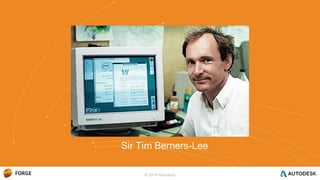
Sir Tim Berners-Lee
“In those days [1980’s], there was different
information on different computers, but you
had to log on to different computers to get at
it. Also, sometimes you had to learn a
different program on each computer. Often it
was just easier to go and ask people when
they were having coffee…”
Sir Tim Berners-Lee
The World Wide Web
© 2016 Autodesk
“In those days [2000’s], there was different
design data on different computers, but you
had to use different computers to get at it.
Also, sometimes you had to use a different
application on each computer. Often it was
just easier to go and ask people when they
were having coffee…”
Adam Nagy
The World Wide Web
© 2016 Autodesk
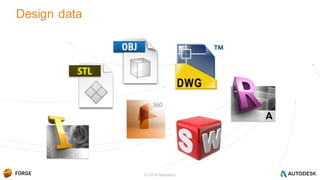
Design data
© 2016 Autodesk
© 2016 Autodesk© 2016 Autodesk
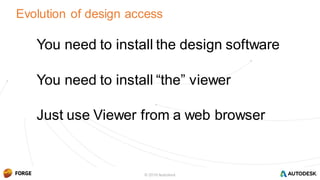
1) You need to install the design software
2) You need to install “the” viewer
3) Just use Viewer from a web browser
Evolution of design access
© 2016 Autodesk
Viewer
© 2016 Autodesk
Design is not just geometry
© 2016 Autodesk
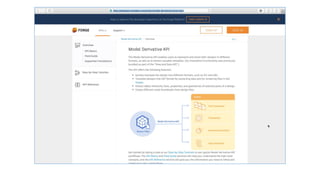
Model Derivative API
=
Design Data Extraction &
Translation
© 2016 Autodesk
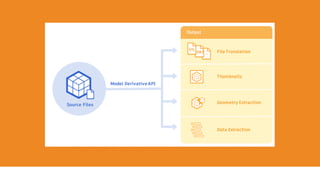
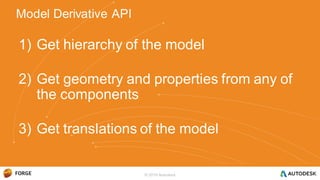
1) Get hierarchy of the model
2) Get geometry and properties from any of
the components
3) Get translations of the model
Model Derivative API
© 2016 Autodesk
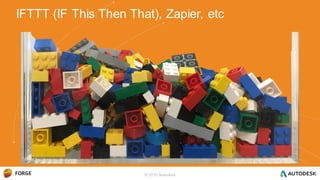
IFTTT (IF This Then That), Zapier, etc
© 2016 Autodesk
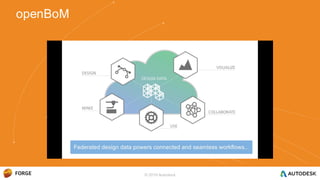
openBoM
© 2016 Autodesk
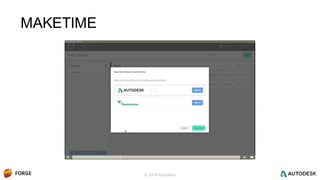
MAKETIME
© 2016 Autodesk
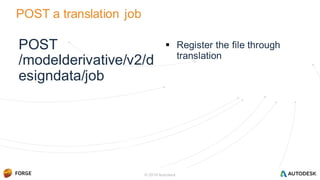
POST a translation job
POST
/modelderivative/v2/d
esigndata/job
 Register the file through
translation
© 2016 Autodesk
© 2016 Autodesk
 In the past we relied on the client-side to
retrieve data from models.
 Server-side available now.
New features with the server side APIs
© 2016 Autodesk
© 2016 Autodesk
 Viewing/Data extraction: 60+ file formats
 OBJ:
 any supported format at component level
 STEP, IGES, STL:
 only specific file types and only at file level
Translation
© 2016 Autodesk
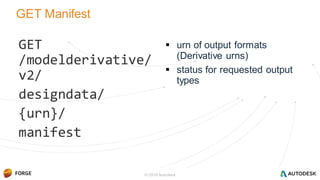
GET Manifest
GET
/modelderivative/
v2/
designdata/
{urn}/
manifest
 urn of output formats
(Derivative urns)
 status for requested output
types
© 2016 Autodesk
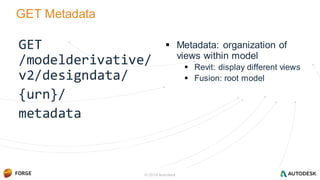
GET Metadata
GET
/modelderivative/
v2/designdata/
{urn}/
metadata
 Metadata: organization of
views within model
 Revit: display different views
 Fusion: root model
© 2016 Autodesk
GET Hierarchy
GET
/modelderivative/
v2/
designdata/
{urn}/
metadata/
{guid}
 Get object tree for specified
metadata guid
© 2016 Autodesk
GET properties
GET
/modelderivative/
v2/
designdata/{urn}/
metadata/{guid}/
properties
 Get the properties of a file
through REST API
 In the past, you needed to
instantiate a viewer instance
or parse the svf file in order
to have access to those
information
© 2016 Autodesk
GET thumbnail
GET
modelderivative/
v2/
designdata/{urn}/
thumbnail?
width=$WIDTH$ &
height=$HEIGHT$
 What if you just want to get
the thumbnail of a model?
© 2016 Autodesk
© 2016 Autodesk
Get Started!
developer.autodesk.com
forge.autodesk.com
@AutodeskForge
facebook.com/adskForge
Forge - DevCon 2016: Free your design data

Forge - DevCon 2016: Free your design data

Editor's Notes

  • #4 Let’s start with a tiny bit of history lesson  Does any of you know the beginning of the World Wide Web? How it came about?
  • #5 So, back in the 1980’s Sir Tim Berners-Lee was working at CERN (European Organization for Nuclear Research, Geneva, Switzerland) where many scientists were working on their research. They all had their own computers and own applications to help them, which is OK, but when it came to sharing the results they gathered, they ran into a problem. They faced the issue of data being locked up in different systems. Sir Tim said… (next slide)
  • #6 How people could got access to data depended on: the computer the data was on and what application they were using. So he introduced a protocol to make communication possible between computers, a client and a server, through Hypertext Transfer Protocol (HTTP) – the system that drives the internet, that thing we now could not live without.
  • #7 In the design world it would look like this
  • #9 Design sharing went through a couple of steps… In the past you needed the specific design software even just to have a look at the model or you could export the file to a more generic format and lose some of the information, sometimes all the meta data inside the model Then file specific viewers were introduced, DWG Viewer, Inventor Viewer, etc (with ADR/Autodesk Design Review you could view in a browser but needed to install an ActiveX component, and only worked in IE) – but then you still needed to install something on your computer As design is going more and more agile, where you have to be in direct contact with your customers, the end users of your product, enabling them to view the models early on and make comments and suggestions that will influence the final product, these previous solutions start to fail. Now with Forge you can get geometric and meta data out of any file and access it from any browser on any device
  • #10 (show the viewer with all the data being accessible, hierarchy, properties, etc)
  • #11 As you’ve seen with the Viewer, design is not just geometry but lots of other information as well. Design also defines the materials you choose, the hierarchy between the components, the manufacturing option of each part, the surface finish to use on the faces, the parameters driving the model, and so on. You might also need to access some of this data programmatically from an application or a service, to integrate all the various components of your design process, without a viewer popping up along the way.
  • #12 And that’s what the Model Derivative API can help you with. All the information you’ve seen in the viewer’s property and hierarchy windows were provided by this service.
  • #14 What was again all the info that the viewer pulled from this service? The hierarchy of the model, all the geometric and meta data of the model. And it can also translate the model into various export formats: STL, STEP, IGES, OBJ, etc (point out that more are coming)
  • #15 In case you are familiar with IFTTT, Zapier or similar solutions which allow you to connect multiple services together to form a complete workflow – well our services can be used like that. They are like lego pieces from which you can choose the ones you need and build something cool from them.
  • #16 The services inside Forge can be
  • #17 The services inside Forge can be
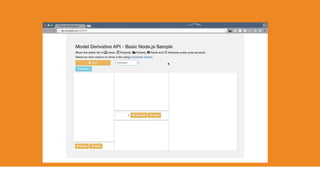
  • #18 http://modelderivative.herokuapp.com
  • #19 { "input": { "urn":"dXJu...56aXA“ }, "output": { "destination": { "region": "us” }, "formats": [{ "type": "svf", "views":["2d","3d"] }] } }
  • #21 There are 50+ formats supported for viewing and data extraction, and many of them are also available for export. OBJ export is possible even at component level so you can pick and choose the components to export, while STEP, IGES and STL can only be done for the whole file – and currently not available for many design file formats.