Fredric H. Jones Tools for Teaching By Carrie Pearson
Biography of Jones Clinical psychologist  Developed and implemented programs for special needs children with mental disorders Univ. of Rochester- working in the areas of nonadversarial  classroom management & teacher training Independent consultant for school districts Author-  Classroom Discipline (1987), Positive Classroom Instruction (1987), Tools for Teaching: Discipline, Instruction, Motivation (2007) A series of DVDs
Jones’ Research Jones research began by observing 2 “natural” teachers who worked with emotionally and educationally handicapped students. Natural Teachers-  Didn’t raise their voices Left the classroom still fresh, compared to other teachers who were burnt out “ mean business” No extensive record keeping, contracts, or tangible reinforcers After weekly observations, after-school brainstorming with teachers, and mini-experiments, Jones ideas began to surface.
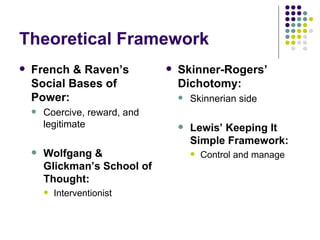
Theoretical Framework French & Raven’s Social Bases of Power: Coercive, reward, and legitimate Wolfgang & Glickman’s School of Thought: Interventionist Skinner-Rogers’ Dichotomy: Skinnerian side Lewis’ Keeping It Simple Framework: Control and manage
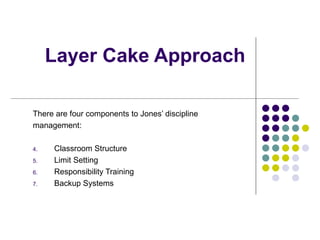
Layer Cake Approach There are four components to Jones’ discipline management: Classroom Structure Limit Setting Responsibility Training Backup Systems
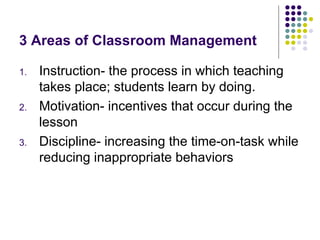
3 Areas of Classroom Management Instruction- the process in which teaching takes place; students learn by doing. Motivation- incentives that occur during the lesson Discipline- increasing the time-on-task while reducing inappropriate behaviors
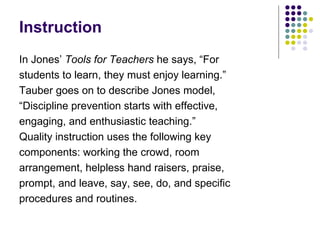
Instruction In Jones’  Tools for Teachers  he says, “For  students to learn, they must enjoy learning.”  Tauber goes on to describe Jones model, “ Discipline prevention starts with effective,  engaging, and enthusiastic teaching.”  Quality instruction uses the following key components: working the crowd, room arrangement, helpless hand raisers, praise,  prompt, and leave, say, see, do, and specific  procedures and routines.
Working the Crowd Natural teachers spend less time in front of the class teaching and more time circulating the room while students are working.  Physical proximity of the teacher is a powerful factor that lessens the chances of students misbehaving.
Room Arrangement Broad walkways- make it easier for a teacher to get from one student to another. Remove furniture barriers between teacher and students. Students desks are near the board for easy conversation b/w teacher and students. Assigned seating. Loop-type set up so the teacher can see everyone’s work.
Helpless Hand Raisers Some students look for your attention as the class begins independent work.  Working with that child can take up to 4 minutes, meanwhile the rest of the class is getting off task.  Using guided practice and praise, prompt, and leave will help those students become more independent workers.
Praise, Prompt, and Leave Jones’ suggests, “be clear, be brief, be gone,” when addressing the questions of the “helpless hand raiser.” Use visual instructional plans- describing the specific steps to solving the problem with a picture for every step and a minimum reliance on words. VIPs are a string of visual prompts a student can access at will- making them less dependent on you and making you more available to work the crowd. *These ideas were taken from Dr. Fred Jones articles “Weaning the Helpless Handraisers, Part 1:  Reinforcing Helplessness,” (10/2003) and “Weaning the Helpless Handraisers, Part 2: Teaching to the  Visual Modality” from  www.Educationworld.com  (11/2003).
See, Say, Do Teaching In a lesson, you tell and show students what to do next, then have them practice it before they forget. Students learn by doing and the teacher continually monitors their performance.  Structured practice includes repetitions of a newly learned skill within a controlled environment by the teacher.  This practice builds confidence in the learner, leading to less helpless hand raising.
Specific Procedures & Routines By practicing routines to mastery, you are telling the students you value the importance of the appropriate behavior and will spend time and energy getting it right. Research shows that highly effective teacher spend most of the first two weeks of the semester practicing routines. Investing time in classroom procedures is an example of proactive versus reactive management. *This information is from Dr. Jones’ article  Rules, Routines, and Standards in Elementary and Secondary Grades , 10/ 2007, posted on  www.Educationworld.com
Motivation Motivation is managed through the use of incentives. Incentives answer the question, "Why should I?" By managing incentives, we can increase the motivation of students to work  hard  while working  conscientiously . -Fred Jones’ article  Positive Discipline: Part 3 No Joy, No Work,  1/ 2006; posted on  www.Educationworld.com
Incentives Informal incentives- most incentives in life.  In a family an informal incentive is love. Formal incentives- an agreed upon exchange of goods and services (i.e. a paycheck). Proactive incentives- are established in advance (i.e.- “you have to finish your homework before you can watch tv”) Reactive incentives- an exchange happening in the heat of the moment (i.e.- often ends up with a bribe, a child refuses to clean his room, mother and son argue, mother offers him money and now he cleans his room)  * Positive Discipline: Part 3 No Joy, No Work,  1/ 2006; posted on  www.Educationworld.com
Preferred Activity Time (PAT) PAT is the incentive program designed to keep students motivated in the classroom.  It is a way to reinforce time management responsibility among the students.  The students earn PAT for quickly transitioning or finishing early with their work.  Jones’ PAT model encourages students to make their own responsible choices along with classroom collaboration- earning more or losing time for their behaviors.  In order for this technique to work, the teacher must establish clear routines and expectations so the class will understand what is at stake.  PAT activities should be enjoyable for the students.
Preferred Activity Time Examples Art projects Computer time Science projects Learning centers Learning games Reading & writing for pleasure Helping the teacher Preferred Activity Time must be fun for the students!  Jones’ says, “Having fun with learning amounts to enlightened self-interest.” * Positive Discipline: Part 3 No Joy, No Work,  1/ 2006; posted on  www.Educationworld.com
Discipline In Jones’ article,  Responsibility Training: Part 1 Incentives Teach Lessons,  he states: “ There are only two things you can do with a behavior. You can increase it or you can decrease it. If you consistently increase the behaviors you want, and consistently decrease the behaviors you do not want, sooner or later you will be left with what you want.”
Meaning Business Meaning Business means: Efficiently dealing with the daily misbehaviors of students Working smart, not working hard Self-preservation Remaining calm for effective classroom management

Fredric h jones power point(backup)

  • 1.
    Fredric H. JonesTools for Teaching By Carrie Pearson
  • 2.
    Biography of JonesClinical psychologist Developed and implemented programs for special needs children with mental disorders Univ. of Rochester- working in the areas of nonadversarial classroom management & teacher training Independent consultant for school districts Author- Classroom Discipline (1987), Positive Classroom Instruction (1987), Tools for Teaching: Discipline, Instruction, Motivation (2007) A series of DVDs
  • 3.
    Jones’ Research Jonesresearch began by observing 2 “natural” teachers who worked with emotionally and educationally handicapped students. Natural Teachers- Didn’t raise their voices Left the classroom still fresh, compared to other teachers who were burnt out “ mean business” No extensive record keeping, contracts, or tangible reinforcers After weekly observations, after-school brainstorming with teachers, and mini-experiments, Jones ideas began to surface.
  • 4.
    Theoretical Framework French& Raven’s Social Bases of Power: Coercive, reward, and legitimate Wolfgang & Glickman’s School of Thought: Interventionist Skinner-Rogers’ Dichotomy: Skinnerian side Lewis’ Keeping It Simple Framework: Control and manage
  • 5.
    Layer Cake ApproachThere are four components to Jones’ discipline management: Classroom Structure Limit Setting Responsibility Training Backup Systems
  • 6.
    3 Areas ofClassroom Management Instruction- the process in which teaching takes place; students learn by doing. Motivation- incentives that occur during the lesson Discipline- increasing the time-on-task while reducing inappropriate behaviors
  • 7.
    Instruction In Jones’ Tools for Teachers he says, “For students to learn, they must enjoy learning.” Tauber goes on to describe Jones model, “ Discipline prevention starts with effective, engaging, and enthusiastic teaching.” Quality instruction uses the following key components: working the crowd, room arrangement, helpless hand raisers, praise, prompt, and leave, say, see, do, and specific procedures and routines.
  • 8.
    Working the CrowdNatural teachers spend less time in front of the class teaching and more time circulating the room while students are working. Physical proximity of the teacher is a powerful factor that lessens the chances of students misbehaving.
  • 9.
    Room Arrangement Broadwalkways- make it easier for a teacher to get from one student to another. Remove furniture barriers between teacher and students. Students desks are near the board for easy conversation b/w teacher and students. Assigned seating. Loop-type set up so the teacher can see everyone’s work.
  • 10.
    Helpless Hand RaisersSome students look for your attention as the class begins independent work. Working with that child can take up to 4 minutes, meanwhile the rest of the class is getting off task. Using guided practice and praise, prompt, and leave will help those students become more independent workers.
  • 11.
    Praise, Prompt, andLeave Jones’ suggests, “be clear, be brief, be gone,” when addressing the questions of the “helpless hand raiser.” Use visual instructional plans- describing the specific steps to solving the problem with a picture for every step and a minimum reliance on words. VIPs are a string of visual prompts a student can access at will- making them less dependent on you and making you more available to work the crowd. *These ideas were taken from Dr. Fred Jones articles “Weaning the Helpless Handraisers, Part 1: Reinforcing Helplessness,” (10/2003) and “Weaning the Helpless Handraisers, Part 2: Teaching to the Visual Modality” from www.Educationworld.com (11/2003).
  • 12.
    See, Say, DoTeaching In a lesson, you tell and show students what to do next, then have them practice it before they forget. Students learn by doing and the teacher continually monitors their performance. Structured practice includes repetitions of a newly learned skill within a controlled environment by the teacher. This practice builds confidence in the learner, leading to less helpless hand raising.
  • 13.
    Specific Procedures &Routines By practicing routines to mastery, you are telling the students you value the importance of the appropriate behavior and will spend time and energy getting it right. Research shows that highly effective teacher spend most of the first two weeks of the semester practicing routines. Investing time in classroom procedures is an example of proactive versus reactive management. *This information is from Dr. Jones’ article Rules, Routines, and Standards in Elementary and Secondary Grades , 10/ 2007, posted on www.Educationworld.com
  • 14.
    Motivation Motivation ismanaged through the use of incentives. Incentives answer the question, "Why should I?" By managing incentives, we can increase the motivation of students to work hard while working conscientiously . -Fred Jones’ article Positive Discipline: Part 3 No Joy, No Work, 1/ 2006; posted on www.Educationworld.com
  • 15.
    Incentives Informal incentives-most incentives in life. In a family an informal incentive is love. Formal incentives- an agreed upon exchange of goods and services (i.e. a paycheck). Proactive incentives- are established in advance (i.e.- “you have to finish your homework before you can watch tv”) Reactive incentives- an exchange happening in the heat of the moment (i.e.- often ends up with a bribe, a child refuses to clean his room, mother and son argue, mother offers him money and now he cleans his room) * Positive Discipline: Part 3 No Joy, No Work, 1/ 2006; posted on www.Educationworld.com
  • 16.
    Preferred Activity Time(PAT) PAT is the incentive program designed to keep students motivated in the classroom. It is a way to reinforce time management responsibility among the students. The students earn PAT for quickly transitioning or finishing early with their work. Jones’ PAT model encourages students to make their own responsible choices along with classroom collaboration- earning more or losing time for their behaviors. In order for this technique to work, the teacher must establish clear routines and expectations so the class will understand what is at stake. PAT activities should be enjoyable for the students.
  • 17.
    Preferred Activity TimeExamples Art projects Computer time Science projects Learning centers Learning games Reading & writing for pleasure Helping the teacher Preferred Activity Time must be fun for the students! Jones’ says, “Having fun with learning amounts to enlightened self-interest.” * Positive Discipline: Part 3 No Joy, No Work, 1/ 2006; posted on www.Educationworld.com
  • 18.
    Discipline In Jones’article, Responsibility Training: Part 1 Incentives Teach Lessons, he states: “ There are only two things you can do with a behavior. You can increase it or you can decrease it. If you consistently increase the behaviors you want, and consistently decrease the behaviors you do not want, sooner or later you will be left with what you want.”
  • 19.
    Meaning Business MeaningBusiness means: Efficiently dealing with the daily misbehaviors of students Working smart, not working hard Self-preservation Remaining calm for effective classroom management