Building a Positive Behaviour Classroom
Approaches to
Behaviour
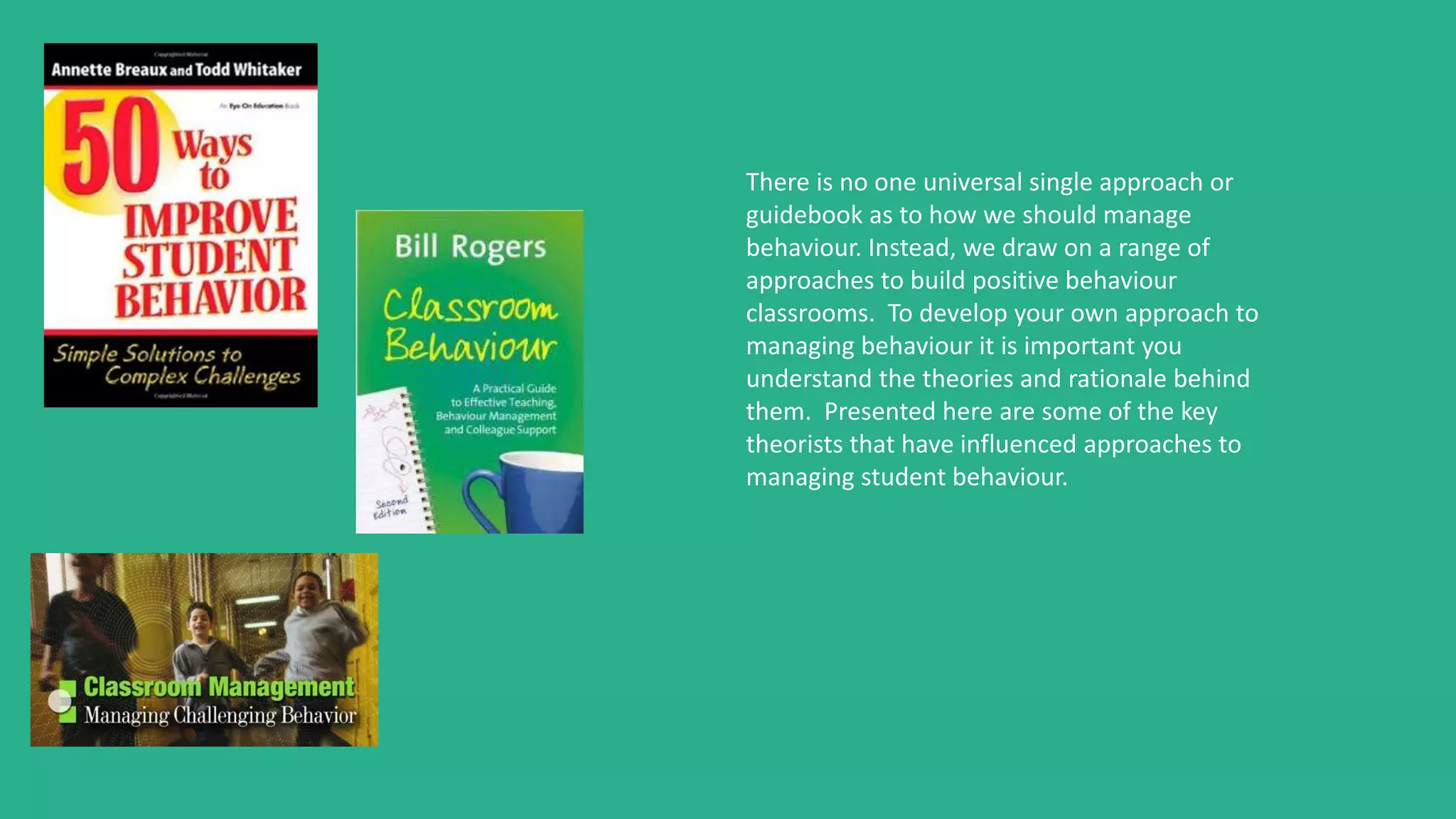
There is no one universal single approach or
guidebook as to how we should manage
behaviour. Instead, we draw on a range of
approaches to build positive behaviour
classrooms. To develop your own approach to
managing behaviour it is important you
understand the theories and rationale behind
them. Presented here are some of the key
theorists that have influenced approaches to
managing student behaviour.
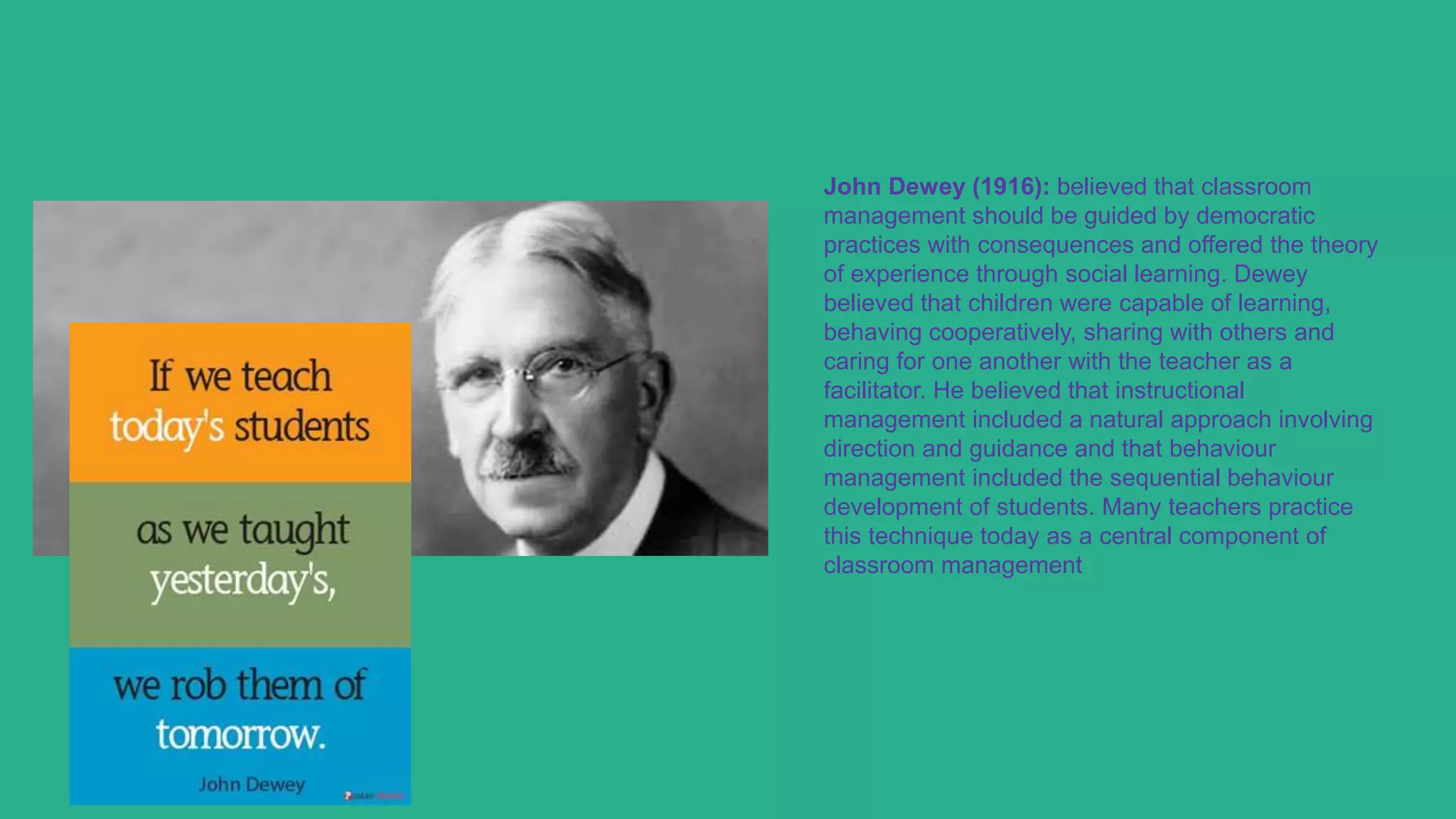
John Dewey (1916): believed that classroom
management should be guided by democratic
practices with consequences and offered the theory
of experience through social learning. Dewey
believed that children were capable of learning,
behaving cooperatively, sharing with others and
caring for one another with the teacher as a
facilitator. He believed that instructional
management included a natural approach involving
direction and guidance and that behaviour
management included the sequential behaviour
development of students. Many teachers practice
this technique today as a central component of
classroom management
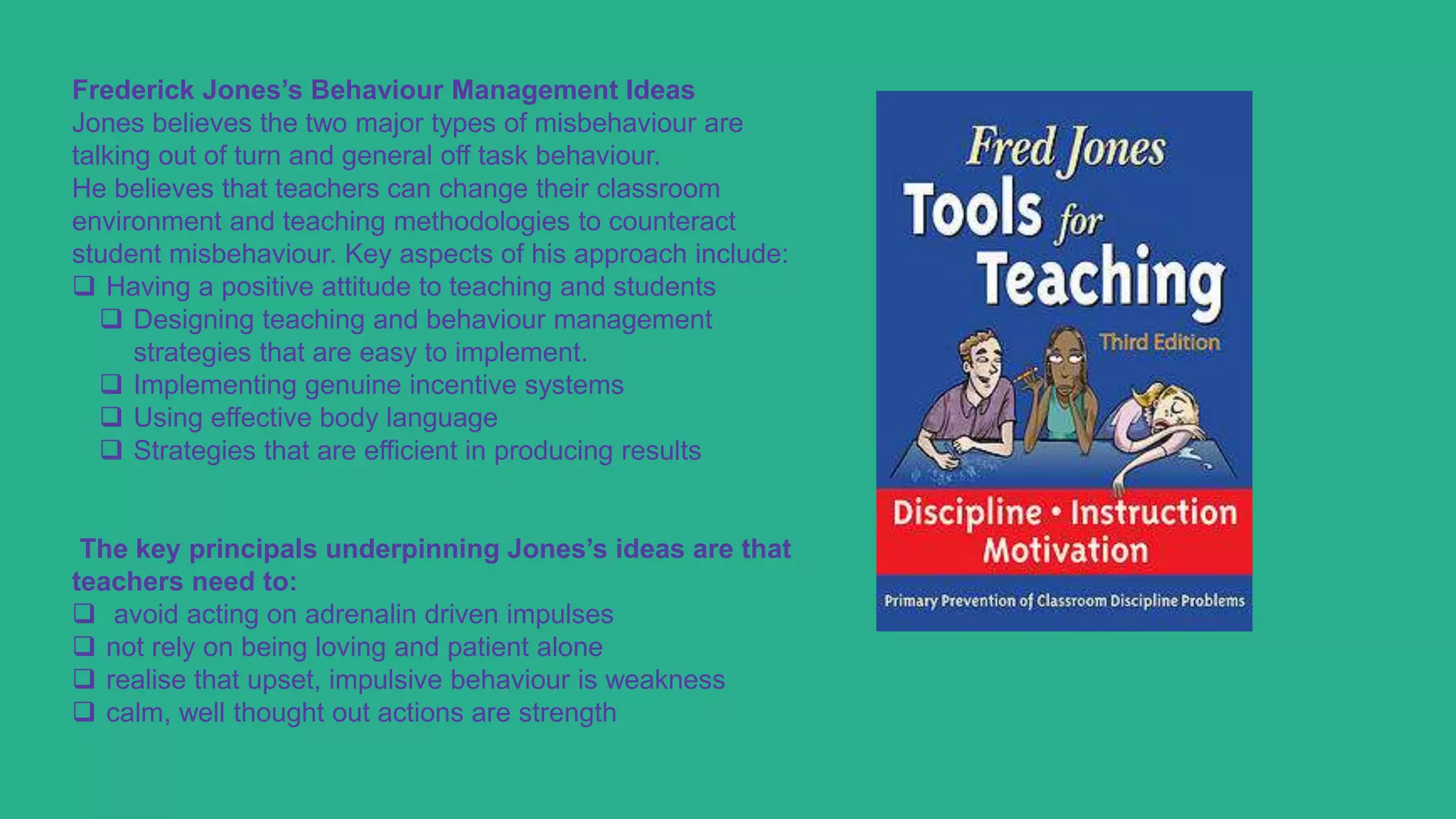
Frederick Jones’s Behaviour Management Ideas
Jones believes the two major types of misbehaviour are
talking out of turn and general off task behaviour.
He believes that teachers can change their classroom
environment and teaching methodologies to counteract
student misbehaviour. Key aspects of his approach include:
 Having a positive attitude to teaching and students
 Designing teaching and behaviour management
strategies that are easy to implement.
 Implementing genuine incentive systems
 Using effective body language
 Strategies that are efficient in producing results
The key principals underpinning Jones’s ideas are that
teachers need to:
 avoid acting on adrenalin driven impulses
 not rely on being loving and patient alone
 realise that upset, impulsive behaviour is weakness
 calm, well thought out actions are strength
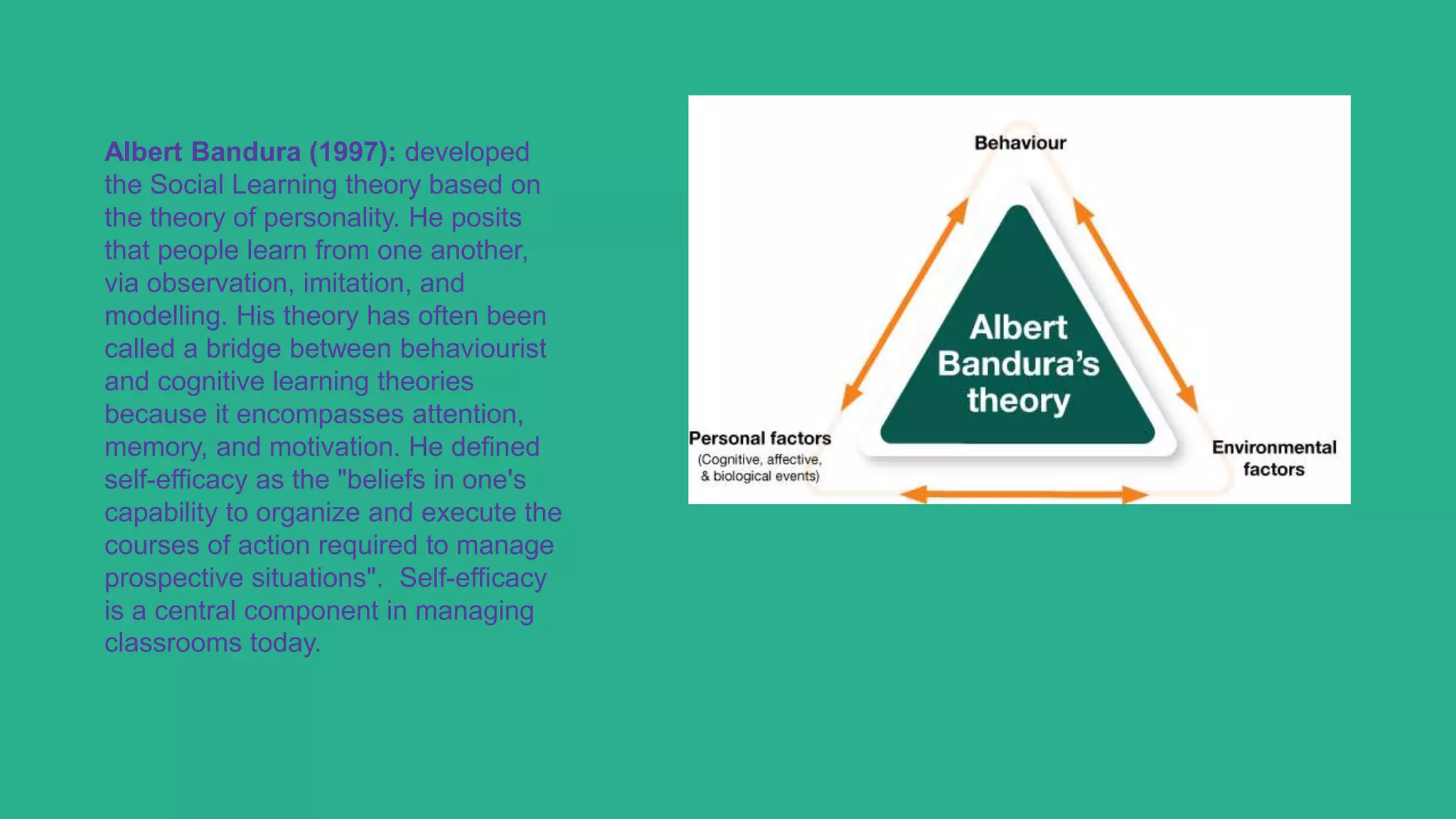
Albert Bandura (1997): developed
the Social Learning theory based on
the theory of personality. He posits
that people learn from one another,
via observation, imitation, and
modelling. His theory has often been
called a bridge between behaviourist
and cognitive learning theories
because it encompasses attention,
memory, and motivation. He defined
self-efficacy as the "beliefs in one's
capability to organize and execute the
courses of action required to manage
prospective situations". Self-efficacy
is a central component in managing
classrooms today.
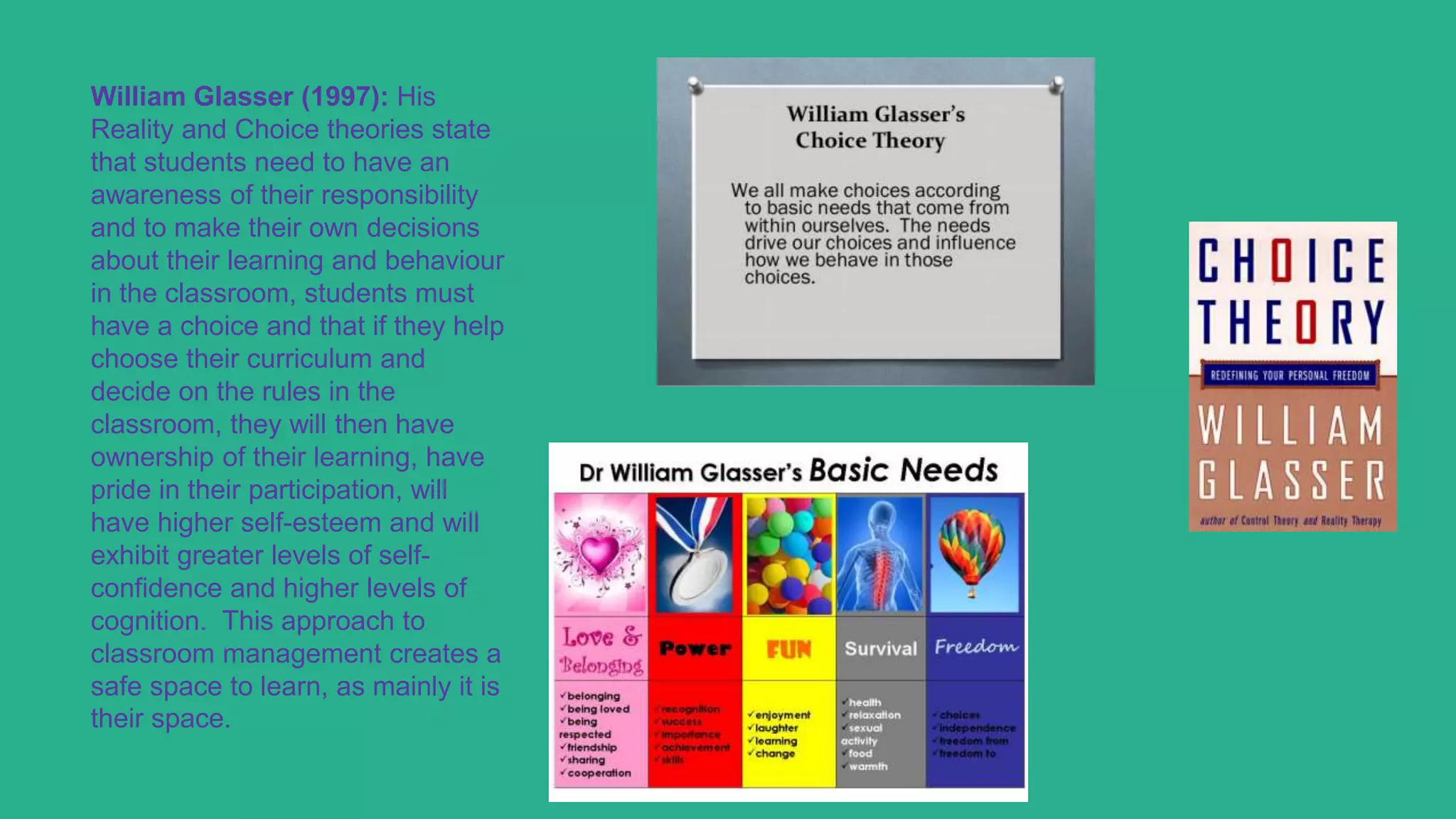
William Glasser (1997): His
Reality and Choice theories state
that students need to have an
awareness of their responsibility
and to make their own decisions
about their learning and behaviour
in the classroom, students must
have a choice and that if they help
choose their curriculum and
decide on the rules in the
classroom, they will then have
ownership of their learning, have
pride in their participation, will
have higher self-esteem and will
exhibit greater levels of self-
confidence and higher levels of
cognition. This approach to
classroom management creates a
safe space to learn, as mainly it is
their space.
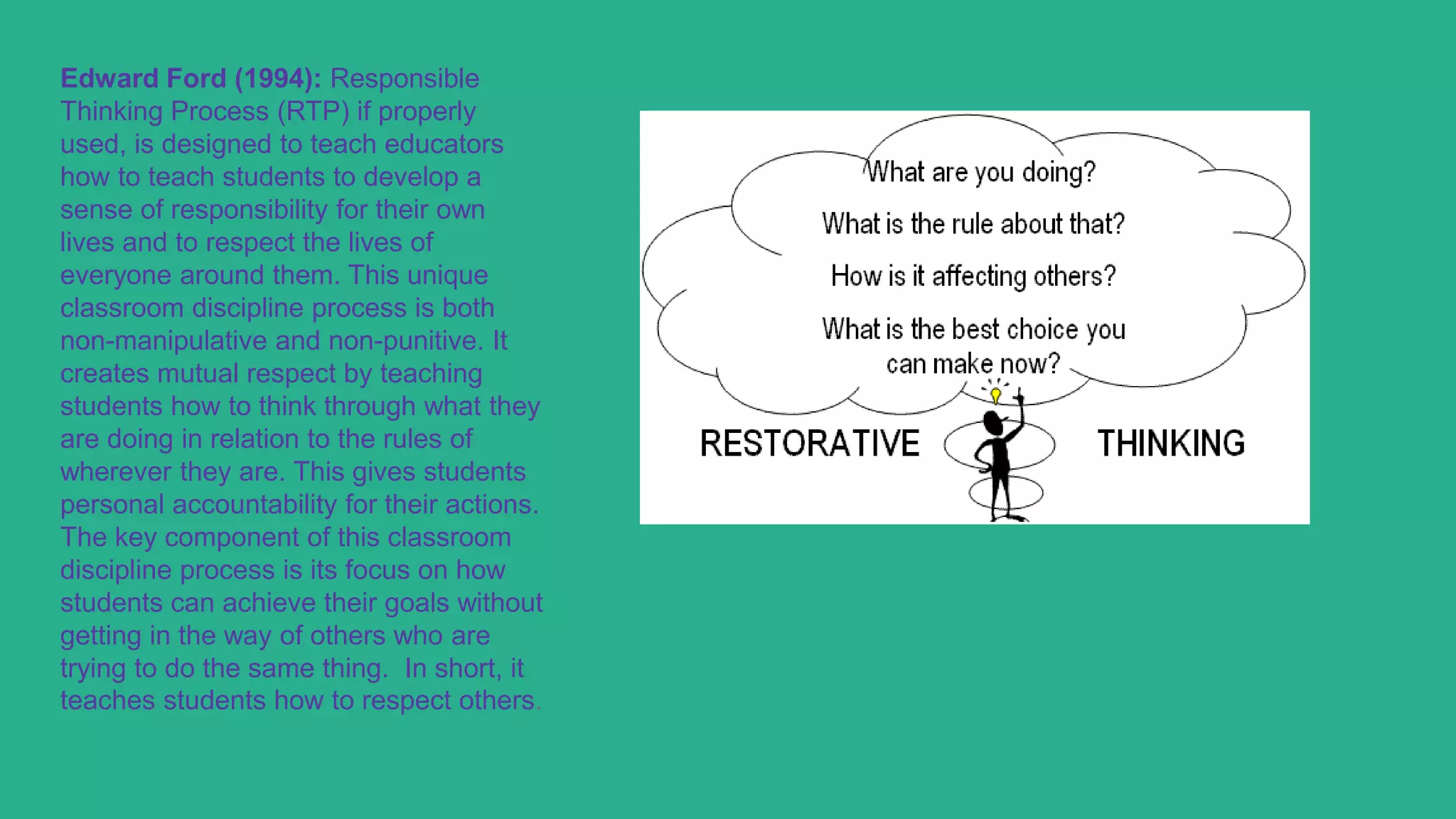
Edward Ford (1994): Responsible
Thinking Process (RTP) if properly
used, is designed to teach educators
how to teach students to develop a
sense of responsibility for their own
lives and to respect the lives of
everyone around them. This unique
classroom discipline process is both
non-manipulative and non-punitive. It
creates mutual respect by teaching
students how to think through what they
are doing in relation to the rules of
wherever they are. This gives students
personal accountability for their actions.
The key component of this classroom
discipline process is its focus on how
students can achieve their goals without
getting in the way of others who are
trying to do the same thing. In short, it
teaches students how to respect others.
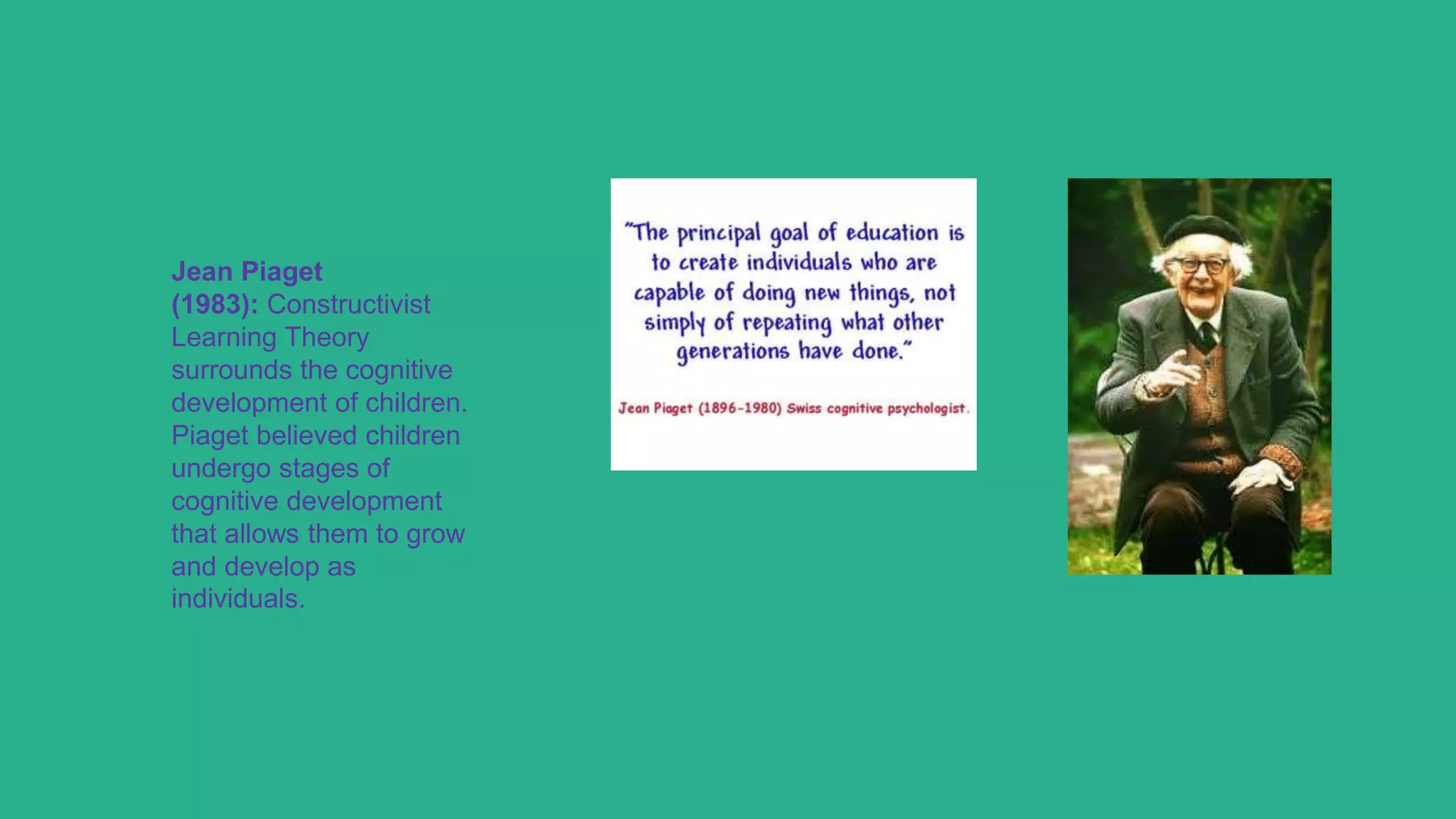
Jean Piaget
(1983): Constructivist
Learning Theory
surrounds the cognitive
development of children.
Piaget believed children
undergo stages of
cognitive development
that allows them to grow
and develop as
individuals.
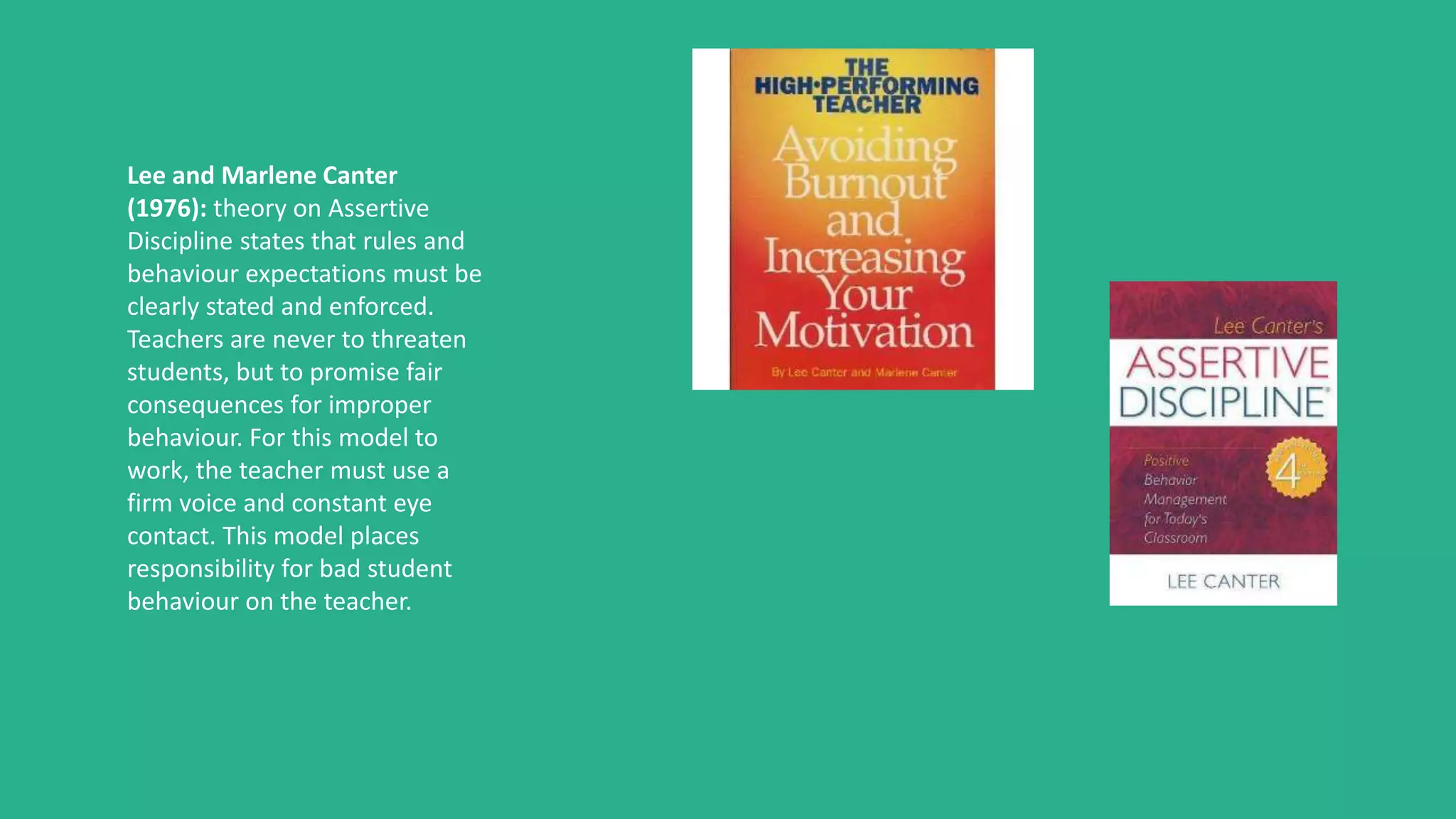
Lee and Marlene Canter
(1976): theory on Assertive
Discipline states that rules and
behaviour expectations must be
clearly stated and enforced.
Teachers are never to threaten
students, but to promise fair
consequences for improper
behaviour. For this model to
work, the teacher must use a
firm voice and constant eye
contact. This model places
responsibility for bad student
behaviour on the teacher.
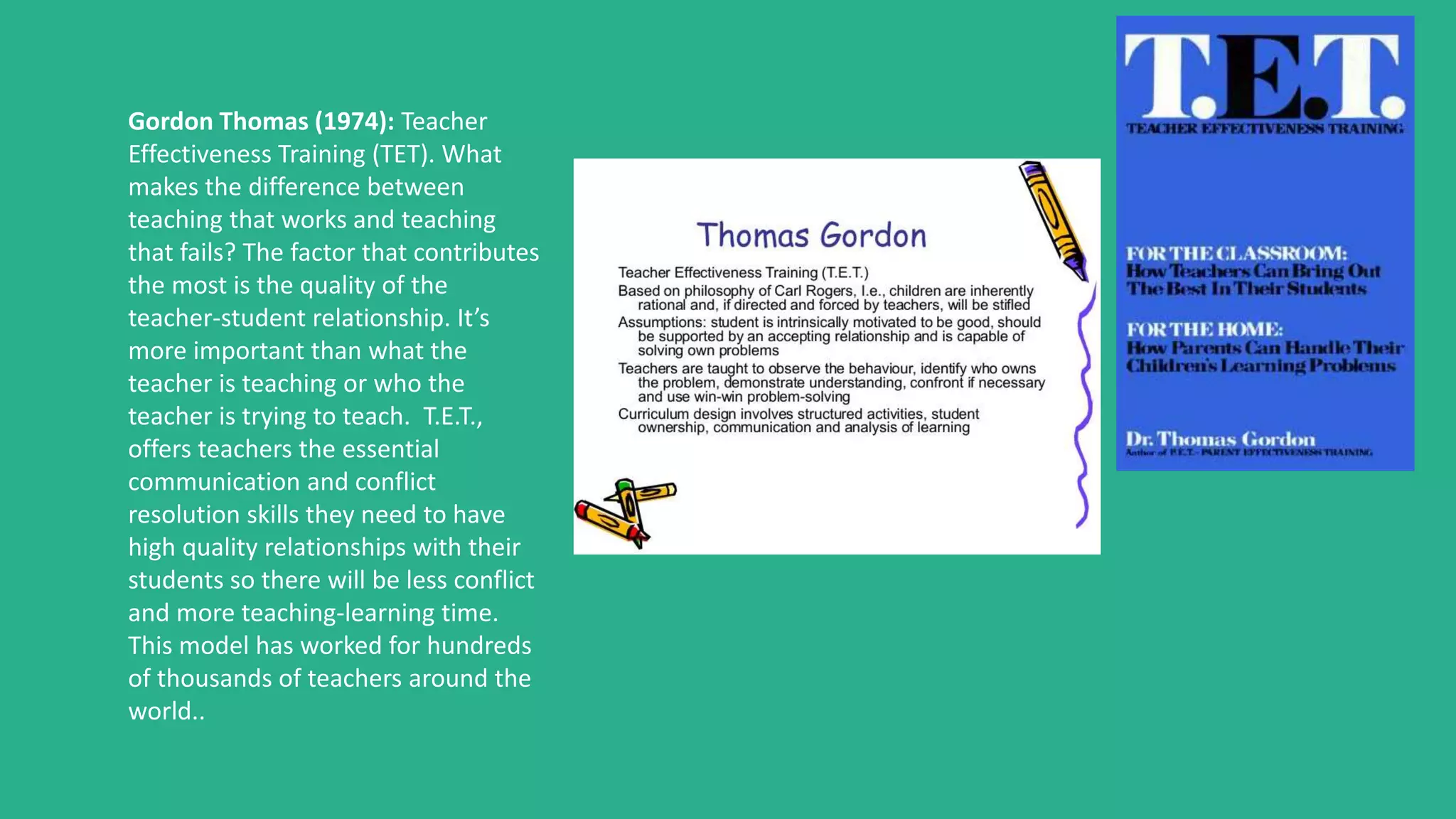
Gordon Thomas (1974): Teacher
Effectiveness Training (TET). What
makes the difference between
teaching that works and teaching
that fails? The factor that contributes
the most is the quality of the
teacher-student relationship. It’s
more important than what the
teacher is teaching or who the
teacher is trying to teach. T.E.T.,
offers teachers the essential
communication and conflict
resolution skills they need to have
high quality relationships with their
students so there will be less conflict
and more teaching-learning time.
This model has worked for hundreds
of thousands of teachers around the
world..
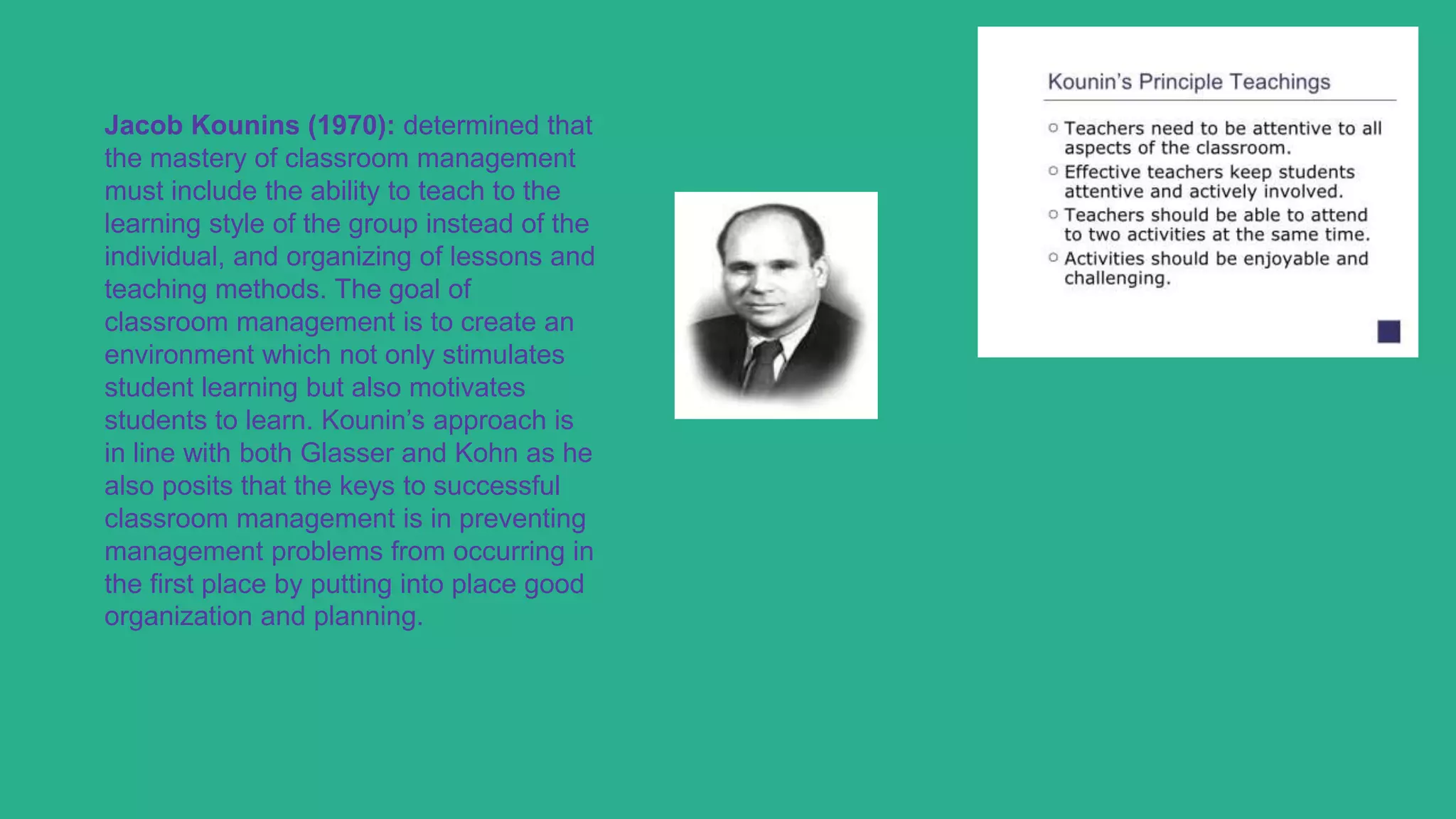
Jacob Kounins (1970): determined that
the mastery of classroom management
must include the ability to teach to the
learning style of the group instead of the
individual, and organizing of lessons and
teaching methods. The goal of
classroom management is to create an
environment which not only stimulates
student learning but also motivates
students to learn. Kounin’s approach is
in line with both Glasser and Kohn as he
also posits that the keys to successful
classroom management is in preventing
management problems from occurring in
the first place by putting into place good
organization and planning.
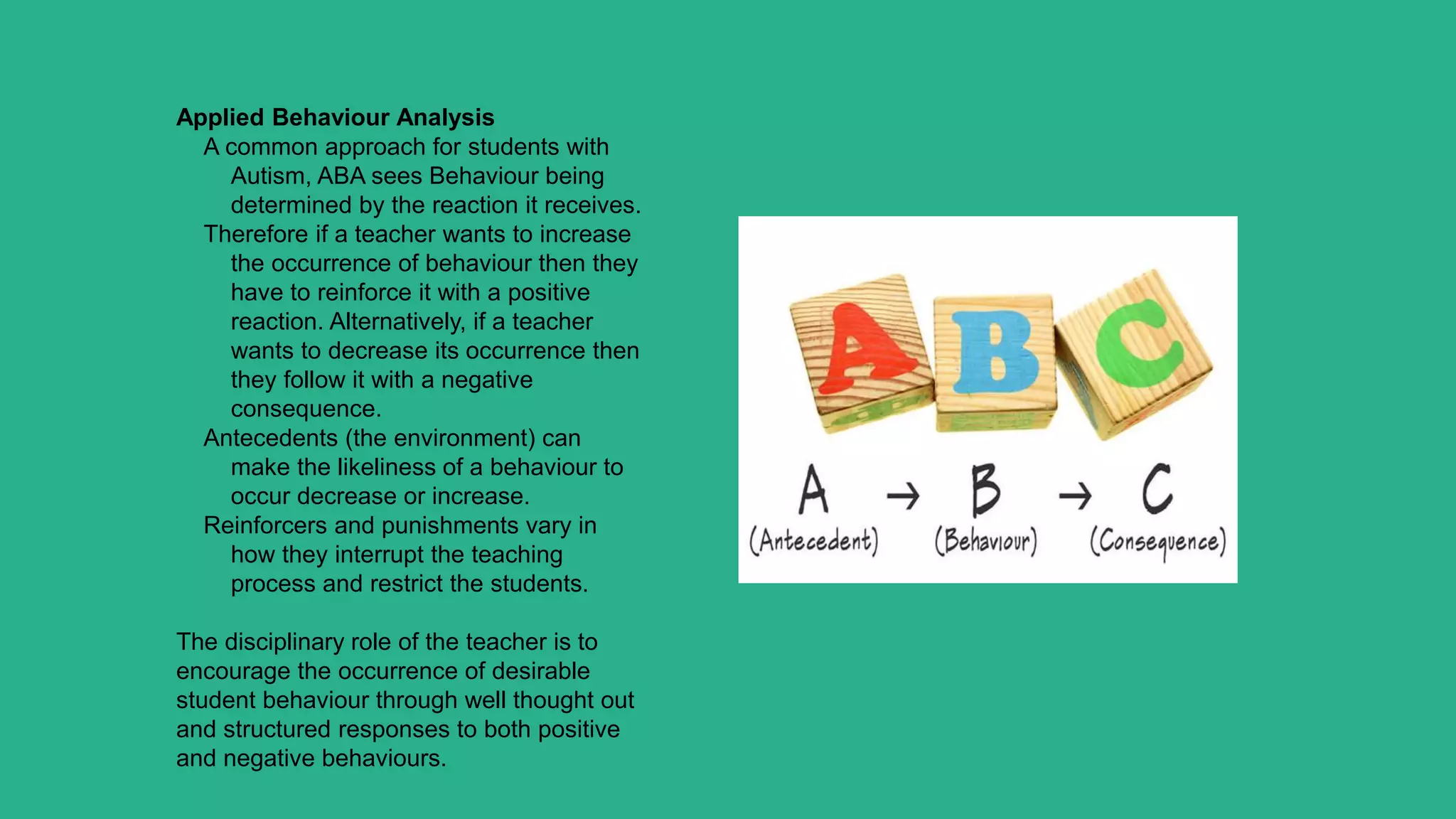
Applied Behaviour Analysis
A common approach for students with
Autism, ABA sees Behaviour being
determined by the reaction it receives.
Therefore if a teacher wants to increase
the occurrence of behaviour then they
have to reinforce it with a positive
reaction. Alternatively, if a teacher
wants to decrease its occurrence then
they follow it with a negative
consequence.
Antecedents (the environment) can
make the likeliness of a behaviour to
occur decrease or increase.
Reinforcers and punishments vary in
how they interrupt the teaching
process and restrict the students.
The disciplinary role of the teacher is to
encourage the occurrence of desirable
student behaviour through well thought out
and structured responses to both positive
and negative behaviours.
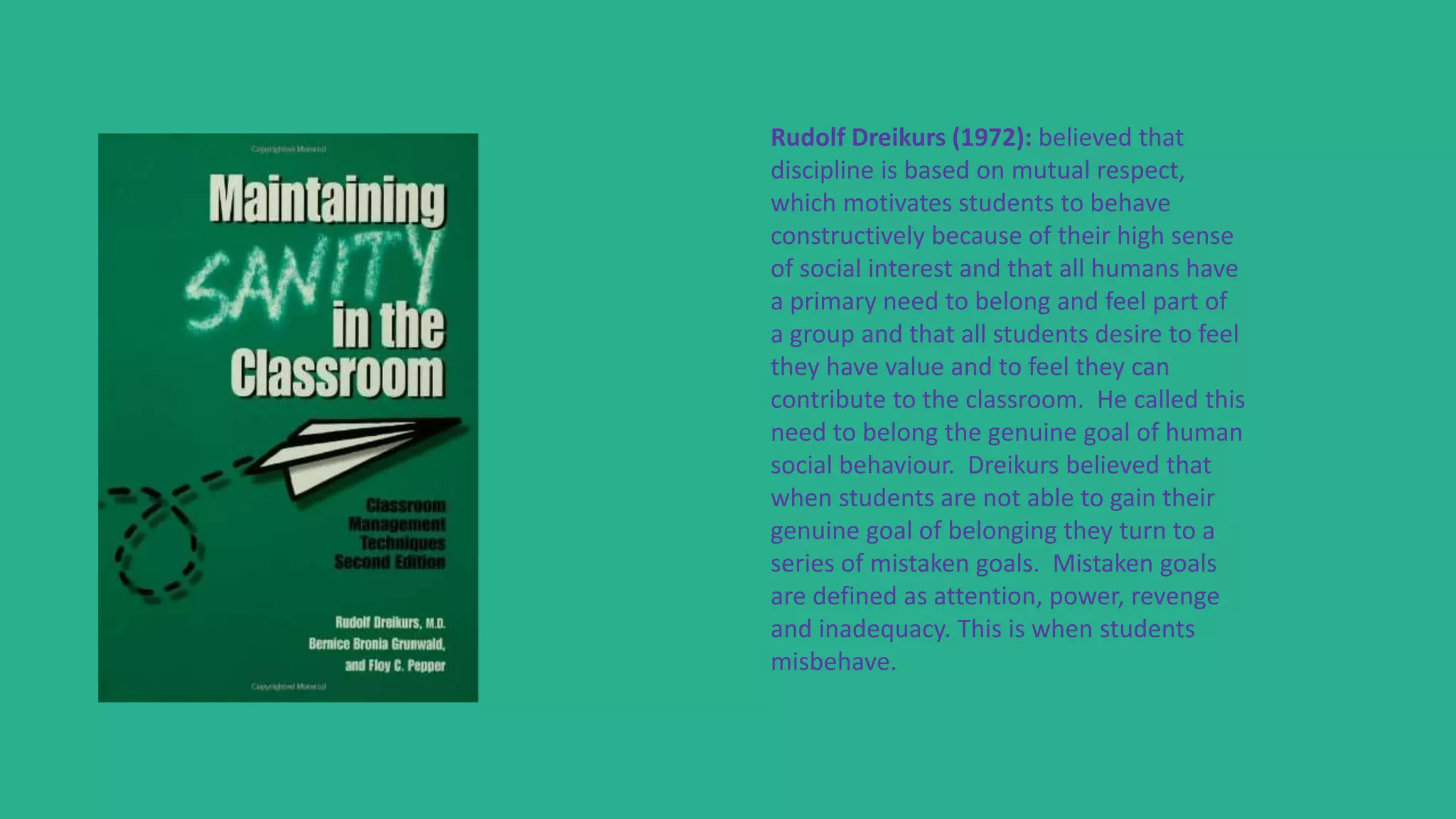
Rudolf Dreikurs (1972): believed that
discipline is based on mutual respect,
which motivates students to behave
constructively because of their high sense
of social interest and that all humans have
a primary need to belong and feel part of
a group and that all students desire to feel
they have value and to feel they can
contribute to the classroom. He called this
need to belong the genuine goal of human
social behaviour. Dreikurs believed that
when students are not able to gain their
genuine goal of belonging they turn to a
series of mistaken goals. Mistaken goals
are defined as attention, power, revenge
and inadequacy. This is when students
misbehave.
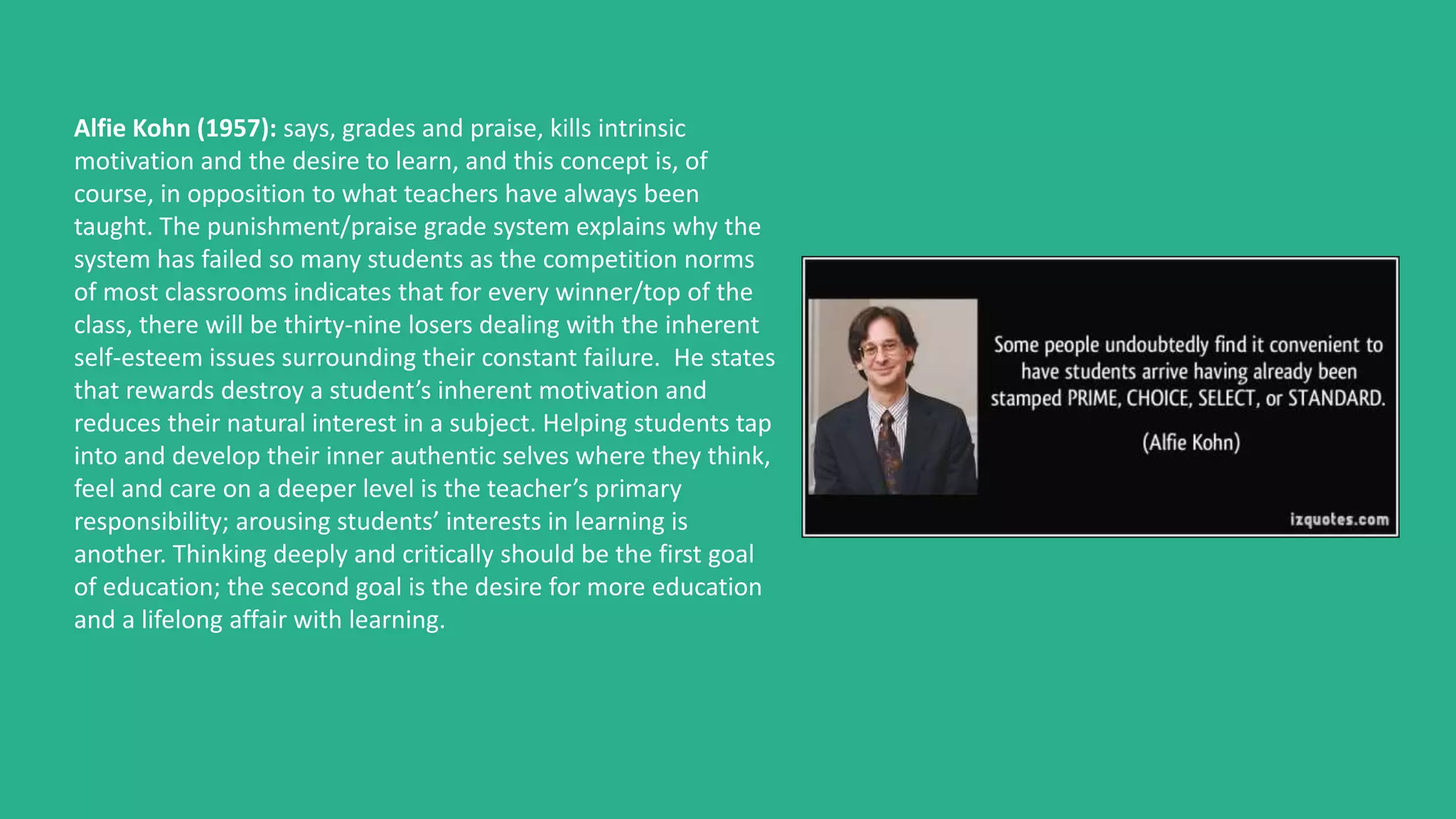
Alfie Kohn (1957): says, grades and praise, kills intrinsic
motivation and the desire to learn, and this concept is, of
course, in opposition to what teachers have always been
taught. The punishment/praise grade system explains why the
system has failed so many students as the competition norms
of most classrooms indicates that for every winner/top of the
class, there will be thirty-nine losers dealing with the inherent
self-esteem issues surrounding their constant failure. He states
that rewards destroy a student’s inherent motivation and
reduces their natural interest in a subject. Helping students tap
into and develop their inner authentic selves where they think,
feel and care on a deeper level is the teacher’s primary
responsibility; arousing students’ interests in learning is
another. Thinking deeply and critically should be the first goal
of education; the second goal is the desire for more education
and a lifelong affair with learning.
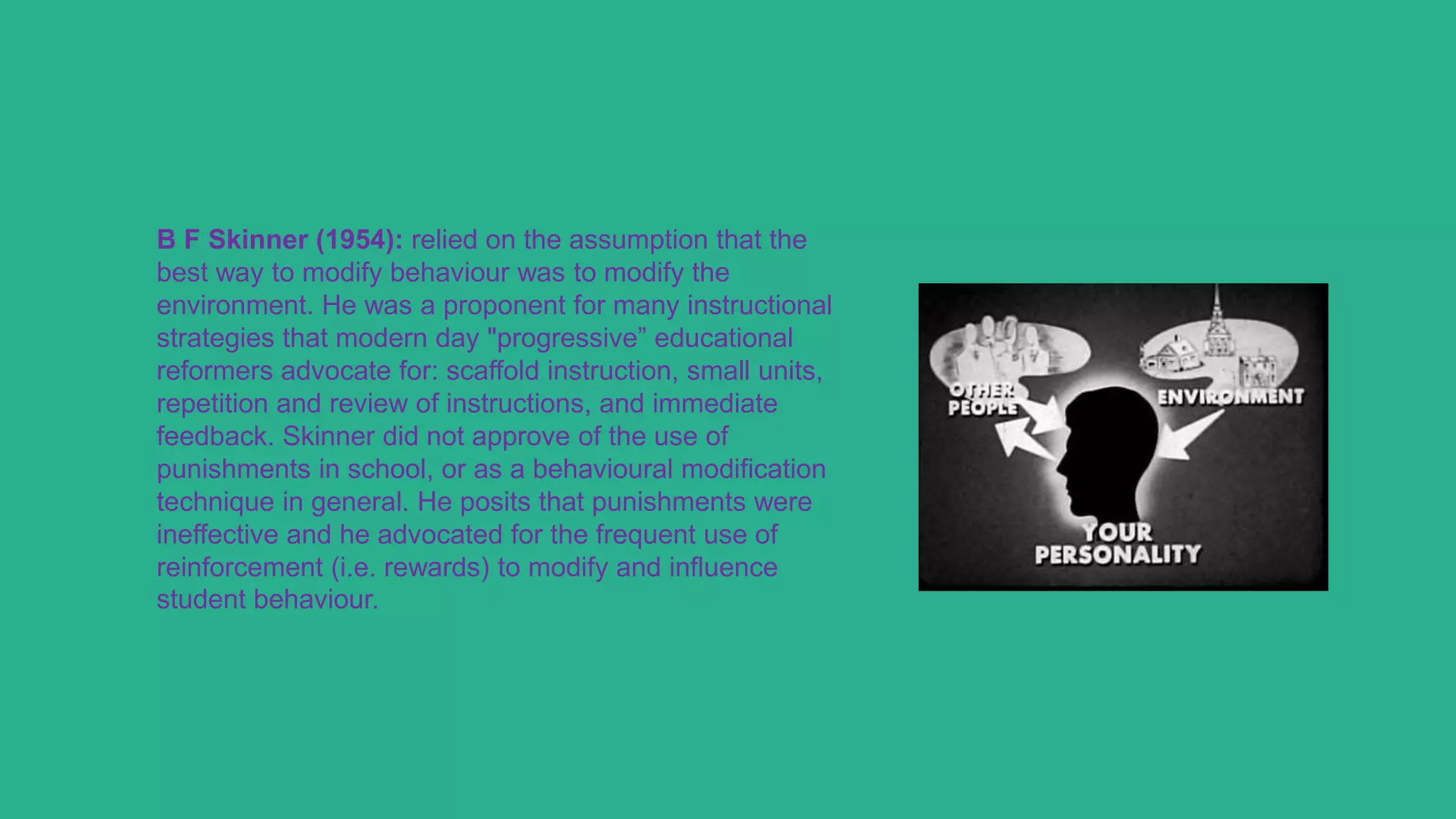
B F Skinner (1954): relied on the assumption that the
best way to modify behaviour was to modify the
environment. He was a proponent for many instructional
strategies that modern day "progressive” educational
reformers advocate for: scaffold instruction, small units,
repetition and review of instructions, and immediate
feedback. Skinner did not approve of the use of
punishments in school, or as a behavioural modification
technique in general. He posits that punishments were
ineffective and he advocated for the frequent use of
reinforcement (i.e. rewards) to modify and influence
student behaviour.

Approaches to behaviour Management

  • 1.
    Building a PositiveBehaviour Classroom Approaches to Behaviour
  • 2.
    There is noone universal single approach or guidebook as to how we should manage behaviour. Instead, we draw on a range of approaches to build positive behaviour classrooms. To develop your own approach to managing behaviour it is important you understand the theories and rationale behind them. Presented here are some of the key theorists that have influenced approaches to managing student behaviour.
  • 3.
    John Dewey (1916):believed that classroom management should be guided by democratic practices with consequences and offered the theory of experience through social learning. Dewey believed that children were capable of learning, behaving cooperatively, sharing with others and caring for one another with the teacher as a facilitator. He believed that instructional management included a natural approach involving direction and guidance and that behaviour management included the sequential behaviour development of students. Many teachers practice this technique today as a central component of classroom management
  • 4.
    Frederick Jones’s BehaviourManagement Ideas Jones believes the two major types of misbehaviour are talking out of turn and general off task behaviour. He believes that teachers can change their classroom environment and teaching methodologies to counteract student misbehaviour. Key aspects of his approach include:  Having a positive attitude to teaching and students  Designing teaching and behaviour management strategies that are easy to implement.  Implementing genuine incentive systems  Using effective body language  Strategies that are efficient in producing results The key principals underpinning Jones’s ideas are that teachers need to:  avoid acting on adrenalin driven impulses  not rely on being loving and patient alone  realise that upset, impulsive behaviour is weakness  calm, well thought out actions are strength
  • 5.
    Albert Bandura (1997):developed the Social Learning theory based on the theory of personality. He posits that people learn from one another, via observation, imitation, and modelling. His theory has often been called a bridge between behaviourist and cognitive learning theories because it encompasses attention, memory, and motivation. He defined self-efficacy as the "beliefs in one's capability to organize and execute the courses of action required to manage prospective situations". Self-efficacy is a central component in managing classrooms today.
  • 6.
    William Glasser (1997):His Reality and Choice theories state that students need to have an awareness of their responsibility and to make their own decisions about their learning and behaviour in the classroom, students must have a choice and that if they help choose their curriculum and decide on the rules in the classroom, they will then have ownership of their learning, have pride in their participation, will have higher self-esteem and will exhibit greater levels of self- confidence and higher levels of cognition. This approach to classroom management creates a safe space to learn, as mainly it is their space.
  • 7.
    Edward Ford (1994):Responsible Thinking Process (RTP) if properly used, is designed to teach educators how to teach students to develop a sense of responsibility for their own lives and to respect the lives of everyone around them. This unique classroom discipline process is both non-manipulative and non-punitive. It creates mutual respect by teaching students how to think through what they are doing in relation to the rules of wherever they are. This gives students personal accountability for their actions. The key component of this classroom discipline process is its focus on how students can achieve their goals without getting in the way of others who are trying to do the same thing. In short, it teaches students how to respect others.
  • 8.
    Jean Piaget (1983): Constructivist LearningTheory surrounds the cognitive development of children. Piaget believed children undergo stages of cognitive development that allows them to grow and develop as individuals.
  • 9.
    Lee and MarleneCanter (1976): theory on Assertive Discipline states that rules and behaviour expectations must be clearly stated and enforced. Teachers are never to threaten students, but to promise fair consequences for improper behaviour. For this model to work, the teacher must use a firm voice and constant eye contact. This model places responsibility for bad student behaviour on the teacher.
  • 10.
    Gordon Thomas (1974):Teacher Effectiveness Training (TET). What makes the difference between teaching that works and teaching that fails? The factor that contributes the most is the quality of the teacher-student relationship. It’s more important than what the teacher is teaching or who the teacher is trying to teach. T.E.T., offers teachers the essential communication and conflict resolution skills they need to have high quality relationships with their students so there will be less conflict and more teaching-learning time. This model has worked for hundreds of thousands of teachers around the world..
  • 11.
    Jacob Kounins (1970):determined that the mastery of classroom management must include the ability to teach to the learning style of the group instead of the individual, and organizing of lessons and teaching methods. The goal of classroom management is to create an environment which not only stimulates student learning but also motivates students to learn. Kounin’s approach is in line with both Glasser and Kohn as he also posits that the keys to successful classroom management is in preventing management problems from occurring in the first place by putting into place good organization and planning.
  • 12.
    Applied Behaviour Analysis Acommon approach for students with Autism, ABA sees Behaviour being determined by the reaction it receives. Therefore if a teacher wants to increase the occurrence of behaviour then they have to reinforce it with a positive reaction. Alternatively, if a teacher wants to decrease its occurrence then they follow it with a negative consequence. Antecedents (the environment) can make the likeliness of a behaviour to occur decrease or increase. Reinforcers and punishments vary in how they interrupt the teaching process and restrict the students. The disciplinary role of the teacher is to encourage the occurrence of desirable student behaviour through well thought out and structured responses to both positive and negative behaviours.
  • 13.
    Rudolf Dreikurs (1972):believed that discipline is based on mutual respect, which motivates students to behave constructively because of their high sense of social interest and that all humans have a primary need to belong and feel part of a group and that all students desire to feel they have value and to feel they can contribute to the classroom. He called this need to belong the genuine goal of human social behaviour. Dreikurs believed that when students are not able to gain their genuine goal of belonging they turn to a series of mistaken goals. Mistaken goals are defined as attention, power, revenge and inadequacy. This is when students misbehave.
  • 14.
    Alfie Kohn (1957):says, grades and praise, kills intrinsic motivation and the desire to learn, and this concept is, of course, in opposition to what teachers have always been taught. The punishment/praise grade system explains why the system has failed so many students as the competition norms of most classrooms indicates that for every winner/top of the class, there will be thirty-nine losers dealing with the inherent self-esteem issues surrounding their constant failure. He states that rewards destroy a student’s inherent motivation and reduces their natural interest in a subject. Helping students tap into and develop their inner authentic selves where they think, feel and care on a deeper level is the teacher’s primary responsibility; arousing students’ interests in learning is another. Thinking deeply and critically should be the first goal of education; the second goal is the desire for more education and a lifelong affair with learning.
  • 15.
    B F Skinner(1954): relied on the assumption that the best way to modify behaviour was to modify the environment. He was a proponent for many instructional strategies that modern day "progressive” educational reformers advocate for: scaffold instruction, small units, repetition and review of instructions, and immediate feedback. Skinner did not approve of the use of punishments in school, or as a behavioural modification technique in general. He posits that punishments were ineffective and he advocated for the frequent use of reinforcement (i.e. rewards) to modify and influence student behaviour.