+
Behaviour Management
Wednesday 9th November 2011
+
Behaviour management
 RCHK Primary has a positive behaviour management
approach.
 Built on respect.
 Aimed at enabling all students to learn.
 EAs are crucial to behaviour management, working with the
teacher.
+
What is disruptive behaviour?
 Any behaviour which is disruptive to learning or safety,
physically or mentally.
 The learning of the student causing the disruption, or the
learning of other students.
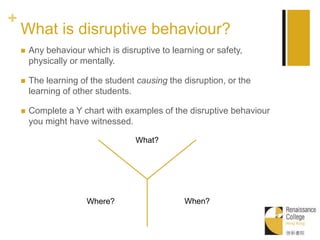
 Complete a Y chart with examples of the disruptive behaviour
you might have witnessed.
What?
When?Where?
+
Four types of disruption
A
B
C
D
From Win-Win Discipline by Spencer Kagan, PhD; Patricia Kyle,
PhD; Sally Scott, MA.
Aggression
Breaking the Rules
Confrontation
Disengagment
 Consider the behaviours you listed on the Y-chart “What” section.
Label them A, B, C or D.
 Look at the list of disruptions. Discuss which ones you may
encounter.
+
The position of the student
 Attention seeking
 Avoiding failure/embarrassment
 Angry
 Control-seeking
 Energetic
 Bored
 Uninformed
From Win-Win Discipline by Spencer Kagan, PhD; Patricia Kyle,
PhD; Sally Scott, MA.
+
Managing Behaviour
 Win-Win approach –
 Preventative
 Moment-of-Disruption
 Follow-Ups
 Moment-of-Disruption
 What sort of disruption do you think the one shown is?
 What position do you think the student is taking?
 How could you deal with the disruption?
+
Moment-of-Disruption strategies
 Remind students of class agreements.
 Ask students to make better choices.
 Redirect students’ attention to the work.
 Try another way – take tasks one step at a time.
 Coupons for frequent behaviour.
 Catch-me strategies.
 Call attention to the Learner Profile.
Further ideas in Win-Win Discipline.
+
Moving forward
 Choose one strategy that you will use from the session today…

EA training behaviour management

  • 1.
  • 2.
    + Behaviour management  RCHKPrimary has a positive behaviour management approach.  Built on respect.  Aimed at enabling all students to learn.  EAs are crucial to behaviour management, working with the teacher.
  • 3.
    + What is disruptivebehaviour?  Any behaviour which is disruptive to learning or safety, physically or mentally.  The learning of the student causing the disruption, or the learning of other students.  Complete a Y chart with examples of the disruptive behaviour you might have witnessed. What? When?Where?
  • 4.
    + Four types ofdisruption A B C D From Win-Win Discipline by Spencer Kagan, PhD; Patricia Kyle, PhD; Sally Scott, MA. Aggression Breaking the Rules Confrontation Disengagment  Consider the behaviours you listed on the Y-chart “What” section. Label them A, B, C or D.  Look at the list of disruptions. Discuss which ones you may encounter.
  • 5.
    + The position ofthe student  Attention seeking  Avoiding failure/embarrassment  Angry  Control-seeking  Energetic  Bored  Uninformed From Win-Win Discipline by Spencer Kagan, PhD; Patricia Kyle, PhD; Sally Scott, MA.
  • 6.
    + Managing Behaviour  Win-Winapproach –  Preventative  Moment-of-Disruption  Follow-Ups  Moment-of-Disruption  What sort of disruption do you think the one shown is?  What position do you think the student is taking?  How could you deal with the disruption?
  • 7.
    + Moment-of-Disruption strategies  Remindstudents of class agreements.  Ask students to make better choices.  Redirect students’ attention to the work.  Try another way – take tasks one step at a time.  Coupons for frequent behaviour.  Catch-me strategies.  Call attention to the Learner Profile. Further ideas in Win-Win Discipline.
  • 8.
    + Moving forward  Chooseone strategy that you will use from the session today…

Editor's Notes

  • #4 Where might Educational Assistants encounter challenging behaviour, and what steps can they take to counter it?
  • #5 The reason it is important to know what sort of behaviour is because it is helpful when thinking about how to deal with it.
  • #6 Can you think of examples of these positions from students you know or have known? Share with a talk partner. Hand out sheets with the condensed information on them!