Reducing Fractions
to their
Simplest Form

For more maths help & free games related to this, visit:
www.makemymathsbetter.com
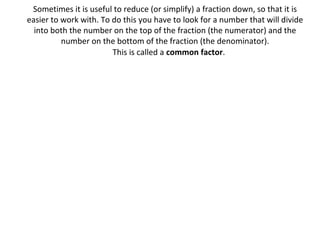
Sometimes it is useful to reduce (or simplify) a fraction down, so that it is
easier to work with. To do this you have to look for a number that will divide
into both the number on the top of the fraction (the numerator) and the
number on the bottom of the fraction (the denominator).
This is called a common factor.
Sometimes it is useful to reduce (or simplify) a fraction down, so that it is
easier to work with. To do this you have to look for a number that will divide
into both the number on the top of the fraction (the numerator) and the
number on the bottom of the fraction (the denominator).
This is called a common factor.
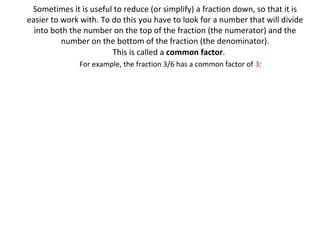
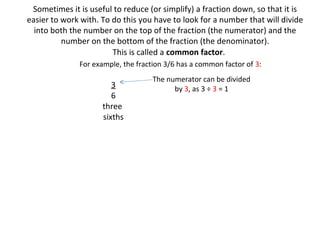
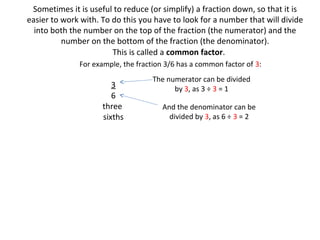
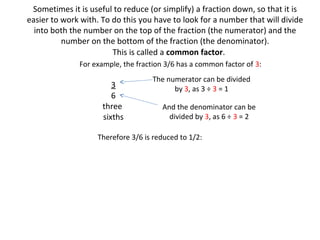
For example, the fraction 3/6 has a common factor of 3:
Sometimes it is useful to reduce (or simplify) a fraction down, so that it is
easier to work with. To do this you have to look for a number that will divide
into both the number on the top of the fraction (the numerator) and the
number on the bottom of the fraction (the denominator).
This is called a common factor.
For example, the fraction 3/6 has a common factor of 3:

3
6
three
sixths

The numerator can be divided
by 3, as 3 ÷ 3 = 1
Sometimes it is useful to reduce (or simplify) a fraction down, so that it is
easier to work with. To do this you have to look for a number that will divide
into both the number on the top of the fraction (the numerator) and the
number on the bottom of the fraction (the denominator).
This is called a common factor.
For example, the fraction 3/6 has a common factor of 3:

3
6
three
sixths

The numerator can be divided
by 3, as 3 ÷ 3 = 1
And the denominator can be
divided by 3, as 6 ÷ 3 = 2
Sometimes it is useful to reduce (or simplify) a fraction down, so that it is
easier to work with. To do this you have to look for a number that will divide
into both the number on the top of the fraction (the numerator) and the
number on the bottom of the fraction (the denominator).
This is called a common factor.
For example, the fraction 3/6 has a common factor of 3:

3
6
three
sixths

The numerator can be divided
by 3, as 3 ÷ 3 = 1
And the denominator can be
divided by 3, as 6 ÷ 3 = 2

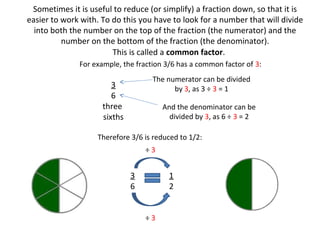
Therefore 3/6 is reduced to 1/2:
Sometimes it is useful to reduce (or simplify) a fraction down, so that it is
easier to work with. To do this you have to look for a number that will divide
into both the number on the top of the fraction (the numerator) and the
number on the bottom of the fraction (the denominator).
This is called a common factor.
For example, the fraction 3/6 has a common factor of 3:
The numerator can be divided
by 3, as 3 ÷ 3 = 1

3
6
three
sixths

And the denominator can be
divided by 3, as 6 ÷ 3 = 2

Therefore 3/6 is reduced to 1/2:
÷3

3
6

1
2
÷3
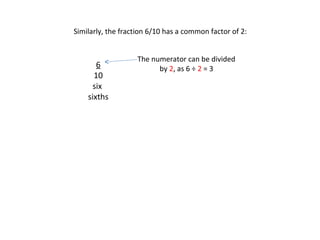
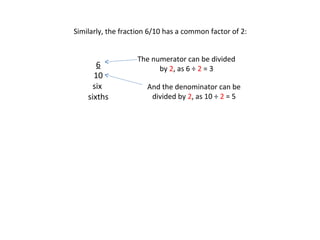
Similarly, the fraction 6/10 has a common factor of 2:

6
10
six
sixths

The numerator can be divided
by 2, as 6 ÷ 2 = 3
Similarly, the fraction 6/10 has a common factor of 2:

6
10
six
sixths

The numerator can be divided
by 2, as 6 ÷ 2 = 3
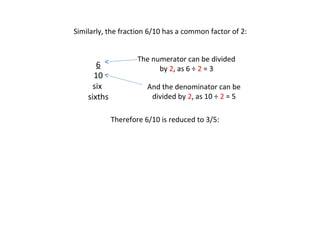
And the denominator can be
divided by 2, as 10 ÷ 2 = 5
Similarly, the fraction 6/10 has a common factor of 2:

6
10
six
sixths

The numerator can be divided
by 2, as 6 ÷ 2 = 3
And the denominator can be
divided by 2, as 10 ÷ 2 = 5
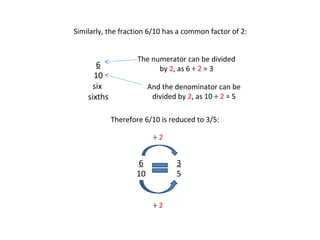
Therefore 6/10 is reduced to 3/5:
Similarly, the fraction 6/10 has a common factor of 2:

6
10
six
sixths

The numerator can be divided
by 2, as 6 ÷ 2 = 3
And the denominator can be
divided by 2, as 10 ÷ 2 = 5
Therefore 6/10 is reduced to 3/5:
÷2

6
10

3
5
÷2
When looking for a common factor, it is worth remembering the following:

Any even number (a number that ends in 0, 2, 4, 6 & 8) can be divided by 2
When looking for a common factor, it is worth remembering the following:

Any even number (a number that ends in 0, 2, 4, 6 & 8) can be divided by 2
A number that ends in 5 or 0 can be divided by 5
When looking for a common factor, it is worth remembering the following:

Any even number (a number that ends in 0, 2, 4, 6 & 8) can be divided by 2
A number that ends in 5 or 0 can be divided by 5
A number that ends in 0, can be divided by 10
When looking for a common factor, it is worth remembering the following:

Any even number (a number that ends in 0, 2, 4, 6 & 8) can be divided by 2
A number that ends in 5 or 0 can be divided by 5
A number that ends in 0, can be divided by 10
If you add the digits of a number together and they make 9 or a multiple of 9
(18, 27, 36 etc) the number can be divided by 9
The most common mistake when trying to simplify a
fraction, is that the fraction isn’t reduced to the lowest
form. This means that it can still be simplified further.
The most common mistake when trying to simplify a
fraction, is that the fraction isn’t reduced to the lowest
form. This means that it can still be simplified further.
Ideally, you need to find the highest common factor – the largest number
that will divide into both the numerator & the denominator – straight
away. However, this can be difficult to see sometimes, so you may have to
divide in stages.
The most common mistake when trying to simplify a
fraction, is that the fraction isn’t reduced to the lowest
form. This means that it can still be simplified further.
Ideally, you need to find the highest common factor – the largest number
that will divide into both the numerator & the denominator – straight
away. However, this can be difficult to see sometimes, so you may have to
divide in stages.
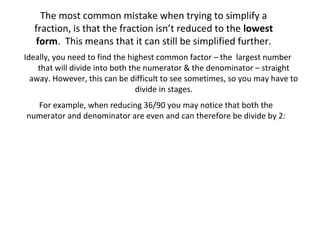
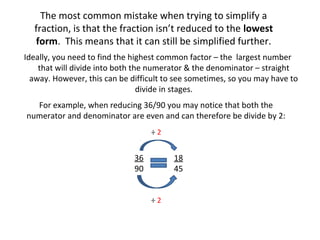
For example, when reducing 36/90 you may notice that both the
numerator and denominator are even and can therefore be divide by 2:
The most common mistake when trying to simplify a
fraction, is that the fraction isn’t reduced to the lowest
form. This means that it can still be simplified further.
Ideally, you need to find the highest common factor – the largest number
that will divide into both the numerator & the denominator – straight
away. However, this can be difficult to see sometimes, so you may have to
divide in stages.
For example, when reducing 36/90 you may notice that both the
numerator and denominator are even and can therefore be divide by 2:
÷2

36
90

18
45
÷2
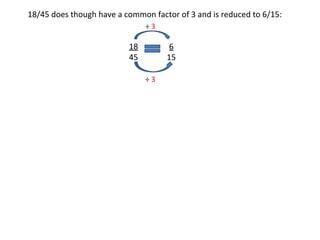
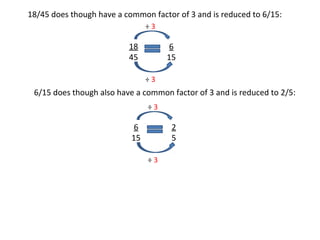
18/45 does though have a common factor of 3 and is reduced to 6/15:
÷3

18
45

6
15
÷3
18/45 does though have a common factor of 3 and is reduced to 6/15:
÷3

18
45

6
15
÷3

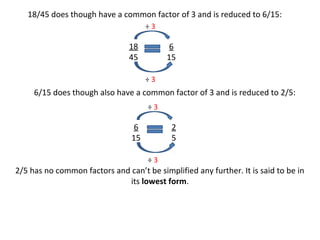
6/15 does though also have a common factor of 3 and is reduced to 2/5:
÷3

6
15

2
5
÷3
18/45 does though have a common factor of 3 and is reduced to 6/15:
÷3

18
45

6
15
÷3

6/15 does though also have a common factor of 3 and is reduced to 2/5:
÷3

6
15

2
5
÷3

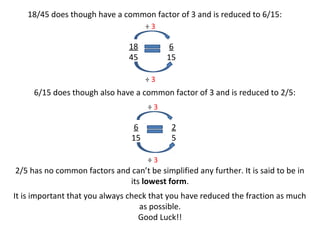
2/5 has no common factors and can’t be simplified any further. It is said to be in
its lowest form.
18/45 does though have a common factor of 3 and is reduced to 6/15:
÷3

18
45

6
15
÷3

6/15 does though also have a common factor of 3 and is reduced to 2/5:
÷3

6
15

2
5
÷3

2/5 has no common factors and can’t be simplified any further. It is said to be in
its lowest form.
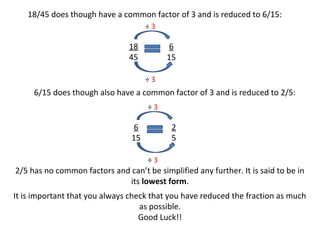
It is important that you always check that you have reduced the fraction as much
as possible.
Good Luck!!
18/45 does though have a common factor of 3 and is reduced to 6/15:
÷3

18
45

6
15
÷3

6/15 does though also have a common factor of 3 and is reduced to 2/5:
÷3

6
15

2
5
÷3

2/5 has no common factors and can’t be simplified any further. It is said to be in
its lowest form.
It is important that you always check that you have reduced the fraction as much
as possible.
Good Luck!!
For more help with your maths, try my
book:
mastering multiplication tables
on amazon.com

Reducing fractions

  • 1.
    Reducing Fractions to their SimplestForm For more maths help & free games related to this, visit: www.makemymathsbetter.com
  • 2.
    Sometimes it isuseful to reduce (or simplify) a fraction down, so that it is easier to work with. To do this you have to look for a number that will divide into both the number on the top of the fraction (the numerator) and the number on the bottom of the fraction (the denominator). This is called a common factor.
  • 3.
    Sometimes it isuseful to reduce (or simplify) a fraction down, so that it is easier to work with. To do this you have to look for a number that will divide into both the number on the top of the fraction (the numerator) and the number on the bottom of the fraction (the denominator). This is called a common factor. For example, the fraction 3/6 has a common factor of 3:
  • 4.
    Sometimes it isuseful to reduce (or simplify) a fraction down, so that it is easier to work with. To do this you have to look for a number that will divide into both the number on the top of the fraction (the numerator) and the number on the bottom of the fraction (the denominator). This is called a common factor. For example, the fraction 3/6 has a common factor of 3: 3 6 three sixths The numerator can be divided by 3, as 3 ÷ 3 = 1
  • 5.
    Sometimes it isuseful to reduce (or simplify) a fraction down, so that it is easier to work with. To do this you have to look for a number that will divide into both the number on the top of the fraction (the numerator) and the number on the bottom of the fraction (the denominator). This is called a common factor. For example, the fraction 3/6 has a common factor of 3: 3 6 three sixths The numerator can be divided by 3, as 3 ÷ 3 = 1 And the denominator can be divided by 3, as 6 ÷ 3 = 2
  • 6.
    Sometimes it isuseful to reduce (or simplify) a fraction down, so that it is easier to work with. To do this you have to look for a number that will divide into both the number on the top of the fraction (the numerator) and the number on the bottom of the fraction (the denominator). This is called a common factor. For example, the fraction 3/6 has a common factor of 3: 3 6 three sixths The numerator can be divided by 3, as 3 ÷ 3 = 1 And the denominator can be divided by 3, as 6 ÷ 3 = 2 Therefore 3/6 is reduced to 1/2:
  • 7.
    Sometimes it isuseful to reduce (or simplify) a fraction down, so that it is easier to work with. To do this you have to look for a number that will divide into both the number on the top of the fraction (the numerator) and the number on the bottom of the fraction (the denominator). This is called a common factor. For example, the fraction 3/6 has a common factor of 3: The numerator can be divided by 3, as 3 ÷ 3 = 1 3 6 three sixths And the denominator can be divided by 3, as 6 ÷ 3 = 2 Therefore 3/6 is reduced to 1/2: ÷3 3 6 1 2 ÷3
  • 8.
    Similarly, the fraction6/10 has a common factor of 2:
  • 9.
    Similarly, the fraction6/10 has a common factor of 2: 6 10 six sixths The numerator can be divided by 2, as 6 ÷ 2 = 3
  • 10.
    Similarly, the fraction6/10 has a common factor of 2: 6 10 six sixths The numerator can be divided by 2, as 6 ÷ 2 = 3 And the denominator can be divided by 2, as 10 ÷ 2 = 5
  • 11.
    Similarly, the fraction6/10 has a common factor of 2: 6 10 six sixths The numerator can be divided by 2, as 6 ÷ 2 = 3 And the denominator can be divided by 2, as 10 ÷ 2 = 5 Therefore 6/10 is reduced to 3/5:
  • 12.
    Similarly, the fraction6/10 has a common factor of 2: 6 10 six sixths The numerator can be divided by 2, as 6 ÷ 2 = 3 And the denominator can be divided by 2, as 10 ÷ 2 = 5 Therefore 6/10 is reduced to 3/5: ÷2 6 10 3 5 ÷2
  • 13.
    When looking fora common factor, it is worth remembering the following: Any even number (a number that ends in 0, 2, 4, 6 & 8) can be divided by 2
  • 14.
    When looking fora common factor, it is worth remembering the following: Any even number (a number that ends in 0, 2, 4, 6 & 8) can be divided by 2 A number that ends in 5 or 0 can be divided by 5
  • 15.
    When looking fora common factor, it is worth remembering the following: Any even number (a number that ends in 0, 2, 4, 6 & 8) can be divided by 2 A number that ends in 5 or 0 can be divided by 5 A number that ends in 0, can be divided by 10
  • 16.
    When looking fora common factor, it is worth remembering the following: Any even number (a number that ends in 0, 2, 4, 6 & 8) can be divided by 2 A number that ends in 5 or 0 can be divided by 5 A number that ends in 0, can be divided by 10 If you add the digits of a number together and they make 9 or a multiple of 9 (18, 27, 36 etc) the number can be divided by 9
  • 17.
    The most commonmistake when trying to simplify a fraction, is that the fraction isn’t reduced to the lowest form. This means that it can still be simplified further.
  • 18.
    The most commonmistake when trying to simplify a fraction, is that the fraction isn’t reduced to the lowest form. This means that it can still be simplified further. Ideally, you need to find the highest common factor – the largest number that will divide into both the numerator & the denominator – straight away. However, this can be difficult to see sometimes, so you may have to divide in stages.
  • 19.
    The most commonmistake when trying to simplify a fraction, is that the fraction isn’t reduced to the lowest form. This means that it can still be simplified further. Ideally, you need to find the highest common factor – the largest number that will divide into both the numerator & the denominator – straight away. However, this can be difficult to see sometimes, so you may have to divide in stages. For example, when reducing 36/90 you may notice that both the numerator and denominator are even and can therefore be divide by 2:
  • 20.
    The most commonmistake when trying to simplify a fraction, is that the fraction isn’t reduced to the lowest form. This means that it can still be simplified further. Ideally, you need to find the highest common factor – the largest number that will divide into both the numerator & the denominator – straight away. However, this can be difficult to see sometimes, so you may have to divide in stages. For example, when reducing 36/90 you may notice that both the numerator and denominator are even and can therefore be divide by 2: ÷2 36 90 18 45 ÷2
  • 21.
    18/45 does thoughhave a common factor of 3 and is reduced to 6/15: ÷3 18 45 6 15 ÷3
  • 22.
    18/45 does thoughhave a common factor of 3 and is reduced to 6/15: ÷3 18 45 6 15 ÷3 6/15 does though also have a common factor of 3 and is reduced to 2/5: ÷3 6 15 2 5 ÷3
  • 23.
    18/45 does thoughhave a common factor of 3 and is reduced to 6/15: ÷3 18 45 6 15 ÷3 6/15 does though also have a common factor of 3 and is reduced to 2/5: ÷3 6 15 2 5 ÷3 2/5 has no common factors and can’t be simplified any further. It is said to be in its lowest form.
  • 24.
    18/45 does thoughhave a common factor of 3 and is reduced to 6/15: ÷3 18 45 6 15 ÷3 6/15 does though also have a common factor of 3 and is reduced to 2/5: ÷3 6 15 2 5 ÷3 2/5 has no common factors and can’t be simplified any further. It is said to be in its lowest form. It is important that you always check that you have reduced the fraction as much as possible. Good Luck!!
  • 25.
    18/45 does thoughhave a common factor of 3 and is reduced to 6/15: ÷3 18 45 6 15 ÷3 6/15 does though also have a common factor of 3 and is reduced to 2/5: ÷3 6 15 2 5 ÷3 2/5 has no common factors and can’t be simplified any further. It is said to be in its lowest form. It is important that you always check that you have reduced the fraction as much as possible. Good Luck!!
  • 26.
    For more helpwith your maths, try my book: mastering multiplication tables on amazon.com