TBI GUIDELINES-
IN-HOSPITAL CARE
Dr Sumit Sinha
Additional Professor
Deptt of Neurosurgery, JPNA Trauma
Center and AIIMS, New Delhi, India
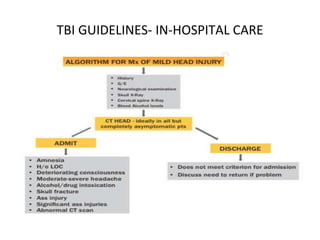
TBI GUIDELINES- IN-HOSPITAL CARE
• Trauma care systems in India- nascent stage of
development.
• Complete lack of an organized trauma care- gross
disparity between trauma services
• No mechanisms for accreditation of trauma centers
and professionals.
• Need of creating a rationale for developing
guidelines and protocol.
TBI- Current status- Problems
• In the absence of guidelines- prehospital and
hospital-based critical care varies enormously.
• Available personnel and their skills often do
not match the needs of the patients.
• The concept of a dedicated trauma team is
not accepted at all levels.
TBI- Current status- PROBLEMS
TBI In-hospital Care- PESSIMISTIC SITUATION !!
• No Guidelines YET
• Financial Constraints
• Lack of Public Awareness
• Lack of trained Manpower
• Lack of Dedicated trauma centers
• ABSENT Referral system
• Lack of nationwide regulatory policies
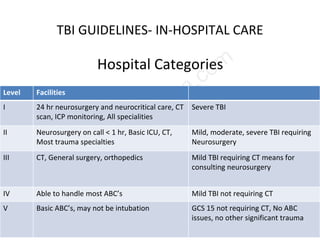
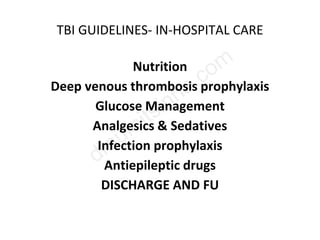
TBI GUIDELINES- IN-HOSPITAL CARE
Level Facilities
I 24 hr neurosurgery and neurocritical care, CT
scan, ICP monitoring, All specialities
Severe TBI
II Neurosurgery on call < 1 hr, Basic ICU, CT,
Most trauma specialties
Mild, moderate, severe TBI requiring
Neurosurgery
III CT, General surgery, orthopedics Mild TBI requiring CT means for
consulting neurosurgery
IV Able to handle most ABC’s Mild TBI not requiring CT
V Basic ABC’s, may not be intubation GCS 15 not requiring CT, No ABC
issues, no other significant trauma
Hospital Categories
TBI GUIDELINES- IN-HOSPITAL CARE
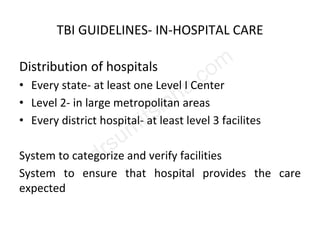
Distribution of hospitals
• Every state- at least one Level I Center
• Level 2- in large metropolitan areas
• Every district hospital- at least level 3 facilites
System to categorize and verify facilities
System to ensure that hospital provides the care
expected
TBI GUIDELINES- IN-HOSPITAL CARE
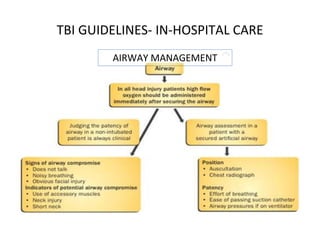
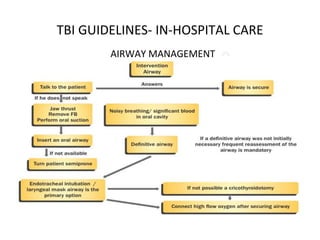
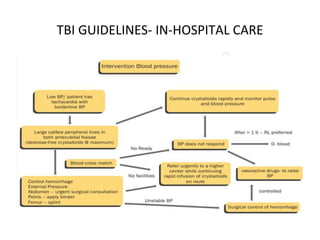
AIRWAY MANAGEMENT
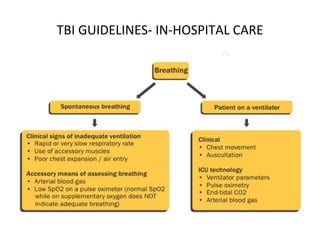
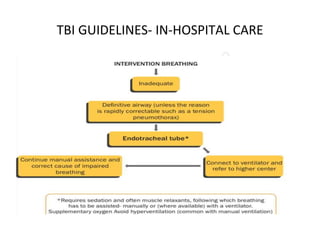
TBI GUIDELINES- IN-HOSPITAL CARE
AIRWAY MANAGEMENT
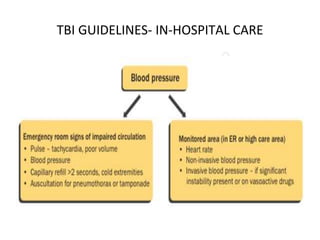
TBI GUIDELINES- IN-HOSPITAL CARE
CLINICAL MONITORING
All personnel involved in monitoring a head
injury patient must be trained to assess the
Glasgow Coma Scale and pupils.
TBI GUIDELINES- IN-HOSPITAL CARE
Response to deterioration
• Report immediately
• Rapid decision to be made on the need for
– Repeat investigation
– Referral
– Transfer to ICU / OR
TBI GUIDELINES- IN-HOSPITAL CARE
• Deteriorating GCS
• Focal or abnormal neurological signs
• Early post-traumatic seizure
• Skull fracture
• High-risk mechanism of injury
• Patients whose GCS has not returned to 15 after imaging, regardless of the
imaging results.
• Pt has indications for CT but this cannot be done (CT not available or pt not
cooperative)
• persistent vomiting, severe
headaches, amnesia
• Drug or alcohol intoxication, other
injuries, shock, suspected non-
accidental injury, meningism,
cerebrospinal fluid leak where a scalp
laceration overlies a fracture, or the
person’s age.
• No responsible caregiver under
whose care the person could be
discharged.
• ‘Mild’ head injuries with symptoms
such as headache, photophobia,
nausea and vomiting, or amnesia
requiring management.
Criteria for admitting patients to hospital following TBI
TBI GUIDELINES- IN-HOSPITAL CARE
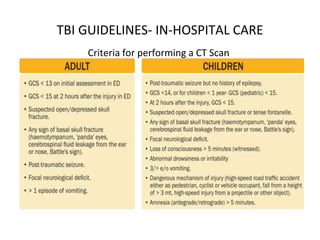
Criteria for performing a CT Scan
TBI GUIDELINES- IN-HOSPITAL CARE
Nutrition
Deep venous thrombosis prophylaxis
Glucose Management
Analgesics & Sedatives
Infection prophylaxis
Antiepileptic drugs
DISCHARGE AND FU
TBI- Current status
GUIDELINES ???
• Formulation- Probably not a problem at all
• Enforcement- YES !!!
Together we can
And
Together we MUST !!

Guidelines in hospital care

  • 1.
    TBI GUIDELINES- IN-HOSPITAL CARE DrSumit Sinha Additional Professor Deptt of Neurosurgery, JPNA Trauma Center and AIIMS, New Delhi, India
  • 2.
    TBI GUIDELINES- IN-HOSPITALCARE • Trauma care systems in India- nascent stage of development. • Complete lack of an organized trauma care- gross disparity between trauma services • No mechanisms for accreditation of trauma centers and professionals. • Need of creating a rationale for developing guidelines and protocol.
  • 3.
    TBI- Current status-Problems • In the absence of guidelines- prehospital and hospital-based critical care varies enormously. • Available personnel and their skills often do not match the needs of the patients. • The concept of a dedicated trauma team is not accepted at all levels.
  • 4.
    TBI- Current status-PROBLEMS TBI In-hospital Care- PESSIMISTIC SITUATION !! • No Guidelines YET • Financial Constraints • Lack of Public Awareness • Lack of trained Manpower • Lack of Dedicated trauma centers • ABSENT Referral system • Lack of nationwide regulatory policies
  • 6.
    TBI GUIDELINES- IN-HOSPITALCARE Level Facilities I 24 hr neurosurgery and neurocritical care, CT scan, ICP monitoring, All specialities Severe TBI II Neurosurgery on call < 1 hr, Basic ICU, CT, Most trauma specialties Mild, moderate, severe TBI requiring Neurosurgery III CT, General surgery, orthopedics Mild TBI requiring CT means for consulting neurosurgery IV Able to handle most ABC’s Mild TBI not requiring CT V Basic ABC’s, may not be intubation GCS 15 not requiring CT, No ABC issues, no other significant trauma Hospital Categories
  • 7.
    TBI GUIDELINES- IN-HOSPITALCARE Distribution of hospitals • Every state- at least one Level I Center • Level 2- in large metropolitan areas • Every district hospital- at least level 3 facilites System to categorize and verify facilities System to ensure that hospital provides the care expected
  • 8.
    TBI GUIDELINES- IN-HOSPITALCARE AIRWAY MANAGEMENT
  • 9.
    TBI GUIDELINES- IN-HOSPITALCARE AIRWAY MANAGEMENT
  • 10.
  • 11.
  • 12.
  • 13.
  • 14.
    TBI GUIDELINES- IN-HOSPITALCARE CLINICAL MONITORING All personnel involved in monitoring a head injury patient must be trained to assess the Glasgow Coma Scale and pupils.
  • 15.
    TBI GUIDELINES- IN-HOSPITALCARE Response to deterioration • Report immediately • Rapid decision to be made on the need for – Repeat investigation – Referral – Transfer to ICU / OR
  • 16.
    TBI GUIDELINES- IN-HOSPITALCARE • Deteriorating GCS • Focal or abnormal neurological signs • Early post-traumatic seizure • Skull fracture • High-risk mechanism of injury • Patients whose GCS has not returned to 15 after imaging, regardless of the imaging results. • Pt has indications for CT but this cannot be done (CT not available or pt not cooperative) • persistent vomiting, severe headaches, amnesia • Drug or alcohol intoxication, other injuries, shock, suspected non- accidental injury, meningism, cerebrospinal fluid leak where a scalp laceration overlies a fracture, or the person’s age. • No responsible caregiver under whose care the person could be discharged. • ‘Mild’ head injuries with symptoms such as headache, photophobia, nausea and vomiting, or amnesia requiring management. Criteria for admitting patients to hospital following TBI
  • 17.
    TBI GUIDELINES- IN-HOSPITALCARE Criteria for performing a CT Scan
  • 18.
  • 19.
  • 20.
  • 21.
    TBI GUIDELINES- IN-HOSPITALCARE Nutrition Deep venous thrombosis prophylaxis Glucose Management Analgesics & Sedatives Infection prophylaxis Antiepileptic drugs DISCHARGE AND FU
  • 22.
    TBI- Current status GUIDELINES??? • Formulation- Probably not a problem at all • Enforcement- YES !!! Together we can And Together we MUST !!