By: Sandra Pico
History of English
English Language. Chapter 10. Conclusion
Elly Van Gelderen
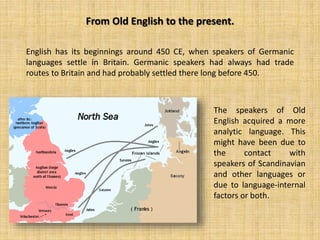
From Old English to the present.
The speakers of Old
English acquired a more
analytic language. This
might have been due to
the contact with
speakers of Scandinavian
and other languages or
due to language-internal
factors or both.
English has its beginnings around 450 CE, when speakers of Germanic
languages settle in Britain. Germanic speakers had always had trade
routes to Britain and had probably settled there long before 450.
• 1150 was adopted as the start of Middle English.
• Between 1150 and 1500, the English at the end of the Middle English period
resembles present-day English in many respects.
• During the Middle English period, French and Latin words come into the
language and cause changes in the sound system.
• The period between 1500 and 1700 is a transition period with some
changes in grammar and sounds.
• The major change is perhaps the adoption of tens of thousands of Latin,
Greek, and newly-invented words.
• This leads to the appearance of dictionaries of hard words and gives rise to
concerns about the purity of the language.
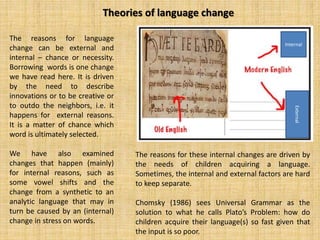
Theories of language change
The reasons for language
change can be external and
internal – chance or necessity.
Borrowing words is one change
we have read here. It is driven
by the need to describe
innovations or to be creative or
to outdo the neighbors, i.e. it
happens for external reasons.
It is a matter of chance which
word is ultimately selected.
We have also examined
changes that happen (mainly)
for internal reasons, such as
some vowel shifts and the
change from a synthetic to an
analytic language that may in
turn be caused by an (internal)
change in stress on words.
The reasons for these internal changes are driven by
the needs of children acquiring a language.
Sometimes, the internal and external factors are hard
to keep separate.
Chomsky (1986) sees Universal Grammar as the
solution to what he calls Plato’s Problem: how do
children acquire their language(s) so fast given that
the input is so poor.
Internal
External
Lenguaje acquisition, in this framework, is not imitation but interplay between Universal
Grammar and the exposure to a particular language.
We know that acquisition is not just imitation since children create e.g. goed as the past
tense of go, and we know that input is essential from the fact that children who were
neglected by their parents never acquired a regular language.
Some linguists disagree with this position and put more emphasis on the actual input than
on Universal Grammar and some on the communicative needs of speakers.
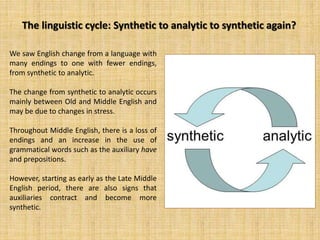
The linguistic cycle: Synthetic to analytic to synthetic again?
We saw English change from a language with
many endings to one with fewer endings,
from synthetic to analytic.
The change from synthetic to analytic occurs
mainly between Old and Middle English and
may be due to changes in stress.
Throughout Middle English, there is a loss of
endings and an increase in the use of
grammatical words such as the auxiliary have
and prepositions.
However, starting as early as the Late Middle
English period, there are also signs that
auxiliaries contract and become more
synthetic.
Examples:
1. I shoulda known that. (starts in 1450)
2. Don’t you be jealous now. (HC from1680)
3. Me, I was flying economy, but the plane, … was guzzling gas. (BNC from 1985)
4. I possibly won’t do that.
This change where separate pronouns start marking the agreement on the verb is
known as the linguistic cycle. It is not unexpected: languages go from synthetic to
analytic and to synthetic again.
If the pronoun in (3) becomes the agreement on the verb, there is an increase in
synthetic marking. In the case of English, the change towards synthetic seems to
involve only the verbal system.
Some theories about language
• Children have to be exposed to language to build up a grammar and Universal Grammar
helps in this process. Children can therefore learn any language they are exposed to,
regardless of the language of their parents.
• There is still sometimes a mistaken perception that language is in children’s DNA and that
they are better at learning the languages of their biological parents. This is absolutely not
true.
• Genetic theories have affected theories of language change.
• Other theories had to do with the climate of a region or the ethnic character of a group:
• for example, one theory claimed that consonants shift in mountainous regions or due to
the ‘desire for liberty’ on the part of the people. We have to evaluate these claims very
carefully.
• It may be that a nation, in order to assert its independence, adopts spellings or
pronunciations identified as especially significant.
• A very influential theory is the one that the language we speak influences our thinking. It
has been named the Sapir-Whorf Hypothesis or the Linguistic Relativity Principle, after
two linguists, Edward Sapir and Benjamin Lee Whorf, who wrote about Native American
languages in the early 20th century.
The invading Germanic tribes spoke similar languages, which in
Britain developed into what we now call Old English.
About half of the most commonly used words in modern English
have old English roots. The English language in its complex
shapes and forms changes fast.
It has been interesting to know English language from various
time periods, to be able to read each stage with a glossary, to get
an understanding of typical language change, internal and
external; different theories and to understand something about
language typology through the emphasis on the change from
synthetic to analytic.
Conclusion

Foro 2 old english

  • 1.
    By: Sandra Pico Historyof English English Language. Chapter 10. Conclusion Elly Van Gelderen
  • 2.
    From Old Englishto the present. The speakers of Old English acquired a more analytic language. This might have been due to the contact with speakers of Scandinavian and other languages or due to language-internal factors or both. English has its beginnings around 450 CE, when speakers of Germanic languages settle in Britain. Germanic speakers had always had trade routes to Britain and had probably settled there long before 450.
  • 3.
    • 1150 wasadopted as the start of Middle English. • Between 1150 and 1500, the English at the end of the Middle English period resembles present-day English in many respects. • During the Middle English period, French and Latin words come into the language and cause changes in the sound system. • The period between 1500 and 1700 is a transition period with some changes in grammar and sounds. • The major change is perhaps the adoption of tens of thousands of Latin, Greek, and newly-invented words. • This leads to the appearance of dictionaries of hard words and gives rise to concerns about the purity of the language.
  • 4.
    Theories of languagechange The reasons for language change can be external and internal – chance or necessity. Borrowing words is one change we have read here. It is driven by the need to describe innovations or to be creative or to outdo the neighbors, i.e. it happens for external reasons. It is a matter of chance which word is ultimately selected. We have also examined changes that happen (mainly) for internal reasons, such as some vowel shifts and the change from a synthetic to an analytic language that may in turn be caused by an (internal) change in stress on words. The reasons for these internal changes are driven by the needs of children acquiring a language. Sometimes, the internal and external factors are hard to keep separate. Chomsky (1986) sees Universal Grammar as the solution to what he calls Plato’s Problem: how do children acquire their language(s) so fast given that the input is so poor. Internal External
  • 5.
    Lenguaje acquisition, inthis framework, is not imitation but interplay between Universal Grammar and the exposure to a particular language. We know that acquisition is not just imitation since children create e.g. goed as the past tense of go, and we know that input is essential from the fact that children who were neglected by their parents never acquired a regular language. Some linguists disagree with this position and put more emphasis on the actual input than on Universal Grammar and some on the communicative needs of speakers.
  • 6.
    The linguistic cycle:Synthetic to analytic to synthetic again? We saw English change from a language with many endings to one with fewer endings, from synthetic to analytic. The change from synthetic to analytic occurs mainly between Old and Middle English and may be due to changes in stress. Throughout Middle English, there is a loss of endings and an increase in the use of grammatical words such as the auxiliary have and prepositions. However, starting as early as the Late Middle English period, there are also signs that auxiliaries contract and become more synthetic.
  • 7.
    Examples: 1. I shouldaknown that. (starts in 1450) 2. Don’t you be jealous now. (HC from1680) 3. Me, I was flying economy, but the plane, … was guzzling gas. (BNC from 1985) 4. I possibly won’t do that. This change where separate pronouns start marking the agreement on the verb is known as the linguistic cycle. It is not unexpected: languages go from synthetic to analytic and to synthetic again. If the pronoun in (3) becomes the agreement on the verb, there is an increase in synthetic marking. In the case of English, the change towards synthetic seems to involve only the verbal system.
  • 8.
    Some theories aboutlanguage • Children have to be exposed to language to build up a grammar and Universal Grammar helps in this process. Children can therefore learn any language they are exposed to, regardless of the language of their parents. • There is still sometimes a mistaken perception that language is in children’s DNA and that they are better at learning the languages of their biological parents. This is absolutely not true. • Genetic theories have affected theories of language change. • Other theories had to do with the climate of a region or the ethnic character of a group: • for example, one theory claimed that consonants shift in mountainous regions or due to the ‘desire for liberty’ on the part of the people. We have to evaluate these claims very carefully. • It may be that a nation, in order to assert its independence, adopts spellings or pronunciations identified as especially significant. • A very influential theory is the one that the language we speak influences our thinking. It has been named the Sapir-Whorf Hypothesis or the Linguistic Relativity Principle, after two linguists, Edward Sapir and Benjamin Lee Whorf, who wrote about Native American languages in the early 20th century.
  • 9.
    The invading Germanictribes spoke similar languages, which in Britain developed into what we now call Old English. About half of the most commonly used words in modern English have old English roots. The English language in its complex shapes and forms changes fast. It has been interesting to know English language from various time periods, to be able to read each stage with a glossary, to get an understanding of typical language change, internal and external; different theories and to understand something about language typology through the emphasis on the change from synthetic to analytic. Conclusion