Teacher: Miguel Vinicio Ponce Medina
By: Ingrid Arias
Margarita Pazmiño
Sandra Pico
SOCIO-EDUCATIONAL PROJECT
Project Evaluation
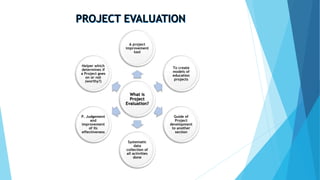
What is
Project
Evaluation?
A project
improvement
tool
To create
models of
education
projects
Guide of
Project
development
to another
section
Systematic
data
collection of
all activities
done
P. Judgement
and
improvement
of its
effectiveness
Helper which
determines if
a Project goes
on or not
(worthy?)
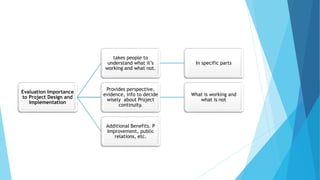
Evaluation Importance
to Project Design and
Implementation
takes people to
understand what it’s
working and what not.
In specific parts
Provides perspective,
evidence, info to decide
wisely about Project
continuity.
What is working and
what is not
Additional Benefits. P
Improvement, public
relations, etc.
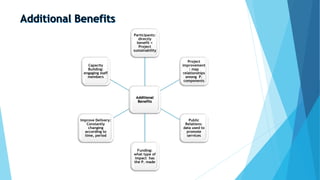
Additional
Benefits
Participants:
directly
benefit =
Project
sustainability
Project
improvement
: map
relationships
among P.
components
Public
Relations:
data used to
promote
services
Funding:
what type of
impact has
the P. made
Improve Delivery:
Constantly
changing
according to
time, period
Capacity
Building:
engaging staff
members
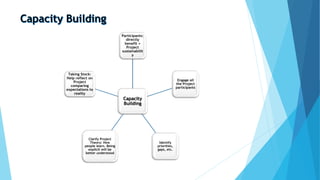
Capacity
Building
Participants:
directly
benefit =
Project
sustainabilit
y
Engage all
the Project
participants
Identify
priorities,
gaps, etc.
Clarify Project
Theory: How
people learn. Being
explicit will be
better understood
Taking Stock:
Help reflect on
Project
comparing
expectations to
reality
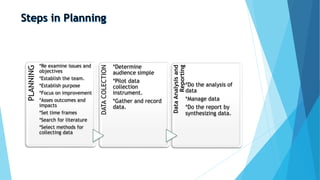
PLANNING
*Re examine issues and
objectives
*Establish the team.
*Establish purpose
*Focus on improvement
*Asses outcomes and
impacts
*Set time frames
*Search for literature
*Select methods for
collecting data
DATACOLECTION
*Determine
audience simple
*Pilot data
collection
instrument.
*Gather and record
data.
DataAnalysisand
Reporting
*Do the analysis of
data
*Manage data
*Do the report by
synthesizing data.
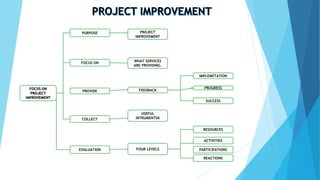
FOCUS ON
PROJECT
IMPROVEMENT
PURPOSE
EVALUATION
PROVIDE
COLLECT
FOCUS ON
PROJECT
IMPROVEMENT
WHAT SERVICES
ARE PROVIDING.
FEEDBACK
IMPLEMETATION
PROGRESS
SUCCESS
USEFUL
INTRUMENTSK
FOUR LEVELS
REACTIONS
PARTICIPATIONS
ACTIVITIES
RESOURCES
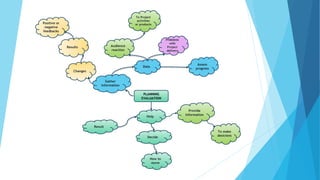
PLANNING
EVALUATION
Gather
information
Data
Audience
reaction
Problems
with
Project
delivery
Assess
progress
To Project
activities
or products
Changes
Positive or
negative
feedbacks
Results
Help
Provide
information
To make
desicions
Result
Decide
How to
move
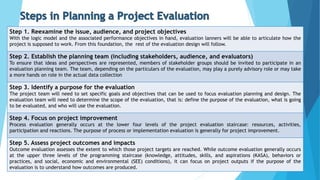
Step 1. Reexamine the issue, audience, and project objectives
With the logic model and the associated performance objectives in hand, evaluation lanners will be able to articulate how the
project is supposed to work. From this foundation, the rest of the evaluation design will follow.
Step 2. Establish the planning team (including stakeholders, audience, and evaluators)
To ensure that ideas and perspectives are represented, members of stakeholder groups should be invited to participate in an
evaluation planning team. The team, depending on the particulars of the evaluation, may play a purely advisory role or may take
a more hands on role in the actual data collection
Step 3. Identify a purpose for the evaluation
The project team will need to set specific goals and objectives that can be used to focus evaluation planning and design. The
evaluation team will need to determine the scope of the evaluation, that is: define the purpose of the evaluation, what is going
to be evaluated, and who will use the evaluation.
Step 4. Focus on project improvement
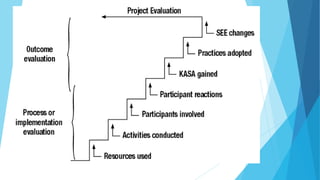
Process evaluation generally occurs at the lower four levels of the project evaluation staircase: resources, activities,
participation and reactions. The purpose of process or implementation evaluation is generally for project improvement.
Step 5. Assess project outcomes and impacts
Outcome evaluation assesses the extent to which those project targets are reached. While outcome evaluation generally occurs
at the upper three levels of the programming staircase (knowledge, attitudes, skills, and aspirations (KASA), behaviors or
practices, and social, economic and environmental (SEE) conditions), it can focus on project outputs if the purpose of the
evaluation is to understand how outcomes are produced.
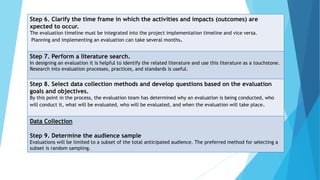
Step 6. Clarify the time frame in which the activities and impacts (outcomes) are
xpected to occur.
The evaluation timeline must be integrated into the project implementation timeline and vice versa.
Planning and implementing an evaluation can take several months.
Step 7. Perform a literature search.
In designing an evaluation it is helpful to identify the related literature and use this literature as a touchstone.
Research into evaluation processes, practices, and standards is useful.
Step 8. Select data collection methods and develop questions based on the evaluation
goals and objectives.
By this point in the process, the evaluation team has determined why an evaluation is being conducted, who
will conduct it, what will be evaluated, who will be evaluated, and when the evaluation will take place.
Data Collection
Step 9. Determine the audience sample
Evaluations will be limited to a subset of the total anticipated audience. The preferred method for selecting a
subset is random sampling.
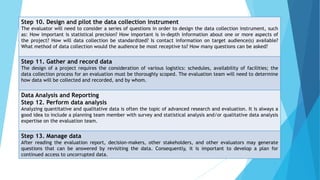
Step 10. Design and pilot the data collection instrument
The evaluator will need to consider a series of questions in order to design the data collection instrument, such
as: How important is statistical precision? How important is in-depth information about one or more aspects of
the project? How will data collection be standardized? Is contact information on target audience(s) available?
What method of data collection would the audience be most receptive to? How many questions can be asked?
Step 11. Gather and record data
The design of a project requires the consideration of various logistics: schedules, availability of facilities; the
data collection process for an evaluation must be thoroughly scoped. The evaluation team will need to determine
how data will be collected and recorded, and by whom.
Data Analysis and Reporting
Step 12. Perform data analysis
Analyzing quantitative and qualitative data is often the topic of advanced research and evaluation. It is always a
good idea to include a planning team member with survey and statistical analysis and/or qualitative data analysis
expertise on the evaluation team.
Step 13. Manage data
After reading the evaluation report, decision-makers, other stakeholders, and other evaluators may generate
questions that can be answered by revisiting the data. Consequently, it is important to develop a plan for
continued access to uncorrupted data.
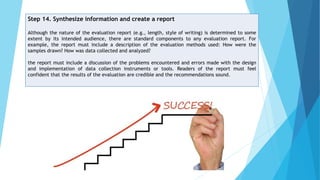
Step 14. Synthesize information and create a report
Although the nature of the evaluation report (e.g., length, style of writing) is determined to some
extent by its intended audience, there are standard components to any evaluation report. For
example, the report must include a description of the evaluation methods used: How were the
samples drawn? How was data collected and analyzed?
the report must include a discussion of the problems encountered and errors made with the design
and implementation of data collection instruments or tools. Readers of the report must feel
confident that the results of the evaluation are credible and the recommendations sound.
Many managers require that an outside evaluator be contracted. An outside evaluator is seen as an
objective third-party who may be able to bring a fresh perspective to the project. In addition, a
professional evaluator has expertise that may not exist in-house. Many funding agencies require
external evaluators to conduct evaluations to minimize bias and provide credible evidence of
project achievements.
If evaluation expertise does exist and an outside evaluator is not required, it is possible to run
major components of the evaluation in-house. However, managers should proceed with caution.
Ethics
Evaluation Costs
Depending on the size and complexity of the project, it is typically recommended that 5 to 15% of
project costs be set aside for evaluation. It should also be remembered that a great deal of data
may already exist – for example, in annual reports or participant exit interviews. Obviously,
building an evaluation around existing data has its pitfalls, but a critical examination of quality
sources of existing information that can help answer the evaluation questions should not be
overlooked.
In designing the evaluation, the project team
must ensure that the individuals involved are
treated with respect and sensitivity. Not only
should the maintenance of confidentiality and/or
anonymity be a high priority, but the time and
effort expended by evaluation participants should
be respected.

Collaborative 2 ingrid margarita and sandra

  • 1.
    Teacher: Miguel VinicioPonce Medina By: Ingrid Arias Margarita Pazmiño Sandra Pico SOCIO-EDUCATIONAL PROJECT Project Evaluation
  • 2.
    What is Project Evaluation? A project improvement tool Tocreate models of education projects Guide of Project development to another section Systematic data collection of all activities done P. Judgement and improvement of its effectiveness Helper which determines if a Project goes on or not (worthy?)
  • 3.
    Evaluation Importance to ProjectDesign and Implementation takes people to understand what it’s working and what not. In specific parts Provides perspective, evidence, info to decide wisely about Project continuity. What is working and what is not Additional Benefits. P Improvement, public relations, etc.
  • 4.
    Additional Benefits Participants: directly benefit = Project sustainability Project improvement : map relationships amongP. components Public Relations: data used to promote services Funding: what type of impact has the P. made Improve Delivery: Constantly changing according to time, period Capacity Building: engaging staff members
  • 5.
    Capacity Building Participants: directly benefit = Project sustainabilit y Engage all theProject participants Identify priorities, gaps, etc. Clarify Project Theory: How people learn. Being explicit will be better understood Taking Stock: Help reflect on Project comparing expectations to reality
  • 6.
    PLANNING *Re examine issuesand objectives *Establish the team. *Establish purpose *Focus on improvement *Asses outcomes and impacts *Set time frames *Search for literature *Select methods for collecting data DATACOLECTION *Determine audience simple *Pilot data collection instrument. *Gather and record data. DataAnalysisand Reporting *Do the analysis of data *Manage data *Do the report by synthesizing data.
  • 7.
    FOCUS ON PROJECT IMPROVEMENT PURPOSE EVALUATION PROVIDE COLLECT FOCUS ON PROJECT IMPROVEMENT WHATSERVICES ARE PROVIDING. FEEDBACK IMPLEMETATION PROGRESS SUCCESS USEFUL INTRUMENTSK FOUR LEVELS REACTIONS PARTICIPATIONS ACTIVITIES RESOURCES
  • 8.
  • 9.
    Step 1. Reexaminethe issue, audience, and project objectives With the logic model and the associated performance objectives in hand, evaluation lanners will be able to articulate how the project is supposed to work. From this foundation, the rest of the evaluation design will follow. Step 2. Establish the planning team (including stakeholders, audience, and evaluators) To ensure that ideas and perspectives are represented, members of stakeholder groups should be invited to participate in an evaluation planning team. The team, depending on the particulars of the evaluation, may play a purely advisory role or may take a more hands on role in the actual data collection Step 3. Identify a purpose for the evaluation The project team will need to set specific goals and objectives that can be used to focus evaluation planning and design. The evaluation team will need to determine the scope of the evaluation, that is: define the purpose of the evaluation, what is going to be evaluated, and who will use the evaluation. Step 4. Focus on project improvement Process evaluation generally occurs at the lower four levels of the project evaluation staircase: resources, activities, participation and reactions. The purpose of process or implementation evaluation is generally for project improvement. Step 5. Assess project outcomes and impacts Outcome evaluation assesses the extent to which those project targets are reached. While outcome evaluation generally occurs at the upper three levels of the programming staircase (knowledge, attitudes, skills, and aspirations (KASA), behaviors or practices, and social, economic and environmental (SEE) conditions), it can focus on project outputs if the purpose of the evaluation is to understand how outcomes are produced.
  • 11.
    Step 6. Clarifythe time frame in which the activities and impacts (outcomes) are xpected to occur. The evaluation timeline must be integrated into the project implementation timeline and vice versa. Planning and implementing an evaluation can take several months. Step 7. Perform a literature search. In designing an evaluation it is helpful to identify the related literature and use this literature as a touchstone. Research into evaluation processes, practices, and standards is useful. Step 8. Select data collection methods and develop questions based on the evaluation goals and objectives. By this point in the process, the evaluation team has determined why an evaluation is being conducted, who will conduct it, what will be evaluated, who will be evaluated, and when the evaluation will take place. Data Collection Step 9. Determine the audience sample Evaluations will be limited to a subset of the total anticipated audience. The preferred method for selecting a subset is random sampling.
  • 12.
    Step 10. Designand pilot the data collection instrument The evaluator will need to consider a series of questions in order to design the data collection instrument, such as: How important is statistical precision? How important is in-depth information about one or more aspects of the project? How will data collection be standardized? Is contact information on target audience(s) available? What method of data collection would the audience be most receptive to? How many questions can be asked? Step 11. Gather and record data The design of a project requires the consideration of various logistics: schedules, availability of facilities; the data collection process for an evaluation must be thoroughly scoped. The evaluation team will need to determine how data will be collected and recorded, and by whom. Data Analysis and Reporting Step 12. Perform data analysis Analyzing quantitative and qualitative data is often the topic of advanced research and evaluation. It is always a good idea to include a planning team member with survey and statistical analysis and/or qualitative data analysis expertise on the evaluation team. Step 13. Manage data After reading the evaluation report, decision-makers, other stakeholders, and other evaluators may generate questions that can be answered by revisiting the data. Consequently, it is important to develop a plan for continued access to uncorrupted data.
  • 13.
    Step 14. Synthesizeinformation and create a report Although the nature of the evaluation report (e.g., length, style of writing) is determined to some extent by its intended audience, there are standard components to any evaluation report. For example, the report must include a description of the evaluation methods used: How were the samples drawn? How was data collected and analyzed? the report must include a discussion of the problems encountered and errors made with the design and implementation of data collection instruments or tools. Readers of the report must feel confident that the results of the evaluation are credible and the recommendations sound.
  • 14.
    Many managers requirethat an outside evaluator be contracted. An outside evaluator is seen as an objective third-party who may be able to bring a fresh perspective to the project. In addition, a professional evaluator has expertise that may not exist in-house. Many funding agencies require external evaluators to conduct evaluations to minimize bias and provide credible evidence of project achievements. If evaluation expertise does exist and an outside evaluator is not required, it is possible to run major components of the evaluation in-house. However, managers should proceed with caution.
  • 15.
    Ethics Evaluation Costs Depending onthe size and complexity of the project, it is typically recommended that 5 to 15% of project costs be set aside for evaluation. It should also be remembered that a great deal of data may already exist – for example, in annual reports or participant exit interviews. Obviously, building an evaluation around existing data has its pitfalls, but a critical examination of quality sources of existing information that can help answer the evaluation questions should not be overlooked. In designing the evaluation, the project team must ensure that the individuals involved are treated with respect and sensitivity. Not only should the maintenance of confidentiality and/or anonymity be a high priority, but the time and effort expended by evaluation participants should be respected.