PRESENTED BY
ANUJ TRIPATHI
UNDER THE GUIDENCE OF
MR. DINESH KUMAR SHARMA
SWAMI KESHWANAND
INSTITUTE OF TECHNOLOGY
SEMINAR ON
F1 TRACK DESIGN AND SAFETY
F1 CARS
Introduction
 Most sophisticated vehicles used in the most
technologically advanced form of sports.
 Each and every minute details tuned to perfection
 Each f1 team has the responsibility to come up
with the most efficient design.
 Bringing the f1 cars to a halt is an incredible
challenge.
 F1 car driving demands precision, incredibly fast
reflexes and endurance from the driver.
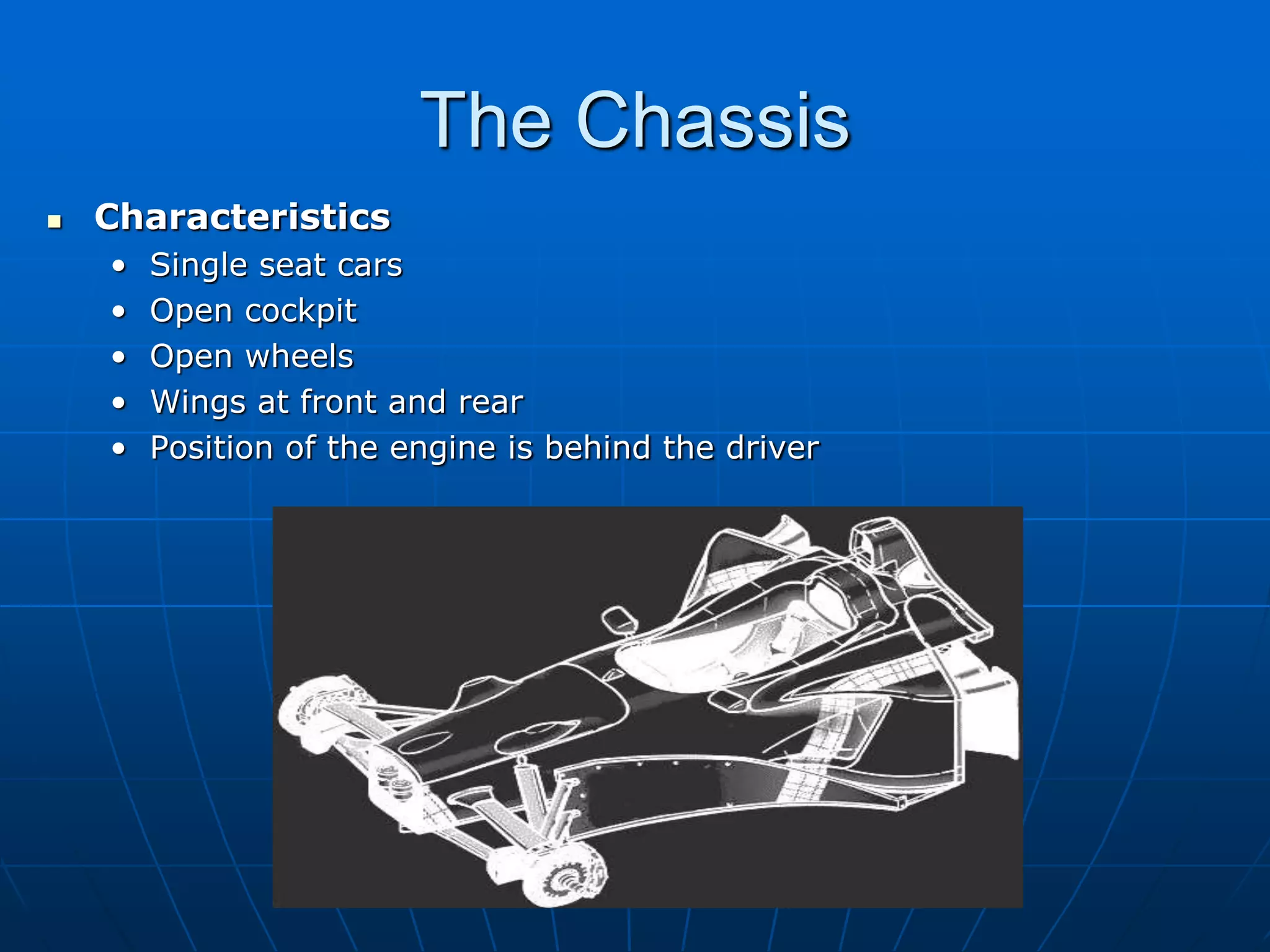
The Chassis
 Characteristics
• Single seat cars
• Open cockpit
• Open wheels
• Wings at front and rear
• Position of the engine is behind the driver
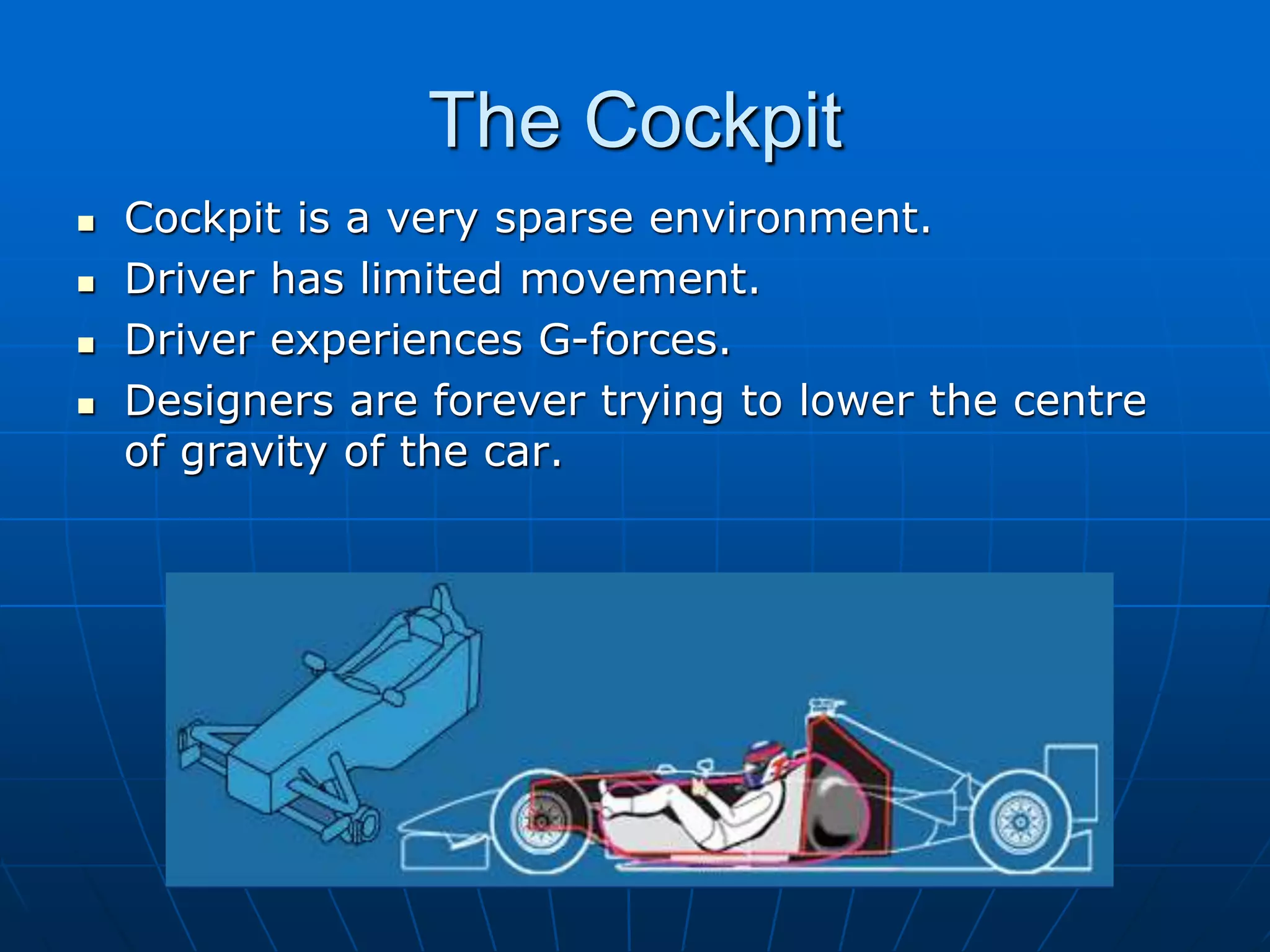
The Cockpit
 Cockpit is a very sparse environment.
 Driver has limited movement.
 Driver experiences G-forces.
 Designers are forever trying to lower the centre
of gravity of the car.
Aerodynamics
 Wing theory
 Rear wing
 Front wing
 Barge boards
 Diffuser
Wing theory
 Uses the same principle as an aircraft.
 Aircraft uses lift whereas f1 cars uses down-
force.
 Drag- another important factor on an f1 car.
Rear wing
 Made up of 2 sets of aerofoil connected to each
other by wing endplates.
 Top aerofoil made up of a maximum of 3 elements.
 Lower aerofoil made up of single element.
 Endplates prevent the air from spilling over the
sides of the wings.
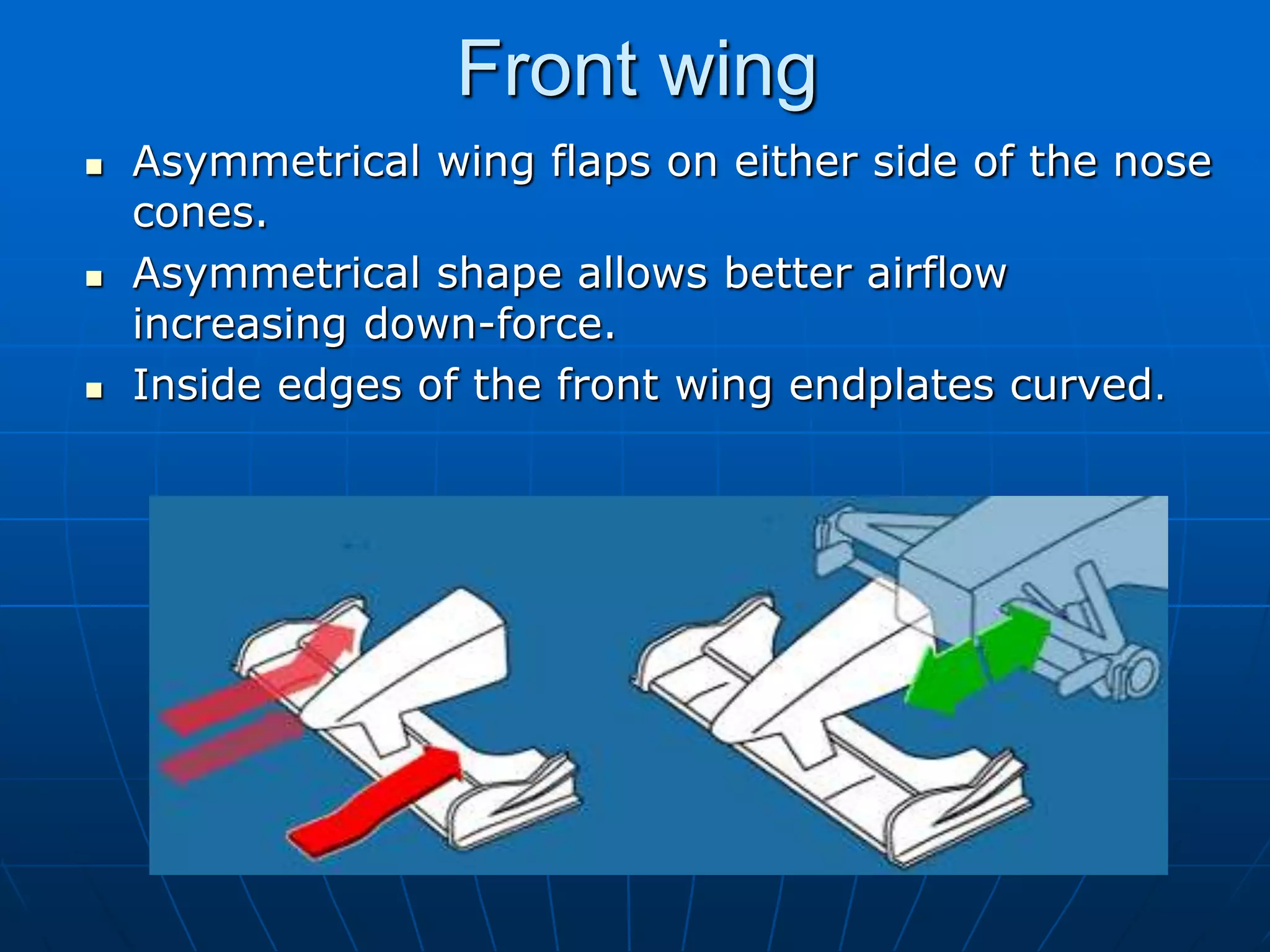
Front wing
 Asymmetrical wing flaps on either side of the nose
cones.
 Asymmetrical shape allows better airflow
increasing down-force.
 Inside edges of the front wing endplates curved.
Barge-boards
 Mounted between front wheels and side-pods.
 Can be situated in the suspension.
 Main purpose- Smoothen and direct the airflow
coming from the front wheels.
 They have contours to direct airflow in different
directions.
Diffuser
 Situated at the underside
of the car behind the rear
axle line.
 Consists of many tunnels
and splitters to control
airflow.
 Maximizes suction effect
thus increasing down-force.
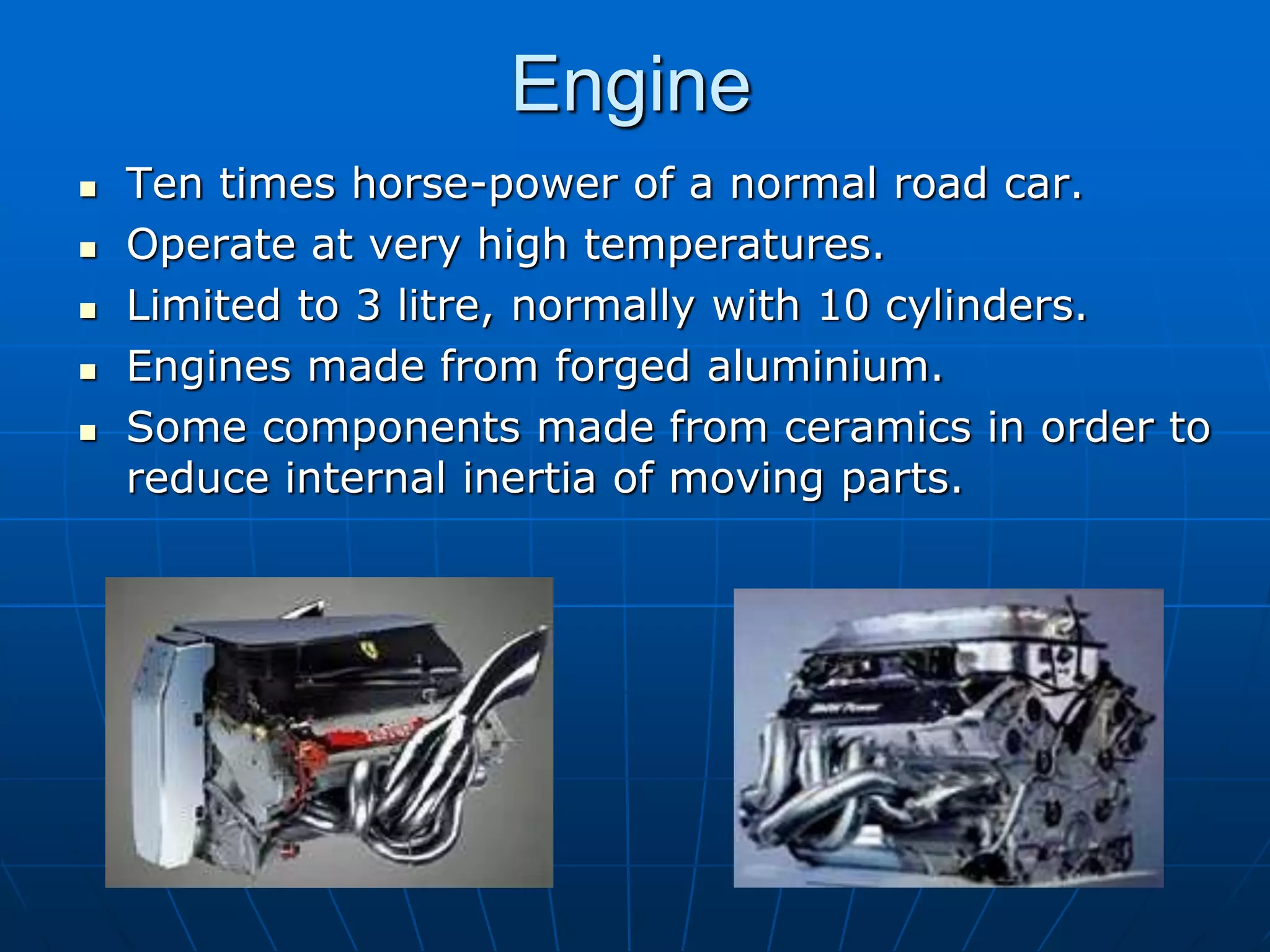
Engine
 Ten times horse-power of a normal road car.
 Operate at very high temperatures.
 Limited to 3 litre, normally with 10 cylinders.
 Engines made from forged aluminium.
 Some components made from ceramics in order to
reduce internal inertia of moving parts.
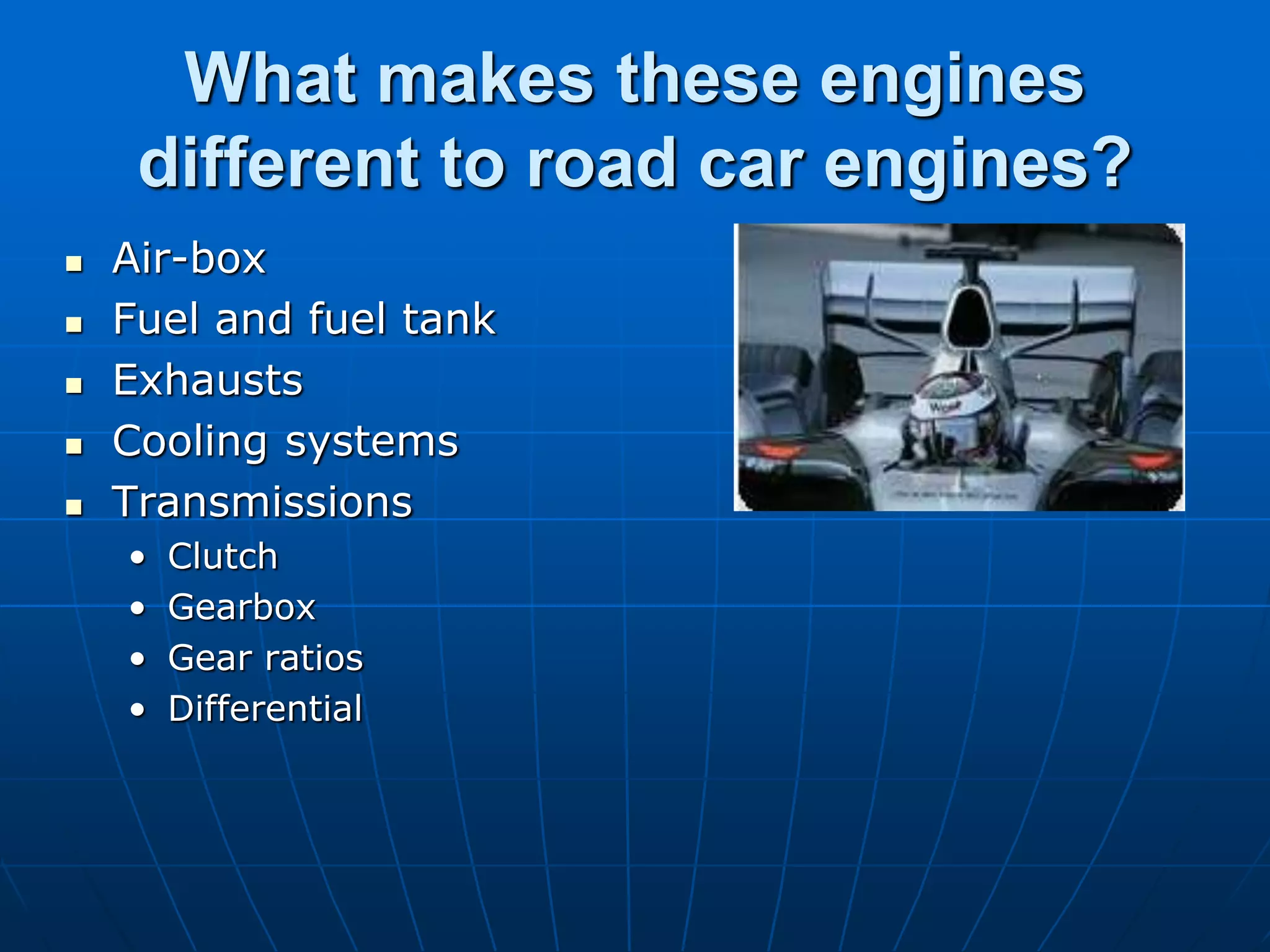
What makes these engines
different to road car engines?
 Air-box
 Fuel and fuel tank
 Exhausts
 Cooling systems
 Transmissions
• Clutch
• Gearbox
• Gear ratios
• Differential
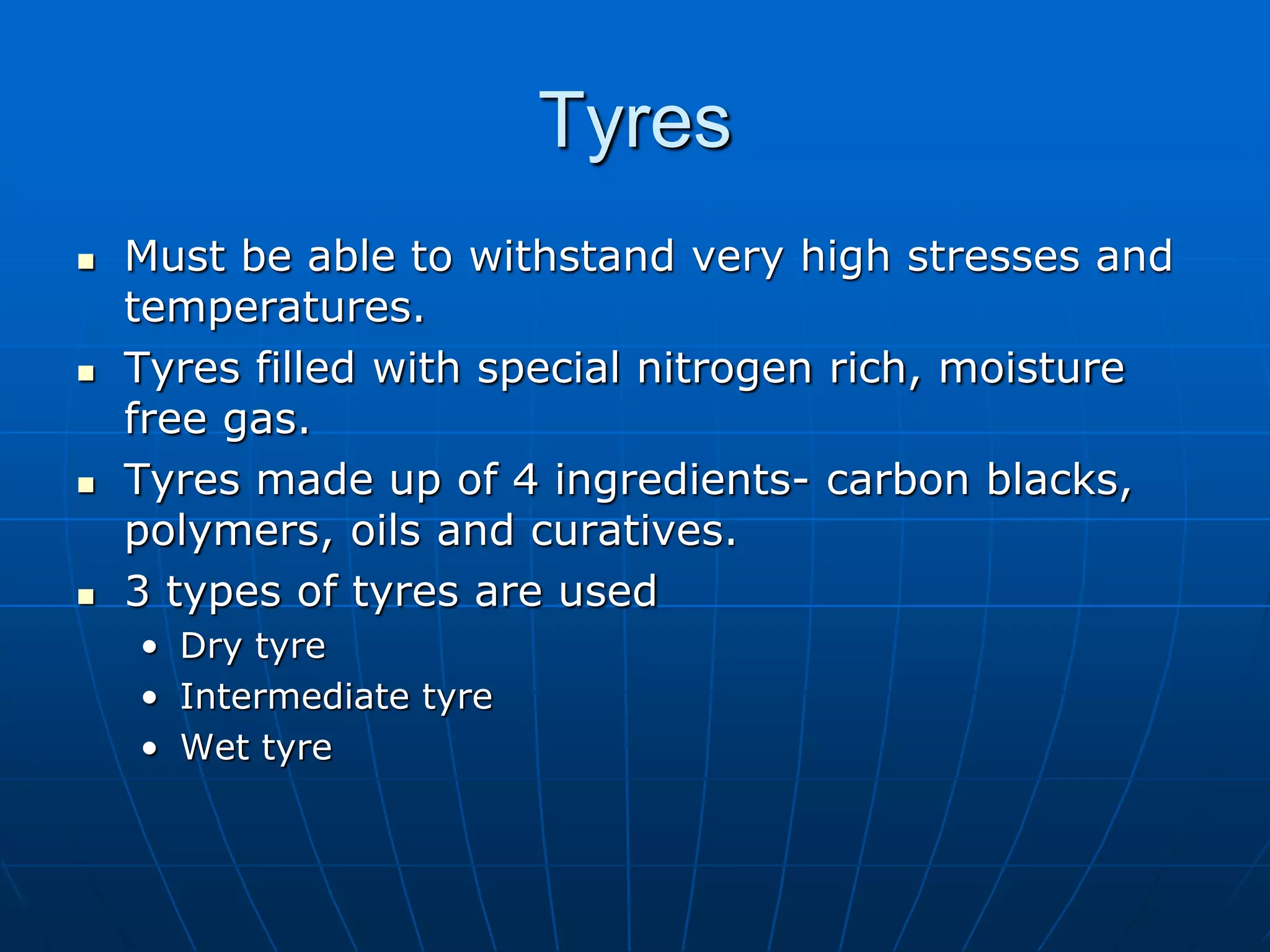
Tyres
 Must be able to withstand very high stresses and
temperatures.
 Tyres filled with special nitrogen rich, moisture
free gas.
 Tyres made up of 4 ingredients- carbon blacks,
polymers, oils and curatives.
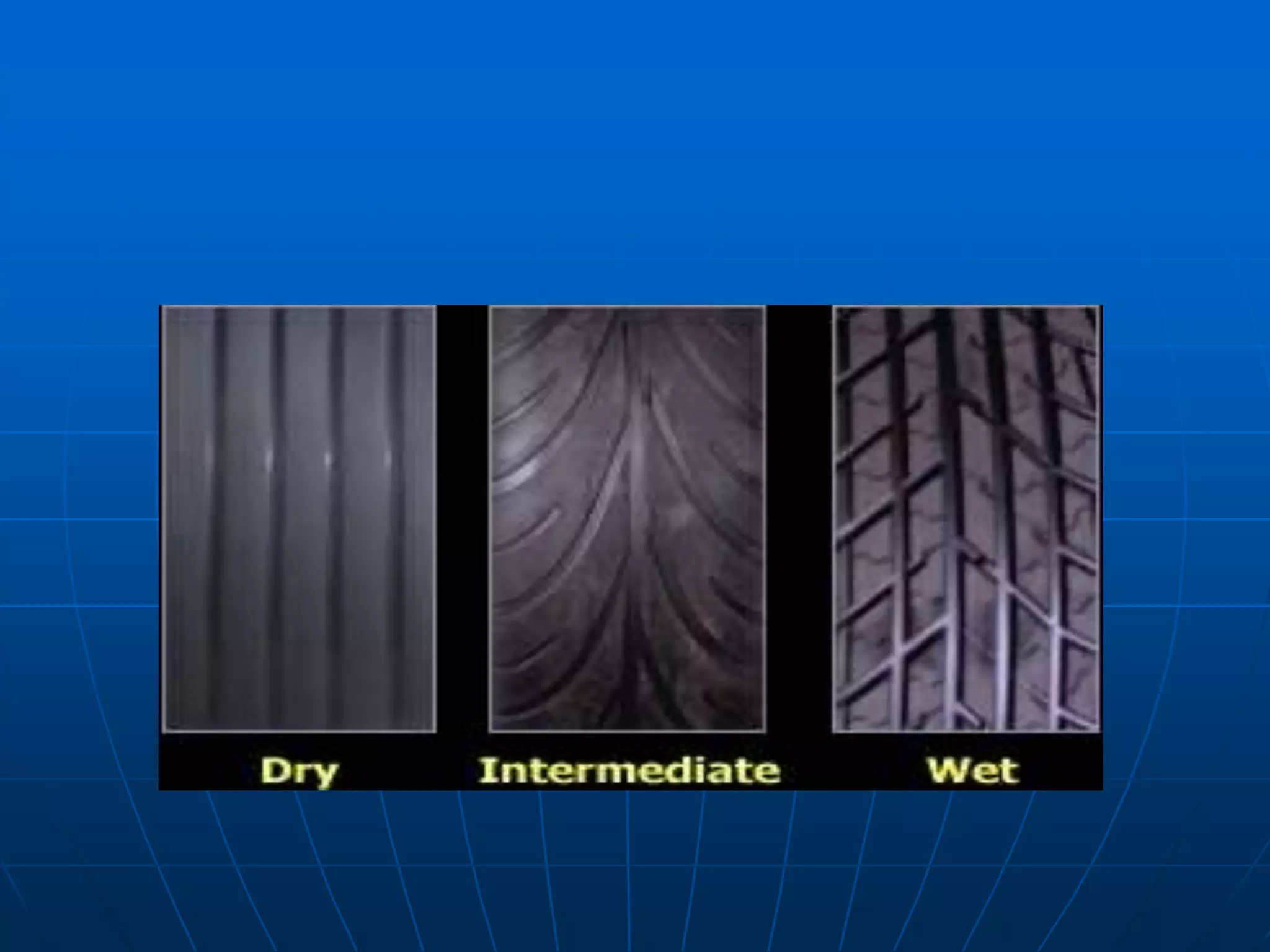
 3 types of tyres are used
• Dry tyre
• Intermediate tyre
• Wet tyre
The Suspensions
 Two forms of suspension.
• Traditional coil spring setup.
• Torsion bar setup
 Both forms are mounted on the chassis.
Dampers
 Often called shock absorbers.
 Main purpose is to prevent the spring from
oscillating too much
 These dampers can be tuned to alter the
handling.
The Brakes
 F1 cars use disc brakes designed to work at 750
degrees celcius.
 Brakes are set up with 60% braking force to the
front and 40% to the rear.
 Drivers are able to adjust the balance btw front
and rear braking force from a dial in the cockpit.
 Rotating discs are gripped by caliper squeezing
the disc.
 Discs are drilled for airflow to keep temperature
down.
 Front and rear braking systems are connected
separately
Steering wheel and pedals
 A sophisticated steering wheel with all the
information available.
 On the front of the wheel items such as rev
lights, speed limit button, fuel mixture controls,
radio buttons etc. are provided.
 Levers for changing gears are located on the
back of the wheel.
 Pedals are designed specifically for each driver.
 Only 2 pedals are available- for acceleration and
for braking.
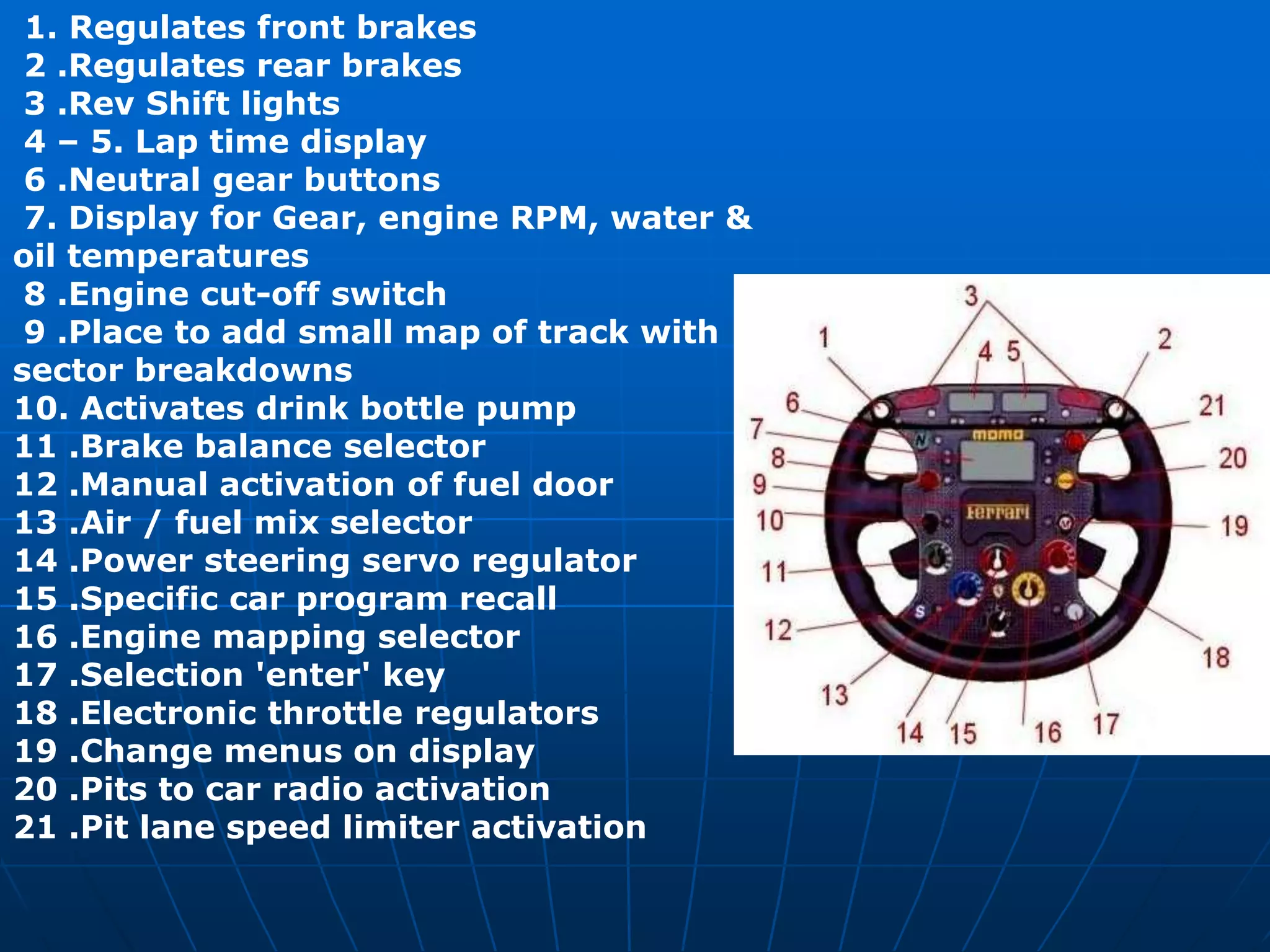
1. Regulates front brakes
2 .Regulates rear brakes
3 .Rev Shift lights
4 – 5. Lap time display
6 .Neutral gear buttons
7. Display for Gear, engine RPM, water &
oil temperatures
8 .Engine cut-off switch
9 .Place to add small map of track with
sector breakdowns
10. Activates drink bottle pump
11 .Brake balance selector
12 .Manual activation of fuel door
13 .Air / fuel mix selector
14 .Power steering servo regulator
15 .Specific car program recall
16 .Engine mapping selector
17 .Selection 'enter' key
18 .Electronic throttle regulators
19 .Change menus on display
20 .Pits to car radio activation
21 .Pit lane speed limiter activation
 Each part costs:
 PARTS AMOUNT SINGLE PRICE (€) AMOUNT NEEDED TOTAL (€)
 Monocoque 112 360 1 112,360
 Bodywork 8026 1 8,026
 Rear Wing 12842 1 12,842
 Front Wing 16051 1 16,051
 Engine 240770 1 240,770
 Gearbox 128411 1 128,411
 Gear Ratios (set) 112360 1 112,360
 Exhaust System 9631 1 9,631
Telemetry 128411 1 128,411
 Fire Extinguisher 3210 2 6,420
 Brake Discs 964 4 3,856
 Brake Pads 642 8 5,136
 Brake Callipers 16051 4 64,205
 Wheels 1124 4 4,496
 Tyres 642 4 2,568
 Shock Absorber 2087 4 8,346
 Pedals (set) 1605 1 1,605
 Dashboard 3210 1 3,210
 Steering System 4815 1 4,815
 Steering Wheel 32103 1 32,103
 Fuel Tank 9632 1 9,632
 Suspension 3210 1 3,210
 Wiring 8026 1 8,026

 GRAND TOTAL € 926,490
In addition to the build costs, thousands of pounds will be spent
on designing the car. Design costs include the making of models,
using the wind tunnel and paying crash test expenses etc. The
cost of producing the final product will be €7,700,000
Random facts about f1
 In an f1 engine revving at 18000rpm, piston travels
up and down 300 times a second.
 If a connecting rod let go of its piston at max speed,
the piston would have enough energy to travel
vertically over 100 metres.
 If a water hose were to blow off, complete cooling
system would empty in just over a second.
 F1 cars have 3 built in pneumatic jacks.
 F1 car has as many as 8 radios operating at a time.
Conclusion
 The car’s engine, suspension, aerodynamics, tyres etc
determine how fast they go.
 The engineering of materials, cooling system,
aerodynamics and high temperature structural
stiffness of f1 components is leading edge
technology.
 Getting the car tuned up and keeping it in a state of
perfection are 2 of the team’s most important tasks
during a season.
THANK YOU……
ANY QUERIES?

F1-CARS-Presentation.ppt

  • 1.
    PRESENTED BY ANUJ TRIPATHI UNDERTHE GUIDENCE OF MR. DINESH KUMAR SHARMA SWAMI KESHWANAND INSTITUTE OF TECHNOLOGY SEMINAR ON F1 TRACK DESIGN AND SAFETY
  • 2.
  • 3.
    Introduction  Most sophisticatedvehicles used in the most technologically advanced form of sports.  Each and every minute details tuned to perfection  Each f1 team has the responsibility to come up with the most efficient design.  Bringing the f1 cars to a halt is an incredible challenge.  F1 car driving demands precision, incredibly fast reflexes and endurance from the driver.
  • 4.
    The Chassis  Characteristics •Single seat cars • Open cockpit • Open wheels • Wings at front and rear • Position of the engine is behind the driver
  • 5.
    The Cockpit  Cockpitis a very sparse environment.  Driver has limited movement.  Driver experiences G-forces.  Designers are forever trying to lower the centre of gravity of the car.
  • 6.
    Aerodynamics  Wing theory Rear wing  Front wing  Barge boards  Diffuser
  • 7.
    Wing theory  Usesthe same principle as an aircraft.  Aircraft uses lift whereas f1 cars uses down- force.  Drag- another important factor on an f1 car.
  • 8.
    Rear wing  Madeup of 2 sets of aerofoil connected to each other by wing endplates.  Top aerofoil made up of a maximum of 3 elements.  Lower aerofoil made up of single element.  Endplates prevent the air from spilling over the sides of the wings.
  • 9.
    Front wing  Asymmetricalwing flaps on either side of the nose cones.  Asymmetrical shape allows better airflow increasing down-force.  Inside edges of the front wing endplates curved.
  • 10.
    Barge-boards  Mounted betweenfront wheels and side-pods.  Can be situated in the suspension.  Main purpose- Smoothen and direct the airflow coming from the front wheels.  They have contours to direct airflow in different directions.
  • 11.
    Diffuser  Situated atthe underside of the car behind the rear axle line.  Consists of many tunnels and splitters to control airflow.  Maximizes suction effect thus increasing down-force.
  • 12.
    Engine  Ten timeshorse-power of a normal road car.  Operate at very high temperatures.  Limited to 3 litre, normally with 10 cylinders.  Engines made from forged aluminium.  Some components made from ceramics in order to reduce internal inertia of moving parts.
  • 13.
    What makes theseengines different to road car engines?  Air-box  Fuel and fuel tank  Exhausts  Cooling systems  Transmissions • Clutch • Gearbox • Gear ratios • Differential
  • 14.
    Tyres  Must beable to withstand very high stresses and temperatures.  Tyres filled with special nitrogen rich, moisture free gas.  Tyres made up of 4 ingredients- carbon blacks, polymers, oils and curatives.  3 types of tyres are used • Dry tyre • Intermediate tyre • Wet tyre
  • 16.
    The Suspensions  Twoforms of suspension. • Traditional coil spring setup. • Torsion bar setup  Both forms are mounted on the chassis.
  • 17.
    Dampers  Often calledshock absorbers.  Main purpose is to prevent the spring from oscillating too much  These dampers can be tuned to alter the handling.
  • 18.
    The Brakes  F1cars use disc brakes designed to work at 750 degrees celcius.  Brakes are set up with 60% braking force to the front and 40% to the rear.  Drivers are able to adjust the balance btw front and rear braking force from a dial in the cockpit.  Rotating discs are gripped by caliper squeezing the disc.  Discs are drilled for airflow to keep temperature down.  Front and rear braking systems are connected separately
  • 19.
    Steering wheel andpedals  A sophisticated steering wheel with all the information available.  On the front of the wheel items such as rev lights, speed limit button, fuel mixture controls, radio buttons etc. are provided.  Levers for changing gears are located on the back of the wheel.  Pedals are designed specifically for each driver.  Only 2 pedals are available- for acceleration and for braking.
  • 20.
    1. Regulates frontbrakes 2 .Regulates rear brakes 3 .Rev Shift lights 4 – 5. Lap time display 6 .Neutral gear buttons 7. Display for Gear, engine RPM, water & oil temperatures 8 .Engine cut-off switch 9 .Place to add small map of track with sector breakdowns 10. Activates drink bottle pump 11 .Brake balance selector 12 .Manual activation of fuel door 13 .Air / fuel mix selector 14 .Power steering servo regulator 15 .Specific car program recall 16 .Engine mapping selector 17 .Selection 'enter' key 18 .Electronic throttle regulators 19 .Change menus on display 20 .Pits to car radio activation 21 .Pit lane speed limiter activation
  • 21.
     Each partcosts:  PARTS AMOUNT SINGLE PRICE (€) AMOUNT NEEDED TOTAL (€)  Monocoque 112 360 1 112,360  Bodywork 8026 1 8,026  Rear Wing 12842 1 12,842  Front Wing 16051 1 16,051  Engine 240770 1 240,770  Gearbox 128411 1 128,411  Gear Ratios (set) 112360 1 112,360  Exhaust System 9631 1 9,631 Telemetry 128411 1 128,411  Fire Extinguisher 3210 2 6,420  Brake Discs 964 4 3,856  Brake Pads 642 8 5,136  Brake Callipers 16051 4 64,205  Wheels 1124 4 4,496  Tyres 642 4 2,568  Shock Absorber 2087 4 8,346  Pedals (set) 1605 1 1,605  Dashboard 3210 1 3,210  Steering System 4815 1 4,815  Steering Wheel 32103 1 32,103  Fuel Tank 9632 1 9,632  Suspension 3210 1 3,210  Wiring 8026 1 8,026   GRAND TOTAL € 926,490 In addition to the build costs, thousands of pounds will be spent on designing the car. Design costs include the making of models, using the wind tunnel and paying crash test expenses etc. The cost of producing the final product will be €7,700,000
  • 22.
    Random facts aboutf1  In an f1 engine revving at 18000rpm, piston travels up and down 300 times a second.  If a connecting rod let go of its piston at max speed, the piston would have enough energy to travel vertically over 100 metres.  If a water hose were to blow off, complete cooling system would empty in just over a second.  F1 cars have 3 built in pneumatic jacks.  F1 car has as many as 8 radios operating at a time.
  • 23.
    Conclusion  The car’sengine, suspension, aerodynamics, tyres etc determine how fast they go.  The engineering of materials, cooling system, aerodynamics and high temperature structural stiffness of f1 components is leading edge technology.  Getting the car tuned up and keeping it in a state of perfection are 2 of the team’s most important tasks during a season.
  • 24.
  • 25.