Pythagorean Theorem
Forms of the Theorem
Forms of the Pythagorean Theorem
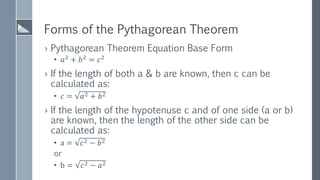
› Pythagorean Theorem Equation Base Form
• 𝑎2
+ 𝑏2
= 𝑐2
› If the length of both a & b are known, then c can be
calculated as:
• 𝑐 = 𝑎2 + 𝑏2
› If the length of the hypotenuse c and of one side (a or b)
are known, then the length of the other side can be
calculated as:
• a = 𝑐2 − 𝑏2
or
• b = 𝑐2 − 𝑎2
Forms of the Pythagorean Theorem Cont’d
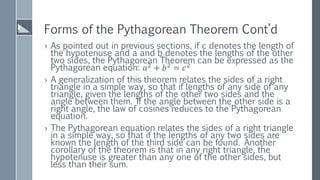
› As pointed out in previous sections, if c denotes the length of
the hypotenuse and a and b denotes the lengths of the other
two sides, the Pythagorean Theorem can be expressed as the
Pythagorean equation: 𝑎2
+ 𝑏2
= 𝑐2
› A generalization of this theorem relates the sides of a right
triangle in a simple way, so that if lengths of any side of any
triangle, given the lengths of the other two sides and the
angle between them. If the angle between the other side is a
right angle, the law of cosines reduces to the Pythagorean
equation.
› The Pythagorean equation relates the sides of a right triangle
in a simple way, so that if the lengths of any two sides are
known the length of the third side can be found. Another
corollary of the theorem is that in any right triangle, the
hypotenuse is greater than any one of the other sides, but
less than their sum.

Forms of the Pythagorean theorem

  • 1.
  • 2.
    Forms of thePythagorean Theorem › Pythagorean Theorem Equation Base Form • 𝑎2 + 𝑏2 = 𝑐2 › If the length of both a & b are known, then c can be calculated as: • 𝑐 = 𝑎2 + 𝑏2 › If the length of the hypotenuse c and of one side (a or b) are known, then the length of the other side can be calculated as: • a = 𝑐2 − 𝑏2 or • b = 𝑐2 − 𝑎2
  • 3.
    Forms of thePythagorean Theorem Cont’d › As pointed out in previous sections, if c denotes the length of the hypotenuse and a and b denotes the lengths of the other two sides, the Pythagorean Theorem can be expressed as the Pythagorean equation: 𝑎2 + 𝑏2 = 𝑐2 › A generalization of this theorem relates the sides of a right triangle in a simple way, so that if lengths of any side of any triangle, given the lengths of the other two sides and the angle between them. If the angle between the other side is a right angle, the law of cosines reduces to the Pythagorean equation. › The Pythagorean equation relates the sides of a right triangle in a simple way, so that if the lengths of any two sides are known the length of the third side can be found. Another corollary of the theorem is that in any right triangle, the hypotenuse is greater than any one of the other sides, but less than their sum.