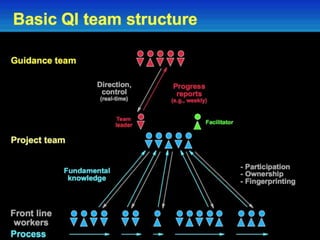
Forming Effective
Teams
(Rebecca) Suzie Miltner, PhD, RN
Associate Professor
School of Nursing
1
Objectives
 Describe characteristics and dynamics of
effective teams.
 Identify barriers and facilitators to teamwork in
healthcare settings.
 Understand factors that contribute to conflict
and how to resolve that conflict within groups.
Healthcare is complex….
How can we fix it?
Quality Improvement offers a
systematic, data-driven, iterative,
problem solving process that can
be adapted to local context.
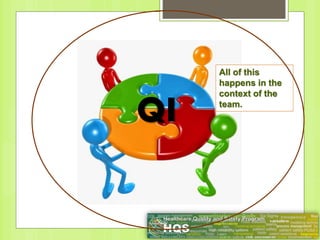
QI
All of this
happens in the
context of the
team.
5 observations about teams…
from Ed Salas
1. Most organizations want a culture of
collaboration
2. Organizations are using teams more than ever
3. Many teams perform sub-optimally
4. What happens in leadership teams can
permeate the organization
5. Patient safety demands reliable, adaptive, self-
correcting teams
From Eduardo Salas, PhD
Department of Psychology
Rice University
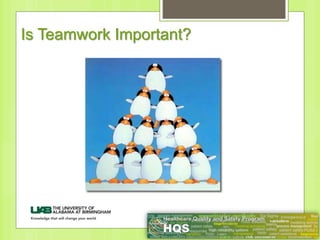
Is Teamwork Important?
We think so…
Improves the quality and safety of care.
May improve coordination of services
Increases professional satisfaction
May maximize resources (more efficient delivery
of care)
What is a Team?
 “A group of people organized to work together.”1
 “A group of people with a full set of
complementary skills required to complete a
task, job, or project.”2
 “A team is a small number of people with
complementary skills who are committed to a
common purpose, set of performance goals,
and approach for which they hold themselves
mutually accountable.”3
1http://www.thefreedictionary.com/team
2http://www.businessdictionary.com/definition/team.html
3Katzenbach, JR, and Smith, DK. (1993). The discipline of teams. Harvard Business Review. 162-171.
Teams
Teams differ in terms of their purpose, size,
membership, experience, level of authority,
history and chemistry.
Interestingly, to be effective, teams do not
necessarily have to have a long history of
working together, or have members who even
like each other.
Working Groups
 Purpose is usually the same as organizational purpose
 Strong, focused leader who delegates work
 Individual work products and accountability
Team
 Team has specific purpose that may be different from
organizational goals
 Collective work products with individual and team
accountability
 Performance measurement based on collective work
products
Working Group or Team?
Katzenbach, JR, and Smith, DK. (1993). The discipline of teams. Harvard Business Review. 162-171.
Teams in Healthcare
Widespread adoption
Classification of teams
Temporal stability
Authority differentiation
Skill differentiation
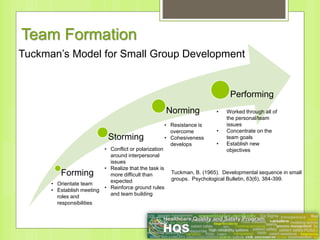
Team Formation
Forming
Storming
Norming
Performing
Tuckman’s Model for Small Group Development
• Orientate team
• Establish meeting
roles and
responsibilities
• Conflict or polarization
around interpersonal
issues
• Realize that the task is
more difficult than
expected
• Reinforce ground rules
and team building
• Resistance is
overcome
• Cohesiveness
develops
• Worked through all of
the personal/team
issues
• Concentrate on the
team goals
• Establish new
objectives
Tuckman, B. (1965). Developmental sequence in small
groups. Psychological Bulletin, 63(6), 384-399.
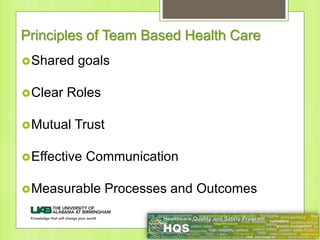
Principles of Team Based Health Care
Shared goals
Clear Roles
Mutual Trust
Effective Communication
Measurable Processes and Outcomes
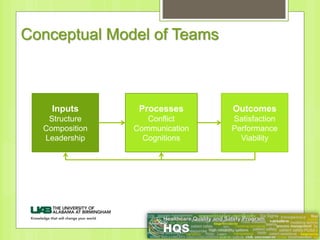
Conceptual Model of Teams
Inputs
Structure
Composition
Leadership
Processes
Conflict
Communication
Cognitions
Outcomes
Satisfaction
Performance
Viability
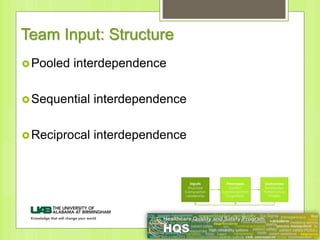
Team Input: Structure
Pooled interdependence
Sequential interdependence
Reciprocal interdependence
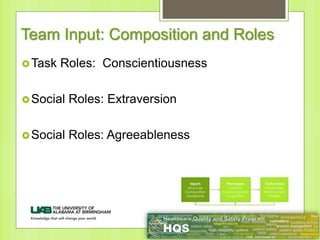
Team Input: Composition and Roles
Task Roles: Conscientiousness
Social Roles: Extraversion
Social Roles: Agreeableness
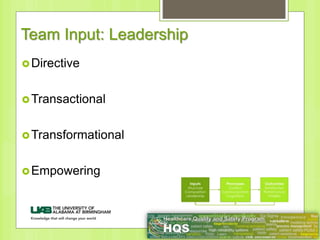
Team Input: Leadership
Directive
Transactional
Transformational
Empowering
Leadership
A leader is best when people barely know he
exists, when his work is done, his aim
fulfilled, they will say: we did it ourselves.
Lao Tzu
Team Process: Conflict
Relational Conflict
 This is problematic for team conflict
 Have to develop mutual trust and respect
 Sometimes this is not possible
Team Process: Conflict
Relational Conflict
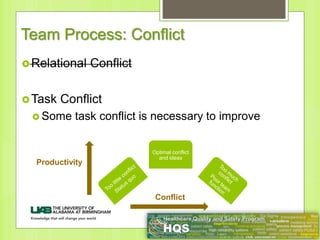
Task Conflict
 Some task conflict is necessary to improve
Optimal conflict
and ideas
Productivity
Conflict
Team Process: Cognitions
Shared mental models
Transactive memory systems
Shared Mental
Models
 “Our aim is to reduce
wait times in the
specialty clinic.”
 “Everyone has a part
in making this
happen.”
Transactive Memory
Systems
 “The expertise in
clinic flow is in the
clinic manager and
triage LPN.”
 We don’t have to
know all the details,
but we need to know
who does know that.
Team Process: Cognitions
Barriers to Team Success
Team Dysfunction
Mistrust
Lack of commitment and accountability
Poor resource allocation
Communication and collaboration
Disruptive behavior
Facilitators for Team Success
 Goals/aims/objectives are clearly defined.
 Members are selected for skill and team
competencies.
 Every team member has a role and participates.
 Team develops mutual respect and trust.
 There is effective management of the team.
Ground rules
Communication
Role expectations
7 drivers that influence team
effectiveness: Seven “C’s”
 Capability (right people with the right KSAs)
 Cooperation (right attitudes and willingness)
 Coordination (demonstrate teamwork behaviors)
 Communication (effective with each other)
 Cognition (shared understanding)
 Coaching (team members demo leadership behaviors
 Conditions (have favorable conditions such as
resources, culture, and senior leadership)
From Eduardo Salas, PhD
Department of Psychology
Rice University
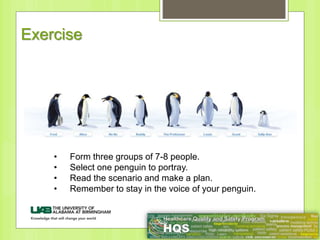
Exercise
• Form three groups of 7-8 people.
• Select one penguin to portray.
• Read the scenario and make a plan.
• Remember to stay in the voice of your penguin.
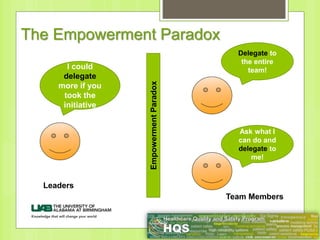
The Empowerment Paradox
I could
delegate
more if you
took the
initiative
EmpowermentParadox
Delegate to
the entire
team!
Ask what I
can do and
delegate to
me!
Leaders
Team Members
What can YOU do to create more
effective QI teams?
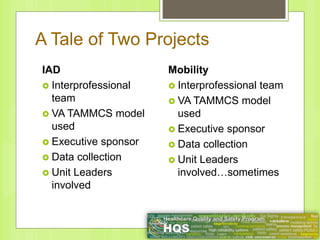
IAD
 Interprofessional
team
 VA TAMMCS model
used
 Executive sponsor
 Data collection
 Unit Leaders
involved
Mobility
 Interprofessional team
 VA TAMMCS model
used
 Executive sponsor
 Data collection
 Unit Leaders
involved…sometimes
A Tale of Two Projects
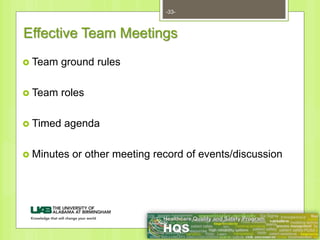
Effective Team Meetings
 Team ground rules
 Team roles
 Timed agenda
 Minutes or other meeting record of events/discussion
-33-
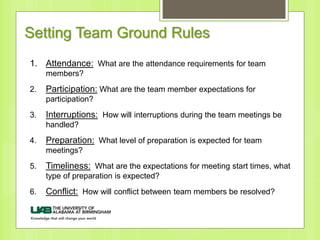
Setting Team Ground Rules
1. Attendance: What are the attendance requirements for team
members?
2. Participation: What are the team member expectations for
participation?
3. Interruptions: How will interruptions during the team meetings be
handled?
4. Preparation: What level of preparation is expected for team
meetings?
5. Timeliness: What are the expectations for meeting start times, what
type of preparation is expected?
6. Conflict: How will conflict between team members be resolved?
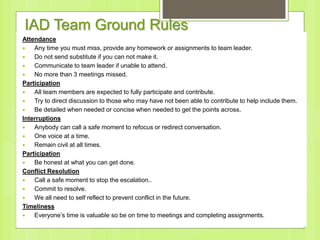
IAD Team Ground Rules
Attendance
 Any time you must miss, provide any homework or assignments to team leader.
 Do not send substitute if you can not make it.
 Communicate to team leader if unable to attend.
 No more than 3 meetings missed.
Participation
 All team members are expected to fully participate and contribute.
 Try to direct discussion to those who may have not been able to contribute to help include them.
 Be detailed when needed or concise when needed to get the points across.
Interruptions
 Anybody can call a safe moment to refocus or redirect conversation.
 One voice at a time.
 Remain civil at all times.
Participation
 Be honest at what you can get done.
Conflict Resolution
 Call a safe moment to stop the escalation..
 Commit to resolve.
 We all need to self reflect to prevent conflict in the future.
Timeliness
 Everyone’s time is valuable so be on time to meetings and completing assignments.
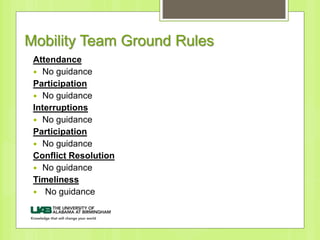
Mobility Team Ground Rules
Attendance
 No guidance
Participation
 No guidance
Interruptions
 No guidance
Participation
 No guidance
Conflict Resolution
 No guidance
Timeliness
 No guidance
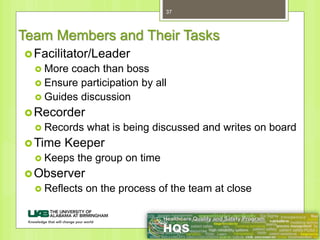
Team Members and Their Tasks
Facilitator/Leader
 More coach than boss
 Ensure participation by all
 Guides discussion
Recorder
 Records what is being discussed and writes on board
Time Keeper
 Keeps the group on time
Observer
 Reflects on the process of the team at close
37
Questions?

Forming Effective Teams

  • 1.
    Forming Effective Teams (Rebecca) SuzieMiltner, PhD, RN Associate Professor School of Nursing 1
  • 2.
    Objectives  Describe characteristicsand dynamics of effective teams.  Identify barriers and facilitators to teamwork in healthcare settings.  Understand factors that contribute to conflict and how to resolve that conflict within groups.
  • 3.
  • 4.
    Quality Improvement offersa systematic, data-driven, iterative, problem solving process that can be adapted to local context.
  • 5.
    QI All of this happensin the context of the team.
  • 6.
    5 observations aboutteams… from Ed Salas 1. Most organizations want a culture of collaboration 2. Organizations are using teams more than ever 3. Many teams perform sub-optimally 4. What happens in leadership teams can permeate the organization 5. Patient safety demands reliable, adaptive, self- correcting teams From Eduardo Salas, PhD Department of Psychology Rice University
  • 7.
  • 8.
    We think so… Improvesthe quality and safety of care. May improve coordination of services Increases professional satisfaction May maximize resources (more efficient delivery of care)
  • 9.
    What is aTeam?  “A group of people organized to work together.”1  “A group of people with a full set of complementary skills required to complete a task, job, or project.”2  “A team is a small number of people with complementary skills who are committed to a common purpose, set of performance goals, and approach for which they hold themselves mutually accountable.”3 1http://www.thefreedictionary.com/team 2http://www.businessdictionary.com/definition/team.html 3Katzenbach, JR, and Smith, DK. (1993). The discipline of teams. Harvard Business Review. 162-171.
  • 10.
    Teams Teams differ interms of their purpose, size, membership, experience, level of authority, history and chemistry. Interestingly, to be effective, teams do not necessarily have to have a long history of working together, or have members who even like each other.
  • 11.
    Working Groups  Purposeis usually the same as organizational purpose  Strong, focused leader who delegates work  Individual work products and accountability Team  Team has specific purpose that may be different from organizational goals  Collective work products with individual and team accountability  Performance measurement based on collective work products Working Group or Team? Katzenbach, JR, and Smith, DK. (1993). The discipline of teams. Harvard Business Review. 162-171.
  • 12.
    Teams in Healthcare Widespreadadoption Classification of teams Temporal stability Authority differentiation Skill differentiation
  • 14.
    Team Formation Forming Storming Norming Performing Tuckman’s Modelfor Small Group Development • Orientate team • Establish meeting roles and responsibilities • Conflict or polarization around interpersonal issues • Realize that the task is more difficult than expected • Reinforce ground rules and team building • Resistance is overcome • Cohesiveness develops • Worked through all of the personal/team issues • Concentrate on the team goals • Establish new objectives Tuckman, B. (1965). Developmental sequence in small groups. Psychological Bulletin, 63(6), 384-399.
  • 15.
    Principles of TeamBased Health Care Shared goals Clear Roles Mutual Trust Effective Communication Measurable Processes and Outcomes
  • 16.
    Conceptual Model ofTeams Inputs Structure Composition Leadership Processes Conflict Communication Cognitions Outcomes Satisfaction Performance Viability
  • 17.
    Team Input: Structure Pooledinterdependence Sequential interdependence Reciprocal interdependence
  • 18.
    Team Input: Compositionand Roles Task Roles: Conscientiousness Social Roles: Extraversion Social Roles: Agreeableness
  • 19.
  • 20.
    Leadership A leader isbest when people barely know he exists, when his work is done, his aim fulfilled, they will say: we did it ourselves. Lao Tzu
  • 21.
    Team Process: Conflict RelationalConflict  This is problematic for team conflict  Have to develop mutual trust and respect  Sometimes this is not possible
  • 22.
    Team Process: Conflict RelationalConflict Task Conflict  Some task conflict is necessary to improve Optimal conflict and ideas Productivity Conflict
  • 23.
    Team Process: Cognitions Sharedmental models Transactive memory systems
  • 24.
    Shared Mental Models  “Ouraim is to reduce wait times in the specialty clinic.”  “Everyone has a part in making this happen.” Transactive Memory Systems  “The expertise in clinic flow is in the clinic manager and triage LPN.”  We don’t have to know all the details, but we need to know who does know that. Team Process: Cognitions
  • 25.
    Barriers to TeamSuccess Team Dysfunction Mistrust Lack of commitment and accountability Poor resource allocation Communication and collaboration Disruptive behavior
  • 26.
    Facilitators for TeamSuccess  Goals/aims/objectives are clearly defined.  Members are selected for skill and team competencies.  Every team member has a role and participates.  Team develops mutual respect and trust.  There is effective management of the team. Ground rules Communication Role expectations
  • 27.
    7 drivers thatinfluence team effectiveness: Seven “C’s”  Capability (right people with the right KSAs)  Cooperation (right attitudes and willingness)  Coordination (demonstrate teamwork behaviors)  Communication (effective with each other)  Cognition (shared understanding)  Coaching (team members demo leadership behaviors  Conditions (have favorable conditions such as resources, culture, and senior leadership) From Eduardo Salas, PhD Department of Psychology Rice University
  • 28.
    Exercise • Form threegroups of 7-8 people. • Select one penguin to portray. • Read the scenario and make a plan. • Remember to stay in the voice of your penguin.
  • 29.
    The Empowerment Paradox Icould delegate more if you took the initiative EmpowermentParadox Delegate to the entire team! Ask what I can do and delegate to me! Leaders Team Members
  • 31.
    What can YOUdo to create more effective QI teams?
  • 32.
    IAD  Interprofessional team  VATAMMCS model used  Executive sponsor  Data collection  Unit Leaders involved Mobility  Interprofessional team  VA TAMMCS model used  Executive sponsor  Data collection  Unit Leaders involved…sometimes A Tale of Two Projects
  • 33.
    Effective Team Meetings Team ground rules  Team roles  Timed agenda  Minutes or other meeting record of events/discussion -33-
  • 34.
    Setting Team GroundRules 1. Attendance: What are the attendance requirements for team members? 2. Participation: What are the team member expectations for participation? 3. Interruptions: How will interruptions during the team meetings be handled? 4. Preparation: What level of preparation is expected for team meetings? 5. Timeliness: What are the expectations for meeting start times, what type of preparation is expected? 6. Conflict: How will conflict between team members be resolved?
  • 35.
    IAD Team GroundRules Attendance  Any time you must miss, provide any homework or assignments to team leader.  Do not send substitute if you can not make it.  Communicate to team leader if unable to attend.  No more than 3 meetings missed. Participation  All team members are expected to fully participate and contribute.  Try to direct discussion to those who may have not been able to contribute to help include them.  Be detailed when needed or concise when needed to get the points across. Interruptions  Anybody can call a safe moment to refocus or redirect conversation.  One voice at a time.  Remain civil at all times. Participation  Be honest at what you can get done. Conflict Resolution  Call a safe moment to stop the escalation..  Commit to resolve.  We all need to self reflect to prevent conflict in the future. Timeliness  Everyone’s time is valuable so be on time to meetings and completing assignments.
  • 36.
    Mobility Team GroundRules Attendance  No guidance Participation  No guidance Interruptions  No guidance Participation  No guidance Conflict Resolution  No guidance Timeliness  No guidance
  • 37.
    Team Members andTheir Tasks Facilitator/Leader  More coach than boss  Ensure participation by all  Guides discussion Recorder  Records what is being discussed and writes on board Time Keeper  Keeps the group on time Observer  Reflects on the process of the team at close 37
  • 38.