1
TEAMPRES.PPT
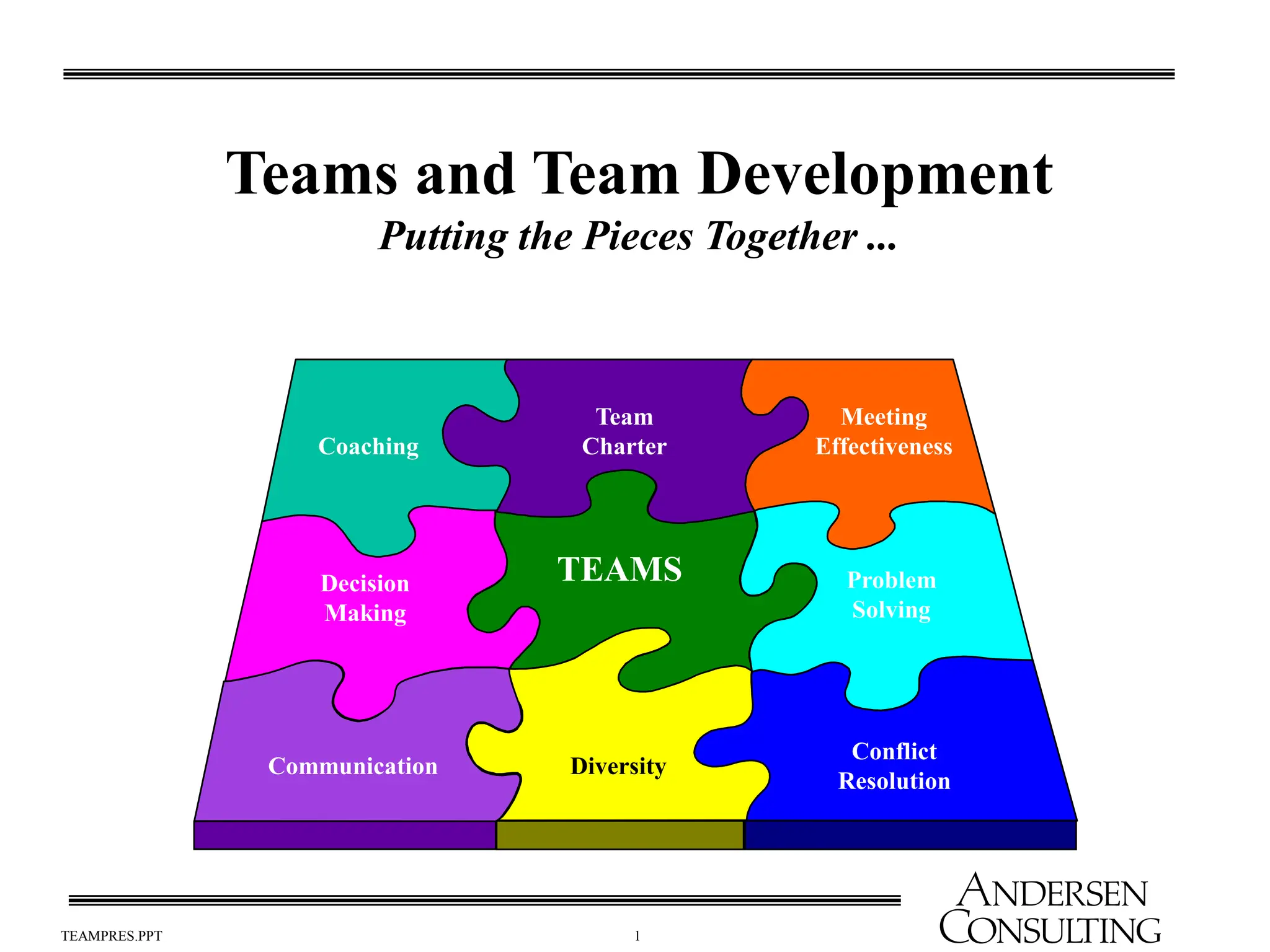
Teams and Team Development
Putting the Pieces Together ...
TEAMS
Communication
Conflict
Resolution
Diversity
Coaching
Decision
Making
Meeting
Effectiveness
Team
Charter
Problem
Solving
Decision
Making
2
TEAMPRES.PPT
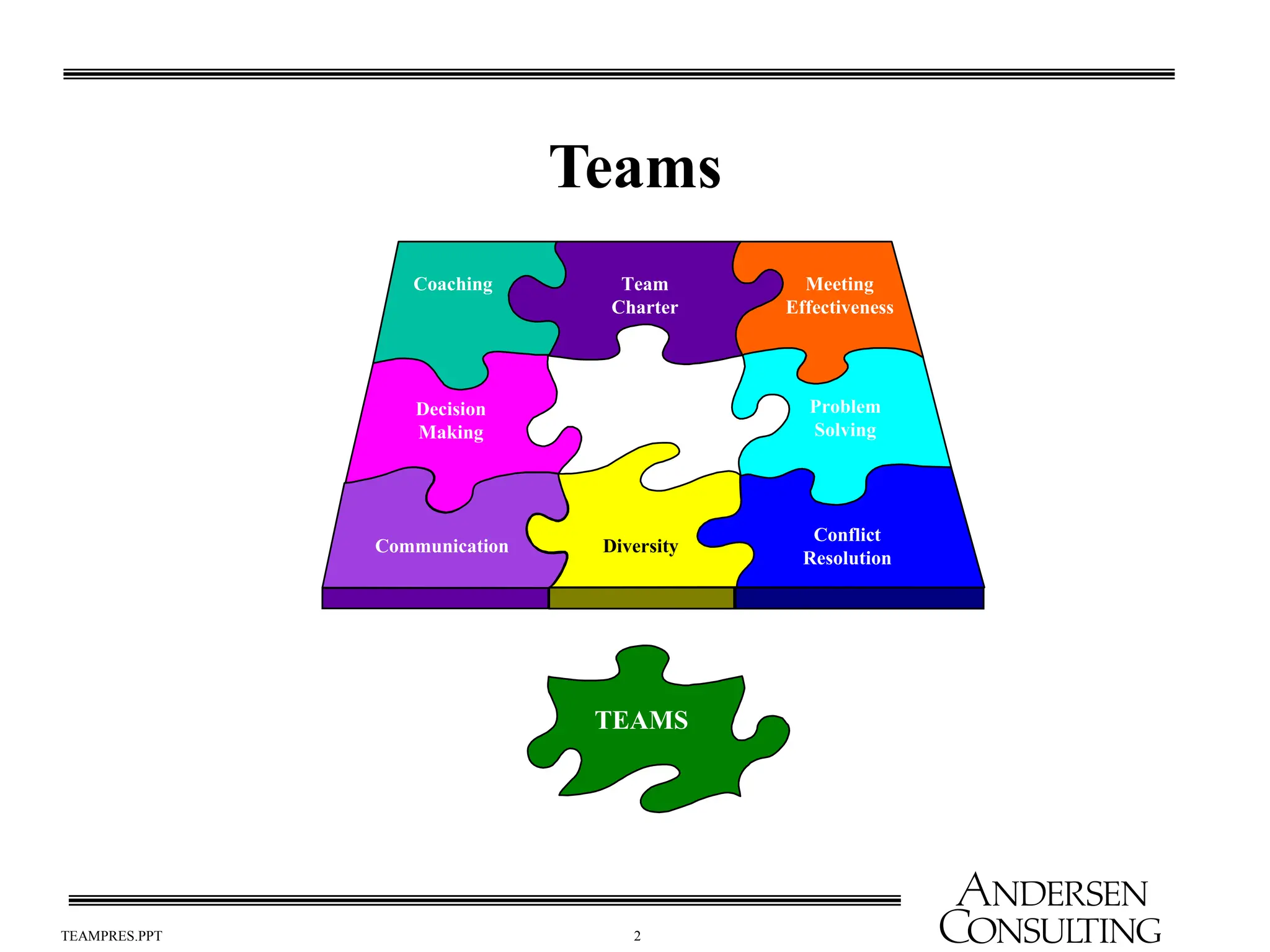
Teams
TEAMS
Communication
Conflict
Resolution
Diversity
Coaching
Decision
Making
Meeting
Effectiveness
Team
Charter
Problem
Solving
Decision
Making
3
TEAMPRES.PPT
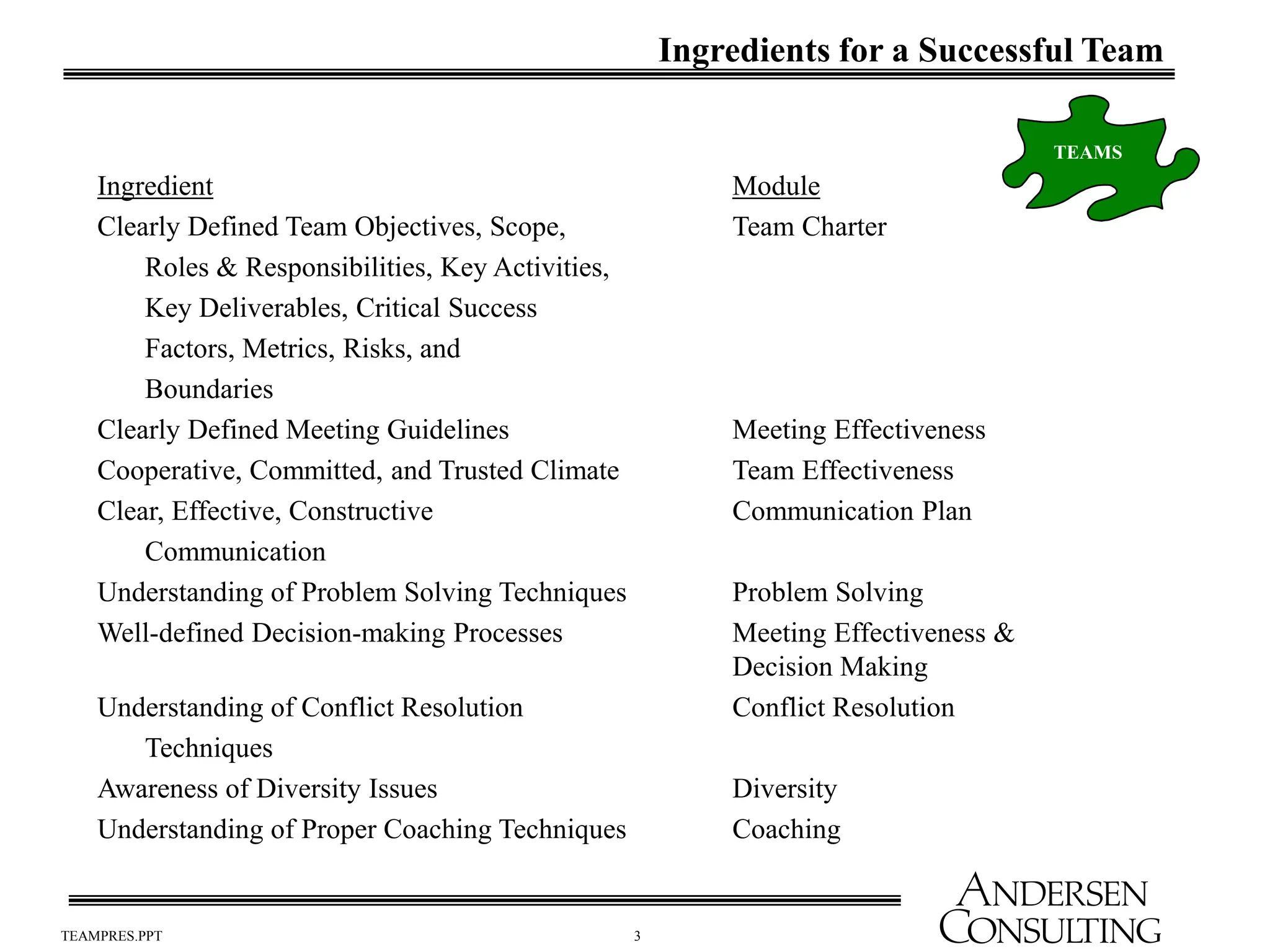
Ingredient Module
Clearly Defined Team Objectives, Scope, Team Charter
Roles & Responsibilities, Key Activities,
Key Deliverables, Critical Success
Factors, Metrics, Risks, and
Boundaries
Clearly Defined Meeting Guidelines Meeting Effectiveness
Cooperative, Committed, and Trusted Climate Team Effectiveness
Clear, Effective, Constructive Communication Plan
Communication
Understanding of Problem Solving Techniques Problem Solving
Well-defined Decision-making Processes Meeting Effectiveness &
Decision Making
Understanding of Conflict Resolution Conflict Resolution
Techniques
Awareness of Diversity Issues Diversity
Understanding of Proper Coaching Techniques Coaching
Ingredients for a Successful Team
TEAMS
4
TEAMPRES.PPT
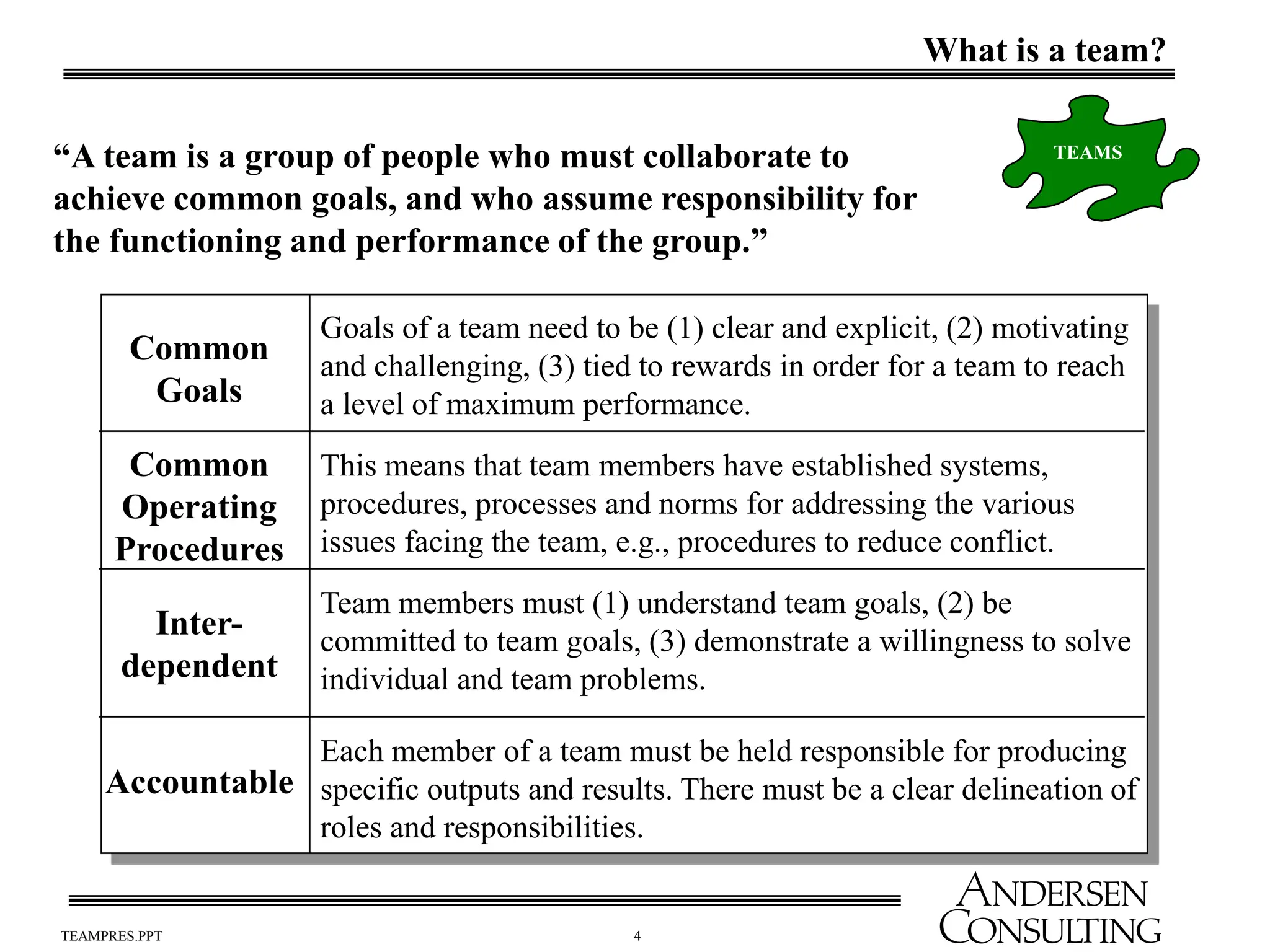
“A team is a group of people who must collaborate to
achieve common goals, and who assume responsibility for
the functioning and performance of the group.”
Common
Goals
Common
Operating
Procedures
Inter-
dependent
Accountable
Goals of a team need to be (1) clear and explicit, (2) motivating
and challenging, (3) tied to rewards in order for a team to reach
a level of maximum performance.
This means that team members have established systems,
procedures, processes and norms for addressing the various
issues facing the team, e.g., procedures to reduce conflict.
Team members must (1) understand team goals, (2) be
committed to team goals, (3) demonstrate a willingness to solve
individual and team problems.
Each member of a team must be held responsible for producing
specific outputs and results. There must be a clear delineation of
roles and responsibilities.
What is a team?
TEAMS
5
TEAMPRES.PPT
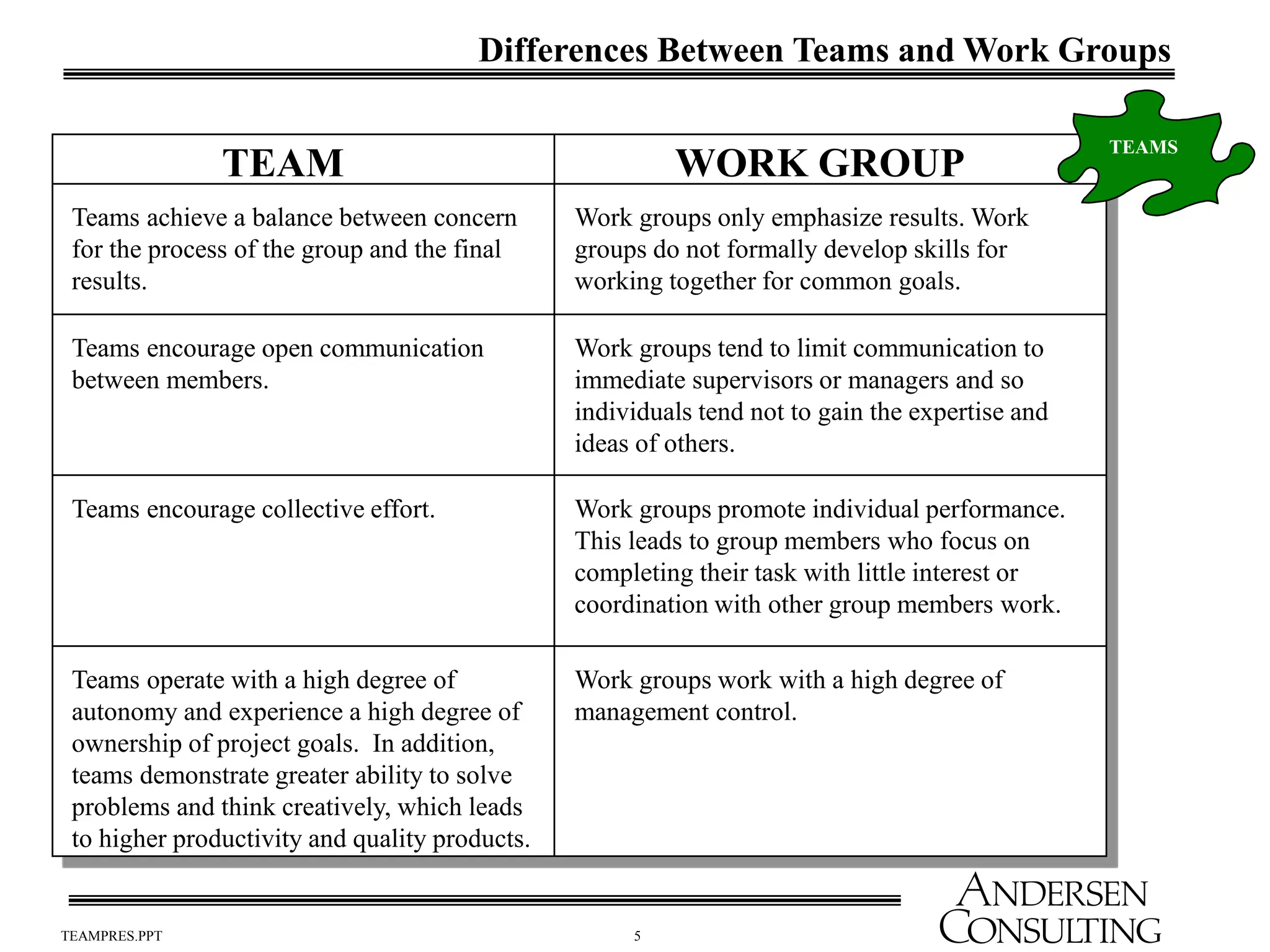
Differences Between Teams and Work Groups
TEAM WORK GROUP
Teams achieve a balance between concern
for the process of the group and the final
results.
Work groups only emphasize results. Work
groups do not formally develop skills for
working together for common goals.
Teams encourage open communication
between members.
Work groups tend to limit communication to
immediate supervisors or managers and so
individuals tend not to gain the expertise and
ideas of others.
Teams encourage collective effort. Work groups promote individual performance.
This leads to group members who focus on
completing their task with little interest or
coordination with other group members work.
Teams operate with a high degree of
autonomy and experience a high degree of
ownership of project goals. In addition,
teams demonstrate greater ability to solve
problems and think creatively, which leads
to higher productivity and quality products.
Work groups work with a high degree of
management control.
TEAMS
6
TEAMPRES.PPT
Component Definition
Component
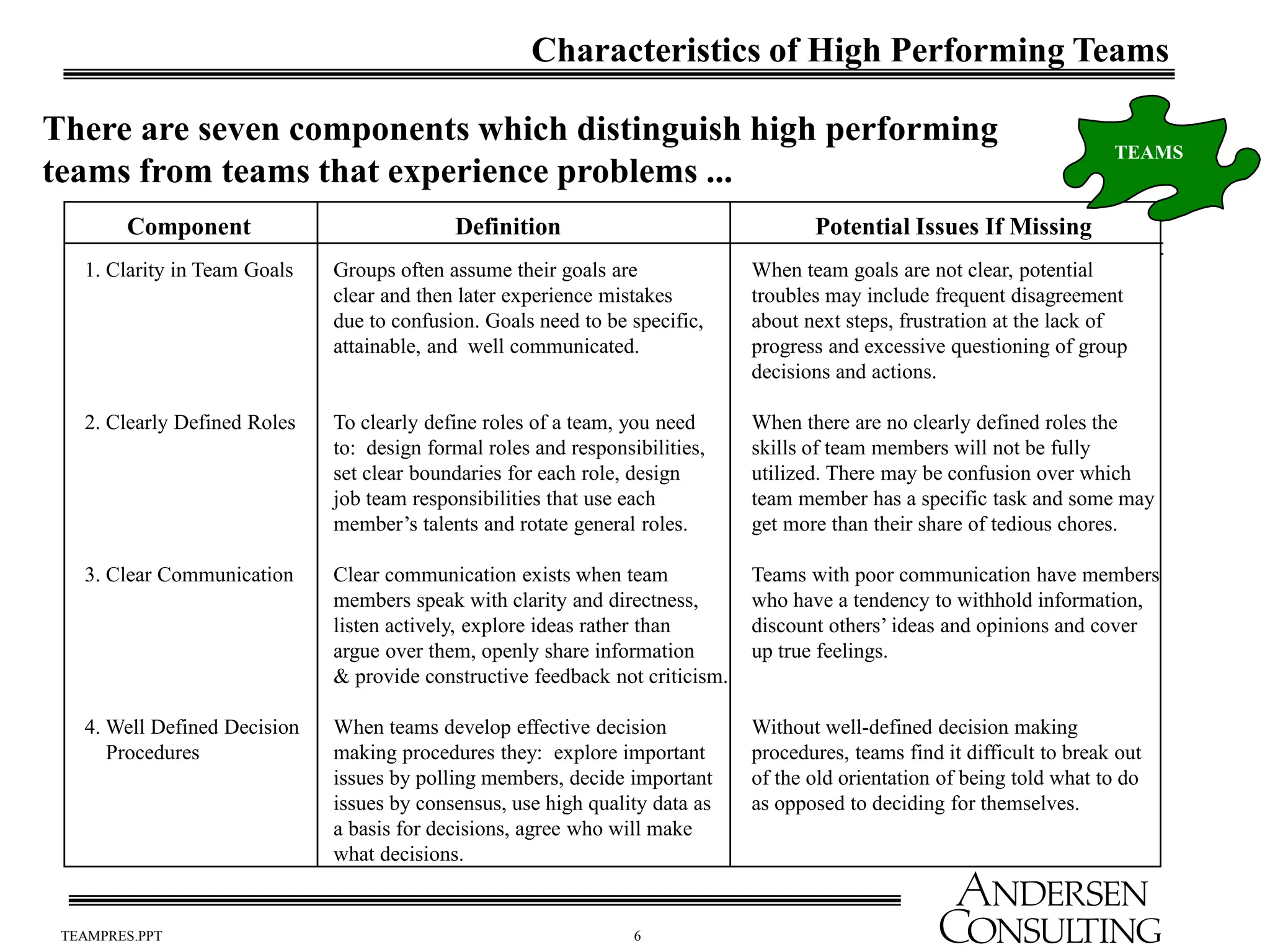
Characteristics of High Performing Teams
There are seven components which distinguish high performing
teams from teams that experience problems ...
1. Clarity in Team Goals
2. Clearly Defined Roles
3. Clear Communication
4. Well Defined Decision
Procedures
Groups often assume their goals are
clear and then later experience mistakes
due to confusion. Goals need to be specific,
attainable, and well communicated.
To clearly define roles of a team, you need
to: design formal roles and responsibilities,
set clear boundaries for each role, design
job team responsibilities that use each
member’s talents and rotate general roles.
Clear communication exists when team
members speak with clarity and directness,
listen actively, explore ideas rather than
argue over them, openly share information
& provide constructive feedback not criticism.
When teams develop effective decision
making procedures they: explore important
issues by polling members, decide important
issues by consensus, use high quality data as
a basis for decisions, agree who will make
what decisions.
When team goals are not clear, potential
troubles may include frequent disagreement
about next steps, frustration at the lack of
progress and excessive questioning of group
decisions and actions.
When there are no clearly defined roles the
skills of team members will not be fully
utilized. There may be confusion over which
team member has a specific task and some may
get more than their share of tedious chores.
Teams with poor communication have members
who have a tendency to withhold information,
discount others’ ideas and opinions and cover
up true feelings.
Without well-defined decision making
procedures, teams find it difficult to break out
of the old orientation of being told what to do
as opposed to deciding for themselves.
Potential Issues If Missing
TEAMS
7
TEAMPRES.PPT
Definition
Component
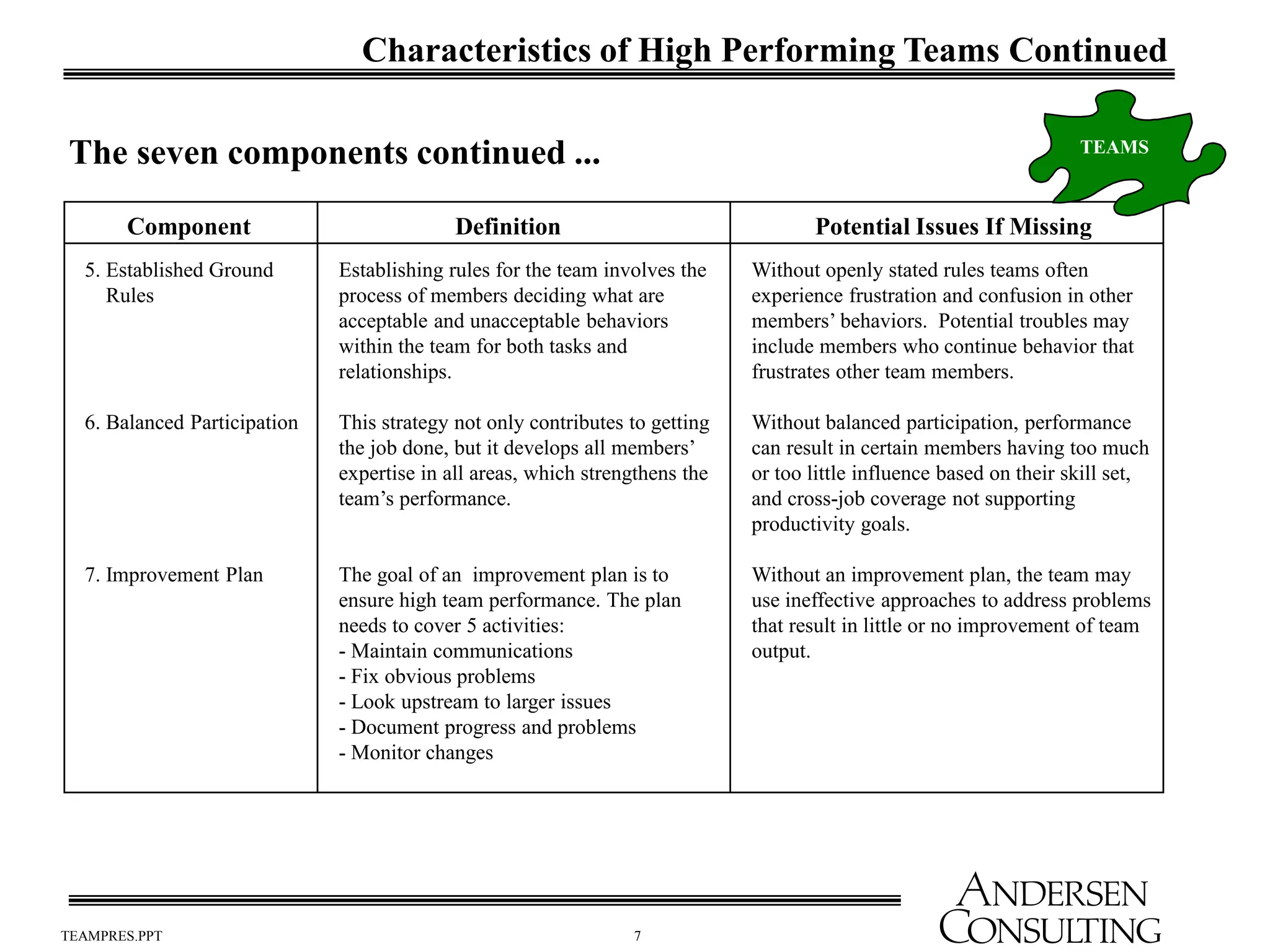
Characteristics of High Performing Teams Continued
The seven components continued ...
5. Established Ground
Rules
6. Balanced Participation
7. Improvement Plan
Establishing rules for the team involves the
process of members deciding what are
acceptable and unacceptable behaviors
within the team for both tasks and
relationships.
This strategy not only contributes to getting
the job done, but it develops all members’
expertise in all areas, which strengthens the
team’s performance.
The goal of an improvement plan is to
ensure high team performance. The plan
needs to cover 5 activities:
- Maintain communications
- Fix obvious problems
- Look upstream to larger issues
- Document progress and problems
- Monitor changes
Without openly stated rules teams often
experience frustration and confusion in other
members’ behaviors. Potential troubles may
include members who continue behavior that
frustrates other team members.
Without balanced participation, performance
can result in certain members having too much
or too little influence based on their skill set,
and cross-job coverage not supporting
productivity goals.
Without an improvement plan, the team may
use ineffective approaches to address problems
that result in little or no improvement of team
output.
Potential Issues If Missing
TEAMS
8
TEAMPRES.PPT
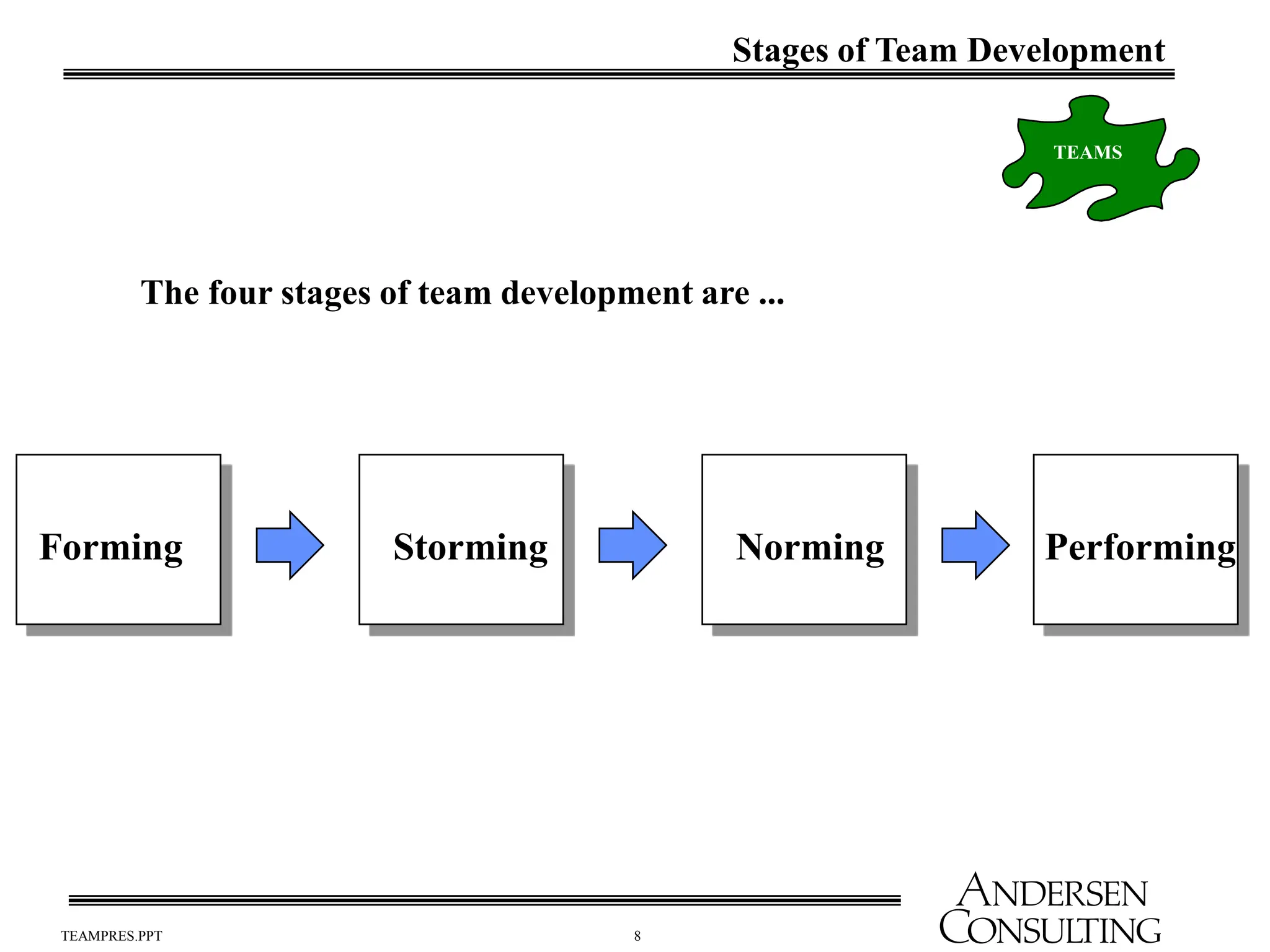
Stages of Team Development
Forming Storming Norming Performing
The four stages of team development are ...
TEAMS
9
TEAMPRES.PPT
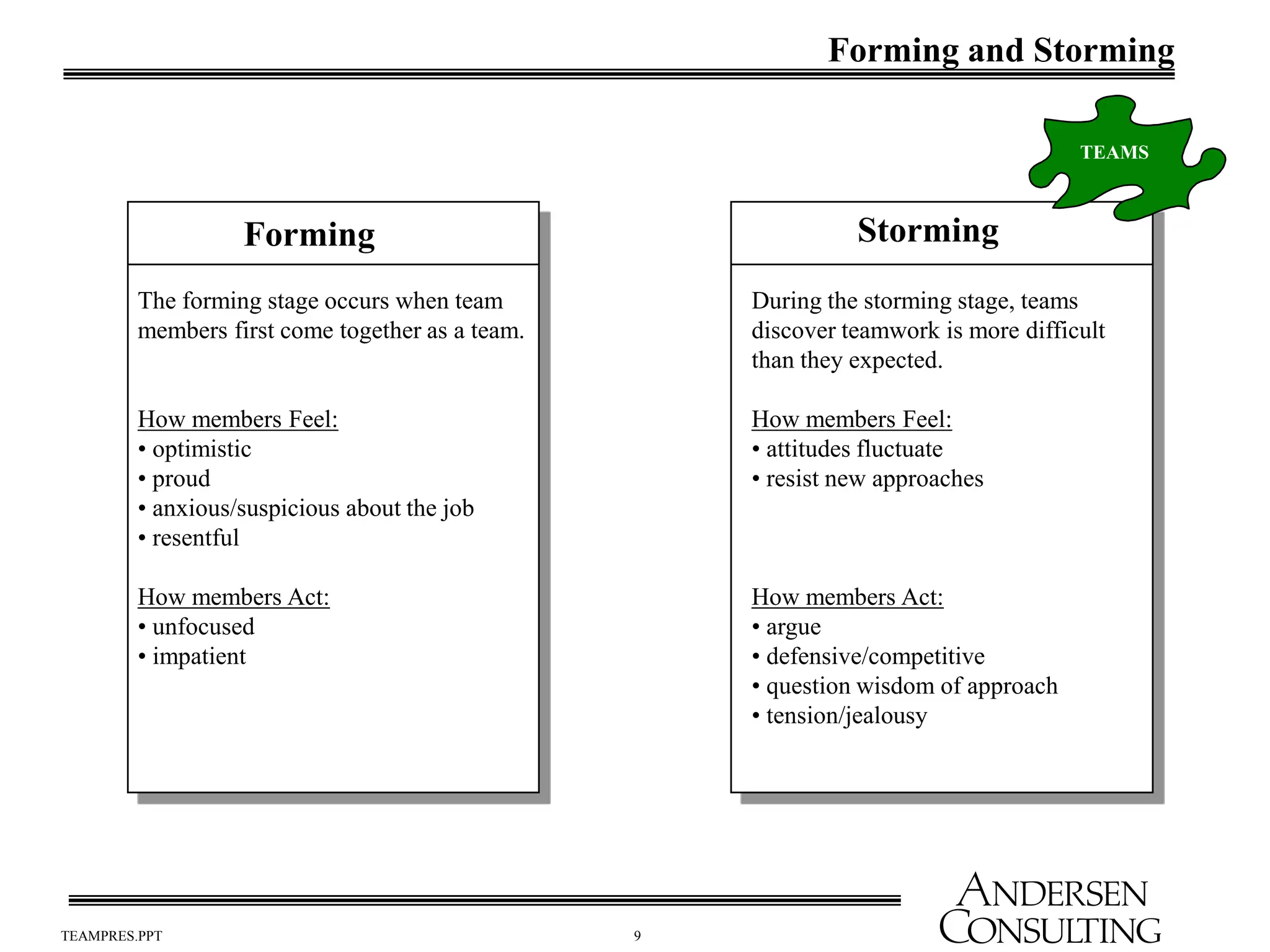
Forming and Storming
Forming Storming
The forming stage occurs when team
members first come together as a team.
How members Feel:
• optimistic
• proud
• anxious/suspicious about the job
• resentful
How members Act:
• unfocused
• impatient
During the storming stage, teams
discover teamwork is more difficult
than they expected.
How members Feel:
• attitudes fluctuate
• resist new approaches
How members Act:
• argue
• defensive/competitive
• question wisdom of approach
• tension/jealousy
TEAMS
10
TEAMPRES.PPT
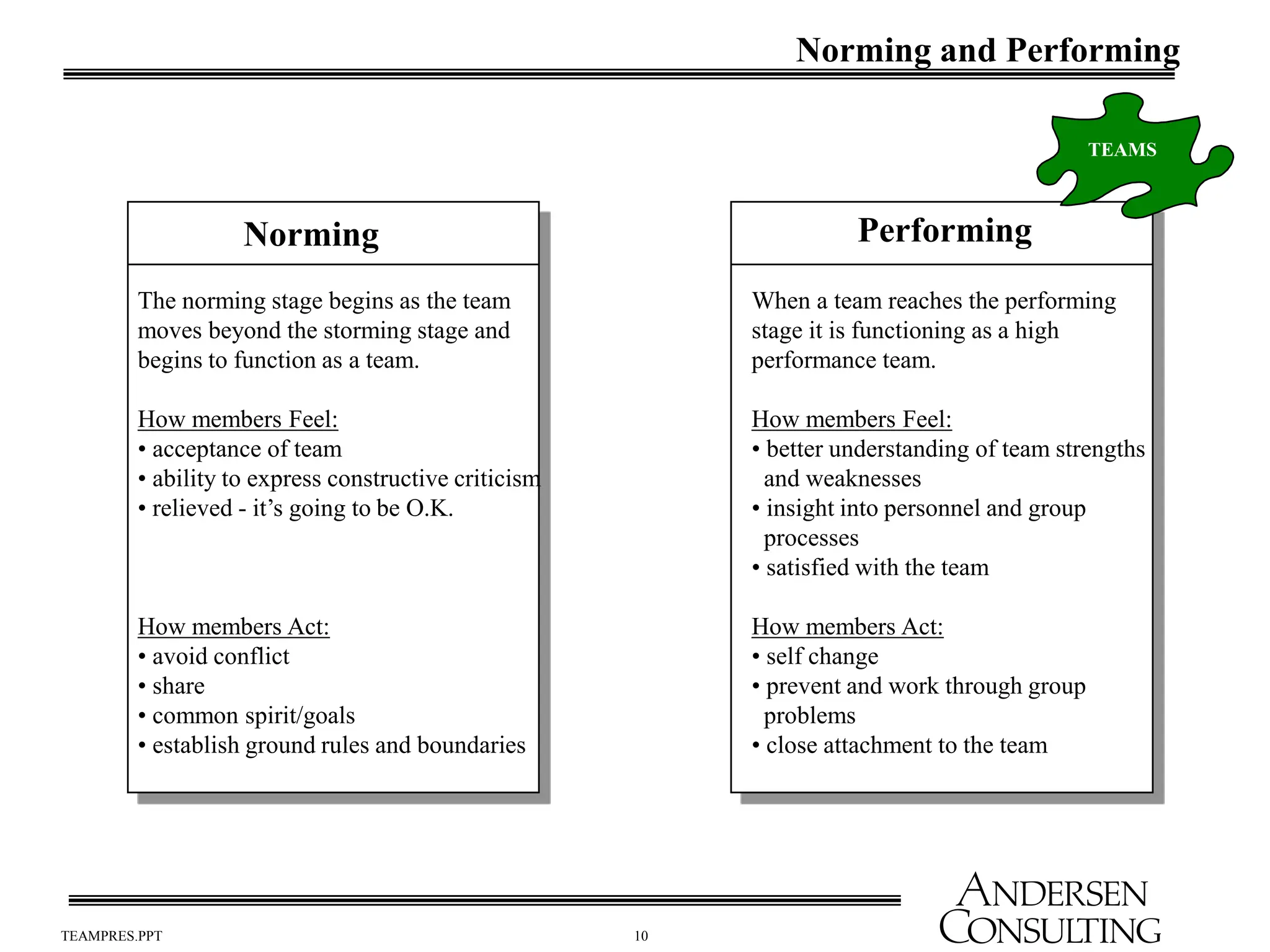
Norming and Performing
Norming Performing
The norming stage begins as the team
moves beyond the storming stage and
begins to function as a team.
How members Feel:
• acceptance of team
• ability to express constructive criticism
• relieved - it’s going to be O.K.
How members Act:
• avoid conflict
• share
• common spirit/goals
• establish ground rules and boundaries
When a team reaches the performing
stage it is functioning as a high
performance team.
How members Feel:
• better understanding of team strengths
and weaknesses
• insight into personnel and group
processes
• satisfied with the team
How members Act:
• self change
• prevent and work through group
problems
• close attachment to the team
TEAMS
11
TEAMPRES.PPT
 FACT: As each bird flaps it wings, it creates an “uplift” for the bird following. By flying in a “V” formation, the whole flock adds
71% greater flying range than if each bird flew alone.
 LESSON: People who share a common direction and sense of community can get where they are going quicker and easier because they are traveling
on the thrust of one another.
 FACT: Whenever a goose falls out of formation, it suddenly feels the drag and resistance of trying to fly alone. It quickly gets back
into formation to take advantage of the “lifting power” of the bird immediately in front.
 LESSON: If we have as much sense as a goose, we will stay in formation with those who are headed where we want to go.
 FACT: When the lead goose gets tired, it rotates back into the formation, and another goose flies at the point position.
 LESSON: It pays to take turns doing the hard tasks and sharing leadership; people, as with geese, are interdependent with each other.
 FACT: The geese in formation honk from behind to encourage those up front to keep up their speed.
 LESSON: We need to make sure our “honking” from behind is encouraging.
 FACT: When a goose gets sick or wounded or shot down, two geese drop out of formation to follow him down to help and protect
him. They stay with him until he is either able to fly again or dies. Then they launch out on their own with another
formation or catch up with their flock.
 LESSON: If we have as much sense as the geese, we will stand by each other; DON’T SHOOT THE SICK OR WOUNDED.
TEAMS
Lessons from the Geese
There is an interdependence in the way geese function.
Teams, like flocks of geese, learn from their experience.
12
TEAMPRES.PPT
Team Charter
Team
Charter
TEAMS
Communication
Conflict
Resolution
Diversity
Introduction
to Teams
Decision
Making
Meeting
Effectiveness
Problem
Solving
Decision
Making
13
TEAMPRES.PPT
Team
Charter
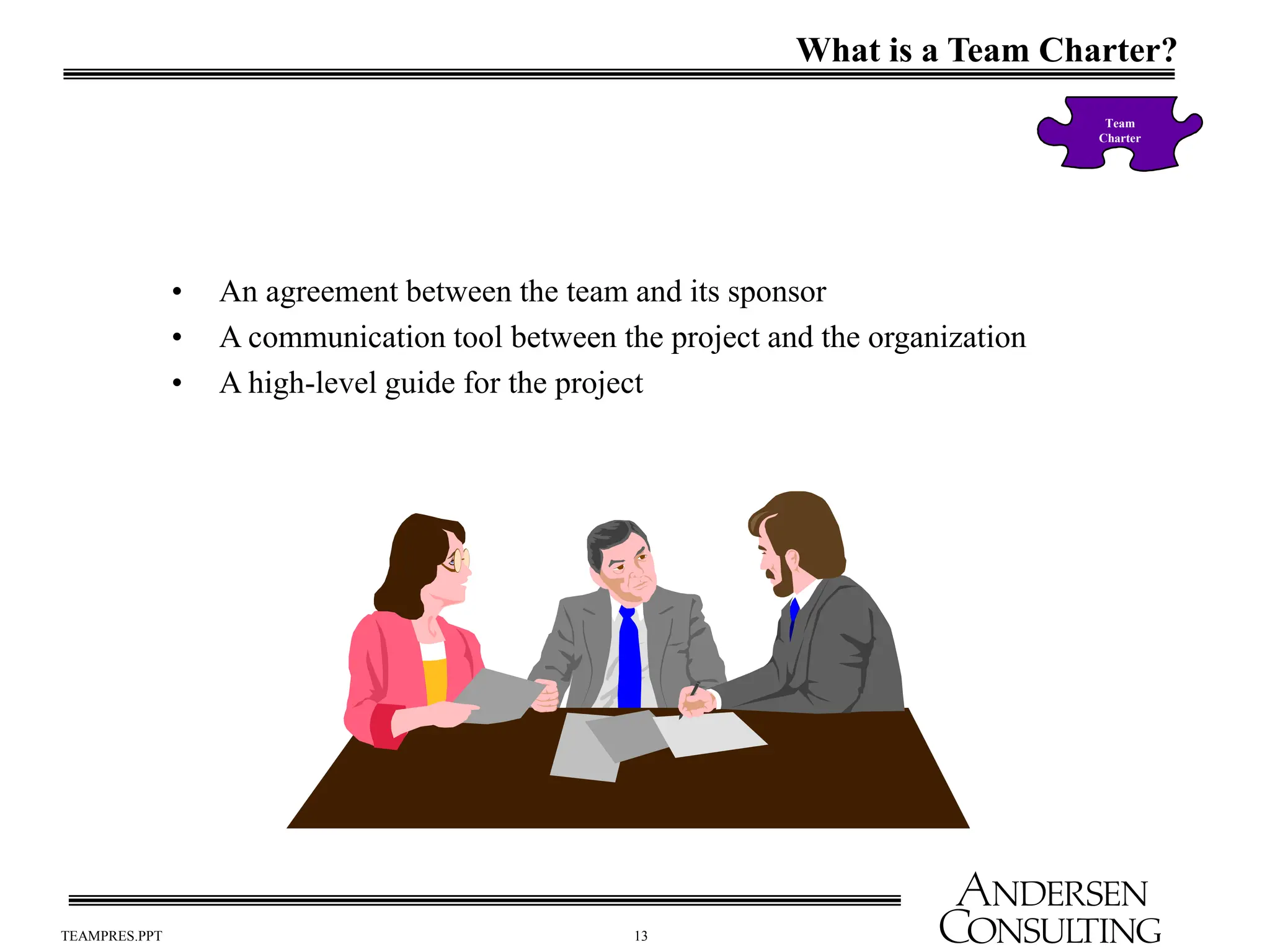
• An agreement between the team and its sponsor
• A communication tool between the project and the organization
• A high-level guide for the project
What is a Team Charter?
14
TEAMPRES.PPT
Objectives: Goals of the team.
Scope: Fundamental aspects of the project that will not change:
objectives, limits, initial assumptions, timeframes.
Roles/Responsibilities: Duties & assignments for each member of the team.
Key Activities: Defined by the workplan to foster accomplishment of the
project.
Key Deliverables: Tangible outcomes of the project, usually in the form of documents.
These should be tied directly to Key Activities.
Timeline/Schedule: Target dates for completion of the project and its various phase,
activities, etc.
Milestones: Dates of key accomplishments of the team.
Critical Success
Factors: Any factors that must occur to ensure success of the project.
Metrics: Information looked at regularly and systematically to monitor,
control, and improve our work.
Risks: Anything that prevents the team from completing the key activities.
Boundaries: Factors that limit the scope of work (e.g. timeframes).
Team
Charter
Components of a Team Charter
15
TEAMPRES.PPT
Example Team Charter
Denver Broncos Football Team
Objective: To win the Super Bowl
Scope: Play a sixteen game regular season schedule, two playoff games, and the Super
Bowl
Roles & Responsibilities: Quarterback - Team Leader, calls offensive plays
Defensive Back: Defensive leader, calls defensive plays
Punter: Kicks punts in fourth down situations
Key Activities: Practices four times a week, Games every Sunday (two on Monday)
Key Deliverables: Offensive playbook, Defensive playbook
Critical Success Factors: Best record in AFC West , to make playoffs. Few turnovers,
Minimal penalties
Metrics: Points scored, Yards allowed, Win/Loss record
Risks: Injurys to players, weather conditions during season
Boundaries: Game scheduled, roster after final cuts
Team
Charter
16
TEAMPRES.PPT
Team Charter Validation
Objective - Does it accurately described the project?
Scope - Is the project well defined?
Roles & Responsibilities - Have they been determined for all team
members?
Key Activities - Will they allow team to meet its objectives?
Key Deliverables - Are they tangible, and do they demonstrate
results?
Timeline/Schedule- Is the schedule sufficient to finish the project on a timely basis?
Milestones- Do they support accomplishment of the project?
Critical Success Factors - Do they ensure team’s success?
Metrics - Do they accurately measure results, and
support critical success factors?
Risks - Are they full documented, and do they
significantly impede success?
Boundaries - What elements are in, and out, of the project?
Sponsor - Is the sponsor at a high enough level in the
organization to clear barriers, provide
resources, etc?
Team
Charter
17
TEAMPRES.PPT
Team Charter Validation ...
Who validates the Charter? The team sponsor, and other key stakeholders
of the project.
What does the validation process A series of meetings with the sponsor and other
consist of? stakeholders where representatives of the team
talk through the various components of the
Charter getting feedback and sign off on each
part from the stakeholders.
How does validation usually go? Each iteration usually brings fine-tuning to the
respective components. Once all parties are in
agreement, and support the team moving ahead
with its efforts.
Team
Charter
18
TEAMPRES.PPT
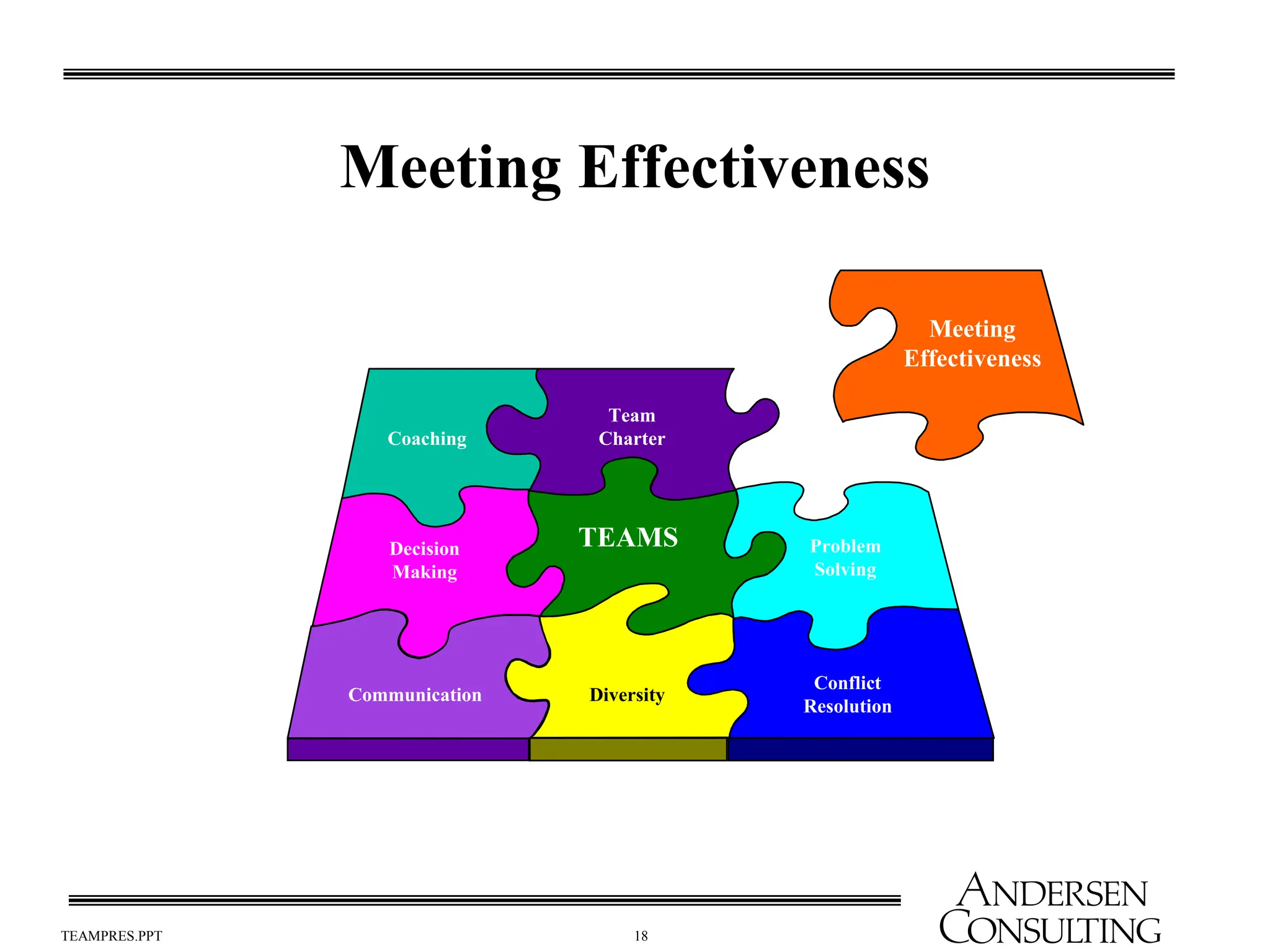
Meeting Effectiveness
TEAMS
Communication
Conflict
Resolution
Diversity
Coaching
Decision
Making
Meeting
Effectiveness
Team
Charter
Problem
Solving
Decision
Making
19
TEAMPRES.PPT
• Simple method for effective, direct, communication of information
perceptions, concerns, etc.
• Structured forum for reaching decisions and resolving conflicts
• Dedicated time to work on goals and objectives
• Gathering for face to face interactions and opportunities to develop
familiarity, and trust as a team
• Place where outsiders can interface with all team members at the same
time to communicate important information
• Facilitates involvement, input, and ownership in results
• Enables/supports easy clarification & elaboration of information and
intent
Decision
Making
Meeting
Effectiveness
Source: Jonier & Associates, The Team Handbook, 1988.
Why have meetings?
Meetings should provide a ...
20
TEAMPRES.PPT
Create meeting ground rules
Create guiding principles
Use agendas with clear definition of expected
outcomes & processes
Apply effective facilitation methods
Manage meeting processes to achieve desired
outcomes
Document meetings
Evaluate meetings (to identify & address
problems early & to enable continual
improvement in team effectiveness)
Decision
Making
Meeting
Effectiveness
Source: Jonier & Associates, The Team Handbook, 1988.
General Meeting Guidelines
Teams should commit to the following guidelines ...
21
TEAMPRES.PPT
• Start all meetings on time
• Establish an agenda and stick to it
• Use a flip chart to record ideas
• Everyone should participation
• No side discussions
• Test ideas for agreement
• Document & distribute all meeting minutes and group decisions
• Clarify follow-up responsibilities
• Agenda will be developed for the next meeting
Decision
Making
Meeting
Effectiveness
Create Meeting Ground Rules
Ground rules should be specific enough to enable easy
compliance and enforcement. Examples ...
22
TEAMPRES.PPT
• Review of Agenda and Time Contract
• Assignment of Meeting Roles
• Review of Meeting Purpose
• Brainstorming/Discussion
• Consensus Development
• Development of Path Forward Plans
• Meeting Feedback (e.g. “Likes”, “Changes”, and “Overall Rating”)
Decision
Making
Meeting
Effectiveness
Source: Jonier & Associates, The Team Handbook, 1988.
Typical Meeting Structure
A meeting will typically have the following format ...

Factors leading to Team Effectiveness.ppt

  • 1.
    1 TEAMPRES.PPT Teams and TeamDevelopment Putting the Pieces Together ... TEAMS Communication Conflict Resolution Diversity Coaching Decision Making Meeting Effectiveness Team Charter Problem Solving Decision Making
  • 2.
  • 3.
    3 TEAMPRES.PPT Ingredient Module Clearly DefinedTeam Objectives, Scope, Team Charter Roles & Responsibilities, Key Activities, Key Deliverables, Critical Success Factors, Metrics, Risks, and Boundaries Clearly Defined Meeting Guidelines Meeting Effectiveness Cooperative, Committed, and Trusted Climate Team Effectiveness Clear, Effective, Constructive Communication Plan Communication Understanding of Problem Solving Techniques Problem Solving Well-defined Decision-making Processes Meeting Effectiveness & Decision Making Understanding of Conflict Resolution Conflict Resolution Techniques Awareness of Diversity Issues Diversity Understanding of Proper Coaching Techniques Coaching Ingredients for a Successful Team TEAMS
  • 4.
    4 TEAMPRES.PPT “A team isa group of people who must collaborate to achieve common goals, and who assume responsibility for the functioning and performance of the group.” Common Goals Common Operating Procedures Inter- dependent Accountable Goals of a team need to be (1) clear and explicit, (2) motivating and challenging, (3) tied to rewards in order for a team to reach a level of maximum performance. This means that team members have established systems, procedures, processes and norms for addressing the various issues facing the team, e.g., procedures to reduce conflict. Team members must (1) understand team goals, (2) be committed to team goals, (3) demonstrate a willingness to solve individual and team problems. Each member of a team must be held responsible for producing specific outputs and results. There must be a clear delineation of roles and responsibilities. What is a team? TEAMS
  • 5.
    5 TEAMPRES.PPT Differences Between Teamsand Work Groups TEAM WORK GROUP Teams achieve a balance between concern for the process of the group and the final results. Work groups only emphasize results. Work groups do not formally develop skills for working together for common goals. Teams encourage open communication between members. Work groups tend to limit communication to immediate supervisors or managers and so individuals tend not to gain the expertise and ideas of others. Teams encourage collective effort. Work groups promote individual performance. This leads to group members who focus on completing their task with little interest or coordination with other group members work. Teams operate with a high degree of autonomy and experience a high degree of ownership of project goals. In addition, teams demonstrate greater ability to solve problems and think creatively, which leads to higher productivity and quality products. Work groups work with a high degree of management control. TEAMS
  • 6.
    6 TEAMPRES.PPT Component Definition Component Characteristics ofHigh Performing Teams There are seven components which distinguish high performing teams from teams that experience problems ... 1. Clarity in Team Goals 2. Clearly Defined Roles 3. Clear Communication 4. Well Defined Decision Procedures Groups often assume their goals are clear and then later experience mistakes due to confusion. Goals need to be specific, attainable, and well communicated. To clearly define roles of a team, you need to: design formal roles and responsibilities, set clear boundaries for each role, design job team responsibilities that use each member’s talents and rotate general roles. Clear communication exists when team members speak with clarity and directness, listen actively, explore ideas rather than argue over them, openly share information & provide constructive feedback not criticism. When teams develop effective decision making procedures they: explore important issues by polling members, decide important issues by consensus, use high quality data as a basis for decisions, agree who will make what decisions. When team goals are not clear, potential troubles may include frequent disagreement about next steps, frustration at the lack of progress and excessive questioning of group decisions and actions. When there are no clearly defined roles the skills of team members will not be fully utilized. There may be confusion over which team member has a specific task and some may get more than their share of tedious chores. Teams with poor communication have members who have a tendency to withhold information, discount others’ ideas and opinions and cover up true feelings. Without well-defined decision making procedures, teams find it difficult to break out of the old orientation of being told what to do as opposed to deciding for themselves. Potential Issues If Missing TEAMS
  • 7.
    7 TEAMPRES.PPT Definition Component Characteristics of HighPerforming Teams Continued The seven components continued ... 5. Established Ground Rules 6. Balanced Participation 7. Improvement Plan Establishing rules for the team involves the process of members deciding what are acceptable and unacceptable behaviors within the team for both tasks and relationships. This strategy not only contributes to getting the job done, but it develops all members’ expertise in all areas, which strengthens the team’s performance. The goal of an improvement plan is to ensure high team performance. The plan needs to cover 5 activities: - Maintain communications - Fix obvious problems - Look upstream to larger issues - Document progress and problems - Monitor changes Without openly stated rules teams often experience frustration and confusion in other members’ behaviors. Potential troubles may include members who continue behavior that frustrates other team members. Without balanced participation, performance can result in certain members having too much or too little influence based on their skill set, and cross-job coverage not supporting productivity goals. Without an improvement plan, the team may use ineffective approaches to address problems that result in little or no improvement of team output. Potential Issues If Missing TEAMS
  • 8.
    8 TEAMPRES.PPT Stages of TeamDevelopment Forming Storming Norming Performing The four stages of team development are ... TEAMS
  • 9.
    9 TEAMPRES.PPT Forming and Storming FormingStorming The forming stage occurs when team members first come together as a team. How members Feel: • optimistic • proud • anxious/suspicious about the job • resentful How members Act: • unfocused • impatient During the storming stage, teams discover teamwork is more difficult than they expected. How members Feel: • attitudes fluctuate • resist new approaches How members Act: • argue • defensive/competitive • question wisdom of approach • tension/jealousy TEAMS
  • 10.
    10 TEAMPRES.PPT Norming and Performing NormingPerforming The norming stage begins as the team moves beyond the storming stage and begins to function as a team. How members Feel: • acceptance of team • ability to express constructive criticism • relieved - it’s going to be O.K. How members Act: • avoid conflict • share • common spirit/goals • establish ground rules and boundaries When a team reaches the performing stage it is functioning as a high performance team. How members Feel: • better understanding of team strengths and weaknesses • insight into personnel and group processes • satisfied with the team How members Act: • self change • prevent and work through group problems • close attachment to the team TEAMS
  • 11.
    11 TEAMPRES.PPT  FACT: Aseach bird flaps it wings, it creates an “uplift” for the bird following. By flying in a “V” formation, the whole flock adds 71% greater flying range than if each bird flew alone.  LESSON: People who share a common direction and sense of community can get where they are going quicker and easier because they are traveling on the thrust of one another.  FACT: Whenever a goose falls out of formation, it suddenly feels the drag and resistance of trying to fly alone. It quickly gets back into formation to take advantage of the “lifting power” of the bird immediately in front.  LESSON: If we have as much sense as a goose, we will stay in formation with those who are headed where we want to go.  FACT: When the lead goose gets tired, it rotates back into the formation, and another goose flies at the point position.  LESSON: It pays to take turns doing the hard tasks and sharing leadership; people, as with geese, are interdependent with each other.  FACT: The geese in formation honk from behind to encourage those up front to keep up their speed.  LESSON: We need to make sure our “honking” from behind is encouraging.  FACT: When a goose gets sick or wounded or shot down, two geese drop out of formation to follow him down to help and protect him. They stay with him until he is either able to fly again or dies. Then they launch out on their own with another formation or catch up with their flock.  LESSON: If we have as much sense as the geese, we will stand by each other; DON’T SHOOT THE SICK OR WOUNDED. TEAMS Lessons from the Geese There is an interdependence in the way geese function. Teams, like flocks of geese, learn from their experience.
  • 12.
  • 13.
    13 TEAMPRES.PPT Team Charter • An agreementbetween the team and its sponsor • A communication tool between the project and the organization • A high-level guide for the project What is a Team Charter?
  • 14.
    14 TEAMPRES.PPT Objectives: Goals ofthe team. Scope: Fundamental aspects of the project that will not change: objectives, limits, initial assumptions, timeframes. Roles/Responsibilities: Duties & assignments for each member of the team. Key Activities: Defined by the workplan to foster accomplishment of the project. Key Deliverables: Tangible outcomes of the project, usually in the form of documents. These should be tied directly to Key Activities. Timeline/Schedule: Target dates for completion of the project and its various phase, activities, etc. Milestones: Dates of key accomplishments of the team. Critical Success Factors: Any factors that must occur to ensure success of the project. Metrics: Information looked at regularly and systematically to monitor, control, and improve our work. Risks: Anything that prevents the team from completing the key activities. Boundaries: Factors that limit the scope of work (e.g. timeframes). Team Charter Components of a Team Charter
  • 15.
    15 TEAMPRES.PPT Example Team Charter DenverBroncos Football Team Objective: To win the Super Bowl Scope: Play a sixteen game regular season schedule, two playoff games, and the Super Bowl Roles & Responsibilities: Quarterback - Team Leader, calls offensive plays Defensive Back: Defensive leader, calls defensive plays Punter: Kicks punts in fourth down situations Key Activities: Practices four times a week, Games every Sunday (two on Monday) Key Deliverables: Offensive playbook, Defensive playbook Critical Success Factors: Best record in AFC West , to make playoffs. Few turnovers, Minimal penalties Metrics: Points scored, Yards allowed, Win/Loss record Risks: Injurys to players, weather conditions during season Boundaries: Game scheduled, roster after final cuts Team Charter
  • 16.
    16 TEAMPRES.PPT Team Charter Validation Objective- Does it accurately described the project? Scope - Is the project well defined? Roles & Responsibilities - Have they been determined for all team members? Key Activities - Will they allow team to meet its objectives? Key Deliverables - Are they tangible, and do they demonstrate results? Timeline/Schedule- Is the schedule sufficient to finish the project on a timely basis? Milestones- Do they support accomplishment of the project? Critical Success Factors - Do they ensure team’s success? Metrics - Do they accurately measure results, and support critical success factors? Risks - Are they full documented, and do they significantly impede success? Boundaries - What elements are in, and out, of the project? Sponsor - Is the sponsor at a high enough level in the organization to clear barriers, provide resources, etc? Team Charter
  • 17.
    17 TEAMPRES.PPT Team Charter Validation... Who validates the Charter? The team sponsor, and other key stakeholders of the project. What does the validation process A series of meetings with the sponsor and other consist of? stakeholders where representatives of the team talk through the various components of the Charter getting feedback and sign off on each part from the stakeholders. How does validation usually go? Each iteration usually brings fine-tuning to the respective components. Once all parties are in agreement, and support the team moving ahead with its efforts. Team Charter
  • 18.
  • 19.
    19 TEAMPRES.PPT • Simple methodfor effective, direct, communication of information perceptions, concerns, etc. • Structured forum for reaching decisions and resolving conflicts • Dedicated time to work on goals and objectives • Gathering for face to face interactions and opportunities to develop familiarity, and trust as a team • Place where outsiders can interface with all team members at the same time to communicate important information • Facilitates involvement, input, and ownership in results • Enables/supports easy clarification & elaboration of information and intent Decision Making Meeting Effectiveness Source: Jonier & Associates, The Team Handbook, 1988. Why have meetings? Meetings should provide a ...
  • 20.
    20 TEAMPRES.PPT Create meeting groundrules Create guiding principles Use agendas with clear definition of expected outcomes & processes Apply effective facilitation methods Manage meeting processes to achieve desired outcomes Document meetings Evaluate meetings (to identify & address problems early & to enable continual improvement in team effectiveness) Decision Making Meeting Effectiveness Source: Jonier & Associates, The Team Handbook, 1988. General Meeting Guidelines Teams should commit to the following guidelines ...
  • 21.
    21 TEAMPRES.PPT • Start allmeetings on time • Establish an agenda and stick to it • Use a flip chart to record ideas • Everyone should participation • No side discussions • Test ideas for agreement • Document & distribute all meeting minutes and group decisions • Clarify follow-up responsibilities • Agenda will be developed for the next meeting Decision Making Meeting Effectiveness Create Meeting Ground Rules Ground rules should be specific enough to enable easy compliance and enforcement. Examples ...
  • 22.
    22 TEAMPRES.PPT • Review ofAgenda and Time Contract • Assignment of Meeting Roles • Review of Meeting Purpose • Brainstorming/Discussion • Consensus Development • Development of Path Forward Plans • Meeting Feedback (e.g. “Likes”, “Changes”, and “Overall Rating”) Decision Making Meeting Effectiveness Source: Jonier & Associates, The Team Handbook, 1988. Typical Meeting Structure A meeting will typically have the following format ...