Formative and summative
evaluation
A.P Giri
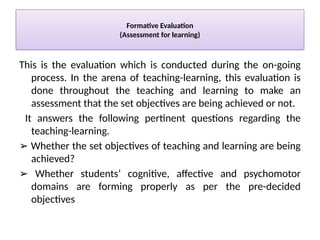
Formative Evaluation
(Assessment for learning)
This is the evaluation which is conducted during the on-going
process. In the arena of teaching-learning, this evaluation is
done throughout the teaching and learning to make an
assessment that the set objectives are being achieved or not.
It answers the following pertinent questions regarding the
teaching-learning.
➢ Whether the set objectives of teaching and learning are being
achieved?
➢ Whether students’ cognitive, affective and psychomotor
domains are forming properly as per the pre-decided
objectives
The scholastic and co-scholastic areas of personality of the children are
developing normally or is there any problem?
➢ Whether the progress of the learners’ is satisfactory or not?
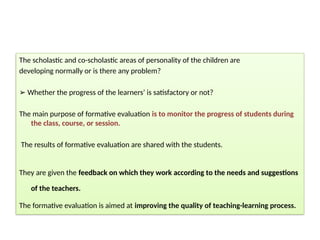
The main purpose of formative evaluation is to monitor the progress of students during
the class, course, or session.
The results of formative evaluation are shared with the students.
They are given the feedback on which they work according to the needs and suggestions
of the teachers.
The formative evaluation is aimed at improving the quality of teaching-learning process.
Summative Evaluation
(Assessment of learning)
Summative evaluation is conducted at the end of a course, semester, or a class or
topic.
The purpose of this evaluation is to find out the quality of the final product and to
find out the extent to which the instructional objectives have been achieved.
There is no provision of remedial teaching after summative evaluation.
Certification is also done on the basis of the results of summative evaluation.
Results of this evaluation reflect the overall performance of the learners as well as
school. Some of
the important examples of summative evaluations are annual and semester-end
exams of all courses.
Some of the important features of summative evaluation are:
1. It is conducted at the completion of a topic, class, chapter, unit or course.
2. The summative evaluation tells the final progress of the students in a
class, in a topic, in a unit, in a course or in any educational Programme.
3. The results of summative evaluation of students are used in making
decisions of pass/fail/promotion and awarding degrees or diplomas to
the examinees.
EXTRA
SELF ASSESSMENT (ASSESSMENT AS LEARNING)
• When learners are asked to assess their
performance on their own.
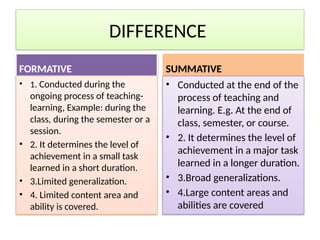
DIFFERENCE
FORMATIVE
• 1. Conducted during the
ongoing process of teaching-
learning, Example: during the
class, during the semester or a
session.
• 2. It determines the level of
achievement in a small task
learned in a short duration.
• 3.Limited generalization.
• 4. Limited content area and
ability is covered.
SUMMATIVE
• Conducted at the end of the
process of teaching and
learning. E.g. At the end of
class, semester, or course.
• 2. It determines the level of
achievement in a major task
learned in a longer duration.
• 3.Broad generalizations.
• 4.Large content areas and
abilities are covered
External Evaluation
External evaluation is that which is carried out by someone who is not
directly involved in the development or operation of the system being
evaluated, or we can say it is carried out by someone who is not
having direct relation as a part of system or a component of system.
The external evaluation is having a number of advantages like objectivity,
impartiality, lack of vested interest, less emotional pressures and the
capability to observe the situation from a clean outlook.
Cont…
When the examinations are conducted by the same institution
which teaches but tests are prepared and marked by persons
other than the ones who teach the group, evaluation is called
external.
Thus when the teacher who teaches is not involved in the
evaluation process, the evaluation should be called external.
Advantages and disadvantages
• External evaluator is not personally concerned to
the examinee therefore assumed to be more
objective.
• It is free from expensive organizational biases
• Disadvantages
• External evaluator may not completely
understand the organization policies, procedures,
personalities and philosophy.
• External evaluation may be expensive.
Internal evaluation
• Internal evaluation is that which is carried out by someone
from the actual system.
• This is conducted to know the learning progress of the
students and difficulties that they face during the process of
teaching of teaching and learning.
• It has the advantage of understanding completely the
thoughts behind the development and control the
trust ,cooperation of the other members of the team.
• In the present days, internal evaluation in the school is quite
popular and it is conducted by observation, peer evaluation,
using portfolios,projects,discussions,demonstrations,etc.
Advantage and disadvantages
• Internal evaluation is usually less expensive.
• It helps to develop internal evaluation
capacity at advanced level.
• He is better able to communicate evaluation
findings throughout organization.
• Disadvantages
• He may be part of power structure, concerned
in inner politics or conflicts.

formative and summative evaluation in educational assesment.pptx

  • 1.
  • 2.
    Formative Evaluation (Assessment forlearning) This is the evaluation which is conducted during the on-going process. In the arena of teaching-learning, this evaluation is done throughout the teaching and learning to make an assessment that the set objectives are being achieved or not. It answers the following pertinent questions regarding the teaching-learning. ➢ Whether the set objectives of teaching and learning are being achieved? ➢ Whether students’ cognitive, affective and psychomotor domains are forming properly as per the pre-decided objectives
  • 3.
    The scholastic andco-scholastic areas of personality of the children are developing normally or is there any problem? ➢ Whether the progress of the learners’ is satisfactory or not? The main purpose of formative evaluation is to monitor the progress of students during the class, course, or session. The results of formative evaluation are shared with the students. They are given the feedback on which they work according to the needs and suggestions of the teachers. The formative evaluation is aimed at improving the quality of teaching-learning process.
  • 4.
    Summative Evaluation (Assessment oflearning) Summative evaluation is conducted at the end of a course, semester, or a class or topic. The purpose of this evaluation is to find out the quality of the final product and to find out the extent to which the instructional objectives have been achieved. There is no provision of remedial teaching after summative evaluation. Certification is also done on the basis of the results of summative evaluation. Results of this evaluation reflect the overall performance of the learners as well as school. Some of the important examples of summative evaluations are annual and semester-end exams of all courses.
  • 5.
    Some of theimportant features of summative evaluation are: 1. It is conducted at the completion of a topic, class, chapter, unit or course. 2. The summative evaluation tells the final progress of the students in a class, in a topic, in a unit, in a course or in any educational Programme. 3. The results of summative evaluation of students are used in making decisions of pass/fail/promotion and awarding degrees or diplomas to the examinees.
  • 6.
    EXTRA SELF ASSESSMENT (ASSESSMENTAS LEARNING) • When learners are asked to assess their performance on their own.
  • 7.
    DIFFERENCE FORMATIVE • 1. Conductedduring the ongoing process of teaching- learning, Example: during the class, during the semester or a session. • 2. It determines the level of achievement in a small task learned in a short duration. • 3.Limited generalization. • 4. Limited content area and ability is covered. SUMMATIVE • Conducted at the end of the process of teaching and learning. E.g. At the end of class, semester, or course. • 2. It determines the level of achievement in a major task learned in a longer duration. • 3.Broad generalizations. • 4.Large content areas and abilities are covered
  • 8.
    External Evaluation External evaluationis that which is carried out by someone who is not directly involved in the development or operation of the system being evaluated, or we can say it is carried out by someone who is not having direct relation as a part of system or a component of system. The external evaluation is having a number of advantages like objectivity, impartiality, lack of vested interest, less emotional pressures and the capability to observe the situation from a clean outlook.
  • 9.
    Cont… When the examinationsare conducted by the same institution which teaches but tests are prepared and marked by persons other than the ones who teach the group, evaluation is called external. Thus when the teacher who teaches is not involved in the evaluation process, the evaluation should be called external.
  • 10.
    Advantages and disadvantages •External evaluator is not personally concerned to the examinee therefore assumed to be more objective. • It is free from expensive organizational biases • Disadvantages • External evaluator may not completely understand the organization policies, procedures, personalities and philosophy. • External evaluation may be expensive.
  • 11.
    Internal evaluation • Internalevaluation is that which is carried out by someone from the actual system. • This is conducted to know the learning progress of the students and difficulties that they face during the process of teaching of teaching and learning. • It has the advantage of understanding completely the thoughts behind the development and control the trust ,cooperation of the other members of the team. • In the present days, internal evaluation in the school is quite popular and it is conducted by observation, peer evaluation, using portfolios,projects,discussions,demonstrations,etc.
  • 12.
    Advantage and disadvantages •Internal evaluation is usually less expensive. • It helps to develop internal evaluation capacity at advanced level. • He is better able to communicate evaluation findings throughout organization. • Disadvantages • He may be part of power structure, concerned in inner politics or conflicts.