Module 5
Facilitating Challenge Case
Exploration
Section 3
Lecture 2: Formative and Summative
Assessment
©2018 Ford Motor Company Fund
Formative Assessments
©2018 Ford Motor Company Fund
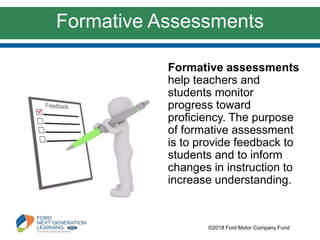
Formative assessments
help teachers and
students monitor
progress toward
proficiency. The purpose
of formative assessment
is to provide feedback to
students and to inform
changes in instruction to
increase understanding.
Formative Assessments
©2018 Ford Motor Company Fund
Formative assessments are a form of continuous
improvement, a way to “take the pulse” of an
individual or group of students to figure out where
they are, what they need, and how to better
support deep learning.
Summative Assessments
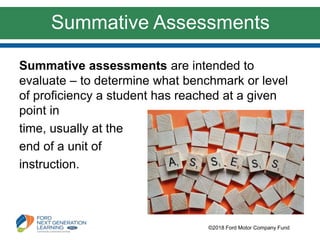
Summative assessments are intended to
evaluate – to determine what benchmark or level
of proficiency a student has reached at a given
point in
time, usually at the
end of a unit of
instruction.
©2018 Ford Motor Company Fund
Why They Matter in
Challenged-based
Learning
©2018 Ford Motor Company Fund
Challenge-based learning is
designed to develop student
competencies that cannot always be
demonstrated in a final product or
final presentation. Most criteria
included on the student assessment
rubric must be assessed over the
course of the entire process - during
the beginning, middle, and end of the
Challenge Case Exploration – and
the results should inform changes in
what either the teacher or student is
doing.
©2018 Ford Motor Company Fund
Student Competencies
Formative assessment is crucial to set students up for
successful outcomes. For example, if a student doesn’t
have enough information about an employer’s workplace
system early in the process, he or she will need to develop
additional questions or make new observations, or run the
risk of misunderstanding the nature of the problem, and
therefore designing an unappealing or ineffective solution.
Without formative assessment, students may get all the
way to the end of the experience without having the
resources they need to be successful.
©2018 Ford Motor Company Fund
Successful Outcomes
Formative assessment is also important because it
helps model a design thinking mindset, and get
students used to the notion of frequent progress
checks to improve quality. It teaches students that
testing and checking early and often is a way to
improve outcomes down the road.
©2018 Ford Motor Company Fund
Model Design Thinking
Helpful Readings
To refresh your own understanding (or that of your team), check
out the following resources to learn more about formative and
summative assessment.
– “Formative and Summative Assessments.” Yale Center for Teaching
and Learning, Yale University (2018).
– “Summative and Formative Assessment.” Center for Innovative
Teaching and Learning, Indiana University Bloomington (2018).
– “A More Complete Picture of Student Learning” by Andrew Miller.
Edutopia (December 2017).
If your team is already comfortable with formative and
summative assessment but is looking to improve the quality and
effectiveness of the feedback provided, this resource provides
some useful classroom strategies.
– “Maximizing Your Feedback’s Impact” by Marianne Stenger.
Edutopia (March 2017).
©2018 Ford Motor Company Fund

Formative and Summative Assessment

  • 1.
    Module 5 Facilitating ChallengeCase Exploration Section 3 Lecture 2: Formative and Summative Assessment ©2018 Ford Motor Company Fund
  • 2.
    Formative Assessments ©2018 FordMotor Company Fund Formative assessments help teachers and students monitor progress toward proficiency. The purpose of formative assessment is to provide feedback to students and to inform changes in instruction to increase understanding.
  • 3.
    Formative Assessments ©2018 FordMotor Company Fund Formative assessments are a form of continuous improvement, a way to “take the pulse” of an individual or group of students to figure out where they are, what they need, and how to better support deep learning.
  • 4.
    Summative Assessments Summative assessmentsare intended to evaluate – to determine what benchmark or level of proficiency a student has reached at a given point in time, usually at the end of a unit of instruction. ©2018 Ford Motor Company Fund
  • 5.
    Why They Matterin Challenged-based Learning ©2018 Ford Motor Company Fund
  • 6.
    Challenge-based learning is designedto develop student competencies that cannot always be demonstrated in a final product or final presentation. Most criteria included on the student assessment rubric must be assessed over the course of the entire process - during the beginning, middle, and end of the Challenge Case Exploration – and the results should inform changes in what either the teacher or student is doing. ©2018 Ford Motor Company Fund Student Competencies
  • 7.
    Formative assessment iscrucial to set students up for successful outcomes. For example, if a student doesn’t have enough information about an employer’s workplace system early in the process, he or she will need to develop additional questions or make new observations, or run the risk of misunderstanding the nature of the problem, and therefore designing an unappealing or ineffective solution. Without formative assessment, students may get all the way to the end of the experience without having the resources they need to be successful. ©2018 Ford Motor Company Fund Successful Outcomes
  • 8.
    Formative assessment isalso important because it helps model a design thinking mindset, and get students used to the notion of frequent progress checks to improve quality. It teaches students that testing and checking early and often is a way to improve outcomes down the road. ©2018 Ford Motor Company Fund Model Design Thinking
  • 9.
    Helpful Readings To refreshyour own understanding (or that of your team), check out the following resources to learn more about formative and summative assessment. – “Formative and Summative Assessments.” Yale Center for Teaching and Learning, Yale University (2018). – “Summative and Formative Assessment.” Center for Innovative Teaching and Learning, Indiana University Bloomington (2018). – “A More Complete Picture of Student Learning” by Andrew Miller. Edutopia (December 2017). If your team is already comfortable with formative and summative assessment but is looking to improve the quality and effectiveness of the feedback provided, this resource provides some useful classroom strategies. – “Maximizing Your Feedback’s Impact” by Marianne Stenger. Edutopia (March 2017). ©2018 Ford Motor Company Fund