
Cagayan De Oro City
COLLEGE OF NURSING
ASSESSMENT FORM
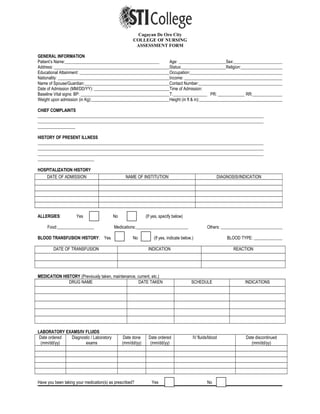
GENERAL INFORMATION
Patient’s Name: Age: Sex:
Address: Status: Religion:
Educational Attainment: Occupation:
Nationality: Income:
Name of Spouse/Guardian: Contact Number:
Date of Admission (MM/DD/YY): Time of Admission:
Baseline Vital signs: BP: T: PR: RR:
Weight upon admission (in Kg): Height (in ft & in):
CHIEF COMPLAINTS
HISTORY OF PRESENT ILLNESS
HOSPITALIZATION HISTORY
ALLERGIES: Yes No (If yes, specify below)
Food: Medications: Others:
BLOOD TRANSFUSION HISTORY: Yes No (If yes, indicate below.) BLOOD TYPE:
DATE OF TRANSFUSION INDICATION REACTION
MEDICATION HISTORY (Previously taken, maintenance, current, etc.)
DRUG NAME DATE TAKEN SCHEDULE INDICATIONS
LABORATORY EXAMS/IV FLUIDS
Date ordered
(mm/dd/yy)
Diagnostic / Laboratory
exams
Date done
(mm/dd/yy)
Date ordered
(mm/dd/yy)
IV fluids/blood Date discontinued
(mm/dd/yy)
Have you been taking your medication(s) as prescribed? Yes No
DATE OF ADMISSION NAME OF INSTITUTION DIAGNOSIS/INDICATION
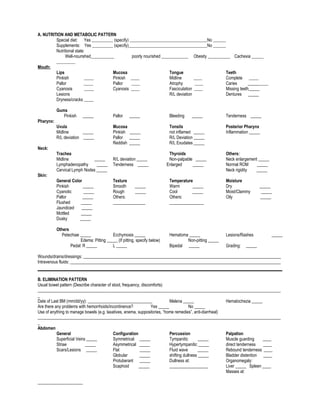
A. NUTRITION AND METABOLIC PATTERN
Special diet: Yes (specify) No
Supplements: Yes (specify) No
Nutritional state:
Well-nourished poorly nourished Obesity Cachexia
Mouth:
Lips Mucosa Tongue Teeth
Pinkish Pinkish Midline Complete
Pallor Pallor Atrophy Caries _____
Cyanosis Cyanosis Fasciculation Missing teeth_____
Lesions R/L deviation Dentures _____
Dryness/cracks
Gums
Pinkish _____ Pallor _____ Bleeding _____ Tenderness _____
Pharynx:
Uvula Mucosa Tonsils Posterior Pharynx
Midline _____ Pinkish _____ not inflamed _____ Inflammation _____
R/L deviation _____ Pallor _____ R/L Deviation _____
Reddish _____ R/L Exudates _____
Neck:
Trachea Thyroids Others:
Midline _____ R/L deviation _____ Non-palpable _____ Neck enlargement _____
Lymphadenopathy _____ Tenderness _____ Enlarged _____ Normal ROM _____
Cervical Lymph Nodes _____ Neck rigidity _____
Skin:
General Color Texture Temperature Moisture
Pinkish _____ Smooth _____ Warm _____ Dry _____
Cyanotic _____ Rough _____ Cool _____ Moist/Clammy _____
Pallor _____ Others: Others: Oily _____
Flushed _____ _______________ ________________
Jaundiced _____
Mottled _____
Dusky _____
Others
Petechiae _____ Ecchymosis _____ Hematoma _____ Lesions/Rashes _____
Edema: Pitting _____ (If pitting, specify below) Non-pitting _____
Pedal: R _____ L _____ Bipedal _____ Grading: _____
Wounds/drains/dressings: ____________________________________________________________________________________________
Intravenous fluids: __________________________________________________________________________________________________
B. ELIMINATION PATTERN
Usual bowel pattern (Describe character of stool, frequency, discomforts)
_________________________________________________________________________________________________________________
_
Date of Last BM (mm/dd/yy): ______________________________ Melena _____ Hematochezia _____
Are there any problems with hemorrhoids/incontinence? Yes _____ No _____
Use of anything to manage bowels (e.g. laxatives, enema, suppositories, “home remedies”, anti-diarrheal)
_________________________________________________________________________________________________________________
_
Abdomen
General Configuration Percussion Palpation
Superficial Veins _____ Symmetrical _____ Tympanitic _____ Muscle guarding ____
Striae _____ Asymmetrical _____ Hypertympanitic _____ direct tenderness ____
Scars/Lesions _____ Flat _____ Fluid wave _____ Rebound tenderness ____
Globular _____ shifting dullness _____ Bladder distention ____
Protuberant _____ Dullness at: Organomegaly:
Scaphoid _____ __________________ Liver _____ Spleen ____
Masses at:
_____________________
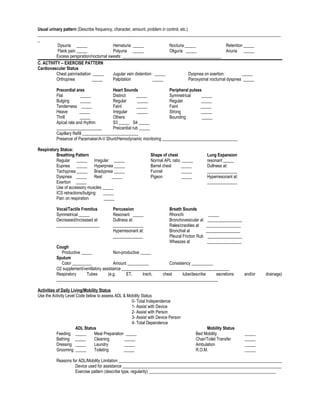
Usual urinary pattern (Describe frequency, character, amount, problem in control, etc.)
_________________________________________________________________________________________________________________
_
Dysuria _____ Hematuria _____ Nocturia _____ Retention _____
Flank pain _____ Polyuria _____ Oliguria _____ Anuria _____
Excess perspiration/nocturnal sweats: ______________________________________________
C. ACTIVITY – EXERCISE PATTERN
Cardiovascular Status
Chest pain/radiation _____ Jugular vein distention _____ Dyspnea on exertion _____
Orthopnea _____ Palpitation _____ Paroxysmal nocturnal dyspnea _____
Precordial area Heart Sounds Peripheral pulses
Flat _____ Distinct _____ Symmetrical _____
Bulging _____ Regular _____ Regular _____
Tenderness _____ Faint _____ Faint _____
Heave _____ Irregular _____ Strong _____
Thrill _____ Others: Bounding _____
Apical rate and rhythm: S3 _____ S4 _____
_____________________ Preicardial rub _____
Capillary Refill __________________________
Presence of Pacemaker/A-V Shunt/Hemodynamic monitoring ___________________________________
Respiratory Status:
Breathing Pattern Shape of chest Lung Expansion
Regular _____ Irregular _____ Normal APL ratio _____ resonant _____
Eupnea _____ Hyperpnea _____ Barrel chest _____ Dullness at:
Tachypnea _____ Bradypnea _____ Funnel _____ ______________
Dyspnea _____ Rest _____ Pigeon _____ Hyperresonant at:
Exertion _____ ______________
Use of accessory muscles _____
ICS retractions/bulging _____
Pain on respiration _____
Vocal/Tactile Fremitus Percussion Breath Sounds
Symmetrical _____ Resonant _____ Rhonchi _____
Decreased/increased at: Dullness at: Bronchovesicular at ________________
____________________ ______________ Rales/crackles at ________________
Hyperresonant at: Bronchial at ________________
______________ Pleural Friction Rub ________________
Wheezes at ________________
Cough
Productive _____ Non-productive _____
Sputum
Color _________ Amount __________ Consistency __________
O2 supplement/ventilatory assistance __________________________________________________
Respiratory Tubes (e.g. ET, trach, chest tube/describe secretions and/or drainage)
___________________________________________________________________________
Activities of Daily Living/Mobility Status
Use the Activity Level Code below to assess ADL & Mobility Status
0- Total Independence
1- Assist with Device
2- Assist with Person
3- Assist with Device Person
4- Total Dependence
ADL Status Mobility Status
Feeding _____ Meal Preparation _____ Bed Mobility _____
Bathing _____ Cleaning _____ Chair/Toilet Transfer _____
Dressing _____ Laundry _____ Ambulation _____
Grooming _____ Toileting _____ R.O.M. _____
Reasons for ADL/Mobility Limitation ____________________________________________________________________________
Device used for assistance __________________________________________________________________________
Exercise pattern (describe type, regularity) ___________________________________________________________
BACK AND EXTREMITIES
Range of motion Muscle tone and strength
Decreased ROM (indicate joint) _________ equally strong __________
Joint tenderness/pain _________ Symmetrical in size __________
Varicose veins _________ R/L Upper/Lower extremities __________
Deformities _________ R/L Upper/Lower Paresis __________
Joint swelling at : __________________ R/L Upper/Lower Paralysis __________
Spine Gait
Midline _____ Lordosis _____ Coordinated _____ Shuffling _____
Kyphosis _____ Scoliosis _____ Smooth _____ Uncoordinated _____
Staggering _____
D. COGNITIVE – PERCEPTUAL PATTERN
Level of Consciousness
Conscious _____ Alert _____ Confused _____ Drowsy _____
Stuporous _____ Comatose _____ Others ______________
Orientation Emotional State
Oriented _____ Calm _____ Worrried/Anxious _____ Restless _____
Disoriented to: Dizziness _____ Numbness _____ Tingling Sensation _____
Time/Person/Place _____ Others: ________
Head:
Normocephalic _____ Assymetrical _____ Enlarged _____ Masses _____ Others: _______
Facial Movements Fontanels Hair Scalp
Symmetrical _____ Closed _____ Fine _____ Clean _____
Assymetrical: Sunken _____ Coarse _____ Dandruff _____
lag at R _____L _____ Bulging _____ Dry _____ Lice _____
Open: specify _____ Alopecia _____ Wounds/scars/lesions (specify)
________________________
Eyes:
Lids Periorbital region Conjunctiva Cornea and lens
Symmetrical _____ Edema _____ Pink _____ Opacity:
R/L edema/swelling _____ Sunken _____ Pale _____ R _____ L _____
R/L ptosis _____ Discoloration _____ Lesions _____ Lesions _______
Lesions _____ Discharges _____
Sclera Visual Acuity Peripheral vision Reaction to accomodation
Anicteric _____ grossly normal _____ Intact/Full _____ Uniform constriction/convergence
Subicteric _____ Farsighted _____ Decreased/Limited _____ __________________________
Icteric _____ nearsighted _____ Unequal constriction/convergence
Hemorrhages _____ Wears eyeglasses/convergence __________________________
___________________
Pupils
Equal _____ size _____ mm Unequal: R= ___ mm L= ___ mm
Reaction to light: R: brisk _____ sluggish _____ fixed _____
L: brisk _____ sluggish _____ fixed _____
Ears
External Pinnae External canal Tympanic membrane Gross Hearing
Normoset _____ Discharge: Intact ______ Normal _____
Symmetrical _____ Foul smelling _____ Not intact _____ Decreased _____
Tenderness _____ Serous _____ Symmetrical _____
Lesions _____ Purulent _____ R/L deafness _____
Gross abnormalities: Mucoid _____
_________________ Cerumen:
Impacted _____
Not impacted _____
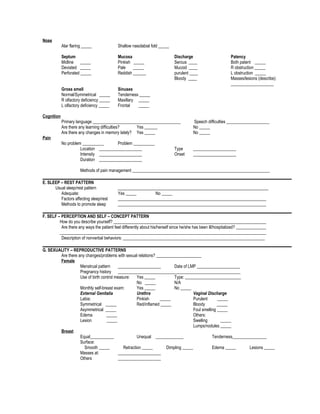
Nose
Alar flaring _____ Shallow nasolabial fold _____
Septum Mucosa Discharge Patency
Midline _____ Pinkish _____ Serous ____ Both patent _____
Deviated _____ Pale _____ Mucoid ____ R obstruction _____
Perforated _____ Reddish ______ purulent ____ L obstruction _____
Bloody ____ Masses/lesions (describe):
____________________
Gross smell Sinuses
Normal/Symmetrical _____ Tenderness _____
R olfactory deficiency _____ Maxillary _____
L olfactory deficiency _____ Frontal _____
Cognition
Primary language _________________________________________ Speech difficulties ____________________
Are there any learning difficulties? Yes ______ No _____
Are there any changes in memory lately? Yes _____ No _____
Pain
No problem __________ Problem __________
Location ____________________ Type ____________________
Intensity ____________________ Onset ____________________
Duration ____________________
Methods of pain management ________________________________________________________________
E. SLEEP – REST PATTERN
Usual sleep/rest pattern ______________________________________________________________________
Adequate: Yes _____ No _____
Factors affecting sleep/rest _____________________________________________________________________
Methods to promote sleep _____________________________________________________________________
F. SELF – PERCEPTION AND SELF – CONCEPT PATTERN
How do you describe yourself? _______________________________________________________________________
Are there any ways the patient feel differently about his/herself since he/she has been ill/hospitalized? ______________
________________________________________________________________________________________________
Description of nonverbal behaviors: __________________________________________________________________
G. SEXUALITY – REPRODUCTIVE PATTERNS
Are there any changes/problems with sexual relations? _____________________
Female
Menstrual pattern ____________________ Date of LMP ____________________
Pregnancy history _________________________________________________________
Use of birth control measure: Yes _____ Type: __________________________
No _____ N/A
Monthly self-breast exam: Yes _____ No _____
External Genitalia Urethra Vaginal Discharge
Labia: Pinkish _____ Purulent _____
Symmetrical _____ Red/inflamed _____ Bloody _____
Asymmetrical _____ Foul smelling _____
Edema _____ Others:
Lesion _____ Swelling _____
Lumps/nodules _____
Breast
Equal___________ Unequal _____________ Tenderness________________
Surface:
Smooth _____ Retraction _____ Dimpling _____ Edema _____ Lesions _____
Masses at: ____________________
Others ____________________
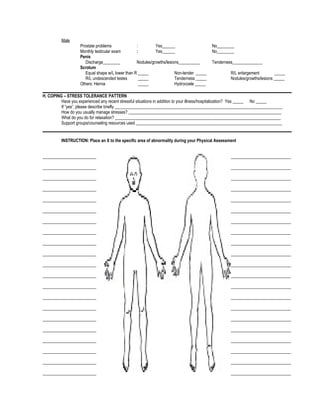
Male
Prostate problems : Yes______ No________
Monthly testicular exam : Yes______ No________
Penis
Discharge________ Nodules/growths/lesions__________ Tenderness______________
Scrotum
Equal shape w/L lower than R _____ Non-tender _____ R/L enlargement _____
R/L undescended testes _____ Tenderness _____ Nodules/growths/lesions _____
Others: Hernia _____ Hydrocoele _____
H. COPING – STRESS TOLERANCE PATTERN
Have you experienced any recent stressful situations in addition to your illness/hospitalization? Yes _____ No _____
If “yes”, please describe briefly ______________________________________________________________________________
How do you usually manage stresses? _______________________________________________________________________
What do you do for relaxation? _____________________________________________________________________________
Support groups/counseling resources used ____________________________________________________________________
INSTRUCTION: Place an X to the specific area of abnormality during your Physical Assessment
_________________________ ____________________________
_________________________ ____________________________
_________________________ ____________________________
_________________________ ____________________________
_________________________ ____________________________
_________________________ ____________________________
_________________________ ____________________________
_________________________ ____________________________
_________________________ ____________________________
_________________________ ____________________________
_________________________ ____________________________
_________________________ ____________________________
_________________________ ____________________________
_________________________ ____________________________
_________________________ ____________________________
_________________________ ____________________________
_________________________ ____________________________
_________________________ ____________________________
_________________________ ____________________________
_________________________ ____________________________
_________________________ ____________________________
PATHOPHYSIOLOGY
PREDISPOSING FACTORS: PRECIPITATING FACTORS:
________________________________________________ _____________________________________________
________________________________________________ _____________________________________________
________________________________________________ _____________________________________________
DIAGNOSTIC STUDIES AND LABORATORY RESULTS
Note: Place all the diagnostic studies done to the patient and indicate only significant results.
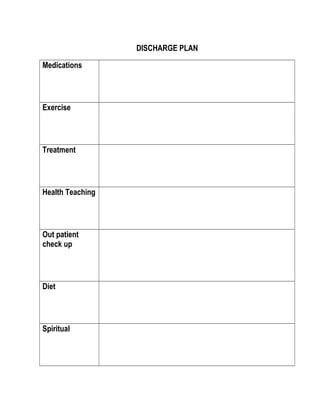
DISCHARGE PLAN
Medications
Exercise
Treatment
Health Teaching
Out patient
check up
Diet
Spiritual
Cagayan de Oro City
Bachelor of Science in Nursing
HOSPITAL ROTATION
MANUAL
__________________________________
AREA OF ROTATION
Clinical Instructor:
_____________________________
Florig, Sharmaine Grace B.
Name of Student

Assessment tool

  • 1.
    Cagayan De OroCity COLLEGE OF NURSING ASSESSMENT FORM GENERAL INFORMATION Patient’s Name: Age: Sex: Address: Status: Religion: Educational Attainment: Occupation: Nationality: Income: Name of Spouse/Guardian: Contact Number: Date of Admission (MM/DD/YY): Time of Admission: Baseline Vital signs: BP: T: PR: RR: Weight upon admission (in Kg): Height (in ft & in): CHIEF COMPLAINTS HISTORY OF PRESENT ILLNESS HOSPITALIZATION HISTORY ALLERGIES: Yes No (If yes, specify below) Food: Medications: Others: BLOOD TRANSFUSION HISTORY: Yes No (If yes, indicate below.) BLOOD TYPE: DATE OF TRANSFUSION INDICATION REACTION MEDICATION HISTORY (Previously taken, maintenance, current, etc.) DRUG NAME DATE TAKEN SCHEDULE INDICATIONS LABORATORY EXAMS/IV FLUIDS Date ordered (mm/dd/yy) Diagnostic / Laboratory exams Date done (mm/dd/yy) Date ordered (mm/dd/yy) IV fluids/blood Date discontinued (mm/dd/yy) Have you been taking your medication(s) as prescribed? Yes No DATE OF ADMISSION NAME OF INSTITUTION DIAGNOSIS/INDICATION
  • 2.
    A. NUTRITION ANDMETABOLIC PATTERN Special diet: Yes (specify) No Supplements: Yes (specify) No Nutritional state: Well-nourished poorly nourished Obesity Cachexia Mouth: Lips Mucosa Tongue Teeth Pinkish Pinkish Midline Complete Pallor Pallor Atrophy Caries _____ Cyanosis Cyanosis Fasciculation Missing teeth_____ Lesions R/L deviation Dentures _____ Dryness/cracks Gums Pinkish _____ Pallor _____ Bleeding _____ Tenderness _____ Pharynx: Uvula Mucosa Tonsils Posterior Pharynx Midline _____ Pinkish _____ not inflamed _____ Inflammation _____ R/L deviation _____ Pallor _____ R/L Deviation _____ Reddish _____ R/L Exudates _____ Neck: Trachea Thyroids Others: Midline _____ R/L deviation _____ Non-palpable _____ Neck enlargement _____ Lymphadenopathy _____ Tenderness _____ Enlarged _____ Normal ROM _____ Cervical Lymph Nodes _____ Neck rigidity _____ Skin: General Color Texture Temperature Moisture Pinkish _____ Smooth _____ Warm _____ Dry _____ Cyanotic _____ Rough _____ Cool _____ Moist/Clammy _____ Pallor _____ Others: Others: Oily _____ Flushed _____ _______________ ________________ Jaundiced _____ Mottled _____ Dusky _____ Others Petechiae _____ Ecchymosis _____ Hematoma _____ Lesions/Rashes _____ Edema: Pitting _____ (If pitting, specify below) Non-pitting _____ Pedal: R _____ L _____ Bipedal _____ Grading: _____ Wounds/drains/dressings: ____________________________________________________________________________________________ Intravenous fluids: __________________________________________________________________________________________________ B. ELIMINATION PATTERN Usual bowel pattern (Describe character of stool, frequency, discomforts) _________________________________________________________________________________________________________________ _ Date of Last BM (mm/dd/yy): ______________________________ Melena _____ Hematochezia _____ Are there any problems with hemorrhoids/incontinence? Yes _____ No _____ Use of anything to manage bowels (e.g. laxatives, enema, suppositories, “home remedies”, anti-diarrheal) _________________________________________________________________________________________________________________ _ Abdomen General Configuration Percussion Palpation Superficial Veins _____ Symmetrical _____ Tympanitic _____ Muscle guarding ____ Striae _____ Asymmetrical _____ Hypertympanitic _____ direct tenderness ____ Scars/Lesions _____ Flat _____ Fluid wave _____ Rebound tenderness ____ Globular _____ shifting dullness _____ Bladder distention ____ Protuberant _____ Dullness at: Organomegaly: Scaphoid _____ __________________ Liver _____ Spleen ____ Masses at: _____________________
  • 3.
    Usual urinary pattern(Describe frequency, character, amount, problem in control, etc.) _________________________________________________________________________________________________________________ _ Dysuria _____ Hematuria _____ Nocturia _____ Retention _____ Flank pain _____ Polyuria _____ Oliguria _____ Anuria _____ Excess perspiration/nocturnal sweats: ______________________________________________ C. ACTIVITY – EXERCISE PATTERN Cardiovascular Status Chest pain/radiation _____ Jugular vein distention _____ Dyspnea on exertion _____ Orthopnea _____ Palpitation _____ Paroxysmal nocturnal dyspnea _____ Precordial area Heart Sounds Peripheral pulses Flat _____ Distinct _____ Symmetrical _____ Bulging _____ Regular _____ Regular _____ Tenderness _____ Faint _____ Faint _____ Heave _____ Irregular _____ Strong _____ Thrill _____ Others: Bounding _____ Apical rate and rhythm: S3 _____ S4 _____ _____________________ Preicardial rub _____ Capillary Refill __________________________ Presence of Pacemaker/A-V Shunt/Hemodynamic monitoring ___________________________________ Respiratory Status: Breathing Pattern Shape of chest Lung Expansion Regular _____ Irregular _____ Normal APL ratio _____ resonant _____ Eupnea _____ Hyperpnea _____ Barrel chest _____ Dullness at: Tachypnea _____ Bradypnea _____ Funnel _____ ______________ Dyspnea _____ Rest _____ Pigeon _____ Hyperresonant at: Exertion _____ ______________ Use of accessory muscles _____ ICS retractions/bulging _____ Pain on respiration _____ Vocal/Tactile Fremitus Percussion Breath Sounds Symmetrical _____ Resonant _____ Rhonchi _____ Decreased/increased at: Dullness at: Bronchovesicular at ________________ ____________________ ______________ Rales/crackles at ________________ Hyperresonant at: Bronchial at ________________ ______________ Pleural Friction Rub ________________ Wheezes at ________________ Cough Productive _____ Non-productive _____ Sputum Color _________ Amount __________ Consistency __________ O2 supplement/ventilatory assistance __________________________________________________ Respiratory Tubes (e.g. ET, trach, chest tube/describe secretions and/or drainage) ___________________________________________________________________________ Activities of Daily Living/Mobility Status Use the Activity Level Code below to assess ADL & Mobility Status 0- Total Independence 1- Assist with Device 2- Assist with Person 3- Assist with Device Person 4- Total Dependence ADL Status Mobility Status Feeding _____ Meal Preparation _____ Bed Mobility _____ Bathing _____ Cleaning _____ Chair/Toilet Transfer _____ Dressing _____ Laundry _____ Ambulation _____ Grooming _____ Toileting _____ R.O.M. _____ Reasons for ADL/Mobility Limitation ____________________________________________________________________________ Device used for assistance __________________________________________________________________________ Exercise pattern (describe type, regularity) ___________________________________________________________
  • 4.
    BACK AND EXTREMITIES Rangeof motion Muscle tone and strength Decreased ROM (indicate joint) _________ equally strong __________ Joint tenderness/pain _________ Symmetrical in size __________ Varicose veins _________ R/L Upper/Lower extremities __________ Deformities _________ R/L Upper/Lower Paresis __________ Joint swelling at : __________________ R/L Upper/Lower Paralysis __________ Spine Gait Midline _____ Lordosis _____ Coordinated _____ Shuffling _____ Kyphosis _____ Scoliosis _____ Smooth _____ Uncoordinated _____ Staggering _____ D. COGNITIVE – PERCEPTUAL PATTERN Level of Consciousness Conscious _____ Alert _____ Confused _____ Drowsy _____ Stuporous _____ Comatose _____ Others ______________ Orientation Emotional State Oriented _____ Calm _____ Worrried/Anxious _____ Restless _____ Disoriented to: Dizziness _____ Numbness _____ Tingling Sensation _____ Time/Person/Place _____ Others: ________ Head: Normocephalic _____ Assymetrical _____ Enlarged _____ Masses _____ Others: _______ Facial Movements Fontanels Hair Scalp Symmetrical _____ Closed _____ Fine _____ Clean _____ Assymetrical: Sunken _____ Coarse _____ Dandruff _____ lag at R _____L _____ Bulging _____ Dry _____ Lice _____ Open: specify _____ Alopecia _____ Wounds/scars/lesions (specify) ________________________ Eyes: Lids Periorbital region Conjunctiva Cornea and lens Symmetrical _____ Edema _____ Pink _____ Opacity: R/L edema/swelling _____ Sunken _____ Pale _____ R _____ L _____ R/L ptosis _____ Discoloration _____ Lesions _____ Lesions _______ Lesions _____ Discharges _____ Sclera Visual Acuity Peripheral vision Reaction to accomodation Anicteric _____ grossly normal _____ Intact/Full _____ Uniform constriction/convergence Subicteric _____ Farsighted _____ Decreased/Limited _____ __________________________ Icteric _____ nearsighted _____ Unequal constriction/convergence Hemorrhages _____ Wears eyeglasses/convergence __________________________ ___________________ Pupils Equal _____ size _____ mm Unequal: R= ___ mm L= ___ mm Reaction to light: R: brisk _____ sluggish _____ fixed _____ L: brisk _____ sluggish _____ fixed _____ Ears External Pinnae External canal Tympanic membrane Gross Hearing Normoset _____ Discharge: Intact ______ Normal _____ Symmetrical _____ Foul smelling _____ Not intact _____ Decreased _____ Tenderness _____ Serous _____ Symmetrical _____ Lesions _____ Purulent _____ R/L deafness _____ Gross abnormalities: Mucoid _____ _________________ Cerumen: Impacted _____ Not impacted _____
  • 5.
    Nose Alar flaring _____Shallow nasolabial fold _____ Septum Mucosa Discharge Patency Midline _____ Pinkish _____ Serous ____ Both patent _____ Deviated _____ Pale _____ Mucoid ____ R obstruction _____ Perforated _____ Reddish ______ purulent ____ L obstruction _____ Bloody ____ Masses/lesions (describe): ____________________ Gross smell Sinuses Normal/Symmetrical _____ Tenderness _____ R olfactory deficiency _____ Maxillary _____ L olfactory deficiency _____ Frontal _____ Cognition Primary language _________________________________________ Speech difficulties ____________________ Are there any learning difficulties? Yes ______ No _____ Are there any changes in memory lately? Yes _____ No _____ Pain No problem __________ Problem __________ Location ____________________ Type ____________________ Intensity ____________________ Onset ____________________ Duration ____________________ Methods of pain management ________________________________________________________________ E. SLEEP – REST PATTERN Usual sleep/rest pattern ______________________________________________________________________ Adequate: Yes _____ No _____ Factors affecting sleep/rest _____________________________________________________________________ Methods to promote sleep _____________________________________________________________________ F. SELF – PERCEPTION AND SELF – CONCEPT PATTERN How do you describe yourself? _______________________________________________________________________ Are there any ways the patient feel differently about his/herself since he/she has been ill/hospitalized? ______________ ________________________________________________________________________________________________ Description of nonverbal behaviors: __________________________________________________________________ G. SEXUALITY – REPRODUCTIVE PATTERNS Are there any changes/problems with sexual relations? _____________________ Female Menstrual pattern ____________________ Date of LMP ____________________ Pregnancy history _________________________________________________________ Use of birth control measure: Yes _____ Type: __________________________ No _____ N/A Monthly self-breast exam: Yes _____ No _____ External Genitalia Urethra Vaginal Discharge Labia: Pinkish _____ Purulent _____ Symmetrical _____ Red/inflamed _____ Bloody _____ Asymmetrical _____ Foul smelling _____ Edema _____ Others: Lesion _____ Swelling _____ Lumps/nodules _____ Breast Equal___________ Unequal _____________ Tenderness________________ Surface: Smooth _____ Retraction _____ Dimpling _____ Edema _____ Lesions _____ Masses at: ____________________ Others ____________________
  • 6.
    Male Prostate problems :Yes______ No________ Monthly testicular exam : Yes______ No________ Penis Discharge________ Nodules/growths/lesions__________ Tenderness______________ Scrotum Equal shape w/L lower than R _____ Non-tender _____ R/L enlargement _____ R/L undescended testes _____ Tenderness _____ Nodules/growths/lesions _____ Others: Hernia _____ Hydrocoele _____ H. COPING – STRESS TOLERANCE PATTERN Have you experienced any recent stressful situations in addition to your illness/hospitalization? Yes _____ No _____ If “yes”, please describe briefly ______________________________________________________________________________ How do you usually manage stresses? _______________________________________________________________________ What do you do for relaxation? _____________________________________________________________________________ Support groups/counseling resources used ____________________________________________________________________ INSTRUCTION: Place an X to the specific area of abnormality during your Physical Assessment _________________________ ____________________________ _________________________ ____________________________ _________________________ ____________________________ _________________________ ____________________________ _________________________ ____________________________ _________________________ ____________________________ _________________________ ____________________________ _________________________ ____________________________ _________________________ ____________________________ _________________________ ____________________________ _________________________ ____________________________ _________________________ ____________________________ _________________________ ____________________________ _________________________ ____________________________ _________________________ ____________________________ _________________________ ____________________________ _________________________ ____________________________ _________________________ ____________________________ _________________________ ____________________________ _________________________ ____________________________ _________________________ ____________________________
  • 7.
    PATHOPHYSIOLOGY PREDISPOSING FACTORS: PRECIPITATINGFACTORS: ________________________________________________ _____________________________________________ ________________________________________________ _____________________________________________ ________________________________________________ _____________________________________________
  • 8.
    DIAGNOSTIC STUDIES ANDLABORATORY RESULTS Note: Place all the diagnostic studies done to the patient and indicate only significant results.
  • 9.
  • 10.
    Cagayan de OroCity Bachelor of Science in Nursing HOSPITAL ROTATION MANUAL __________________________________ AREA OF ROTATION Clinical Instructor: _____________________________ Florig, Sharmaine Grace B. Name of Student