ELEMENT OF
DESIGN
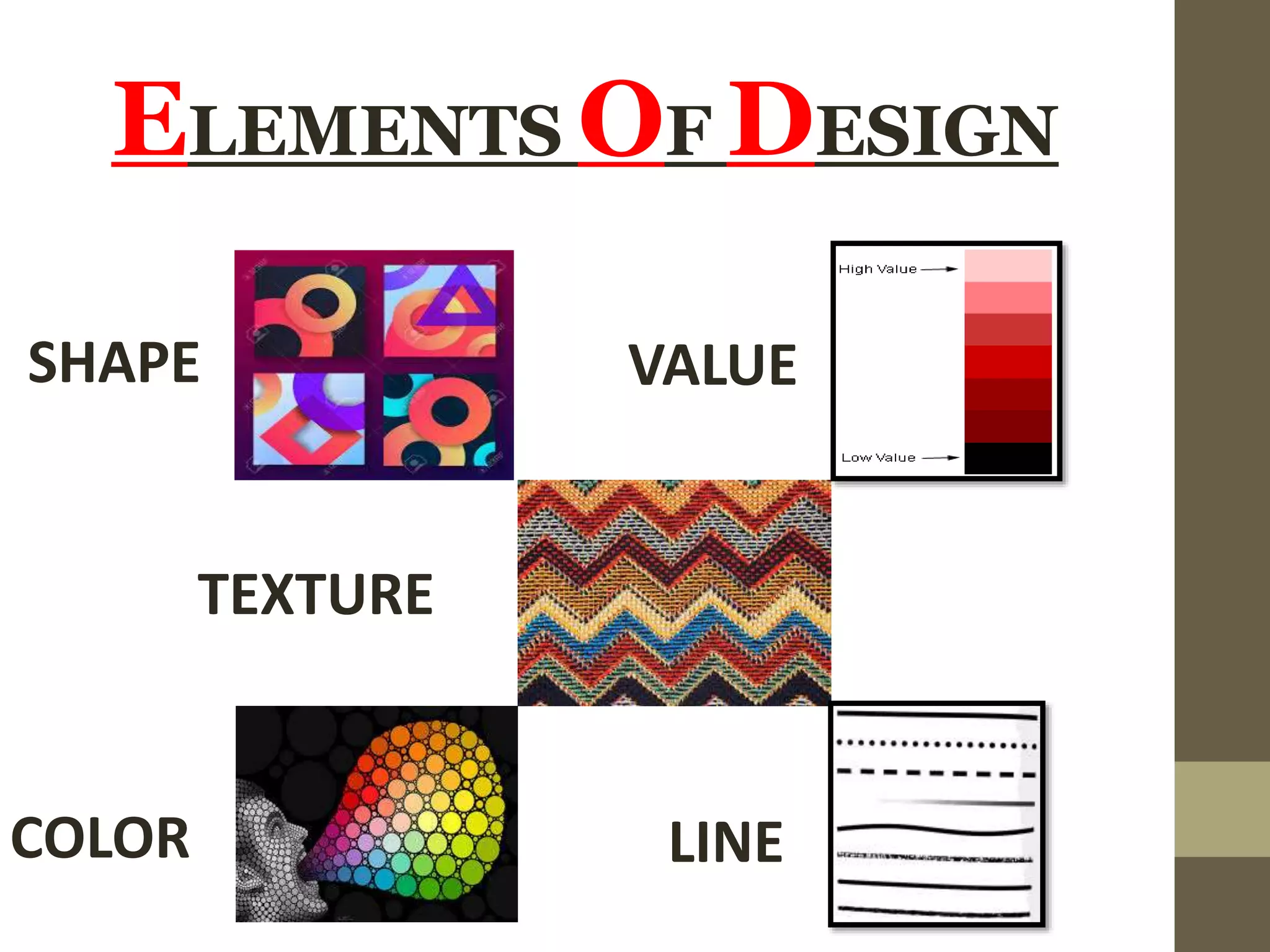
ELEMENTS OF DESIGN
LINE
SHAPE
COLOR
VALUE
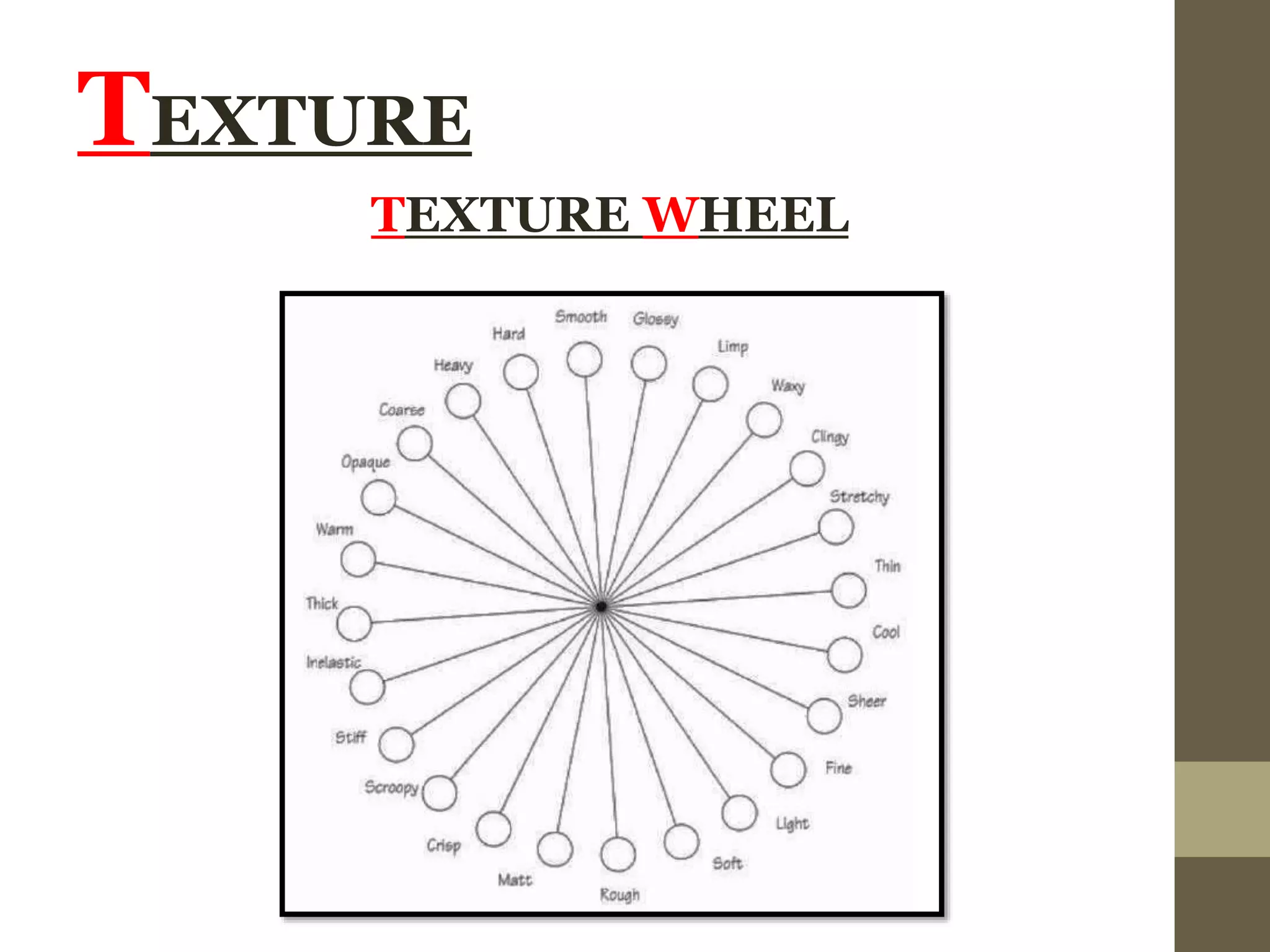
TEXTURE
Shape
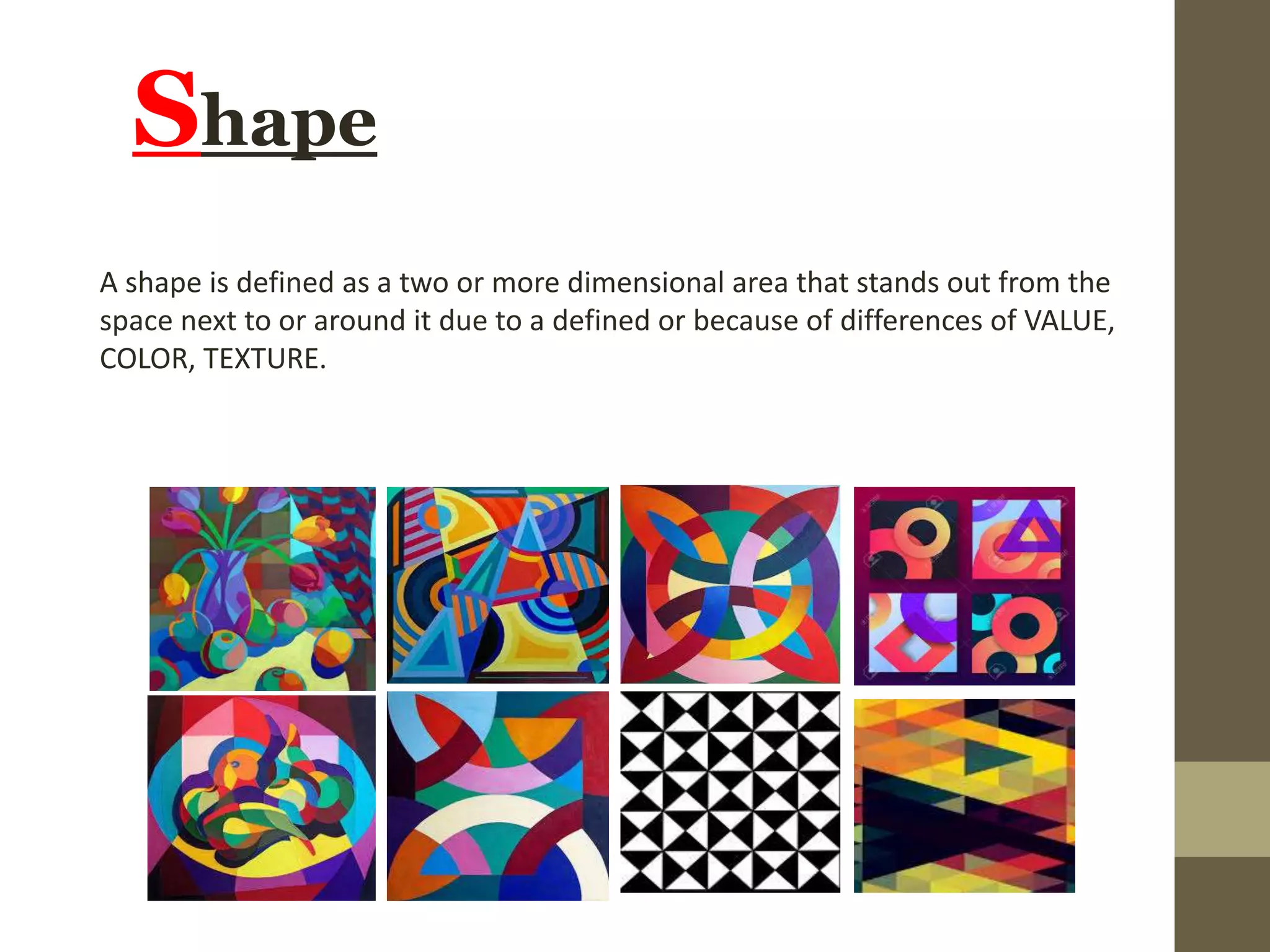
A shape is defined as a two or more dimensional area that stands out from the
space next to or around it due to a defined or because of differences of VALUE,
COLOR, TEXTURE.
SHAPE
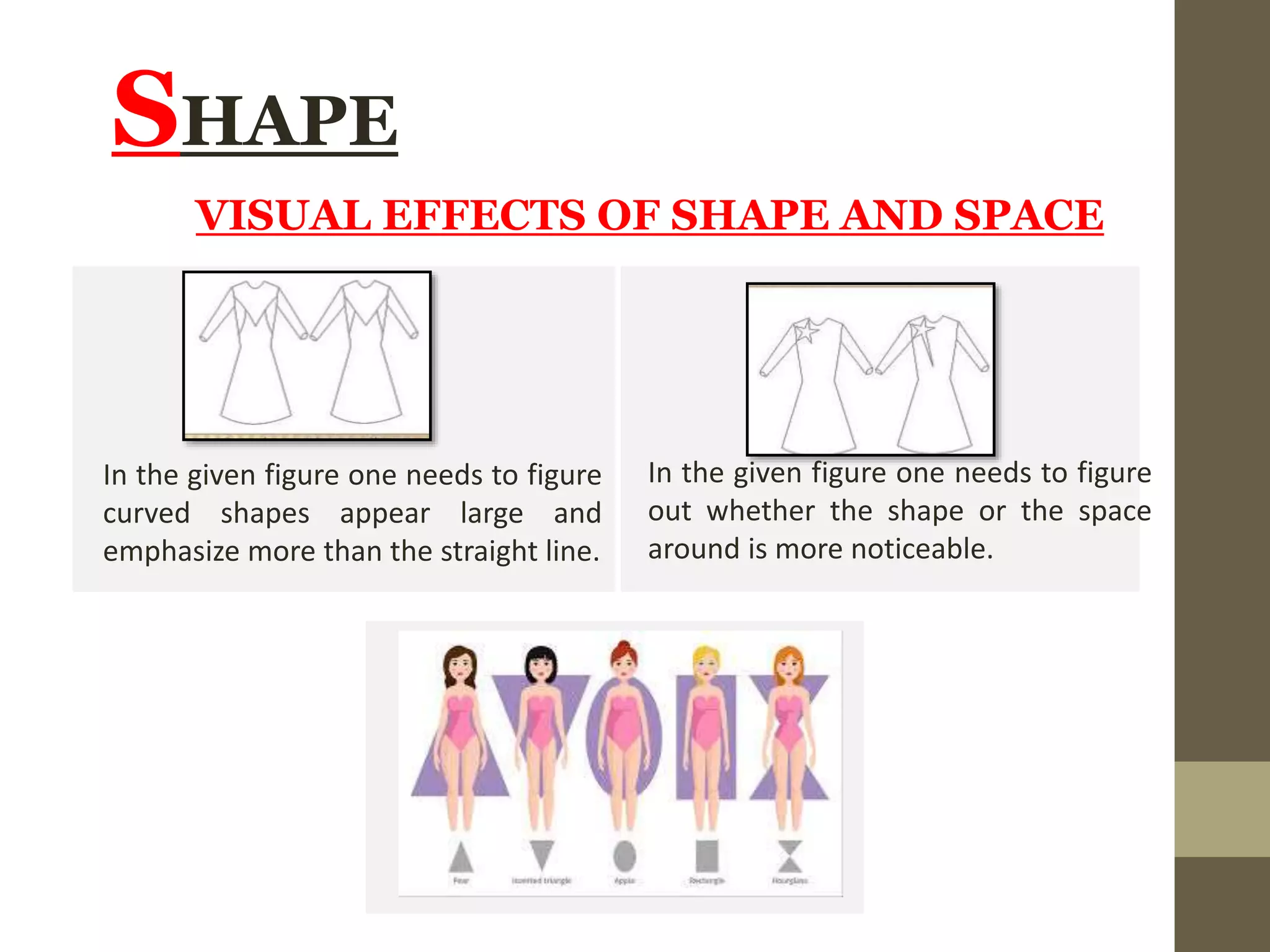
VISUAL EFFECTS OF SHAPE AND SPACE
In the given figure one needs to figure
out whether the shape or the space
around is more noticeable.
In the given figure one needs to figure
curved shapes appear large and
emphasize more than the straight line.
Colour
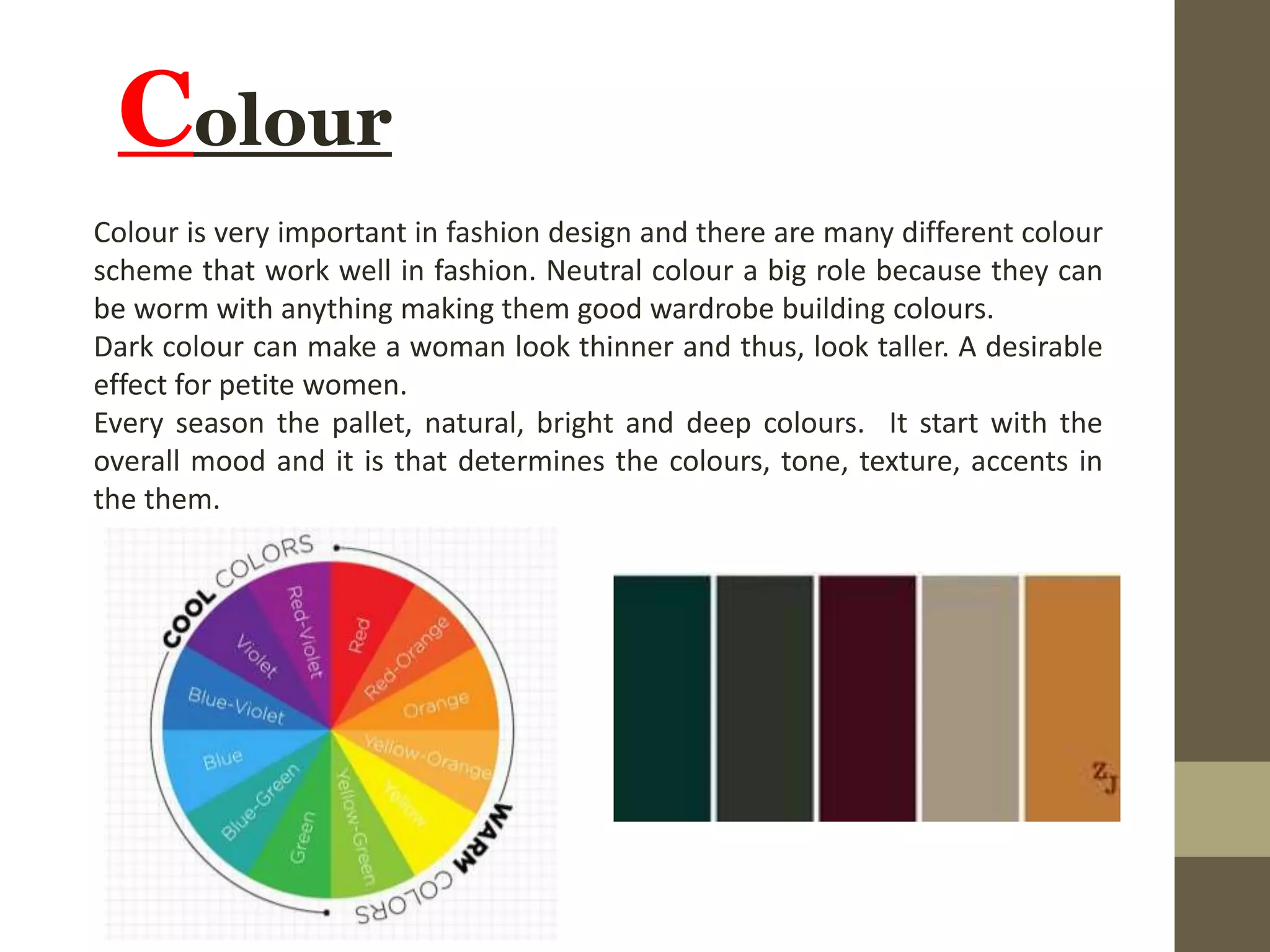
Colour is very important in fashion design and there are many different colour
scheme that work well in fashion. Neutral colour a big role because they can
be worm with anything making them good wardrobe building colours.
Dark colour can make a woman look thinner and thus, look taller. A desirable
effect for petite women.
Every season the pallet, natural, bright and deep colours. It start with the
overall mood and it is that determines the colours, tone, texture, accents in
the them.
Colour
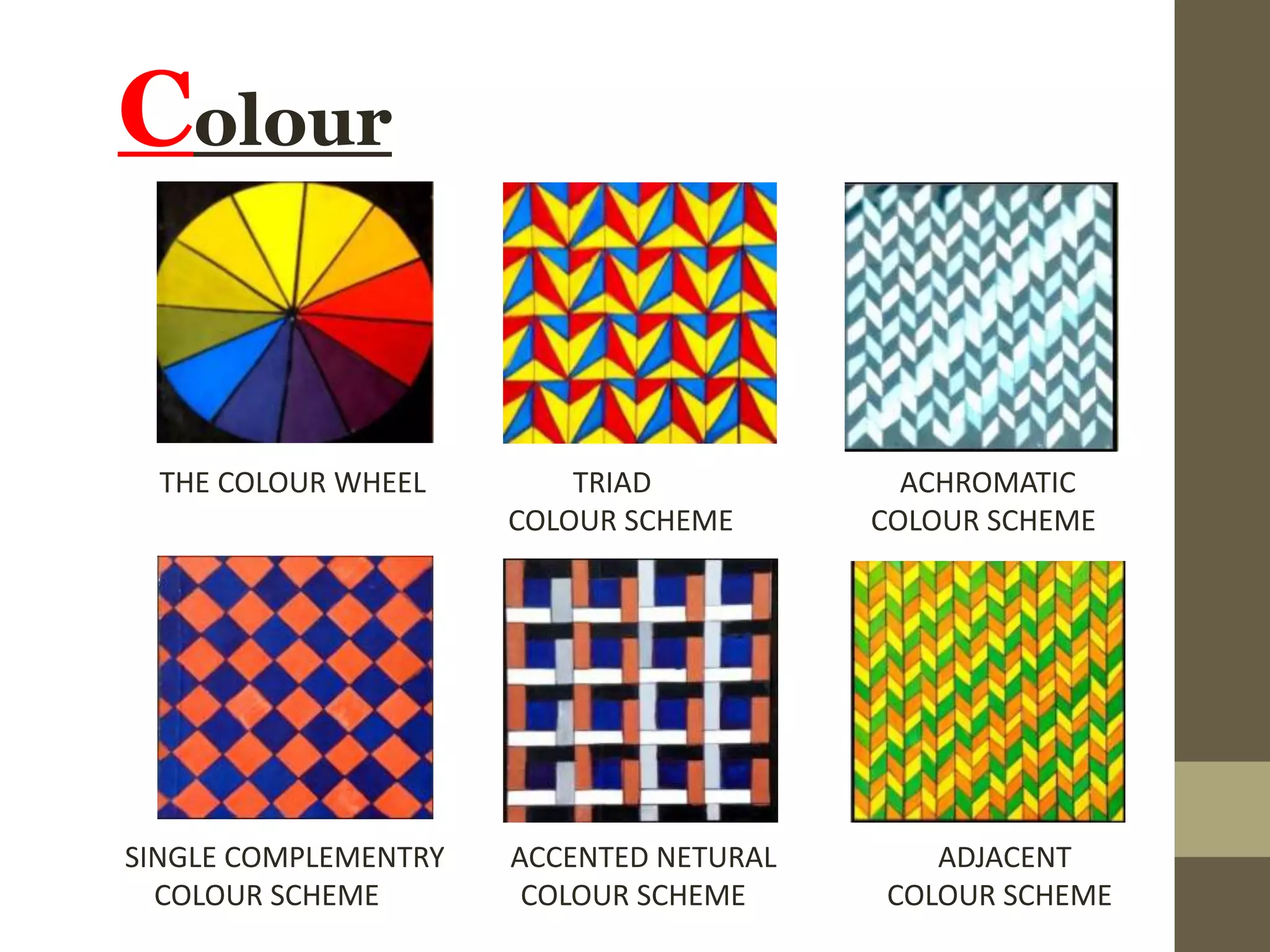
THE COLOUR WHEEL TRIAD ACHROMATIC
COLOUR SCHEME COLOUR SCHEME
SINGLE COMPLEMENTRY ACCENTED NETURAL ADJACENT
COLOUR SCHEME COLOUR SCHEME COLOUR SCHEME
Value
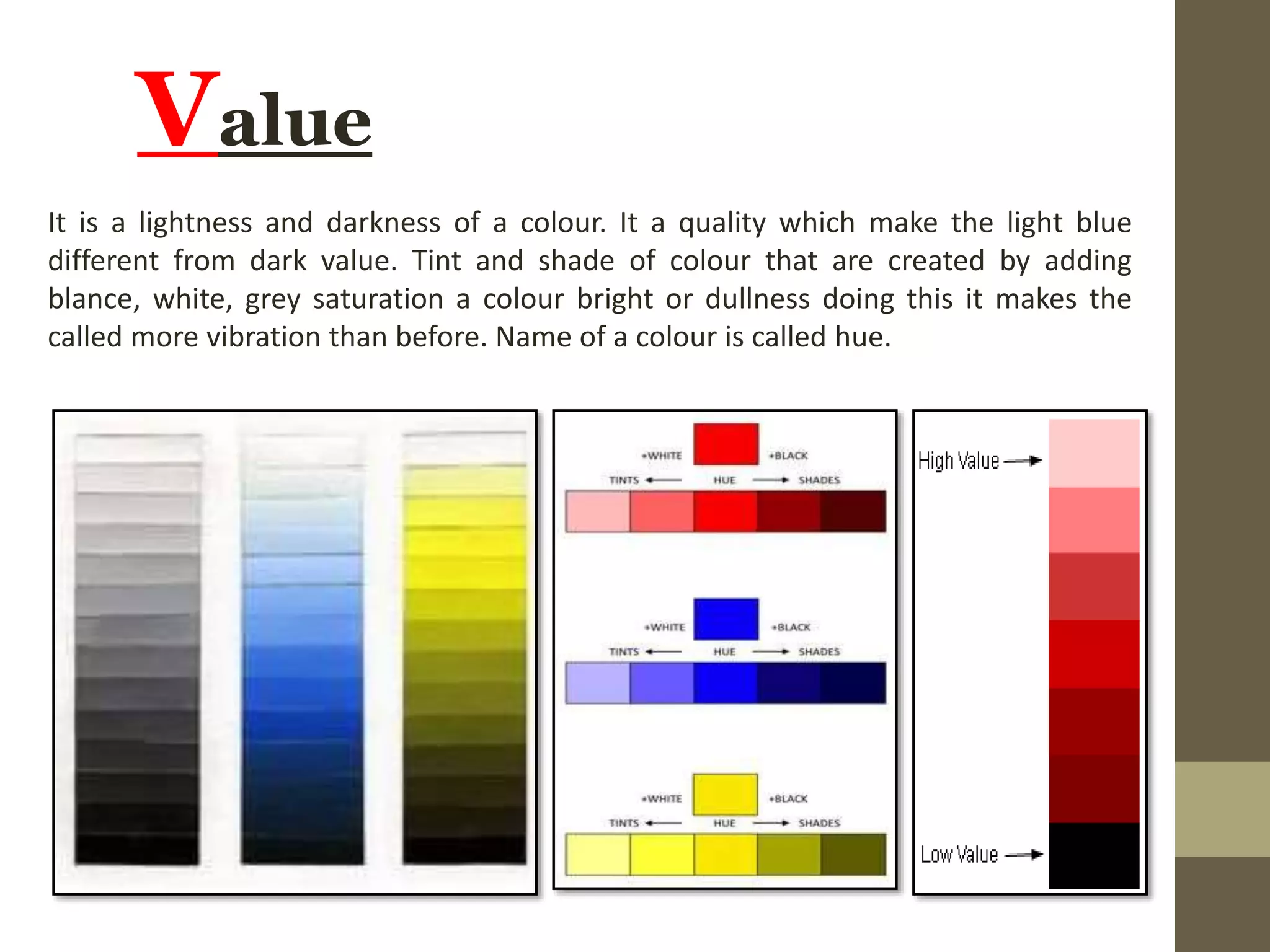
It is a lightness and darkness of a colour. It a quality which make the light blue
different from dark value. Tint and shade of colour that are created by adding
blance, white, grey saturation a colour bright or dullness doing this it makes the
called more vibration than before. Name of a colour is called hue.
Line
A line is a series of connecting points. It is the simple design element. A line is a
mark by a moving point and having psychological impact according to its
direction, weight and the variations in its direction, weight. It is an enormously
useful and versatile graphic device that is made to function in both visual and
verbal ways.
Line is the very first elements of design. There are so many lines in an outfit in
one could take a look, these are hemlines, seam, gores, placket, pleats, tucks,
darts, yokes, necklines, etc.
There are vertical , horizontal and diagonal line. A series of connecting points. It
is the simplest design elements. All lines have direction, length and width. Line
can be used as structural or decorative.
• LINE DIRECTS
• LINE DIVIDE
Line
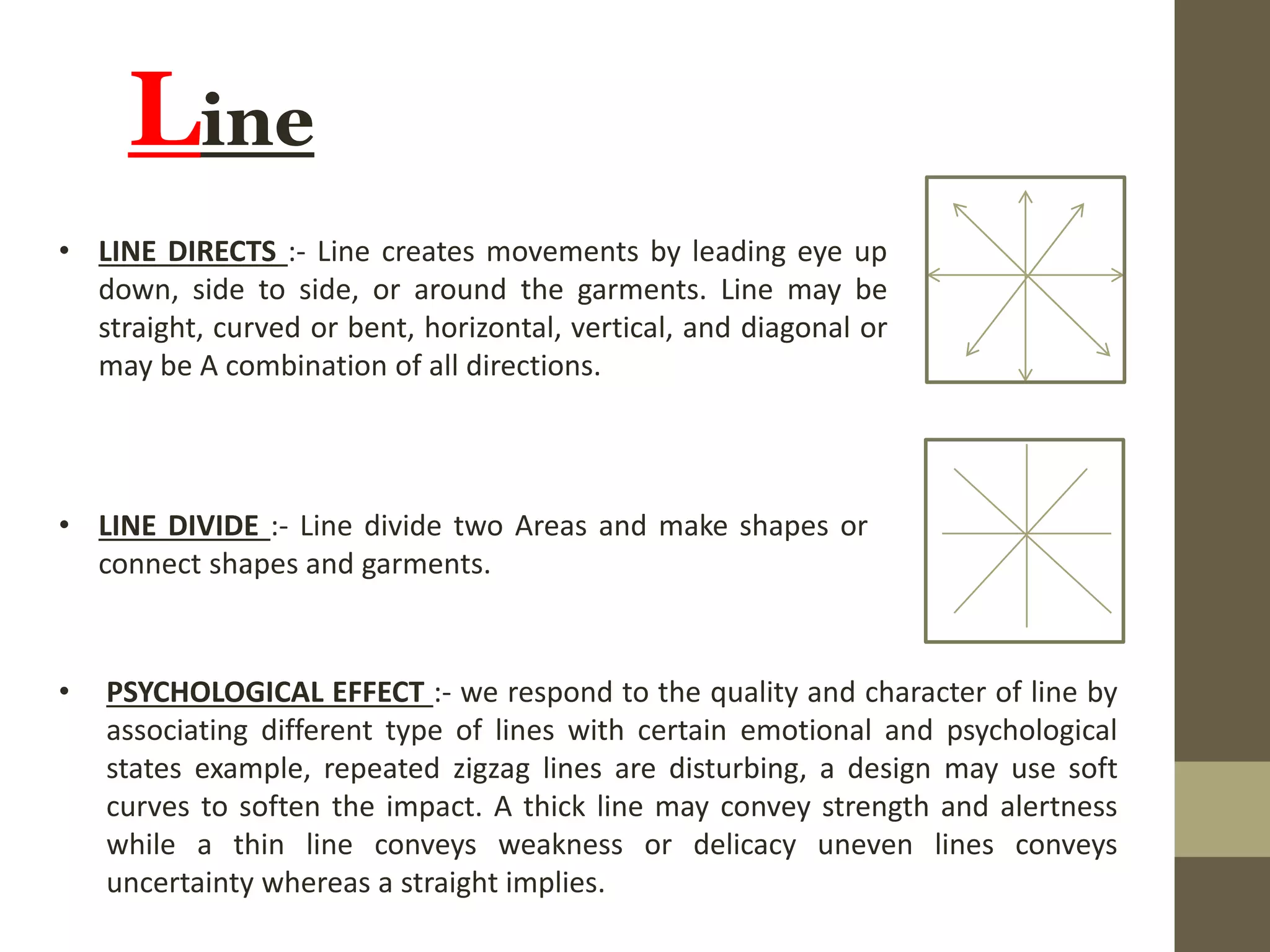
• LINE DIRECTS :- Line creates movements by leading eye up
down, side to side, or around the garments. Line may be
straight, curved or bent, horizontal, vertical, and diagonal or
may be A combination of all directions.
• LINE DIVIDE :- Line divide two Areas and make shapes or
connect shapes and garments.
• PSYCHOLOGICAL EFFECT :- we respond to the quality and character of line by
associating different type of lines with certain emotional and psychological
states example, repeated zigzag lines are disturbing, a design may use soft
curves to soften the impact. A thick line may convey strength and alertness
while a thin line conveys weakness or delicacy uneven lines conveys
uncertainty whereas a straight implies.
Line
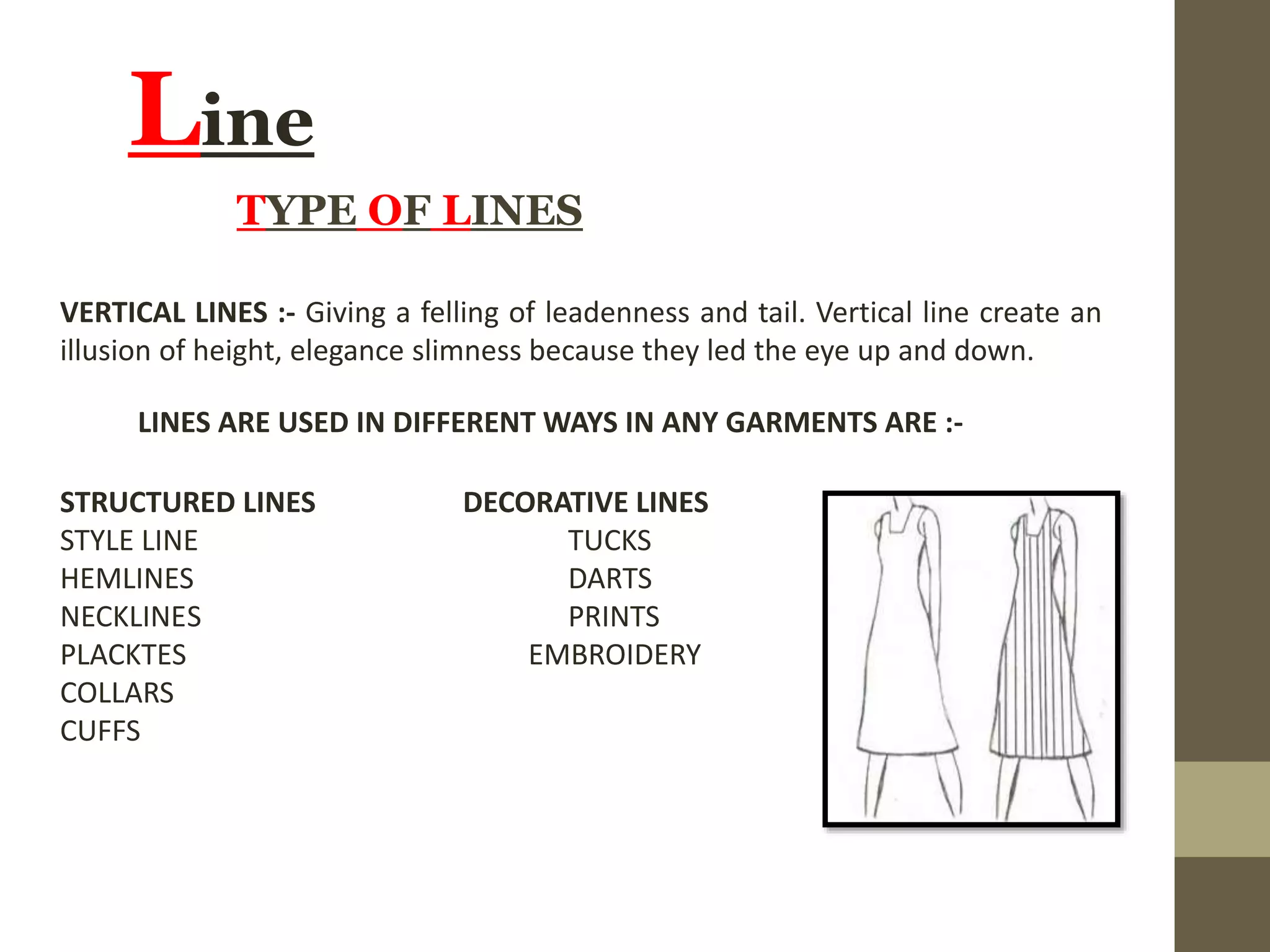
VERTICAL LINES :- Giving a felling of leadenness and tail. Vertical line create an
illusion of height, elegance slimness because they led the eye up and down.
TYPE OF LINES
LINES ARE USED IN DIFFERENT WAYS IN ANY GARMENTS ARE :-
STRUCTURED LINES DECORATIVE LINES
STYLE LINE TUCKS
HEMLINES DARTS
NECKLINES PRINTS
PLACKTES EMBROIDERY
COLLARS
CUFFS
Line
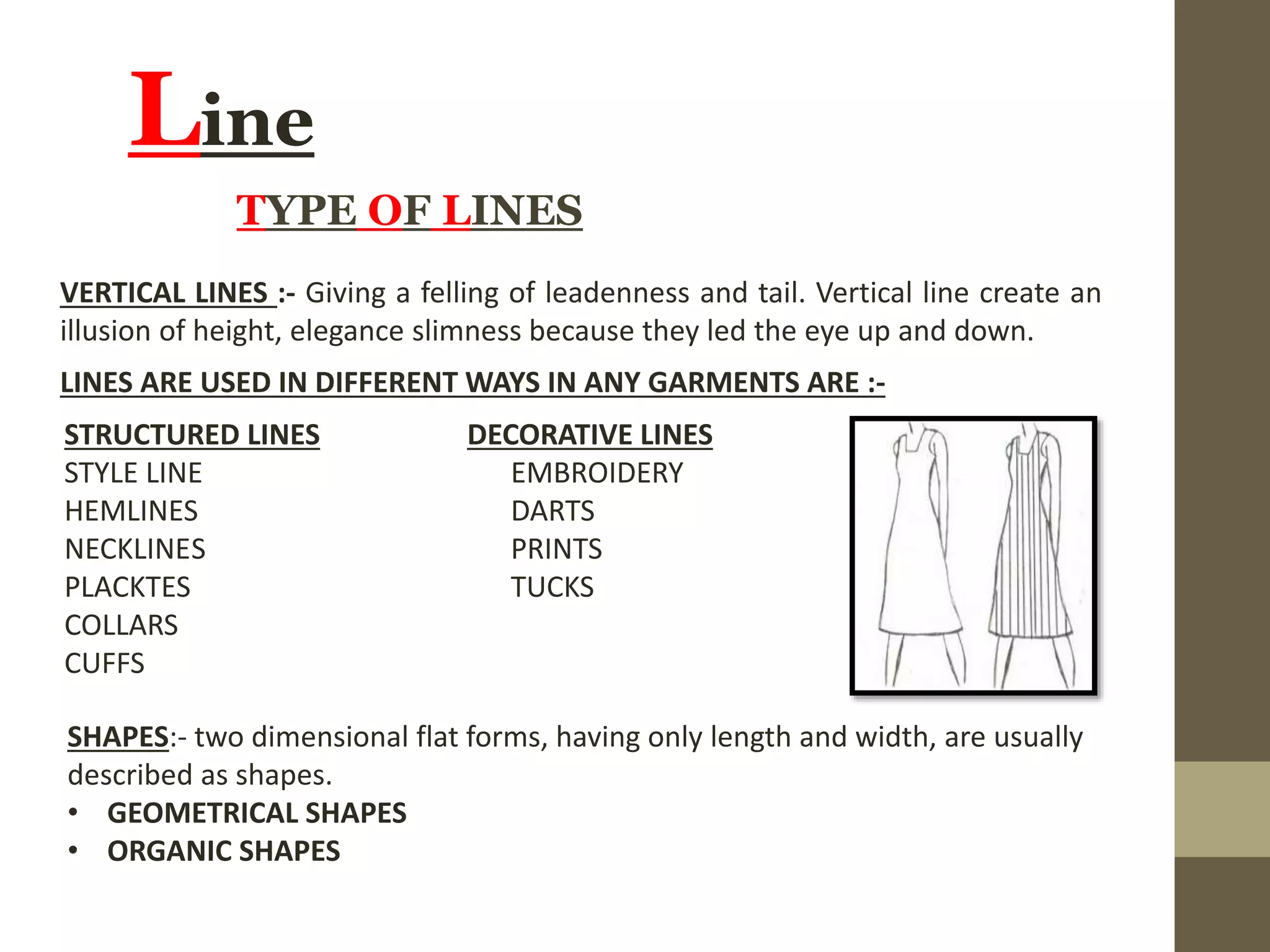
VERTICAL LINES :- Giving a felling of leadenness and tail. Vertical line create an
illusion of height, elegance slimness because they led the eye up and down.
TYPE OF LINES
LINES ARE USED IN DIFFERENT WAYS IN ANY GARMENTS ARE :-
STRUCTURED LINES DECORATIVE LINES
STYLE LINE EMBROIDERY
HEMLINES DARTS
NECKLINES PRINTS
PLACKTES TUCKS
COLLARS
CUFFS
SHAPES:- two dimensional flat forms, having only length and width, are usually
described as shapes.
• GEOMETRICAL SHAPES
• ORGANIC SHAPES
Line
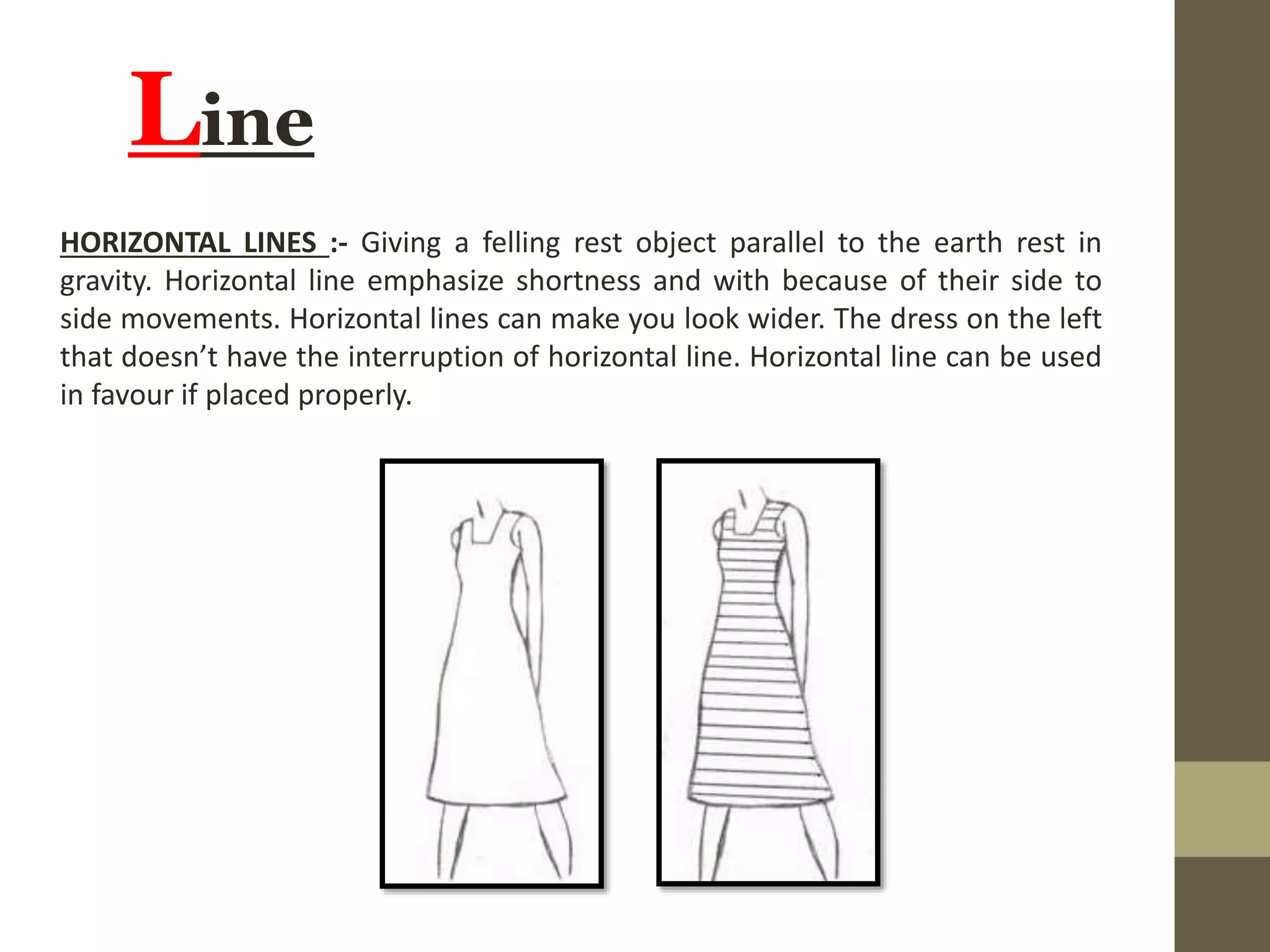
HORIZONTAL LINES :- Giving a felling rest object parallel to the earth rest in
gravity. Horizontal line emphasize shortness and with because of their side to
side movements. Horizontal lines can make you look wider. The dress on the left
that doesn’t have the interruption of horizontal line. Horizontal line can be used
in favour if placed properly.
Line
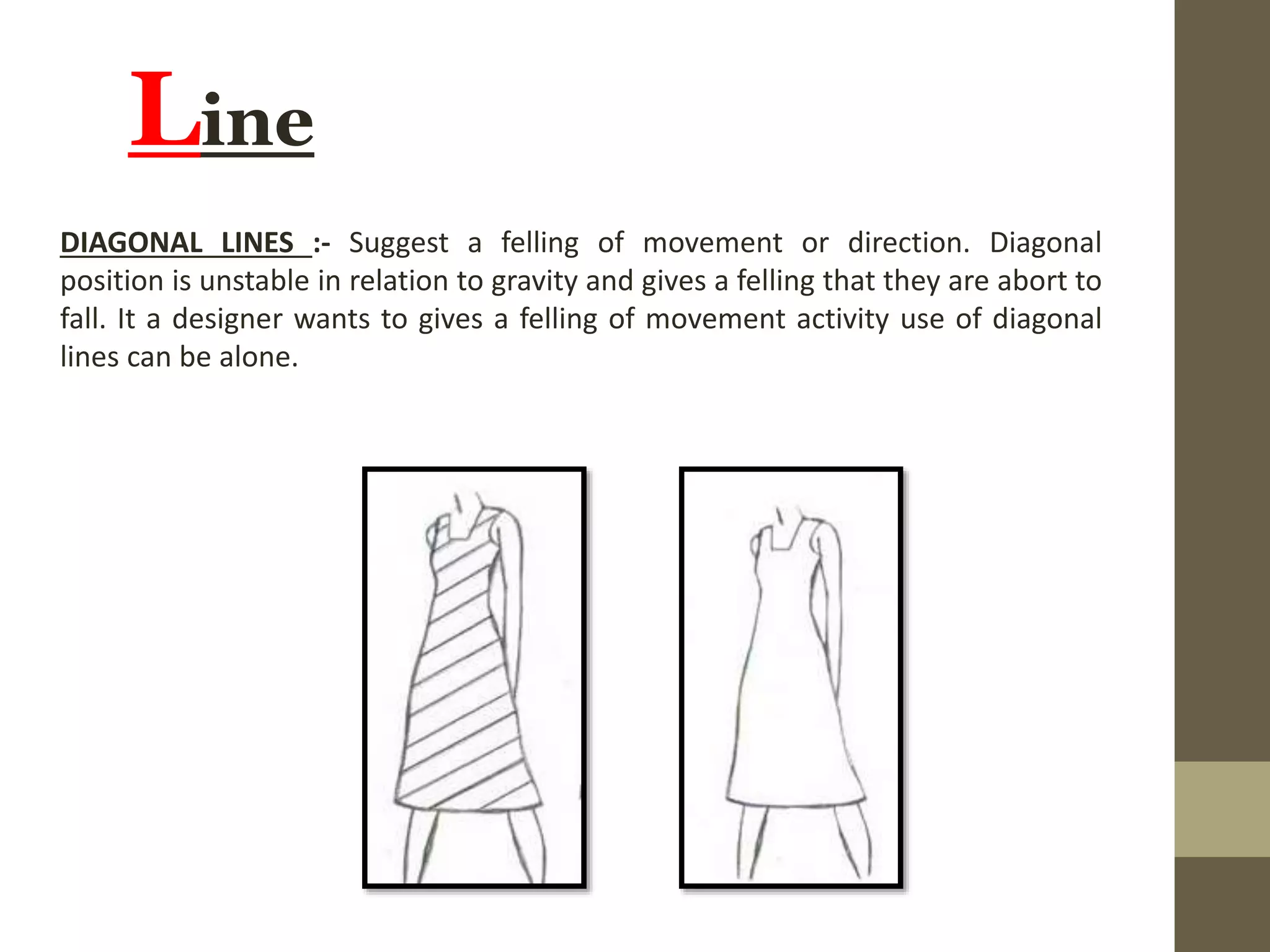
DIAGONAL LINES :- Suggest a felling of movement or direction. Diagonal
position is unstable in relation to gravity and gives a felling that they are abort to
fall. It a designer wants to gives a felling of movement activity use of diagonal
lines can be alone.
TEXTURE
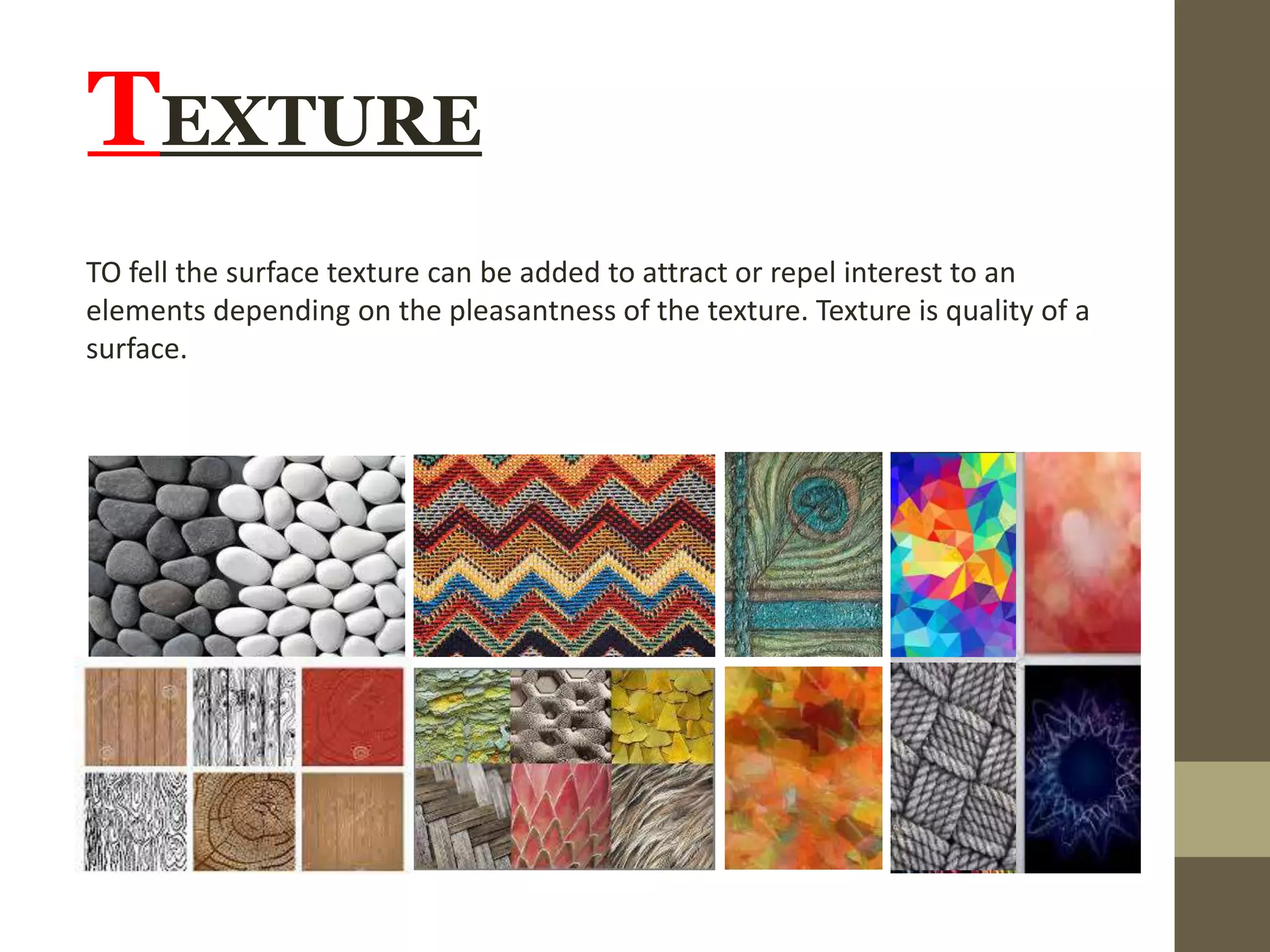
TO fell the surface texture can be added to attract or repel interest to an
elements depending on the pleasantness of the texture. Texture is quality of a
surface.
TEXTURE
TYPE OF TEXTURE
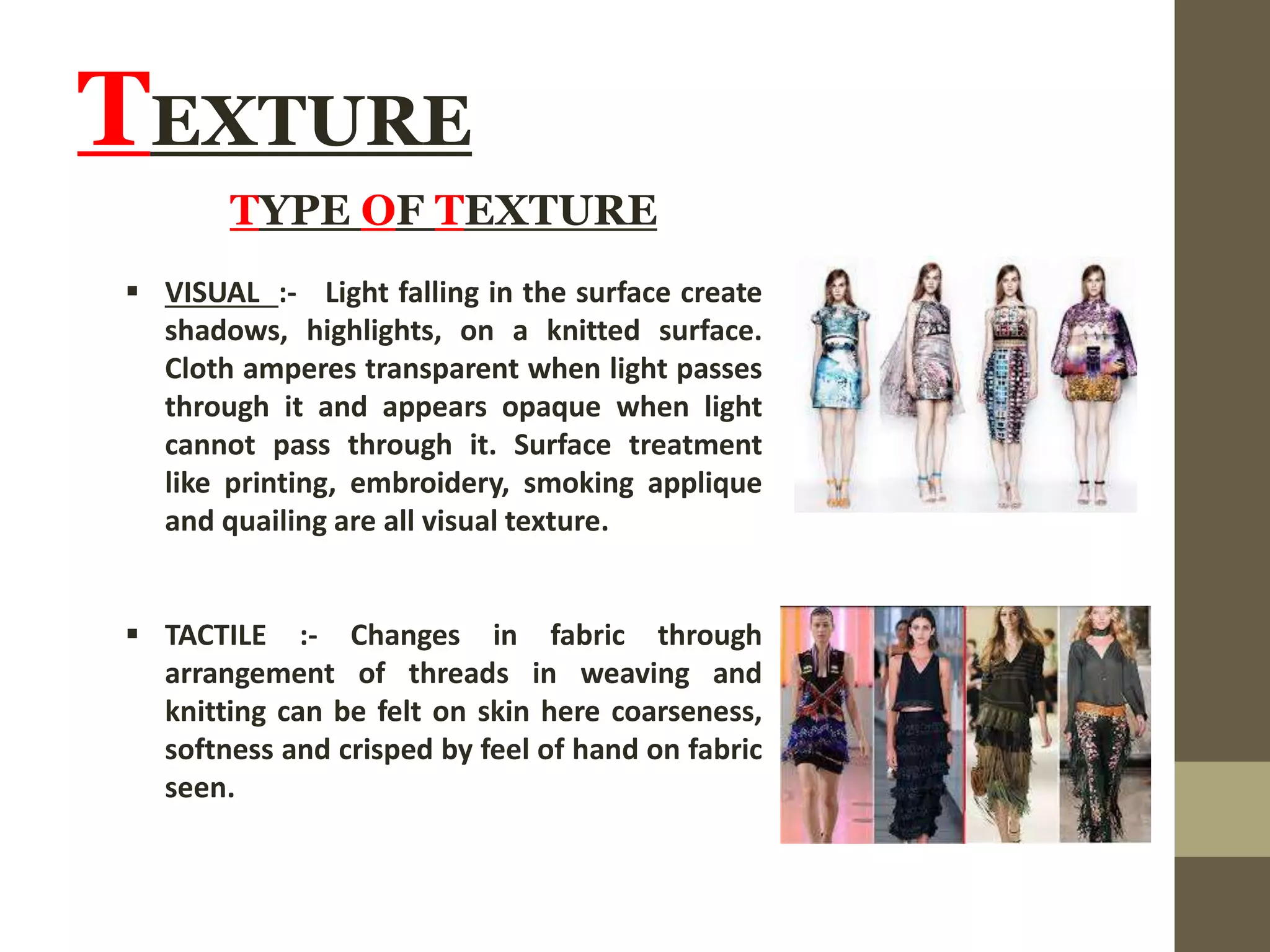
 VISUAL :- Light falling in the surface create
shadows, highlights, on a knitted surface.
Cloth amperes transparent when light passes
through it and appears opaque when light
cannot pass through it. Surface treatment
like printing, embroidery, smoking applique
and quailing are all visual texture.
 TACTILE :- Changes in fabric through
arrangement of threads in weaving and
knitting can be felt on skin here coarseness,
softness and crisped by feel of hand on fabric
seen.
TEXTURE
• AUDIBLE :- through friction when the fabric rub over each other a sound
can be heard. The crisp rustle of silk.
THERE ARE FOLLOWING VISUAL EFFECTS OF TEXTURE:-
1. Coarse and bulky fabric texture have an enlarging effect.
2. Large and bold texture overpowers the small garments or trims for
which they are used.
3. Light stiff fabrics such as taffeta, organza take on their from because
they stand away form the body and are good for creating dramatic
silhouettes.
4. Dull texture are slimming because they absorb light smooth, shiny
surface like satin seen to advance and make the body look large.
5. Plain surface require more construction and trimming to add interest in
any design.
TEXTURE
TEXTURE WHEEL
THANK YOU
Presented By
NIKITA SHARMA

Elements of design

  • 1.
  • 2.
  • 3.
    Shape A shape isdefined as a two or more dimensional area that stands out from the space next to or around it due to a defined or because of differences of VALUE, COLOR, TEXTURE.
  • 4.
    SHAPE VISUAL EFFECTS OFSHAPE AND SPACE In the given figure one needs to figure out whether the shape or the space around is more noticeable. In the given figure one needs to figure curved shapes appear large and emphasize more than the straight line.
  • 5.
    Colour Colour is veryimportant in fashion design and there are many different colour scheme that work well in fashion. Neutral colour a big role because they can be worm with anything making them good wardrobe building colours. Dark colour can make a woman look thinner and thus, look taller. A desirable effect for petite women. Every season the pallet, natural, bright and deep colours. It start with the overall mood and it is that determines the colours, tone, texture, accents in the them.
  • 6.
    Colour THE COLOUR WHEELTRIAD ACHROMATIC COLOUR SCHEME COLOUR SCHEME SINGLE COMPLEMENTRY ACCENTED NETURAL ADJACENT COLOUR SCHEME COLOUR SCHEME COLOUR SCHEME
  • 7.
    Value It is alightness and darkness of a colour. It a quality which make the light blue different from dark value. Tint and shade of colour that are created by adding blance, white, grey saturation a colour bright or dullness doing this it makes the called more vibration than before. Name of a colour is called hue.
  • 8.
    Line A line isa series of connecting points. It is the simple design element. A line is a mark by a moving point and having psychological impact according to its direction, weight and the variations in its direction, weight. It is an enormously useful and versatile graphic device that is made to function in both visual and verbal ways. Line is the very first elements of design. There are so many lines in an outfit in one could take a look, these are hemlines, seam, gores, placket, pleats, tucks, darts, yokes, necklines, etc. There are vertical , horizontal and diagonal line. A series of connecting points. It is the simplest design elements. All lines have direction, length and width. Line can be used as structural or decorative. • LINE DIRECTS • LINE DIVIDE
  • 9.
    Line • LINE DIRECTS:- Line creates movements by leading eye up down, side to side, or around the garments. Line may be straight, curved or bent, horizontal, vertical, and diagonal or may be A combination of all directions. • LINE DIVIDE :- Line divide two Areas and make shapes or connect shapes and garments. • PSYCHOLOGICAL EFFECT :- we respond to the quality and character of line by associating different type of lines with certain emotional and psychological states example, repeated zigzag lines are disturbing, a design may use soft curves to soften the impact. A thick line may convey strength and alertness while a thin line conveys weakness or delicacy uneven lines conveys uncertainty whereas a straight implies.
  • 10.
    Line VERTICAL LINES :-Giving a felling of leadenness and tail. Vertical line create an illusion of height, elegance slimness because they led the eye up and down. TYPE OF LINES LINES ARE USED IN DIFFERENT WAYS IN ANY GARMENTS ARE :- STRUCTURED LINES DECORATIVE LINES STYLE LINE TUCKS HEMLINES DARTS NECKLINES PRINTS PLACKTES EMBROIDERY COLLARS CUFFS
  • 11.
    Line VERTICAL LINES :-Giving a felling of leadenness and tail. Vertical line create an illusion of height, elegance slimness because they led the eye up and down. TYPE OF LINES LINES ARE USED IN DIFFERENT WAYS IN ANY GARMENTS ARE :- STRUCTURED LINES DECORATIVE LINES STYLE LINE EMBROIDERY HEMLINES DARTS NECKLINES PRINTS PLACKTES TUCKS COLLARS CUFFS SHAPES:- two dimensional flat forms, having only length and width, are usually described as shapes. • GEOMETRICAL SHAPES • ORGANIC SHAPES
  • 12.
    Line HORIZONTAL LINES :-Giving a felling rest object parallel to the earth rest in gravity. Horizontal line emphasize shortness and with because of their side to side movements. Horizontal lines can make you look wider. The dress on the left that doesn’t have the interruption of horizontal line. Horizontal line can be used in favour if placed properly.
  • 13.
    Line DIAGONAL LINES :-Suggest a felling of movement or direction. Diagonal position is unstable in relation to gravity and gives a felling that they are abort to fall. It a designer wants to gives a felling of movement activity use of diagonal lines can be alone.
  • 14.
    TEXTURE TO fell thesurface texture can be added to attract or repel interest to an elements depending on the pleasantness of the texture. Texture is quality of a surface.
  • 15.
    TEXTURE TYPE OF TEXTURE VISUAL :- Light falling in the surface create shadows, highlights, on a knitted surface. Cloth amperes transparent when light passes through it and appears opaque when light cannot pass through it. Surface treatment like printing, embroidery, smoking applique and quailing are all visual texture.  TACTILE :- Changes in fabric through arrangement of threads in weaving and knitting can be felt on skin here coarseness, softness and crisped by feel of hand on fabric seen.
  • 16.
    TEXTURE • AUDIBLE :-through friction when the fabric rub over each other a sound can be heard. The crisp rustle of silk. THERE ARE FOLLOWING VISUAL EFFECTS OF TEXTURE:- 1. Coarse and bulky fabric texture have an enlarging effect. 2. Large and bold texture overpowers the small garments or trims for which they are used. 3. Light stiff fabrics such as taffeta, organza take on their from because they stand away form the body and are good for creating dramatic silhouettes. 4. Dull texture are slimming because they absorb light smooth, shiny surface like satin seen to advance and make the body look large. 5. Plain surface require more construction and trimming to add interest in any design.
  • 17.
  • 18.