BASIC
ELEMENTS
OF VISUAL
LANGUAGE
(FOR THE EXAM)
THE DOT
1.Definition
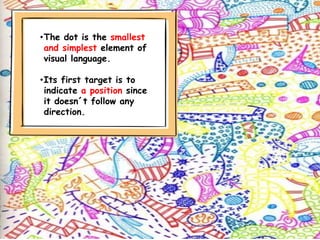
•The dot is the smallest
and simplest element of
visual language.
•Its first target is to
indicate a position since
it doesn´t follow any
direction.
3.Expressive
capacity
of the dot
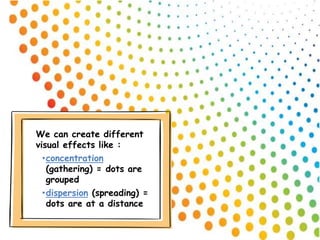
We can create different
visual effects like :
•concentration
(gathering) = dots are
grouped
•dispersion (spreading) =
dots are at a distance
4.Dot´s uses
We can use
dots for:
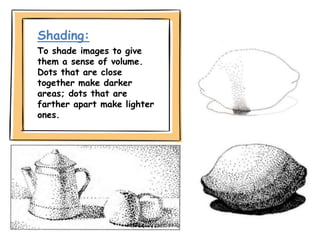
Shading:
To shade images to give
them a sense of volume.
Dots that are close
together make darker
areas; dots that are
farther apart make lighter
ones.
Colouring:
to colour the objects
and figures we
create. A colour is
uniform if the dots
are at an equal
distance from each
other. If the dots
are closer together,
the colour is more
intense than if they
are further apart.
Giving
images a
sense of
depth:
Smaller dots
seem further
away, larger
dots seem
closer.
Producing
and
creating
textures
THE LINE
1.Definition
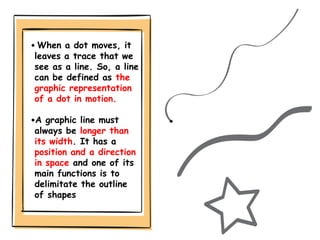
• When a dot moves, it
leaves a trace that we
see as a line. So, a line
can be defined as the
graphic representation
of a dot in motion.
•A graphic line must
always be longer than
its width. It has a
position and a direction
in space and one of its
main functions is to
delimitate the outline
of shapes
2.Types of
lines
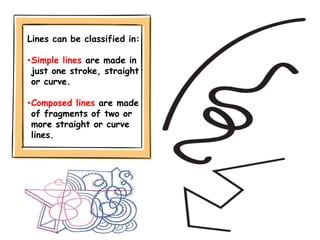
Lines can be classified in:
•Simple lines are made in
just one stroke, straight
or curve.
•Composed lines are made
of fragments of two or
more straight or curve
lines.
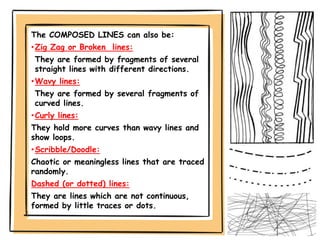
The COMPOSED LINES can also be:
•Zig Zag or Broken lines:
They are formed by fragments of several
straight lines with different directions.
•Wavy lines:
They are formed by several fragments of
curved lines.
•Curly lines:
They hold more curves than wavy lines and
show loops.
•Scribble/Doodle:
Chaotic or meaningless lines that are traced
randomly.
Dashed (or dotted) lines:
They are lines which are not continuous,
formed by little traces or dots.
4.Line´s uses
We can use
lines for:
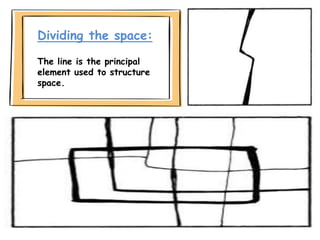
Dividing the space:
The line is the principal
element used to structure
space.
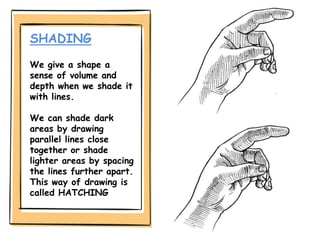
SHADING
We give a shape a
sense of volume and
depth when we shade it
with lines.
We can shade dark
areas by drawing
parallel lines close
together or shade
lighter areas by spacing
the lines further apart.
This way of drawing is
called HATCHING
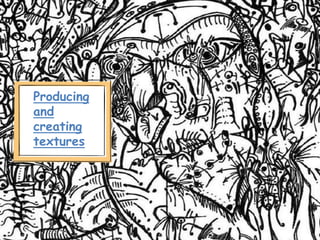
Producing
and
creating
textures
THE SHAPE
1.Definition
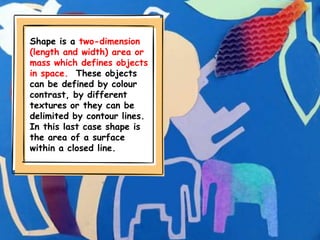
Shape is a two-dimension
(length and width) area or
mass which defines objects
in space. These objects
can be defined by colour
contrast, by different
textures or they can be
delimited by contour lines.
In this last case shape is
the area of a surface
within a closed line.
2.Types of
shapes
GEOMETRIC
AND ORGANIC
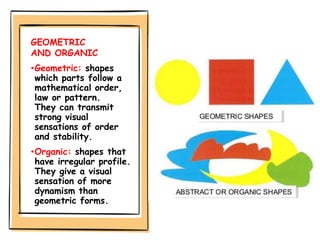
•Geometric: shapes
which parts follow a
mathematical order,
law or pattern.
They can transmit
strong visual
sensations of order
and stability.
•Organic: shapes that
have irregular profile.
They give a visual
sensation of more
dynamism than
geometric forms.
OPEN AND CLOSED
SHAPES
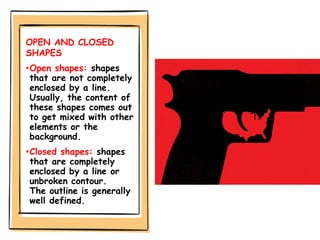
•Open shapes: shapes
that are not completely
enclosed by a line.
Usually, the content of
these shapes comes out
to get mixed with other
elements or the
background.
•Closed shapes: shapes
that are completely
enclosed by a line or
unbroken contour.
The outline is generally
well defined.
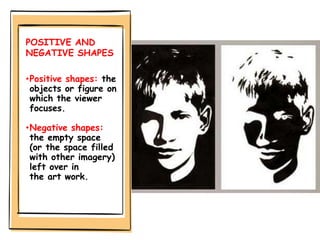
POSITIVE AND
NEGATIVE SHAPES
•Positive shapes: the
objects or figure on
which the viewer
focuses.
•Negative shapes:
the empty space
(or the space filled
with other imagery)
left over in
the art work.
Parts of a
shape
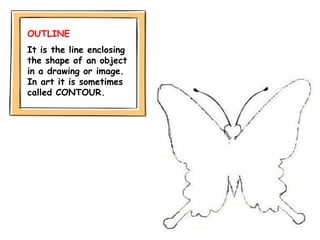
OUTLINE
It is the line enclosing
the shape of an object
in a drawing or image.
In art it is sometimes
called CONTOUR.
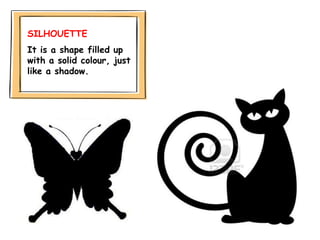
SILHOUETTE
It is a shape filled up
with a solid colour, just
like a shadow.
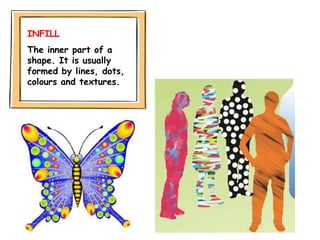
INFILL
The inner part of a
shape. It is usually
formed by lines, dots,
colours and textures.
TEXTURE
1.Definition
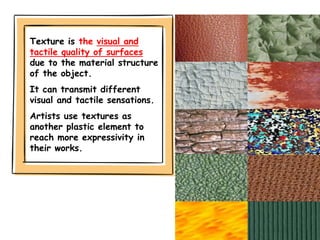
Texture is the visual and
tactile quality of surfaces
due to the material structure
of the object.
It can transmit different
visual and tactile sensations.
Artists use textures as
another plastic element to
reach more expressivity in
their works.
2.Types of
textures according
to their origin
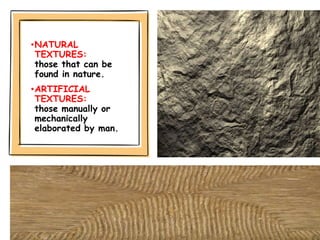
•NATURAL
TEXTURES:
those that can be
found in nature.
•ARTIFICIAL
TEXTURES:
those manually or
mechanically
elaborated by man.
2.Types of
textures according
to their dimension
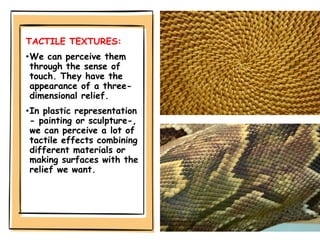
TACTILE TEXTURES:
•We can perceive them
through the sense of
touch. They have the
appearance of a three-
dimensional relief.
•In plastic representation
- painting or sculpture-,
we can perceive a lot of
tactile effects combining
different materials or
making surfaces with the
relief we want.
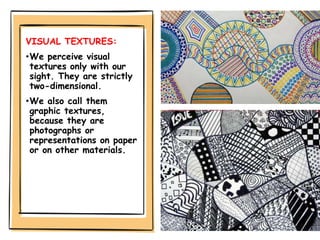
VISUAL TEXTURES:
•We perceive visual
textures only with our
sight. They are strictly
two-dimensional.
•We also call them
graphic textures,
because they are
photographs or
representations on paper
or on other materials.

Basic elements of the visual language

  • 1.
  • 2.
  • 3.
  • 4.
    •The dot isthe smallest and simplest element of visual language. •Its first target is to indicate a position since it doesn´t follow any direction.
  • 5.
  • 6.
    We can createdifferent visual effects like : •concentration (gathering) = dots are grouped •dispersion (spreading) = dots are at a distance
  • 7.
    4.Dot´s uses We canuse dots for:
  • 8.
    Shading: To shade imagesto give them a sense of volume. Dots that are close together make darker areas; dots that are farther apart make lighter ones.
  • 9.
    Colouring: to colour theobjects and figures we create. A colour is uniform if the dots are at an equal distance from each other. If the dots are closer together, the colour is more intense than if they are further apart.
  • 10.
    Giving images a sense of depth: Smallerdots seem further away, larger dots seem closer.
  • 11.
  • 12.
  • 13.
  • 14.
    • When adot moves, it leaves a trace that we see as a line. So, a line can be defined as the graphic representation of a dot in motion. •A graphic line must always be longer than its width. It has a position and a direction in space and one of its main functions is to delimitate the outline of shapes
  • 15.
  • 16.
    Lines can beclassified in: •Simple lines are made in just one stroke, straight or curve. •Composed lines are made of fragments of two or more straight or curve lines.
  • 17.
    The COMPOSED LINEScan also be: •Zig Zag or Broken lines: They are formed by fragments of several straight lines with different directions. •Wavy lines: They are formed by several fragments of curved lines. •Curly lines: They hold more curves than wavy lines and show loops. •Scribble/Doodle: Chaotic or meaningless lines that are traced randomly. Dashed (or dotted) lines: They are lines which are not continuous, formed by little traces or dots.
  • 18.
    4.Line´s uses We canuse lines for:
  • 19.
    Dividing the space: Theline is the principal element used to structure space.
  • 20.
    SHADING We give ashape a sense of volume and depth when we shade it with lines. We can shade dark areas by drawing parallel lines close together or shade lighter areas by spacing the lines further apart. This way of drawing is called HATCHING
  • 21.
  • 22.
  • 23.
  • 24.
    Shape is atwo-dimension (length and width) area or mass which defines objects in space. These objects can be defined by colour contrast, by different textures or they can be delimited by contour lines. In this last case shape is the area of a surface within a closed line.
  • 25.
  • 26.
    GEOMETRIC AND ORGANIC •Geometric: shapes whichparts follow a mathematical order, law or pattern. They can transmit strong visual sensations of order and stability. •Organic: shapes that have irregular profile. They give a visual sensation of more dynamism than geometric forms.
  • 27.
    OPEN AND CLOSED SHAPES •Openshapes: shapes that are not completely enclosed by a line. Usually, the content of these shapes comes out to get mixed with other elements or the background. •Closed shapes: shapes that are completely enclosed by a line or unbroken contour. The outline is generally well defined.
  • 28.
    POSITIVE AND NEGATIVE SHAPES •Positiveshapes: the objects or figure on which the viewer focuses. •Negative shapes: the empty space (or the space filled with other imagery) left over in the art work.
  • 29.
  • 30.
    OUTLINE It is theline enclosing the shape of an object in a drawing or image. In art it is sometimes called CONTOUR.
  • 31.
    SILHOUETTE It is ashape filled up with a solid colour, just like a shadow.
  • 32.
    INFILL The inner partof a shape. It is usually formed by lines, dots, colours and textures.
  • 33.
  • 34.
  • 35.
    Texture is thevisual and tactile quality of surfaces due to the material structure of the object. It can transmit different visual and tactile sensations. Artists use textures as another plastic element to reach more expressivity in their works.
  • 36.
  • 37.
    •NATURAL TEXTURES: those that canbe found in nature. •ARTIFICIAL TEXTURES: those manually or mechanically elaborated by man.
  • 38.
  • 39.
    TACTILE TEXTURES: •We canperceive them through the sense of touch. They have the appearance of a three- dimensional relief. •In plastic representation - painting or sculpture-, we can perceive a lot of tactile effects combining different materials or making surfaces with the relief we want.
  • 40.
    VISUAL TEXTURES: •We perceivevisual textures only with our sight. They are strictly two-dimensional. •We also call them graphic textures, because they are photographs or representations on paper or on other materials.