

Forex Markets &Managing
Risks in Forex Business
Exchange Rate Arithmetic
Exchange Rate
It reflects how much a currency values to another currency. It
is the rate at which one currency is converted in to another
currency.
Exchange rate codes are expressed in 6 letter currency codes.
e. g.; USD/CHF ; GBP/USD; USD/ INR
In the first place : it is base currency code and quotations are
expressed in units of the second currency against one unit of
the first currency.
07/08/13
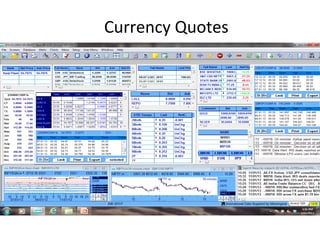
Currency Quotes
07/08/13
Currency Quotes
What are Direct Quotes & Indirect Quotes ?
 Direct Quote : system of expressing exchange rate
for 1 unit of foreign currency in units of home
currency i.e USD/INR = 52.50/52
 Indirect Quote : system of expressing exchange rate
of a unit of local currency in units of foreign currency
i.e EUR/USD = 1.5930/ 35
Currency Quotes-combined Currency
All currencies are valued against the US Dollar.
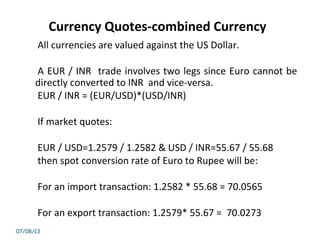
A EUR / INR trade involves two legs since Euro cannot be
directly converted to INR and vice-versa.
EUR / INR = (EUR/USD)*(USD/INR)
If market quotes:
EUR / USD=1.2579 / 1.2582 & USD / INR=55.67 / 55.68
then spot conversion rate of Euro to Rupee will be:
For an import transaction: 1.2582 * 55.68 = 70.0565
For an export transaction: 1.2579* 55.67 = 70.0273
07/08/13
Currency Quotes-combined Currency
CONTD
All currencies are valued against the US Dollar.
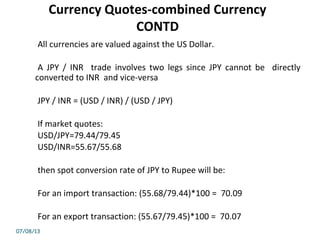
A JPY / INR trade involves two legs since JPY cannot be directly
converted to INR and vice-versa
JPY / INR = (USD / INR) / (USD / JPY)
If market quotes:
USD/JPY=79.44/79.45
USD/INR=55.67/55.68
then spot conversion rate of JPY to Rupee will be:
For an import transaction: (55.68/79.44)*100 = 70.09
For an export transaction: (55.67/79.45)*100 = 70.07
07/08/13
Value Date - Time Scale
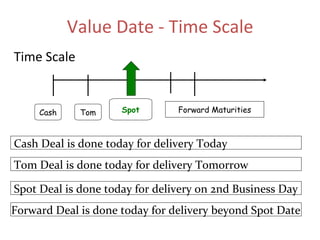
Time Scale
Cash Tom Spot Forward Maturities
Cash Deal is done today for delivery Today
Tom Deal is done today for delivery Tomorrow
Spot Deal is done today for delivery on 2nd Business Day
Forward Deal is done today for delivery beyond Spot Date
Forward Premium/Discount
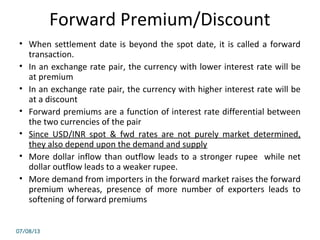
• When settlement date is beyond the spot date, it is called a forward
transaction.
• In an exchange rate pair, the currency with lower interest rate will be
at premium
• In an exchange rate pair, the currency with higher interest rate will be
at a discount
• Forward premiums are a function of interest rate differential between
the two currencies of the pair
• Since USD/INR spot & fwd rates are not purely market determined,
they also depend upon the demand and supply
• More dollar inflow than outflow leads to a stronger rupee while net
dollar outflow leads to a weaker rupee.
• More demand from importers in the forward market raises the forward
premium whereas, presence of more number of exporters leads to
softening of forward premiums
07/08/13
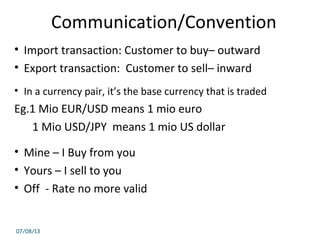
Communication/Convention
• Import transaction: Customer to buy– outward
• Export transaction: Customer to sell– inward
• In a currency pair, it’s the base currency that is traded
Eg.1 Mio EUR/USD means 1 mio euro
1 Mio USD/JPY means 1 mio US dollar
• Mine – I Buy from you
• Yours – I sell to you
• Off - Rate no more valid
07/08/13
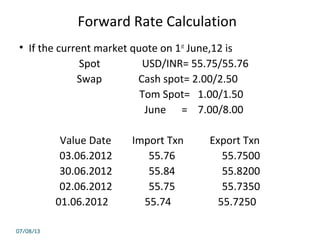
Forward Rate Calculation
• If the current market quote on 1st
June,12 is
Spot USD/INR= 55.75/55.76
Swap Cash spot= 2.00/2.50
Tom Spot= 1.00/1.50
June = 7.00/8.00
Value Date Import Txn Export Txn
03.06.2012 55.76 55.7500
30.06.2012 55.84 55.8200
02.06.2012 55.75 55.7350
01.06.2012 55.74 55.7250
07/08/13
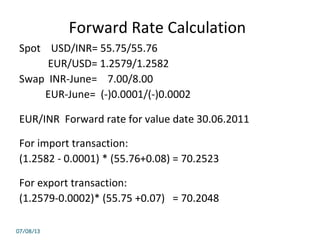
Forward Rate Calculation
Spot USD/INR= 55.75/55.76
EUR/USD= 1.2579/1.2582
Swap INR-June= 7.00/8.00
EUR-June= (-)0.0001/(-)0.0002
EUR/INR Forward rate for value date 30.06.2011
For import transaction:
(1.2582 - 0.0001) * (55.76+0.08) = 70.2523
For export transaction:
(1.2579-0.0002)* (55.75 +0.07) = 70.2048
07/08/13
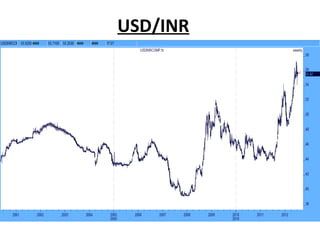
Why need hedging ??
USD/INR
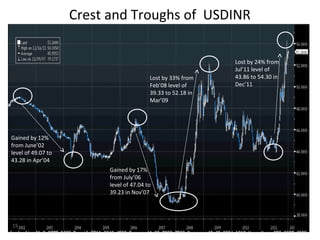
Gained by 12%
from June’02
level of 49.07 to
43.28 in Apr’04
Crest and Troughs of USDINR
Gained by 17%
from July’06
level of 47.04 to
39.23 in Nov’07
Lost by 33% from
Feb’08 level of
39.33 to 52.18 in
Mar’09
Lost by 24% from
Jul’11 level of
43.86 to 54.30 in
Dec’11
15
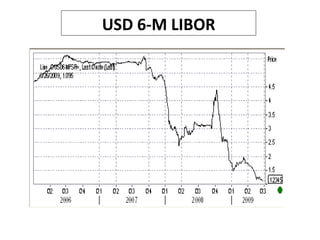
USD 6-M LIBOR
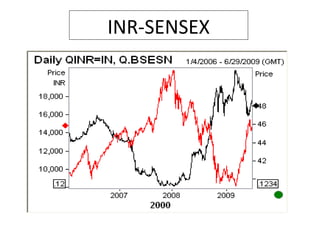
INR-SENSEX
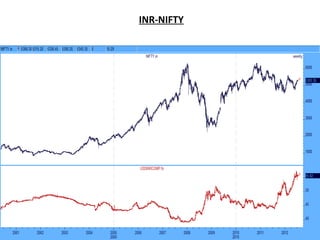
INR-NIFTY
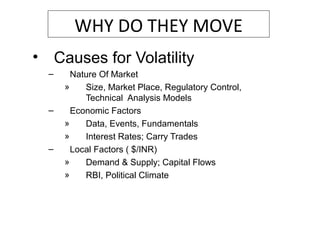
WHY DO THEY MOVE
• Causes for Volatility
– Nature Of Market
» Size, Market Place, Regulatory Control,
Technical Analysis Models
– Economic Factors
» Data, Events, Fundamentals
» Interest Rates; Carry Trades
– Local Factors ( $/INR)
» Demand & Supply; Capital Flows
» RBI, Political Climate
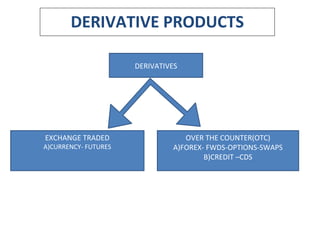
DERIVATIVES
EXCHANGE TRADED
A)CURRENCY- FUTURES
OVER THE COUNTER(OTC)
A)FOREX- FWDS-OPTIONS-SWAPS
B)CREDIT –CDS
DERIVATIVE PRODUCTS
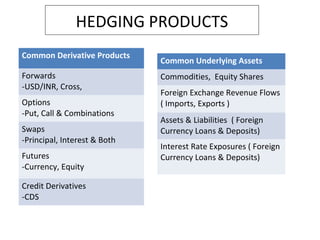
HEDGING PRODUCTS
Common Derivative Products
Forwards
-USD/INR, Cross,
Options
-Put, Call & Combinations
Swaps
-Principal, Interest & Both
Futures
-Currency, Equity
Credit Derivatives
-CDS
Common Underlying Assets
Commodities, Equity Shares
Foreign Exchange Revenue Flows
( Imports, Exports )
Assets & Liabilities ( Foreign
Currency Loans & Deposits)
Interest Rate Exposures ( Foreign
Currency Loans & Deposits)
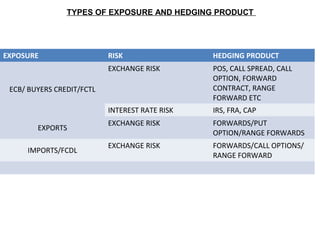
TYPES OF EXPOSURE AND HEDGING PRODUCT
EXPOSURE RISK HEDGING PRODUCT
ECB/ BUYERS CREDIT/FCTL
EXCHANGE RISK POS, CALL SPREAD, CALL
OPTION, FORWARD
CONTRACT, RANGE
FORWARD ETC
INTEREST RATE RISK IRS, FRA, CAP
EXPORTS
EXCHANGE RISK FORWARDS/PUT
OPTION/RANGE FORWARDS
IMPORTS/FCDL
EXCHANGE RISK FORWARDS/CALL OPTIONS/
RANGE FORWARD
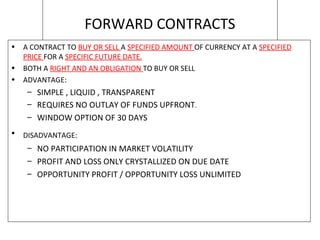
FORWARD CONTRACTS
• A CONTRACT TO BUY OR SELL A SPECIFIED AMOUNT OF CURRENCY AT A SPECIFIED
PRICE FOR A SPECIFIC FUTURE DATE.
• BOTH A RIGHT AND AN OBLIGATION TO BUY OR SELL
• ADVANTAGE:
– SIMPLE , LIQUID , TRANSPARENT
– REQUIRES NO OUTLAY OF FUNDS UPFRONT.
– WINDOW OPTION OF 30 DAYS
• DISADVANTAGE:
– NO PARTICIPATION IN MARKET VOLATILITY
– PROFIT AND LOSS ONLY CRYSTALLIZED ON DUE DATE
– OPPORTUNITY PROFIT / OPPORTUNITY LOSS UNLIMITED
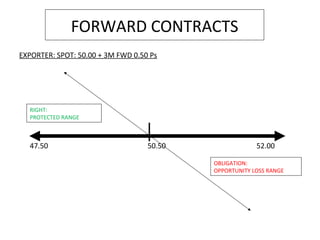
FORWARD CONTRACTS
47.50 52.0050.50
EXPORTER: SPOT: 50.00 + 3M FWD 0.50 Ps
RIGHT:
PROTECTED RANGE
OBLIGATION:
OPPORTUNITY LOSS RANGE
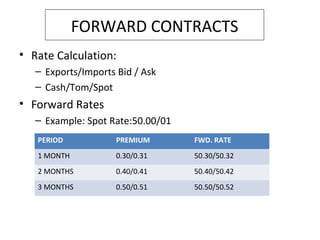
• Rate Calculation:
– Exports/Imports Bid / Ask
– Cash/Tom/Spot
• Forward Rates
– Example: Spot Rate:50.00/01
FORWARD CONTRACTS
PERIOD PREMIUM FWD. RATE
1 MONTH 0.30/0.31 50.30/50.32
2 MONTHS 0.40/0.41 50.40/50.42
3 MONTHS 0.50/0.51 50.50/50.52
OPTIONS
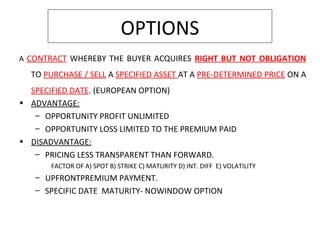
OPTIONS
A CONTRACT WHEREBY THE BUYER ACQUIRES RIGHT BUT NOT OBLIGATION
TO PURCHASE / SELL A SPECIFIED ASSET AT A PRE-DETERMINED PRICE ON A
SPECIFIED DATE. (EUROPEAN OPTION)
• ADVANTAGE:
– OPPORTUNITY PROFIT UNLIMITED
– OPPORTUNITY LOSS LIMITED TO THE PREMIUM PAID
• DISADVANTAGE:
– PRICING LESS TRANSPARENT THAN FORWARD.
FACTOR OF A) SPOT B) STRIKE C) MATURITY D) INT. DIFF E) VOLATILITY
– UPFRONTPREMIUM PAYMENT.
– SPECIFIC DATE MATURITY- NOWINDOW OPTION
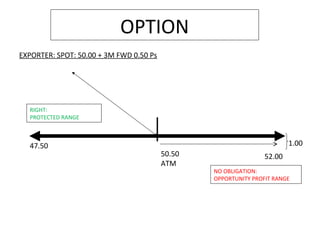
OPTION
47.50
52.0050.50
ATM
1.00
RIGHT:
PROTECTED RANGE
NO OBLIGATION:
OPPORTUNITY PROFIT RANGE
EXPORTER: SPOT: 50.00 + 3M FWD 0.50 Ps
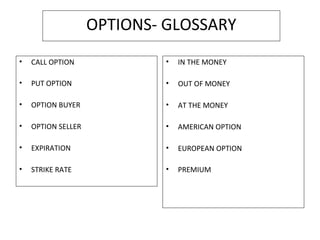
OPTIONS- GLOSSARY
• CALL OPTION
• PUT OPTION
• OPTION BUYER
• OPTION SELLER
• EXPIRATION
• STRIKE RATE
• IN THE MONEY
• OUT OF MONEY
• AT THE MONEY
• AMERICAN OPTION
• EUROPEAN OPTION
• PREMIUM
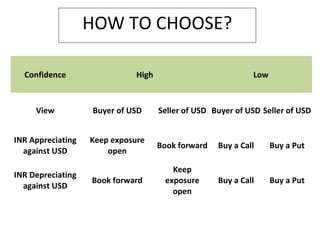
HOW TO CHOOSE?
Confidence High Low
View Buyer of USD Seller of USD Buyer of USD Seller of USD
INR Appreciating
against USD
Keep exposure
open
Book forward Buy a Call Buy a Put
INR Depreciating
against USD
Book forward
Keep
exposure
open
Buy a Call Buy a Put
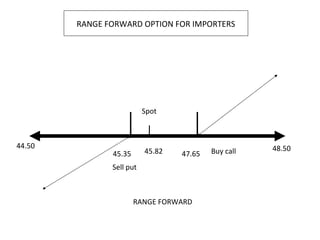
RANGE FORWARD OPTION FOR IMPORTERS
44.50
45.82 48.50
47.65
RANGE FORWARD
45.35
Spot
Sell put
Buy call
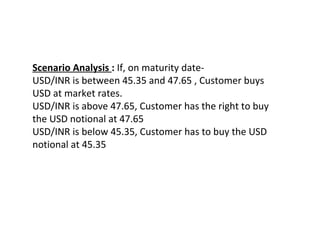
Scenario Analysis : If, on maturity date-
USD/INR is between 45.35 and 47.65 , Customer buys
USD at market rates.
USD/INR is above 47.65, Customer has the right to buy
the USD notional at 47.65
USD/INR is below 45.35, Customer has to buy the USD
notional at 45.35
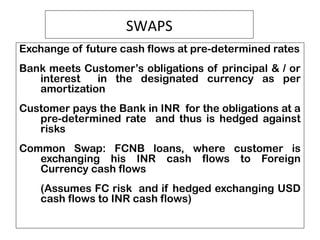
SWAPS
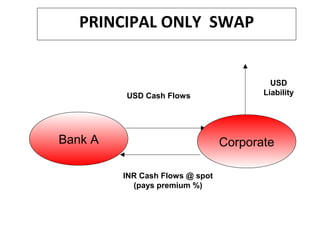
Exchange of future cash flows at pre-determined rates
Bank meets Customer’s obligations of principal & / or
interest in the designated currency as per
amortization
Customer pays the Bank in INR for the obligations at a
pre-determined rate and thus is hedged against
risks
Common Swap: FCNB loans, where customer is
exchanging his INR cash flows to Foreign
Currency cash flows
(Assumes FC risk and if hedged exchanging USD
cash flows to INR cash flows)
Bank A
USD Cash Flows
Corporate
USD
Liability
INR Cash Flows @ spot
(pays premium %)
PRINCIPAL ONLY SWAP
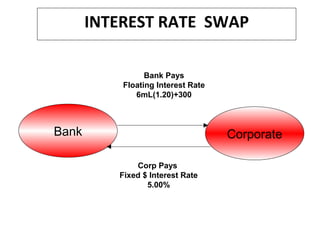
Bank
Bank Pays
Floating Interest Rate
6mL(1.20)+300
Corp Pays
Fixed $ Interest Rate
5.00%
Corporate
INTEREST RATE SWAP
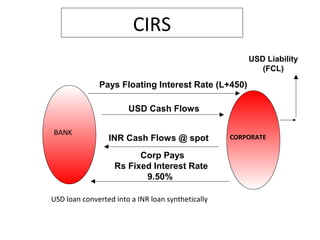
USD Cash Flows
USD Liability
(FCL)
INR Cash Flows @ spot
CIRS
Pays Floating Interest Rate (L+450)
Corp Pays
Rs Fixed Interest Rate
9.50%
BANK
CORPORATE
USD loan converted into a INR loan synthetically
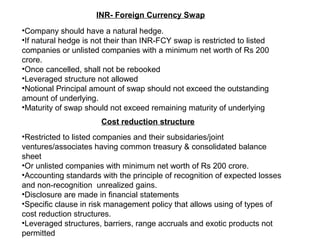
INR- Foreign Currency Swap
•Company should have a natural hedge.
•If natural hedge is not their than INR-FCY swap is restricted to listed
companies or unlisted companies with a minimum net worth of Rs 200
crore.
•Once cancelled, shall not be rebooked
•Leveraged structure not allowed
•Notional Principal amount of swap should not exceed the outstanding
amount of underlying.
•Maturity of swap should not exceed remaining maturity of underlying
Cost reduction structure
•Restricted to listed companies and their subsidaries/joint
ventures/associates having common treasury & consolidated balance
sheet
•Or unlisted companies with minimum net worth of Rs 200 crore.
•Accounting standards with the principle of recognition of expected losses
and non-recognition unrealized gains.
•Disclosure are made in financial statements
•Specific clause in risk management policy that allows using of types of
cost reduction structures.
•Leveraged structures, barriers, range accruals and exotic products not
permitted
Forward Contract & FCY-INR option
Contracted Exposures
•Full particulars of the contracts should be marked on the original documents
under proper authentication , where it is not possible to obtain original
documents, a copy of original documents duly certified may be obtained.
•Maximum period of 15 days may be allowed for production of the underlying
document.
•The Currency , Tenor & maturity of hedge should be in line with underlying
exposure, where currency of hedge is different from currency of underlying
exposure, the risk management policy should permit such hedging
•Exporters are allowed to cancel and rebook 25% of their annual Forward
contracts.
•Long term contracts can be cancelled with one bank and rebooked with
another bank but to be done simultaneously on maturity date.
Past performance :
Cost reduction structure : Companies with net worth of Rs 200 crore and annual
export/ import turnover exceeding Rs 1000 crores may be allowed subject to
satisfying other guidelines in this regard.
•Limit : Import : Limit to be reduced to 25% of eligible limit
•Limit can not be reinstated either on cancellation or on maturity of the contract.
•Forwards booked under this facility should be on fully deliverable basis. In case of
cancellation, exchange gains, if any, should not be passed to customer (both for
exporter & importer)
•Higher limits may be permitted but after approval from RBI.
•Rollovers are also not permitted.
•Contract in excess of 50% of eligible limit may be permitted on obtaining (a)
certificate from statutory auditor of the customer that all guidelines have been
adhered to while utilizing the facility (b) Certificate of import/export turnover of the
customer during past 3 years duly certified by the statutory auditor.
Setting up of Derivative Limit
• Sanctioned limit is a must for any deal
• Total requirements for various types of FCs and derivatives should
be considered.
• May consider total Balance Sheet exposures including exposures of
other banks.
• Separate limits should be calculated for Imports and Exports
• CEL arrived at by applying suitable CCFs
• One limit to be sanctioned for both Contracted and Probable
exposures
Short term (upto 1 year) exposures
Existing units: Average of last three years turnover or last
year’s turnover whichever is higher
Units having orders *} Limits to be assessed based
More than eligibility*} on documentary evidence available.
New units*: A suitable CEL based on CMA
*The limit would be made available on production of documentary
evidence.
Long term (over 1 year) exposures
Only on documentary evidence basis
As per Exchange/Interest exposure in particular maturity slot
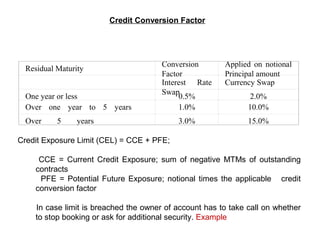
Residual Maturity
Conversion
Factor
Applied on notional
Principal amount
Interest Rate
Swap
Currency Swap
One year or less 0.5% 2.0%
Over one year to 5 years 1.0% 10.0%
Over 5 years 3.0% 15.0%
Credit Conversion Factor
Credit Exposure Limit (CEL) = CCE + PFE;
CCE = Current Credit Exposure; sum of negative MTMs of outstanding
contracts
PFE = Potential Future Exposure; notional times the applicable credit
conversion factor
In case limit is breached the owner of account has to take call on whether
to stop booking or ask for additional security. Example
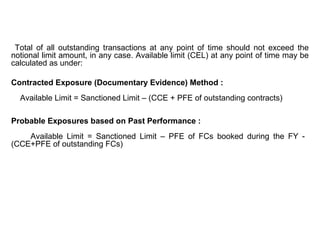
Total of all outstanding transactions at any point of time should not exceed the
notional limit amount, in any case. Available limit (CEL) at any point of time may be
calculated as under:
Contracted Exposure (Documentary Evidence) Method :
Available Limit = Sanctioned Limit – (CCE + PFE of outstanding contracts)
Probable Exposures based on Past Performance :
Available Limit = Sanctioned Limit – PFE of FCs booked during the FY -
(CCE+PFE of outstanding FCs)
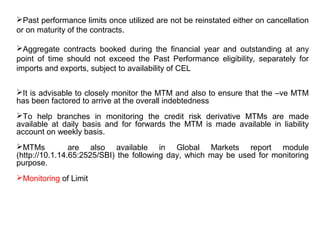
Past performance limits once utilized are not be reinstated either on cancellation
or on maturity of the contracts.
Aggregate contracts booked during the financial year and outstanding at any
point of time should not exceed the Past Performance eligibility, separately for
imports and exports, subject to availability of CEL
It is advisable to closely monitor the MTM and also to ensure that the –ve MTM
has been factored to arrive at the overall indebtedness
To help branches in monitoring the credit risk derivative MTMs are made
available at daily basis and for forwards the MTM is made available in liability
account on weekly basis.
MTMs are also available in Global Markets report module
(http://10.1.14.65:2525/SBI) the following day, which may be used for monitoring
purpose.
Monitoring of Limit
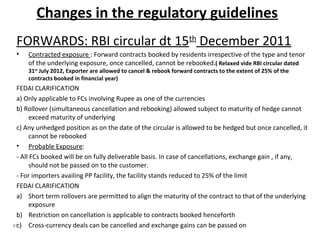
Changes in the regulatory guidelines
FORWARDS: RBI circular dt 15th
December 2011
• Contracted exposure : Forward contracts booked by residents irrespective of the type and tenor
of the underlying exposure, once cancelled, cannot be rebooked.( Relaxed vide RBI circular dated
31st
July 2012, Exporter are allowed to cancel & rebook forward contracts to the extent of 25% of the
contracts booked in financial year)
FEDAI CLARIFICATION
a) Only applicable to FCs involving Rupee as one of the currencies
b) Rollover (simultaneous cancellation and rebooking) allowed subject to maturity of hedge cannot
exceed maturity of underlying
c) Any unhedged position as on the date of the circular is allowed to be hedged but once cancelled, it
cannot be rebooked
• Probable Exposure:
- All FCs booked will be on fully deliverable basis. In case of cancellations, exchange gain , if any,
should not be passed on to the customer.
- For importers availing PP facility, the facility stands reduced to 25% of the limit
FEDAI CLARIFICATION
a) Short term rollovers are permitted to align the maturity of the contract to that of the underlying
exposure
b) Restriction on cancellation is applicable to contracts booked henceforth
c) Cross-currency deals can be cancelled and exchange gains can be passed on45
Changes in the regulatory guidelines
DERIVATIVES: ‘Comprehensive Guidelines on Derivatives’ was modified
by RBI on 2nd
August 2011 and 2nd
November 2011.
The revised guidelines which were applicable from 01st
January 2012 have made
a distinction between generic and structured derivative products.
Following instruments fall under the category of Generic derivative products –
1. Forex Forward Contracts
2. Forward Rate Agreements
3. Interest rate caps and floors (plain vanilla only)
4. Plain Vanilla Options (call option and put option)
5. Interest Rate Swaps
6. Currency Swaps including Cross-Currency Swaps
Structured derivative products have been defined as:
1. Instruments which are combinations of either cash instrument and one or
more generic derivative products.
2. Instruments which are combination of two or more generic derivative
products.
46
Before offering any derivative product to clients, banks should obtain Board
resolution from the corporate which
a) explicitly mentions the limit assigned by the corporate to the bank. While
monitoring this limit, bank would take into account absolute notional amount
of all outstanding derivative contracts entered into by the corporate with the
bank. In other words, notionals of long and short positions will not be netted
for the purpose of compliance with the limit.
b) mentions the names and designation of the officials of the company
authorised to undertake particular derivative transactions on behalf of the
company.
c) specifies the names of the people to whom transactions should be reported by
the bank. These personnel should be distinct from those authorized to
undertake the transactions.
d) mentions the names and designation of person(s) authorised to sign the ISDA
and similar agreements;
e) mentions specific products that can be transacted by the designated officials
named therein.
It should be ensured that the Board resolution submitted by the company is
signed by a person other than the persons authorized to undertake the
transactions.47
Banks are required to obtain Board resolution from the corporate which wants to deal
in structured derivatives products that states the following:
i) The corporate has in place a Risk Management Policy approved by its Board which
contains the following:
• Guidelines on risk identification, measurement and control
• Guidelines and procedures to be followed with respect to revaluation and
monitoring of positions
• Designation of officials authorized to undertake transactions and limits per
transaction assigned to them and a requirement that the assignment of limits to
an official would be on per transaction basis
• Accounting policy and disclosure norms to be followed in respect of derivative
transactions
• A requirement to disclose the MTM valuations appropriately
• A requirement to ensure separation of duties between front, middle and back
office
• Mechanism regarding reporting of data to the Board including financial position of
transaction etc
ii) The corporate has laid down clear guidelines for conducting the transactions and
institutionalised the arrangements for a periodical review of operations and
annual audit of transactions to verify compliance with the regulations.
48
E- Circular No 647/2012-13 on Comprehensive
guidelines on Derivatives
• Branch has to obtain Board resolution from existing / prospective derivative
customer in line with RBI guidelines in this regard vide their circular dated 02nd
Nov 2011
•Concurrent auditor/ authorised official at branch has to certify that the resolution
conforms to the RBI guidelines.
•Relationship Manager to forward the resolution along with concurrent auditor’s
certificate to RTMU(before entering any fresh derivative), who in turn will forward
it to SSB Mumbai.
•At SSB Mumbai the resolution will again be vetted by concurrent auditor.
•Further as a onetime exercise, branch has to get all the available resolution
certified from Branch Concurrent Auditors / authorised officers for all customers
having outstanding derivative contracts as well as all active customers
irrespective of derivative contracts are outstanding or not and forward the same
to RTMU for onward submission to SSB.
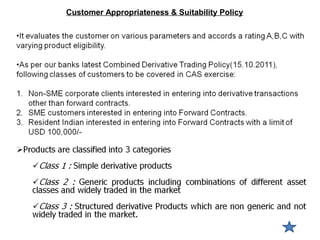
Customer Appropriateness & Suitability Policy
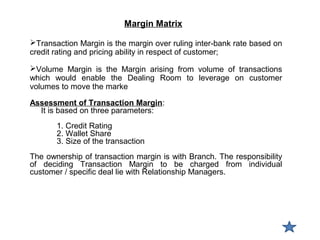
Margin Matrix
Transaction Margin is the margin over ruling inter-bank rate based on
credit rating and pricing ability in respect of customer;
Volume Margin is the Margin arising from volume of transactions
which would enable the Dealing Room to leverage on customer
volumes to move the marke
Assessment of Transaction Margin:
It is based on three parameters:
1. Credit Rating
2. Wallet Share
3. Size of the transaction
The ownership of transaction margin is with Branch. The responsibility
of deciding Transaction Margin to be charged from individual
customer / specific deal lie with Relationship Managers.
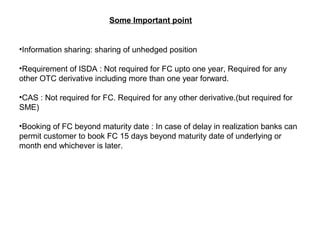
Some Important point
•Information sharing: sharing of unhedged position
•Requirement of ISDA : Not required for FC upto one year, Required for any
other OTC derivative including more than one year forward.
•CAS : Not required for FC. Required for any other derivative.(but required for
SME)
•Booking of FC beyond maturity date : In case of delay in realization banks can
permit customer to book FC 15 days beyond maturity date of underlying or
month end whichever is later.
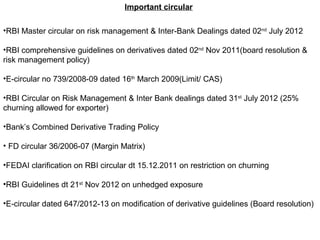
Important circular
•RBI Master circular on risk management & Inter-Bank Dealings dated 02nd
July 2012
•RBI comprehensive guidelines on derivatives dated 02nd
Nov 2011(board resolution &
risk management policy)
•E-circular no 739/2008-09 dated 16th
March 2009(Limit/ CAS)
•RBI Circular on Risk Management & Inter Bank dealings dated 31st
July 2012 (25%
churning allowed for exporter)
•Bank’s Combined Derivative Trading Policy
• FD circular 36/2006-07 (Margin Matrix)
•FEDAI clarification on RBI circular dt 15.12.2011 on restriction on churning
•RBI Guidelines dt 21st
Nov 2012 on unhedged exposure
•E-circular dated 647/2012-13 on modification of derivative guidelines (Board resolution)
THANK YOU
                                                 
54

Forex markets & managing risks in forex business

  • 1.
  • 2.
  • 3.
    Exchange Rate It reflectshow much a currency values to another currency. It is the rate at which one currency is converted in to another currency. Exchange rate codes are expressed in 6 letter currency codes. e. g.; USD/CHF ; GBP/USD; USD/ INR In the first place : it is base currency code and quotations are expressed in units of the second currency against one unit of the first currency. 07/08/13
  • 4.
  • 5.
    Currency Quotes What areDirect Quotes & Indirect Quotes ?  Direct Quote : system of expressing exchange rate for 1 unit of foreign currency in units of home currency i.e USD/INR = 52.50/52  Indirect Quote : system of expressing exchange rate of a unit of local currency in units of foreign currency i.e EUR/USD = 1.5930/ 35
  • 6.
    Currency Quotes-combined Currency Allcurrencies are valued against the US Dollar. A EUR / INR trade involves two legs since Euro cannot be directly converted to INR and vice-versa. EUR / INR = (EUR/USD)*(USD/INR) If market quotes: EUR / USD=1.2579 / 1.2582 & USD / INR=55.67 / 55.68 then spot conversion rate of Euro to Rupee will be: For an import transaction: 1.2582 * 55.68 = 70.0565 For an export transaction: 1.2579* 55.67 = 70.0273 07/08/13
  • 7.
    Currency Quotes-combined Currency CONTD Allcurrencies are valued against the US Dollar. A JPY / INR trade involves two legs since JPY cannot be directly converted to INR and vice-versa JPY / INR = (USD / INR) / (USD / JPY) If market quotes: USD/JPY=79.44/79.45 USD/INR=55.67/55.68 then spot conversion rate of JPY to Rupee will be: For an import transaction: (55.68/79.44)*100 = 70.09 For an export transaction: (55.67/79.45)*100 = 70.07 07/08/13
  • 8.
    Value Date -Time Scale Time Scale Cash Tom Spot Forward Maturities Cash Deal is done today for delivery Today Tom Deal is done today for delivery Tomorrow Spot Deal is done today for delivery on 2nd Business Day Forward Deal is done today for delivery beyond Spot Date
  • 9.
    Forward Premium/Discount • Whensettlement date is beyond the spot date, it is called a forward transaction. • In an exchange rate pair, the currency with lower interest rate will be at premium • In an exchange rate pair, the currency with higher interest rate will be at a discount • Forward premiums are a function of interest rate differential between the two currencies of the pair • Since USD/INR spot & fwd rates are not purely market determined, they also depend upon the demand and supply • More dollar inflow than outflow leads to a stronger rupee while net dollar outflow leads to a weaker rupee. • More demand from importers in the forward market raises the forward premium whereas, presence of more number of exporters leads to softening of forward premiums 07/08/13
  • 10.
    Communication/Convention • Import transaction:Customer to buy– outward • Export transaction: Customer to sell– inward • In a currency pair, it’s the base currency that is traded Eg.1 Mio EUR/USD means 1 mio euro 1 Mio USD/JPY means 1 mio US dollar • Mine – I Buy from you • Yours – I sell to you • Off - Rate no more valid 07/08/13
  • 11.
    Forward Rate Calculation •If the current market quote on 1st June,12 is Spot USD/INR= 55.75/55.76 Swap Cash spot= 2.00/2.50 Tom Spot= 1.00/1.50 June = 7.00/8.00 Value Date Import Txn Export Txn 03.06.2012 55.76 55.7500 30.06.2012 55.84 55.8200 02.06.2012 55.75 55.7350 01.06.2012 55.74 55.7250 07/08/13
  • 12.
    Forward Rate Calculation SpotUSD/INR= 55.75/55.76 EUR/USD= 1.2579/1.2582 Swap INR-June= 7.00/8.00 EUR-June= (-)0.0001/(-)0.0002 EUR/INR Forward rate for value date 30.06.2011 For import transaction: (1.2582 - 0.0001) * (55.76+0.08) = 70.2523 For export transaction: (1.2579-0.0002)* (55.75 +0.07) = 70.2048 07/08/13
  • 13.
  • 14.
  • 15.
    Gained by 12% fromJune’02 level of 49.07 to 43.28 in Apr’04 Crest and Troughs of USDINR Gained by 17% from July’06 level of 47.04 to 39.23 in Nov’07 Lost by 33% from Feb’08 level of 39.33 to 52.18 in Mar’09 Lost by 24% from Jul’11 level of 43.86 to 54.30 in Dec’11 15
  • 16.
  • 17.
  • 18.
  • 19.
    WHY DO THEYMOVE • Causes for Volatility – Nature Of Market » Size, Market Place, Regulatory Control, Technical Analysis Models – Economic Factors » Data, Events, Fundamentals » Interest Rates; Carry Trades – Local Factors ( $/INR) » Demand & Supply; Capital Flows » RBI, Political Climate
  • 20.
    DERIVATIVES EXCHANGE TRADED A)CURRENCY- FUTURES OVERTHE COUNTER(OTC) A)FOREX- FWDS-OPTIONS-SWAPS B)CREDIT –CDS DERIVATIVE PRODUCTS
  • 21.
    HEDGING PRODUCTS Common DerivativeProducts Forwards -USD/INR, Cross, Options -Put, Call & Combinations Swaps -Principal, Interest & Both Futures -Currency, Equity Credit Derivatives -CDS Common Underlying Assets Commodities, Equity Shares Foreign Exchange Revenue Flows ( Imports, Exports ) Assets & Liabilities ( Foreign Currency Loans & Deposits) Interest Rate Exposures ( Foreign Currency Loans & Deposits)
  • 22.
    TYPES OF EXPOSUREAND HEDGING PRODUCT EXPOSURE RISK HEDGING PRODUCT ECB/ BUYERS CREDIT/FCTL EXCHANGE RISK POS, CALL SPREAD, CALL OPTION, FORWARD CONTRACT, RANGE FORWARD ETC INTEREST RATE RISK IRS, FRA, CAP EXPORTS EXCHANGE RISK FORWARDS/PUT OPTION/RANGE FORWARDS IMPORTS/FCDL EXCHANGE RISK FORWARDS/CALL OPTIONS/ RANGE FORWARD
  • 23.
    FORWARD CONTRACTS • ACONTRACT TO BUY OR SELL A SPECIFIED AMOUNT OF CURRENCY AT A SPECIFIED PRICE FOR A SPECIFIC FUTURE DATE. • BOTH A RIGHT AND AN OBLIGATION TO BUY OR SELL • ADVANTAGE: – SIMPLE , LIQUID , TRANSPARENT – REQUIRES NO OUTLAY OF FUNDS UPFRONT. – WINDOW OPTION OF 30 DAYS • DISADVANTAGE: – NO PARTICIPATION IN MARKET VOLATILITY – PROFIT AND LOSS ONLY CRYSTALLIZED ON DUE DATE – OPPORTUNITY PROFIT / OPPORTUNITY LOSS UNLIMITED
  • 24.
    FORWARD CONTRACTS 47.50 52.0050.50 EXPORTER:SPOT: 50.00 + 3M FWD 0.50 Ps RIGHT: PROTECTED RANGE OBLIGATION: OPPORTUNITY LOSS RANGE
  • 25.
    • Rate Calculation: –Exports/Imports Bid / Ask – Cash/Tom/Spot • Forward Rates – Example: Spot Rate:50.00/01 FORWARD CONTRACTS PERIOD PREMIUM FWD. RATE 1 MONTH 0.30/0.31 50.30/50.32 2 MONTHS 0.40/0.41 50.40/50.42 3 MONTHS 0.50/0.51 50.50/50.52
  • 26.
  • 27.
    OPTIONS A CONTRACT WHEREBYTHE BUYER ACQUIRES RIGHT BUT NOT OBLIGATION TO PURCHASE / SELL A SPECIFIED ASSET AT A PRE-DETERMINED PRICE ON A SPECIFIED DATE. (EUROPEAN OPTION) • ADVANTAGE: – OPPORTUNITY PROFIT UNLIMITED – OPPORTUNITY LOSS LIMITED TO THE PREMIUM PAID • DISADVANTAGE: – PRICING LESS TRANSPARENT THAN FORWARD. FACTOR OF A) SPOT B) STRIKE C) MATURITY D) INT. DIFF E) VOLATILITY – UPFRONTPREMIUM PAYMENT. – SPECIFIC DATE MATURITY- NOWINDOW OPTION
  • 28.
  • 29.
    OPTIONS- GLOSSARY • CALLOPTION • PUT OPTION • OPTION BUYER • OPTION SELLER • EXPIRATION • STRIKE RATE • IN THE MONEY • OUT OF MONEY • AT THE MONEY • AMERICAN OPTION • EUROPEAN OPTION • PREMIUM
  • 30.
    HOW TO CHOOSE? ConfidenceHigh Low View Buyer of USD Seller of USD Buyer of USD Seller of USD INR Appreciating against USD Keep exposure open Book forward Buy a Call Buy a Put INR Depreciating against USD Book forward Keep exposure open Buy a Call Buy a Put
  • 31.
    RANGE FORWARD OPTIONFOR IMPORTERS 44.50 45.82 48.50 47.65 RANGE FORWARD 45.35 Spot Sell put Buy call
  • 32.
    Scenario Analysis :If, on maturity date- USD/INR is between 45.35 and 47.65 , Customer buys USD at market rates. USD/INR is above 47.65, Customer has the right to buy the USD notional at 47.65 USD/INR is below 45.35, Customer has to buy the USD notional at 45.35
  • 33.
    SWAPS Exchange of futurecash flows at pre-determined rates Bank meets Customer’s obligations of principal & / or interest in the designated currency as per amortization Customer pays the Bank in INR for the obligations at a pre-determined rate and thus is hedged against risks Common Swap: FCNB loans, where customer is exchanging his INR cash flows to Foreign Currency cash flows (Assumes FC risk and if hedged exchanging USD cash flows to INR cash flows)
  • 34.
    Bank A USD CashFlows Corporate USD Liability INR Cash Flows @ spot (pays premium %) PRINCIPAL ONLY SWAP
  • 35.
    Bank Bank Pays Floating InterestRate 6mL(1.20)+300 Corp Pays Fixed $ Interest Rate 5.00% Corporate INTEREST RATE SWAP
  • 36.
    USD Cash Flows USDLiability (FCL) INR Cash Flows @ spot CIRS Pays Floating Interest Rate (L+450) Corp Pays Rs Fixed Interest Rate 9.50% BANK CORPORATE USD loan converted into a INR loan synthetically
  • 37.
    INR- Foreign CurrencySwap •Company should have a natural hedge. •If natural hedge is not their than INR-FCY swap is restricted to listed companies or unlisted companies with a minimum net worth of Rs 200 crore. •Once cancelled, shall not be rebooked •Leveraged structure not allowed •Notional Principal amount of swap should not exceed the outstanding amount of underlying. •Maturity of swap should not exceed remaining maturity of underlying Cost reduction structure •Restricted to listed companies and their subsidaries/joint ventures/associates having common treasury & consolidated balance sheet •Or unlisted companies with minimum net worth of Rs 200 crore. •Accounting standards with the principle of recognition of expected losses and non-recognition unrealized gains. •Disclosure are made in financial statements •Specific clause in risk management policy that allows using of types of cost reduction structures. •Leveraged structures, barriers, range accruals and exotic products not permitted
  • 38.
    Forward Contract &FCY-INR option Contracted Exposures •Full particulars of the contracts should be marked on the original documents under proper authentication , where it is not possible to obtain original documents, a copy of original documents duly certified may be obtained. •Maximum period of 15 days may be allowed for production of the underlying document. •The Currency , Tenor & maturity of hedge should be in line with underlying exposure, where currency of hedge is different from currency of underlying exposure, the risk management policy should permit such hedging •Exporters are allowed to cancel and rebook 25% of their annual Forward contracts. •Long term contracts can be cancelled with one bank and rebooked with another bank but to be done simultaneously on maturity date.
  • 39.
    Past performance : Costreduction structure : Companies with net worth of Rs 200 crore and annual export/ import turnover exceeding Rs 1000 crores may be allowed subject to satisfying other guidelines in this regard. •Limit : Import : Limit to be reduced to 25% of eligible limit •Limit can not be reinstated either on cancellation or on maturity of the contract. •Forwards booked under this facility should be on fully deliverable basis. In case of cancellation, exchange gains, if any, should not be passed to customer (both for exporter & importer) •Higher limits may be permitted but after approval from RBI. •Rollovers are also not permitted. •Contract in excess of 50% of eligible limit may be permitted on obtaining (a) certificate from statutory auditor of the customer that all guidelines have been adhered to while utilizing the facility (b) Certificate of import/export turnover of the customer during past 3 years duly certified by the statutory auditor.
  • 40.
    Setting up ofDerivative Limit • Sanctioned limit is a must for any deal • Total requirements for various types of FCs and derivatives should be considered. • May consider total Balance Sheet exposures including exposures of other banks. • Separate limits should be calculated for Imports and Exports • CEL arrived at by applying suitable CCFs • One limit to be sanctioned for both Contracted and Probable exposures
  • 41.
    Short term (upto1 year) exposures Existing units: Average of last three years turnover or last year’s turnover whichever is higher Units having orders *} Limits to be assessed based More than eligibility*} on documentary evidence available. New units*: A suitable CEL based on CMA *The limit would be made available on production of documentary evidence. Long term (over 1 year) exposures Only on documentary evidence basis As per Exchange/Interest exposure in particular maturity slot
  • 42.
    Residual Maturity Conversion Factor Applied onnotional Principal amount Interest Rate Swap Currency Swap One year or less 0.5% 2.0% Over one year to 5 years 1.0% 10.0% Over 5 years 3.0% 15.0% Credit Conversion Factor Credit Exposure Limit (CEL) = CCE + PFE; CCE = Current Credit Exposure; sum of negative MTMs of outstanding contracts PFE = Potential Future Exposure; notional times the applicable credit conversion factor In case limit is breached the owner of account has to take call on whether to stop booking or ask for additional security. Example
  • 43.
    Total of alloutstanding transactions at any point of time should not exceed the notional limit amount, in any case. Available limit (CEL) at any point of time may be calculated as under: Contracted Exposure (Documentary Evidence) Method : Available Limit = Sanctioned Limit – (CCE + PFE of outstanding contracts) Probable Exposures based on Past Performance : Available Limit = Sanctioned Limit – PFE of FCs booked during the FY - (CCE+PFE of outstanding FCs)
  • 44.
    Past performance limitsonce utilized are not be reinstated either on cancellation or on maturity of the contracts. Aggregate contracts booked during the financial year and outstanding at any point of time should not exceed the Past Performance eligibility, separately for imports and exports, subject to availability of CEL It is advisable to closely monitor the MTM and also to ensure that the –ve MTM has been factored to arrive at the overall indebtedness To help branches in monitoring the credit risk derivative MTMs are made available at daily basis and for forwards the MTM is made available in liability account on weekly basis. MTMs are also available in Global Markets report module (http://10.1.14.65:2525/SBI) the following day, which may be used for monitoring purpose. Monitoring of Limit
  • 45.
    Changes in theregulatory guidelines FORWARDS: RBI circular dt 15th December 2011 • Contracted exposure : Forward contracts booked by residents irrespective of the type and tenor of the underlying exposure, once cancelled, cannot be rebooked.( Relaxed vide RBI circular dated 31st July 2012, Exporter are allowed to cancel & rebook forward contracts to the extent of 25% of the contracts booked in financial year) FEDAI CLARIFICATION a) Only applicable to FCs involving Rupee as one of the currencies b) Rollover (simultaneous cancellation and rebooking) allowed subject to maturity of hedge cannot exceed maturity of underlying c) Any unhedged position as on the date of the circular is allowed to be hedged but once cancelled, it cannot be rebooked • Probable Exposure: - All FCs booked will be on fully deliverable basis. In case of cancellations, exchange gain , if any, should not be passed on to the customer. - For importers availing PP facility, the facility stands reduced to 25% of the limit FEDAI CLARIFICATION a) Short term rollovers are permitted to align the maturity of the contract to that of the underlying exposure b) Restriction on cancellation is applicable to contracts booked henceforth c) Cross-currency deals can be cancelled and exchange gains can be passed on45
  • 46.
    Changes in theregulatory guidelines DERIVATIVES: ‘Comprehensive Guidelines on Derivatives’ was modified by RBI on 2nd August 2011 and 2nd November 2011. The revised guidelines which were applicable from 01st January 2012 have made a distinction between generic and structured derivative products. Following instruments fall under the category of Generic derivative products – 1. Forex Forward Contracts 2. Forward Rate Agreements 3. Interest rate caps and floors (plain vanilla only) 4. Plain Vanilla Options (call option and put option) 5. Interest Rate Swaps 6. Currency Swaps including Cross-Currency Swaps Structured derivative products have been defined as: 1. Instruments which are combinations of either cash instrument and one or more generic derivative products. 2. Instruments which are combination of two or more generic derivative products. 46
  • 47.
    Before offering anyderivative product to clients, banks should obtain Board resolution from the corporate which a) explicitly mentions the limit assigned by the corporate to the bank. While monitoring this limit, bank would take into account absolute notional amount of all outstanding derivative contracts entered into by the corporate with the bank. In other words, notionals of long and short positions will not be netted for the purpose of compliance with the limit. b) mentions the names and designation of the officials of the company authorised to undertake particular derivative transactions on behalf of the company. c) specifies the names of the people to whom transactions should be reported by the bank. These personnel should be distinct from those authorized to undertake the transactions. d) mentions the names and designation of person(s) authorised to sign the ISDA and similar agreements; e) mentions specific products that can be transacted by the designated officials named therein. It should be ensured that the Board resolution submitted by the company is signed by a person other than the persons authorized to undertake the transactions.47
  • 48.
    Banks are requiredto obtain Board resolution from the corporate which wants to deal in structured derivatives products that states the following: i) The corporate has in place a Risk Management Policy approved by its Board which contains the following: • Guidelines on risk identification, measurement and control • Guidelines and procedures to be followed with respect to revaluation and monitoring of positions • Designation of officials authorized to undertake transactions and limits per transaction assigned to them and a requirement that the assignment of limits to an official would be on per transaction basis • Accounting policy and disclosure norms to be followed in respect of derivative transactions • A requirement to disclose the MTM valuations appropriately • A requirement to ensure separation of duties between front, middle and back office • Mechanism regarding reporting of data to the Board including financial position of transaction etc ii) The corporate has laid down clear guidelines for conducting the transactions and institutionalised the arrangements for a periodical review of operations and annual audit of transactions to verify compliance with the regulations. 48
  • 49.
    E- Circular No647/2012-13 on Comprehensive guidelines on Derivatives • Branch has to obtain Board resolution from existing / prospective derivative customer in line with RBI guidelines in this regard vide their circular dated 02nd Nov 2011 •Concurrent auditor/ authorised official at branch has to certify that the resolution conforms to the RBI guidelines. •Relationship Manager to forward the resolution along with concurrent auditor’s certificate to RTMU(before entering any fresh derivative), who in turn will forward it to SSB Mumbai. •At SSB Mumbai the resolution will again be vetted by concurrent auditor. •Further as a onetime exercise, branch has to get all the available resolution certified from Branch Concurrent Auditors / authorised officers for all customers having outstanding derivative contracts as well as all active customers irrespective of derivative contracts are outstanding or not and forward the same to RTMU for onward submission to SSB.
  • 50.
    Customer Appropriateness &Suitability Policy
  • 51.
    Margin Matrix Transaction Marginis the margin over ruling inter-bank rate based on credit rating and pricing ability in respect of customer; Volume Margin is the Margin arising from volume of transactions which would enable the Dealing Room to leverage on customer volumes to move the marke Assessment of Transaction Margin: It is based on three parameters: 1. Credit Rating 2. Wallet Share 3. Size of the transaction The ownership of transaction margin is with Branch. The responsibility of deciding Transaction Margin to be charged from individual customer / specific deal lie with Relationship Managers.
  • 52.
    Some Important point •Informationsharing: sharing of unhedged position •Requirement of ISDA : Not required for FC upto one year, Required for any other OTC derivative including more than one year forward. •CAS : Not required for FC. Required for any other derivative.(but required for SME) •Booking of FC beyond maturity date : In case of delay in realization banks can permit customer to book FC 15 days beyond maturity date of underlying or month end whichever is later.
  • 53.
    Important circular •RBI Mastercircular on risk management & Inter-Bank Dealings dated 02nd July 2012 •RBI comprehensive guidelines on derivatives dated 02nd Nov 2011(board resolution & risk management policy) •E-circular no 739/2008-09 dated 16th March 2009(Limit/ CAS) •RBI Circular on Risk Management & Inter Bank dealings dated 31st July 2012 (25% churning allowed for exporter) •Bank’s Combined Derivative Trading Policy • FD circular 36/2006-07 (Margin Matrix) •FEDAI clarification on RBI circular dt 15.12.2011 on restriction on churning •RBI Guidelines dt 21st Nov 2012 on unhedged exposure •E-circular dated 647/2012-13 on modification of derivative guidelines (Board resolution)
  • 54.