International Business
Foreign Exchange
Prof Bharat Nadkarni
International Business
Theories for Determining Foreign Exchange Rates
1. Purchasing Power Parity
Purchasing power parity is a theory about exchange rate
determination based on a plain idea that the two currencies
involved in the calculation of the exchange rate have the
same purchasing power for the same good sold in the two
countries.
2. Interest Rate Parity
The determination of exchange rate in a forward market
finds an important place in the theory of Interest Rate
Parity (IRP). The IRP theory states that equilibrium is
achieved when the forward rate differential is approximately
equal to the interest rate differential. In other words, the
forward rate differs from the spot rate by an amount that
represents the interest rate differential. In this process, the
currency of a country with a lower interest rate should be
International Business
at a forward premium in relation to the currency of a
country with a higher interest rate.
• Interest Rate Arbitrage
This is borrowing a currency in one country, transferring in
to another (at spot rate), investing it in the converted
currency, and converting it back to original currency at
forward rate, repaying loan and making profit.
Profit depends upon spot-forward rate and interest rate
difference in two countries.
In perfect market there should not be any arbitrage
opportunity. But in practice such opportunities exist and as
arbitrageurs spot it and use it, these opportunities vanish
and equilibrium is established.
International Business
3. The Fisher effect
According to Fisher, the interest rate has two components
viz., a real return and adjustment for price level changes.
The formula given by Fisher is :
Nominal Interest Rate = Real Interest Rate + Expected
Inflation Rate.
Exchange Rate Systems/ Mechanism
Exchange rate systems can be classified according to the
degree by which exchange rates are controlled by the
government. Exchange rate systems normally fall into three of
the categories, these categories are as follows:
1. Fixed Exchange Rate System
2. Flexible Exchange Rate System
3. Managed Exchange Rate System
International Business
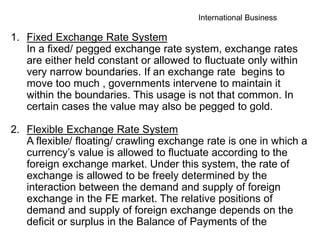
1. Fixed Exchange Rate System
In a fixed/ pegged exchange rate system, exchange rates
are either held constant or allowed to fluctuate only within
very narrow boundaries. If an exchange rate begins to
move too much , governments intervene to maintain it
within the boundaries. This usage is not that common. In
certain cases the value may also be pegged to gold.
2. Flexible Exchange Rate System
A flexible/ floating/ crawling exchange rate is one in which a
currency’s value is allowed to fluctuate according to the
foreign exchange market. Under this system, the rate of
exchange is allowed to be freely determined by the
interaction between the demand and supply of foreign
exchange in the FE market. The relative positions of
demand and supply of foreign exchange depends on the
deficit or surplus in the Balance of Payments of the
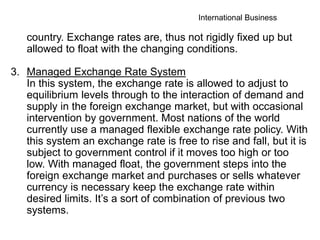
International Business
country. Exchange rates are, thus not rigidly fixed up but
allowed to float with the changing conditions.
3. Managed Exchange Rate System
In this system, the exchange rate is allowed to adjust to
equilibrium levels through to the interaction of demand and
supply in the foreign exchange market, but with occasional
intervention by government. Most nations of the world
currently use a managed flexible exchange rate policy. With
this system an exchange rate is free to rise and fall, but it is
subject to government control if it moves too high or too
low. With managed float, the government steps into the
foreign exchange market and purchases or sells whatever
currency is necessary keep the exchange rate within
desired limits. It’s a sort of combination of previous two
systems.
International Business
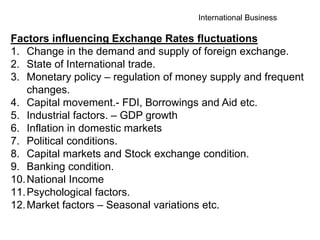
Factors influencing Exchange Rates fluctuations
1. Change in the demand and supply of foreign exchange.
2. State of International trade.
3. Monetary policy – regulation of money supply and frequent
changes.
4. Capital movement.- FDI, Borrowings and Aid etc.
5. Industrial factors. – GDP growth
6. Inflation in domestic markets
7. Political conditions.
8. Capital markets and Stock exchange condition.
9. Banking condition.
10.National Income
11.Psychological factors.
12.Market factors – Seasonal variations etc.
International Business
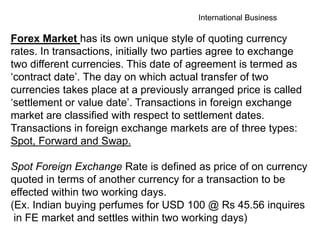
Forex Market has its own unique style of quoting currency
rates. In transactions, initially two parties agree to exchange
two different currencies. This date of agreement is termed as
‘contract date’. The day on which actual transfer of two
currencies takes place at a previously arranged price is called
‘settlement or value date’. Transactions in foreign exchange
market are classified with respect to settlement dates.
Transactions in foreign exchange markets are of three types:
Spot, Forward and Swap.
Spot Foreign Exchange Rate is defined as price of on currency
quoted in terms of another currency for a transaction to be
effected within two working days.
(Ex. Indian buying perfumes for USD 100 @ Rs 45.56 inquires
in FE market and settles within two working days)
International Business
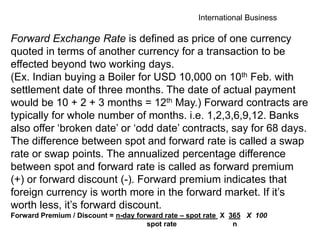
Forward Exchange Rate is defined as price of one currency
quoted in terms of another currency for a transaction to be
effected beyond two working days.
(Ex. Indian buying a Boiler for USD 10,000 on 10th Feb. with
settlement date of three months. The date of actual payment
would be 10 + 2 + 3 months = 12th May.) Forward contracts are
typically for whole number of months. i.e. 1,2,3,6,9,12. Banks
also offer ‘broken date’ or ‘odd date’ contracts, say for 68 days.
The difference between spot and forward rate is called a swap
rate or swap points. The annualized percentage difference
between spot and forward rate is called as forward premium
(+) or forward discount (-). Forward premium indicates that
foreign currency is worth more in the forward market. If it’s
worth less, it’s forward discount.
Forward Premium / Discount = n-day forward rate – spot rate X 365 X 100
spot rate n
International Business
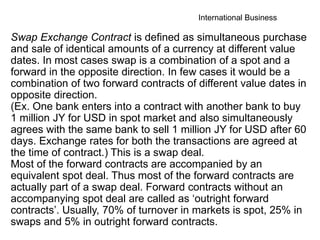
Swap Exchange Contract is defined as simultaneous purchase
and sale of identical amounts of a currency at different value
dates. In most cases swap is a combination of a spot and a
forward in the opposite direction. In few cases it would be a
combination of two forward contracts of different value dates in
opposite direction.
(Ex. One bank enters into a contract with another bank to buy
1 million JY for USD in spot market and also simultaneously
agrees with the same bank to sell 1 million JY for USD after 60
days. Exchange rates for both the transactions are agreed at
the time of contract.) This is a swap deal.
Most of the forward contracts are accompanied by an
equivalent spot deal. Thus most of the forward contracts are
actually part of a swap deal. Forward contracts without an
accompanying spot deal are called as ‘outright forward
contracts’. Usually, 70% of turnover in markets is spot, 25% in
swaps and 5% in outright forward contracts.
International Business
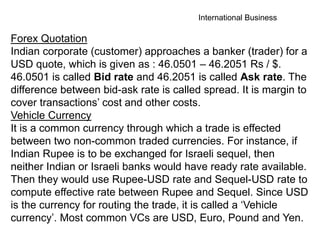
Forex Quotation
Indian corporate (customer) approaches a banker (trader) for a
USD quote, which is given as : 46.0501 – 46.2051 Rs / $.
46.0501 is called Bid rate and 46.2051 is called Ask rate. The
difference between bid-ask rate is called spread. It is margin to
cover transactions’ cost and other costs.
Vehicle Currency
It is a common currency through which a trade is effected
between two non-common traded currencies. For instance, if
Indian Rupee is to be exchanged for Israeli sequel, then
neither Indian or Israeli banks would have ready rate available.
Then they would use Rupee-USD rate and Sequel-USD rate to
compute effective rate between Rupee and Sequel. Since USD
is the currency for routing the trade, it is called a ‘Vehicle
currency’. Most common VCs are USD, Euro, Pound and Yen.
International Business
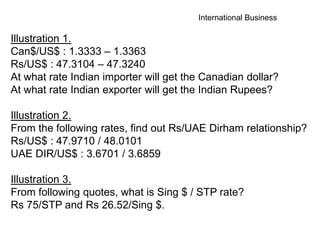
Illustration 1.
Can$/US$ : 1.3333 – 1.3363
Rs/US$ : 47.3104 – 47.3240
At what rate Indian importer will get the Canadian dollar?
At what rate Indian exporter will get the Indian Rupees?
Illustration 2.
From the following rates, find out Rs/UAE Dirham relationship?
Rs/US$ : 47.9710 / 48.0101
UAE DIR/US$ : 3.6701 / 3.6859
Illustration 3.
From following quotes, what is Sing $ / STP rate?
Rs 75/STP and Rs 26.52/Sing $.
International Business
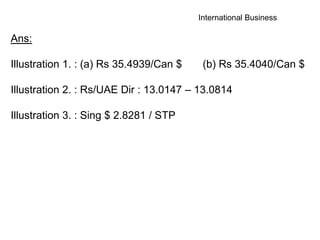
Ans:
Illustration 1. : (a) Rs 35.4939/Can $ (b) Rs 35.4040/Can $
Illustration 2. : Rs/UAE Dir : 13.0147 – 13.0814
Illustration 3. : Sing $ 2.8281 / STP
International Business
Quotations on Forward Markets
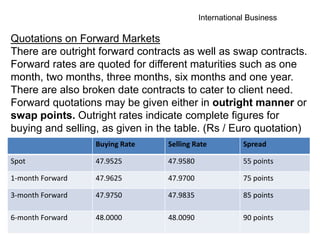
There are outright forward contracts as well as swap contracts.
Forward rates are quoted for different maturities such as one
month, two months, three months, six months and one year.
There are also broken date contracts to cater to client need.
Forward quotations may be given either in outright manner or
swap points. Outright rates indicate complete figures for
buying and selling, as given in the table. (Rs / Euro quotation)
Buying Rate Selling Rate Spread
Spot 47.9525 47.9580 55 points
1-month Forward 47.9625 47.9700 75 points
3-month Forward 47.9750 47.9835 85 points
6-month Forward 48.0000 48.0090 90 points
International Business
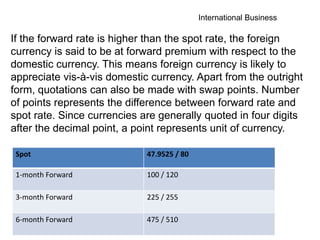
If the forward rate is higher than the spot rate, the foreign
currency is said to be at forward premium with respect to the
domestic currency. This means foreign currency is likely to
appreciate vis-à-vis domestic currency. Apart from the outright
form, quotations can also be made with swap points. Number
of points represents the difference between forward rate and
spot rate. Since currencies are generally quoted in four digits
after the decimal point, a point represents unit of currency.
Spot 47.9525 / 80
1-month Forward 100 / 120
3-month Forward 225 / 255
6-month Forward 475 / 510
International Business
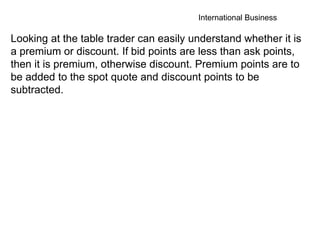
Looking at the table trader can easily understand whether it is
a premium or discount. If bid points are less than ask points,
then it is premium, otherwise discount. Premium points are to
be added to the spot quote and discount points to be
subtracted.
10 forex financial management ppt useful

10 forex financial management ppt useful

  • 1.
  • 2.
    International Business Theories forDetermining Foreign Exchange Rates 1. Purchasing Power Parity Purchasing power parity is a theory about exchange rate determination based on a plain idea that the two currencies involved in the calculation of the exchange rate have the same purchasing power for the same good sold in the two countries. 2. Interest Rate Parity The determination of exchange rate in a forward market finds an important place in the theory of Interest Rate Parity (IRP). The IRP theory states that equilibrium is achieved when the forward rate differential is approximately equal to the interest rate differential. In other words, the forward rate differs from the spot rate by an amount that represents the interest rate differential. In this process, the currency of a country with a lower interest rate should be
  • 3.
    International Business at aforward premium in relation to the currency of a country with a higher interest rate. • Interest Rate Arbitrage This is borrowing a currency in one country, transferring in to another (at spot rate), investing it in the converted currency, and converting it back to original currency at forward rate, repaying loan and making profit. Profit depends upon spot-forward rate and interest rate difference in two countries. In perfect market there should not be any arbitrage opportunity. But in practice such opportunities exist and as arbitrageurs spot it and use it, these opportunities vanish and equilibrium is established.
  • 4.
    International Business 3. TheFisher effect According to Fisher, the interest rate has two components viz., a real return and adjustment for price level changes. The formula given by Fisher is : Nominal Interest Rate = Real Interest Rate + Expected Inflation Rate. Exchange Rate Systems/ Mechanism Exchange rate systems can be classified according to the degree by which exchange rates are controlled by the government. Exchange rate systems normally fall into three of the categories, these categories are as follows: 1. Fixed Exchange Rate System 2. Flexible Exchange Rate System 3. Managed Exchange Rate System
  • 5.
    International Business 1. FixedExchange Rate System In a fixed/ pegged exchange rate system, exchange rates are either held constant or allowed to fluctuate only within very narrow boundaries. If an exchange rate begins to move too much , governments intervene to maintain it within the boundaries. This usage is not that common. In certain cases the value may also be pegged to gold. 2. Flexible Exchange Rate System A flexible/ floating/ crawling exchange rate is one in which a currency’s value is allowed to fluctuate according to the foreign exchange market. Under this system, the rate of exchange is allowed to be freely determined by the interaction between the demand and supply of foreign exchange in the FE market. The relative positions of demand and supply of foreign exchange depends on the deficit or surplus in the Balance of Payments of the
  • 6.
    International Business country. Exchangerates are, thus not rigidly fixed up but allowed to float with the changing conditions. 3. Managed Exchange Rate System In this system, the exchange rate is allowed to adjust to equilibrium levels through to the interaction of demand and supply in the foreign exchange market, but with occasional intervention by government. Most nations of the world currently use a managed flexible exchange rate policy. With this system an exchange rate is free to rise and fall, but it is subject to government control if it moves too high or too low. With managed float, the government steps into the foreign exchange market and purchases or sells whatever currency is necessary keep the exchange rate within desired limits. It’s a sort of combination of previous two systems.
  • 7.
    International Business Factors influencingExchange Rates fluctuations 1. Change in the demand and supply of foreign exchange. 2. State of International trade. 3. Monetary policy – regulation of money supply and frequent changes. 4. Capital movement.- FDI, Borrowings and Aid etc. 5. Industrial factors. – GDP growth 6. Inflation in domestic markets 7. Political conditions. 8. Capital markets and Stock exchange condition. 9. Banking condition. 10.National Income 11.Psychological factors. 12.Market factors – Seasonal variations etc.
  • 8.
    International Business Forex Markethas its own unique style of quoting currency rates. In transactions, initially two parties agree to exchange two different currencies. This date of agreement is termed as ‘contract date’. The day on which actual transfer of two currencies takes place at a previously arranged price is called ‘settlement or value date’. Transactions in foreign exchange market are classified with respect to settlement dates. Transactions in foreign exchange markets are of three types: Spot, Forward and Swap. Spot Foreign Exchange Rate is defined as price of on currency quoted in terms of another currency for a transaction to be effected within two working days. (Ex. Indian buying perfumes for USD 100 @ Rs 45.56 inquires in FE market and settles within two working days)
  • 9.
    International Business Forward ExchangeRate is defined as price of one currency quoted in terms of another currency for a transaction to be effected beyond two working days. (Ex. Indian buying a Boiler for USD 10,000 on 10th Feb. with settlement date of three months. The date of actual payment would be 10 + 2 + 3 months = 12th May.) Forward contracts are typically for whole number of months. i.e. 1,2,3,6,9,12. Banks also offer ‘broken date’ or ‘odd date’ contracts, say for 68 days. The difference between spot and forward rate is called a swap rate or swap points. The annualized percentage difference between spot and forward rate is called as forward premium (+) or forward discount (-). Forward premium indicates that foreign currency is worth more in the forward market. If it’s worth less, it’s forward discount. Forward Premium / Discount = n-day forward rate – spot rate X 365 X 100 spot rate n
  • 10.
    International Business Swap ExchangeContract is defined as simultaneous purchase and sale of identical amounts of a currency at different value dates. In most cases swap is a combination of a spot and a forward in the opposite direction. In few cases it would be a combination of two forward contracts of different value dates in opposite direction. (Ex. One bank enters into a contract with another bank to buy 1 million JY for USD in spot market and also simultaneously agrees with the same bank to sell 1 million JY for USD after 60 days. Exchange rates for both the transactions are agreed at the time of contract.) This is a swap deal. Most of the forward contracts are accompanied by an equivalent spot deal. Thus most of the forward contracts are actually part of a swap deal. Forward contracts without an accompanying spot deal are called as ‘outright forward contracts’. Usually, 70% of turnover in markets is spot, 25% in swaps and 5% in outright forward contracts.
  • 11.
    International Business Forex Quotation Indiancorporate (customer) approaches a banker (trader) for a USD quote, which is given as : 46.0501 – 46.2051 Rs / $. 46.0501 is called Bid rate and 46.2051 is called Ask rate. The difference between bid-ask rate is called spread. It is margin to cover transactions’ cost and other costs. Vehicle Currency It is a common currency through which a trade is effected between two non-common traded currencies. For instance, if Indian Rupee is to be exchanged for Israeli sequel, then neither Indian or Israeli banks would have ready rate available. Then they would use Rupee-USD rate and Sequel-USD rate to compute effective rate between Rupee and Sequel. Since USD is the currency for routing the trade, it is called a ‘Vehicle currency’. Most common VCs are USD, Euro, Pound and Yen.
  • 12.
    International Business Illustration 1. Can$/US$: 1.3333 – 1.3363 Rs/US$ : 47.3104 – 47.3240 At what rate Indian importer will get the Canadian dollar? At what rate Indian exporter will get the Indian Rupees? Illustration 2. From the following rates, find out Rs/UAE Dirham relationship? Rs/US$ : 47.9710 / 48.0101 UAE DIR/US$ : 3.6701 / 3.6859 Illustration 3. From following quotes, what is Sing $ / STP rate? Rs 75/STP and Rs 26.52/Sing $.
  • 13.
    International Business Ans: Illustration 1.: (a) Rs 35.4939/Can $ (b) Rs 35.4040/Can $ Illustration 2. : Rs/UAE Dir : 13.0147 – 13.0814 Illustration 3. : Sing $ 2.8281 / STP
  • 14.
    International Business Quotations onForward Markets There are outright forward contracts as well as swap contracts. Forward rates are quoted for different maturities such as one month, two months, three months, six months and one year. There are also broken date contracts to cater to client need. Forward quotations may be given either in outright manner or swap points. Outright rates indicate complete figures for buying and selling, as given in the table. (Rs / Euro quotation) Buying Rate Selling Rate Spread Spot 47.9525 47.9580 55 points 1-month Forward 47.9625 47.9700 75 points 3-month Forward 47.9750 47.9835 85 points 6-month Forward 48.0000 48.0090 90 points
  • 15.
    International Business If theforward rate is higher than the spot rate, the foreign currency is said to be at forward premium with respect to the domestic currency. This means foreign currency is likely to appreciate vis-à-vis domestic currency. Apart from the outright form, quotations can also be made with swap points. Number of points represents the difference between forward rate and spot rate. Since currencies are generally quoted in four digits after the decimal point, a point represents unit of currency. Spot 47.9525 / 80 1-month Forward 100 / 120 3-month Forward 225 / 255 6-month Forward 475 / 510
  • 16.
    International Business Looking atthe table trader can easily understand whether it is a premium or discount. If bid points are less than ask points, then it is premium, otherwise discount. Premium points are to be added to the spot quote and discount points to be subtracted.