Forests, Trees and Agroforestry
Lima
25 May 2016
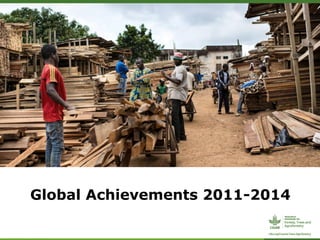
Global Achievements 2011-2014
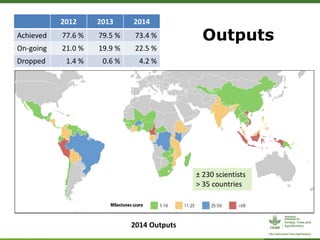
Outputs
2014 Outputs
2012 2013 2014
Achieved 77.6 % 79.5 % 73.4 %
On-going 21.0 % 19.9 % 22.5 %
Dropped 1.4 % 0.6 % 4.2 %
± 230 scientists
> 35 countries
• Around 10 M people benefiting of improved livelihoods thanks to
FTA research
• More than 140 Mt CO2eq of avoided emissions in Latin America
and the Congo Basin
• Around 15 M ha of forests and agroforests better and more
sustainably managed in the tropics
• Policy influences and changes (IPCC guidelines, FLEGT-VPA,
national policies in Indonesia, Peru, Cameroon…)
FTA outcomes & impacts today
• Spatial data and monitoring
• Terra-I (http://www.terra-i.org/terra-i.html)
• ICRAF Landscape portal (http://landscapeportal.org/)
• CIFOR spatial data portal (http://www.cgiar-csi.org/portfolio-items/forests-of-borneo)
• Networks
• Sentinel Landscapes (http://www1.cifor.org/sentinel-landscapes/home.html)
• Poverty and Environment Network (http://www1.cifor.org/pen)
• Tropical managed forests observatory (http://tmfo.org)
• Data repositories (Dataverse)
• FTA (http://thedata.harvard.edu/dvn/dv/crp6/faces/StudyListingPage.xhtml?mode=1&collectionId=3524)
• CIFOR (http://data.cifor.org/dvn/)
• ICRAF (https://thedata.harvard.edu/dvn/dv/icraf)
Open Data Platforms
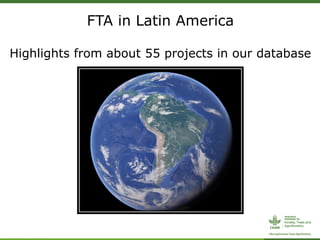
FTA in Latin America
Highlights from about 55 projects in our database
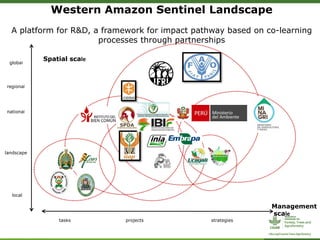
Western Amazon Sentinel Landscape
A platform for R&D, a framework for impact pathway based on co-learning
processes through partnerships
global
regional
national
landscape
local
tasks projects strategies
Spatial scale
Management
scale
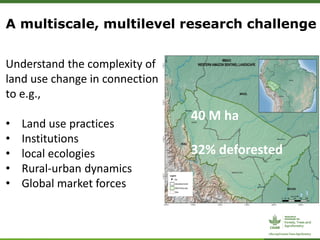
Understand the complexity of
land use change in connection
to e.g.,
• Land use practices
• Institutions
• local ecologies
• Rural-urban dynamics
• Global market forces
A multiscale, multilevel research challenge
40 M ha
32% deforested
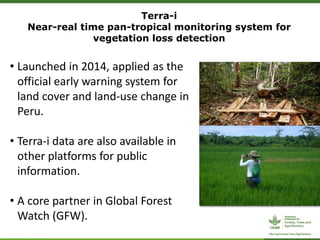
Terra-i
Near-real time pan-tropical monitoring system for
vegetation loss detection
• Launched in 2014, applied as the
official early warning system for
land cover and land-use change in
Peru.
• Terra-i data are also available in
other platforms for public
information.
• A core partner in Global Forest
Watch (GFW).
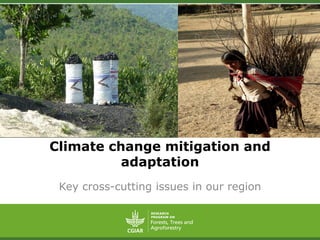
Climate change mitigation and
adaptation
Key cross-cutting issues in our region
Support to mitigation policy in Peru
• Scientific and technical backstopping to Ministry of
Agriculture and multistakeholder dialogue facilitation
• iNAMAzonia: Formulation of Nationally Appropriate
Mitigation Actions (NAMA) for cash crops under a landscape
approach
• Low Carbon and Resilient Coffee: Design of the COFFEE-
NAMA and technological packages based on co-learning
with the private sector
• Decision making in the cocoa sector on sustainable
intensification and links to potential carbon markets
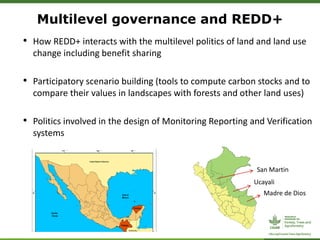
Multilevel governance and REDD+
• How REDD+ interacts with the multilevel politics of land and land use
change including benefit sharing
• Participatory scenario building (tools to compute carbon stocks and to
compare their values in landscapes with forests and other land uses)
• Politics involved in the design of Monitoring Reporting and Verification
systems
San Martin
Ucayali
Madre de Dios
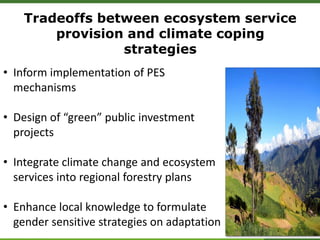
Tradeoffs between ecosystem service
provision and climate coping
strategies
• Inform implementation of PES
mechanisms
• Design of “green” public investment
projects
• Integrate climate change and ecosystem
services into regional forestry plans
• Enhance local knowledge to formulate
gender sensitive strategies on adaptation
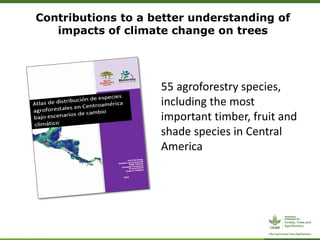
Contributions to a better understanding of
impacts of climate change on trees
55 agroforestry species,
including the most
important timber, fruit and
shade species in Central
America
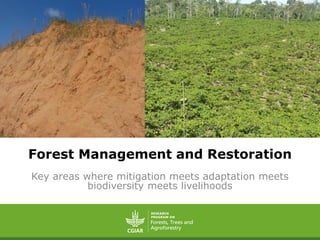
Forest Management and Restoration
Key areas where mitigation meets adaptation meets
biodiversity meets livelihoods
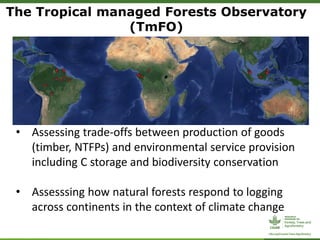
The Tropical managed Forests Observatory
(TmFO)
• Assessing trade-offs between production of goods
(timber, NTFPs) and environmental service provision
including C storage and biodiversity conservation
• Assesssing how natural forests respond to logging
across continents in the context of climate change
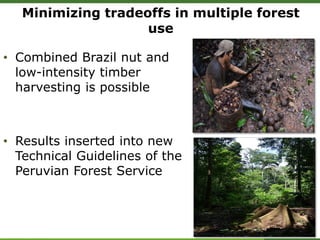
Minimizing tradeoffs in multiple forest
use
• Combined Brazil nut and
low-intensity timber
harvesting is possible
• Results inserted into new
Technical Guidelines of the
Peruvian Forest Service
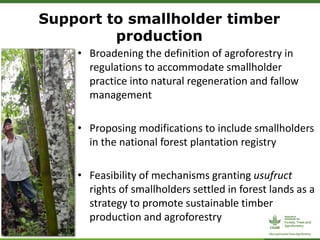
Support to smallholder timber
production
• Broadening the definition of agroforestry in
regulations to accommodate smallholder
practice into natural regeneration and fallow
management
• Proposing modifications to include smallholders
in the national forest plantation registry
• Feasibility of mechanisms granting usufruct
rights of smallholders settled in forest lands as a
strategy to promote sustainable timber
production and agroforestry
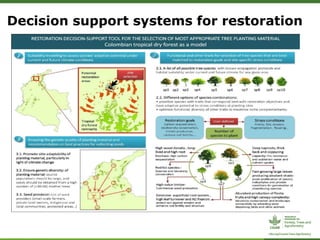
Decision support systems for restoration
Supporting Development of National
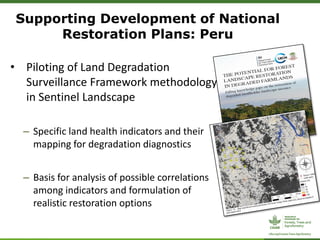
Restoration Plans: Peru
• Piloting of Land Degradation
Surveillance Framework methodology
in Sentinel Landscape
– Specific land health indicators and their
mapping for degradation diagnostics
– Basis for analysis of possible correlations
among indicators and formulation of
realistic restoration options
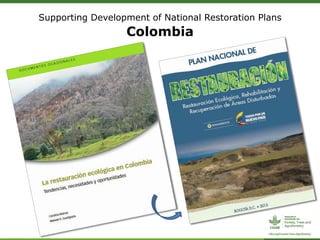
Supporting Development of National Restoration Plans
Colombia
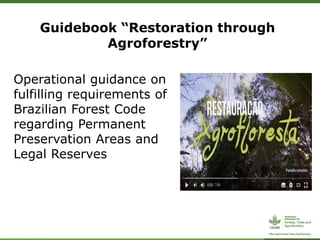
Guidebook “Restoration through
Agroforestry”
Operational guidance on
fulfilling requirements of
Brazilian Forest Code
regarding Permanent
Preservation Areas and
Legal Reserves
Tree genetic resources
Fundamental in adaptation, mitigation, restoration
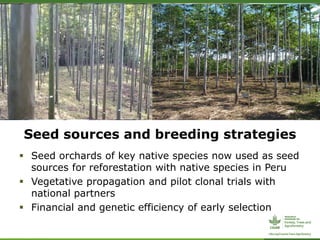
Seed sources and breeding strategies
 Seed orchards of key native species now used as seed
sources for reforestation with native species in Peru
 Vegetative propagation and pilot clonal trials with
national partners
 Financial and genetic efficiency of early selection
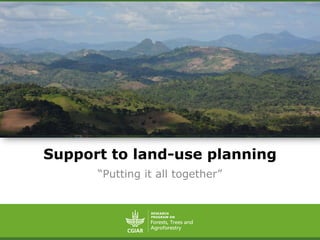
Support to land-use planning
“Putting it all together”
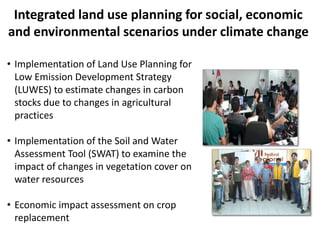
• Implementation of Land Use Planning for
Low Emission Development Strategy
(LUWES) to estimate changes in carbon
stocks due to changes in agricultural
practices
• Implementation of the Soil and Water
Assessment Tool (SWAT) to examine the
impact of changes in vegetation cover on
water resources
• Economic impact assessment on crop
replacement
Integrated land use planning for social, economic
and environmental scenarios under climate change
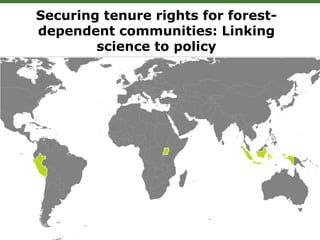
Securing tenure rights for forest-
dependent communities: Linking
science to policy
 Increased awareness of
the factors that constrain
reforms with on-the-
ground customary systems
and stronger collective
tenure rights in and
around forests
 Enhanced skills in tenure
reform implementation by
researchers, practitioners,
and government agencies
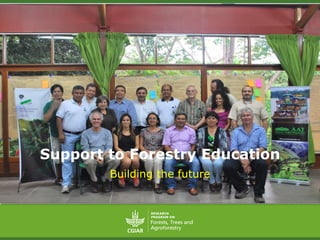
Support to Forestry Education
Building the future
“Toward the modernization of forestry
curricula in the American Tropics: a
modular approach”
• Undergraduate level
• Teaching materials for professors
• Topics not often taught in forestry programs
• Tools for active teaching
• Open-access
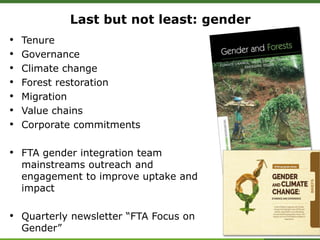
Last but not least: gender
• Tenure
• Governance
• Climate change
• Forest restoration
• Migration
• Value chains
• Corporate commitments
• FTA gender integration team
mainstreams outreach and
engagement to improve uptake and
impact
• Quarterly newsletter “FTA Focus on
Gender”
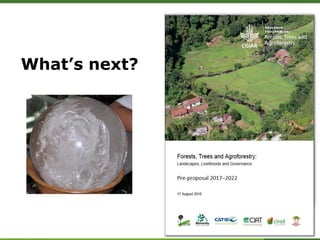
What’s next?
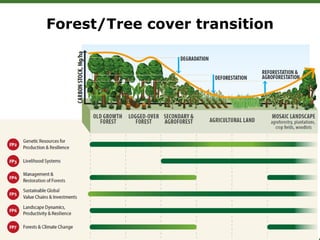
Forest/Tree cover transition
How did we fare?
B
B
B
B
B
B B B
C
C
C
C “The [FTA] pre-proposal is
well written, compelling and
shows clear evidence of
improvement on Phase I”
“The research program
appears a more coherent
whole“
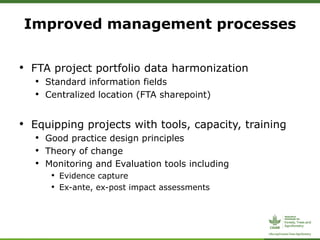
• FTA project portfolio data harmonization
• Standard information fields
• Centralized location (FTA sharepoint)
• Equipping projects with tools, capacity, training
• Good practice design principles
• Theory of change
• Monitoring and Evaluation tools including
• Evidence capture
• Ex-ante, ex-post impact assessments
Improved management processes
http://foreststreesagroforestry.org/

Forest, Trees and Agroforestry - Manuel Guariguata

  • 1.
    Forests, Trees andAgroforestry Lima 25 May 2016
  • 2.
  • 3.
    Outputs 2014 Outputs 2012 20132014 Achieved 77.6 % 79.5 % 73.4 % On-going 21.0 % 19.9 % 22.5 % Dropped 1.4 % 0.6 % 4.2 % ± 230 scientists > 35 countries
  • 4.
    • Around 10M people benefiting of improved livelihoods thanks to FTA research • More than 140 Mt CO2eq of avoided emissions in Latin America and the Congo Basin • Around 15 M ha of forests and agroforests better and more sustainably managed in the tropics • Policy influences and changes (IPCC guidelines, FLEGT-VPA, national policies in Indonesia, Peru, Cameroon…) FTA outcomes & impacts today
  • 5.
    • Spatial dataand monitoring • Terra-I (http://www.terra-i.org/terra-i.html) • ICRAF Landscape portal (http://landscapeportal.org/) • CIFOR spatial data portal (http://www.cgiar-csi.org/portfolio-items/forests-of-borneo) • Networks • Sentinel Landscapes (http://www1.cifor.org/sentinel-landscapes/home.html) • Poverty and Environment Network (http://www1.cifor.org/pen) • Tropical managed forests observatory (http://tmfo.org) • Data repositories (Dataverse) • FTA (http://thedata.harvard.edu/dvn/dv/crp6/faces/StudyListingPage.xhtml?mode=1&collectionId=3524) • CIFOR (http://data.cifor.org/dvn/) • ICRAF (https://thedata.harvard.edu/dvn/dv/icraf) Open Data Platforms
  • 6.
    FTA in LatinAmerica Highlights from about 55 projects in our database
  • 7.
    Western Amazon SentinelLandscape A platform for R&D, a framework for impact pathway based on co-learning processes through partnerships global regional national landscape local tasks projects strategies Spatial scale Management scale
  • 8.
    Understand the complexityof land use change in connection to e.g., • Land use practices • Institutions • local ecologies • Rural-urban dynamics • Global market forces A multiscale, multilevel research challenge 40 M ha 32% deforested
  • 9.
    Terra-i Near-real time pan-tropicalmonitoring system for vegetation loss detection • Launched in 2014, applied as the official early warning system for land cover and land-use change in Peru. • Terra-i data are also available in other platforms for public information. • A core partner in Global Forest Watch (GFW).
  • 10.
    Climate change mitigationand adaptation Key cross-cutting issues in our region
  • 11.
    Support to mitigationpolicy in Peru • Scientific and technical backstopping to Ministry of Agriculture and multistakeholder dialogue facilitation • iNAMAzonia: Formulation of Nationally Appropriate Mitigation Actions (NAMA) for cash crops under a landscape approach • Low Carbon and Resilient Coffee: Design of the COFFEE- NAMA and technological packages based on co-learning with the private sector • Decision making in the cocoa sector on sustainable intensification and links to potential carbon markets
  • 12.
    Multilevel governance andREDD+ • How REDD+ interacts with the multilevel politics of land and land use change including benefit sharing • Participatory scenario building (tools to compute carbon stocks and to compare their values in landscapes with forests and other land uses) • Politics involved in the design of Monitoring Reporting and Verification systems San Martin Ucayali Madre de Dios
  • 13.
    Tradeoffs between ecosystemservice provision and climate coping strategies • Inform implementation of PES mechanisms • Design of “green” public investment projects • Integrate climate change and ecosystem services into regional forestry plans • Enhance local knowledge to formulate gender sensitive strategies on adaptation
  • 14.
    Contributions to abetter understanding of impacts of climate change on trees 55 agroforestry species, including the most important timber, fruit and shade species in Central America
  • 15.
    Forest Management andRestoration Key areas where mitigation meets adaptation meets biodiversity meets livelihoods
  • 16.
    The Tropical managedForests Observatory (TmFO) • Assessing trade-offs between production of goods (timber, NTFPs) and environmental service provision including C storage and biodiversity conservation • Assesssing how natural forests respond to logging across continents in the context of climate change
  • 17.
    Minimizing tradeoffs inmultiple forest use • Combined Brazil nut and low-intensity timber harvesting is possible • Results inserted into new Technical Guidelines of the Peruvian Forest Service
  • 18.
    Support to smallholdertimber production • Broadening the definition of agroforestry in regulations to accommodate smallholder practice into natural regeneration and fallow management • Proposing modifications to include smallholders in the national forest plantation registry • Feasibility of mechanisms granting usufruct rights of smallholders settled in forest lands as a strategy to promote sustainable timber production and agroforestry
  • 19.
    Decision support systemsfor restoration
  • 20.
    Supporting Development ofNational Restoration Plans: Peru • Piloting of Land Degradation Surveillance Framework methodology in Sentinel Landscape – Specific land health indicators and their mapping for degradation diagnostics – Basis for analysis of possible correlations among indicators and formulation of realistic restoration options
  • 21.
    Supporting Development ofNational Restoration Plans Colombia
  • 22.
    Guidebook “Restoration through Agroforestry” Operationalguidance on fulfilling requirements of Brazilian Forest Code regarding Permanent Preservation Areas and Legal Reserves
  • 23.
    Tree genetic resources Fundamentalin adaptation, mitigation, restoration
  • 25.
    Seed sources andbreeding strategies  Seed orchards of key native species now used as seed sources for reforestation with native species in Peru  Vegetative propagation and pilot clonal trials with national partners  Financial and genetic efficiency of early selection
  • 26.
    Support to land-useplanning “Putting it all together”
  • 27.
    • Implementation ofLand Use Planning for Low Emission Development Strategy (LUWES) to estimate changes in carbon stocks due to changes in agricultural practices • Implementation of the Soil and Water Assessment Tool (SWAT) to examine the impact of changes in vegetation cover on water resources • Economic impact assessment on crop replacement Integrated land use planning for social, economic and environmental scenarios under climate change
  • 28.
    Securing tenure rightsfor forest- dependent communities: Linking science to policy  Increased awareness of the factors that constrain reforms with on-the- ground customary systems and stronger collective tenure rights in and around forests  Enhanced skills in tenure reform implementation by researchers, practitioners, and government agencies
  • 29.
    Support to ForestryEducation Building the future
  • 30.
    “Toward the modernizationof forestry curricula in the American Tropics: a modular approach” • Undergraduate level • Teaching materials for professors • Topics not often taught in forestry programs • Tools for active teaching • Open-access
  • 31.
    Last but notleast: gender • Tenure • Governance • Climate change • Forest restoration • Migration • Value chains • Corporate commitments • FTA gender integration team mainstreams outreach and engagement to improve uptake and impact • Quarterly newsletter “FTA Focus on Gender”
  • 32.
  • 33.
  • 34.
    How did wefare? B B B B B B B B C C C C “The [FTA] pre-proposal is well written, compelling and shows clear evidence of improvement on Phase I” “The research program appears a more coherent whole“
  • 35.
    • FTA projectportfolio data harmonization • Standard information fields • Centralized location (FTA sharepoint) • Equipping projects with tools, capacity, training • Good practice design principles • Theory of change • Monitoring and Evaluation tools including • Evidence capture • Ex-ante, ex-post impact assessments Improved management processes
  • 36.