Strategic foresight:
Long-term projections from
IFPRI, GFSF and AgMIP
Keith Wiebe, IFPRI and GFSF
ISPC, Rome, 16 September 2015
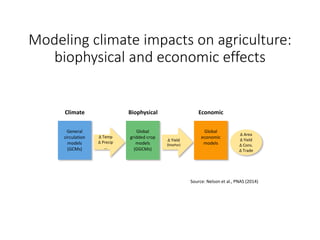
Source: Nelson et al., PNAS (2014)
Modeling climate impacts on agriculture:
biophysical and economic effects
General
circulation
models
(GCMs)
Global
gridded crop
models
(GGCMs)
Global
economic
models
Δ Temp
Δ Precip
…
Δ Yield
(biophys)
Δ Area
Δ Yield
Δ Cons.
Δ Trade
Climate Biophysical Economic
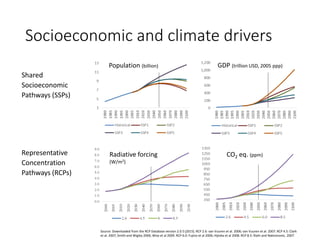
Socioeconomic and climate drivers
Shared
Socioeconomic
Pathways (SSPs)
Representative
Concentration
Pathways (RCPs)
Source: Downloaded from the RCP Database version 2.0.5 (2015). RCP 2.6: van Vuuren et al. 2006; van Vuuren et al. 2007. RCP 4.5: Clark
et al. 2007; Smith and Wigley 2006; Wise et al 2009. RCP 6.0: Fujino et al 2006; Hijioka et al 2008. RCP 8.5: Riahi and Nakicenovic, 2007.
CO2 eq. (ppm)Radiative forcing
(W/m2)
Population (billion) GDP (trillion USD, 2005 ppp)
AgMIP Global Economics results
Groups participating in this study:
• International Food Policy Research Institute – IMPACT
• LEI Wageningen UR – MAGNET
• Potsdam Institute for Climate Impact Research – MAgPIE
• Purdue University/Global Trade Analysis Project & Food and
Agriculture Organization of the UN – ENVISAGE
• USDA Economic Research Service – FARM
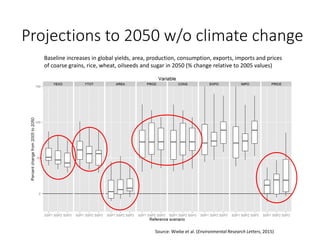
Projections to 2050 w/o climate change
Baseline increases in global yields, area, production, consumption, exports, imports and prices
of coarse grains, rice, wheat, oilseeds and sugar in 2050 (% change relative to 2005 values)
Source: Wiebe et al. (Environmental Research Letters, 2015)
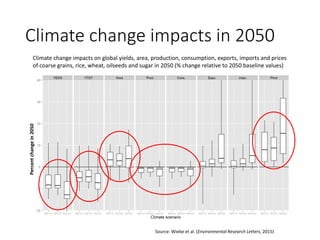
Climate change impacts in 2050
Climate change impacts on global yields, area, production, consumption, exports, imports and prices
of coarse grains, rice, wheat, oilseeds and sugar in 2050 (% change relative to 2050 baseline values)
Source: Wiebe et al. (Environmental Research Letters, 2015)
Percentchangein2050
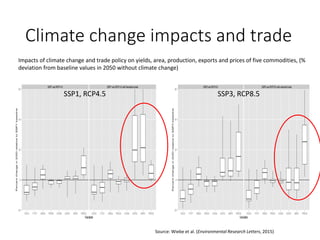
Climate change impacts and trade
Impacts of climate change and trade policy on yields, area, production, exports and prices of five commodities, (%
deviation from baseline values in 2050 without climate change)
SSP1, RCP4.5 SSP3, RCP8.5
Source: Wiebe et al. (Environmental Research Letters, 2015)
IMPACT baseline results
• Yields – climate effects by commodity and region
• Prices – comparing socioeconomic and climate effects
• Total demand – comparing commodities
• Per-capita food demand – by commodity and region
• Net trade – by region
• Food security – by region
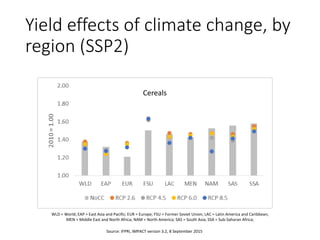
Yield effects of climate change, by
region (SSP2)
Cereals
Source: IFPRI, IMPACT version 3.2, 8 September 2015
WLD = World; EAP = East Asia and Pacific; EUR = Europe; FSU = Former Soviet Union; LAC = Latin America and Caribbean;
MEN = Middle East and North Africa; NAM = North America; SAS = South Asia; SSA = Sub-Saharan Africa;
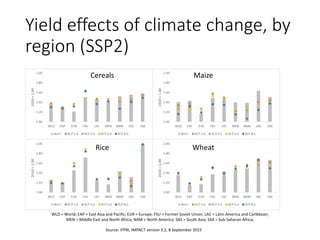
Yield effects of climate change, by
region (SSP2)
Source: IFPRI, IMPACT version 3.2, 8 September 2015
Cereals Maize
Rice Wheat
WLD = World; EAP = East Asia and Pacific; EUR = Europe; FSU = Former Soviet Union; LAC = Latin America and Caribbean;
MEN = Middle East and North Africa; NAM = North America; SAS = South Asia; SSA = Sub-Saharan Africa;
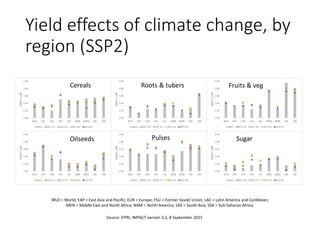
Yield effects of climate change, by
region (SSP2)
Source: IFPRI, IMPACT version 3.2, 8 September 2015
Cereals Roots & tubers
Oilseeds Pulses
Fruits & veg
Sugar
WLD = World; EAP = East Asia and Pacific; EUR = Europe; FSU = Former Soviet Union; LAC = Latin America and Caribbean;
MEN = Middle East and North Africa; NAM = North America; SAS = South Asia; SSA = Sub-Saharan Africa;
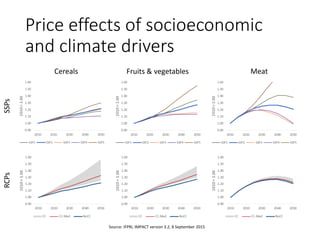
Price effects of socioeconomic
and climate drivers
Source: IFPRI, IMPACT version 3.2, 8 September 2015
Cereals Fruits & vegetables Meat
SSPsRCPs
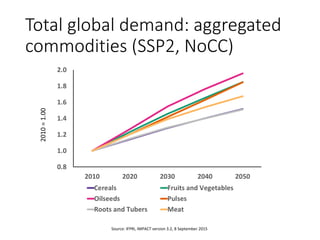
Total global demand: aggregated
commodities (SSP2, NoCC)2010=1.00
Source: IFPRI, IMPACT version 3.2, 8 September 2015
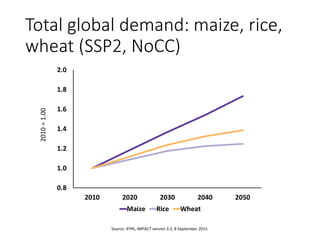
Total global demand: maize, rice,
wheat (SSP2, NoCC)2010=1.00
Source: IFPRI, IMPACT version 3.2, 8 September 2015
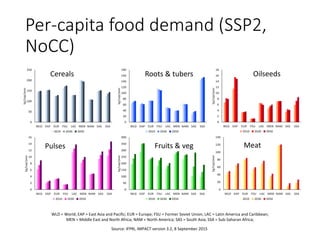
Per-capita food demand (SSP2,
NoCC)
Source: IFPRI, IMPACT version 3.2, 8 September 2015
Cereals
Meat
Roots & tubers
Pulses
Oilseeds
Fruits & veg
WLD = World; EAP = East Asia and Pacific; EUR = Europe; FSU = Former Soviet Union; LAC = Latin America and Caribbean;
MEN = Middle East and North Africa; NAM = North America; SAS = South Asia; SSA = Sub-Saharan Africa;
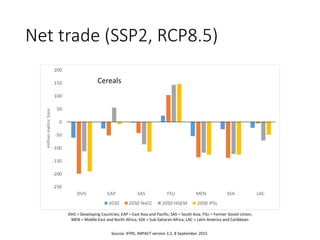
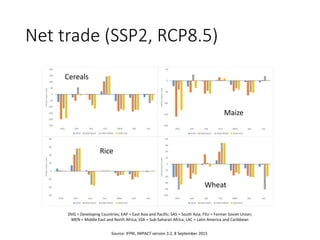
Net trade (SSP2, RCP8.5)
DVG = Developing Countries; EAP = East Asia and Pacific; SAS = South Asia; FSU = Former Soviet Union;
MEN = Middle East and North Africa; SSA = Sub-Saharan Africa; LAC = Latin America and Caribbean
Source: IFPRI, IMPACT version 3.2, 8 September 2015
Cereals
Net trade (SSP2, RCP8.5)
DVG = Developing Countries; EAP = East Asia and Pacific; SAS = South Asia; FSU = Former Soviet Union;
MEN = Middle East and North Africa; SSA = Sub-Saharan Africa; LAC = Latin America and Caribbean
Source: IFPRI, IMPACT version 3.2, 8 September 2015
Cereals
Maize
Rice
Wheat
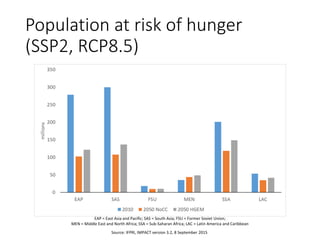
Population at risk of hunger
(SSP2, RCP8.5)
Source: IFPRI, IMPACT version 3.2, 8 September 2015
EAP = East Asia and Pacific; SAS = South Asia; FSU = Former Soviet Union;
MEN = Middle East and North Africa; SSA = Sub-Saharan Africa; LAC = Latin America and Caribbean
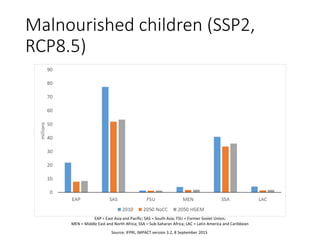
Malnourished children (SSP2,
RCP8.5)
Source: IFPRI, IMPACT version 3.2, 8 September 2015
EAP = East Asia and Pacific; SAS = South Asia; FSU = Former Soviet Union;
MEN = Middle East and North Africa; SSA = Sub-Saharan Africa; LAC = Latin America and Caribbean
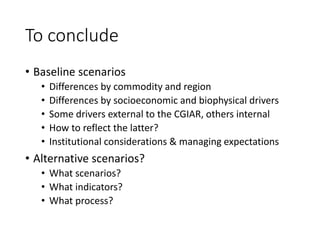
To conclude
• Baseline scenarios
• Differences by commodity and region
• Differences by socioeconomic and biophysical drivers
• Some drivers external to the CGIAR, others internal
• How to reflect the latter?
• Institutional considerations & managing expectations
• Alternative scenarios?
• What scenarios?
• What indicators?
• What process?
Thank you
k.wiebe@cgiar.org

Strategic Foresight - Keith Wiebe

  • 1.
    Strategic foresight: Long-term projectionsfrom IFPRI, GFSF and AgMIP Keith Wiebe, IFPRI and GFSF ISPC, Rome, 16 September 2015
  • 2.
    Source: Nelson etal., PNAS (2014) Modeling climate impacts on agriculture: biophysical and economic effects General circulation models (GCMs) Global gridded crop models (GGCMs) Global economic models Δ Temp Δ Precip … Δ Yield (biophys) Δ Area Δ Yield Δ Cons. Δ Trade Climate Biophysical Economic
  • 3.
    Socioeconomic and climatedrivers Shared Socioeconomic Pathways (SSPs) Representative Concentration Pathways (RCPs) Source: Downloaded from the RCP Database version 2.0.5 (2015). RCP 2.6: van Vuuren et al. 2006; van Vuuren et al. 2007. RCP 4.5: Clark et al. 2007; Smith and Wigley 2006; Wise et al 2009. RCP 6.0: Fujino et al 2006; Hijioka et al 2008. RCP 8.5: Riahi and Nakicenovic, 2007. CO2 eq. (ppm)Radiative forcing (W/m2) Population (billion) GDP (trillion USD, 2005 ppp)
  • 4.
    AgMIP Global Economicsresults Groups participating in this study: • International Food Policy Research Institute – IMPACT • LEI Wageningen UR – MAGNET • Potsdam Institute for Climate Impact Research – MAgPIE • Purdue University/Global Trade Analysis Project & Food and Agriculture Organization of the UN – ENVISAGE • USDA Economic Research Service – FARM
  • 5.
    Projections to 2050w/o climate change Baseline increases in global yields, area, production, consumption, exports, imports and prices of coarse grains, rice, wheat, oilseeds and sugar in 2050 (% change relative to 2005 values) Source: Wiebe et al. (Environmental Research Letters, 2015)
  • 6.
    Climate change impactsin 2050 Climate change impacts on global yields, area, production, consumption, exports, imports and prices of coarse grains, rice, wheat, oilseeds and sugar in 2050 (% change relative to 2050 baseline values) Source: Wiebe et al. (Environmental Research Letters, 2015) Percentchangein2050
  • 7.
    Climate change impactsand trade Impacts of climate change and trade policy on yields, area, production, exports and prices of five commodities, (% deviation from baseline values in 2050 without climate change) SSP1, RCP4.5 SSP3, RCP8.5 Source: Wiebe et al. (Environmental Research Letters, 2015)
  • 8.
    IMPACT baseline results •Yields – climate effects by commodity and region • Prices – comparing socioeconomic and climate effects • Total demand – comparing commodities • Per-capita food demand – by commodity and region • Net trade – by region • Food security – by region
  • 9.
    Yield effects ofclimate change, by region (SSP2) Cereals Source: IFPRI, IMPACT version 3.2, 8 September 2015 WLD = World; EAP = East Asia and Pacific; EUR = Europe; FSU = Former Soviet Union; LAC = Latin America and Caribbean; MEN = Middle East and North Africa; NAM = North America; SAS = South Asia; SSA = Sub-Saharan Africa;
  • 10.
    Yield effects ofclimate change, by region (SSP2) Source: IFPRI, IMPACT version 3.2, 8 September 2015 Cereals Maize Rice Wheat WLD = World; EAP = East Asia and Pacific; EUR = Europe; FSU = Former Soviet Union; LAC = Latin America and Caribbean; MEN = Middle East and North Africa; NAM = North America; SAS = South Asia; SSA = Sub-Saharan Africa;
  • 11.
    Yield effects ofclimate change, by region (SSP2) Source: IFPRI, IMPACT version 3.2, 8 September 2015 Cereals Roots & tubers Oilseeds Pulses Fruits & veg Sugar WLD = World; EAP = East Asia and Pacific; EUR = Europe; FSU = Former Soviet Union; LAC = Latin America and Caribbean; MEN = Middle East and North Africa; NAM = North America; SAS = South Asia; SSA = Sub-Saharan Africa;
  • 12.
    Price effects ofsocioeconomic and climate drivers Source: IFPRI, IMPACT version 3.2, 8 September 2015 Cereals Fruits & vegetables Meat SSPsRCPs
  • 13.
    Total global demand:aggregated commodities (SSP2, NoCC)2010=1.00 Source: IFPRI, IMPACT version 3.2, 8 September 2015
  • 14.
    Total global demand:maize, rice, wheat (SSP2, NoCC)2010=1.00 Source: IFPRI, IMPACT version 3.2, 8 September 2015
  • 15.
    Per-capita food demand(SSP2, NoCC) Source: IFPRI, IMPACT version 3.2, 8 September 2015 Cereals Meat Roots & tubers Pulses Oilseeds Fruits & veg WLD = World; EAP = East Asia and Pacific; EUR = Europe; FSU = Former Soviet Union; LAC = Latin America and Caribbean; MEN = Middle East and North Africa; NAM = North America; SAS = South Asia; SSA = Sub-Saharan Africa;
  • 16.
    Net trade (SSP2,RCP8.5) DVG = Developing Countries; EAP = East Asia and Pacific; SAS = South Asia; FSU = Former Soviet Union; MEN = Middle East and North Africa; SSA = Sub-Saharan Africa; LAC = Latin America and Caribbean Source: IFPRI, IMPACT version 3.2, 8 September 2015 Cereals
  • 17.
    Net trade (SSP2,RCP8.5) DVG = Developing Countries; EAP = East Asia and Pacific; SAS = South Asia; FSU = Former Soviet Union; MEN = Middle East and North Africa; SSA = Sub-Saharan Africa; LAC = Latin America and Caribbean Source: IFPRI, IMPACT version 3.2, 8 September 2015 Cereals Maize Rice Wheat
  • 18.
    Population at riskof hunger (SSP2, RCP8.5) Source: IFPRI, IMPACT version 3.2, 8 September 2015 EAP = East Asia and Pacific; SAS = South Asia; FSU = Former Soviet Union; MEN = Middle East and North Africa; SSA = Sub-Saharan Africa; LAC = Latin America and Caribbean
  • 19.
    Malnourished children (SSP2, RCP8.5) Source:IFPRI, IMPACT version 3.2, 8 September 2015 EAP = East Asia and Pacific; SAS = South Asia; FSU = Former Soviet Union; MEN = Middle East and North Africa; SSA = Sub-Saharan Africa; LAC = Latin America and Caribbean
  • 20.
    To conclude • Baselinescenarios • Differences by commodity and region • Differences by socioeconomic and biophysical drivers • Some drivers external to the CGIAR, others internal • How to reflect the latter? • Institutional considerations & managing expectations • Alternative scenarios? • What scenarios? • What indicators? • What process?
  • 21.