FOREST COVER TYPE
ECKOVATION MACHINE LEARNING
PROJECT
SUBMITTED BY:
•INA SINGHAL
•VISHESH NAHATA
•VAIBHAV TAYAL
•KARAN TANWAR
OBJECTIVE
To predict type of forest cover using
different machine learning models
DESCRIPTION
 In The given task predict the forest cover type (the predominant kind of
tree cover) from strictly cartographic variables (as opposed to remotely
sensed data).
 The actual forest cover type for a given 30 x 30 meter cell was
determined from US Forest Service (USFS) Region 2 Resource
Information System data. Independent variables were then derived from
data obtained from the US Geological Survey and USFS.
 The data is in raw form (not scaled) and contains binary columns of data
for qualitative independent variables such as wilderness areas and soil
type.
 This study area includes four wilderness areas located in the Roosevelt
National Forest of northern
 Colorado.
 These areas represent forests with minimal human-caused
disturbances, so that existing forest cover types are more a result of
ecological processes rather than forest management
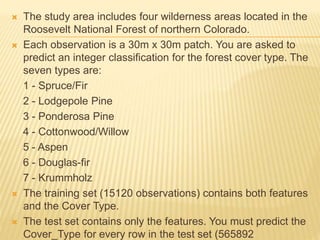
 The study area includes four wilderness areas located in the
Roosevelt National Forest of northern Colorado.
 Each observation is a 30m x 30m patch. You are asked to
predict an integer classification for the forest cover type. The
seven types are:
1 - Spruce/Fir
2 - Lodgepole Pine
3 - Ponderosa Pine
4 - Cottonwood/Willow
5 - Aspen
6 - Douglas-fir
7 - Krummholz
 The training set (15120 observations) contains both features
and the Cover Type.
 The test set contains only the features. You must predict the
Cover_Type for every row in the test set (565892
ALGORITHMS USED:
1. RANDOM FOREST CLASSIFIER
2. NAÏVE BAYES
3. DECISION TREE CLASSIFIER
4. SUPPORT VECTOR
CLASSIFIER(SVC)
5. DNN CLASSIFIER
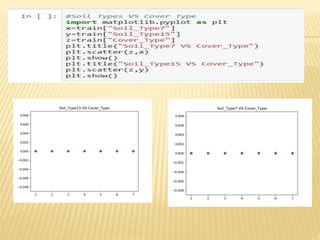
DATA VISUALIZATION
IMPORTING FILES
NAÏVE BAYES
 The Naive Bayesian
classifier is based on
Bayes’ theorem with the
independence
assumptions between
predictors.
 A Naive Bayesian model is
easy to build, with no
complicated iterative
parameter estimation
which makes it particularly
useful for very large
datasets.
CODE:
RANDOM FOREST
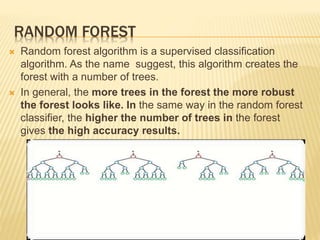
 Random forest algorithm is a supervised classification
algorithm. As the name suggest, this algorithm creates the
forest with a number of trees.
 In general, the more trees in the forest the more robust
the forest looks like. In the same way in the random forest
classifier, the higher the number of trees in the forest
gives the high accuracy results.
CODE:
DECISION TREE CLASSIFIER
 A decision tree is a decision
support tool that uses a tree-
like graph or model of decisions
and their possible
consequences,
including chance event
outcomes, resource costs,
and utility. It is one way to
display an algorithm that only
contains conditional control
statements.
 Decision trees are commonly
used in operations research,
specifically in decision analysis,
to help identify a strategy most
likely to reach a goal, but are
also a popular tool in machine
CODE:
DNN CLASSIFIER:
 A deep neural network (DNN) is
an artificial neural
network (ANN) with multiple
layers between the input and
output layers.
 The DNN finds the correct
mathematical manipulation to
turn the input into the output,
whether it be a linear
relationship or a non-linear
relationship.
 The network moves through the
layers calculating the probability
of each output.
CODE:
SUPPORT VECTOR CLASSIFIER(SVC)
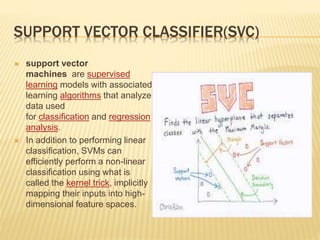
 support vector
machines are supervised
learning models with associated
learning algorithms that analyze
data used
for classification and regression
analysis.
 In addition to performing linear
classification, SVMs can
efficiently perform a non-linear
classification using what is
called the kernel trick, implicitly
mapping their inputs into high-
dimensional feature spaces.
CODE:
CONCLUSION
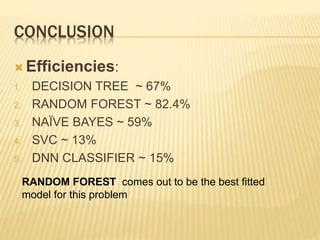
 Efficiencies:
1. DECISION TREE ~ 67%
2. RANDOM FOREST ~ 82.4%
3. NAÏVE BAYES ~ 59%
4. SVC ~ 13%
5. DNN CLASSIFIER ~ 15%
RANDOM FOREST comes out to be the best fitted
model for this problem
BIBLIOGRAPHY
 www.analyticsvidhya.com
 www.stackoverflow.com
 www.kaggle.com
 www.eckovation.com
 www.wikipedia.com
Forest cover type

Forest cover type

  • 1.
    FOREST COVER TYPE ECKOVATIONMACHINE LEARNING PROJECT SUBMITTED BY: •INA SINGHAL •VISHESH NAHATA •VAIBHAV TAYAL •KARAN TANWAR
  • 2.
    OBJECTIVE To predict typeof forest cover using different machine learning models
  • 3.
    DESCRIPTION  In Thegiven task predict the forest cover type (the predominant kind of tree cover) from strictly cartographic variables (as opposed to remotely sensed data).  The actual forest cover type for a given 30 x 30 meter cell was determined from US Forest Service (USFS) Region 2 Resource Information System data. Independent variables were then derived from data obtained from the US Geological Survey and USFS.  The data is in raw form (not scaled) and contains binary columns of data for qualitative independent variables such as wilderness areas and soil type.  This study area includes four wilderness areas located in the Roosevelt National Forest of northern  Colorado.  These areas represent forests with minimal human-caused disturbances, so that existing forest cover types are more a result of ecological processes rather than forest management
  • 4.
     The studyarea includes four wilderness areas located in the Roosevelt National Forest of northern Colorado.  Each observation is a 30m x 30m patch. You are asked to predict an integer classification for the forest cover type. The seven types are: 1 - Spruce/Fir 2 - Lodgepole Pine 3 - Ponderosa Pine 4 - Cottonwood/Willow 5 - Aspen 6 - Douglas-fir 7 - Krummholz  The training set (15120 observations) contains both features and the Cover Type.  The test set contains only the features. You must predict the Cover_Type for every row in the test set (565892
  • 5.
    ALGORITHMS USED: 1. RANDOMFOREST CLASSIFIER 2. NAÏVE BAYES 3. DECISION TREE CLASSIFIER 4. SUPPORT VECTOR CLASSIFIER(SVC) 5. DNN CLASSIFIER
  • 6.
  • 8.
  • 9.
    NAÏVE BAYES  TheNaive Bayesian classifier is based on Bayes’ theorem with the independence assumptions between predictors.  A Naive Bayesian model is easy to build, with no complicated iterative parameter estimation which makes it particularly useful for very large datasets.
  • 10.
  • 11.
    RANDOM FOREST  Randomforest algorithm is a supervised classification algorithm. As the name suggest, this algorithm creates the forest with a number of trees.  In general, the more trees in the forest the more robust the forest looks like. In the same way in the random forest classifier, the higher the number of trees in the forest gives the high accuracy results.
  • 12.
  • 13.
    DECISION TREE CLASSIFIER A decision tree is a decision support tool that uses a tree- like graph or model of decisions and their possible consequences, including chance event outcomes, resource costs, and utility. It is one way to display an algorithm that only contains conditional control statements.  Decision trees are commonly used in operations research, specifically in decision analysis, to help identify a strategy most likely to reach a goal, but are also a popular tool in machine
  • 14.
  • 15.
    DNN CLASSIFIER:  Adeep neural network (DNN) is an artificial neural network (ANN) with multiple layers between the input and output layers.  The DNN finds the correct mathematical manipulation to turn the input into the output, whether it be a linear relationship or a non-linear relationship.  The network moves through the layers calculating the probability of each output.
  • 16.
  • 17.
    SUPPORT VECTOR CLASSIFIER(SVC) support vector machines are supervised learning models with associated learning algorithms that analyze data used for classification and regression analysis.  In addition to performing linear classification, SVMs can efficiently perform a non-linear classification using what is called the kernel trick, implicitly mapping their inputs into high- dimensional feature spaces.
  • 18.
  • 19.
    CONCLUSION  Efficiencies: 1. DECISIONTREE ~ 67% 2. RANDOM FOREST ~ 82.4% 3. NAÏVE BAYES ~ 59% 4. SVC ~ 13% 5. DNN CLASSIFIER ~ 15% RANDOM FOREST comes out to be the best fitted model for this problem
  • 20.
    BIBLIOGRAPHY  www.analyticsvidhya.com  www.stackoverflow.com www.kaggle.com  www.eckovation.com  www.wikipedia.com