Introduction to
Forest
Mensuration
1
Introduction
Forest
• An area set a side for the production of timber and other
forest produce.
• Forests are the lands of more than 0.5 ha with a tree canopy
cover of more than 10% which are not primarily under
agricultural or urban landuse (FAO).
• “Forest” means an area fully or partly covered by trees
(Forest Act)
Mensuration
• It means measurement of length, mass and time etc.
• Art and science of locating, measuring and calculating the
length of lines, areas of planes, and volumes of solids.
2
Forest Mensuration
• Forest mensuration concentrates on trees and forests or
potentially forested locations.
• Forest mensuration also includes measuring or calculating
growth and change in trees and forests.
• Forest mensuration then may be defined as the art and
science of providing the quantitative information about
trees and forest stands necessary for forest management,
planning and research.
3
Forest Mensuration
• Estimation of the total and merchantable stand volume and
its size class distribution.
• Estimation of the diameter, basal area, height, and volume growth
of single trees and forest stands
• Estimation of the damages to the quality of individual trees and
forest stands
In addition, it has to deal with the development of models
for the construction of tree volume, taper and biomass
functions, the construction of stand tables, as well as the
development of growth and yield models.
4
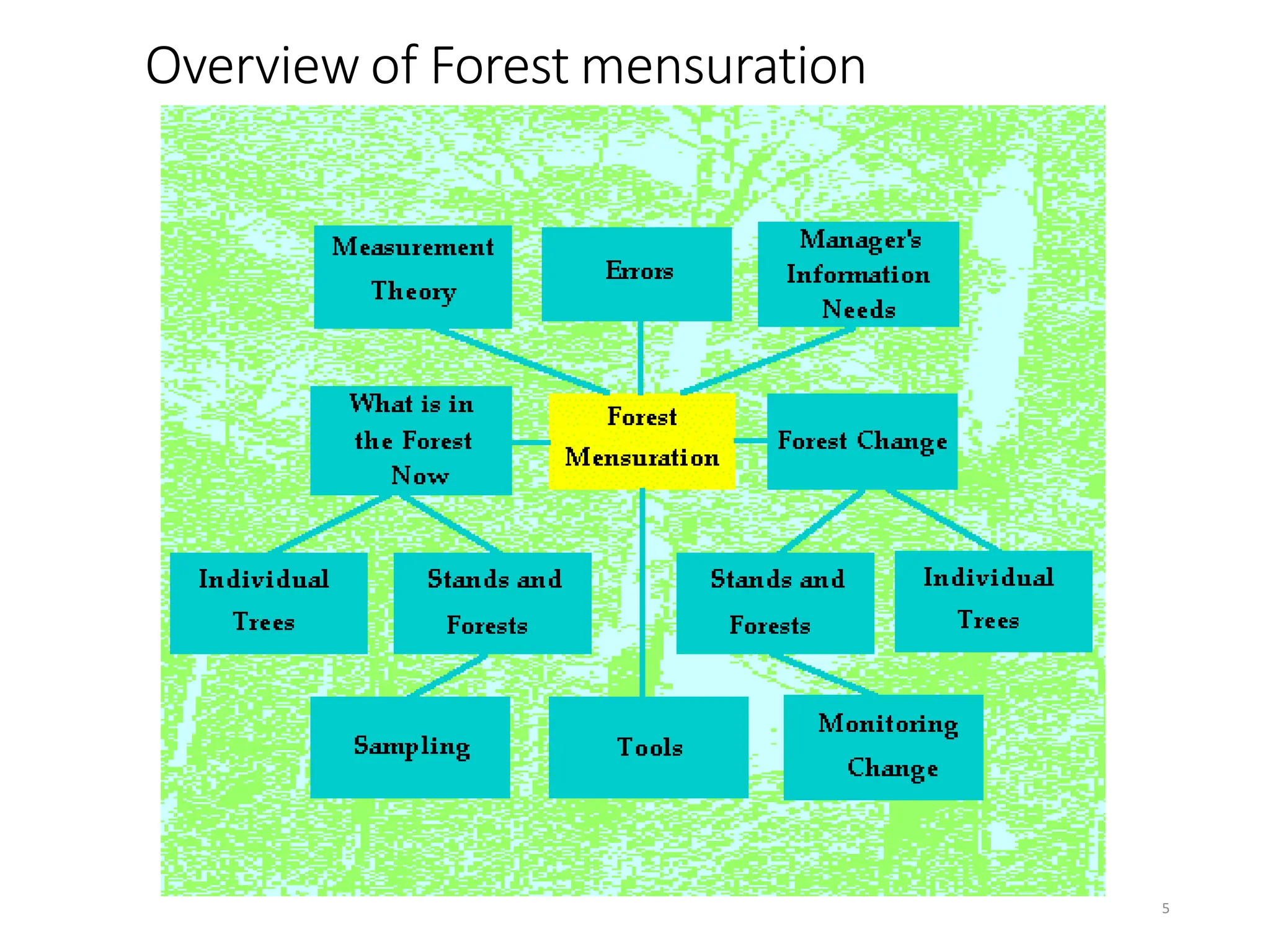
Overview of Forest mensuration
5
Importance of Forest Mensuration
It is the keystone foundation of forestry.
• What Silvicultural treatment will result in best regeneration
and growth?
• What species is most suitable for reforestation?
• Is there sufficient timber to supply a forest industry and for
an economical harvesting operation?
• What is the value of the timber and land?
• What is the recreational potential?
• What is the wildlife potential?
• What is the status of biodiversity on the area?
• What is the status of the forest as a carbon sink?
6
• What is in the forest now?
• How is the forest changing?
• What can we do to manage the forest properly?
• How can it be assessed?
• And for what purpose?
It helps to answer all these questions and concepts involved in
forest management.
• Forest mensuration is the application of measurement
principles to obtain quantifiable information for forest
management decision making.
7
Unit 1.2
Bias, Precision &
Accuracy
8
•Bias is a systematic distortion arising from such
sources as a flaw in measurement or an incorrect
method of sampling. For example, measurements
of 100 ft units with a tape only 99 ft long will be
biased.
1.2 Bias, Accuracy and Precision
9
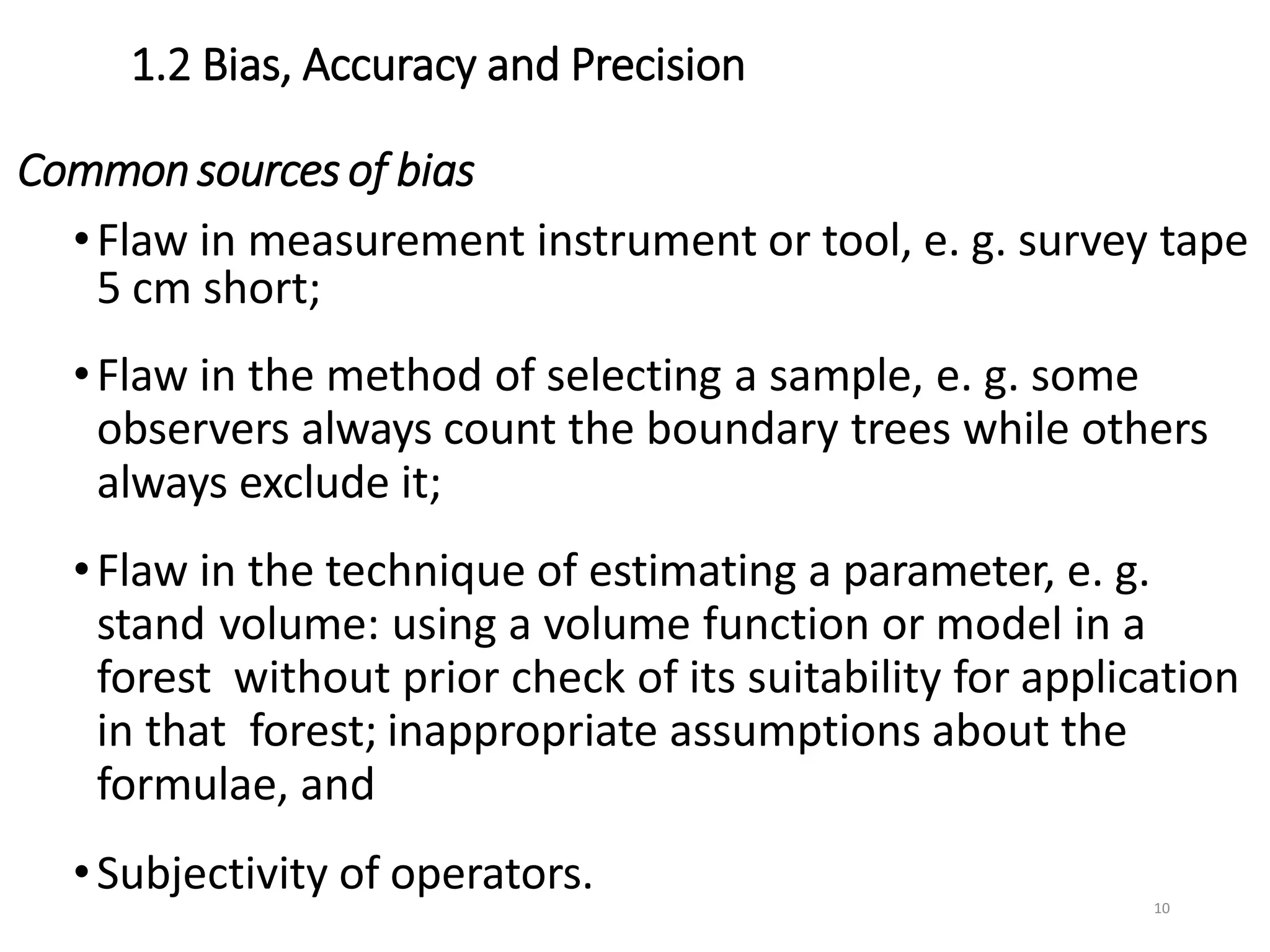
Common sources of bias
•Flaw in measurement instrument or tool, e. g. survey tape
5 cm short;
•Flaw in the method of selecting a sample, e. g. some
observers always count the boundary trees while others
always exclude it;
•Flaw in the technique of estimating a parameter, e. g.
stand volume: using a volume function or model in a
forest without prior check of its suitability for application
in that forest; inappropriate assumptions about the
formulae, and
•Subjectivity of operators.
1.2 Bias, Accuracy and Precision
10
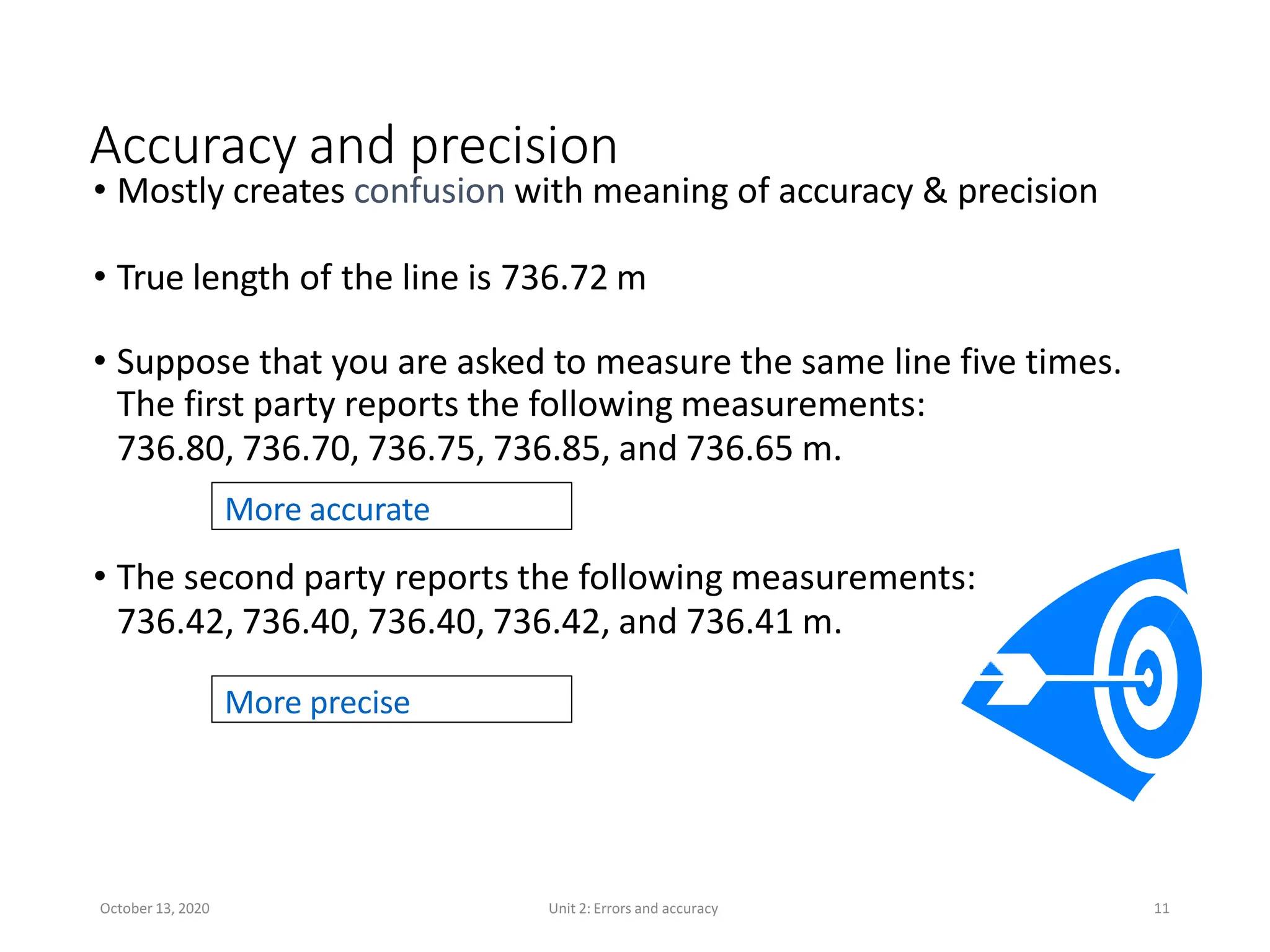
Accuracy and precision
• Mostly creates confusion with meaning of accuracy & precision
• True length of the line is 736.72 m
• Suppose that you are asked to measure the same line five times.
The first party reports the following measurements:
736.80, 736.70, 736.75, 736.85, and 736.65 m.
October 13, 2020 Unit 2: Errors and accuracy
• The second party reports the following measurements:
736.42, 736.40, 736.40, 736.42, and 736.41 m.
More accurate
More precise
11
Accuracy and precision
Accurate but not precise
October 13, 2020 Unit 2: Errors and accuracy
Precise but not accurate Accurate and precise
12
Accuracy and precision
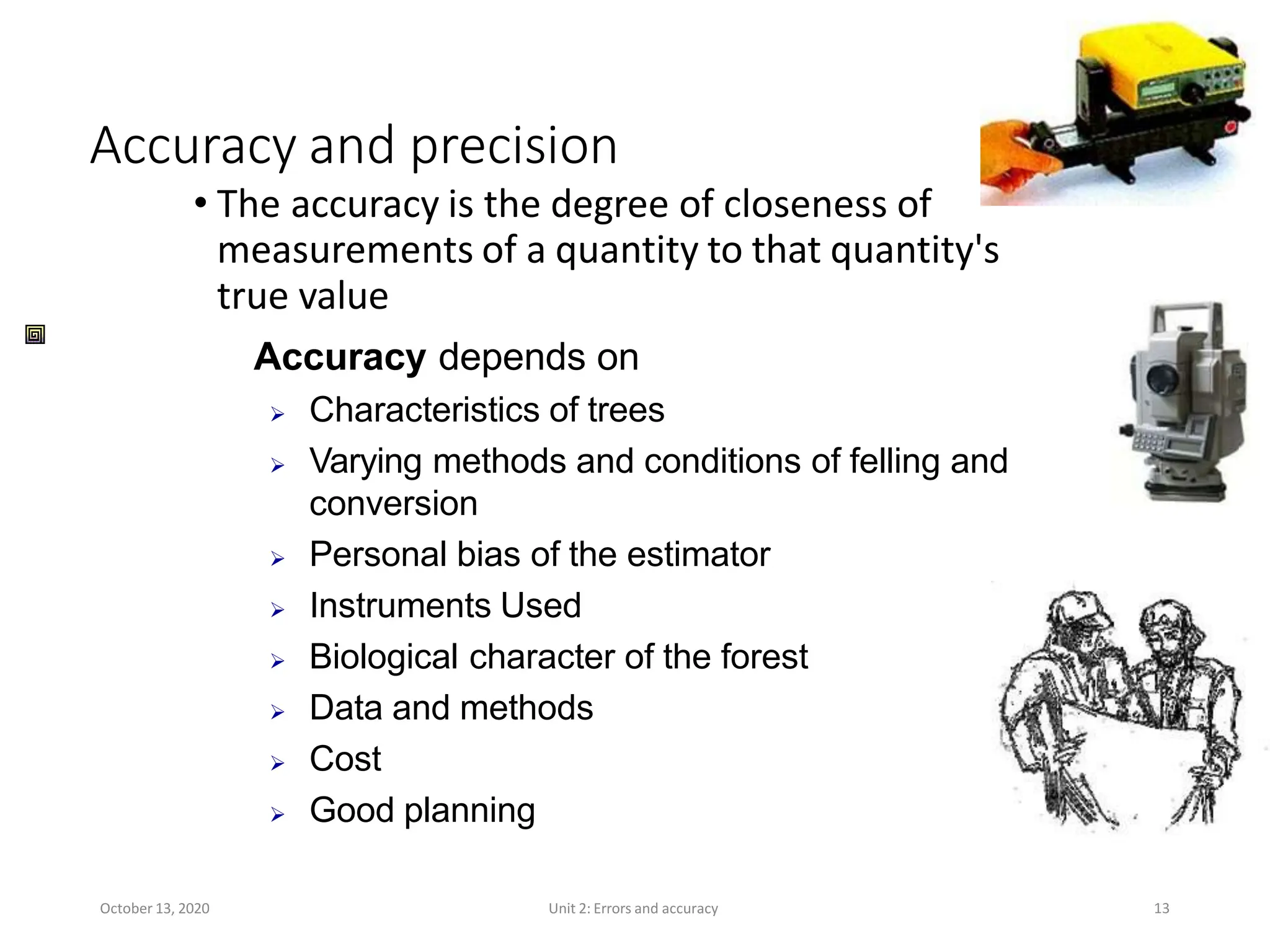
• The accuracy is the degree of closeness of
measurements of a quantity to that quantity's
true value
Accuracy depends on
 Characteristics of trees
 Varying methods and conditions of felling and
conversion
 Personal bias of the estimator
 Instruments Used
 Biological character of the forest
 Data and methods
 Cost
 Good planning
October 13, 2020 Unit 2: Errors and accuracy 13
Accuracy and precision
• Precision also known as apparent accuracy
• Precision is the degree of perfection used in
• instruments, methods and observation
• Closeness of one measurement to another
• Good precision doesn’t mean that good accuracy
• Meaning of precision in distance measurement
• In distance measurement,
Error of measurements
Precision
Distance measured Number
1
= =
Suppose in measuring the distance of 500m the
error was found to be .20 m then, precision is
0.20/500 = 1/2500.
October 13, 2020 Unit 2: Errors and accuracy 14
Relationships between bias, accuracy and
precision
15
How to minimize bias
The only practical way to minimise measurement bias is
by:
• Continual check of instruments and assumptions
• Meticulous training
• Care in the use of instruments and application of
methods
Complete elimination of bias may be costly.
To avoid bias being introduced via faulty instruments, it
is essential to check all instruments before one
commences any important measuring project and re-
check periodically during the course of the project.
16
Accuracy and precision
October 13, 2020 Unit 2: Errors and accuracy
• How to get both accuracy and precision?
• Answer is simple in saying but hard in practicing
• So what to do?
• Use logical thinking
• Be patience in your work
• Use good instruments
• Apply good procedure
17
Unit 1.3
System of Measurement
and Unit Conversion
18
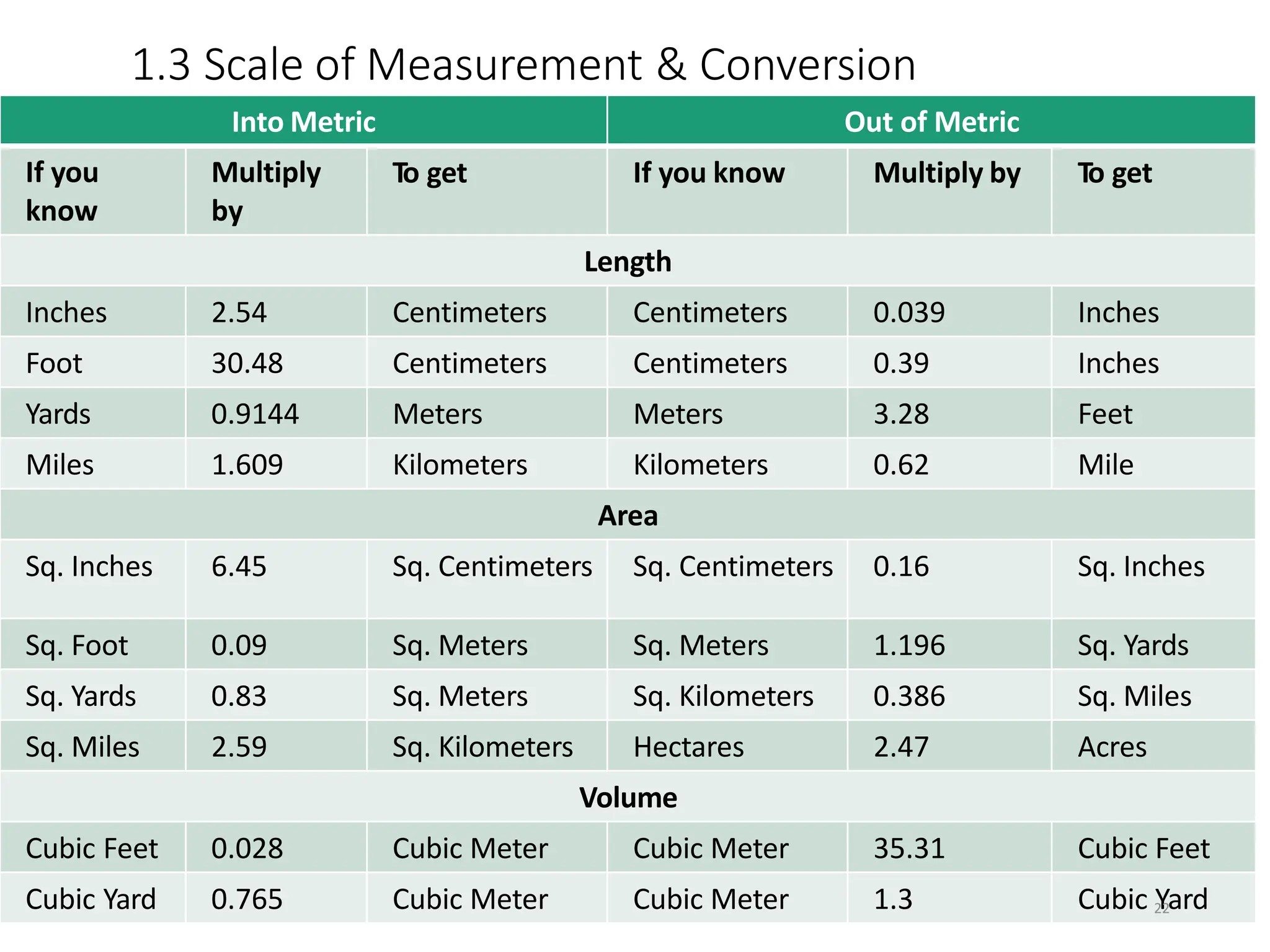
1.3 Scale of Measurement & Conversion
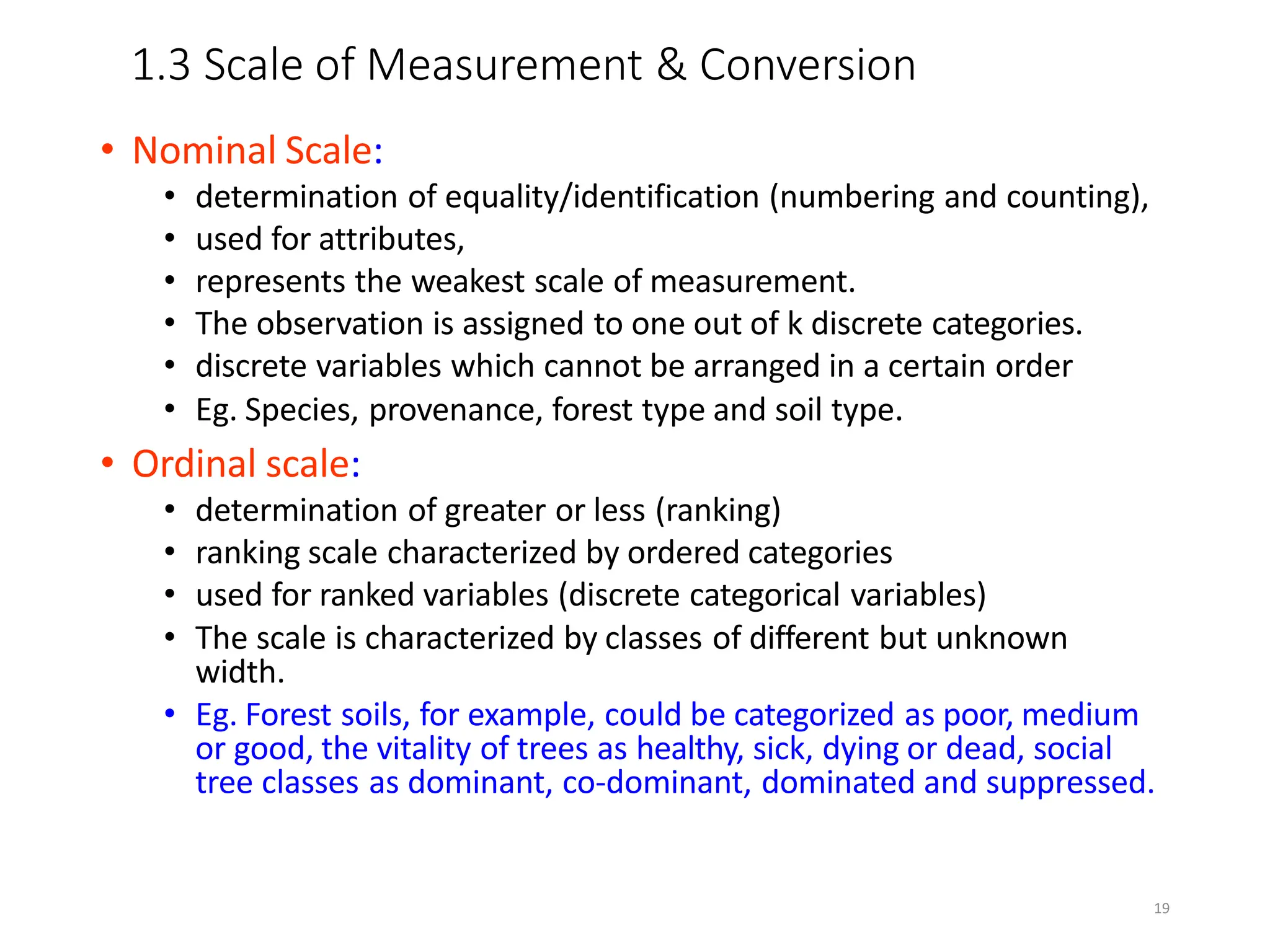
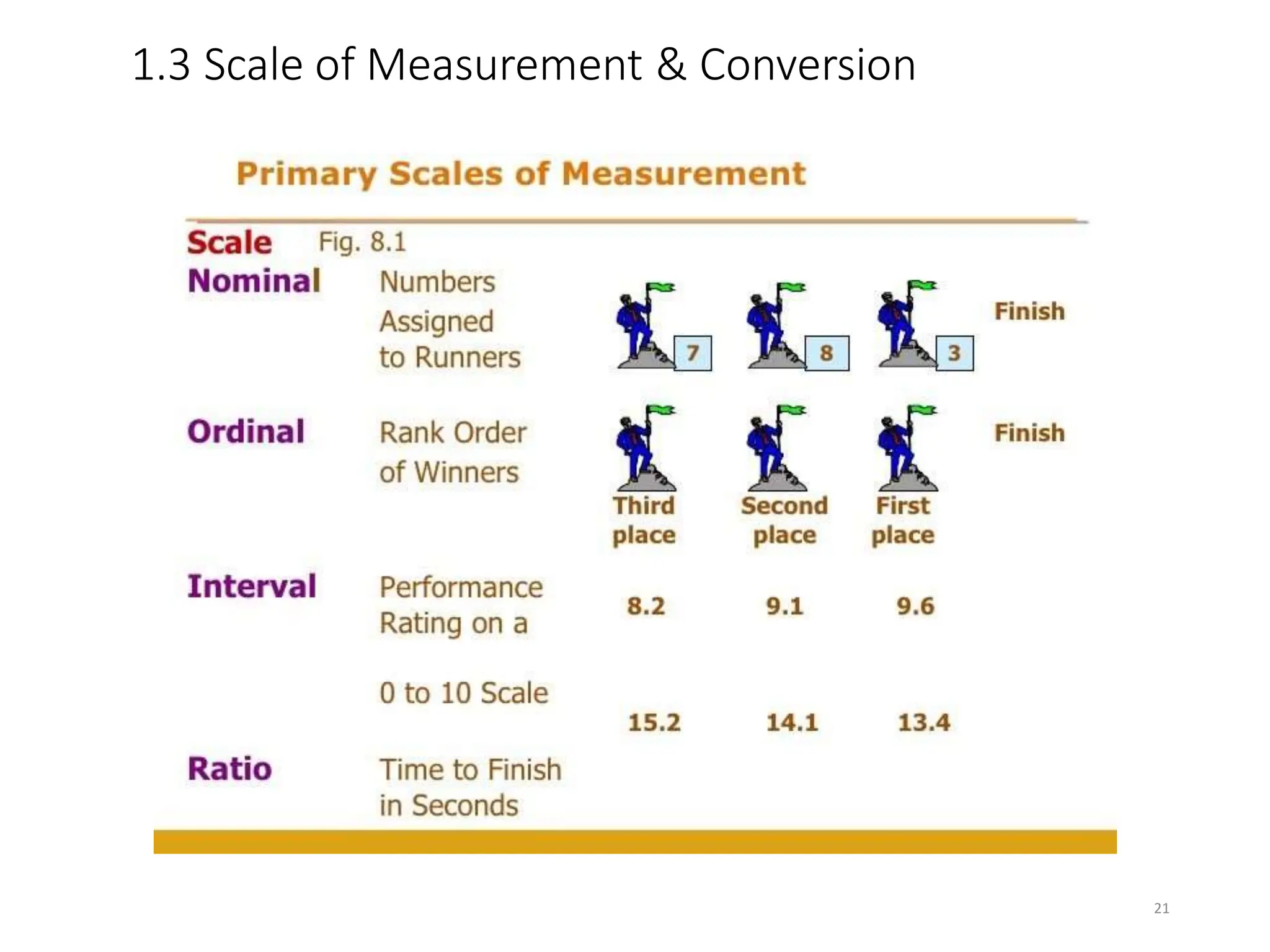
• Nominal Scale:
• determination of equality/identification (numbering and counting),
• used for attributes,
• represents the weakest scale of measurement.
• The observation is assigned to one out of k discrete categories.
• discrete variables which cannot be arranged in a certain order
• Eg. Species, provenance, forest type and soil type.
• Ordinal scale:
• determination of greater or less (ranking)
• ranking scale characterized by ordered categories
• used for ranked variables (discrete categorical variables)
• The scale is characterized by classes of different but unknown
width.
• Eg. Forest soils, for example, could be categorized as poor, medium
or good, the vitality of trees as healthy, sick, dying or dead, social
tree classes as dominant, co-dominant, dominated and suppressed.
19
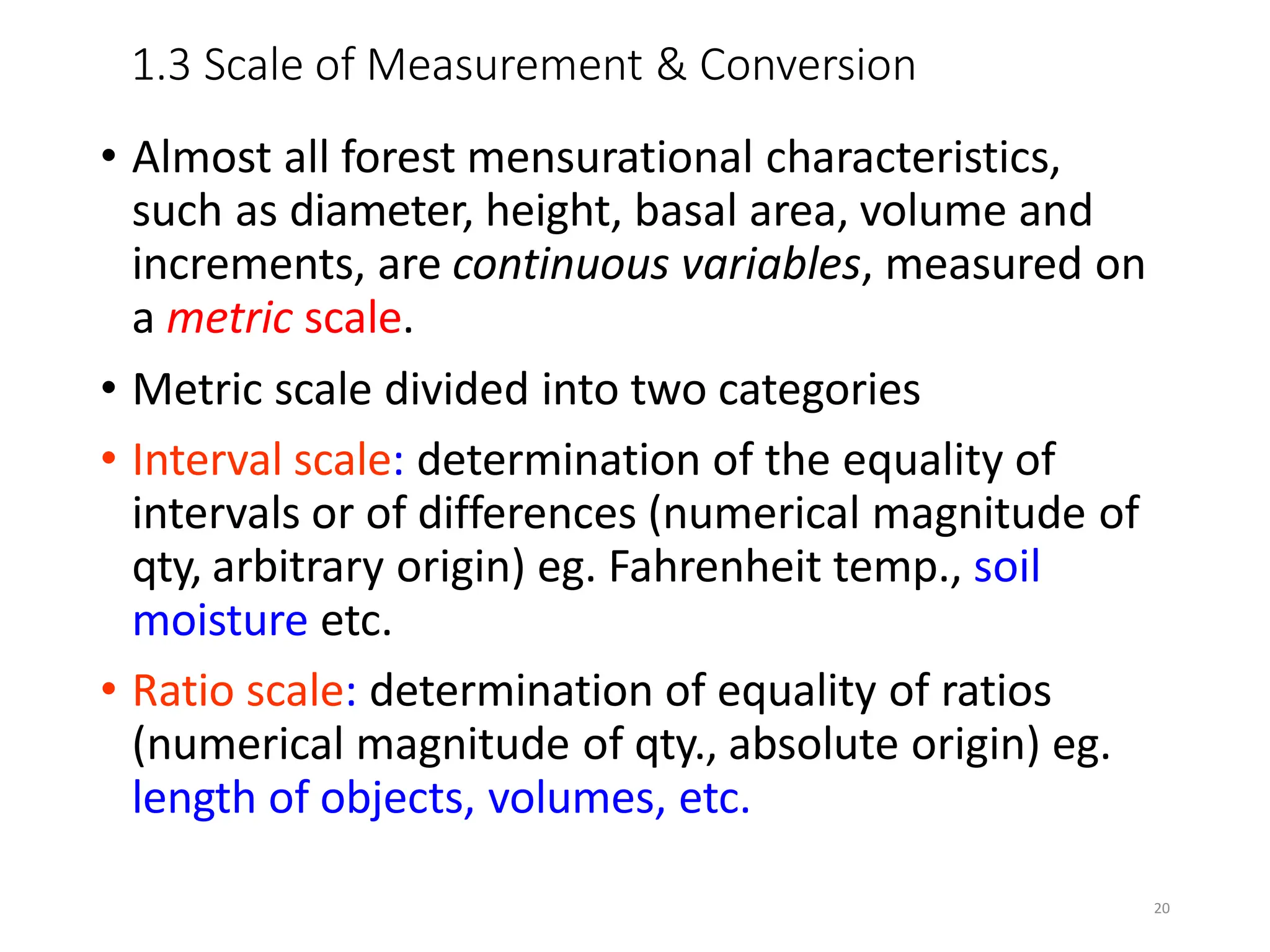
• Almost all forest mensurational characteristics,
such as diameter, height, basal area, volume and
increments, are continuous variables, measured on
a metric scale.
• Metric scale divided into two categories
• Interval scale: determination of the equality of
intervals or of differences (numerical magnitude of
qty, arbitrary origin) eg. Fahrenheit temp., soil
moisture etc.
• Ratio scale: determination of equality of ratios
(numerical magnitude of qty., absolute origin) eg.
length of objects, volumes, etc.
1.3 Scale of Measurement & Conversion
20
1.3 Scale of Measurement & Conversion
21
18
Into Metric Out of Metric
If you
know
Multiply
by
To get If you know Multiply by To get
Length
Inches 2.54 Centimeters Centimeters 0.039 Inches
Foot 30.48 Centimeters Centimeters 0.39 Inches
Yards 0.9144 Meters Meters 3.28 Feet
Miles 1.609 Kilometers Kilometers 0.62 Mile
Area
Sq. Inches 6.45 Sq. Centimeters Sq. Centimeters 0.16 Sq. Inches
Sq. Foot 0.09 Sq. Meters Sq. Meters 1.196 Sq. Yards
Sq. Yards 0.83 Sq. Meters Sq. Kilometers 0.386 Sq. Miles
Sq. Miles 2.59 Sq. Kilometers Hectares 2.47 Acres
Volume
Cubic Feet 0.028 Cubic Meter Cubic Meter 35.31 Cubic Feet
Cubic Yard 0.765 Cubic Meter Cubic Meter 1.3 Cubic Yard
1.3 Scale of Measurement & Conversion
22
MEASUREMENT OF
TREE
Diameter and Height 23
Measurement of trees:
• Diameter Measurement
• DBH measurement and Its significance
• Rules of DBH Measurement and instruments used
• Height Measurement
• Measurement of height of trees in plane and slope
• Instruments used in height measurement
• Measurement of logs and fuelwood
• Measurement of length, diameter and sectional area of
logs
• Formula for log volume calculation
• Volume of stacked timber and chatta (stacked
fuelwood)
24
Diameter measurement and its
significance
What is Diameter??
• A straight line passing through the center of a circle or
sphere and meeting at each end of circumference or surface.
• The most common diameter measurements taken in
forestry are of the main stem of standing trees, cut portions
of trees and branches.
Important because
• directly measurable dimensions
• tree cross sectional area, surface area and volume can be
computed.
25
• The point at which diameters are measured will vary with
circumstances.
• The most frequent tree measurement made by forester is
diameter at breast height (dbh).
• DBH is defined as the average stem diameter outside bark,
at a point 1.3 m above ground as measured
• Europe, the UK, and Canada : 1.3 metres
• US, Australia, New Zealand, Burma, India, Malaysia, and South Africa,
:1.4 metres (previously 1.37m)
• The rationale of DBH measurement of individual trees is to
estimate the quantity of timber, fuel wood or any other
forest products which can be obtained from them.
• DBH is important variable to calculate the product quantity.
• These measurement are also necessary for making inventory
of growing stock as well as to correlate height, volume, age,
increment with most easily determinable dimension i.e. dbh
26
DBH has been accepted as the standard height for
diameter measurement because …
• convenient height for taking measurements
• Economically fit
• Time Value
• escape from abnormalities
• standardize the measurement
Assumption
• Tree stem sections are circular
27
Rules of DBH measurement and instrument
used
• Moss, creepers, lichens and loose bark
found on the tree must be removed
before measuring the dia. over bark.
• Breast height (BH) should be marked by
means of a measuring stick on standing
trees at 1.3m above the ground level.
• BH point should be marked by
intersecting vertical and horizontal lines
12 cm long, painted with white paint.
28
Rules of DBH Measurement
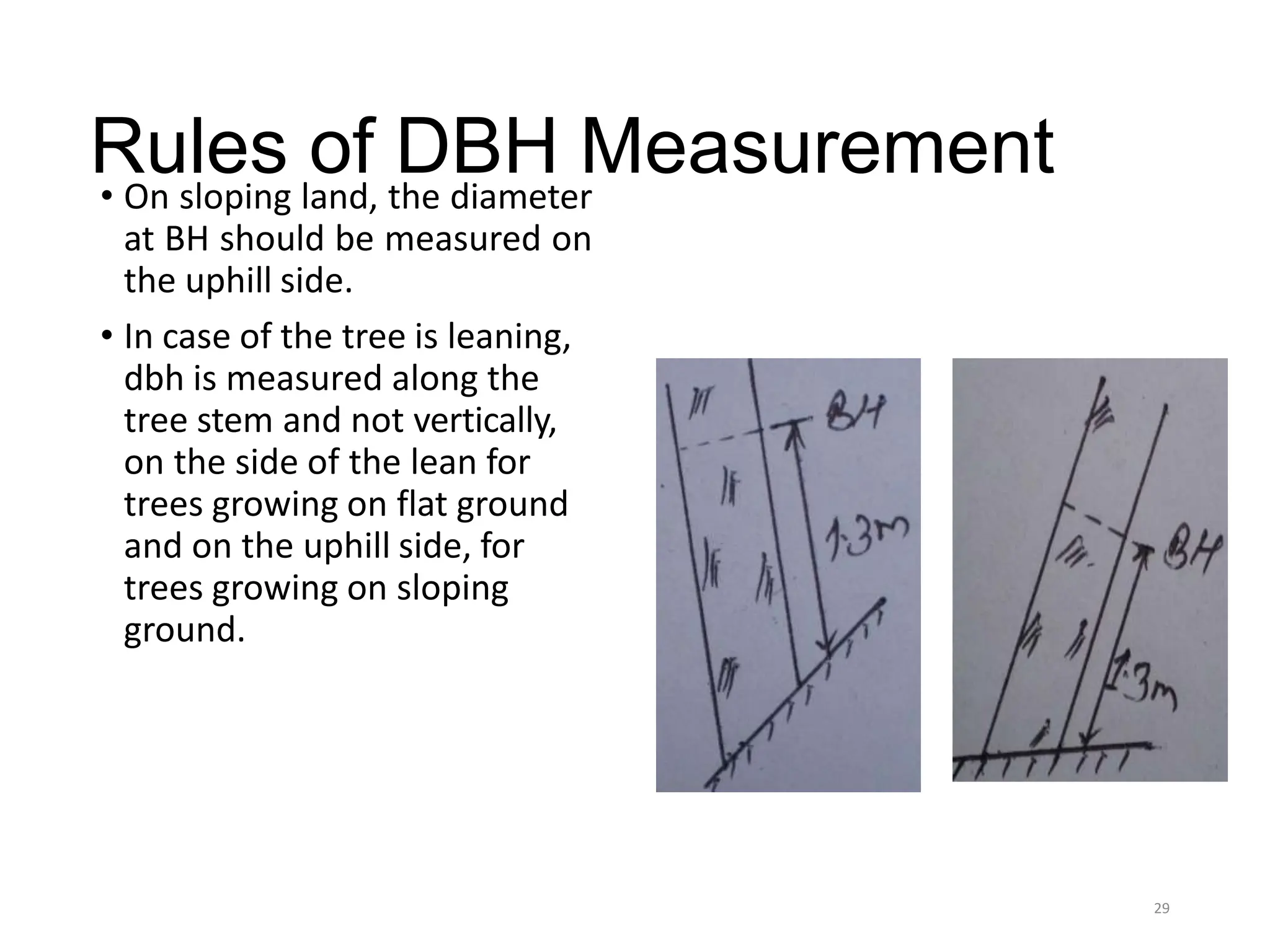
• On sloping land, the diameter
at BH should be measured on
the uphill side.
• In case of the tree is leaning,
dbh is measured along the
tree stem and not vertically,
on the side of the lean for
trees growing on flat ground
and on the uphill side, for
trees growing on sloping
ground.
29
Rules of DBH Measurement
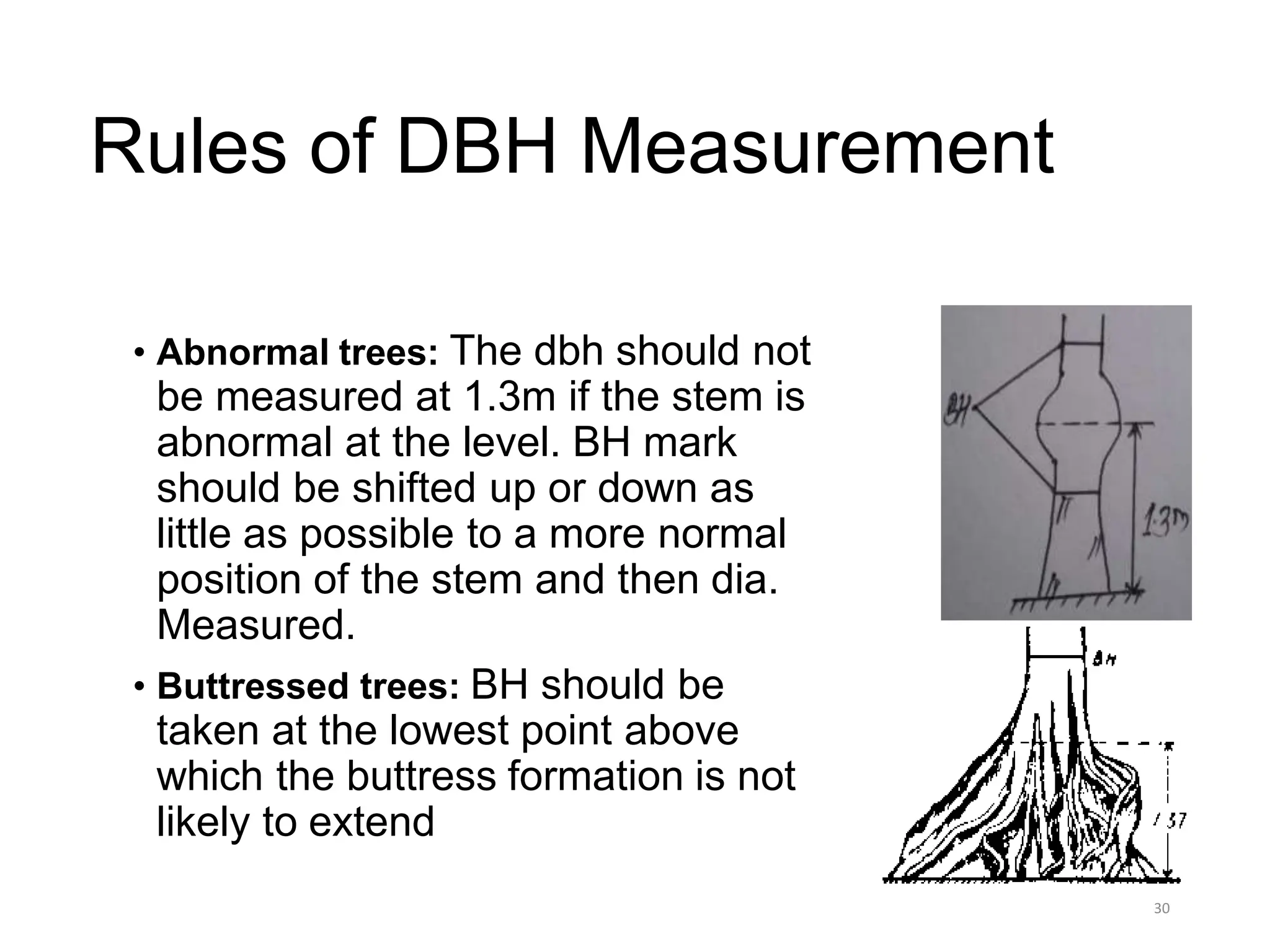
• Abnormal trees: The dbh should not
be measured at 1.3m if the stem is
abnormal at the level. BH mark
should be shifted up or down as
little as possible to a more normal
position of the stem and then dia.
Measured.
• Buttressed trees: BH should be
taken at the lowest point above
which the buttress formation is not
likely to extend
30
Rules of DBH Measurement
• Forked trees: When
the tree is forked
above the BH, it is
counted as one tree,
but when it is forked
below BH, each fork
should be treated as
though it were a
separate tree.
31
Instrumentusedindiametermeasurement
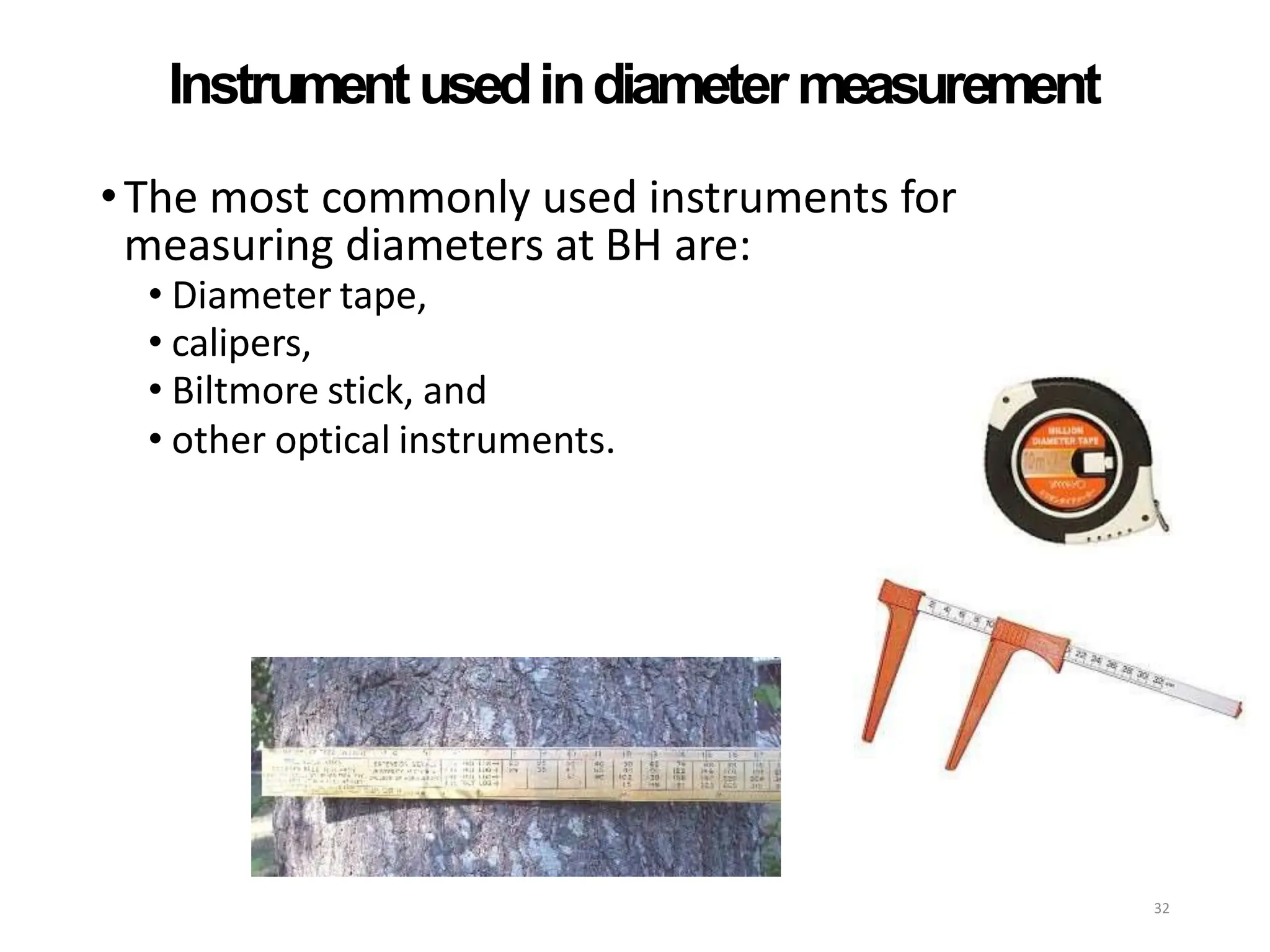
•The most commonly used instruments for
measuring diameters at BH are:
• Diameter tape,
• calipers,
• Biltmore stick, and
• other optical instruments.
32
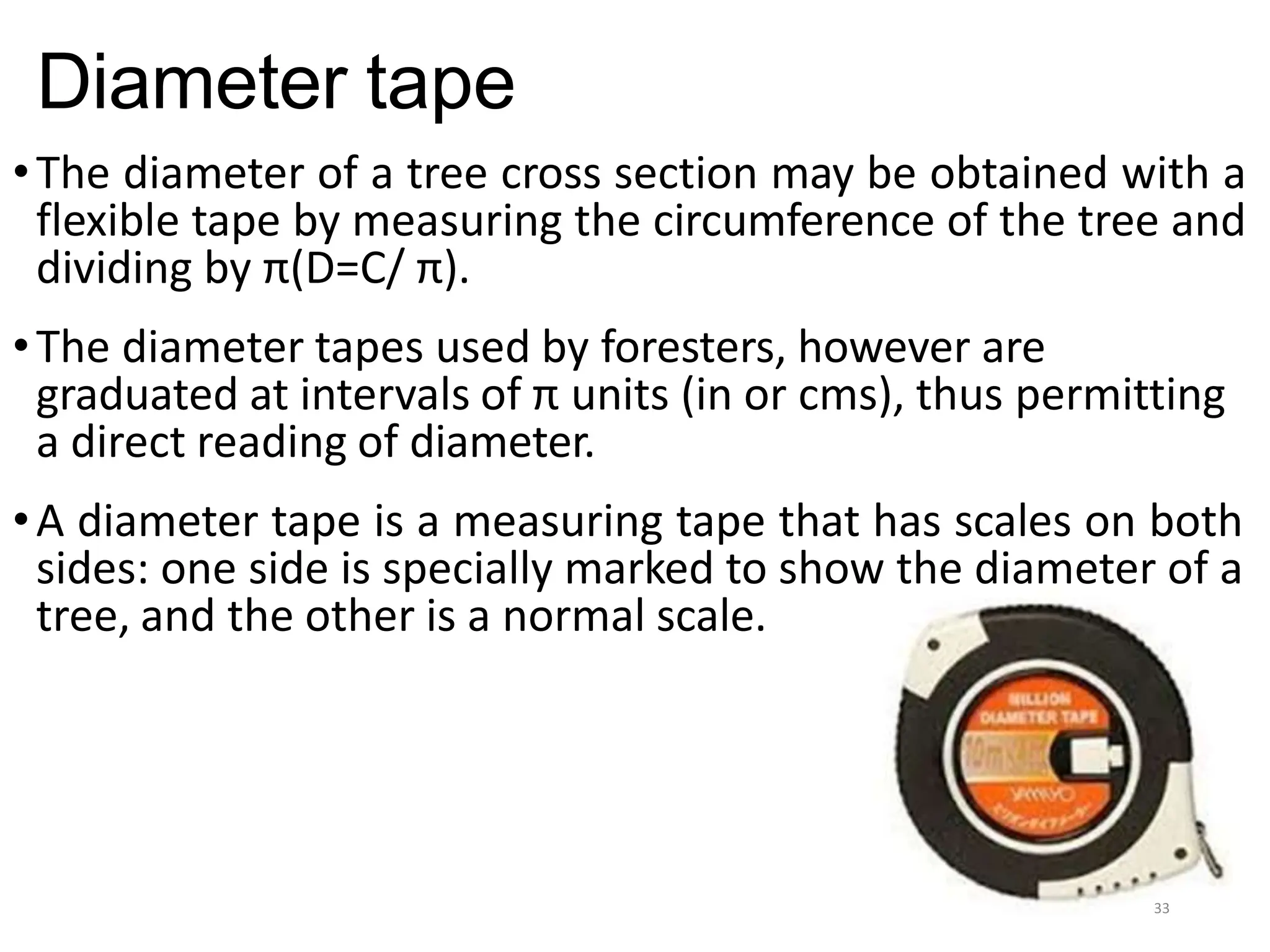
Diameter tape
•The diameter of a tree cross section may be obtained with a
flexible tape by measuring the circumference of the tree and
dividing by π(D=C/ π).
•The diameter tapes used by foresters, however are
graduated at intervals of π units (in or cms), thus permitting
a direct reading of diameter.
•A diameter tape is a measuring tape that has scales on both
sides: one side is specially marked to show the diameter of a
tree, and the other is a normal scale.
33
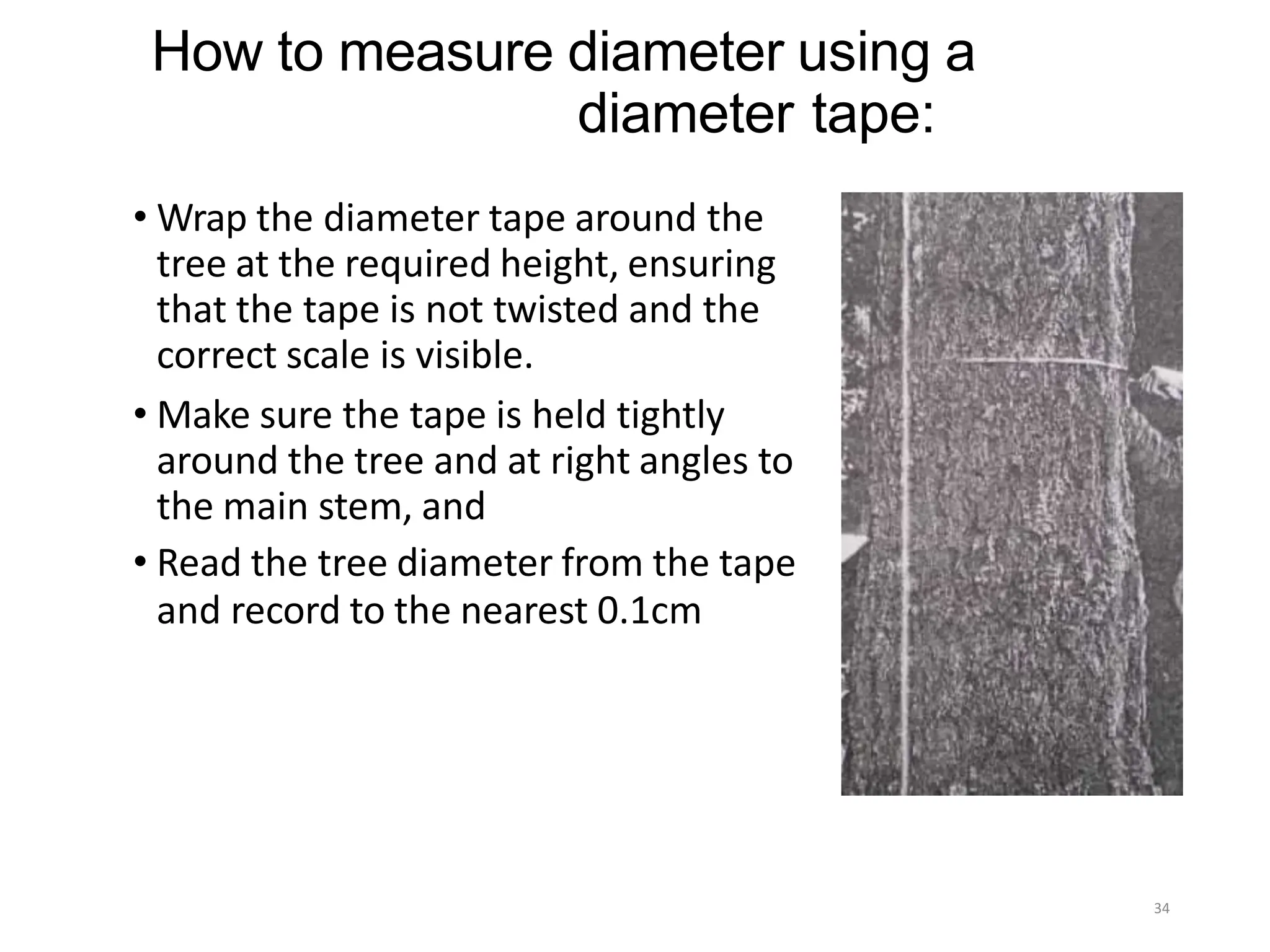
How to measure diameter using a
diameter tape:
• Wrap the diameter tape around the
tree at the required height, ensuring
that the tape is not twisted and the
correct scale is visible.
• Make sure the tape is held tightly
around the tree and at right angles to
the main stem, and
• Read the tree diameter from the tape
and record to the nearest 0.1cm
34
How to measure diameter using a diameter
tape:
• Care must be taken that the tape is correctly positioned at
the point of measurement that it is kept in a plane
perpendicular to the axis of the stem, and that it is set firmly
around the tree trunk.
• These tapes are accurate only for trees that are circular in
cross section.
• The diameter tape is convenient to carry and in the case of
irregular trees, requires only one measurement.
35
Caliper
s
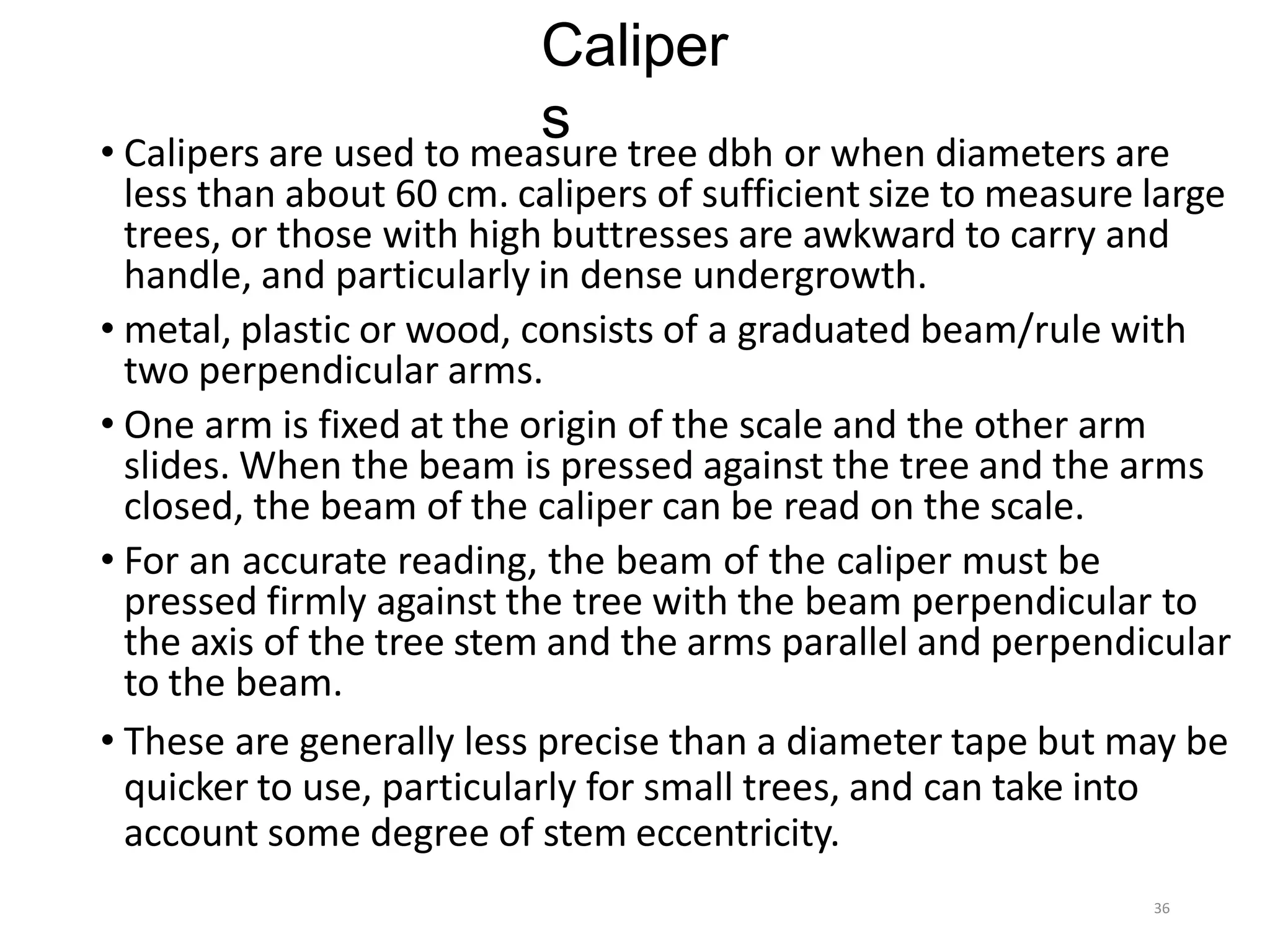
• Calipers are used to measure tree dbh or when diameters are
less than about 60 cm. calipers of sufficient size to measure large
trees, or those with high buttresses are awkward to carry and
handle, and particularly in dense undergrowth.
• metal, plastic or wood, consists of a graduated beam/rule with
two perpendicular arms.
• One arm is fixed at the origin of the scale and the other arm
slides. When the beam is pressed against the tree and the arms
closed, the beam of the caliper can be read on the scale.
• For an accurate reading, the beam of the caliper must be
pressed firmly against the tree with the beam perpendicular to
the axis of the tree stem and the arms parallel and perpendicular
to the beam.
• These are generally less precise than a diameter tape but may be
quicker to use, particularly for small trees, and can take into
account some degree of stem eccentricity.
36
How to use calipers to measure
diameter:
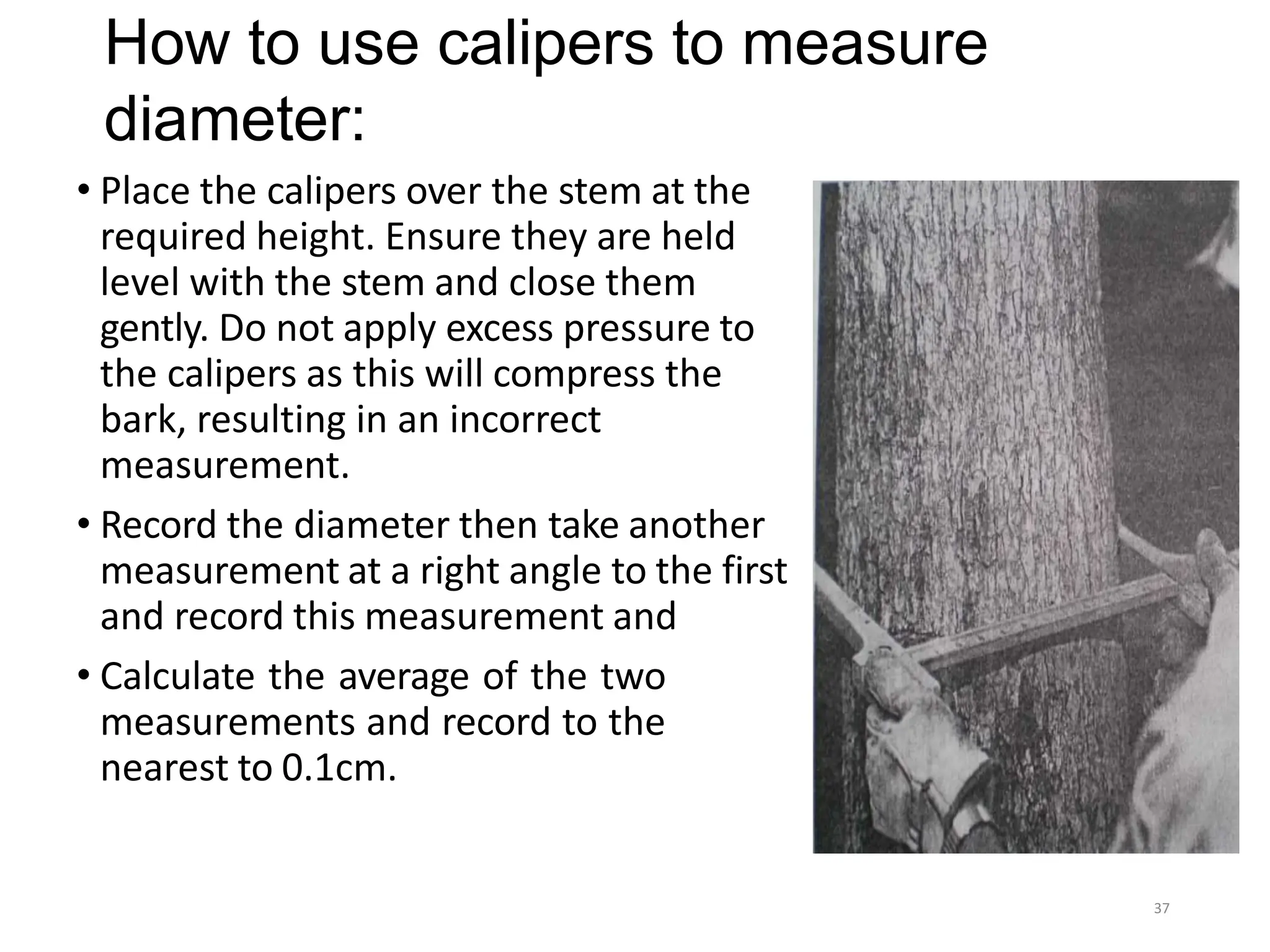
• Place the calipers over the stem at the
required height. Ensure they are held
level with the stem and close them
gently. Do not apply excess pressure to
the calipers as this will compress the
bark, resulting in an incorrect
measurement.
• Record the diameter then take another
measurement at a right angle to the first
and record this measurement and
• Calculate the average of the two
measurements and record to the
nearest to 0.1cm.
37
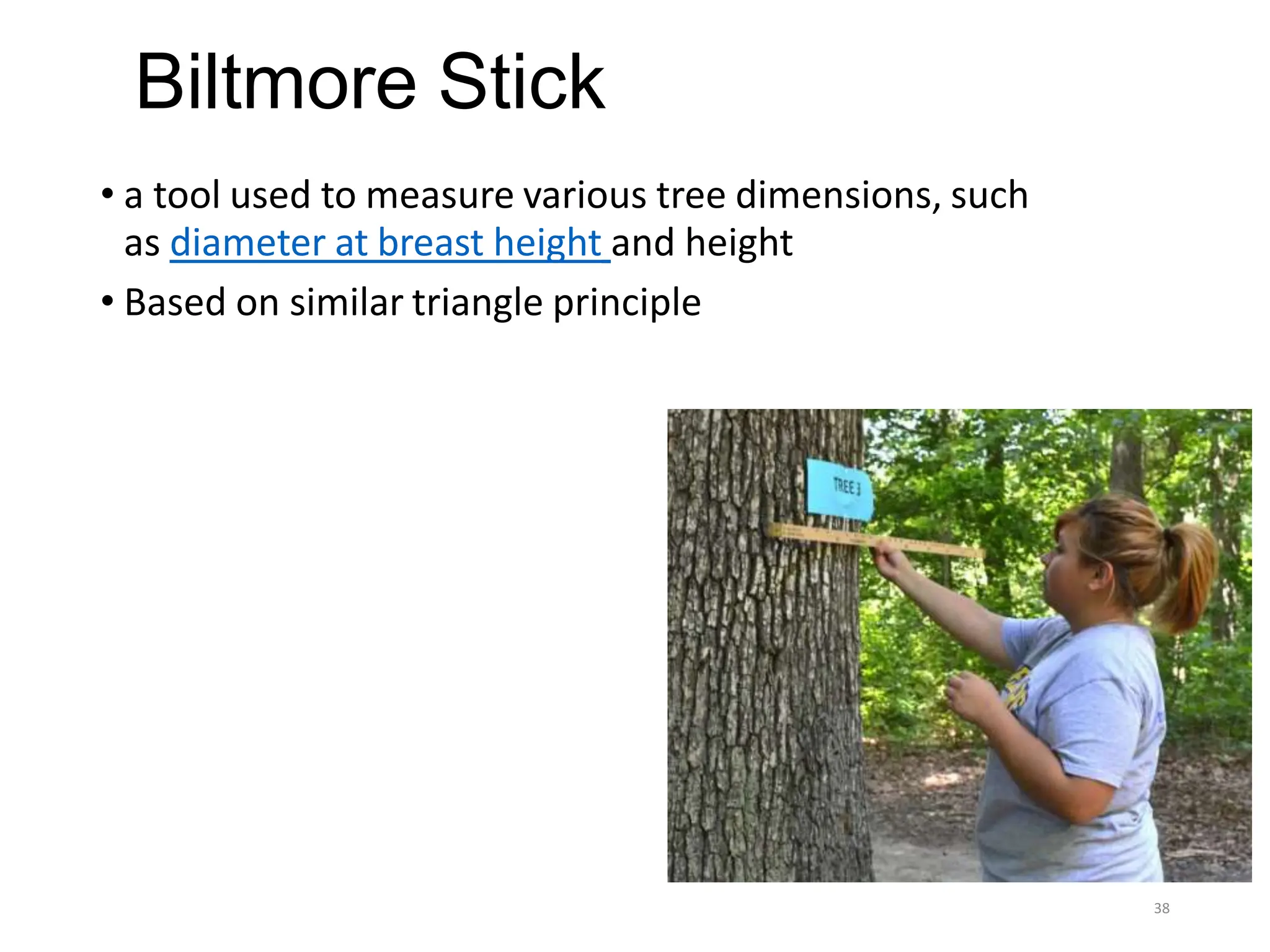
Biltmore Stick
• a tool used to measure various tree dimensions, such
as diameter at breast height and height
• Based on similar triangle principle
38
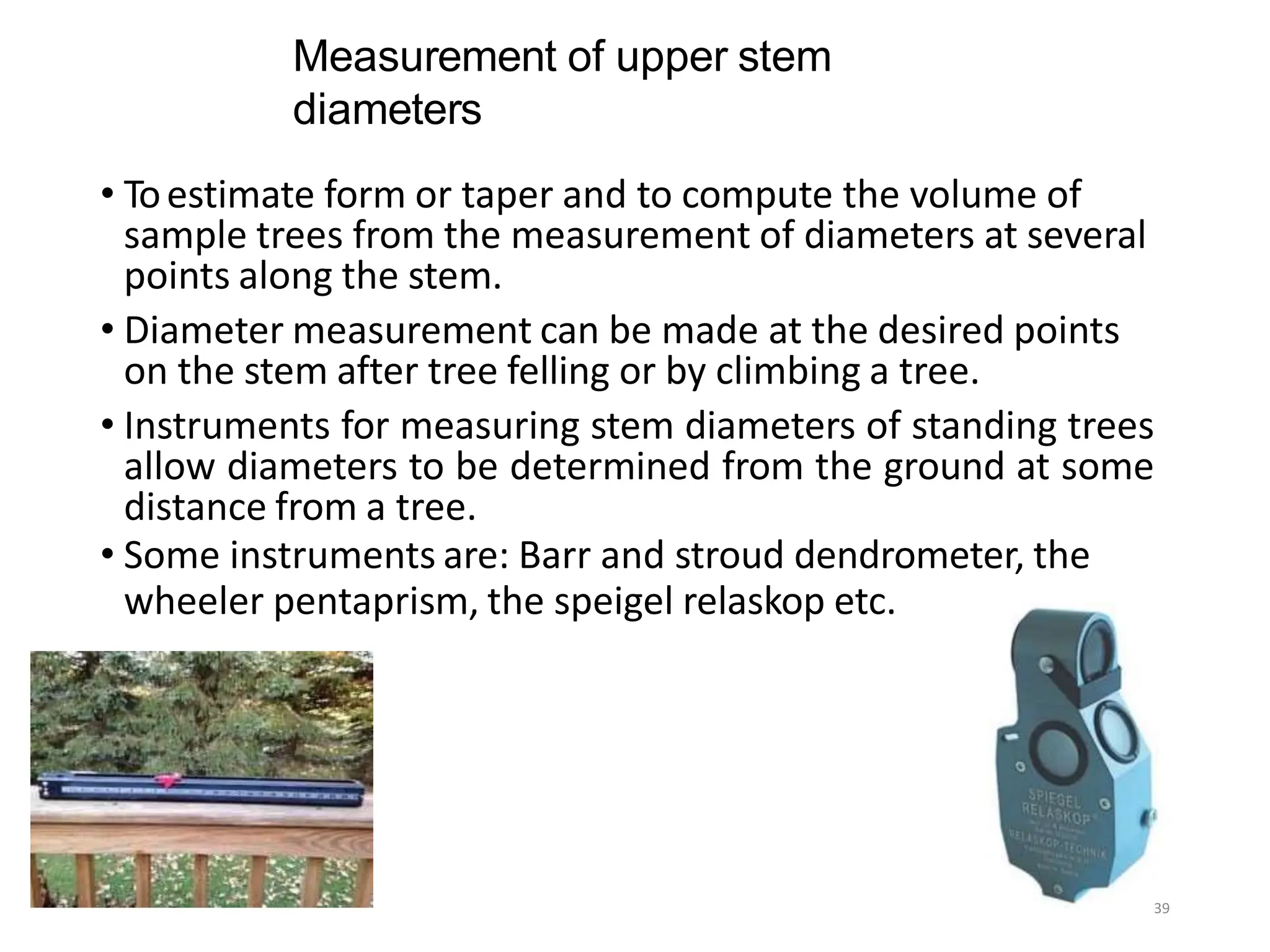
Measurement of upper stem
diameters
• Toestimate form or taper and to compute the volume of
sample trees from the measurement of diameters at several
points along the stem.
• Diameter measurement can be made at the desired points
on the stem after tree felling or by climbing a tree.
• Instruments for measuring stem diameters of standing trees
allow diameters to be determined from the ground at some
distance from a tree.
• Some instruments are: Barr and stroud dendrometer, the
wheeler pentaprism, the speigel relaskop etc.
39
Height Measurement
1
40
Height
Measurement
▶ Important variable as it reflects the fertility of the
site at a given areas.
▶ one of the three variables used in the estimation
of tree volume.
▶ Measured from ground level to different points
of the tree.
2
41
Height Measurement
▶ Height is the linear distance of an object normal to the
surface of the earth.
▶ T
ree height isthe vertical distance measured from the
ground surface.
▶ to find out volume.
▶ to find out productive capacity of site
▶ Height of selected trees in a forest are also required to read
volume tables, form factor tables, yield tables etc.
▶ Considered as an index of fertility and with the knowledge of
age it gives a reliable measure of the site quality of a locality.
3
42
Height
▶ Total height of a standing tree isthe distance
along the axis of the tree stem between the
ground and the tip of the tree.
▶ Bole height isthe distance along the axis of
tree between ground level and crown
point. (crown point isthe position of the first
crown forming branch).
▶ Commercial bole height is the height of bole
that is
usually fit for utilization astimber.
▶ Height of standard timber bole isthe
height of the bole from the ground level
up to the point where average diameter
over bark is 20cm.
▶ Stump height is the distance between the
ground and basal position on the main
stem where a tree is cut.
4
43
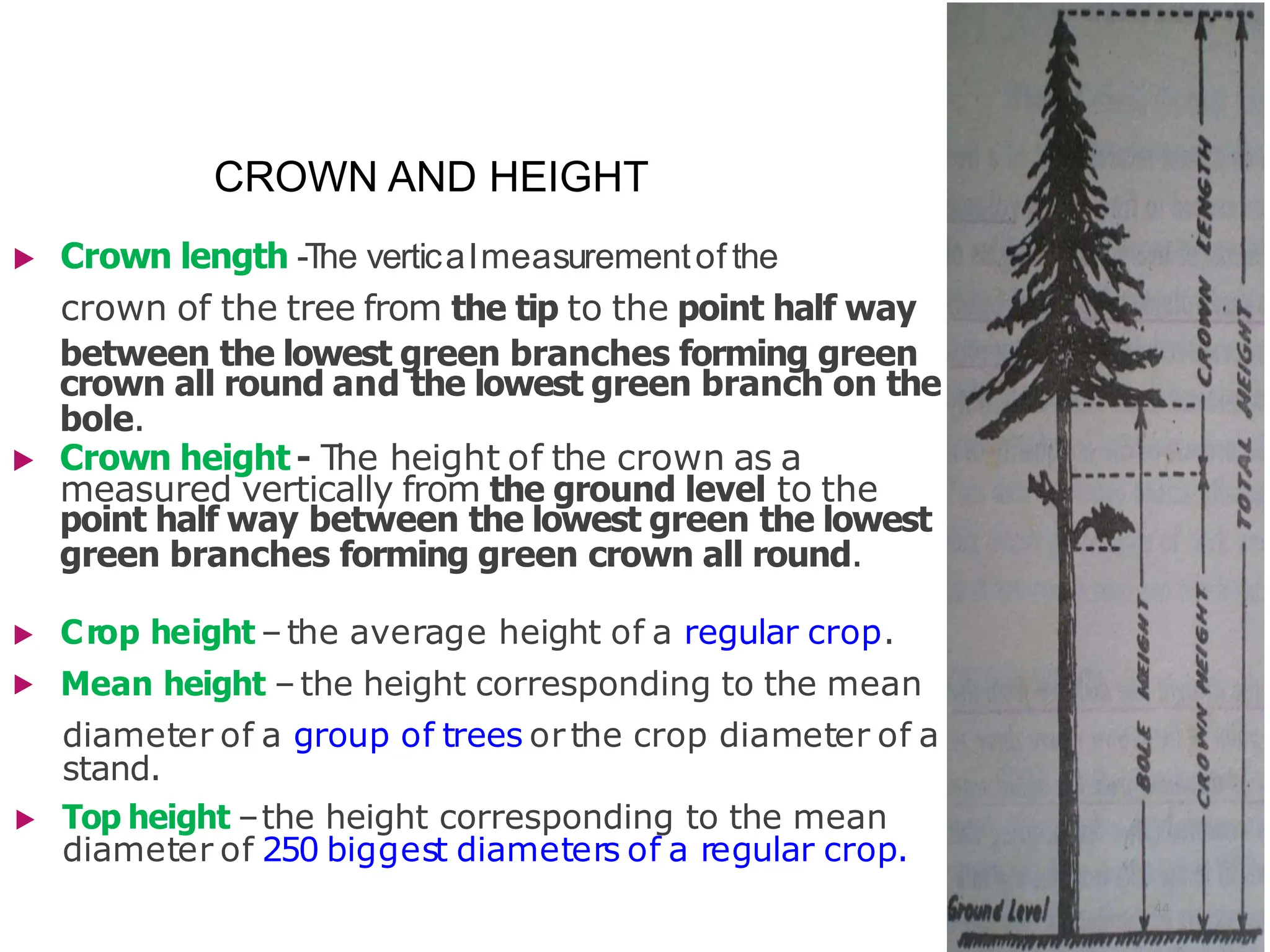
▶ Crown length -The verticalmeasurementof the
crown of the tree from the tip to the point half way
between the lowest green branches forming green
crown all round and the lowest green branch on the
bole.
▶ Crown height - The height of the crown as a
measured vertically from the ground level to the
point half way between the lowest green the lowest
green branches forming green crown all round.
▶ Crop height –the average height of a regular crop.
▶ Mean height –the height corresponding to the mean
diameter of a group of trees orthe crop diameter of a
stand.
▶ Top height –the height corresponding to the mean
diameter of 250 biggest diameters of a regular crop.
CROWN AND HEIGHT
44
Principle of Height
Measurement
45
Principles of Height
Measurement
Two principles of height measurement
Trigonometric principles and
Principle of similar triangle.
46
Trigonometric principles
• The principles follow the basic rules of trigonometry for
deriving heights of trees from distance and angle
measurements.
• Two laws are applicable for this purpose and they are:
•tangent law and
•sine law.
• Brandis Hypsometer, Abney's Level, HAGA Altimeter, Blume-
leiss hypsometer, Relaskop
47
Tangent
Law
• Applicable to right angle triangle
• Instruments based on this principle are Abney's level, clinometers,
altimeter etc.
• For accurate results, trees must not lean more than 5° from the vertical, and the fixed horizontal distance must be determined by taped measurement
• Let ABC be a right-angled triangle. The trigonometrical ratios of angle
ACB are defined as follows:
1. AB/AC is called sine.
2. BC/AC is called cosine.
3. AB/BC is called tangent.
• If AB is assumed to be a tree and C the position of the observer, then AB
can be calculated from tangent ratio as follows:
• AB = BC × tan angle ACB, where BC is the horizontal distance of the
observer from the tree and angle ACB can be measured by any angle
measuring instrument. This is known as the tangent method.
A
B
C
48
Sine Law
• Applicable to non right angle triangle and is useful in
deriving tree height in difficult conditions.
A
B
• Trigonometry also tells us that in any triangle, sines of angles
are proportional to the opposite sides.
• Thus in the triangle ABC in fig,
• Sin <ACB/AB = sin<CAB/BC = sin<ABC/AC
C
• The knowledge on this relationship can also be used in
calculation of heights of trees and is known as the sine
method.
49
Principle of Similar Triangle
•Two triangles are said to be similar only by one of the
following conditions:
1.Each angle of a triangle is equal to its corresponding angle
of the other triangle.
2.Each side of a triangle is proportional to the corresponding
side of the other triangle and
3.One angle of a triangle is equal to one angle of the other
and the corresponding sides which subtend the equal angles
are proportional.
•Eg. Christen's Hypsometer, Smythies Hypsometer,
Improvised Calipers
50
Principle of
Similar Triangle
• Let ABC and A’B’C be two similar triangles. A'B' and B'C are known in
triangle A'B'C and only BC is known in triangle ABC. Then AB can be
found as follows:
• AB/A'B' = BC/B'C
• Or, AB × B'C = A'B' × BC
• Therefore, AB = (A'B' × BC)/B'C.
• This is known as principle of similar triangle.
A
B
C
A'
B'
51
• The basic assumptions in applying these principles for
measuring the heights of trees are that:
1. the tree is vertical and
2. the tip and the base of the tree are simultaneously visible.
• When the base of the tree is not visible from a distance, the
sight may be taken on a point on the stem, which is of
known height above the base.
• In such cases, it is better to place a staff of height equal to
observer’s eye height against the tree and sight the top of
the staff in place of the base.
• Then the height of the tree can be calculated using principle
of similar triangle.
52
Methods of Height Measurement
• Ocular Estimate: by using
• specific length of pole.
• Non Instrumental methods
• ▶ Shadow method:a
pole of convenient
length is fixed upright in
the ground and its
height above the
ground is measured.
The shadows of the
pole and the tree are
also measured.
B
A
a
b D
d
AB/ab =BD/bd, AB =BD x
ab/bd
Where, AB isthe tree, ab isthe
portion of the pole above the
ground level, BD isthe length
of shadow of the tree and bd
isthe shadow of ab.
6
53
Single pole method
▶ Pole of about 1.5 m length
vertically at arm’s length in
one hand in such a way that
portion of the pole above the
hand isequal in length to the
distance of the pole from eye.
AB/ab =EB/Eb i.e. AB =EB x ab/Eb
Where,
AB =tree, ac=pole about 1.5 m long,
Eb=ab
7
54
Instrumental method
▶ By using a instruments like hypsometer,
clinometer, altimeters, abneys level,
improverised calipers etc.
▶ All these instruments are based either on
geometric principles of similar triangles or on
trigonometric principles.
8
55
Measurement of tree height
(vertical tree) in plane and
slope
On level ground
▶ T
he height of the tree is
calculated with the help
of the tangents of the
angle to the top and the
distance of the observer
from the tree.
AB =AD +BD =ED tanα +BD =BF tan α +EF
Where, AB =tree, EF =eye height of the observer,
BF =horizontal distance
10/13/2020
ForestMensuration:Unit 2: HeightMeasurement
9
56
On sloping ground
▶ Where the observer is
standing at such a place
that the top of the tree is
above the eye level and
the base below it.
AB =AD +DB
=ED tan α +ED tan β =ED (tan α +tanβ)
=EB Cosβ (tan α +tanβ)
10
57
On sloping ground
▶ Where top and
base of the tree are
above the eye level.
AB =AD-BD
=ED tan α –ED tan β =ED (tanα-tan β)
=EB cos β (tanα-tan β)
11
58
On sloping ground
▶ Where base and
top of the tree are
below the eye level
AB =BD – AD
=ED tan β – ED tan α =ED (tan β - tan α)
=EB cos β (tan β - tan α)
12
59
Measurement of
leaning trees
▶ Height measuring instrumentsassume
that the tree isvertical
▶ but in practice, forest trees are rarely
vertical
▶ chance of either over estimating or
under estimating the tree height.
▶ height of the tree leaning towards the
observer isover estimated and tree
leaning away from the observer isunder
estimated.
13
60
Measurementof the height of Leaning
Tree
leaning trees
Case (I)
(a) In case of the observer standing at between the top
and bottom of the tree (lean away from observer).
Height= distance X sin (top angle +
bottom angle)
Cos (top angle +
lean angle)
(b) Same ascase (I)a, but lean istoward the observer.
Height= distance X sin (top angle +
bottom angle)
Cos(top angle -lean angle)
10/13/2020
ForestMensuration:Unit 2: HeightMeasurement
14
β
θ
A
B
C
D
E
90-
?
?
β
A
C
E
90-
θ
D
B
61
Case (I
I
)
(a) When the observer is below the top and bottom
of the tree (lean away from observer)
Height = distance X sin (top angle -bottom angle)
Cos(top angle +
lean angle)
(b) Same ascase (II)a, but lean toward the
observer
Height = distance X sin (top angle -bottom angle)
Cos(top angle -lean angle)
15
Measurementof the height of Leaning
Tree
62
Case (I
I
I
)
(a)When the observer is above the top and bottom of
the tree (lean away from the observer)
Height= distance X sin (bottom angle –top angle)
Cos (top angle -lean angle)
(b) Same ascase (III)a, but lean toward from the
observer
Height= distance X sin (bottom angle –top angle)
Cos (top angle +
lean angle)
16
Measurementof the height of Leaning
Tree
63
Measurement of the
lean
tree
▶ A plumb bob
▶ Device reading angle
17
64
Measuring height of
lean tree
18
65
Sources of errorin Height
measurement
▶ Instrumental and personal errors
▶ Errors due to measurement and
observation
▶ Errors due to lean of trees
The height of the tree leaning towards the
observer isover estimated while that of
leaning away from the observer is under-
estimated
T
he percentage error due to lean
𝐶𝑜𝑠 (𝑎𝑛𝑔𝑙𝑒 𝑜𝑓 𝑒𝑙𝑒𝑣𝑎𝑡𝑖𝑜𝑛±𝐿𝑒𝑎𝑛 𝑎𝑛𝑔𝑙𝑒)
− 1 × 100
𝐶𝑜𝑠 𝑎𝑛𝑔𝑙𝑒 𝑜𝑓 𝑒𝑙𝑒𝑣𝑎𝑡𝑖𝑜𝑛
+towards, - away
19
66
Instrument Used in Height
Measurement
▶ VariousInstrument
▶ Instrumentare based ontrigonometrical and geometric
principle
▶ Instrumentbased ontrigonometrical are more accurate than
the ones employinggeometrical principles
20
67
Instrument Used in
Height
Measurement
▶ Christen Hypsometer
▶ BLUME-LEIS
SDendrometer
▶ T
he HAGA Dendrometer
▶ SUNT
O Clinometer
▶ Abney's level
▶ Relaskop
▶ Vertex
▶ Range Finder
21
68
Some other
terminologies
• Crop diameter – diameter corresponding to the mean basal
area of a uniform, generally pure crop.
• Mean diameter – diameter corresponding to the mean basal
area of a group of trees or a stand; sometimes used for the
arithmetic mean of the summated diameters.
• Top diameter – diameter corresponding to the mean basal
area of the biggest trees in a uniform, generally pure crop
69
• Crown – the upper branchy part of a tree above the bole
• Canopy – the cover of branches and foliage formed by the
crowns of trees in a wood.
• Crown width – maximum spread of the crown along its
widest diameter.
• Crown cover – the horizontal projection on the ground of
the tree crown.
• Canopy density- measure of relative completeness of
canopy
(1=closed, 0.75-1 =dense, 0.5 -0.75 = thin and <0.5 =open)
70
Measurement of
log and fuelwood
1
71
Log volume by direct
measurement
▶ volume estimation based on measurements of
diameter and length of log.
▶ measurements made most accurately when the
logs are separate and accessible to measurer
.
▶ Piles of logs cannot easily be measured
accurately
▶ logs are neither cylinder nor of any regular
geometric shape
▶ shape of a quadratic paraboloid isadopted
72
Formulae for log volume
calculation
▶ Volume: traditional and important measure of wood quantity
in spite of increasing use of weight or biomass asa measure of
forest productivity.
▶ Basal portion: frustum of Neiloid,
▶ the middle portion: frustum of Paraboloid and
▶ the top portion: cone.
▶ Formula
▶ Huber'sFormula
▶ Smalian'sFormula
▶ Neuton'sFormula
73
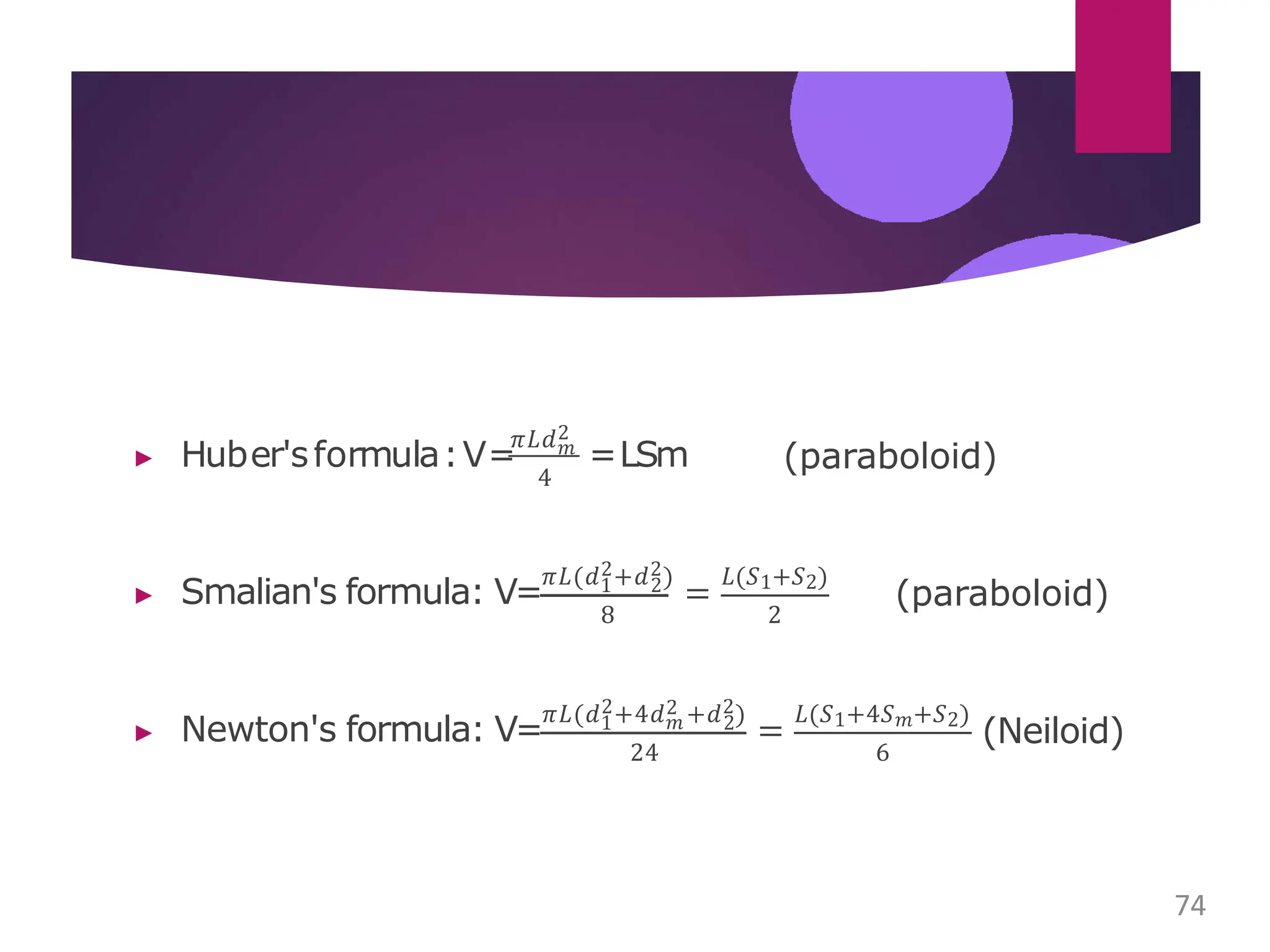
𝜋𝐿𝑑2
4
▶ Huber'sformula:V= 𝑚
=LSm (paraboloid)
𝜋𝐿(𝑑2+𝑑2)
8
▶ Smalian's formula: V= 1 2
=
𝐿(𝑆1+𝑆2)
2
(paraboloid)
𝜋𝐿(𝑑2+4𝑑2 +𝑑2)
24
▶ Newton's formula: V= 1 𝑚 2
=
𝐿(𝑆1+4𝑆𝑚+𝑆2)
6
(Neiloid)
74
Prismoidal or Newton's Formula
▶ Best and Accurate for volume calculation
▶ givesvolume of frustum of Neiloid
▶ used to calculate the error in volume calculated by
other formulae
▶ difficultto apply for stacked.
75
Smalian'sFormula
▶ givesvolume of the frustum
of Paraboloid & cylinder
▶ overestimates the volume
▶ easy to used on stacked log
▶ Positive error
Difference between S& N
= −
2 6
𝑆1+𝑆2
× 𝐿 𝑆1+ 4𝑆𝑚+𝑆2
× 𝐿
=𝐿
6
3𝑆1 + 3𝑆2 − 𝑆1 − 4𝑆𝑚 − 𝑆2
=𝐿
6
=𝐿
3
2𝑆1 + 2𝑆2 − 4𝑆𝑚
𝑆1 + 𝑆2 − 2𝑆𝑚
76
Huber'sFormula
▶ gives the volume of the frustum of
paraboloid (&cylinder)
▶ underestimates the volume
▶ difficult to apply particularlywhen the
logs are stacked
▶ more easy and accurate than
smalian’s formula
▶ Negative error
Difference between H & N
= 𝑆𝑚 × 𝐿 −
6
𝑆1+ 4𝑆𝑚+𝑆2
× 𝐿
=𝐿
6
6𝑆𝑚 − 𝑆1 − 4𝑆𝑚 − 𝑆2
6
=𝐿
[2𝑆𝑚 − (𝑆1 + 𝑆2)]
77
Cubic Volume of squared
timbers
▶ 𝑉 =
▶ Quarter girth formula is also know as Hoppus
formula, gives the under estimate ( only 78.5 %
)
▶ measured by log rule known as the "quarter girth".
or"Hoppus rule"in which girth ismeasured in
inches at the middle of the log and length in feet,
the volume of log in cubic feet.
2
𝑔 𝐿
×
4 144
▶ system of measurement used in Great Britain and
also in Nepal for sale purpose when round timber
issold by volume
Volume =𝜋𝑟2𝑙
g =2πr & r= 𝑔
Volume =π
2𝜋
𝑔
2𝜋
2
𝐿
4𝜋
Full cir Vol.(V1) = 𝑔 2
𝐿
16
Quarter G Vol. (V) =𝑔 2
𝐿
Thus
𝑉1 16
𝑉 4𝜋
= = 0.785 = 78.5%
78
Stacked volume
▶ bulk volume occupied by the pieces of wood
one meter long piled on one meter width, and
one meter height.
▶ Volume containsairspace
▶ piling co-efficient used to get the actual
volume.
▶ Ifthe wood were cylindrical and of the same
diameter the piling co-efficient should be
4
▶
𝜋
= 0.7854
79
Solid volume of firewood
(I) Xylometric method
▶ W:w =V:v
▶ Where, W is the weight of the whole stack of wood, w is the weight after
submersed into a water, V is the volume of former and v is the volume of later
▶ This method is, however cumbersome and seldom used in practice
( II) specific gravity method
▶ if the specific gravity of wood is known then volume can be calculated from
the weight of the billet, specific gravity of pieces of wood
▶
weight of wood
weight of same volume of water
▶ Or ratio of the density of wood and density of water
80
Dimensionsof Chatta
▶ Standard size of Chatta =5 ft x 5 ft x 20 ft =500 cft including air
space.
▶ One Chatta in metric unit =14.16 m3
▶ The following formula should be used in order to calculate the
amount of fuelwood that is obtained from the total volume up to
10 cm top-diameter of class IIIand the remaining portions up to
20 cm top-diameter of class Iand IItrees which could not be used
as timber.
▶ Amount of fuelwood in terms of number of Chatta
=(0.8778xvol.I+1.4316xvol.II+3xvol.III)/1000
Where, Vol.I =gross volume of up to 20 cm top-diameter of class I
trees, Vol.II =gross volume of up to 20 cm diameter of class IItrees
and Vol.III=gross volume of up to 10 cm top-diameter of class III
trees.
81
Class I=Green, dead or dying, standing or uprooted
tree having good and solid trunk in which sign of any
disease or wound is not visible from outside.
Class II=Green, dead or dying, standing or uprooted
tree in which complete volume could not be
realised due to hollowness or other sign of defect
but at least two straight logs of each 1.83 m (6ft)
long orone straight log of 3.05m (10 ft) long which
should have at least 20 cm diameter could be
recovered.
Class III=Remaining trees which do not belong to class
Iand classII
82
Measurement of Form
83
Sub Headings
1. Form Factors and its types
2. Form quotient and its types
3. Taper Table
84
▶ 3.1 Form Factor and Its Types
▶ Tree has verities of shape and size
▶ Form isdefined asthe rate of taper of a log or
stem.
▶ T
aper isthe decrease in diameter of a stem of a
tree or of a log from base upwards.
▶ T
he taper variesnot only with species, age, site
and crop density but also in the different parts of
the same tree.
▶ Basal portion of the tree corresponds to the
frustum of Neiloid, the middle portion to the
frustum of Paraboloid and the top portion to a
cone
D1
D2
D3
85
- straight bole
- fine branches
- no apparent defects etc.
Perfect tree form
86
- not ideal
- some kinks in stem
- evidence of insect attack etc.
Acceptable tree form
87
- crooked bole
- severe butt sweep
- forked
- evidence of diseases e.g.
rot
Unacceptable tree form
88
89
90
91
92
Tree form - theories
 Nutritional theory
 Water conducting theory
 Hormonal theory
 Mechanistic theory or Metzger's beam theory
93
▶ Nutritional theory and Water conducting theory are
based on ideas that deal with the movement of
liquids through pipes. They relate tree bole shape to
the need of the tree to transport water or nutrients
within the tree
▶ The hormonal theory envisages that growth
substances, originating in the crown, are distributed
around and down the bole to control the activity of
the cambium. These substances would reduce or
enhance radial growth at specific locations on the
bole and thus affect bole shape.
94
Metzger’s Theory
• Has received greatest acceptance so far
• Tree stem - a beam of uniform resistance to
bending, anchored at the base and
functioning asa lever  asa Cantilever
beam of uniform size against the bending
force of the wind
• Maximum pressure is on the base so the tree
reinforces towards the base and more
material deposited at lower ends
95
Metzger’s Theory or Girder
Theory
▶ Metzger
▶ a German forester
▶ theory to explain variationsin taper from tree to
tree and in the same tree.
▶ the tree stem should be considered asa
cantileverbeam of uniform size against the
bending force of the wind.
▶ T
he wind pressure acts on the crown and is
conveyed to the lowerparts of the stem in an
increasing measure with the increasing length of
the bole.
▶ Thusthe greatest pressure is exerted at the base
and there isa danger of the tree snapping at that
place.
▶ To counteract this tendency, the tree reinforces
itself towardsthe base.
d
L
P
96
Metzger’s Theory or Girder
Theory
▶ The limited growth material is so distribute among the trees stem
that it affords a uniform resistance all along its length to that
pressure.
▶ As the pressure in the upper part of the tree is less, due to smaller
length of the lever in that portion it isallocated lesser growth
material than the lower part where the pressure gets increased with
the increased length of the bole.
▶ The pressure of wind on crowns keeps on changing as the tree is
growing in open or crowed portion.
97
▶ T
rees growing in complete isolation have largercrownsand
so the pressure exerted on them is the greatest.
▶ Ifsuch a tree is to exist, it should allocate most of the growth
material towards the base even though it may have to be
done at the expense of height growth.
▶ That is why trees growing in complete isolation or exposed
situations have short but rapidly tapering boles while the
trees growing in dense crops have long and nearly
cylindrical boles.
98
Metzger’s Theory
or Girder Theory
▶ T
hiscan be proved mathematically asfollows:
then by the rule of mechanics,
▶ S=[(P ×l)/d3] ×(32/π)
▶ As the force P in case of trees consists of components W =wind pressure
per unit area and F =crown area, it will be P =W ×F
. Then,
▶ S=[(W ×
F ×l)/d3] ×(32/π)
▶ Or
, d3 =(32 ×W ×
F×l)/ π ×S
▶ For a given tree W
, F and Scan be considered as constant. Therefore,
▶ d3 =kl, where k isa constant.
▶ Thus, the diameter rose to the third power increases proportionately with
lengthening of the lever or with the increasing distance from the central
point of application of wind force, which can be assumed to be at the
centre of gravity of the crown.
17
P =force applied to a
cantileverbeam at itsfree
end
l =the distance of a given
crosssection from the point
of application of thisforce,
D =the diameter of the
beam at thispoint and
S=the bending stress
kg/cm2,
99
19
100
High Taper
▶ Solitary
▶ Widely spaced
▶ Heavily thinned
Low T
aper
▶ Groups
▶ Closed together
▶ Lightly thinned
Competition for
Light
Water
Nutrients
Lesscompetition High competition
101
Definition of FormFactor
▶ Form factor is defined as the ratio of the volume of
a tree or its part to the volume of a cylinder having
the same length and cross-section as the tree.
▶ the ratio between the volume of a tree to the
product of basal area and height.
▶ F =V/(S×h)
▶ Where F isthe form factor
,
▶ V isthe tree volume in cubic units,
▶ Sis the basal area at breast-height in area units, and
▶ h isthe height of the tree in linearunits.
102
Types of FormFactors
▶ Depending on the height of
measurement of basal area and on
the parts of the tree considered, form
factors are of three types. T
hey are:
i. Artificial (or breast height) form factor
ii.Absolute form factor
iii.Normal (or true) form factor
103
Artificial (or breast height) form
factor
▶ For this form factor, basal area is measured at the breast height
and the volume refers to the whole tree both above and below
the point of measurement.
Why is the artificial form factor not reliable?
▶ The point of diameter measurement is fixed and it bears no fixed
relation to the height of the tree which is that of the whole tree
and not of the portion above the breast height.
▶ So the trees of same form but different heights will have different
form factors.
▶ Not withstanding its unreliability as a measure of tree form, the
artificial form factor is universally used because its computation
involves handy measurement.
104
Specific breast height form
factors
Cylinder 1.00 (>0.9)
Neiloid 0.25 (0.2-0.3)
Conoid 0.33 (0.3-
0.45)
Quadratic paraboloid 0.50 (0.45-
0.55)
Cubic paraboloid 0.60 (0.55-
0.65)
If the appropriate bh form factorfora tree of a given
age, species and site can be determined, then the
stem volume iseasily calculated by multiplying the
form factorby the tree height and basal area.
105
Absolute form factor
▶ For this form factor, basal area is measured at any
convenient height and the volume refers only to
that part of the tree above the point of
measurement.
106
Normal (or true) form factor
▶ In this form factor, basal area is measured at a constant
proportion of the total height of tree, e. g., 1/10th, 1/20th
etc., of the total height and the volume refers to the
whole tree above ground level.
▶ This form factor has several disadvantages, viz.,
(i) the height of the tree has to be determined before the point
of measurement can be fixed, and
(
i
i
) T
he point of measurement may be very inconvenient in case
of very tall as well as very short trees.
▶ Absolute and normal form factors are no longer used.
107
Uses of FormFactors
The form factorsmay be used for following purposes:
1. To estimate volume of standing trees
▶Form factors may be compiled into tabular form giving average form
factor of trees of different dimensions by diameter and height
classes.
▶These tables can be used to estimate the volume of standing trees
by measuring theirdiameter and height.
▶ To study the lawsof growth
▶ Form factor along with form point and form quotient give an insight
into the laws of growth, particularly the stem form, of trees.
108
Form quotient
• Ratio of the diameter at two
different places on the tree
• Generally calculated for some
point above bh to the dbh
• Absolute form quotient –most
common
dbh
bh
109
Form Quotient and ItsTypes
Basically there are two types of form quotients
i.Normal form quotient –postulated by A. Schiffel
ii.Absolute form quotient –postulated by T
. Jonson
i. Normal form quotient
▶ It isthe ratio between the mid-diameterand the dbh.
▶ FQ =mid-diameter/dbh
▶ Drawback
▶ Schiffel’s formula was, obviously, not always true because in case of a tree
of 2 ×1.3 m height, the mid-point will be breast height and therefore FQ will
be 1.
110
ii. Absolute form quotient
▶ It isthe ratio of diameter or girth of a stem at one
half of itsheight above the breast height to the
diameter or girth at breast-height.
▶ Absolute form quotient is used in practice
throughout the world.
Form point- the point in the crown as which wind
pressure is estimated to be centered.
Form point ratio isdefined as the relationship of
the form point above ground level to the total
height of the tree.
111
Taper Table and Formulae
▶ The rate of tree taper varies not only by species but also by age, dbh
and tree height.
▶ Taper tables are compiled by a series of diameter measurements
taken at intervalsalong the bole.
Formulae
▶ Kozak et al. (1996) have shown that for certain coniferous species,
upper stem diameters (dib) can be reliably predicted from this
parabolic function:
▶ d2/dbh2 =b0 +b1 (h/H) +b2 (h2/H2)
▶ T
herefore, d =dbh √[b0 +b1 (h/H) +b2 (h2/H2)]
▶ Where d =stem diameter at any given height h above ground
▶ H =total tree height
▶ b0, b1, b2 =Régression coefficients
112
▶ Diameter Taper Table : gives taper
directly for dbh without referring to the
tree form
▶ Form Class Taper Table : Dia at
different fixed points on the stem
expressed as %of dbh (ub) for different
form classes
113
General formulae or equations for tree form;
 Hojer`s formula
▶ d/dbh = C log c+
l
c
▶ Where, C and c are constants, l is the distance from the top of the tree
to the point at which d is measured, expressed in percentage
 Behre`s formula
▶ d/dbh =l/(a+
bl)
▶ Where, a and b are constants foreach class, such that a +
b =
1 and d
an l have the same meaning asgiven for Hojer`
sformula
▶ This formula is more consistent ( Reliable )
114
Crown and foliage
115
Crown
Measurement
116
Tree Crown
The tree crown is the upper part of a tree that consists of the
branches, leaves, and reproductive structures.
It is the part of the tree that is visible above the trunk and is
often referred to as the "canopy."
The size, shape, and density of the crown can vary depending
on the species of the tree, its age, and its growing conditions.
The crown plays a vital role in the tree's survival by providing
the tree with the ability to photosynthesize and produce
energy, as well as protect the tree from environmental
stressors such as wind, drought, and extreme temperatures.
The crown is also important for ecological functions, such as
providing habitat for wildlife and contributing to the overall
biodiversity of the forest ecosystem.
117
Importance of Crown
Measurement
Estimating tree volume: Crown measurement provides an accurate
estimation of the size and shape of the tree crown, which is used to
calculate tree volume. Accurate tree volume estimation is essential for
forest management and planning, such as predicting timber yield and
planning harvesting operations.
Assessing forest health: The size, shape, and condition of the crown can
indicate the health status of the tree. A healthy tree will typically have a full,
symmetrical crown with uniform branching, while a tree with a small or
irregular crown may be suffering from stress, damage, or disease.
Monitoring growth and stand dynamics: Crown measurement can be used
to track the growth and development of individual trees over time. This
information can be used to assess the overall health and productivity of the
forest stand, as well as to predict future growth and yield.
118
Importance of Crown
Measurement
Evaluating competition: Crown measurement can help to identify
competition for resources, such as light, water, and nutrients, between
trees in the stand. This information can be used to develop
management strategies that promote the growth and productivity of
the most valuable trees.
Planning silvicultural treatments: Crown measurement is essential for
planning silvicultural treatments, such as thinning or pruning, which can
improve the quality and value of the timber stand. Accurate crown
measurements can help to determine which trees should be removed
or pruned to achieve specific management objectives.
119
Methods of Crown
Measurement
Visual estimation: This involves making an
approximation of the size and shape of the crown by
eye. This method is quick and easy but may be less
accurate than other methods.
Tape drop method: This involves dropping a weighted
tape measure from the top of the tree and measuring
the distance between the ground and the tape
measure. This measurement can be used to estimate
the height and size of the crown.
Point sampling: This involves measuring the distance
from a fixed point to the edge of the crown at regular
intervals around the tree. These measurements are
used to calculate the average radius and area of the
crown.
120
Tape drop method
121
Methods of Crown
Measurement
Photogrammetry: This involves taking aerial photographs of
the tree and using software to create a three-dimensional
model of the crown. This method can provide highly
accurate measurements of crown size and shape.
LiDAR: This involves using laser technology to create a three-
dimensional model of the tree and its crown. This method
can provide highly accurate measurements of crown size
and shape, as well as information about the structure of the
tree and the surrounding forest.
Allometric equations: This involves using mathematical
equations to estimate the size and shape of the crown based
on measurements of other tree characteristics, such as
diameter at breast height and height. This method is less
accurate than other methods but can be useful when direct
measurements are not feasible.
122
Leaf Area Index
(LAI)
123
Leaf area index (LAI)
Leaf area index (LAI) is a measure of the total area of leaves in relation
to the ground surface area. It is an important parameter for
characterizing vegetation structure and function, and is commonly used
in ecological research, agriculture, and forestry.
124
Methods for measuring LAI
Direct measurement: This involves physically collecting and measuring
all of the leaves within a defined area. This can be time-consuming and
labor-intensive, but provides the most accurate measurement of LAI.
Non-destructive measurement: This involves using instruments such as
a LAI-2000 plant canopy analyzer or hemispherical photography to
indirectly measure LAI without collecting or damaging the leaves. This
method is less labor-intensive but may not be as accurate as direct
measurement.
Remote sensing: This involves using satellite or aerial imagery to
estimate LAI. This method is useful for large-scale monitoring but may
be less accurate than direct or non-destructive methods.
125
Direct measurement of LAI
Define the measurement plot: Define a plot within the selected area, typically 1-4 m²
in size. The plot size should be large enough to capture the variability of the
vegetation within the area.
Harvest the leaves: Harvest all the leaves within the plot using a hand-held leaf area
meter or scissors. The leaves should be collected in a way that ensures they are not
damaged or crushed.
Measure the leaf area: Measure the area of each individual leaf using a leaf area
meter or by manually tracing the outline of each leaf onto graph paper and counting
the squares. For small leaves, a leaf area meter is typically used, whereas for larger
leaves, manual tracing is more common.
Select a representative area: Choose a representative area
of the vegetation that is typical of the whole vegetation
type being studied.
126
Direct measurement of LAI
Calculate LAI: Calculate the LAI by summing the leaf area of all leaves
collected within the plot and dividing by the ground surface area of the
plot. The ground surface area can be calculated by measuring the length
and width of the plot and multiplying them.
Repeat measurements: Repeat the above steps in multiple plots to
obtain a representative estimate of LAI for the entire area of interest.
Direct measurement of LAI can be time-consuming and labor-intensive,
especially for larger areas, but it provides the most accurate
measurement of LAI. It is important to ensure that the sampling design is
representative of the vegetation being studied to obtain accurate and
meaningful results.
127
Non-destructive measurement
The LAI-2000 plant canopy analyzer is a portable device that
measures LAI by detecting the amount and distribution of
photosynthetically active radiation (PAR) within a plant canopy.
The following are the general steps involved in using the LAI-2000
plant canopy analyzer:
Set up the instrument: Set up the LAI-2000 plant canopy analyzer
according to the manufacturer's instructions. This typically
involves attaching the instrument to a tripod, connecting the
sensor head to the main unit, and calibrating the instrument.
Define the measurement plot: Define a plot within the
vegetation being studied. The plot size should be large enough to
capture the variability of the vegetation within the area.
128
Non-destructive measurement
Take measurements: Hold the sensor head of the
LAI-2000 plant canopy analyzer at a fixed height
above the vegetation and take multiple readings
at different angles to capture the amount and
distribution of PAR within the plant canopy. The
instrument records the PAR values and calculates
the LAI.
Calculate LAI: Calculate the LAI from the PAR
readings using the software provided with the
LAI-2000 plant canopy analyzer. The software
uses algorithms to calculate the LAI based on the
PAR readings and the angle of the sensor head
129
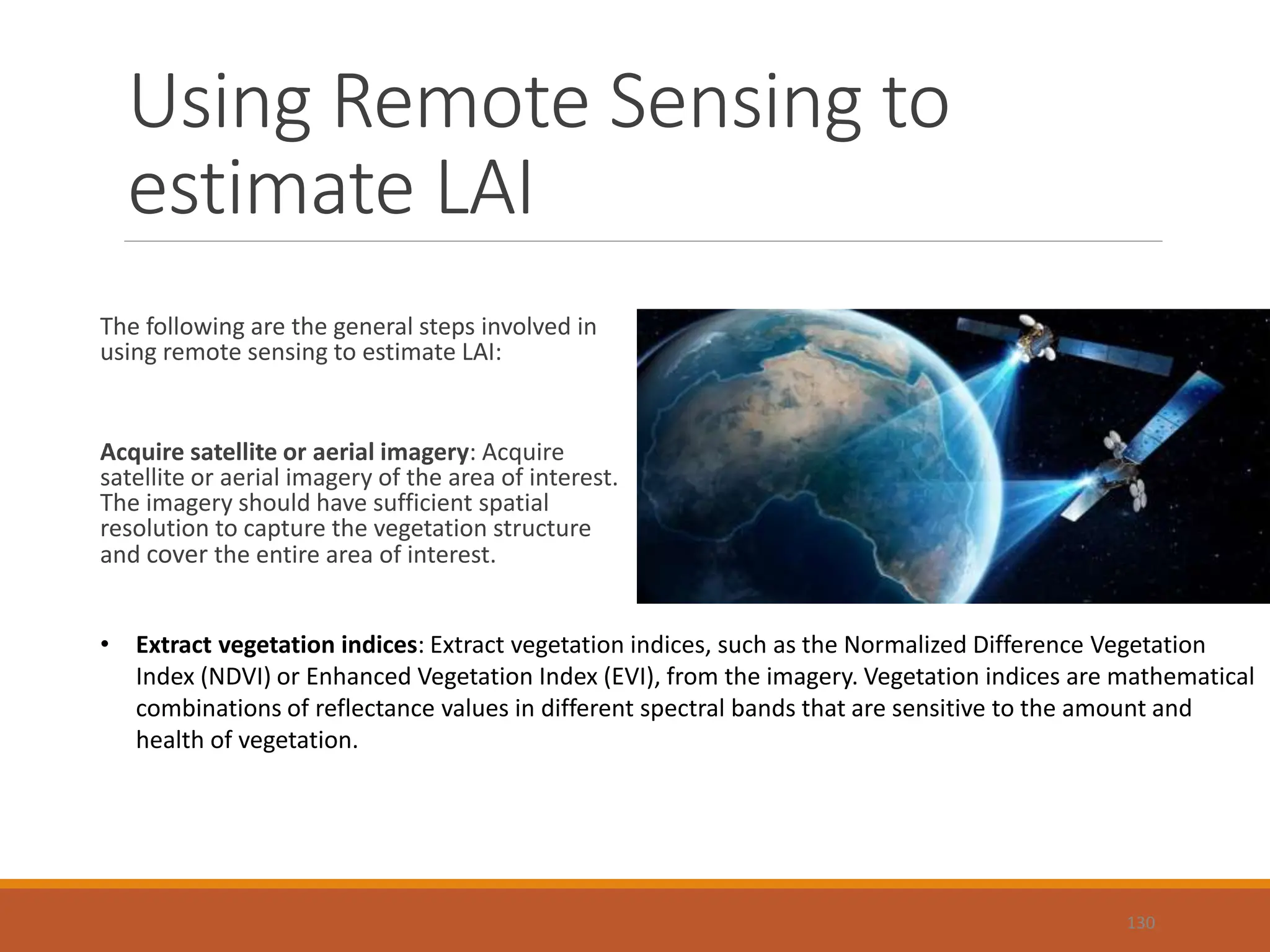
Using Remote Sensing to
estimate LAI
The following are the general steps involved in
using remote sensing to estimate LAI:
Acquire satellite or aerial imagery: Acquire
satellite or aerial imagery of the area of interest.
The imagery should have sufficient spatial
resolution to capture the vegetation structure
and cover the entire area of interest.
• Extract vegetation indices: Extract vegetation indices, such as the Normalized Difference Vegetation
Index (NDVI) or Enhanced Vegetation Index (EVI), from the imagery. Vegetation indices are mathematical
combinations of reflectance values in different spectral bands that are sensitive to the amount and
health of vegetation.
130
Using Remote Sensing to
estimate LAI
Calibrate the vegetation indices: Calibrate the vegetation indices to LAI
using ground-based measurements of LAI. This involves establishing a
relationship between the vegetation indices and LAI using statistical
models.
Estimate LAI: Use the calibrated vegetation indices to estimate LAI for
the entire area of interest. This can be done by applying the statistical
models to the vegetation indices for each pixel in the image.
Validate the LAI estimates: Validate the LAI estimates by comparing
them to ground-based measurements of LAI or other independent
sources of information.
131
Uses of Leaf Area Index (LAI)
LAI is used to estimate crop yield and productivity by providing information
on the amount of photosynthetic area available for plant growth and carbon
assimilation.
LAI is used to monitor the health and vitality of forests, as changes in LAI can
indicate changes in forest structure, biomass, and productivity.
LAI is used in climate models to estimate the exchange of energy, water, and
carbon dioxide between the atmosphere and vegetation, which is critical for
understanding the global carbon cycle and climate change.
LAI is used in hydrological models to estimate the amount of water that is
intercepted by vegetation, which is important for understanding water
balance and water availability.
132
Uses of Leaf Area Index (LAI)
LAI is used in ecological studies to understand the structure and
function of plant communities, including species diversity, resource use,
and competition.
LAI is used in precision agriculture to optimize crop management
practices, such as fertilization and irrigation, by providing information
on the spatial and temporal variability of LAI within a field.
LAI is used in remote sensing applications to estimate biophysical
variables, such as vegetation cover, biomass, and productivity, which are
important for monitoring land use and land cover changes, and for
informing natural resource management policies.
133
Types of Sampling
134
Types of sampling
▶ Probability/random sampling
▶ Simple random sampling
▶ Stratified random sampling
▶ Multistage sampling
▶ Multiphase sampling
▶ Sampling with varying probabilities
▶ Non random sampling
▶ Selective sampling
▶ Systematic sampling
135
Simple Random Sampling
▶ It i
s a selection process in which every possible
combination of sample units has an equal and
independent chance of being selected in the
sample.
▶ Sampling units are chosen completely at random.
▶ For theoretical considerations, SRSis the simplest
form of sampling and is the basis for many
sampling methods.
▶ It is most applicable for the initial survey in an
investigation and for studies that involve sampling
from a small area where the sample size is
relatively small.
136
Selection of SRS by lottery
and random number
table method
When to use
▶ Ifthe population is more or less
homogenous with respect to the
characteristics under study and If
the population is not widely spread
geographically.
16 samples are selected randomly
from a population composed of 256
square plots
137
Advantages
▶ SRSis a scientific method and there is no possibility
of personal bias.
▶ Estimation method are simple and easy.
Disadvantages
▶ Ifthe sample chosen is widely spread, takes more
time and cost.
▶ A population frame or list is needed.
138
Systematic sampling
▶Inthissamplingtechnique, firstunitischosen randomlyand the rest
being automatically selected according to some predetermined
patterns.
▶Systematicsamplingisa commonly employed technique ifthe
complete and up to date listof thesampling unitsis available.
▶Inthissampling,thesamplingunitsare spaced at fixed intervals
throughout the population.
▶Measure of everyith treealong a certain compassbearingis an
example of systematic sampling.
▶A common samplingunitinforestsurveysisa narrowstripat right
anglestoa baselineand runningcompletely across theforest,i.e.
systematic samplingbystrips.
139
▶ Another possibility is known is
systematic line plot sampling
where plots of fixed size and
shape are taken at equal
intervals along equally
spaced parallel lines.
▶ When to use- if the complete
or up to date lists of the
sampling units are available. 16 samples are
selected
systematically from a
population composed
of 256 square plots.
140
JEETENDRA GAUTAM, AGRICULTURE AND FORESTRY UNIVERSITY 141

Forestry Introductory Forest Mensuration.pptx

  • 1.
  • 2.
    Introduction Forest • An areaset a side for the production of timber and other forest produce. • Forests are the lands of more than 0.5 ha with a tree canopy cover of more than 10% which are not primarily under agricultural or urban landuse (FAO). • “Forest” means an area fully or partly covered by trees (Forest Act) Mensuration • It means measurement of length, mass and time etc. • Art and science of locating, measuring and calculating the length of lines, areas of planes, and volumes of solids. 2
  • 3.
    Forest Mensuration • Forestmensuration concentrates on trees and forests or potentially forested locations. • Forest mensuration also includes measuring or calculating growth and change in trees and forests. • Forest mensuration then may be defined as the art and science of providing the quantitative information about trees and forest stands necessary for forest management, planning and research. 3
  • 4.
    Forest Mensuration • Estimationof the total and merchantable stand volume and its size class distribution. • Estimation of the diameter, basal area, height, and volume growth of single trees and forest stands • Estimation of the damages to the quality of individual trees and forest stands In addition, it has to deal with the development of models for the construction of tree volume, taper and biomass functions, the construction of stand tables, as well as the development of growth and yield models. 4
  • 5.
    Overview of Forestmensuration 5
  • 6.
    Importance of ForestMensuration It is the keystone foundation of forestry. • What Silvicultural treatment will result in best regeneration and growth? • What species is most suitable for reforestation? • Is there sufficient timber to supply a forest industry and for an economical harvesting operation? • What is the value of the timber and land? • What is the recreational potential? • What is the wildlife potential? • What is the status of biodiversity on the area? • What is the status of the forest as a carbon sink? 6
  • 7.
    • What isin the forest now? • How is the forest changing? • What can we do to manage the forest properly? • How can it be assessed? • And for what purpose? It helps to answer all these questions and concepts involved in forest management. • Forest mensuration is the application of measurement principles to obtain quantifiable information for forest management decision making. 7
  • 8.
  • 9.
    •Bias is asystematic distortion arising from such sources as a flaw in measurement or an incorrect method of sampling. For example, measurements of 100 ft units with a tape only 99 ft long will be biased. 1.2 Bias, Accuracy and Precision 9
  • 10.
    Common sources ofbias •Flaw in measurement instrument or tool, e. g. survey tape 5 cm short; •Flaw in the method of selecting a sample, e. g. some observers always count the boundary trees while others always exclude it; •Flaw in the technique of estimating a parameter, e. g. stand volume: using a volume function or model in a forest without prior check of its suitability for application in that forest; inappropriate assumptions about the formulae, and •Subjectivity of operators. 1.2 Bias, Accuracy and Precision 10
  • 11.
    Accuracy and precision •Mostly creates confusion with meaning of accuracy & precision • True length of the line is 736.72 m • Suppose that you are asked to measure the same line five times. The first party reports the following measurements: 736.80, 736.70, 736.75, 736.85, and 736.65 m. October 13, 2020 Unit 2: Errors and accuracy • The second party reports the following measurements: 736.42, 736.40, 736.40, 736.42, and 736.41 m. More accurate More precise 11
  • 12.
    Accuracy and precision Accuratebut not precise October 13, 2020 Unit 2: Errors and accuracy Precise but not accurate Accurate and precise 12
  • 13.
    Accuracy and precision •The accuracy is the degree of closeness of measurements of a quantity to that quantity's true value Accuracy depends on  Characteristics of trees  Varying methods and conditions of felling and conversion  Personal bias of the estimator  Instruments Used  Biological character of the forest  Data and methods  Cost  Good planning October 13, 2020 Unit 2: Errors and accuracy 13
  • 14.
    Accuracy and precision •Precision also known as apparent accuracy • Precision is the degree of perfection used in • instruments, methods and observation • Closeness of one measurement to another • Good precision doesn’t mean that good accuracy • Meaning of precision in distance measurement • In distance measurement, Error of measurements Precision Distance measured Number 1 = = Suppose in measuring the distance of 500m the error was found to be .20 m then, precision is 0.20/500 = 1/2500. October 13, 2020 Unit 2: Errors and accuracy 14
  • 15.
    Relationships between bias,accuracy and precision 15
  • 16.
    How to minimizebias The only practical way to minimise measurement bias is by: • Continual check of instruments and assumptions • Meticulous training • Care in the use of instruments and application of methods Complete elimination of bias may be costly. To avoid bias being introduced via faulty instruments, it is essential to check all instruments before one commences any important measuring project and re- check periodically during the course of the project. 16
  • 17.
    Accuracy and precision October13, 2020 Unit 2: Errors and accuracy • How to get both accuracy and precision? • Answer is simple in saying but hard in practicing • So what to do? • Use logical thinking • Be patience in your work • Use good instruments • Apply good procedure 17
  • 18.
    Unit 1.3 System ofMeasurement and Unit Conversion 18
  • 19.
    1.3 Scale ofMeasurement & Conversion • Nominal Scale: • determination of equality/identification (numbering and counting), • used for attributes, • represents the weakest scale of measurement. • The observation is assigned to one out of k discrete categories. • discrete variables which cannot be arranged in a certain order • Eg. Species, provenance, forest type and soil type. • Ordinal scale: • determination of greater or less (ranking) • ranking scale characterized by ordered categories • used for ranked variables (discrete categorical variables) • The scale is characterized by classes of different but unknown width. • Eg. Forest soils, for example, could be categorized as poor, medium or good, the vitality of trees as healthy, sick, dying or dead, social tree classes as dominant, co-dominant, dominated and suppressed. 19
  • 20.
    • Almost allforest mensurational characteristics, such as diameter, height, basal area, volume and increments, are continuous variables, measured on a metric scale. • Metric scale divided into two categories • Interval scale: determination of the equality of intervals or of differences (numerical magnitude of qty, arbitrary origin) eg. Fahrenheit temp., soil moisture etc. • Ratio scale: determination of equality of ratios (numerical magnitude of qty., absolute origin) eg. length of objects, volumes, etc. 1.3 Scale of Measurement & Conversion 20
  • 21.
    1.3 Scale ofMeasurement & Conversion 21
  • 22.
    18 Into Metric Outof Metric If you know Multiply by To get If you know Multiply by To get Length Inches 2.54 Centimeters Centimeters 0.039 Inches Foot 30.48 Centimeters Centimeters 0.39 Inches Yards 0.9144 Meters Meters 3.28 Feet Miles 1.609 Kilometers Kilometers 0.62 Mile Area Sq. Inches 6.45 Sq. Centimeters Sq. Centimeters 0.16 Sq. Inches Sq. Foot 0.09 Sq. Meters Sq. Meters 1.196 Sq. Yards Sq. Yards 0.83 Sq. Meters Sq. Kilometers 0.386 Sq. Miles Sq. Miles 2.59 Sq. Kilometers Hectares 2.47 Acres Volume Cubic Feet 0.028 Cubic Meter Cubic Meter 35.31 Cubic Feet Cubic Yard 0.765 Cubic Meter Cubic Meter 1.3 Cubic Yard 1.3 Scale of Measurement & Conversion 22
  • 23.
  • 24.
    Measurement of trees: •Diameter Measurement • DBH measurement and Its significance • Rules of DBH Measurement and instruments used • Height Measurement • Measurement of height of trees in plane and slope • Instruments used in height measurement • Measurement of logs and fuelwood • Measurement of length, diameter and sectional area of logs • Formula for log volume calculation • Volume of stacked timber and chatta (stacked fuelwood) 24
  • 25.
    Diameter measurement andits significance What is Diameter?? • A straight line passing through the center of a circle or sphere and meeting at each end of circumference or surface. • The most common diameter measurements taken in forestry are of the main stem of standing trees, cut portions of trees and branches. Important because • directly measurable dimensions • tree cross sectional area, surface area and volume can be computed. 25
  • 26.
    • The pointat which diameters are measured will vary with circumstances. • The most frequent tree measurement made by forester is diameter at breast height (dbh). • DBH is defined as the average stem diameter outside bark, at a point 1.3 m above ground as measured • Europe, the UK, and Canada : 1.3 metres • US, Australia, New Zealand, Burma, India, Malaysia, and South Africa, :1.4 metres (previously 1.37m) • The rationale of DBH measurement of individual trees is to estimate the quantity of timber, fuel wood or any other forest products which can be obtained from them. • DBH is important variable to calculate the product quantity. • These measurement are also necessary for making inventory of growing stock as well as to correlate height, volume, age, increment with most easily determinable dimension i.e. dbh 26
  • 27.
    DBH has beenaccepted as the standard height for diameter measurement because … • convenient height for taking measurements • Economically fit • Time Value • escape from abnormalities • standardize the measurement Assumption • Tree stem sections are circular 27
  • 28.
    Rules of DBHmeasurement and instrument used • Moss, creepers, lichens and loose bark found on the tree must be removed before measuring the dia. over bark. • Breast height (BH) should be marked by means of a measuring stick on standing trees at 1.3m above the ground level. • BH point should be marked by intersecting vertical and horizontal lines 12 cm long, painted with white paint. 28
  • 29.
    Rules of DBHMeasurement • On sloping land, the diameter at BH should be measured on the uphill side. • In case of the tree is leaning, dbh is measured along the tree stem and not vertically, on the side of the lean for trees growing on flat ground and on the uphill side, for trees growing on sloping ground. 29
  • 30.
    Rules of DBHMeasurement • Abnormal trees: The dbh should not be measured at 1.3m if the stem is abnormal at the level. BH mark should be shifted up or down as little as possible to a more normal position of the stem and then dia. Measured. • Buttressed trees: BH should be taken at the lowest point above which the buttress formation is not likely to extend 30
  • 31.
    Rules of DBHMeasurement • Forked trees: When the tree is forked above the BH, it is counted as one tree, but when it is forked below BH, each fork should be treated as though it were a separate tree. 31
  • 32.
    Instrumentusedindiametermeasurement •The most commonlyused instruments for measuring diameters at BH are: • Diameter tape, • calipers, • Biltmore stick, and • other optical instruments. 32
  • 33.
    Diameter tape •The diameterof a tree cross section may be obtained with a flexible tape by measuring the circumference of the tree and dividing by π(D=C/ π). •The diameter tapes used by foresters, however are graduated at intervals of π units (in or cms), thus permitting a direct reading of diameter. •A diameter tape is a measuring tape that has scales on both sides: one side is specially marked to show the diameter of a tree, and the other is a normal scale. 33
  • 34.
    How to measurediameter using a diameter tape: • Wrap the diameter tape around the tree at the required height, ensuring that the tape is not twisted and the correct scale is visible. • Make sure the tape is held tightly around the tree and at right angles to the main stem, and • Read the tree diameter from the tape and record to the nearest 0.1cm 34
  • 35.
    How to measurediameter using a diameter tape: • Care must be taken that the tape is correctly positioned at the point of measurement that it is kept in a plane perpendicular to the axis of the stem, and that it is set firmly around the tree trunk. • These tapes are accurate only for trees that are circular in cross section. • The diameter tape is convenient to carry and in the case of irregular trees, requires only one measurement. 35
  • 36.
    Caliper s • Calipers areused to measure tree dbh or when diameters are less than about 60 cm. calipers of sufficient size to measure large trees, or those with high buttresses are awkward to carry and handle, and particularly in dense undergrowth. • metal, plastic or wood, consists of a graduated beam/rule with two perpendicular arms. • One arm is fixed at the origin of the scale and the other arm slides. When the beam is pressed against the tree and the arms closed, the beam of the caliper can be read on the scale. • For an accurate reading, the beam of the caliper must be pressed firmly against the tree with the beam perpendicular to the axis of the tree stem and the arms parallel and perpendicular to the beam. • These are generally less precise than a diameter tape but may be quicker to use, particularly for small trees, and can take into account some degree of stem eccentricity. 36
  • 37.
    How to usecalipers to measure diameter: • Place the calipers over the stem at the required height. Ensure they are held level with the stem and close them gently. Do not apply excess pressure to the calipers as this will compress the bark, resulting in an incorrect measurement. • Record the diameter then take another measurement at a right angle to the first and record this measurement and • Calculate the average of the two measurements and record to the nearest to 0.1cm. 37
  • 38.
    Biltmore Stick • atool used to measure various tree dimensions, such as diameter at breast height and height • Based on similar triangle principle 38
  • 39.
    Measurement of upperstem diameters • Toestimate form or taper and to compute the volume of sample trees from the measurement of diameters at several points along the stem. • Diameter measurement can be made at the desired points on the stem after tree felling or by climbing a tree. • Instruments for measuring stem diameters of standing trees allow diameters to be determined from the ground at some distance from a tree. • Some instruments are: Barr and stroud dendrometer, the wheeler pentaprism, the speigel relaskop etc. 39
  • 40.
  • 41.
    Height Measurement ▶ Important variableas it reflects the fertility of the site at a given areas. ▶ one of the three variables used in the estimation of tree volume. ▶ Measured from ground level to different points of the tree. 2 41
  • 42.
    Height Measurement ▶ Heightis the linear distance of an object normal to the surface of the earth. ▶ T ree height isthe vertical distance measured from the ground surface. ▶ to find out volume. ▶ to find out productive capacity of site ▶ Height of selected trees in a forest are also required to read volume tables, form factor tables, yield tables etc. ▶ Considered as an index of fertility and with the knowledge of age it gives a reliable measure of the site quality of a locality. 3 42
  • 43.
    Height ▶ Total heightof a standing tree isthe distance along the axis of the tree stem between the ground and the tip of the tree. ▶ Bole height isthe distance along the axis of tree between ground level and crown point. (crown point isthe position of the first crown forming branch). ▶ Commercial bole height is the height of bole that is usually fit for utilization astimber. ▶ Height of standard timber bole isthe height of the bole from the ground level up to the point where average diameter over bark is 20cm. ▶ Stump height is the distance between the ground and basal position on the main stem where a tree is cut. 4 43
  • 44.
    ▶ Crown length-The verticalmeasurementof the crown of the tree from the tip to the point half way between the lowest green branches forming green crown all round and the lowest green branch on the bole. ▶ Crown height - The height of the crown as a measured vertically from the ground level to the point half way between the lowest green the lowest green branches forming green crown all round. ▶ Crop height –the average height of a regular crop. ▶ Mean height –the height corresponding to the mean diameter of a group of trees orthe crop diameter of a stand. ▶ Top height –the height corresponding to the mean diameter of 250 biggest diameters of a regular crop. CROWN AND HEIGHT 44
  • 45.
  • 46.
    Principles of Height Measurement Twoprinciples of height measurement Trigonometric principles and Principle of similar triangle. 46
  • 47.
    Trigonometric principles • Theprinciples follow the basic rules of trigonometry for deriving heights of trees from distance and angle measurements. • Two laws are applicable for this purpose and they are: •tangent law and •sine law. • Brandis Hypsometer, Abney's Level, HAGA Altimeter, Blume- leiss hypsometer, Relaskop 47
  • 48.
    Tangent Law • Applicable toright angle triangle • Instruments based on this principle are Abney's level, clinometers, altimeter etc. • For accurate results, trees must not lean more than 5° from the vertical, and the fixed horizontal distance must be determined by taped measurement • Let ABC be a right-angled triangle. The trigonometrical ratios of angle ACB are defined as follows: 1. AB/AC is called sine. 2. BC/AC is called cosine. 3. AB/BC is called tangent. • If AB is assumed to be a tree and C the position of the observer, then AB can be calculated from tangent ratio as follows: • AB = BC × tan angle ACB, where BC is the horizontal distance of the observer from the tree and angle ACB can be measured by any angle measuring instrument. This is known as the tangent method. A B C 48
  • 49.
    Sine Law • Applicableto non right angle triangle and is useful in deriving tree height in difficult conditions. A B • Trigonometry also tells us that in any triangle, sines of angles are proportional to the opposite sides. • Thus in the triangle ABC in fig, • Sin <ACB/AB = sin<CAB/BC = sin<ABC/AC C • The knowledge on this relationship can also be used in calculation of heights of trees and is known as the sine method. 49
  • 50.
    Principle of SimilarTriangle •Two triangles are said to be similar only by one of the following conditions: 1.Each angle of a triangle is equal to its corresponding angle of the other triangle. 2.Each side of a triangle is proportional to the corresponding side of the other triangle and 3.One angle of a triangle is equal to one angle of the other and the corresponding sides which subtend the equal angles are proportional. •Eg. Christen's Hypsometer, Smythies Hypsometer, Improvised Calipers 50
  • 51.
    Principle of Similar Triangle •Let ABC and A’B’C be two similar triangles. A'B' and B'C are known in triangle A'B'C and only BC is known in triangle ABC. Then AB can be found as follows: • AB/A'B' = BC/B'C • Or, AB × B'C = A'B' × BC • Therefore, AB = (A'B' × BC)/B'C. • This is known as principle of similar triangle. A B C A' B' 51
  • 52.
    • The basicassumptions in applying these principles for measuring the heights of trees are that: 1. the tree is vertical and 2. the tip and the base of the tree are simultaneously visible. • When the base of the tree is not visible from a distance, the sight may be taken on a point on the stem, which is of known height above the base. • In such cases, it is better to place a staff of height equal to observer’s eye height against the tree and sight the top of the staff in place of the base. • Then the height of the tree can be calculated using principle of similar triangle. 52
  • 53.
    Methods of HeightMeasurement • Ocular Estimate: by using • specific length of pole. • Non Instrumental methods • ▶ Shadow method:a pole of convenient length is fixed upright in the ground and its height above the ground is measured. The shadows of the pole and the tree are also measured. B A a b D d AB/ab =BD/bd, AB =BD x ab/bd Where, AB isthe tree, ab isthe portion of the pole above the ground level, BD isthe length of shadow of the tree and bd isthe shadow of ab. 6 53
  • 54.
    Single pole method ▶Pole of about 1.5 m length vertically at arm’s length in one hand in such a way that portion of the pole above the hand isequal in length to the distance of the pole from eye. AB/ab =EB/Eb i.e. AB =EB x ab/Eb Where, AB =tree, ac=pole about 1.5 m long, Eb=ab 7 54
  • 55.
    Instrumental method ▶ Byusing a instruments like hypsometer, clinometer, altimeters, abneys level, improverised calipers etc. ▶ All these instruments are based either on geometric principles of similar triangles or on trigonometric principles. 8 55
  • 56.
    Measurement of treeheight (vertical tree) in plane and slope On level ground ▶ T he height of the tree is calculated with the help of the tangents of the angle to the top and the distance of the observer from the tree. AB =AD +BD =ED tanα +BD =BF tan α +EF Where, AB =tree, EF =eye height of the observer, BF =horizontal distance 10/13/2020 ForestMensuration:Unit 2: HeightMeasurement 9 56
  • 57.
    On sloping ground ▶Where the observer is standing at such a place that the top of the tree is above the eye level and the base below it. AB =AD +DB =ED tan α +ED tan β =ED (tan α +tanβ) =EB Cosβ (tan α +tanβ) 10 57
  • 58.
    On sloping ground ▶Where top and base of the tree are above the eye level. AB =AD-BD =ED tan α –ED tan β =ED (tanα-tan β) =EB cos β (tanα-tan β) 11 58
  • 59.
    On sloping ground ▶Where base and top of the tree are below the eye level AB =BD – AD =ED tan β – ED tan α =ED (tan β - tan α) =EB cos β (tan β - tan α) 12 59
  • 60.
    Measurement of leaning trees ▶Height measuring instrumentsassume that the tree isvertical ▶ but in practice, forest trees are rarely vertical ▶ chance of either over estimating or under estimating the tree height. ▶ height of the tree leaning towards the observer isover estimated and tree leaning away from the observer isunder estimated. 13 60
  • 61.
    Measurementof the heightof Leaning Tree leaning trees Case (I) (a) In case of the observer standing at between the top and bottom of the tree (lean away from observer). Height= distance X sin (top angle + bottom angle) Cos (top angle + lean angle) (b) Same ascase (I)a, but lean istoward the observer. Height= distance X sin (top angle + bottom angle) Cos(top angle -lean angle) 10/13/2020 ForestMensuration:Unit 2: HeightMeasurement 14 β θ A B C D E 90- ? ? β A C E 90- θ D B 61
  • 62.
    Case (I I ) (a) Whenthe observer is below the top and bottom of the tree (lean away from observer) Height = distance X sin (top angle -bottom angle) Cos(top angle + lean angle) (b) Same ascase (II)a, but lean toward the observer Height = distance X sin (top angle -bottom angle) Cos(top angle -lean angle) 15 Measurementof the height of Leaning Tree 62
  • 63.
    Case (I I I ) (a)When theobserver is above the top and bottom of the tree (lean away from the observer) Height= distance X sin (bottom angle –top angle) Cos (top angle -lean angle) (b) Same ascase (III)a, but lean toward from the observer Height= distance X sin (bottom angle –top angle) Cos (top angle + lean angle) 16 Measurementof the height of Leaning Tree 63
  • 64.
    Measurement of the lean tree ▶A plumb bob ▶ Device reading angle 17 64
  • 65.
  • 66.
    Sources of errorinHeight measurement ▶ Instrumental and personal errors ▶ Errors due to measurement and observation ▶ Errors due to lean of trees The height of the tree leaning towards the observer isover estimated while that of leaning away from the observer is under- estimated T he percentage error due to lean 𝐶𝑜𝑠 (𝑎𝑛𝑔𝑙𝑒 𝑜𝑓 𝑒𝑙𝑒𝑣𝑎𝑡𝑖𝑜𝑛±𝐿𝑒𝑎𝑛 𝑎𝑛𝑔𝑙𝑒) − 1 × 100 𝐶𝑜𝑠 𝑎𝑛𝑔𝑙𝑒 𝑜𝑓 𝑒𝑙𝑒𝑣𝑎𝑡𝑖𝑜𝑛 +towards, - away 19 66
  • 67.
    Instrument Used inHeight Measurement ▶ VariousInstrument ▶ Instrumentare based ontrigonometrical and geometric principle ▶ Instrumentbased ontrigonometrical are more accurate than the ones employinggeometrical principles 20 67
  • 68.
    Instrument Used in Height Measurement ▶Christen Hypsometer ▶ BLUME-LEIS SDendrometer ▶ T he HAGA Dendrometer ▶ SUNT O Clinometer ▶ Abney's level ▶ Relaskop ▶ Vertex ▶ Range Finder 21 68
  • 69.
    Some other terminologies • Cropdiameter – diameter corresponding to the mean basal area of a uniform, generally pure crop. • Mean diameter – diameter corresponding to the mean basal area of a group of trees or a stand; sometimes used for the arithmetic mean of the summated diameters. • Top diameter – diameter corresponding to the mean basal area of the biggest trees in a uniform, generally pure crop 69
  • 70.
    • Crown –the upper branchy part of a tree above the bole • Canopy – the cover of branches and foliage formed by the crowns of trees in a wood. • Crown width – maximum spread of the crown along its widest diameter. • Crown cover – the horizontal projection on the ground of the tree crown. • Canopy density- measure of relative completeness of canopy (1=closed, 0.75-1 =dense, 0.5 -0.75 = thin and <0.5 =open) 70
  • 71.
  • 72.
    Log volume bydirect measurement ▶ volume estimation based on measurements of diameter and length of log. ▶ measurements made most accurately when the logs are separate and accessible to measurer . ▶ Piles of logs cannot easily be measured accurately ▶ logs are neither cylinder nor of any regular geometric shape ▶ shape of a quadratic paraboloid isadopted 72
  • 73.
    Formulae for logvolume calculation ▶ Volume: traditional and important measure of wood quantity in spite of increasing use of weight or biomass asa measure of forest productivity. ▶ Basal portion: frustum of Neiloid, ▶ the middle portion: frustum of Paraboloid and ▶ the top portion: cone. ▶ Formula ▶ Huber'sFormula ▶ Smalian'sFormula ▶ Neuton'sFormula 73
  • 74.
    𝜋𝐿𝑑2 4 ▶ Huber'sformula:V= 𝑚 =LSm(paraboloid) 𝜋𝐿(𝑑2+𝑑2) 8 ▶ Smalian's formula: V= 1 2 = 𝐿(𝑆1+𝑆2) 2 (paraboloid) 𝜋𝐿(𝑑2+4𝑑2 +𝑑2) 24 ▶ Newton's formula: V= 1 𝑚 2 = 𝐿(𝑆1+4𝑆𝑚+𝑆2) 6 (Neiloid) 74
  • 75.
    Prismoidal or Newton'sFormula ▶ Best and Accurate for volume calculation ▶ givesvolume of frustum of Neiloid ▶ used to calculate the error in volume calculated by other formulae ▶ difficultto apply for stacked. 75
  • 76.
    Smalian'sFormula ▶ givesvolume ofthe frustum of Paraboloid & cylinder ▶ overestimates the volume ▶ easy to used on stacked log ▶ Positive error Difference between S& N = − 2 6 𝑆1+𝑆2 × 𝐿 𝑆1+ 4𝑆𝑚+𝑆2 × 𝐿 =𝐿 6 3𝑆1 + 3𝑆2 − 𝑆1 − 4𝑆𝑚 − 𝑆2 =𝐿 6 =𝐿 3 2𝑆1 + 2𝑆2 − 4𝑆𝑚 𝑆1 + 𝑆2 − 2𝑆𝑚 76
  • 77.
    Huber'sFormula ▶ gives thevolume of the frustum of paraboloid (&cylinder) ▶ underestimates the volume ▶ difficult to apply particularlywhen the logs are stacked ▶ more easy and accurate than smalian’s formula ▶ Negative error Difference between H & N = 𝑆𝑚 × 𝐿 − 6 𝑆1+ 4𝑆𝑚+𝑆2 × 𝐿 =𝐿 6 6𝑆𝑚 − 𝑆1 − 4𝑆𝑚 − 𝑆2 6 =𝐿 [2𝑆𝑚 − (𝑆1 + 𝑆2)] 77
  • 78.
    Cubic Volume ofsquared timbers ▶ 𝑉 = ▶ Quarter girth formula is also know as Hoppus formula, gives the under estimate ( only 78.5 % ) ▶ measured by log rule known as the "quarter girth". or"Hoppus rule"in which girth ismeasured in inches at the middle of the log and length in feet, the volume of log in cubic feet. 2 𝑔 𝐿 × 4 144 ▶ system of measurement used in Great Britain and also in Nepal for sale purpose when round timber issold by volume Volume =𝜋𝑟2𝑙 g =2πr & r= 𝑔 Volume =π 2𝜋 𝑔 2𝜋 2 𝐿 4𝜋 Full cir Vol.(V1) = 𝑔 2 𝐿 16 Quarter G Vol. (V) =𝑔 2 𝐿 Thus 𝑉1 16 𝑉 4𝜋 = = 0.785 = 78.5% 78
  • 79.
    Stacked volume ▶ bulkvolume occupied by the pieces of wood one meter long piled on one meter width, and one meter height. ▶ Volume containsairspace ▶ piling co-efficient used to get the actual volume. ▶ Ifthe wood were cylindrical and of the same diameter the piling co-efficient should be 4 ▶ 𝜋 = 0.7854 79
  • 80.
    Solid volume offirewood (I) Xylometric method ▶ W:w =V:v ▶ Where, W is the weight of the whole stack of wood, w is the weight after submersed into a water, V is the volume of former and v is the volume of later ▶ This method is, however cumbersome and seldom used in practice ( II) specific gravity method ▶ if the specific gravity of wood is known then volume can be calculated from the weight of the billet, specific gravity of pieces of wood ▶ weight of wood weight of same volume of water ▶ Or ratio of the density of wood and density of water 80
  • 81.
    Dimensionsof Chatta ▶ Standardsize of Chatta =5 ft x 5 ft x 20 ft =500 cft including air space. ▶ One Chatta in metric unit =14.16 m3 ▶ The following formula should be used in order to calculate the amount of fuelwood that is obtained from the total volume up to 10 cm top-diameter of class IIIand the remaining portions up to 20 cm top-diameter of class Iand IItrees which could not be used as timber. ▶ Amount of fuelwood in terms of number of Chatta =(0.8778xvol.I+1.4316xvol.II+3xvol.III)/1000 Where, Vol.I =gross volume of up to 20 cm top-diameter of class I trees, Vol.II =gross volume of up to 20 cm diameter of class IItrees and Vol.III=gross volume of up to 10 cm top-diameter of class III trees. 81
  • 82.
    Class I=Green, deador dying, standing or uprooted tree having good and solid trunk in which sign of any disease or wound is not visible from outside. Class II=Green, dead or dying, standing or uprooted tree in which complete volume could not be realised due to hollowness or other sign of defect but at least two straight logs of each 1.83 m (6ft) long orone straight log of 3.05m (10 ft) long which should have at least 20 cm diameter could be recovered. Class III=Remaining trees which do not belong to class Iand classII 82
  • 83.
  • 84.
    Sub Headings 1. FormFactors and its types 2. Form quotient and its types 3. Taper Table 84
  • 85.
    ▶ 3.1 FormFactor and Its Types ▶ Tree has verities of shape and size ▶ Form isdefined asthe rate of taper of a log or stem. ▶ T aper isthe decrease in diameter of a stem of a tree or of a log from base upwards. ▶ T he taper variesnot only with species, age, site and crop density but also in the different parts of the same tree. ▶ Basal portion of the tree corresponds to the frustum of Neiloid, the middle portion to the frustum of Paraboloid and the top portion to a cone D1 D2 D3 85
  • 86.
    - straight bole -fine branches - no apparent defects etc. Perfect tree form 86
  • 87.
    - not ideal -some kinks in stem - evidence of insect attack etc. Acceptable tree form 87
  • 88.
    - crooked bole -severe butt sweep - forked - evidence of diseases e.g. rot Unacceptable tree form 88
  • 89.
  • 90.
  • 91.
  • 92.
  • 93.
    Tree form -theories  Nutritional theory  Water conducting theory  Hormonal theory  Mechanistic theory or Metzger's beam theory 93
  • 94.
    ▶ Nutritional theoryand Water conducting theory are based on ideas that deal with the movement of liquids through pipes. They relate tree bole shape to the need of the tree to transport water or nutrients within the tree ▶ The hormonal theory envisages that growth substances, originating in the crown, are distributed around and down the bole to control the activity of the cambium. These substances would reduce or enhance radial growth at specific locations on the bole and thus affect bole shape. 94
  • 95.
    Metzger’s Theory • Hasreceived greatest acceptance so far • Tree stem - a beam of uniform resistance to bending, anchored at the base and functioning asa lever  asa Cantilever beam of uniform size against the bending force of the wind • Maximum pressure is on the base so the tree reinforces towards the base and more material deposited at lower ends 95
  • 96.
    Metzger’s Theory orGirder Theory ▶ Metzger ▶ a German forester ▶ theory to explain variationsin taper from tree to tree and in the same tree. ▶ the tree stem should be considered asa cantileverbeam of uniform size against the bending force of the wind. ▶ T he wind pressure acts on the crown and is conveyed to the lowerparts of the stem in an increasing measure with the increasing length of the bole. ▶ Thusthe greatest pressure is exerted at the base and there isa danger of the tree snapping at that place. ▶ To counteract this tendency, the tree reinforces itself towardsthe base. d L P 96
  • 97.
    Metzger’s Theory orGirder Theory ▶ The limited growth material is so distribute among the trees stem that it affords a uniform resistance all along its length to that pressure. ▶ As the pressure in the upper part of the tree is less, due to smaller length of the lever in that portion it isallocated lesser growth material than the lower part where the pressure gets increased with the increased length of the bole. ▶ The pressure of wind on crowns keeps on changing as the tree is growing in open or crowed portion. 97
  • 98.
    ▶ T rees growingin complete isolation have largercrownsand so the pressure exerted on them is the greatest. ▶ Ifsuch a tree is to exist, it should allocate most of the growth material towards the base even though it may have to be done at the expense of height growth. ▶ That is why trees growing in complete isolation or exposed situations have short but rapidly tapering boles while the trees growing in dense crops have long and nearly cylindrical boles. 98
  • 99.
    Metzger’s Theory or GirderTheory ▶ T hiscan be proved mathematically asfollows: then by the rule of mechanics, ▶ S=[(P ×l)/d3] ×(32/π) ▶ As the force P in case of trees consists of components W =wind pressure per unit area and F =crown area, it will be P =W ×F . Then, ▶ S=[(W × F ×l)/d3] ×(32/π) ▶ Or , d3 =(32 ×W × F×l)/ π ×S ▶ For a given tree W , F and Scan be considered as constant. Therefore, ▶ d3 =kl, where k isa constant. ▶ Thus, the diameter rose to the third power increases proportionately with lengthening of the lever or with the increasing distance from the central point of application of wind force, which can be assumed to be at the centre of gravity of the crown. 17 P =force applied to a cantileverbeam at itsfree end l =the distance of a given crosssection from the point of application of thisforce, D =the diameter of the beam at thispoint and S=the bending stress kg/cm2, 99
  • 100.
  • 101.
    High Taper ▶ Solitary ▶Widely spaced ▶ Heavily thinned Low T aper ▶ Groups ▶ Closed together ▶ Lightly thinned Competition for Light Water Nutrients Lesscompetition High competition 101
  • 102.
    Definition of FormFactor ▶Form factor is defined as the ratio of the volume of a tree or its part to the volume of a cylinder having the same length and cross-section as the tree. ▶ the ratio between the volume of a tree to the product of basal area and height. ▶ F =V/(S×h) ▶ Where F isthe form factor , ▶ V isthe tree volume in cubic units, ▶ Sis the basal area at breast-height in area units, and ▶ h isthe height of the tree in linearunits. 102
  • 103.
    Types of FormFactors ▶Depending on the height of measurement of basal area and on the parts of the tree considered, form factors are of three types. T hey are: i. Artificial (or breast height) form factor ii.Absolute form factor iii.Normal (or true) form factor 103
  • 104.
    Artificial (or breastheight) form factor ▶ For this form factor, basal area is measured at the breast height and the volume refers to the whole tree both above and below the point of measurement. Why is the artificial form factor not reliable? ▶ The point of diameter measurement is fixed and it bears no fixed relation to the height of the tree which is that of the whole tree and not of the portion above the breast height. ▶ So the trees of same form but different heights will have different form factors. ▶ Not withstanding its unreliability as a measure of tree form, the artificial form factor is universally used because its computation involves handy measurement. 104
  • 105.
    Specific breast heightform factors Cylinder 1.00 (>0.9) Neiloid 0.25 (0.2-0.3) Conoid 0.33 (0.3- 0.45) Quadratic paraboloid 0.50 (0.45- 0.55) Cubic paraboloid 0.60 (0.55- 0.65) If the appropriate bh form factorfora tree of a given age, species and site can be determined, then the stem volume iseasily calculated by multiplying the form factorby the tree height and basal area. 105
  • 106.
    Absolute form factor ▶For this form factor, basal area is measured at any convenient height and the volume refers only to that part of the tree above the point of measurement. 106
  • 107.
    Normal (or true)form factor ▶ In this form factor, basal area is measured at a constant proportion of the total height of tree, e. g., 1/10th, 1/20th etc., of the total height and the volume refers to the whole tree above ground level. ▶ This form factor has several disadvantages, viz., (i) the height of the tree has to be determined before the point of measurement can be fixed, and ( i i ) T he point of measurement may be very inconvenient in case of very tall as well as very short trees. ▶ Absolute and normal form factors are no longer used. 107
  • 108.
    Uses of FormFactors Theform factorsmay be used for following purposes: 1. To estimate volume of standing trees ▶Form factors may be compiled into tabular form giving average form factor of trees of different dimensions by diameter and height classes. ▶These tables can be used to estimate the volume of standing trees by measuring theirdiameter and height. ▶ To study the lawsof growth ▶ Form factor along with form point and form quotient give an insight into the laws of growth, particularly the stem form, of trees. 108
  • 109.
    Form quotient • Ratioof the diameter at two different places on the tree • Generally calculated for some point above bh to the dbh • Absolute form quotient –most common dbh bh 109
  • 110.
    Form Quotient andItsTypes Basically there are two types of form quotients i.Normal form quotient –postulated by A. Schiffel ii.Absolute form quotient –postulated by T . Jonson i. Normal form quotient ▶ It isthe ratio between the mid-diameterand the dbh. ▶ FQ =mid-diameter/dbh ▶ Drawback ▶ Schiffel’s formula was, obviously, not always true because in case of a tree of 2 ×1.3 m height, the mid-point will be breast height and therefore FQ will be 1. 110
  • 111.
    ii. Absolute formquotient ▶ It isthe ratio of diameter or girth of a stem at one half of itsheight above the breast height to the diameter or girth at breast-height. ▶ Absolute form quotient is used in practice throughout the world. Form point- the point in the crown as which wind pressure is estimated to be centered. Form point ratio isdefined as the relationship of the form point above ground level to the total height of the tree. 111
  • 112.
    Taper Table andFormulae ▶ The rate of tree taper varies not only by species but also by age, dbh and tree height. ▶ Taper tables are compiled by a series of diameter measurements taken at intervalsalong the bole. Formulae ▶ Kozak et al. (1996) have shown that for certain coniferous species, upper stem diameters (dib) can be reliably predicted from this parabolic function: ▶ d2/dbh2 =b0 +b1 (h/H) +b2 (h2/H2) ▶ T herefore, d =dbh √[b0 +b1 (h/H) +b2 (h2/H2)] ▶ Where d =stem diameter at any given height h above ground ▶ H =total tree height ▶ b0, b1, b2 =Régression coefficients 112
  • 113.
    ▶ Diameter TaperTable : gives taper directly for dbh without referring to the tree form ▶ Form Class Taper Table : Dia at different fixed points on the stem expressed as %of dbh (ub) for different form classes 113
  • 114.
    General formulae orequations for tree form;  Hojer`s formula ▶ d/dbh = C log c+ l c ▶ Where, C and c are constants, l is the distance from the top of the tree to the point at which d is measured, expressed in percentage  Behre`s formula ▶ d/dbh =l/(a+ bl) ▶ Where, a and b are constants foreach class, such that a + b = 1 and d an l have the same meaning asgiven for Hojer` sformula ▶ This formula is more consistent ( Reliable ) 114
  • 115.
  • 116.
  • 117.
    Tree Crown The treecrown is the upper part of a tree that consists of the branches, leaves, and reproductive structures. It is the part of the tree that is visible above the trunk and is often referred to as the "canopy." The size, shape, and density of the crown can vary depending on the species of the tree, its age, and its growing conditions. The crown plays a vital role in the tree's survival by providing the tree with the ability to photosynthesize and produce energy, as well as protect the tree from environmental stressors such as wind, drought, and extreme temperatures. The crown is also important for ecological functions, such as providing habitat for wildlife and contributing to the overall biodiversity of the forest ecosystem. 117
  • 118.
    Importance of Crown Measurement Estimatingtree volume: Crown measurement provides an accurate estimation of the size and shape of the tree crown, which is used to calculate tree volume. Accurate tree volume estimation is essential for forest management and planning, such as predicting timber yield and planning harvesting operations. Assessing forest health: The size, shape, and condition of the crown can indicate the health status of the tree. A healthy tree will typically have a full, symmetrical crown with uniform branching, while a tree with a small or irregular crown may be suffering from stress, damage, or disease. Monitoring growth and stand dynamics: Crown measurement can be used to track the growth and development of individual trees over time. This information can be used to assess the overall health and productivity of the forest stand, as well as to predict future growth and yield. 118
  • 119.
    Importance of Crown Measurement Evaluatingcompetition: Crown measurement can help to identify competition for resources, such as light, water, and nutrients, between trees in the stand. This information can be used to develop management strategies that promote the growth and productivity of the most valuable trees. Planning silvicultural treatments: Crown measurement is essential for planning silvicultural treatments, such as thinning or pruning, which can improve the quality and value of the timber stand. Accurate crown measurements can help to determine which trees should be removed or pruned to achieve specific management objectives. 119
  • 120.
    Methods of Crown Measurement Visualestimation: This involves making an approximation of the size and shape of the crown by eye. This method is quick and easy but may be less accurate than other methods. Tape drop method: This involves dropping a weighted tape measure from the top of the tree and measuring the distance between the ground and the tape measure. This measurement can be used to estimate the height and size of the crown. Point sampling: This involves measuring the distance from a fixed point to the edge of the crown at regular intervals around the tree. These measurements are used to calculate the average radius and area of the crown. 120
  • 121.
  • 122.
    Methods of Crown Measurement Photogrammetry:This involves taking aerial photographs of the tree and using software to create a three-dimensional model of the crown. This method can provide highly accurate measurements of crown size and shape. LiDAR: This involves using laser technology to create a three- dimensional model of the tree and its crown. This method can provide highly accurate measurements of crown size and shape, as well as information about the structure of the tree and the surrounding forest. Allometric equations: This involves using mathematical equations to estimate the size and shape of the crown based on measurements of other tree characteristics, such as diameter at breast height and height. This method is less accurate than other methods but can be useful when direct measurements are not feasible. 122
  • 123.
  • 124.
    Leaf area index(LAI) Leaf area index (LAI) is a measure of the total area of leaves in relation to the ground surface area. It is an important parameter for characterizing vegetation structure and function, and is commonly used in ecological research, agriculture, and forestry. 124
  • 125.
    Methods for measuringLAI Direct measurement: This involves physically collecting and measuring all of the leaves within a defined area. This can be time-consuming and labor-intensive, but provides the most accurate measurement of LAI. Non-destructive measurement: This involves using instruments such as a LAI-2000 plant canopy analyzer or hemispherical photography to indirectly measure LAI without collecting or damaging the leaves. This method is less labor-intensive but may not be as accurate as direct measurement. Remote sensing: This involves using satellite or aerial imagery to estimate LAI. This method is useful for large-scale monitoring but may be less accurate than direct or non-destructive methods. 125
  • 126.
    Direct measurement ofLAI Define the measurement plot: Define a plot within the selected area, typically 1-4 m² in size. The plot size should be large enough to capture the variability of the vegetation within the area. Harvest the leaves: Harvest all the leaves within the plot using a hand-held leaf area meter or scissors. The leaves should be collected in a way that ensures they are not damaged or crushed. Measure the leaf area: Measure the area of each individual leaf using a leaf area meter or by manually tracing the outline of each leaf onto graph paper and counting the squares. For small leaves, a leaf area meter is typically used, whereas for larger leaves, manual tracing is more common. Select a representative area: Choose a representative area of the vegetation that is typical of the whole vegetation type being studied. 126
  • 127.
    Direct measurement ofLAI Calculate LAI: Calculate the LAI by summing the leaf area of all leaves collected within the plot and dividing by the ground surface area of the plot. The ground surface area can be calculated by measuring the length and width of the plot and multiplying them. Repeat measurements: Repeat the above steps in multiple plots to obtain a representative estimate of LAI for the entire area of interest. Direct measurement of LAI can be time-consuming and labor-intensive, especially for larger areas, but it provides the most accurate measurement of LAI. It is important to ensure that the sampling design is representative of the vegetation being studied to obtain accurate and meaningful results. 127
  • 128.
    Non-destructive measurement The LAI-2000plant canopy analyzer is a portable device that measures LAI by detecting the amount and distribution of photosynthetically active radiation (PAR) within a plant canopy. The following are the general steps involved in using the LAI-2000 plant canopy analyzer: Set up the instrument: Set up the LAI-2000 plant canopy analyzer according to the manufacturer's instructions. This typically involves attaching the instrument to a tripod, connecting the sensor head to the main unit, and calibrating the instrument. Define the measurement plot: Define a plot within the vegetation being studied. The plot size should be large enough to capture the variability of the vegetation within the area. 128
  • 129.
    Non-destructive measurement Take measurements:Hold the sensor head of the LAI-2000 plant canopy analyzer at a fixed height above the vegetation and take multiple readings at different angles to capture the amount and distribution of PAR within the plant canopy. The instrument records the PAR values and calculates the LAI. Calculate LAI: Calculate the LAI from the PAR readings using the software provided with the LAI-2000 plant canopy analyzer. The software uses algorithms to calculate the LAI based on the PAR readings and the angle of the sensor head 129
  • 130.
    Using Remote Sensingto estimate LAI The following are the general steps involved in using remote sensing to estimate LAI: Acquire satellite or aerial imagery: Acquire satellite or aerial imagery of the area of interest. The imagery should have sufficient spatial resolution to capture the vegetation structure and cover the entire area of interest. • Extract vegetation indices: Extract vegetation indices, such as the Normalized Difference Vegetation Index (NDVI) or Enhanced Vegetation Index (EVI), from the imagery. Vegetation indices are mathematical combinations of reflectance values in different spectral bands that are sensitive to the amount and health of vegetation. 130
  • 131.
    Using Remote Sensingto estimate LAI Calibrate the vegetation indices: Calibrate the vegetation indices to LAI using ground-based measurements of LAI. This involves establishing a relationship between the vegetation indices and LAI using statistical models. Estimate LAI: Use the calibrated vegetation indices to estimate LAI for the entire area of interest. This can be done by applying the statistical models to the vegetation indices for each pixel in the image. Validate the LAI estimates: Validate the LAI estimates by comparing them to ground-based measurements of LAI or other independent sources of information. 131
  • 132.
    Uses of LeafArea Index (LAI) LAI is used to estimate crop yield and productivity by providing information on the amount of photosynthetic area available for plant growth and carbon assimilation. LAI is used to monitor the health and vitality of forests, as changes in LAI can indicate changes in forest structure, biomass, and productivity. LAI is used in climate models to estimate the exchange of energy, water, and carbon dioxide between the atmosphere and vegetation, which is critical for understanding the global carbon cycle and climate change. LAI is used in hydrological models to estimate the amount of water that is intercepted by vegetation, which is important for understanding water balance and water availability. 132
  • 133.
    Uses of LeafArea Index (LAI) LAI is used in ecological studies to understand the structure and function of plant communities, including species diversity, resource use, and competition. LAI is used in precision agriculture to optimize crop management practices, such as fertilization and irrigation, by providing information on the spatial and temporal variability of LAI within a field. LAI is used in remote sensing applications to estimate biophysical variables, such as vegetation cover, biomass, and productivity, which are important for monitoring land use and land cover changes, and for informing natural resource management policies. 133
  • 134.
  • 135.
    Types of sampling ▶Probability/random sampling ▶ Simple random sampling ▶ Stratified random sampling ▶ Multistage sampling ▶ Multiphase sampling ▶ Sampling with varying probabilities ▶ Non random sampling ▶ Selective sampling ▶ Systematic sampling 135
  • 136.
    Simple Random Sampling ▶It i s a selection process in which every possible combination of sample units has an equal and independent chance of being selected in the sample. ▶ Sampling units are chosen completely at random. ▶ For theoretical considerations, SRSis the simplest form of sampling and is the basis for many sampling methods. ▶ It is most applicable for the initial survey in an investigation and for studies that involve sampling from a small area where the sample size is relatively small. 136
  • 137.
    Selection of SRSby lottery and random number table method When to use ▶ Ifthe population is more or less homogenous with respect to the characteristics under study and If the population is not widely spread geographically. 16 samples are selected randomly from a population composed of 256 square plots 137
  • 138.
    Advantages ▶ SRSis ascientific method and there is no possibility of personal bias. ▶ Estimation method are simple and easy. Disadvantages ▶ Ifthe sample chosen is widely spread, takes more time and cost. ▶ A population frame or list is needed. 138
  • 139.
    Systematic sampling ▶Inthissamplingtechnique, firstunitischosenrandomlyand the rest being automatically selected according to some predetermined patterns. ▶Systematicsamplingisa commonly employed technique ifthe complete and up to date listof thesampling unitsis available. ▶Inthissampling,thesamplingunitsare spaced at fixed intervals throughout the population. ▶Measure of everyith treealong a certain compassbearingis an example of systematic sampling. ▶A common samplingunitinforestsurveysisa narrowstripat right anglestoa baselineand runningcompletely across theforest,i.e. systematic samplingbystrips. 139
  • 140.
    ▶ Another possibilityis known is systematic line plot sampling where plots of fixed size and shape are taken at equal intervals along equally spaced parallel lines. ▶ When to use- if the complete or up to date lists of the sampling units are available. 16 samples are selected systematically from a population composed of 256 square plots. 140
  • 141.
    JEETENDRA GAUTAM, AGRICULTUREAND FORESTRY UNIVERSITY 141