Evaluating Stuff
By the end of this session, you should:
• Be able to identify key areas for evaluating the
sources you find
• Recognise and be able to explain the effect which
bias and perspective has on information sources
Learning Outcomes
What is evaluation?
Evaluation
Evaluation is:
• “To find out or state the value of, to assess” – Oxford
Study Dictionary
• “Assessing the strengths and weaknesses of
something” – Collins School Dictionary
• A systematic determination of a subject's merit,
worth and significance
• Required to get higher marks in your assignments
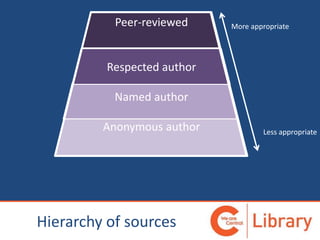
More appropriate
Less appropriate
Peer-reviewed
journal
Respected magazine
Regularly-published
magazine
Website/blog
Peer-reviewed
Respected author
Named author
Anonymous author
Hierarchy of sources
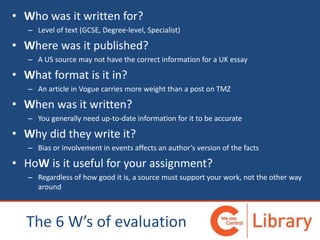
• Who was it written for?
– Level of text (GCSE, Degree-level, Specialist)
• Where was it published?
– A US source may not have the correct information for a UK essay
• What format is it in?
– An article in Vogue carries more weight than a post on TMZ
• When was it written?
– You generally need up-to-date information for it to be accurate
• Why did they write it?
– Bias or involvement in events affects an author’s version of the facts
• HoW is it useful for your assignment?
– Regardless of how good it is, a source must support your work, not the other way
around
The 6 W’s of evaluation
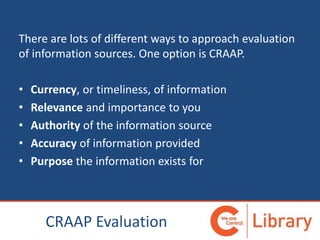
CRAAP Evaluation
There are lots of different ways to approach evaluation
of information sources. One option is CRAAP.
• Currency, or timeliness, of information
• Relevance and importance to you
• Authority of the information source
• Accuracy of information provided
• Purpose the information exists for
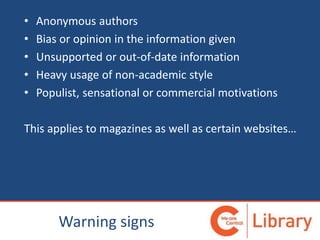
• Anonymous authors
• Bias or opinion in the information given
• Unsupported or out-of-date information
• Heavy usage of non-academic style
• Populist, sensational or commercial motivations
This applies to magazines as well as certain websites…
Warning signs
You can still make use a source if you have concerns after
evaluating it. However, you should make clear these
concerns, and offer balance wherever possible:
• If a source appears biased, look for evidence presented
from an alternate viewpoint
• If a source is dated, make this clear and look for
supporting evidence that is more current
• If a source was written for a distinct audience,
emphasise this and look for other perspectives
Balancing sources
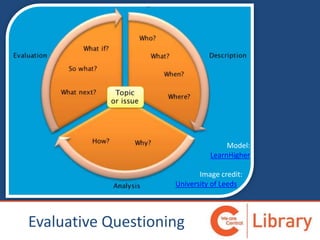
Model:
LearnHigher
Image credit: .
University of Leeds .
Evaluative Questioning

Evaluating Stuff 2015

  • 1.
  • 2.
    By the endof this session, you should: • Be able to identify key areas for evaluating the sources you find • Recognise and be able to explain the effect which bias and perspective has on information sources Learning Outcomes
  • 3.
  • 4.
    Evaluation Evaluation is: • “Tofind out or state the value of, to assess” – Oxford Study Dictionary • “Assessing the strengths and weaknesses of something” – Collins School Dictionary • A systematic determination of a subject's merit, worth and significance • Required to get higher marks in your assignments
  • 5.
    More appropriate Less appropriate Peer-reviewed journal Respectedmagazine Regularly-published magazine Website/blog Peer-reviewed Respected author Named author Anonymous author Hierarchy of sources
  • 6.
    • Who wasit written for? – Level of text (GCSE, Degree-level, Specialist) • Where was it published? – A US source may not have the correct information for a UK essay • What format is it in? – An article in Vogue carries more weight than a post on TMZ • When was it written? – You generally need up-to-date information for it to be accurate • Why did they write it? – Bias or involvement in events affects an author’s version of the facts • HoW is it useful for your assignment? – Regardless of how good it is, a source must support your work, not the other way around The 6 W’s of evaluation
  • 7.
    CRAAP Evaluation There arelots of different ways to approach evaluation of information sources. One option is CRAAP. • Currency, or timeliness, of information • Relevance and importance to you • Authority of the information source • Accuracy of information provided • Purpose the information exists for
  • 8.
    • Anonymous authors •Bias or opinion in the information given • Unsupported or out-of-date information • Heavy usage of non-academic style • Populist, sensational or commercial motivations This applies to magazines as well as certain websites… Warning signs
  • 9.
    You can stillmake use a source if you have concerns after evaluating it. However, you should make clear these concerns, and offer balance wherever possible: • If a source appears biased, look for evidence presented from an alternate viewpoint • If a source is dated, make this clear and look for supporting evidence that is more current • If a source was written for a distinct audience, emphasise this and look for other perspectives Balancing sources
  • 10.
    Model: LearnHigher Image credit: . Universityof Leeds . Evaluative Questioning

Editor's Notes

  • #6 Aim as high on the pyramid as you can! (May need to clarify peer review – very few p-r’d sources available for SNC)
  • #7 Broken down examples for information on previous slide
  • #10 Hopefully this will come up organically from exercise – if not, steer conversation in this direction for segue!