COCAINE DRUG
ABUSE
By-
Tejasvi Bhatia
CONTENTS
 Introduction
-what is cocaine?
-Properties
-Brief history
-Manufacture
 Routes of administration
 Effects and symptoms
 Drug analysis
What is cocaine?
-C, coke, snow ,nose, candy, crack, crystal,
freebase etc.
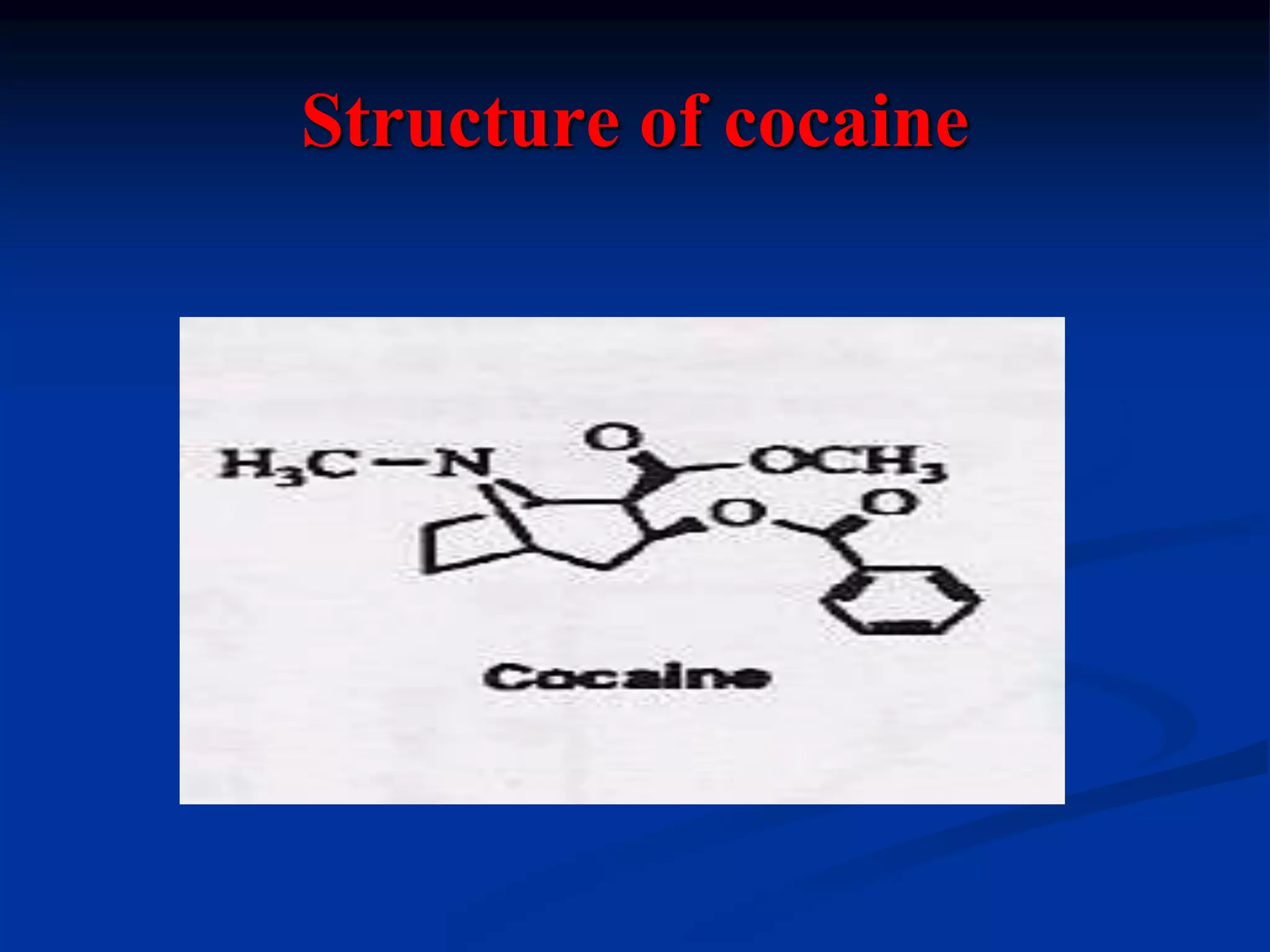
-Cocaine (benzoylmethylecgonine) is
crystalline tropane alkaloid prepared from
the leaves of the Erythroxylon coca plant.
-Chemical formula is C17H21NO4
Contd…
 Cocaine is a bitter, white, odorless,
crystalline drug.
 Cocaine has been classified as a Schedule II
drug by the United States.
 Cocaine is extracted and refined from the
Coca plant.
 A highly addictive stimulant that produces
profound feelings of pleasure
Street Names
The crystal form of cocaine is also known as:
 Crack
 Base
 Free base
 French fries
 Ready rock
 Rock
Properties of cocaine
 Powerful CNS stimulant.
 Colorless crystalline substance having bitter
taste.
 Major metabolite(s): Benzoylecgonine (B.E.),
Ecgonine Methyl Ester (E.M.E.)
 Provides intense feeling of pleasure or pleasing
intoxicant.
 Addictive and can cause death.
Structure of cocaine
Erythroxylon coca
 Cultivated in Bolivia, Peru and Ecuador
 Grows up to a height of 8 feet
 Rich in calcium, vitamin ,mineral, iron fiber
 Cocaine content of leaves ranges from 0.1% to
0.9%
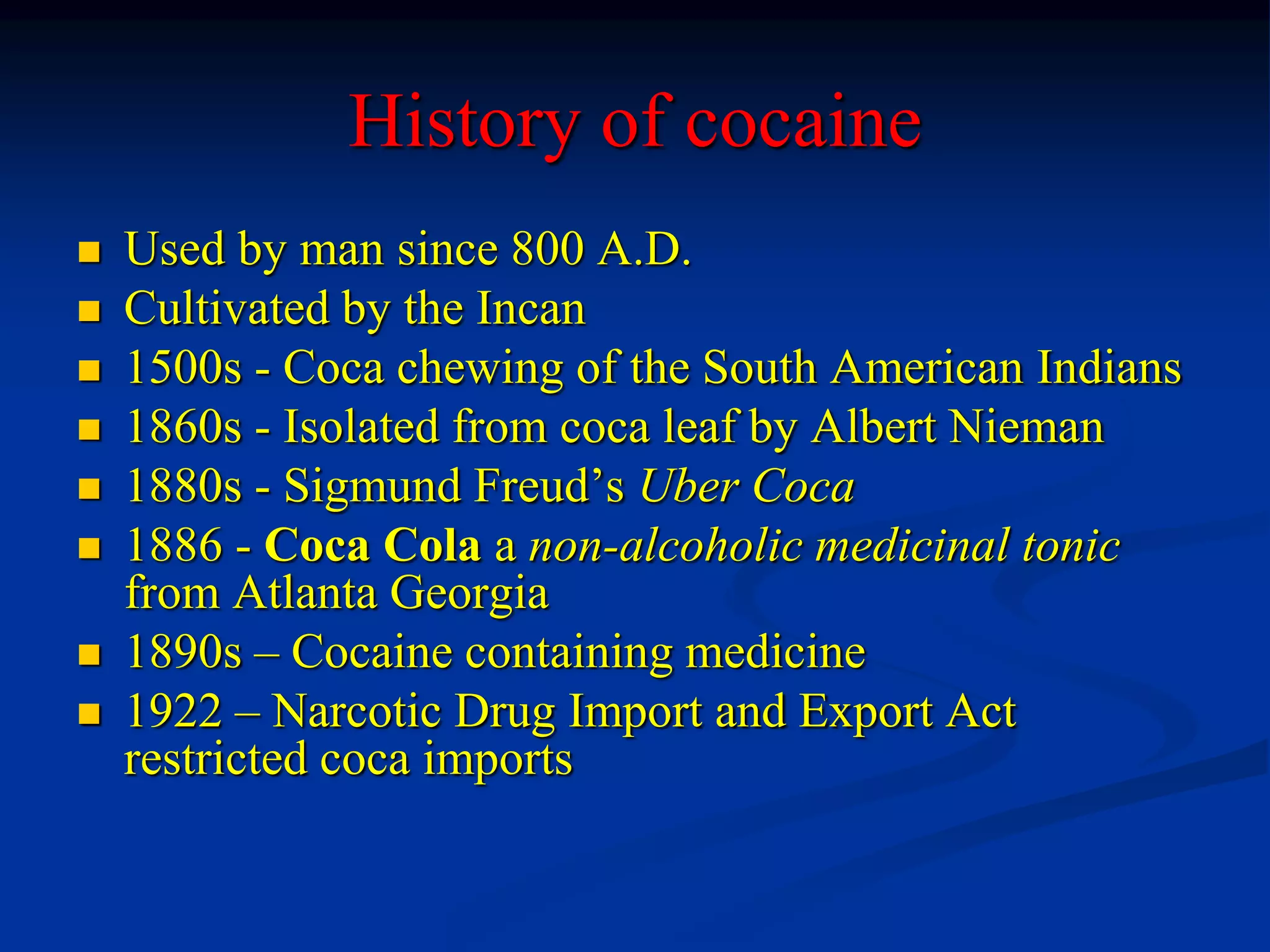
History of cocaine
 Used by man since 800 A.D.
 Cultivated by the Incan
 1500s - Coca chewing of the South American Indians
 1860s - Isolated from coca leaf by Albert Nieman
 1880s - Sigmund Freud’s Uber Coca
 1886 - Coca Cola a non-alcoholic medicinal tonic
from Atlanta Georgia
 1890s – Cocaine containing medicine
 1922 – Narcotic Drug Import and Export Act
restricted coca imports
Manufacture
A. Laboratory isolation of cocaine:
 Production of illicit natural cocaine involves
three steps:
-Extraction of crude coca paste from the coca
leaf;
-Purification of coca paste to coke base; and
-Conversion of coke base to cocaine
hydrochloride.
B. Synthetic cocaine:
It also involves three steps-
-Production of 2- carbomethoxytropinone
-Its conversion to methyl Ecgonine
-Benzoylation to cocaine
How is Cocaine Used?
. The Cocaine can be snorted, injected, smoked or
eaten. The level and length of the effects depend
on how the drug was induced.
Onset
1 minute
1-5 seconds
Immediate
Duration
20-40 minutes
15-20 minutes
5-15 minutes
Snorted
Injected
Smoked
Routes of administration
 Coca leaves– chewed/ ingested
 Cocaine sulphate- pasta, basuco, basa, pitillo,
paste (smoked)
 Cocaine hydrochloride–Snorting (intranasal),
smoking, intravenous (including being mixed
with heroin (‘speedball’ or ‘snowball’)), ingestion
 Free base or crack cocaine. (smoked)
A pile of cocaine hydrochloride
A piece of compressed cocaine
powder
Signs and symptoms
 It first acts as stimulant and then depressant of the
nervous system. The psychoactive effects are due to its
action on neurotransmitter sites by production of
dopamine which goes to the pleasure centre of the brain
and effect the brain metabolism of body
 It blocks dopamine from doing their recycling job.
 It destroys the gene of dopamine transporters.
 It causes brain damage in body or loss of memory and
other.
Cocaine effects are derived in two
categories-
Short term effects-
- Increase heart rate and blood pressure
- constricted blood vessels
-dilated pupils
- decreased appetite
- mental alertness
Long term effects-
- Heart disease,
- Heart attacks,
-Respiratory failure,
-strokes, seizures and other problems
-Physical complications ( nausea, blurred vision,
chest pain, fever, muscle spasms and coma)
-Long term cocaine can cause addiction,
paranoia, irritability, restlessness, auditory
hallucinations and mood disturbances
Metabolism and excretion
-Cocaine is extensively metabolized, primarily in
the liver, with only about 1% excreted
unchanged in the urine. The eliminated
metabolites consist mostly of
benzoylecgonine (BE), the major metabolite,
and other significant metabolites in lesser
amounts such as ecgonine methyl ester (EME)
and ecgonine.
 Further minor metabolites are:
- norcocaine,
- p-hydroxycocaine
-m-hydroxybenzoylecgonine.
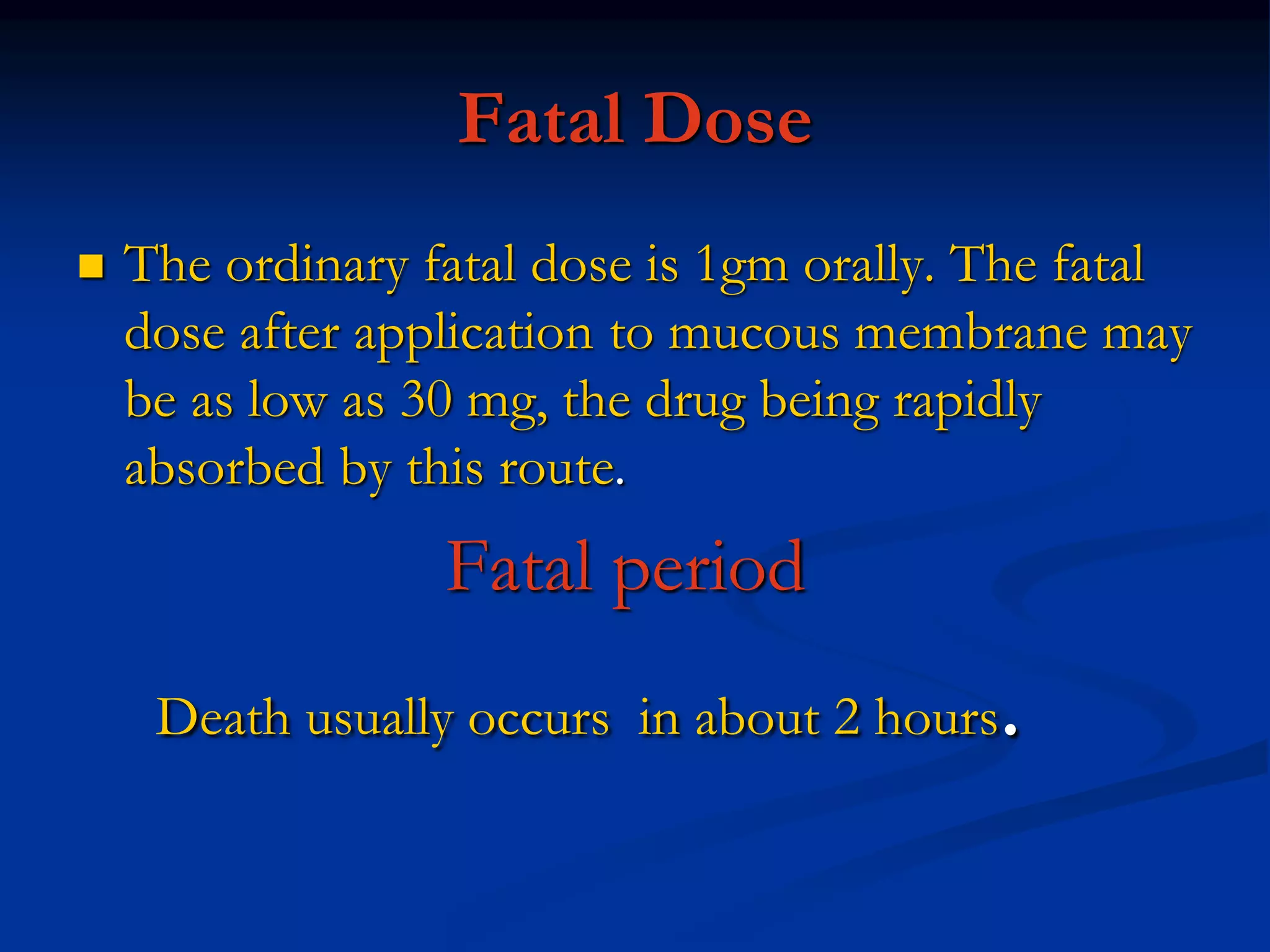
Fatal Dose
 The ordinary fatal dose is 1gm orally. The fatal
dose after application to mucous membrane may
be as low as 30 mg, the drug being rapidly
absorbed by this route.
Fatal period
Death usually occurs in about 2 hours.
Drug analysis
There are three aspects to reliable drug analysis:
 Strict collection procedures;
 Proper Testing Procedures;
 Random notification
Testing Procedure:
-There are two approaches to testing-
1.Cut-off type tests: This test has an
administrative "limit" set to report a positive
result. If the drug is identified, but is below the
limit, it is reported as "not detected".
2.Limit of detection tests reports any detectable
amount present within the capabilities of the
laboratory.
Qualitative Identification of Cocaine
 Presumptive Tests:
1.Spot tests
-Cobalt thiocyanate test (blue ppt)
-Scott test or Acidified Cobalt thiocyanate test.
(blue to turquoise in chloroform layer)
-Liebermann’s reagent (yellow)
2.Microcrystal tests:
-Gold chloride (dilute phosphoric acid)
-platinum chloride
- Lead iodide
-Gold chloride (HCL)
-Gold bromide
-Potassium permanganate
3.Mixed melting point test.
4.Thin Layer Chromatography
 Definitive Identification of Cocaine (IR/FTIR)
Quantification of Cocaine
1.Presumptive test
-UV Spectroscopy
2.Confirmatory test
-GC-MS
-LC-MS
Chris Farley Shannon hoon
Chris Farley
Shannon Hoon
River Phoenix
Thanks
Any Query?
References
1. Parikh, C.K. ”Textbook of Medical Jurisprudence, Forensic
Medicine and Toxicology”, Sixth Edition,1999,Pp 11.8-11.9
2. http://www.cocaine.org/cokeleaf.html
3. http://www. hc-sc.gc.ca /hppb/alcohol-otherdrugs/ pube
/straight stimulants. htm
4. http://www.a1b2c3.com/drugs/coc03.htm
5. www.cocaine.org/process.html -
6. http:// www.cocaine.org /synthesis/index
7. http:// www.krpc.com
8. http:// www.drugdetection.net
9. http://www.forensicmed.co.uk/cocaine.htm

Forensic cocaine drug abuse

  • 1.
  • 2.
    CONTENTS  Introduction -what iscocaine? -Properties -Brief history -Manufacture  Routes of administration  Effects and symptoms  Drug analysis
  • 3.
    What is cocaine? -C,coke, snow ,nose, candy, crack, crystal, freebase etc. -Cocaine (benzoylmethylecgonine) is crystalline tropane alkaloid prepared from the leaves of the Erythroxylon coca plant. -Chemical formula is C17H21NO4
  • 4.
    Contd…  Cocaine isa bitter, white, odorless, crystalline drug.  Cocaine has been classified as a Schedule II drug by the United States.  Cocaine is extracted and refined from the Coca plant.  A highly addictive stimulant that produces profound feelings of pleasure
  • 5.
    Street Names The crystalform of cocaine is also known as:  Crack  Base  Free base  French fries  Ready rock  Rock
  • 6.
    Properties of cocaine Powerful CNS stimulant.  Colorless crystalline substance having bitter taste.  Major metabolite(s): Benzoylecgonine (B.E.), Ecgonine Methyl Ester (E.M.E.)  Provides intense feeling of pleasure or pleasing intoxicant.  Addictive and can cause death.
  • 7.
  • 8.
    Erythroxylon coca  Cultivatedin Bolivia, Peru and Ecuador  Grows up to a height of 8 feet  Rich in calcium, vitamin ,mineral, iron fiber  Cocaine content of leaves ranges from 0.1% to 0.9%
  • 9.
    History of cocaine Used by man since 800 A.D.  Cultivated by the Incan  1500s - Coca chewing of the South American Indians  1860s - Isolated from coca leaf by Albert Nieman  1880s - Sigmund Freud’s Uber Coca  1886 - Coca Cola a non-alcoholic medicinal tonic from Atlanta Georgia  1890s – Cocaine containing medicine  1922 – Narcotic Drug Import and Export Act restricted coca imports
  • 10.
    Manufacture A. Laboratory isolationof cocaine:  Production of illicit natural cocaine involves three steps: -Extraction of crude coca paste from the coca leaf; -Purification of coca paste to coke base; and -Conversion of coke base to cocaine hydrochloride.
  • 11.
    B. Synthetic cocaine: Italso involves three steps- -Production of 2- carbomethoxytropinone -Its conversion to methyl Ecgonine -Benzoylation to cocaine
  • 12.
    How is CocaineUsed? . The Cocaine can be snorted, injected, smoked or eaten. The level and length of the effects depend on how the drug was induced. Onset 1 minute 1-5 seconds Immediate Duration 20-40 minutes 15-20 minutes 5-15 minutes Snorted Injected Smoked
  • 13.
    Routes of administration Coca leaves– chewed/ ingested  Cocaine sulphate- pasta, basuco, basa, pitillo, paste (smoked)  Cocaine hydrochloride–Snorting (intranasal), smoking, intravenous (including being mixed with heroin (‘speedball’ or ‘snowball’)), ingestion  Free base or crack cocaine. (smoked)
  • 15.
    A pile ofcocaine hydrochloride
  • 16.
    A piece ofcompressed cocaine powder
  • 17.
    Signs and symptoms It first acts as stimulant and then depressant of the nervous system. The psychoactive effects are due to its action on neurotransmitter sites by production of dopamine which goes to the pleasure centre of the brain and effect the brain metabolism of body  It blocks dopamine from doing their recycling job.  It destroys the gene of dopamine transporters.  It causes brain damage in body or loss of memory and other.
  • 18.
    Cocaine effects arederived in two categories- Short term effects- - Increase heart rate and blood pressure - constricted blood vessels -dilated pupils - decreased appetite - mental alertness
  • 19.
    Long term effects- -Heart disease, - Heart attacks, -Respiratory failure, -strokes, seizures and other problems -Physical complications ( nausea, blurred vision, chest pain, fever, muscle spasms and coma) -Long term cocaine can cause addiction, paranoia, irritability, restlessness, auditory hallucinations and mood disturbances
  • 20.
    Metabolism and excretion -Cocaineis extensively metabolized, primarily in the liver, with only about 1% excreted unchanged in the urine. The eliminated metabolites consist mostly of benzoylecgonine (BE), the major metabolite, and other significant metabolites in lesser amounts such as ecgonine methyl ester (EME) and ecgonine.  Further minor metabolites are: - norcocaine, - p-hydroxycocaine -m-hydroxybenzoylecgonine.
  • 21.
    Fatal Dose  Theordinary fatal dose is 1gm orally. The fatal dose after application to mucous membrane may be as low as 30 mg, the drug being rapidly absorbed by this route. Fatal period Death usually occurs in about 2 hours.
  • 22.
    Drug analysis There arethree aspects to reliable drug analysis:  Strict collection procedures;  Proper Testing Procedures;  Random notification
  • 23.
    Testing Procedure: -There aretwo approaches to testing- 1.Cut-off type tests: This test has an administrative "limit" set to report a positive result. If the drug is identified, but is below the limit, it is reported as "not detected". 2.Limit of detection tests reports any detectable amount present within the capabilities of the laboratory.
  • 24.
    Qualitative Identification ofCocaine  Presumptive Tests: 1.Spot tests -Cobalt thiocyanate test (blue ppt) -Scott test or Acidified Cobalt thiocyanate test. (blue to turquoise in chloroform layer) -Liebermann’s reagent (yellow) 2.Microcrystal tests: -Gold chloride (dilute phosphoric acid) -platinum chloride - Lead iodide
  • 25.
    -Gold chloride (HCL) -Goldbromide -Potassium permanganate 3.Mixed melting point test. 4.Thin Layer Chromatography  Definitive Identification of Cocaine (IR/FTIR)
  • 26.
    Quantification of Cocaine 1.Presumptivetest -UV Spectroscopy 2.Confirmatory test -GC-MS -LC-MS
  • 27.
    Chris Farley Shannonhoon Chris Farley Shannon Hoon River Phoenix
  • 28.
  • 29.
  • 30.
    References 1. Parikh, C.K.”Textbook of Medical Jurisprudence, Forensic Medicine and Toxicology”, Sixth Edition,1999,Pp 11.8-11.9 2. http://www.cocaine.org/cokeleaf.html 3. http://www. hc-sc.gc.ca /hppb/alcohol-otherdrugs/ pube /straight stimulants. htm 4. http://www.a1b2c3.com/drugs/coc03.htm 5. www.cocaine.org/process.html - 6. http:// www.cocaine.org /synthesis/index 7. http:// www.krpc.com 8. http:// www.drugdetection.net 9. http://www.forensicmed.co.uk/cocaine.htm