Designer Drugs
Laviña, Micaela Joy R.
What Are Designer Drugs?
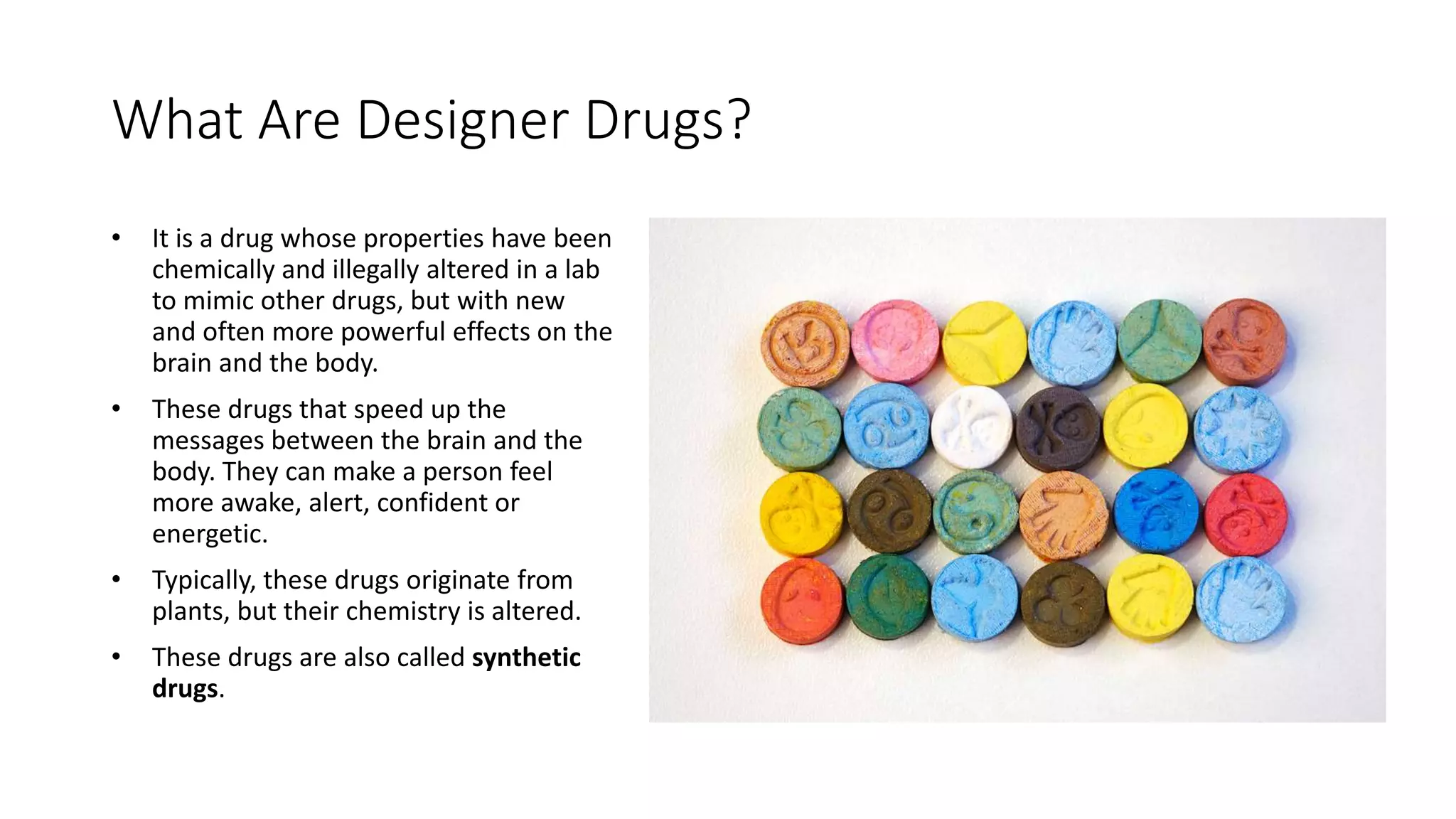
• It is a drug whose properties have been
chemically and illegally altered in a lab
to mimic other drugs, but with new
and often more powerful effects on the
brain and the body.
• These drugs that speed up the
messages between the brain and the
body. They can make a person feel
more awake, alert, confident or
energetic.
• Typically, these drugs originate from
plants, but their chemistry is altered.
• These drugs are also called synthetic
drugs.
How are they used?
usually are snorted, swallowed, smoked or injected. Prescribed
stimulants are usually taken orally, and the duration of effects
differs depending on the type.
Generally speaking, in small to low doses
the following effects may be experienced:
• euphoria
• heightened feelings of wellbeing
• increased heart rate and blood
pressure
• increased alertness
• talkativeness
• reduced appetite
Effects of designer drugs
Higher doses can result in:
• Kidney failure
• anxiety
• tension
• increased body temperature
• nausea
• tremor
• seizures
• Coma
• death
Dangers of Designer Drugs
Some of the potential effects these drugs have been
reported to cause include:
• Psychosis, including paranoia, hallucinations, and
delusions
• Depression and anxiety
• Violent and aggressive behaviors
• Muscle tensions and spasms
• Increased heart rate and chest pains
• Addiction
• Kidney failure
• Seizures
• Suicidal thoughts and behaviors
• Death
Any use of designer drugs, even just one
time, is risky. Some people become
addicted to these substances and they are
at an increased risk of adverse effects.
Generic name:
Ketamine
Brand name:
Ketalar
Indication:
KETALAR is indicated for the induction of anesthesia prior to the
administration of other general anesthetic agents. KETALAR is indicated
to supplement low-potency agents, such as nitrous oxide. Specific areas
of application are described in the CLINICAL PHARMACOLOGY Section.
Route of administration: Intramuscular injection
Pharmacological class: General anaesthetic
Contraindication:
Ketamine hydrochloride is contraindicated in those in whom a
significant elevation of blood pressure
would constitute a serious hazard and in those who have shown
hypersensitivity to the drug.
Half life:
The half-life of ketamine is approximately 45 minutes.
Pharmacokinetics:
Ketamine metabolism is characterized by a low binding to plasma proteins,
about 10–30% 4. Because of a liposolubility five times higher than thiopental,
ketamine has an extensive distribution.
Central compartment volume is about 70 l, and the distribution volume at
steady state is around 200 l 5, or 2.3 l/kg 6. Because of an oxidation by a
microsomal enzyme system (N‐demethylation), ketamine is mostly
metabolized in norketamine (80%), an active metabolite that is itself principally
hydroxylized in 6‐hydroxy‐norketamine (15%), finally excreted in bile and urine
after glucuronoconjugation. Three other less important metabolites are also
formed.
Another way directly transforms ketamine into hydroxy‐ketamine (5%) 7. This
metabolism does not simply involve the liver 8, particularly in animals: the
kidneys, the intestine, and the lungs are the site of significant metabolism 9.
R(−)‐ketamine can be transformed in S(+)‐norketamine but it seems there is, in
vivo, no connection between enantiomers.
Ketamine elimination clearance is high (1000–1600 ml/min or 12–20
ml/min/kg), equal to liver blood flow, and then dependent on this flow 5.
Ketamine elimination half‐life is 2–3 h. Its pharmacokinetics can be described
as a tree compartment model 10. Its clearance may be 20% higher in women
than in men 11.
Pharmacodynamics:
Ketamine is a rapid-acting general anesthetic producing an anesthetic state
characterized by profound analgesia, normal pharyngeal-laryngeal reflexes,
normal or slightly enhanced skeletal muscle tone, cardiovascular and
respiratory stimulation, and occasionally a transient and minimal respiratory
depression. The anesthetic state produced by Ketamine has been termed as
"dissociative anesthesia" in that it appears to selectively interrupt association
pathways of the brain before producing somesthetic sensory blockade. It may
selectively depress the thalamoneocortical system before significantly
obtunding the more ancient cerebral centers and pathways (reticular-
activating and limbic systems).2
Ketamine enhances descending inhibiting serotoninergic pathways and can
exert antidepressive effects. These effects are seen in concentrations ten times
lower than the needed concentration for anesthetic proposes. The effect of
ketamine can be described as analgesic by the prevention of central
sensitization in dorsal horn neurons as well as by the inhibition on the
synthesis of nitric oxide. Ketamine can present cardiovascular changes and
bronchodilatation
Ketamine
• Ketamine is a medication mainly used for starting and maintaining
anesthesia. It induces a trance-like state while providing pain relief,
sedation, and memory loss.
• It has also been used as a "date rape" drug.
• Other uses include sedation in intensive care and treatment of pain and
depression.
• Ketamine can provide pain relief and short-term memory loss (for example,
amnesia of a medical procedure).
• In surgery, it is used an induction and maintenance agent for sedation and
to provide general anesthesia.
Ketamine
• Ketamine is available in a clear liquid or off-white powder form for
intravenous injection or as a nasal spray.
• When abused, it is typically insufflated ("snorted" up the nose) in social
situations. It is also injected, consumed orally as a liquid, or smoked in
marijuana or tobacco.
• It is frequently abused in combination with other substances, such as
cocaine or amphetamines.
• The effects of abuse typically last 1 to 2 hours, but the users judgement,
senses and coordination may be affected for up to 24 hours or longer.
Sensations the user may seek include floating, stimulation and visual effects.
OTHER DRUGS
Methamphetamine (Meth or Crystal Meth)
Methamphetamine
• Crystal meth is short for crystal methamphetamine.
• It is just one form of the drug methamphetamine.
• Methamphetamine is a powerful, highly addictive stimulant that affects the
central nervous system.
• Also known as shabu, meth, blue, ice, and crystal, among many other terms, it
takes the form of a white, odorless, bitter-tasting crystalline powder that easily
dissolves in water or alcohol.
• It is a white crystalline drug that people take by snorting it (inhaling through the
nose), smoking it or injecting it with a needle.
• Some even take it orally, but all develop a strong desire to continue using it
because the drug creates a false sense of happiness and well-being—a rush
(strong feeling) of confidence, hyper activeness and energy. One also experiences
decreased appetite.
• The effects generally last from six to eight hours but can last up to twenty-four
hours.
3,4-methylenedioxy-
methamphetamine (MDMA)
MDMA (Ecstasy/Molly)
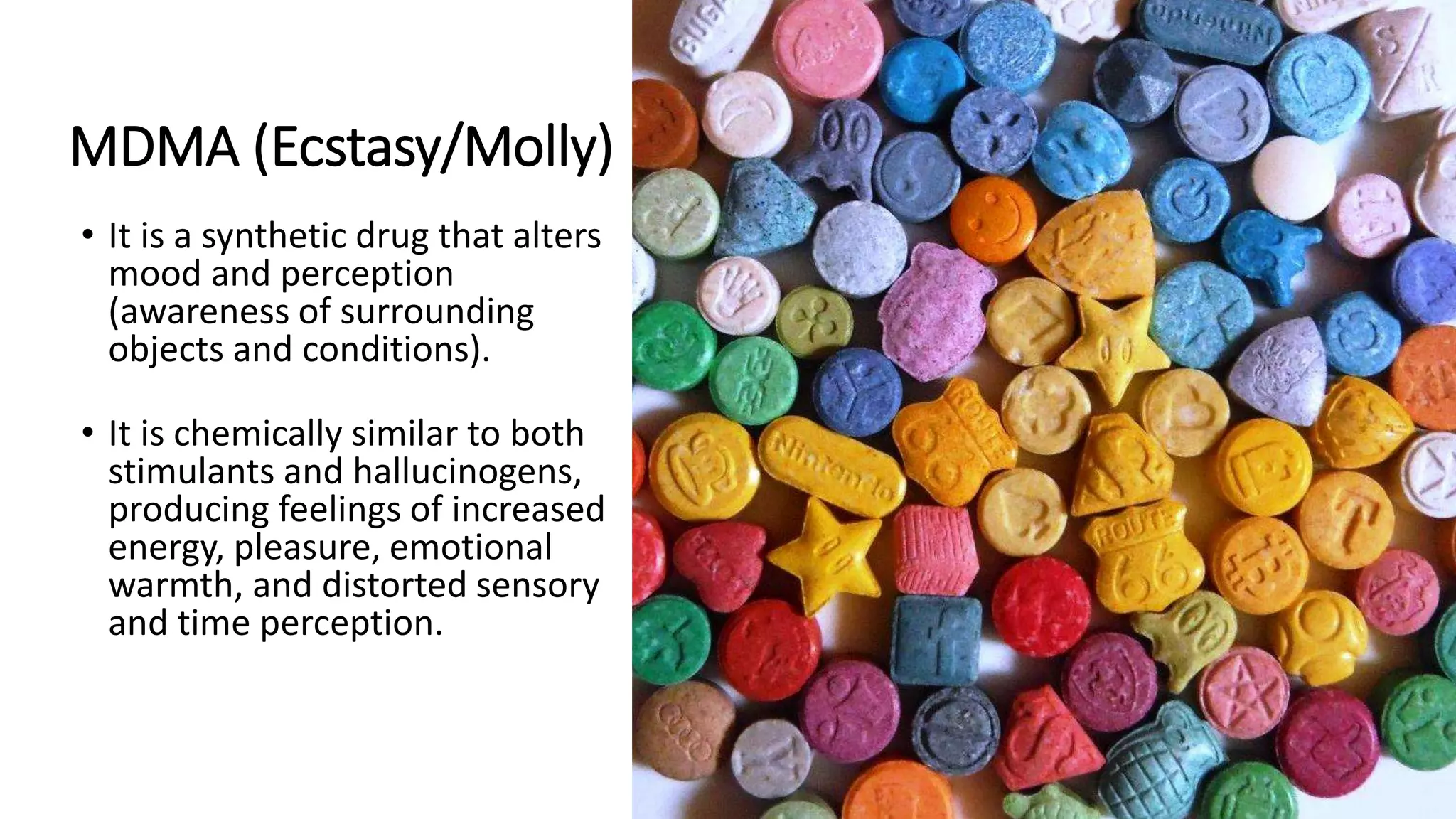
• It is a synthetic drug that alters
mood and perception
(awareness of surrounding
objects and conditions).
• It is chemically similar to both
stimulants and hallucinogens,
producing feelings of increased
energy, pleasure, emotional
warmth, and distorted sensory
and time perception.
MDMA (Ecstasy/Molly)
• MDMA was initially popular
in the nightclub scene and
at all-night dance party
"raves", but the drug now
affects a broader range of
people who more
commonly call the drug
Ecstasy or Molly.
• People who use it usually
take it as a capsule or
tablet, though some
swallow it in liquid form or
snort the powder.
Alpha-pyrrolidinopentiophenone (alpha-PVP)
Alpha-PVP (Flakka)
• It popularly known as “flakka“ and
zombie drug.
• "Flakka", which is popularly known
as the "$5 insanity drug"
• Flakka is just a newer-generation
version of a type of synthetic drug
called bath salts (MDPV).
• Chemically similar to other
synthetic cathinone drugs popularly
called "bath salts“
• It is a form of a white or pink, foul-
smelling crystal that can be eaten,
snorted, injected or vaporized in an
e-cigarette or similar device.
Alpha-PVP (Flakka)
• Like other drugs of this type, alpha-PVP can cause a condition
called "excited delirium" that involves hyperstimulation,
paranoia, and hallucinations that can lead to violent aggression
and self-injury.
• The drug has been linked to deaths by suicide as well as heart
attack. It can also dangerously raise body temperature and lead
to kidney damage or kidney failure.
Methylenedioxypyrovalerone (MDPV)
MDPV (Bath salts)
• MDPV, a common chemical in “bath salts”, has been substituted
for MDMA in capsules sold as Molly in some places.
• Bath salts are powerful stimulant drugs that increase brain and
central nervous system activity.
• It is a white crystalline powder in its pure form, but manufacturing
impurities often render it from off-white to pale brown. It's
usually sold as a powder, powder-filled capsules or tablets.
MDPV (Bath salts)
• “Bath salts” are usually swallowed, snorted through the nose,
inhaled, or injected with a needle. Snorting or injecting is the most
harmful.
• Side-effects, particularly at high doses, can include anxiety and
paranoia, delusions, muscle spasms, and an elevated heart rate. In
extreme cases, MDPV has been linked to rhabdomyolysis (rapid
muscle breakdown), brain injury, and death.
U-47700
U-47700 (Pinky)
• also known as pink heroin, pinky, and pink.
• It is a highly potent synthetic opioid drug that looks like a white or
light pink powder.
• It was originally developed by chemists at Upjohn Pharmaceuticals in
the 1970's as a potent pain reliever for use in surgery, cancer, or
painful injuries and has around 7.5 times the potency of morphine in
animal models.
• This drug is usually snorted, swallowed or injected.
• U-47700 may be measured in serum, plasma, blood or urine to
monitor for abuse, confirm a diagnosis of poisoning, or assist in a
medicolegal death investigation.
U-47700 (Pinky)
• This drug poses the same risks as heroin and many other designer
opioids.
• The detection usually involves analysis by liquid chromatography-
mass spectrometry.
• It is said to be about seven and a half times the strength of morphine.
• With underground labs in China producing the stuff to ship around
the world.

Designer drugs

  • 1.
  • 3.
    What Are DesignerDrugs? • It is a drug whose properties have been chemically and illegally altered in a lab to mimic other drugs, but with new and often more powerful effects on the brain and the body. • These drugs that speed up the messages between the brain and the body. They can make a person feel more awake, alert, confident or energetic. • Typically, these drugs originate from plants, but their chemistry is altered. • These drugs are also called synthetic drugs.
  • 4.
    How are theyused? usually are snorted, swallowed, smoked or injected. Prescribed stimulants are usually taken orally, and the duration of effects differs depending on the type.
  • 5.
    Generally speaking, insmall to low doses the following effects may be experienced: • euphoria • heightened feelings of wellbeing • increased heart rate and blood pressure • increased alertness • talkativeness • reduced appetite Effects of designer drugs
  • 6.
    Higher doses canresult in: • Kidney failure • anxiety • tension • increased body temperature • nausea • tremor • seizures • Coma • death
  • 7.
    Dangers of DesignerDrugs Some of the potential effects these drugs have been reported to cause include: • Psychosis, including paranoia, hallucinations, and delusions • Depression and anxiety • Violent and aggressive behaviors • Muscle tensions and spasms • Increased heart rate and chest pains • Addiction • Kidney failure • Seizures • Suicidal thoughts and behaviors • Death Any use of designer drugs, even just one time, is risky. Some people become addicted to these substances and they are at an increased risk of adverse effects.
  • 8.
  • 9.
  • 10.
    Indication: KETALAR is indicatedfor the induction of anesthesia prior to the administration of other general anesthetic agents. KETALAR is indicated to supplement low-potency agents, such as nitrous oxide. Specific areas of application are described in the CLINICAL PHARMACOLOGY Section. Route of administration: Intramuscular injection Pharmacological class: General anaesthetic
  • 11.
    Contraindication: Ketamine hydrochloride iscontraindicated in those in whom a significant elevation of blood pressure would constitute a serious hazard and in those who have shown hypersensitivity to the drug.
  • 12.
    Half life: The half-lifeof ketamine is approximately 45 minutes.
  • 13.
    Pharmacokinetics: Ketamine metabolism ischaracterized by a low binding to plasma proteins, about 10–30% 4. Because of a liposolubility five times higher than thiopental, ketamine has an extensive distribution. Central compartment volume is about 70 l, and the distribution volume at steady state is around 200 l 5, or 2.3 l/kg 6. Because of an oxidation by a microsomal enzyme system (N‐demethylation), ketamine is mostly metabolized in norketamine (80%), an active metabolite that is itself principally hydroxylized in 6‐hydroxy‐norketamine (15%), finally excreted in bile and urine after glucuronoconjugation. Three other less important metabolites are also formed. Another way directly transforms ketamine into hydroxy‐ketamine (5%) 7. This metabolism does not simply involve the liver 8, particularly in animals: the kidneys, the intestine, and the lungs are the site of significant metabolism 9. R(−)‐ketamine can be transformed in S(+)‐norketamine but it seems there is, in vivo, no connection between enantiomers. Ketamine elimination clearance is high (1000–1600 ml/min or 12–20 ml/min/kg), equal to liver blood flow, and then dependent on this flow 5. Ketamine elimination half‐life is 2–3 h. Its pharmacokinetics can be described as a tree compartment model 10. Its clearance may be 20% higher in women than in men 11.
  • 14.
    Pharmacodynamics: Ketamine is arapid-acting general anesthetic producing an anesthetic state characterized by profound analgesia, normal pharyngeal-laryngeal reflexes, normal or slightly enhanced skeletal muscle tone, cardiovascular and respiratory stimulation, and occasionally a transient and minimal respiratory depression. The anesthetic state produced by Ketamine has been termed as "dissociative anesthesia" in that it appears to selectively interrupt association pathways of the brain before producing somesthetic sensory blockade. It may selectively depress the thalamoneocortical system before significantly obtunding the more ancient cerebral centers and pathways (reticular- activating and limbic systems).2 Ketamine enhances descending inhibiting serotoninergic pathways and can exert antidepressive effects. These effects are seen in concentrations ten times lower than the needed concentration for anesthetic proposes. The effect of ketamine can be described as analgesic by the prevention of central sensitization in dorsal horn neurons as well as by the inhibition on the synthesis of nitric oxide. Ketamine can present cardiovascular changes and bronchodilatation
  • 15.
    Ketamine • Ketamine isa medication mainly used for starting and maintaining anesthesia. It induces a trance-like state while providing pain relief, sedation, and memory loss. • It has also been used as a "date rape" drug. • Other uses include sedation in intensive care and treatment of pain and depression. • Ketamine can provide pain relief and short-term memory loss (for example, amnesia of a medical procedure). • In surgery, it is used an induction and maintenance agent for sedation and to provide general anesthesia.
  • 16.
    Ketamine • Ketamine isavailable in a clear liquid or off-white powder form for intravenous injection or as a nasal spray. • When abused, it is typically insufflated ("snorted" up the nose) in social situations. It is also injected, consumed orally as a liquid, or smoked in marijuana or tobacco. • It is frequently abused in combination with other substances, such as cocaine or amphetamines. • The effects of abuse typically last 1 to 2 hours, but the users judgement, senses and coordination may be affected for up to 24 hours or longer. Sensations the user may seek include floating, stimulation and visual effects.
  • 17.
  • 18.
  • 19.
    Methamphetamine • Crystal methis short for crystal methamphetamine. • It is just one form of the drug methamphetamine. • Methamphetamine is a powerful, highly addictive stimulant that affects the central nervous system. • Also known as shabu, meth, blue, ice, and crystal, among many other terms, it takes the form of a white, odorless, bitter-tasting crystalline powder that easily dissolves in water or alcohol. • It is a white crystalline drug that people take by snorting it (inhaling through the nose), smoking it or injecting it with a needle. • Some even take it orally, but all develop a strong desire to continue using it because the drug creates a false sense of happiness and well-being—a rush (strong feeling) of confidence, hyper activeness and energy. One also experiences decreased appetite. • The effects generally last from six to eight hours but can last up to twenty-four hours.
  • 20.
  • 21.
    MDMA (Ecstasy/Molly) • Itis a synthetic drug that alters mood and perception (awareness of surrounding objects and conditions). • It is chemically similar to both stimulants and hallucinogens, producing feelings of increased energy, pleasure, emotional warmth, and distorted sensory and time perception.
  • 22.
    MDMA (Ecstasy/Molly) • MDMAwas initially popular in the nightclub scene and at all-night dance party "raves", but the drug now affects a broader range of people who more commonly call the drug Ecstasy or Molly. • People who use it usually take it as a capsule or tablet, though some swallow it in liquid form or snort the powder.
  • 23.
  • 24.
    Alpha-PVP (Flakka) • Itpopularly known as “flakka“ and zombie drug. • "Flakka", which is popularly known as the "$5 insanity drug" • Flakka is just a newer-generation version of a type of synthetic drug called bath salts (MDPV). • Chemically similar to other synthetic cathinone drugs popularly called "bath salts“ • It is a form of a white or pink, foul- smelling crystal that can be eaten, snorted, injected or vaporized in an e-cigarette or similar device.
  • 25.
    Alpha-PVP (Flakka) • Likeother drugs of this type, alpha-PVP can cause a condition called "excited delirium" that involves hyperstimulation, paranoia, and hallucinations that can lead to violent aggression and self-injury. • The drug has been linked to deaths by suicide as well as heart attack. It can also dangerously raise body temperature and lead to kidney damage or kidney failure.
  • 26.
  • 27.
    MDPV (Bath salts) •MDPV, a common chemical in “bath salts”, has been substituted for MDMA in capsules sold as Molly in some places. • Bath salts are powerful stimulant drugs that increase brain and central nervous system activity. • It is a white crystalline powder in its pure form, but manufacturing impurities often render it from off-white to pale brown. It's usually sold as a powder, powder-filled capsules or tablets.
  • 28.
    MDPV (Bath salts) •“Bath salts” are usually swallowed, snorted through the nose, inhaled, or injected with a needle. Snorting or injecting is the most harmful. • Side-effects, particularly at high doses, can include anxiety and paranoia, delusions, muscle spasms, and an elevated heart rate. In extreme cases, MDPV has been linked to rhabdomyolysis (rapid muscle breakdown), brain injury, and death.
  • 29.
  • 30.
    U-47700 (Pinky) • alsoknown as pink heroin, pinky, and pink. • It is a highly potent synthetic opioid drug that looks like a white or light pink powder. • It was originally developed by chemists at Upjohn Pharmaceuticals in the 1970's as a potent pain reliever for use in surgery, cancer, or painful injuries and has around 7.5 times the potency of morphine in animal models. • This drug is usually snorted, swallowed or injected. • U-47700 may be measured in serum, plasma, blood or urine to monitor for abuse, confirm a diagnosis of poisoning, or assist in a medicolegal death investigation.
  • 31.
    U-47700 (Pinky) • Thisdrug poses the same risks as heroin and many other designer opioids. • The detection usually involves analysis by liquid chromatography- mass spectrometry. • It is said to be about seven and a half times the strength of morphine. • With underground labs in China producing the stuff to ship around the world.