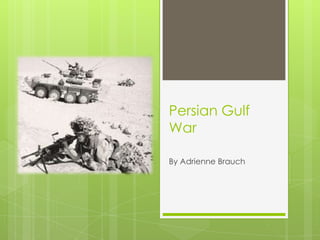
Persian Gulf
War
By Adrienne Brauch
Causes of the War
 Iraq was facing economic problems
 Continued military expansion spending
billions on weapons
 Debt of 80-100 billion
 High ambitions
 Kuwait was capable of adding 2 million
barrels a day of oil to Iraqi exports and
increasing total oil reserved to 198 billion
Unjustified Invasion
 Iraq invaded on August 1, 1990
 No political justification for invasion
 Iraq claimed Kuwait violated oil quotas and
did not drain oil properly
 Kuwait provided Iraq with billions in aid
during the War with Iran
Iraq’s Justification
 Said they were supporting an uprising by
Democratic Kuwaiti forces
 Nonexistent
 Claimed to be liberating territory stolen
from it by Britain
 Iraq had no claim to Kuwait as a
successor state
Hussein’s Expectations
 Hussein felt Saudi Arabia would be too
scared to fight
 He also felt US would not be willing to go
to war
 Underestimated
 Saudi Arabia gave Kuwaiti gov’t full support
and gained support of Gulf Cooperation
Council States
US Response
• George H.W Bush committed massive military
forces and announces they will send air, naval,
and land forces
 Known as Operation Desert Shield (August 7th
1990)US deploys tens of thousands of troops to
defend Saudi Arabia
 Goal: Contain Iraq and liberate Kuwait
• Froze Iraqi assets
• Obtained UN support for a Naval Blockade on Iraq
and an embargo on Iraqi imports and exports
Why did the US attack?
 No possibility for peace resolution
 Hussein’s atrocities- raped, pillaged, etc.
 Tortures to Kuwait were a challenge to
freedom
 Damage to the economies of the world
 US did not attack to conquest Iraq
 Saddam Hussein was a threat to the
region and to the world order
Beginning of the War
 Began January 17th, 1991
 War codenamed Operation Desert Storm
 US led air units launched attacks on Iraqi
targets (control facilities, air bases, etc.)
 Apache helicopters knocked out Iraq’s
radar system
 Launched cruise missiles and precision
guided weapons
Air Combat
 Iraq has 770 combat aircraft
 Coalition air forces much stronger
 Iraqi aircraft flees to Iran
 Iraq fired long range SCUD missiles into
Israel and Saudi Arabia
 US Patriot defense missiles hit the Scuds
 Did not provoke Israel to enter the war
Ground Combat
 Cut logistic supply to Iraqis
 Quick and decisive attack
 US held massive advantage in intelligence
 Iraqi forces poorly trained
 Lacked weapons and man power
 US did not invade Iraq
 Avoid Iraqi civil war and keep some stability
in region
 February 24, 1991
 Two simultaneous attacks
 Pan Arab and US marines attack
penetrating Iraqi Defenses along South
Kuwait border
 Second attack at far west edge of Iraqi
Saudi border- largest air assault operation in
Military history, US and British forces
advance into Iraq –
 Attacks crushed Iraqi army
 February 26, 1991
 Longest sustained armored advance in
history
 Fight for international airport
 Iraqi forces had limited resistance
 Coalition forces had superior tanks and
helicopters with rocket launch systems
 Cease-fire called on February 28, 1991
Overview
 Fighting lasted 43 days
 Shift in East-West Relations
 Forced Iraq to retreat from Kuwait
 Dictator vs. Democracy
 Iraq vs. UN, US, etc.
 War killed 100,000 Iraqi Soldiers and only
200 allied troops
Foreign Policy
 US in period of interventionist foreign
policy
 Saudi Arabia saw US as vital ally in
maintaining stability in Middle East
 Established US as trustworthy ally- nations
can count on the US to maintain world
order, and not only act out of self-interest
 Set up tensions that would lead US to war
with Iraq in 21st century
Works Cited
 Cruden, Alexander, ed. The Persian Gulf
War. Detroit: Greenhaven, 2011. Print.
 Kalaitzidis, Akis, and Gregory W. Streich.
U.S. Foreign Policy: A Documentary and
Reference Guide. Santa Barbara:
Greenwood, 2011. Print.
Image Citation
 "United States soldier during Persian Gulf
War. In 1990, Iraqi forces under the control
of military..." New Dictionary of the History
of Ideas. Ed. Maryanne Cline Horowitz.
Vol. 6. Detroit: Charles Scribner's Sons,
2005. World History In Context. Web. 26
May 2013.

Persian Gulf War

  • 1.
  • 2.
    Causes of theWar  Iraq was facing economic problems  Continued military expansion spending billions on weapons  Debt of 80-100 billion  High ambitions  Kuwait was capable of adding 2 million barrels a day of oil to Iraqi exports and increasing total oil reserved to 198 billion
  • 3.
    Unjustified Invasion  Iraqinvaded on August 1, 1990  No political justification for invasion  Iraq claimed Kuwait violated oil quotas and did not drain oil properly  Kuwait provided Iraq with billions in aid during the War with Iran
  • 4.
    Iraq’s Justification  Saidthey were supporting an uprising by Democratic Kuwaiti forces  Nonexistent  Claimed to be liberating territory stolen from it by Britain  Iraq had no claim to Kuwait as a successor state
  • 5.
    Hussein’s Expectations  Husseinfelt Saudi Arabia would be too scared to fight  He also felt US would not be willing to go to war  Underestimated  Saudi Arabia gave Kuwaiti gov’t full support and gained support of Gulf Cooperation Council States
  • 6.
    US Response • GeorgeH.W Bush committed massive military forces and announces they will send air, naval, and land forces  Known as Operation Desert Shield (August 7th 1990)US deploys tens of thousands of troops to defend Saudi Arabia  Goal: Contain Iraq and liberate Kuwait • Froze Iraqi assets • Obtained UN support for a Naval Blockade on Iraq and an embargo on Iraqi imports and exports
  • 7.
    Why did theUS attack?  No possibility for peace resolution  Hussein’s atrocities- raped, pillaged, etc.  Tortures to Kuwait were a challenge to freedom  Damage to the economies of the world  US did not attack to conquest Iraq  Saddam Hussein was a threat to the region and to the world order
  • 8.
    Beginning of theWar  Began January 17th, 1991  War codenamed Operation Desert Storm  US led air units launched attacks on Iraqi targets (control facilities, air bases, etc.)  Apache helicopters knocked out Iraq’s radar system  Launched cruise missiles and precision guided weapons
  • 9.
    Air Combat  Iraqhas 770 combat aircraft  Coalition air forces much stronger  Iraqi aircraft flees to Iran  Iraq fired long range SCUD missiles into Israel and Saudi Arabia  US Patriot defense missiles hit the Scuds  Did not provoke Israel to enter the war
  • 10.
    Ground Combat  Cutlogistic supply to Iraqis  Quick and decisive attack  US held massive advantage in intelligence  Iraqi forces poorly trained  Lacked weapons and man power  US did not invade Iraq  Avoid Iraqi civil war and keep some stability in region
  • 11.
     February 24,1991  Two simultaneous attacks  Pan Arab and US marines attack penetrating Iraqi Defenses along South Kuwait border  Second attack at far west edge of Iraqi Saudi border- largest air assault operation in Military history, US and British forces advance into Iraq –  Attacks crushed Iraqi army
  • 12.
     February 26,1991  Longest sustained armored advance in history  Fight for international airport  Iraqi forces had limited resistance  Coalition forces had superior tanks and helicopters with rocket launch systems  Cease-fire called on February 28, 1991
  • 13.
    Overview  Fighting lasted43 days  Shift in East-West Relations  Forced Iraq to retreat from Kuwait  Dictator vs. Democracy  Iraq vs. UN, US, etc.  War killed 100,000 Iraqi Soldiers and only 200 allied troops
  • 14.
    Foreign Policy  USin period of interventionist foreign policy  Saudi Arabia saw US as vital ally in maintaining stability in Middle East  Established US as trustworthy ally- nations can count on the US to maintain world order, and not only act out of self-interest  Set up tensions that would lead US to war with Iraq in 21st century
  • 15.
    Works Cited  Cruden,Alexander, ed. The Persian Gulf War. Detroit: Greenhaven, 2011. Print.  Kalaitzidis, Akis, and Gregory W. Streich. U.S. Foreign Policy: A Documentary and Reference Guide. Santa Barbara: Greenwood, 2011. Print.
  • 16.
    Image Citation  "UnitedStates soldier during Persian Gulf War. In 1990, Iraqi forces under the control of military..." New Dictionary of the History of Ideas. Ed. Maryanne Cline Horowitz. Vol. 6. Detroit: Charles Scribner's Sons, 2005. World History In Context. Web. 26 May 2013.