Foreign Banks In India
Assignment on Contemporary Issues in Financial System

By: Matewos Kebede
Punjabi University Patiala
(2013/14)
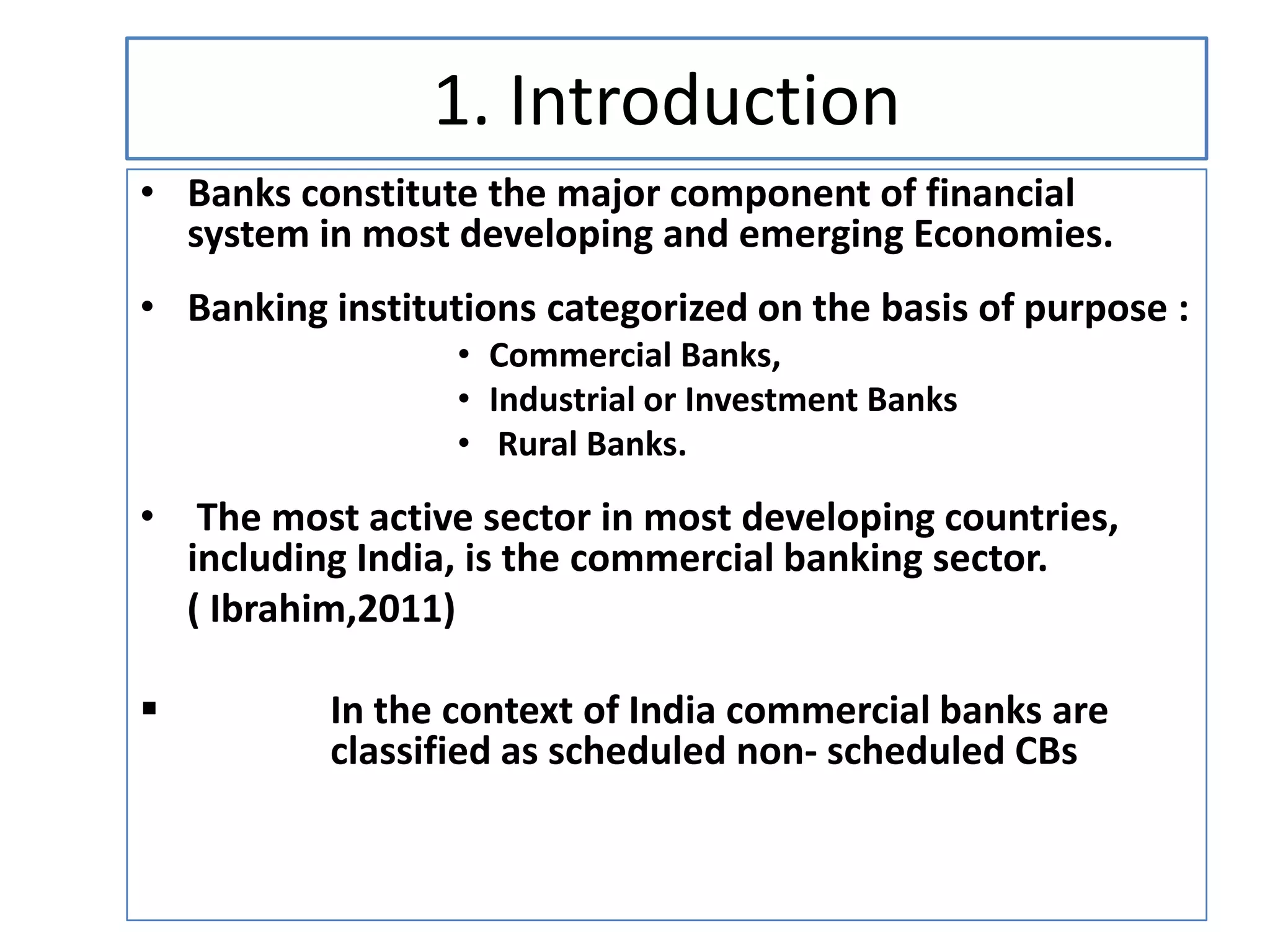
1. Introduction
• Banks constitute the major component of financial
system in most developing and emerging Economies.

• Banking institutions categorized on the basis of purpose :
• Commercial Banks,
• Industrial or Investment Banks
• Rural Banks.

• The most active sector in most developing countries,
including India, is the commercial banking sector.
( Ibrahim,2011)


In the context of India commercial banks are
classified as scheduled non- scheduled CBs
1. Introduction
• As per RBI cited on Indian brand equity foundation (2013) there
are 87 scheduled commercial banks.
• Of these,
• 26 are public sector banks,
• 20 are private banks
• 41 are foreign banks
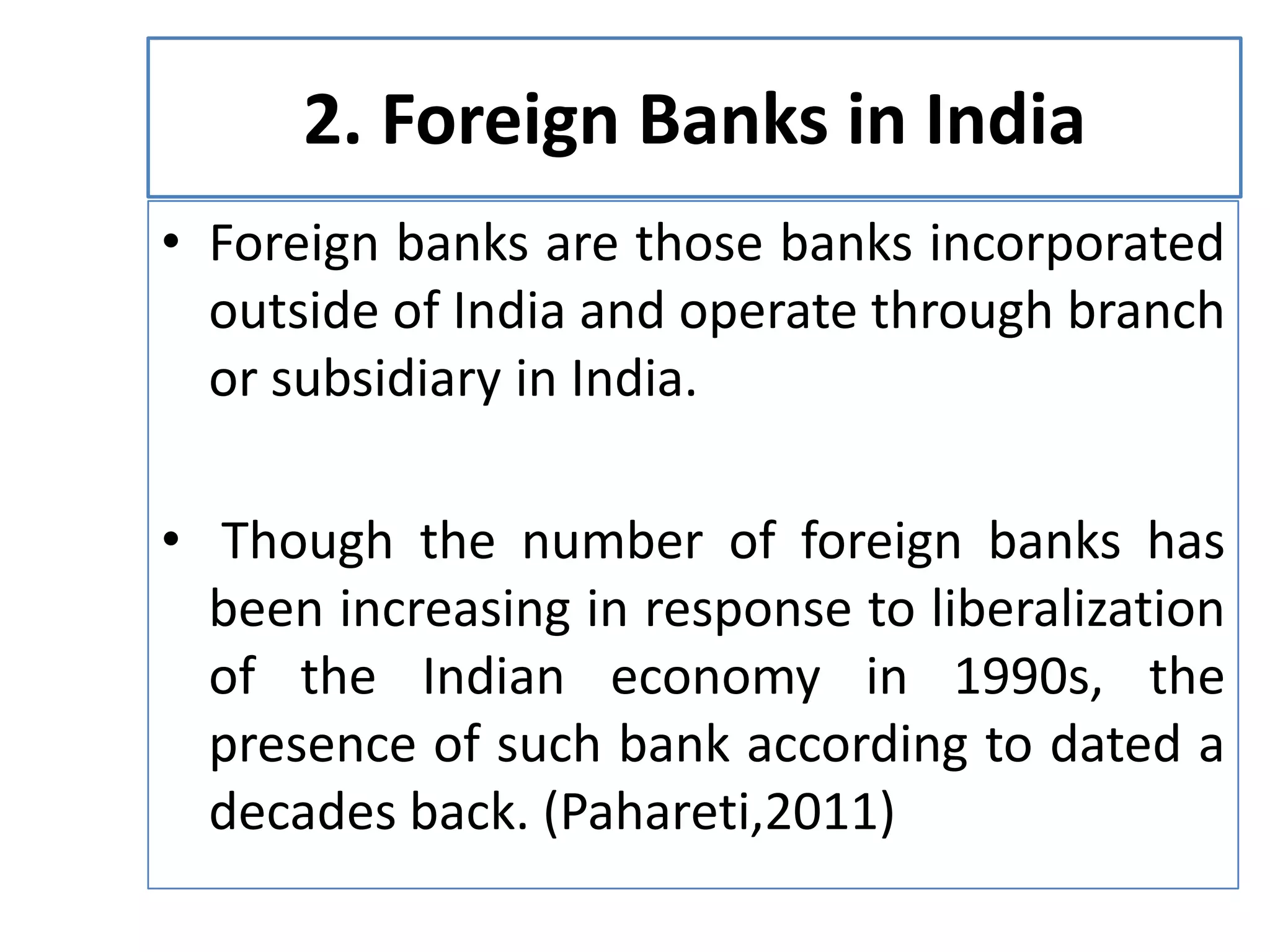
2. Foreign Banks in India
• Foreign banks are those banks incorporated
outside of India and operate through branch
or subsidiary in India.

• Though the number of foreign banks has
been increasing in response to liberalization
of the Indian economy in 1990s, the
presence of such bank according to dated a
decades back. (Pahareti,2011)
Foreign Banks in India(cont’d)
• According to Ashok KApor(na) the history of
banking in India is highly associated with foreign
banks, though their number and extent of
business differs across time.

• Foreign banks in India can be viewed in four
differed phases
2.1. Foreign Banks in India(1786 to 1935)
• Until 1935 there were about 18 foreign banks
that had been facilitating the foreign trade of
India.
• The foreign banks operating in this period were
called as “exchange Banks” for the fact that they
focused mainly on foreign exchange and foreign
trade business.

• Their share in deposit mobilization and credit
market had also been substantial.
2.2. Foreign Bank in India 1935 to 1969
• This period was marked by the establishment of
Reserve Bank of India in 1935
• Enhanced regulation of foreign banking business
in a bid to protect the economy from negative
effects of foreign bank operation.
• Acording to Ashok KApor(na) compared with the
previous periods the business of foreign banks
had been in a steady decline during this period.
2.3. Foreign Bank in India 1969 to 1991
• Their share in total asset, deposit mobilization,
and credit witnessed a decline
• To ensure their survival foreign banks designed a
strategic diversification of services such as:
foreign currency loan,
• investment banking,
• portfolio management
•

• They also followed a niche marketing strategy on
retail banking whereby they focused only on
limited cites with high net worth customer.
2.4. The fourth phase is 1991 onwards
• Economic liberalization, deregulation of the finance sector
and other economic reforms contributed for the surge of
FDI in India, including in the banking sector
• The number of foreign banks offices increased from 145 in
1990 to 324 in march 2013.

• the increasing foreign direct investment in the banking
sector brought significant change on the structure of the
banking sector
• Though there number is increasing their share is in
between 5-7%( M. Thyagarajan & Woudaya Kumar)
3. Mode of Entry
• Foreign banks who wish to open up branches in
India have to apply to the RBI and satisfy the
RBI licensing requirements:
• The banks should also get permission from
their home country to set up branches in India.
• the foreign banks seeking to set up business in
India should have a minimum start-up capital of
$25 million
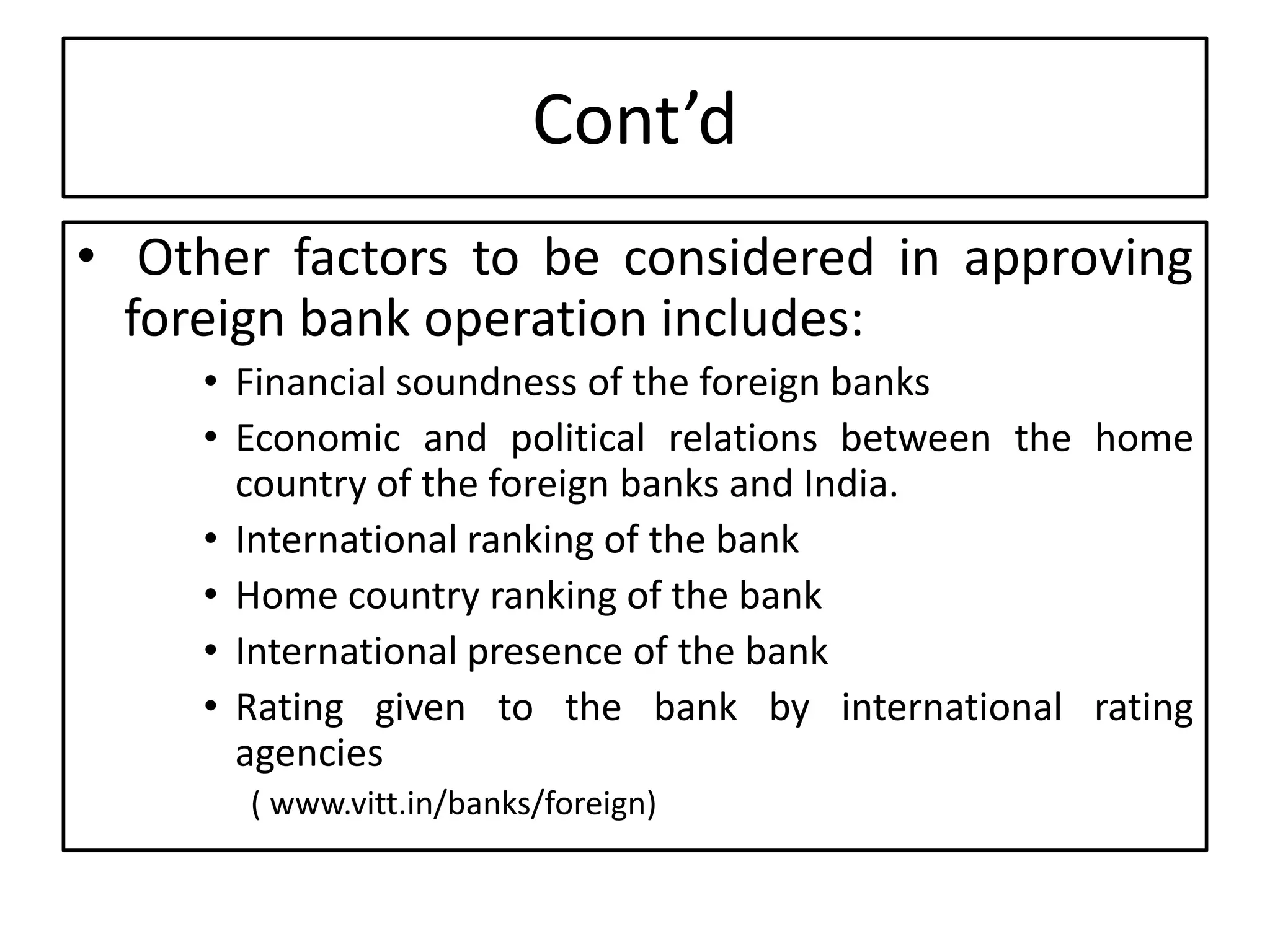
Cont’d
• Other factors to be considered in approving
foreign bank operation includes:
• Financial soundness of the foreign banks
• Economic and political relations between the home
country of the foreign banks and India.
• International ranking of the bank
• Home country ranking of the bank
• International presence of the bank
• Rating given to the bank by international rating
agencies
( www.vitt.in/banks/foreign)
4. Reasons for Foreign Bank Expansion
• India's GDP has been growing at a robust rate and it is
expected to maintain the pace over the next few years,
throwing up opportunities for the banking sector to profit
from.
• The credit of banks has risen and the growth momentum is
expected to continue over the next four to five years.
•

RBI is following a liberal branch licensing policy for those
foreign banks who want to go to the unbanked pockets.

• RBI has also been further liberalizing its policy on foreign
bank entry and operation
5. The Role of Foreign Banks in India
• Enhance competition in the banking sector
• Technology and skill transfer
• Both foreign and Local banks has been investing
on finical innovation
• Modern banking services expanded
• Enhanced customer satisfaction
• Enhanced Provision of foreign currency to
corporations
• Foreign banks participation in foreign exchange
and money market contribute for deepening of
financial system
6. Observations on the performance of Foreign Banks
Table 1: Number of Foreign Commercial Banks and Their
Branch size
Year
Total Number of Number of Foreign
Foreign Banks
Bank offices
2008
2009
2010
2011

31
32
33

272
279
295
317

36

2012

324
41
Table 3: Area wise Distribution Foreign Bank
Branch
year

Rural

Semi urban

Urban

Metropolitan

2005

0

1

37

251

Table 3: 0
Foreign Bank Branch Distribution
1
37
211

2006

2007

2008

year

2009

0
0
Rural

2

44

2
49
Semi urban Urban

4

4

277
226
Metropolitan

52

2011
2010

7

8

2011
2012

7
7

88

62 62

247 242

7

8

62

247

2012

5

6

62

233

60

242

237
Table 4: List of Top 10 foreign Banks in India based on Number of Branches
Rank

Name of the
bank

Entered
Number of
Indian Market Branches in India

1

Standard Chartered Bank

1969

96

2
3
4
5
6
7
8
9

HSBC
City Bank
Royal Bank Of Scotland
Douches Bank
DBSB
Barclays
BNP Paris
Credit Agricola corporate
and Investment
Bank of America

1959
1902
1921
1980

1981

50
50
31
16
12
10
8
6

1981

5

10
Year

The share of foreign bank in
total commercial bank Deposit

2001-02

5.36%

2007-08

6.4%

2009

4.73

2010

5.00

2011

4.29
Profitability

Year

Operating

Net

Profit

profit

2008

60.15

14.22

2009

62.82

13.45

2010

67.2

10.96
Summary and conclusion
• The history of Indian banking system is associated with
foreign banks
• The post 1990 economic liberalization period in India
resulted in increasing number of foreign bank
operations
• Foreign banks contributed to the banking sector and
entire economy
• The growth in Indian economy coupled with emerging
educated middle class showed that the banking sector
could have further potential for foreign banks in India.
• Though their advantage foreign bank has been
criticized for their profit supremacy over social banking
Foreign Banks in India

Foreign Banks in India

  • 1.
    Foreign Banks InIndia Assignment on Contemporary Issues in Financial System By: Matewos Kebede Punjabi University Patiala (2013/14)
  • 2.
    1. Introduction • Banksconstitute the major component of financial system in most developing and emerging Economies. • Banking institutions categorized on the basis of purpose : • Commercial Banks, • Industrial or Investment Banks • Rural Banks. • The most active sector in most developing countries, including India, is the commercial banking sector. ( Ibrahim,2011)  In the context of India commercial banks are classified as scheduled non- scheduled CBs
  • 3.
    1. Introduction • Asper RBI cited on Indian brand equity foundation (2013) there are 87 scheduled commercial banks. • Of these, • 26 are public sector banks, • 20 are private banks • 41 are foreign banks
  • 4.
    2. Foreign Banksin India • Foreign banks are those banks incorporated outside of India and operate through branch or subsidiary in India. • Though the number of foreign banks has been increasing in response to liberalization of the Indian economy in 1990s, the presence of such bank according to dated a decades back. (Pahareti,2011)
  • 5.
    Foreign Banks inIndia(cont’d) • According to Ashok KApor(na) the history of banking in India is highly associated with foreign banks, though their number and extent of business differs across time. • Foreign banks in India can be viewed in four differed phases
  • 6.
    2.1. Foreign Banksin India(1786 to 1935) • Until 1935 there were about 18 foreign banks that had been facilitating the foreign trade of India. • The foreign banks operating in this period were called as “exchange Banks” for the fact that they focused mainly on foreign exchange and foreign trade business. • Their share in deposit mobilization and credit market had also been substantial.
  • 7.
    2.2. Foreign Bankin India 1935 to 1969 • This period was marked by the establishment of Reserve Bank of India in 1935 • Enhanced regulation of foreign banking business in a bid to protect the economy from negative effects of foreign bank operation. • Acording to Ashok KApor(na) compared with the previous periods the business of foreign banks had been in a steady decline during this period.
  • 8.
    2.3. Foreign Bankin India 1969 to 1991 • Their share in total asset, deposit mobilization, and credit witnessed a decline • To ensure their survival foreign banks designed a strategic diversification of services such as: foreign currency loan, • investment banking, • portfolio management • • They also followed a niche marketing strategy on retail banking whereby they focused only on limited cites with high net worth customer.
  • 9.
    2.4. The fourthphase is 1991 onwards • Economic liberalization, deregulation of the finance sector and other economic reforms contributed for the surge of FDI in India, including in the banking sector • The number of foreign banks offices increased from 145 in 1990 to 324 in march 2013. • the increasing foreign direct investment in the banking sector brought significant change on the structure of the banking sector • Though there number is increasing their share is in between 5-7%( M. Thyagarajan & Woudaya Kumar)
  • 10.
    3. Mode ofEntry • Foreign banks who wish to open up branches in India have to apply to the RBI and satisfy the RBI licensing requirements: • The banks should also get permission from their home country to set up branches in India. • the foreign banks seeking to set up business in India should have a minimum start-up capital of $25 million
  • 11.
    Cont’d • Other factorsto be considered in approving foreign bank operation includes: • Financial soundness of the foreign banks • Economic and political relations between the home country of the foreign banks and India. • International ranking of the bank • Home country ranking of the bank • International presence of the bank • Rating given to the bank by international rating agencies ( www.vitt.in/banks/foreign)
  • 12.
    4. Reasons forForeign Bank Expansion • India's GDP has been growing at a robust rate and it is expected to maintain the pace over the next few years, throwing up opportunities for the banking sector to profit from. • The credit of banks has risen and the growth momentum is expected to continue over the next four to five years. • RBI is following a liberal branch licensing policy for those foreign banks who want to go to the unbanked pockets. • RBI has also been further liberalizing its policy on foreign bank entry and operation
  • 13.
    5. The Roleof Foreign Banks in India • Enhance competition in the banking sector • Technology and skill transfer • Both foreign and Local banks has been investing on finical innovation • Modern banking services expanded • Enhanced customer satisfaction • Enhanced Provision of foreign currency to corporations • Foreign banks participation in foreign exchange and money market contribute for deepening of financial system
  • 14.
    6. Observations onthe performance of Foreign Banks Table 1: Number of Foreign Commercial Banks and Their Branch size Year Total Number of Number of Foreign Foreign Banks Bank offices 2008 2009 2010 2011 31 32 33 272 279 295 317 36 2012 324 41
  • 15.
    Table 3: Areawise Distribution Foreign Bank Branch year Rural Semi urban Urban Metropolitan 2005 0 1 37 251 Table 3: 0 Foreign Bank Branch Distribution 1 37 211 2006 2007 2008 year 2009 0 0 Rural 2 44 2 49 Semi urban Urban 4 4 277 226 Metropolitan 52 2011 2010 7 8 2011 2012 7 7 88 62 62 247 242 7 8 62 247 2012 5 6 62 233 60 242 237
  • 16.
    Table 4: Listof Top 10 foreign Banks in India based on Number of Branches Rank Name of the bank Entered Number of Indian Market Branches in India 1 Standard Chartered Bank 1969 96 2 3 4 5 6 7 8 9 HSBC City Bank Royal Bank Of Scotland Douches Bank DBSB Barclays BNP Paris Credit Agricola corporate and Investment Bank of America 1959 1902 1921 1980 1981 50 50 31 16 12 10 8 6 1981 5 10
  • 17.
    Year The share offoreign bank in total commercial bank Deposit 2001-02 5.36% 2007-08 6.4% 2009 4.73 2010 5.00 2011 4.29
  • 18.
  • 19.
    Summary and conclusion •The history of Indian banking system is associated with foreign banks • The post 1990 economic liberalization period in India resulted in increasing number of foreign bank operations • Foreign banks contributed to the banking sector and entire economy • The growth in Indian economy coupled with emerging educated middle class showed that the banking sector could have further potential for foreign banks in India. • Though their advantage foreign bank has been criticized for their profit supremacy over social banking