1
A bank is a financial institution and a financial intermediary that
accepts deposits and channels those deposits into lending activities, either directly
by loaning or indirectly through capital markets. A bank links together customers
that have capital deficits and customers with capital surpluses
Functions of Bank
•Receipt of Deposits
•Lending of money
•Agency services 1) Dividend payment
2) Insurance premium payment
•General services eg deposit valves
What is Bank ????
2
• Factors that influence organisations to change their
performance and the responses as perthe
demands made on them
Institutional
• Amount
of land, labor, capital, and entrepreneurship that a
country possesses and can exploit
for manufacturing at each stage of development
Factor
endowment
• Financial structures may be better suited to growth
at certain stages of development but they may be
less well suited in other
Growth at
certain
stages
Banking Structure
3
Banking Structures
Rather than the nature of financial structure, it is the financial
system’s level of development that matters for growth
•In developing countries where economic development is hampered by
insufficient and inadequate access to financial services in rural areas, local
banks could improve financing opportunities to small and medium size
enterprises and encourage entrepreneurship.
•Economies at different stages of development require different blends of
financial services to operate effectively.
•Depending upon the structure and needs of an economy, the country’s
banking system should be dynamic and competitive to cater to the diverse
needs of the economy.
4
Financial inclusion is the delivery of financial services at affordable
costs to sections of disadvantaged and low-income segments
of society, in contrast to financial exclusion where those services are
not available or affordable
In other words, whether we need small number of large banks
or large number of small banks to promote financial inclusion ?
PROS
• Attract people of small means
• Penetration to unbanked areas
• Require less infrastructure due to limited area of operation
• Relationship banking
Small Banks & Financial Inclusion
5
CONS
• Vulnerable to shocks from the local economy
• Cannot finance big-ticket investments
• Small banks are prone to capture by big bank’s
• Lack economies of scale and scope
6
Types of BANK’S
RBI
Scheduled
Commercial
Co-operative
Un-
scheduled
Public Private Foreign Urban Rural
7
Legal Framework of Regulation of Banks in India
RBI Guidelines
•Deposits Withdrawal by Check
•Acceptance of Deposits by Non- Banking Entities
•Banking License
8
This term refers to any financing arrangement that crosses national
borders. Cross border financing could include cross border
loans, letters of credit or bankers acceptances
Cross border financing within corporations can become very
complex, mostly because almost every inter-company loan that
crosses national borders has tax consequences, even when the loans
or credit are extended by a third party such as a bank
United Kingdom, Hong Kong, Singapore, United States of
America, UAE and Bahrain in Middle East account for a sizeable share
(83.81%) in the total assets of Indian banks deployed in overseas
centers.
9
Until nationalization, all major banks were controlled by one or major
houses. These houses used resources given by common people for their
personal benefits.
Private ownership of banks resulted in concentration of income and
wealth in few hands.
Since publicly owned banks still perform poorly, privatisation seems to be
an effective policy in improving the performance of Indian banks.
10
The Reserve Bank of India (RBI) has suggested reorienting the banking structure in
four tiers and encouraging entry of only well-qualified entities to improve the quality
of the banking system and promote competition.
The first tier may consist of three or four large Indian banks with domestic and
international presence along with branches of foreign banks in India
The second tier is likely to comprise several midsized banking institutions including
niche banks with economy-wide presence.
The third tier may encompass old private sector banks, regional rural banks, and multi
state urban cooperative banks.
The fourth tier may embrace many small privately owned local banks and cooperative
banks
Lesser number of banks would help in better monitory policy transmission.”
11
 Nationalization is the process of taking a
private industry or private assets
into public ownership by a national
government or state.
 The government decided to nationalize
14 major commercial banks on 19th
July, 1969
 All commercial banks with a deposit
base over Rs.50 crores were nationalized
 The second dose of nationalisation
came in April 1980 when banks were
nationalized.
12
 Bank of Maharashtra
 Bank of India
 Vijaya Banka
 Punjab National Bank
 Bank of Baroda
13
 During 1921, the private banks like Bank of
Bengal, Bank of Bombay and Bank of
Madras were in service, which all together
formed Imperial Bank of India.
 There are two categories of the private-
sector banks: "old" and "new".
 Not nationalized at the time of
nationalization that took place during 1969
and 1980 are known to be the old private-
sector banks
 The banks, which came in operation after
1991, with the introduction of economic
reforms and financial sector reforms are
called "new private-sector banks"
14
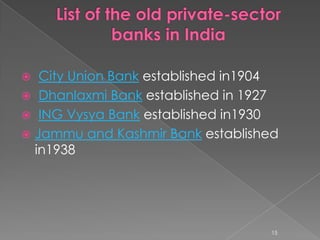
 City Union Bank established in1904
 Dhanlaxmi Bank established in 1927
 ING Vysya Bank established in1930
 Jammu and Kashmir Bank established
in1938
15
 Axis Bank (earlier UTI Bank) established in
1994
 HDFC Bank established in1994
 Kotak Mahindra Bank established 2003
 Yes Bank established in 2005
16
17

Indian banking system

  • 1.
  • 2.
    A bank isa financial institution and a financial intermediary that accepts deposits and channels those deposits into lending activities, either directly by loaning or indirectly through capital markets. A bank links together customers that have capital deficits and customers with capital surpluses Functions of Bank •Receipt of Deposits •Lending of money •Agency services 1) Dividend payment 2) Insurance premium payment •General services eg deposit valves What is Bank ???? 2
  • 3.
    • Factors thatinfluence organisations to change their performance and the responses as perthe demands made on them Institutional • Amount of land, labor, capital, and entrepreneurship that a country possesses and can exploit for manufacturing at each stage of development Factor endowment • Financial structures may be better suited to growth at certain stages of development but they may be less well suited in other Growth at certain stages Banking Structure 3
  • 4.
    Banking Structures Rather thanthe nature of financial structure, it is the financial system’s level of development that matters for growth •In developing countries where economic development is hampered by insufficient and inadequate access to financial services in rural areas, local banks could improve financing opportunities to small and medium size enterprises and encourage entrepreneurship. •Economies at different stages of development require different blends of financial services to operate effectively. •Depending upon the structure and needs of an economy, the country’s banking system should be dynamic and competitive to cater to the diverse needs of the economy. 4
  • 5.
    Financial inclusion isthe delivery of financial services at affordable costs to sections of disadvantaged and low-income segments of society, in contrast to financial exclusion where those services are not available or affordable In other words, whether we need small number of large banks or large number of small banks to promote financial inclusion ? PROS • Attract people of small means • Penetration to unbanked areas • Require less infrastructure due to limited area of operation • Relationship banking Small Banks & Financial Inclusion 5
  • 6.
    CONS • Vulnerable toshocks from the local economy • Cannot finance big-ticket investments • Small banks are prone to capture by big bank’s • Lack economies of scale and scope 6
  • 7.
  • 8.
    Legal Framework ofRegulation of Banks in India RBI Guidelines •Deposits Withdrawal by Check •Acceptance of Deposits by Non- Banking Entities •Banking License 8
  • 9.
    This term refersto any financing arrangement that crosses national borders. Cross border financing could include cross border loans, letters of credit or bankers acceptances Cross border financing within corporations can become very complex, mostly because almost every inter-company loan that crosses national borders has tax consequences, even when the loans or credit are extended by a third party such as a bank United Kingdom, Hong Kong, Singapore, United States of America, UAE and Bahrain in Middle East account for a sizeable share (83.81%) in the total assets of Indian banks deployed in overseas centers. 9
  • 10.
    Until nationalization, allmajor banks were controlled by one or major houses. These houses used resources given by common people for their personal benefits. Private ownership of banks resulted in concentration of income and wealth in few hands. Since publicly owned banks still perform poorly, privatisation seems to be an effective policy in improving the performance of Indian banks. 10
  • 11.
    The Reserve Bankof India (RBI) has suggested reorienting the banking structure in four tiers and encouraging entry of only well-qualified entities to improve the quality of the banking system and promote competition. The first tier may consist of three or four large Indian banks with domestic and international presence along with branches of foreign banks in India The second tier is likely to comprise several midsized banking institutions including niche banks with economy-wide presence. The third tier may encompass old private sector banks, regional rural banks, and multi state urban cooperative banks. The fourth tier may embrace many small privately owned local banks and cooperative banks Lesser number of banks would help in better monitory policy transmission.” 11
  • 12.
     Nationalization isthe process of taking a private industry or private assets into public ownership by a national government or state.  The government decided to nationalize 14 major commercial banks on 19th July, 1969  All commercial banks with a deposit base over Rs.50 crores were nationalized  The second dose of nationalisation came in April 1980 when banks were nationalized. 12
  • 13.
     Bank ofMaharashtra  Bank of India  Vijaya Banka  Punjab National Bank  Bank of Baroda 13
  • 14.
     During 1921,the private banks like Bank of Bengal, Bank of Bombay and Bank of Madras were in service, which all together formed Imperial Bank of India.  There are two categories of the private- sector banks: "old" and "new".  Not nationalized at the time of nationalization that took place during 1969 and 1980 are known to be the old private- sector banks  The banks, which came in operation after 1991, with the introduction of economic reforms and financial sector reforms are called "new private-sector banks" 14
  • 15.
     City UnionBank established in1904  Dhanlaxmi Bank established in 1927  ING Vysya Bank established in1930  Jammu and Kashmir Bank established in1938 15
  • 16.
     Axis Bank(earlier UTI Bank) established in 1994  HDFC Bank established in1994  Kotak Mahindra Bank established 2003  Yes Bank established in 2005 16
  • 17.