5- a. Types of tooth Rests
Dr. Amal Fathy Kaddah
Prof. of Prosthodontic,
Faculty of Oral &Dental Medicine,
Cairo University
Types of Tooth Rests
RESTS AND
REST SEATS
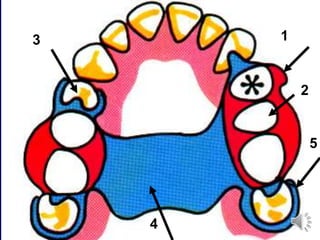
1
2
5
3
4
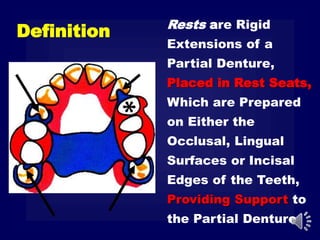
Definition Rests are Rigid
Extensions of a
Partial Denture,
Placed in Rest Seats,
Which are Prepared
on Either the
Occlusal, Lingual
Surfaces or Incisal
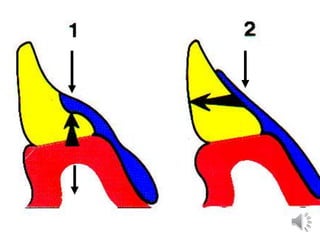
Edges of the Teeth,
Providing Support to
the Partial Denture
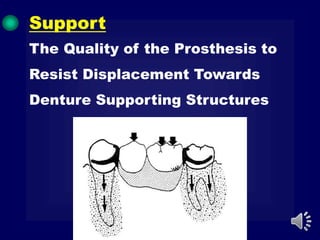
The Quality of the Prosthesis to
Resist Displacement Towards
Denture Supporting Structures
Support
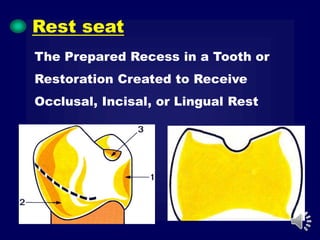
The Prepared Recess in a Tooth or
Restoration Created to Receive
Occlusal, Incisal, or Lingual Rest
Rest seat
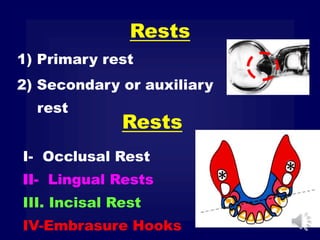
I- Occlusal Rest
II- Lingual Rests
III. Incisal Rest
IV-Embrasure Hooks
1) Primary rest
2) Secondary or auxiliary
rest
Rests
Rests
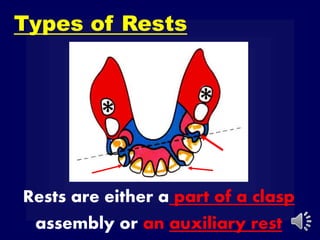
Rests are either a part of a clasp
assembly or an auxiliary rest
Types of Rests
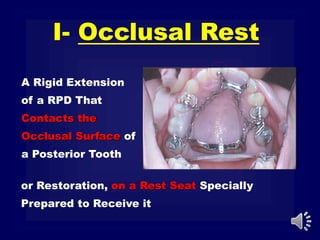
A Rigid Extension
of a RPD That
Contacts the
Occlusal Surface of
a Posterior Tooth
I- Occlusal Rest
or Restoration, on a Rest Seat Specially
Prepared to Receive it
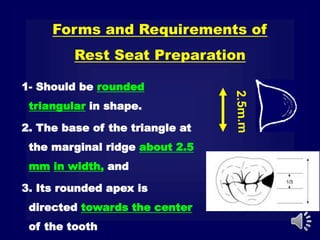
Forms and Requirements of
Rest Seat Preparation
1- Should be rounded
triangular in shape.
2. The base of the triangle at
the marginal ridge about 2.5
mm in width, and
3. Its rounded apex is
directed towards the center
of the tooth
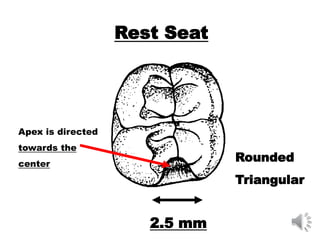
Rest Seat
Apex is directed
towards the
center
Rounded
Triangular
m 2.5 mm
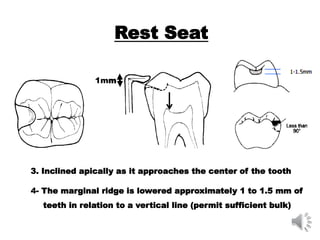
3. Inclined apically as it approaches the center of the tooth
4- The marginal ridge is lowered approximately 1 to 1.5 mm of
teeth in relation to a vertical line (permit sufficient bulk)
1mm
Rest Seat
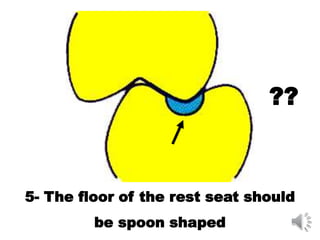
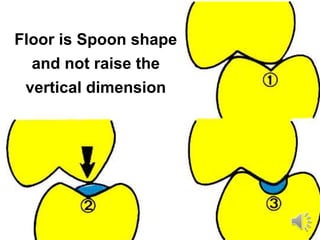
5- The floor of the rest seat should
be spoon shaped
??
6- Rests, should be prepared in
Sound Enamel.
8-If an amalgam restoration is present, it
could be replaced by a cast restoration
(occlusal rests can be prepared in an
old amalgam restoration. ????? why
7- Rests, could be prepared in cast
restorations, crowns or inlays.
• Flow of Amalgam registers
deformation during setting.
• Creep denotes the deformation of
the set amalgam
• High residual mercury >>
High creep & lower strength, low
fracture resistant
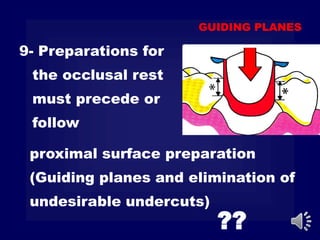
proximal surface preparation
(Guiding planes and elimination of
undesirable undercuts)
9- Preparations for
the occlusal rest
must precede or
follow
GUIDING PLANES
??
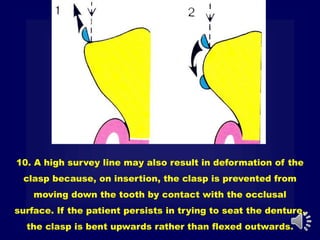
10. A high survey line may also result in deformation of the
clasp because, on insertion, the clasp is prevented from
moving down the tooth by contact with the occlusal
surface. If the patient persists in trying to seat the denture,
the clasp is bent upwards rather than flexed outwards.
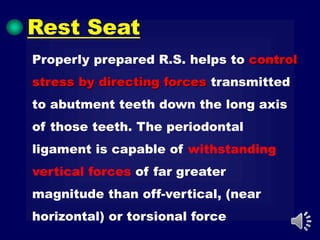
Properly prepared R.S. helps to control
stress by directing forces transmitted
to abutment teeth down the long axis
of those teeth. The periodontal
ligament is capable of withstanding
vertical forces of far greater
magnitude than off-vertical, (near
horizontal) or torsional force
Rest Seat
Requirements of the Occlusal Rest
I-O.R. must fit the tooth ( minimize food
collection and preserve their location
in relation to the tooth
2- It must be strong enough to withstand
the loads without deform
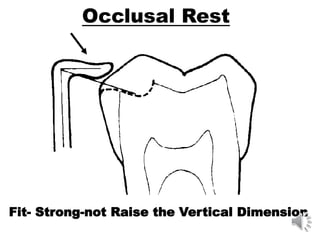
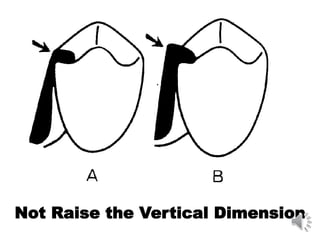
3-It must not raise the vertical
dimension of occlusion
Prevent slippage of the prosthesis
creating an orthodontic like force
To direct the forces along the long
axis of the tooth
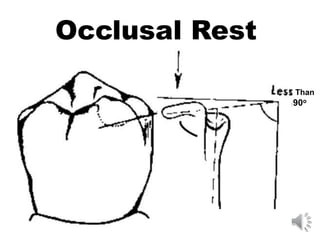
4- The angle between the minor
connector and the rest should be less
than 90˚
Occlusal Rest
Fit- Strong-not Raise the Vertical Dimension
Occlusal Rest
Than
90o
Not Raise the Vertical Dimension
Floor is Spoon shape
and not raise the
vertical dimension
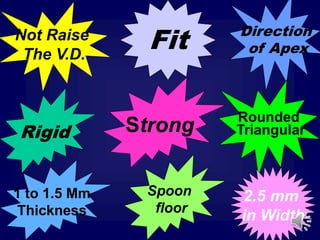
Not Raise
The V.D.
Fit Direction
of Apex
Rounded
TriangularRigid
Spoon
floor
2.5 mm
in Width
Strong
1 to 1.5 Mm
Thickness
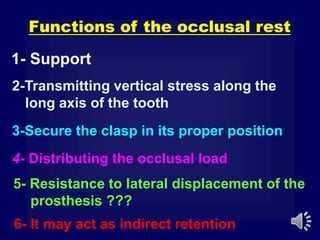
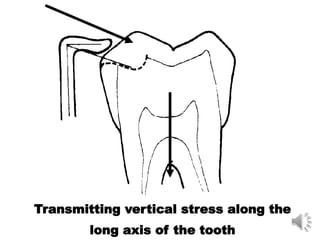
2-Transmitting vertical stress along the
long axis of the tooth
Functions of the occlusal rest
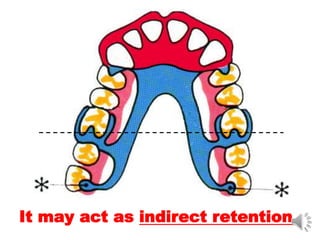
6- It may act as indirect retention
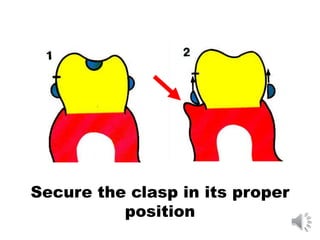
3-Secure the clasp in its proper position
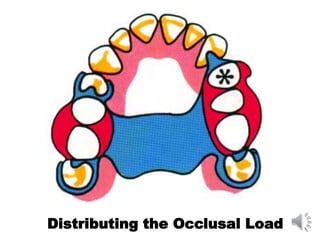
4- Distributing the occlusal load
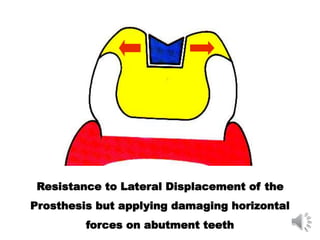
5- Resistance to lateral displacement of the
prosthesis ???
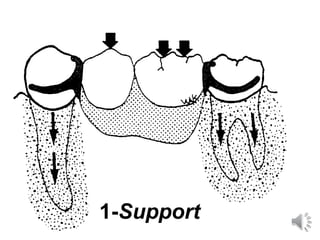
1- Support
1-Support
Transmitting vertical stress along the
long axis of the tooth
Secure the clasp in its proper
position
Distributing the Occlusal Load
It may act as indirect retention
Resistance to Lateral Displacement of the
Prosthesis but applying damaging horizontal
forces on abutment teeth
‫من‬ ‫ل‬‫العاق‬
‫التجارب‬‫وعظته‬
Special Considerations
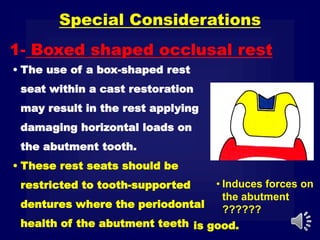
1- Boxed shaped occlusal rest
• Induces forces on
the abutment
??????
• The use of a box-shaped rest
seat within a cast restoration
may result in the rest applying
damaging horizontal loads on
the abutment tooth.
• These rest seats should be
restricted to tooth-supported
dentures where the periodontal
health of the abutment teeth is good.
•Induces
forces on
the
abutment
??????
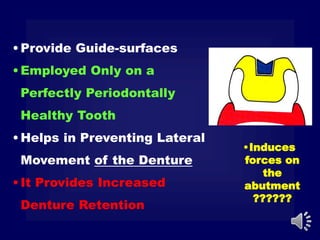
•Provide Guide-surfaces
•Employed Only on a
Perfectly Periodontally
Healthy Tooth
•Helps in Preventing Lateral
Movement of the Denture
•It Provides Increased
Denture Retention
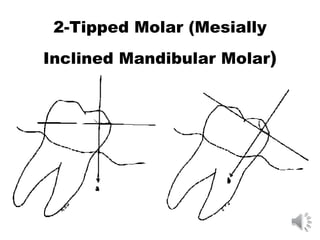
2-Tipped Molar (Mesially
Inclined Mandibular Molar)
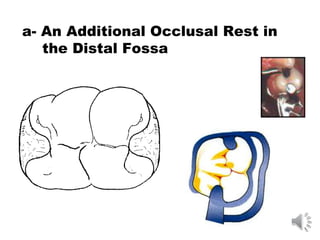
a- An Additional Occlusal Rest in
the Distal Fossa
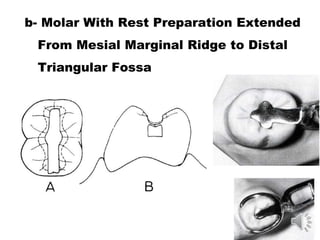
b- Molar With Rest Preparation Extended
From Mesial Marginal Ridge to Distal
Triangular Fossa
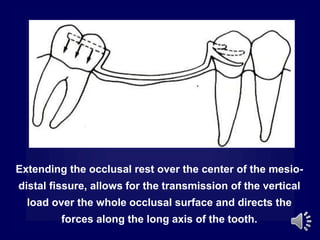
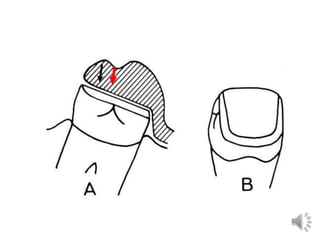
Extending the occlusal rest over the center of the mesio-
distal fissure, allows for the transmission of the vertical
load over the whole occlusal surface and directs the
forces along the long axis of the tooth.
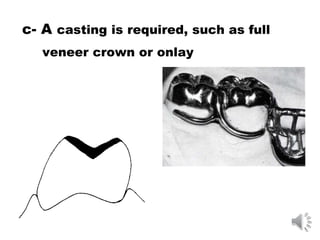
c- A casting is required, such as full
veneer crown or onlay
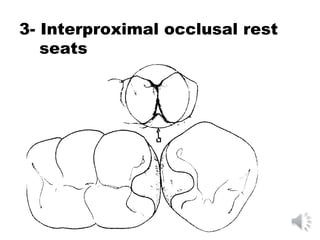
3- Interproximal occlusal rest
seats
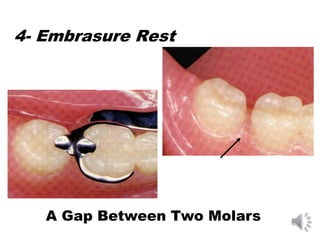
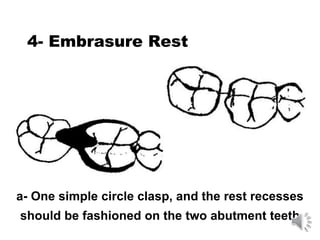
4- Embrasure Rest
A Gap Between Two Molars
4- Embrasure Rest
a- One simple circle clasp, and the rest recesses
should be fashioned on the two abutment teeth
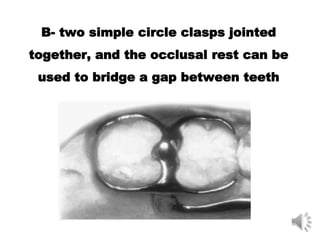
B- two simple circle clasps jointed
together, and the occlusal rest can be
used to bridge a gap between teeth
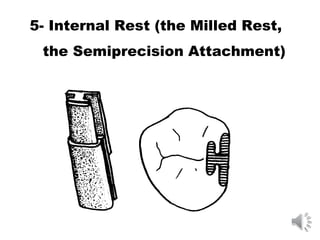
5- Internal Rest (the Milled Rest,
the Semiprecision Attachment)
You can only go
as far
as you push
‫تأتي‬ ‫العزم‬ ‫أهل‬ ‫قدر‬ ‫على‬
‫العزائم‬
Types of tooth rests 1

Types of tooth rests 1

  • 1.
    5- a. Typesof tooth Rests
  • 3.
    Dr. Amal FathyKaddah Prof. of Prosthodontic, Faculty of Oral &Dental Medicine, Cairo University Types of Tooth Rests
  • 5.
  • 6.
  • 7.
    Definition Rests areRigid Extensions of a Partial Denture, Placed in Rest Seats, Which are Prepared on Either the Occlusal, Lingual Surfaces or Incisal Edges of the Teeth, Providing Support to the Partial Denture
  • 8.
    The Quality ofthe Prosthesis to Resist Displacement Towards Denture Supporting Structures Support
  • 9.
    The Prepared Recessin a Tooth or Restoration Created to Receive Occlusal, Incisal, or Lingual Rest Rest seat
  • 11.
    I- Occlusal Rest II-Lingual Rests III. Incisal Rest IV-Embrasure Hooks 1) Primary rest 2) Secondary or auxiliary rest Rests Rests
  • 12.
    Rests are eithera part of a clasp assembly or an auxiliary rest Types of Rests
  • 13.
    A Rigid Extension ofa RPD That Contacts the Occlusal Surface of a Posterior Tooth I- Occlusal Rest or Restoration, on a Rest Seat Specially Prepared to Receive it
  • 14.
    Forms and Requirementsof Rest Seat Preparation 1- Should be rounded triangular in shape. 2. The base of the triangle at the marginal ridge about 2.5 mm in width, and 3. Its rounded apex is directed towards the center of the tooth
  • 15.
    Rest Seat Apex isdirected towards the center Rounded Triangular m 2.5 mm
  • 16.
    3. Inclined apicallyas it approaches the center of the tooth 4- The marginal ridge is lowered approximately 1 to 1.5 mm of teeth in relation to a vertical line (permit sufficient bulk) 1mm Rest Seat
  • 17.
    5- The floorof the rest seat should be spoon shaped ??
  • 18.
    6- Rests, shouldbe prepared in Sound Enamel. 8-If an amalgam restoration is present, it could be replaced by a cast restoration (occlusal rests can be prepared in an old amalgam restoration. ????? why 7- Rests, could be prepared in cast restorations, crowns or inlays.
  • 19.
    • Flow ofAmalgam registers deformation during setting. • Creep denotes the deformation of the set amalgam • High residual mercury >> High creep & lower strength, low fracture resistant
  • 20.
    proximal surface preparation (Guidingplanes and elimination of undesirable undercuts) 9- Preparations for the occlusal rest must precede or follow GUIDING PLANES ??
  • 21.
    10. A highsurvey line may also result in deformation of the clasp because, on insertion, the clasp is prevented from moving down the tooth by contact with the occlusal surface. If the patient persists in trying to seat the denture, the clasp is bent upwards rather than flexed outwards.
  • 22.
    Properly prepared R.S.helps to control stress by directing forces transmitted to abutment teeth down the long axis of those teeth. The periodontal ligament is capable of withstanding vertical forces of far greater magnitude than off-vertical, (near horizontal) or torsional force Rest Seat
  • 23.
    Requirements of theOcclusal Rest I-O.R. must fit the tooth ( minimize food collection and preserve their location in relation to the tooth 2- It must be strong enough to withstand the loads without deform 3-It must not raise the vertical dimension of occlusion
  • 24.
    Prevent slippage ofthe prosthesis creating an orthodontic like force To direct the forces along the long axis of the tooth 4- The angle between the minor connector and the rest should be less than 90˚
  • 25.
    Occlusal Rest Fit- Strong-notRaise the Vertical Dimension
  • 26.
  • 27.
    Not Raise theVertical Dimension
  • 28.
    Floor is Spoonshape and not raise the vertical dimension
  • 29.
    Not Raise The V.D. FitDirection of Apex Rounded TriangularRigid Spoon floor 2.5 mm in Width Strong 1 to 1.5 Mm Thickness
  • 30.
    2-Transmitting vertical stressalong the long axis of the tooth Functions of the occlusal rest 6- It may act as indirect retention 3-Secure the clasp in its proper position 4- Distributing the occlusal load 5- Resistance to lateral displacement of the prosthesis ??? 1- Support
  • 31.
  • 32.
    Transmitting vertical stressalong the long axis of the tooth
  • 33.
    Secure the claspin its proper position
  • 34.
  • 35.
    It may actas indirect retention
  • 36.
    Resistance to LateralDisplacement of the Prosthesis but applying damaging horizontal forces on abutment teeth
  • 37.
  • 38.
    Special Considerations 1- Boxedshaped occlusal rest • Induces forces on the abutment ?????? • The use of a box-shaped rest seat within a cast restoration may result in the rest applying damaging horizontal loads on the abutment tooth. • These rest seats should be restricted to tooth-supported dentures where the periodontal health of the abutment teeth is good.
  • 39.
    •Induces forces on the abutment ?????? •Provide Guide-surfaces •EmployedOnly on a Perfectly Periodontally Healthy Tooth •Helps in Preventing Lateral Movement of the Denture •It Provides Increased Denture Retention
  • 40.
  • 41.
    a- An AdditionalOcclusal Rest in the Distal Fossa
  • 42.
    b- Molar WithRest Preparation Extended From Mesial Marginal Ridge to Distal Triangular Fossa
  • 43.
    Extending the occlusalrest over the center of the mesio- distal fissure, allows for the transmission of the vertical load over the whole occlusal surface and directs the forces along the long axis of the tooth.
  • 44.
    c- A castingis required, such as full veneer crown or onlay
  • 46.
  • 47.
    4- Embrasure Rest AGap Between Two Molars
  • 48.
    4- Embrasure Rest a-One simple circle clasp, and the rest recesses should be fashioned on the two abutment teeth
  • 49.
    B- two simplecircle clasps jointed together, and the occlusal rest can be used to bridge a gap between teeth
  • 50.
    5- Internal Rest(the Milled Rest, the Semiprecision Attachment)
  • 51.
    You can onlygo as far as you push ‫تأتي‬ ‫العزم‬ ‫أهل‬ ‫قدر‬ ‫على‬ ‫العزائم‬