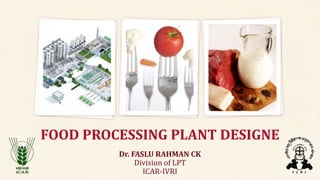
FOOD PROCESSING PLANT DESIGNE
Dr. FASLU RAHMAN CK
Division of LPT
ICAR-IVRI
FOOD PROCESSING PLANT
• Food processing
 transformation of agricultural products into food
 one form of food into other forms.
• Food plant
 Enclosed area into which food materials are brought and
modified in various ways to manufacture an end product.
FACTORY SITE
• Permission from both national and local governments.
• Comply with legislations.
• Facilities for discharge of waste materials.
• Determination of possible hygienic hazards.
• Basic arrangements for workers.
• Close to market
SITE
Water
Quality
labour
Area -
expansion
Road
Electricity
Resource
GENERAL DESIGN PRINCIPLES
• Various services
o heating
o lighting
o ventilation
o waste disposal
• Should operate efficiently.
• Fire resistant.
• Sound transmission and vibration should be minimized.
• Should resist various stresses and strains.
• Must conform to high standard of hygiene
LAYOUT AND DESIGN OF PLANT
• Good Manufacturing Practices (GMP)
• Bio-security
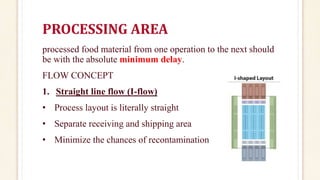
• Black zone and White zone
• No cross movement of labours/ products/ equipment
• White zone - Exit of finished product only
• Black zone – Unhygienic
• Always a forward movement of the products
ROOFING AND LIGHTING
• Flat or slightly pitched.
• Height - critical factor.
• Roof - source of natural light.
• Lighting is from two sides: illumination is more uniform
shadowing is restricted.
• Direct sunlight - glare problems and temperature
increases
ROOFING AND LIGHTING
• Single glazed windows = heat loss restrict 10% of the
roof area.
• Wall window - glazed area of at least 30% -
• Opening windows are not recommended.
• Artificial lighting - Advantageous.
• Shadows and glare to be avoided.
• Intensity – adequate & should spread uniformly
Lux meter – intensity of light
CEILINGS, WALLS AND FLOORS
• Junctions between ceiling and walls should be rounded
and sealed against dust and water
Obviate condensation
Paint flakes
Mould growth
MATERIAL
ROOFING AND LIGHTING
• Smooth and free from cracks and crevices
• Resistant to chemical and biological agents.
• Impervious to grease and water.
• All wall angles, corners and junctions - sealed and rounded
• Coving of the wall floor junctions to a height of approx. 15 cm
FLOORS AND DRAINS
• Material should be impervious, Durable and impact
resistant.
• Resistant to grease, cleaning agents including hot water or
steam and to biochemical and microbial attack.
• Should be free from cracks, crevices
• Surface should be non-slippery.
Non-slippery floor- surface additives such as carborundum
FLOORS AND DRAINS
 Floor - easy to clean and disinfect.
 Slope – 1:40 to 1:60 towards drains.
 Distance between drains:- restricted to 5 m
 Washing fluids should pass from cleaner to dirtier areas
FLOORS- materials
• Prone to dust,
• little resistance to acids or to
biochemical attack and
• liable to wear
• unevenly forming pits.
• resistance to impact,
chemicals and microbial
attack
• Durable and easy to clean
• Good non slippery surfaces
• Temperature
sensitiveness 70-
800C.
• smoothness
• Popular,
• very durable,
• moisture and stain resistant.
But expensive
DRAINAGE SYSTEM
• Totally covered drains - avoided.
• Should have smooth, vertical sides with a rounded base
and be slopped to allow for adequate water velocity.
• Depth should be sufficient - prevent over flow.
• Should be sited adjacent to but not directly against walls.
VENTILATION AND AIR CONDITIONING
• Hygienic food processing and/or comfort of personnel.
• For overcoming condensation
• To minimize the build up of offensive fumes and odors.
• Optimum environment temperature
• 21-22°C (for sedentary occupation)
• 13-14°C (for heavy manual work)
VENTILATION AND AIR CONDITIONING
• Humidity: 30-70%
• Rate of Air Change:
 Cooking areas 20 changes / hour
 Stores and Office 1/2 changes / hour
• Air flow - in the opposite direction to the process flow
• Fresh air - heavy manual work.
• Air entering factory - filtered or treated
• Excess pressure with in factory relative to the outside is
recommended.
FACTORY LAYOUT
a. Reception area
• easy access for transport.
• Efficient unloading to avoid deterioration in the
incoming raw material.
Liquid – may require pumps
Dry – may require mechanical means
FACTORY LAYOUT
Storage area
• Site- efficient flow to processing line.
• Room should be clean, adequate space for inspection and
cleaning, good air circulation and correct temperature and
humidity.
• Protection from dust, insects, rodents
• Food material should not be placed directly on the floor.
• Cold stores -cuboid in shape
• Efficient air circulation- reduces temp. Fluctuations.
PROCESSING AREA
processed food material from one operation to the next should
be with the absolute minimum delay.
FLOW CONCEPT
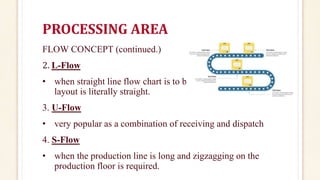
1. Straight line flow (I-flow)
• Process layout is literally straight
• Separate receiving and shipping area
• Minimize the chances of recontamination
PROCESSING AREA
FLOW CONCEPT (continued.)
2. L-Flow
• when straight line flow chart is to be accommodated Process
layout is literally straight.
3. U-Flow
• very popular as a combination of receiving and dispatch
4. S-Flow
• when the production line is long and zigzagging on the
production floor is required.
PROCESSING AREA
small factories
Equipment and
utensils may be
used in more than
one process – In
such cases
equipment must
be cleaned
between one
operation and the
next.
FINISHED PRODUCT STORAGE
(i) Constant environment
 Correct temperature
 Correct humidity
 Correct good air circulation
 Adequate space
 Durable construction materials.
(ii) Clean environment: Protection from Dust, air, insects, birds and
other pets.
(iii) Careful handling.
(iv) Efficient stock rotation.
(v) Sited at distance from warm processing area.
EMPLOYEE SERVICE & WELFARE AREA
• Principal amenities for employees.
• Toilets – with in 50 m distance
1 per 15 female employees
1 per 25 male
• Hand washing – in food handling areas
1 basin/ 10-12 employees
• Hot (440C) + cold water tapes – knee/foot operated
EMPLOYEE SERVICE & WELFARE AREA
Health
facilities
Canteens
Cloak
rooms
Office
Laboratory
Modern food
processing
plants…
“Let your food be your
medicine, and your
medicine be your food.”
-Hippocrates
Safe food…!
Healthy population.
Dr. Faslu Rahman CK
M-6059
Division of LPT
ICAR-IVRI, Izatnagar, UP

Food processing plant dr.faslu

  • 1.
    FOOD PROCESSING PLANTDESIGNE Dr. FASLU RAHMAN CK Division of LPT ICAR-IVRI
  • 2.
    FOOD PROCESSING PLANT •Food processing  transformation of agricultural products into food  one form of food into other forms. • Food plant  Enclosed area into which food materials are brought and modified in various ways to manufacture an end product.
  • 3.
    FACTORY SITE • Permissionfrom both national and local governments. • Comply with legislations. • Facilities for discharge of waste materials. • Determination of possible hygienic hazards. • Basic arrangements for workers. • Close to market
  • 4.
  • 5.
    GENERAL DESIGN PRINCIPLES •Various services o heating o lighting o ventilation o waste disposal • Should operate efficiently. • Fire resistant. • Sound transmission and vibration should be minimized. • Should resist various stresses and strains. • Must conform to high standard of hygiene
  • 6.
    LAYOUT AND DESIGNOF PLANT • Good Manufacturing Practices (GMP) • Bio-security • Black zone and White zone • No cross movement of labours/ products/ equipment • White zone - Exit of finished product only • Black zone – Unhygienic • Always a forward movement of the products
  • 8.
    ROOFING AND LIGHTING •Flat or slightly pitched. • Height - critical factor. • Roof - source of natural light. • Lighting is from two sides: illumination is more uniform shadowing is restricted. • Direct sunlight - glare problems and temperature increases
  • 9.
    ROOFING AND LIGHTING •Single glazed windows = heat loss restrict 10% of the roof area. • Wall window - glazed area of at least 30% - • Opening windows are not recommended. • Artificial lighting - Advantageous. • Shadows and glare to be avoided. • Intensity – adequate & should spread uniformly Lux meter – intensity of light
  • 10.
    CEILINGS, WALLS ANDFLOORS • Junctions between ceiling and walls should be rounded and sealed against dust and water Obviate condensation Paint flakes Mould growth MATERIAL
  • 11.
    ROOFING AND LIGHTING •Smooth and free from cracks and crevices • Resistant to chemical and biological agents. • Impervious to grease and water. • All wall angles, corners and junctions - sealed and rounded • Coving of the wall floor junctions to a height of approx. 15 cm
  • 12.
    FLOORS AND DRAINS •Material should be impervious, Durable and impact resistant. • Resistant to grease, cleaning agents including hot water or steam and to biochemical and microbial attack. • Should be free from cracks, crevices • Surface should be non-slippery. Non-slippery floor- surface additives such as carborundum
  • 13.
    FLOORS AND DRAINS Floor - easy to clean and disinfect.  Slope – 1:40 to 1:60 towards drains.  Distance between drains:- restricted to 5 m  Washing fluids should pass from cleaner to dirtier areas
  • 14.
    FLOORS- materials • Proneto dust, • little resistance to acids or to biochemical attack and • liable to wear • unevenly forming pits. • resistance to impact, chemicals and microbial attack • Durable and easy to clean • Good non slippery surfaces • Temperature sensitiveness 70- 800C. • smoothness • Popular, • very durable, • moisture and stain resistant. But expensive
  • 15.
    DRAINAGE SYSTEM • Totallycovered drains - avoided. • Should have smooth, vertical sides with a rounded base and be slopped to allow for adequate water velocity. • Depth should be sufficient - prevent over flow. • Should be sited adjacent to but not directly against walls.
  • 16.
    VENTILATION AND AIRCONDITIONING • Hygienic food processing and/or comfort of personnel. • For overcoming condensation • To minimize the build up of offensive fumes and odors. • Optimum environment temperature • 21-22°C (for sedentary occupation) • 13-14°C (for heavy manual work)
  • 17.
    VENTILATION AND AIRCONDITIONING • Humidity: 30-70% • Rate of Air Change:  Cooking areas 20 changes / hour  Stores and Office 1/2 changes / hour • Air flow - in the opposite direction to the process flow • Fresh air - heavy manual work. • Air entering factory - filtered or treated • Excess pressure with in factory relative to the outside is recommended.
  • 18.
    FACTORY LAYOUT a. Receptionarea • easy access for transport. • Efficient unloading to avoid deterioration in the incoming raw material. Liquid – may require pumps Dry – may require mechanical means
  • 19.
    FACTORY LAYOUT Storage area •Site- efficient flow to processing line. • Room should be clean, adequate space for inspection and cleaning, good air circulation and correct temperature and humidity. • Protection from dust, insects, rodents • Food material should not be placed directly on the floor. • Cold stores -cuboid in shape • Efficient air circulation- reduces temp. Fluctuations.
  • 20.
    PROCESSING AREA processed foodmaterial from one operation to the next should be with the absolute minimum delay. FLOW CONCEPT 1. Straight line flow (I-flow) • Process layout is literally straight • Separate receiving and shipping area • Minimize the chances of recontamination
  • 21.
    PROCESSING AREA FLOW CONCEPT(continued.) 2. L-Flow • when straight line flow chart is to be accommodated Process layout is literally straight. 3. U-Flow • very popular as a combination of receiving and dispatch 4. S-Flow • when the production line is long and zigzagging on the production floor is required.
  • 22.
    PROCESSING AREA small factories Equipmentand utensils may be used in more than one process – In such cases equipment must be cleaned between one operation and the next.
  • 23.
    FINISHED PRODUCT STORAGE (i)Constant environment  Correct temperature  Correct humidity  Correct good air circulation  Adequate space  Durable construction materials. (ii) Clean environment: Protection from Dust, air, insects, birds and other pets. (iii) Careful handling. (iv) Efficient stock rotation. (v) Sited at distance from warm processing area.
  • 24.
    EMPLOYEE SERVICE &WELFARE AREA • Principal amenities for employees. • Toilets – with in 50 m distance 1 per 15 female employees 1 per 25 male • Hand washing – in food handling areas 1 basin/ 10-12 employees • Hot (440C) + cold water tapes – knee/foot operated
  • 25.
    EMPLOYEE SERVICE &WELFARE AREA Health facilities Canteens Cloak rooms Office Laboratory
  • 26.
    Modern food processing plants… “Let yourfood be your medicine, and your medicine be your food.” -Hippocrates
  • 27.
  • 28.
    Dr. Faslu RahmanCK M-6059 Division of LPT ICAR-IVRI, Izatnagar, UP

Editor's Notes

  • #2 NOTE: To replace a picture, just select and delete it. Then use the Insert Picture icon to replace it with one of your own!
  • #13 Surface should be
  • #14 Surface should be
  • #15 Surface should be
  • #16 Surface should be
  • #17 (foods containing fat pick up odors readily). Surface should be
  • #18 (foods containing fat pick up odors readily). Surface should be
  • #19 (foods containing fat pick up odors readily). Surface should be
  • #20 (Gaps of at least 30 cm below the ceiling and from walls are essential. Surface should be
  • #21 (Gaps of at least 30 cm below the ceiling and from walls are essential. Surface should be
  • #22 (Gaps of at least 30 cm below the ceiling and from walls are essential. Surface should be
  • #23 (Gaps of at least 30 cm below the ceiling and from walls are essential. Surface should be
  • #24 (Gaps of at least 30 cm below the ceiling and from walls are essential. Surface should be
  • #25 (Gaps of at least 30 cm below the ceiling and from walls are essential. Surface should be
  • #26 (Gaps of at least 30 cm below the ceiling and from walls are essential. Surface should be