1
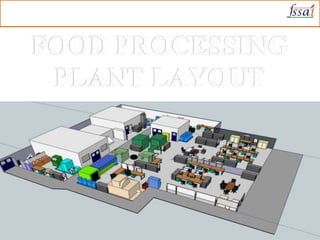
FOOD PROCESSING
PLANT LAYOUT
2
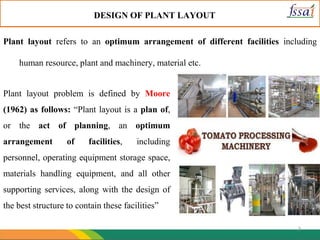
Plant layout refers to an optimum arrangement of different facilities including
human resource, plant and machinery, material etc.
DESIGN OF PLANT LAYOUT
Plant layout problem is defined by Moore
(1962) as follows: “Plant layout is a plan of,
or the act of planning, an optimum
arrangement of facilities, including
personnel, operating equipment storage space,
materials handling equipment, and all other
supporting services, along with the design of
the best structure to contain these facilities”
3
The layout problem occurs because of many developments including :
✔Change in product design
✔introduction of new product
✔obsolescence of facilities
✔changes in demand
✔market changes
✔Competitive cost reduction
✔frequent accidents
✔adoption of new safety standards
✔decision to build a new plant
4
OBJECTIVES OF PLANT LAYOUT
Some of the important objectives of a good plant layout are as follows :
▪Overall simplification of production process in terms of equipment utilization,
minimization of delays, reducing manufacturing time, and better provisions for
maintenance
▪Overall integration of man, materials, machinery, supporting activities and any other
considerations in a way that result in the best compromise.
▪Minimization of material handling cost by suitably placing the facilities in the best
flow sequence
▪Saving in floor space, effective space utilization and less congestion / confusion,
5
▪Increased output and reduced in-process inventories
▪Better supervision and control
▪Worker convenience and satisfaction
▪Better working environment, safety of employees and reduced hazards
▪Minimization of waste and higher productivity
▪Avoid unnecessary capital investment
▪Higher flexibility and adaptability to changing conditions
ADVANTAGES OF PLANT
LAYOUT
6
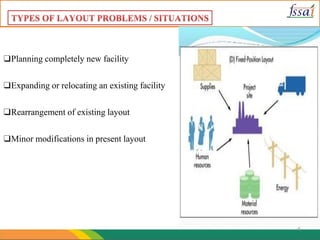
❑Planning completely new facility
❑Expanding or relocating an existing facility
❑Rearrangement of existing layout
❑Minor modifications in present layout
7
FLOW PATTERNS
According to the principle of flow, the layout plan arranges the work area for each
operation or process so as to have an overall smooth flow through the production /
service facility.
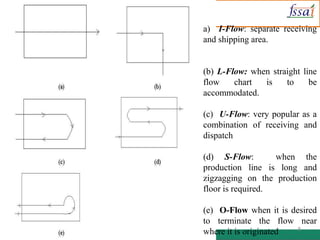
The basic types of flow patterns that are employed in designing the layout are
I-flow,
L-flow,
U- flow,
S-flow and
O - flow
8
a) I-Flow: separate receiving
and shipping area.
(b) L-Flow: when straight line
flow chart is to be
accommodated.
(c) U-Flow: very popular as a
combination of receiving and
dispatch
(d) S-Flow: when the
production line is long and
zigzagging on the production
floor is required.
(e) O-Flow when it is desired
to terminate the flow near
where it is originated
9
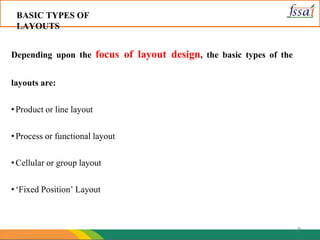
BASIC TYPES OF
LAYOUTS
Depending upon the focus of layout design, the basic types of the
layouts are:
•Product or line layout
•Process or functional layout
•Cellular or group layout
•‘Fixed Position’ Layout
10
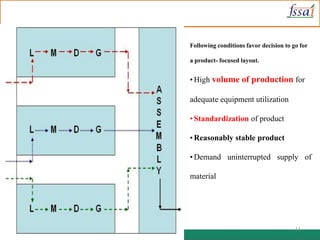
PRODUCT OR LINE LAYOUT
This type of layout is developed for product focused systems. In this type of layout
only one product, or one type of product, is produced in a given area. The work
centre's are organized in the sequence of appearance. The raw material enters at one
end of the line and goes from one operation to another rapidly with minimum of work-
in-process storage and material handling. The equipment is arranged in order of their
appearance in the production process.
11
Following conditions favor decision to go for
a product- focused layout.
•High volume of production for
adequate equipment utilization
•Standardization of product
•Reasonably stable product
•Demand uninterrupted supply of
material
12
Major advantages of this type of layout are:
•Reduction in material handing
•Less work-in-process
•Better utilization and specialization of labor
•Reduced congestion and smooth flow
•Effective supervision and control
13
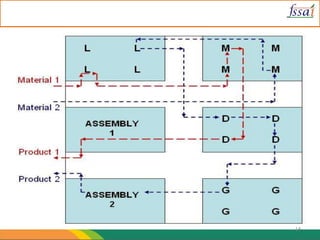
PROCESS OR FUNCTIONAL LAYOUT
This type of layout is developed for process focused systems.
The functional layout is more suited for low-volumes of production (batch production)
and particularly when the product is not standardized. It is economical when
flexibility (material can be rerouted in any sequence) is the basic system requirement.
The flexibility may be in terms of the routes through the system, volume of each
product and the processing requirement of the items.
14
15
Major advantages of a process layout are:
• Better equipment utilization
•Higher flexibility
•Greater incentive to individual worker
•More continuity of production in unforeseen conditions like breakdown, shortages,
absenteeism etc.
16
CELLULAR OR GROUP LAYOUT
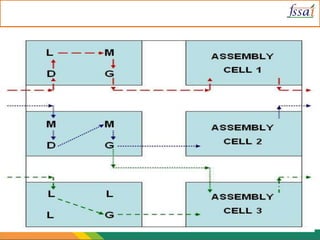
It is a special type of functional layout in which the facilities are clubbed together into
cells.
This is suitable for systems designed to use the concepts, principles and approach of
group technology. Such a layout offers the advantages of mass production with high
degree of flexibility.
We can employ high degree of automation even if the number of products is more with
flexible requirements. In such a system the facilities are grouped into cells which are
able to perform similar type of function for a group of products.
17
18
Advantages :
•Also known as ‘Group Technology’
•Each cell manufactures products belonging to a single family.
•Cells are autonomous manufacturing units which can produce finished parts.
•Commonly applied to machined parts.
•Productivity and quality maximised. Throughput times and work in progress kept to a
minimum.
•Flexible
•Suited to products in batches and where design changes often occur.
19
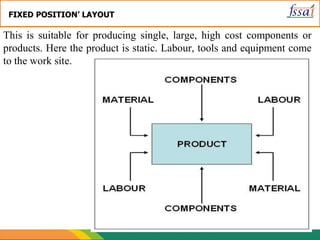
FIXED POSITION’ LAYOUT
This is suitable for producing single, large, high cost components or
products. Here the product is static. Labour, tools and equipment come
to the work site.
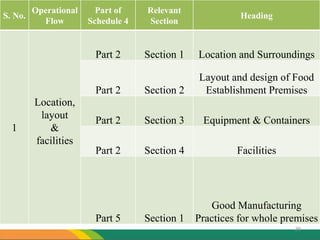
S. No.
Operational
Flow
Part of
Schedule 4
Relevant
Section
Heading
1
Location,
layout
&
facilities
Part 2 Section 1 Location and Surroundings
Part 2 Section 2
Layout and design of Food
Establishment Premises
Part 2 Section 3 Equipment & Containers
Part 2 Section 4 Facilities
Part 5 Section 1
Good Manufacturing
Practices for whole premises
20
LOCATION AND SURROUNDINGS
Location shall ideally be away from-
1. Environmentally polluted area.
2. Industrial activities that produce disagreeable odour, wastes, chemical or
biological emissions etc.
3. Areas which are prone to infestations of pests.
4. Areas where industrial wastes cannot be removed effectively.
5. Residential area.
In case there are hazards of other environment polluting industry located nearby,
1. Take appropriate measures to protect the manufacturing area from any
potential contamination.
21
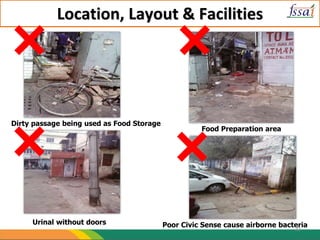
Location, Layout & Facilities
Dirty passage being used as Food Storage
Urinal without doors
Food Preparation area
Poor Civic Sense cause airborne bacteria
22
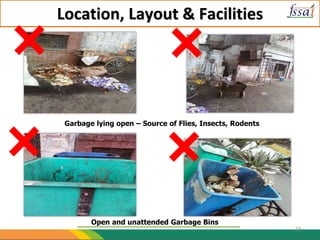
Location, Layout & Facilities
Garbage lying open – Source of Flies, Insects, Rodents
Open and unattended Garbage Bins
23
Location, Layout & Facilities
LAYOUT AND DESIGN OF FOOD ESTABLISHMENT
PREMISES
1. The designing of premises shall be such that -
- no cross contamination in food preparation area occur from pre and post
manufacturing operations
- one direction material movement (no backward flow) should be followed
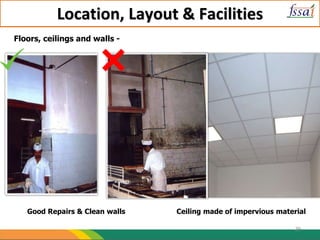
2. Floors, ceilings and walls –
- must be made of impervious material
- maintained in a sound condition to minimize accumulation of dirt, condensation &
growth of moulds
- should be smooth and easy to clean with no flaking paint or plaster.
24
Location, Layout & Facilities
LAYOUT AND DESIGN OF FOOD ESTABLISHMENT PREMISES
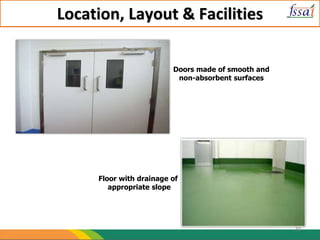
3. Doors –
- shall be made of smooth and non-absorbent surfaces
- shall be easy to clean and disinfectant
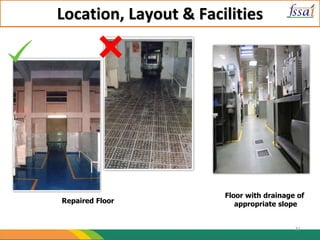
4. Floor –
- shall have adequate and proper drainage with appropriate slope and easy to
clean and where necessary disinfect
- the drainage shall flow in a direction opposite to the direction of food
preparation area.
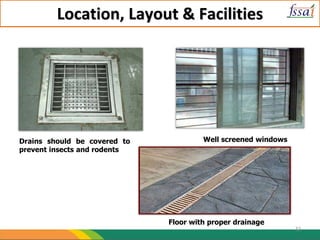
5. Drains –
- should be covered to prevent insects and rodents from entering the processing
area
25
LAYOUT AND DESIGN OF FOOD ESTABLISHMENT
PREMISES
6. Windows, doors & all other openings to outside environment –
- shall be well screened with wire-mesh or insect- proof screen to protect the
premise from pests
- the doors be fitted with automatic closing springs
- mesh should be easy to remove & clean
7. Food Preparation Areas –
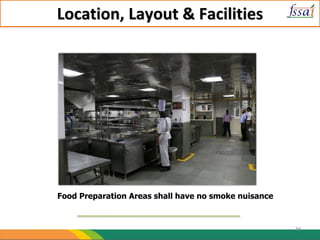
- shall have no smoke nuisance
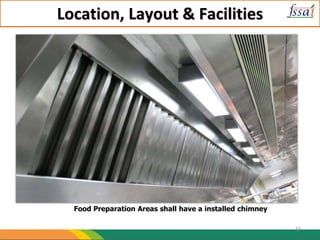
- install a chimney having appropriate suction prior to start of business.
- food if contaminated from any privy, urinal, sullage, drain or place of storage of
foul and waste matter, shall not be manufactured, stored or expose for sale.
26
Location, Layout & Facilities
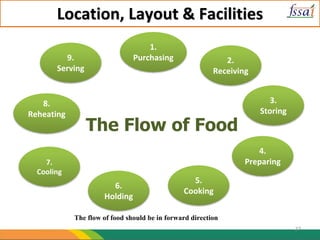
The flow of food should be in forward direction
9.
Serving
1.
Purchasing 2.
Receiving
3.
Storing
4.
Preparing
5.
Cooking
6.
Holding
7.
Cooling
8.
Reheating
The Flow of Food
27
Location, Layout & Facilities
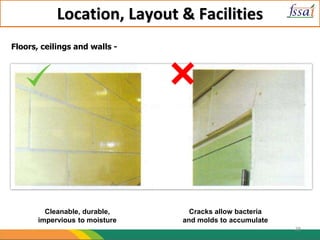
Cleanable, durable,
impervious to moisture
Cracks allow bacteria
and molds to accumulate
Floors, ceilings and walls -
28
Location, Layout & Facilities
Good Repairs & Clean walls
Floors, ceilings and walls -
Ceiling made of impervious material
29
Location, Layout & Facilities
Doors made of smooth and
non-absorbent surfaces
Floor with drainage of
appropriate slope
30
Location, Layout & Facilities
Repaired Floor
Floor with drainage of
appropriate slope
31
Location, Layout & Facilities
Drains should be covered to
prevent insects and rodents
Well screened windows
Floor with proper drainage
32
Location, Layout & Facilities
Food Preparation Areas shall have a installed chimney
33
Location, Layout & Facilities
Food Preparation Areas shall have no smoke nuisance
34
Location, Layout & Facilities
35
Location, Layout & Facilities
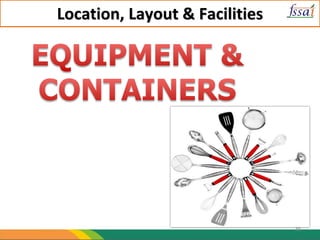
EQUIPMENT & CONTAINERS
Equipment and containers for waste, by-products, cleaning chemicals and
inedible or dangerous substances, shall be
- specifically identifiable
- suitably constructed
- stored separately
All food contacting items, fittings and equipment:
- must be kept in good condition
- chipped enameled containers will not be used.
- stainless steel /Aluminum / glass containers shall be used
- brass utensils shall be frequently provided with lining
36
EQUIPMENT & CONTAINERS
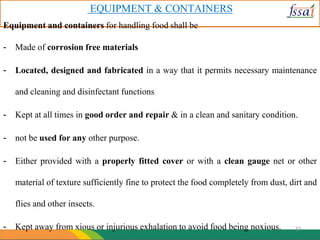
Equipment and containers for handling food shall be
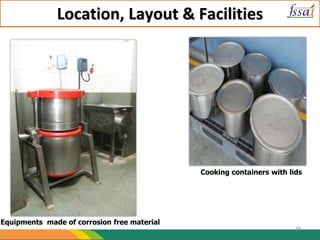
- Made of corrosion free materials
- Located, designed and fabricated in a way that it permits necessary maintenance
and cleaning and disinfectant functions
- Kept at all times in good order and repair & in a clean and sanitary condition.
- not be used for any other purpose.
- Either provided with a properly fitted cover or with a clean gauge net or other
material of texture sufficiently fine to protect the food completely from dust, dirt and
flies and other insects.
- Kept away from xious or injurious exhalation to avoid food being noxious. 37
Location, Layout & Facilities
Cooking containers with lids
Equipments made of corrosion free material
38
Location, Layout & Facilities
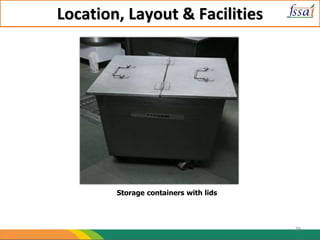
Storage containers with lids
39
Location, Layout & Facilities
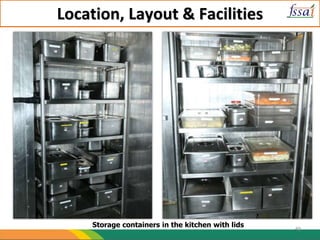
Storage containers in the kitchen with lids
40
Location, Layout & Facilities
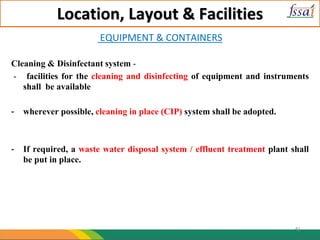
EQUIPMENT & CONTAINERS
Cleaning & Disinfectant system -
- facilities for the cleaning and disinfecting of equipment and instruments
shall be available
- wherever possible, cleaning in place (CIP) system shall be adopted.
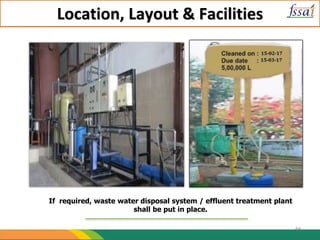
- If required, a waste water disposal system / effluent treatment plant shall
be put in place.
41
Location, Layout & Facilities
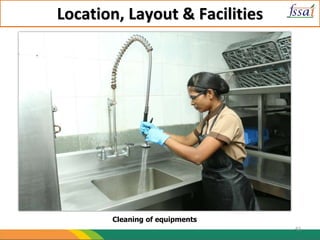
Cleaning of equipments
42
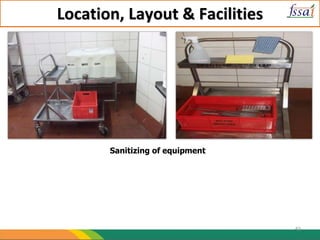
Location, Layout & Facilities
Sanitizing of equipment
43
Location, Layout & Facilities
If required, waste water disposal system / effluent treatment plant
shall be put in place.
44
Location, Layout & Facilities
45
Location, Layout & Facilities
FACILITIES
1. Water supply -
- only potable water in processing and cooking, food handling, washing shall be
used. (Explanatory Note – Potable water shall be tested according to IS:10500)
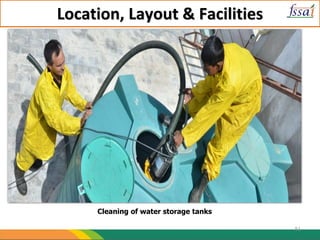
- storage tanks shall be cleaned periodically & records shall be maintained.
- non potable water can be used for cleaning of equipment not coming in contact
with
- Food - Food steam production
- Fire Fighting - Refrigeration equipment
- non potable water pipes shall prevent the use of this water for contamination of
food material.
- non potable water pipes shall be clearly distinguished from those in use for
potable water. 46
Location, Layout & Facilities
FACILITIES
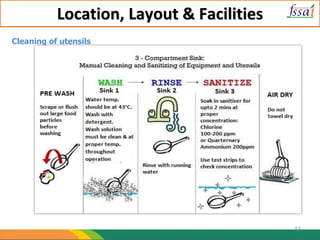
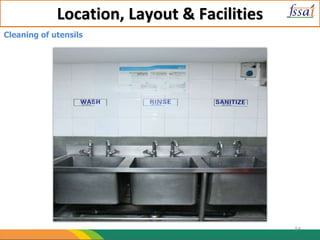
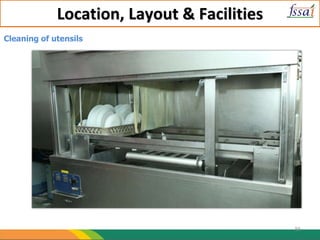
2. For Cleaning Utensils / Equipment –
- adequate facilities for cleaning, disinfecting shall be provided
- hot and cold water facility shall be provided if required
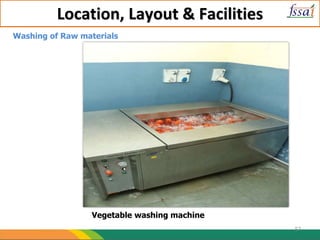
3. Washing of Raw materials –
- sinks with a draining board, detergent and hot water shall be provided
- these facilities must be kept clean and, where necessary, disinfected
- separate sinks shall be used for washing raw foods & washing utensils or any other
purposes.
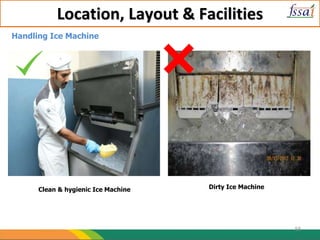
4. Ice and Steam –
- potable water shall be used.
- should be handled hygienically to avoid cross contamination.
47
Location, Layout & Facilities
FACILITIES
5. Personnel facilities and toilets
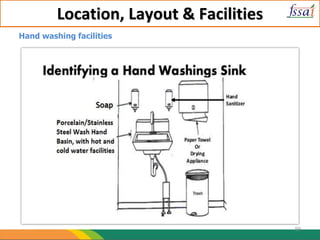
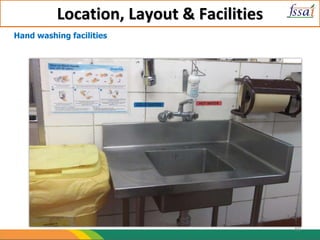
i. Hand washing facilities shall be provided
Requirements of a Hand washing and drying system –
✔ Porcelain/Stainless Steel Wash-hand basins, preferably knee operated
✔ Germicidal liquid Soap
✔ Sanitizer
✔ Supply of hot and /or cold water
✔ Wet hands drying system
✔ Clean and dry towels, preferably paper towel/rolls
✔ Covered Trash Bin, preferably pedal operated with plastic lining
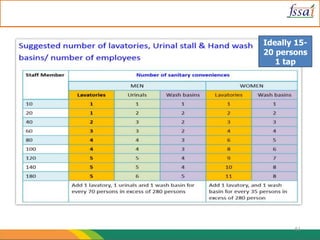
ii. separate adequate number of hygienic lavatories shall be provided
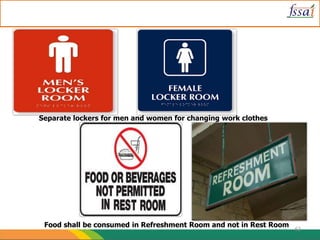
iii. changing facilities for personnel shall be provided
iv. restroom and refreshments rooms shall be separate from food process and service
areas
v. display hygiene requirements for the workers at a prominent place in English or in
local language 48
Location, Layout & Facilities
FACILITIES
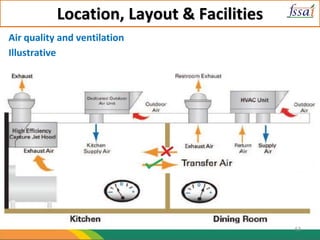
6. Air quality and ventilation –
- Ventilation systems shall be designed and constructed so that air does not flow
from contaminated areas to clean areas.
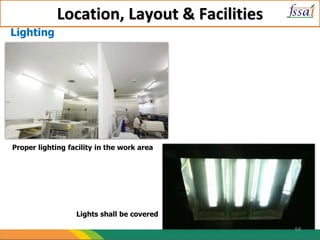
7. Lighting –
- sufficient lighting system shall be provided to the food establishment
- lighting fixtures should be covered to prevent breakages of electrical fittings to
contaminate food.
49
Location, Layout & Facilities
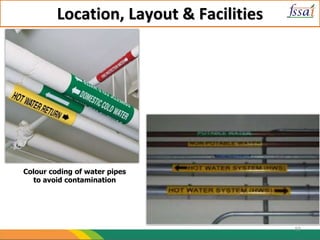
Colour coding of water pipes
to avoid contamination
50
Location, Layout & Facilities
Cleaning of water storage tanks
51
Location, Layout & Facilities
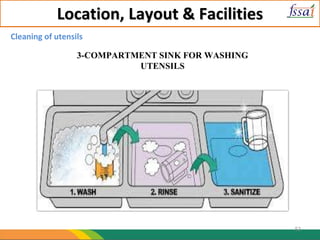
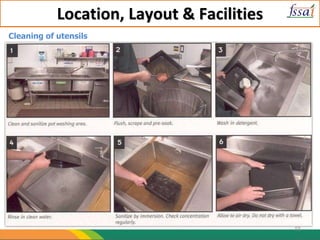
Cleaning of utensils
3-COMPARTMENT SINK FOR WASHING
UTENSILS
52
Location, Layout & Facilities
Cleaning of utensils
53
Location, Layout & Facilities
Cleaning of utensils
54
Location, Layout & Facilities
Cleaning of utensils
55
Location, Layout & Facilities
Cleaning of utensils
56
Location, Layout & Facilities
Washing of Raw materials
Vegetable washing machine
57
Location, Layout & Facilities
Handling Ice Machine
58
Clean & hygienic Ice Machine Dirty Ice Machine
Location, Layout & Facilities
Hand washing facilities
59
Location, Layout & Facilities
Hand washing facilities
60
Ideally 15-
20 persons
1 tap
61
Separate lockers for men and women for changing work clothes
Food shall be consumed in Refreshment Room and not in Rest Room
62
Location, Layout & Facilities
Air quality and ventilation
Illustrative
63
Location, Layout & Facilities
Lighting
Proper lighting facility in the work area
Lights shall be covered
64
65
66
67

location, layout & facilities (1) (1).pptx

  • 1.
  • 2.
    2 Plant layout refersto an optimum arrangement of different facilities including human resource, plant and machinery, material etc. DESIGN OF PLANT LAYOUT Plant layout problem is defined by Moore (1962) as follows: “Plant layout is a plan of, or the act of planning, an optimum arrangement of facilities, including personnel, operating equipment storage space, materials handling equipment, and all other supporting services, along with the design of the best structure to contain these facilities”
  • 3.
    3 The layout problemoccurs because of many developments including : ✔Change in product design ✔introduction of new product ✔obsolescence of facilities ✔changes in demand ✔market changes ✔Competitive cost reduction ✔frequent accidents ✔adoption of new safety standards ✔decision to build a new plant
  • 4.
    4 OBJECTIVES OF PLANTLAYOUT Some of the important objectives of a good plant layout are as follows : ▪Overall simplification of production process in terms of equipment utilization, minimization of delays, reducing manufacturing time, and better provisions for maintenance ▪Overall integration of man, materials, machinery, supporting activities and any other considerations in a way that result in the best compromise. ▪Minimization of material handling cost by suitably placing the facilities in the best flow sequence ▪Saving in floor space, effective space utilization and less congestion / confusion,
  • 5.
    5 ▪Increased output andreduced in-process inventories ▪Better supervision and control ▪Worker convenience and satisfaction ▪Better working environment, safety of employees and reduced hazards ▪Minimization of waste and higher productivity ▪Avoid unnecessary capital investment ▪Higher flexibility and adaptability to changing conditions ADVANTAGES OF PLANT LAYOUT
  • 6.
    6 ❑Planning completely newfacility ❑Expanding or relocating an existing facility ❑Rearrangement of existing layout ❑Minor modifications in present layout
  • 7.
    7 FLOW PATTERNS According tothe principle of flow, the layout plan arranges the work area for each operation or process so as to have an overall smooth flow through the production / service facility. The basic types of flow patterns that are employed in designing the layout are I-flow, L-flow, U- flow, S-flow and O - flow
  • 8.
    8 a) I-Flow: separatereceiving and shipping area. (b) L-Flow: when straight line flow chart is to be accommodated. (c) U-Flow: very popular as a combination of receiving and dispatch (d) S-Flow: when the production line is long and zigzagging on the production floor is required. (e) O-Flow when it is desired to terminate the flow near where it is originated
  • 9.
    9 BASIC TYPES OF LAYOUTS Dependingupon the focus of layout design, the basic types of the layouts are: •Product or line layout •Process or functional layout •Cellular or group layout •‘Fixed Position’ Layout
  • 10.
    10 PRODUCT OR LINELAYOUT This type of layout is developed for product focused systems. In this type of layout only one product, or one type of product, is produced in a given area. The work centre's are organized in the sequence of appearance. The raw material enters at one end of the line and goes from one operation to another rapidly with minimum of work- in-process storage and material handling. The equipment is arranged in order of their appearance in the production process.
  • 11.
    11 Following conditions favordecision to go for a product- focused layout. •High volume of production for adequate equipment utilization •Standardization of product •Reasonably stable product •Demand uninterrupted supply of material
  • 12.
    12 Major advantages ofthis type of layout are: •Reduction in material handing •Less work-in-process •Better utilization and specialization of labor •Reduced congestion and smooth flow •Effective supervision and control
  • 13.
    13 PROCESS OR FUNCTIONALLAYOUT This type of layout is developed for process focused systems. The functional layout is more suited for low-volumes of production (batch production) and particularly when the product is not standardized. It is economical when flexibility (material can be rerouted in any sequence) is the basic system requirement. The flexibility may be in terms of the routes through the system, volume of each product and the processing requirement of the items.
  • 14.
  • 15.
    15 Major advantages ofa process layout are: • Better equipment utilization •Higher flexibility •Greater incentive to individual worker •More continuity of production in unforeseen conditions like breakdown, shortages, absenteeism etc.
  • 16.
    16 CELLULAR OR GROUPLAYOUT It is a special type of functional layout in which the facilities are clubbed together into cells. This is suitable for systems designed to use the concepts, principles and approach of group technology. Such a layout offers the advantages of mass production with high degree of flexibility. We can employ high degree of automation even if the number of products is more with flexible requirements. In such a system the facilities are grouped into cells which are able to perform similar type of function for a group of products.
  • 17.
  • 18.
    18 Advantages : •Also knownas ‘Group Technology’ •Each cell manufactures products belonging to a single family. •Cells are autonomous manufacturing units which can produce finished parts. •Commonly applied to machined parts. •Productivity and quality maximised. Throughput times and work in progress kept to a minimum. •Flexible •Suited to products in batches and where design changes often occur.
  • 19.
    19 FIXED POSITION’ LAYOUT Thisis suitable for producing single, large, high cost components or products. Here the product is static. Labour, tools and equipment come to the work site.
  • 20.
    S. No. Operational Flow Part of Schedule4 Relevant Section Heading 1 Location, layout & facilities Part 2 Section 1 Location and Surroundings Part 2 Section 2 Layout and design of Food Establishment Premises Part 2 Section 3 Equipment & Containers Part 2 Section 4 Facilities Part 5 Section 1 Good Manufacturing Practices for whole premises 20
  • 21.
    LOCATION AND SURROUNDINGS Locationshall ideally be away from- 1. Environmentally polluted area. 2. Industrial activities that produce disagreeable odour, wastes, chemical or biological emissions etc. 3. Areas which are prone to infestations of pests. 4. Areas where industrial wastes cannot be removed effectively. 5. Residential area. In case there are hazards of other environment polluting industry located nearby, 1. Take appropriate measures to protect the manufacturing area from any potential contamination. 21
  • 22.
    Location, Layout &Facilities Dirty passage being used as Food Storage Urinal without doors Food Preparation area Poor Civic Sense cause airborne bacteria 22
  • 23.
    Location, Layout &Facilities Garbage lying open – Source of Flies, Insects, Rodents Open and unattended Garbage Bins 23
  • 24.
    Location, Layout &Facilities LAYOUT AND DESIGN OF FOOD ESTABLISHMENT PREMISES 1. The designing of premises shall be such that - - no cross contamination in food preparation area occur from pre and post manufacturing operations - one direction material movement (no backward flow) should be followed 2. Floors, ceilings and walls – - must be made of impervious material - maintained in a sound condition to minimize accumulation of dirt, condensation & growth of moulds - should be smooth and easy to clean with no flaking paint or plaster. 24
  • 25.
    Location, Layout &Facilities LAYOUT AND DESIGN OF FOOD ESTABLISHMENT PREMISES 3. Doors – - shall be made of smooth and non-absorbent surfaces - shall be easy to clean and disinfectant 4. Floor – - shall have adequate and proper drainage with appropriate slope and easy to clean and where necessary disinfect - the drainage shall flow in a direction opposite to the direction of food preparation area. 5. Drains – - should be covered to prevent insects and rodents from entering the processing area 25
  • 26.
    LAYOUT AND DESIGNOF FOOD ESTABLISHMENT PREMISES 6. Windows, doors & all other openings to outside environment – - shall be well screened with wire-mesh or insect- proof screen to protect the premise from pests - the doors be fitted with automatic closing springs - mesh should be easy to remove & clean 7. Food Preparation Areas – - shall have no smoke nuisance - install a chimney having appropriate suction prior to start of business. - food if contaminated from any privy, urinal, sullage, drain or place of storage of foul and waste matter, shall not be manufactured, stored or expose for sale. 26
  • 27.
    Location, Layout &Facilities The flow of food should be in forward direction 9. Serving 1. Purchasing 2. Receiving 3. Storing 4. Preparing 5. Cooking 6. Holding 7. Cooling 8. Reheating The Flow of Food 27
  • 28.
    Location, Layout &Facilities Cleanable, durable, impervious to moisture Cracks allow bacteria and molds to accumulate Floors, ceilings and walls - 28
  • 29.
    Location, Layout &Facilities Good Repairs & Clean walls Floors, ceilings and walls - Ceiling made of impervious material 29
  • 30.
    Location, Layout &Facilities Doors made of smooth and non-absorbent surfaces Floor with drainage of appropriate slope 30
  • 31.
    Location, Layout &Facilities Repaired Floor Floor with drainage of appropriate slope 31
  • 32.
    Location, Layout &Facilities Drains should be covered to prevent insects and rodents Well screened windows Floor with proper drainage 32
  • 33.
    Location, Layout &Facilities Food Preparation Areas shall have a installed chimney 33
  • 34.
    Location, Layout &Facilities Food Preparation Areas shall have no smoke nuisance 34
  • 35.
    Location, Layout &Facilities 35
  • 36.
    Location, Layout &Facilities EQUIPMENT & CONTAINERS Equipment and containers for waste, by-products, cleaning chemicals and inedible or dangerous substances, shall be - specifically identifiable - suitably constructed - stored separately All food contacting items, fittings and equipment: - must be kept in good condition - chipped enameled containers will not be used. - stainless steel /Aluminum / glass containers shall be used - brass utensils shall be frequently provided with lining 36
  • 37.
    EQUIPMENT & CONTAINERS Equipmentand containers for handling food shall be - Made of corrosion free materials - Located, designed and fabricated in a way that it permits necessary maintenance and cleaning and disinfectant functions - Kept at all times in good order and repair & in a clean and sanitary condition. - not be used for any other purpose. - Either provided with a properly fitted cover or with a clean gauge net or other material of texture sufficiently fine to protect the food completely from dust, dirt and flies and other insects. - Kept away from xious or injurious exhalation to avoid food being noxious. 37
  • 38.
    Location, Layout &Facilities Cooking containers with lids Equipments made of corrosion free material 38
  • 39.
    Location, Layout &Facilities Storage containers with lids 39
  • 40.
    Location, Layout &Facilities Storage containers in the kitchen with lids 40
  • 41.
    Location, Layout &Facilities EQUIPMENT & CONTAINERS Cleaning & Disinfectant system - - facilities for the cleaning and disinfecting of equipment and instruments shall be available - wherever possible, cleaning in place (CIP) system shall be adopted. - If required, a waste water disposal system / effluent treatment plant shall be put in place. 41
  • 42.
    Location, Layout &Facilities Cleaning of equipments 42
  • 43.
    Location, Layout &Facilities Sanitizing of equipment 43
  • 44.
    Location, Layout &Facilities If required, waste water disposal system / effluent treatment plant shall be put in place. 44
  • 45.
    Location, Layout &Facilities 45
  • 46.
    Location, Layout &Facilities FACILITIES 1. Water supply - - only potable water in processing and cooking, food handling, washing shall be used. (Explanatory Note – Potable water shall be tested according to IS:10500) - storage tanks shall be cleaned periodically & records shall be maintained. - non potable water can be used for cleaning of equipment not coming in contact with - Food - Food steam production - Fire Fighting - Refrigeration equipment - non potable water pipes shall prevent the use of this water for contamination of food material. - non potable water pipes shall be clearly distinguished from those in use for potable water. 46
  • 47.
    Location, Layout &Facilities FACILITIES 2. For Cleaning Utensils / Equipment – - adequate facilities for cleaning, disinfecting shall be provided - hot and cold water facility shall be provided if required 3. Washing of Raw materials – - sinks with a draining board, detergent and hot water shall be provided - these facilities must be kept clean and, where necessary, disinfected - separate sinks shall be used for washing raw foods & washing utensils or any other purposes. 4. Ice and Steam – - potable water shall be used. - should be handled hygienically to avoid cross contamination. 47
  • 48.
    Location, Layout &Facilities FACILITIES 5. Personnel facilities and toilets i. Hand washing facilities shall be provided Requirements of a Hand washing and drying system – ✔ Porcelain/Stainless Steel Wash-hand basins, preferably knee operated ✔ Germicidal liquid Soap ✔ Sanitizer ✔ Supply of hot and /or cold water ✔ Wet hands drying system ✔ Clean and dry towels, preferably paper towel/rolls ✔ Covered Trash Bin, preferably pedal operated with plastic lining ii. separate adequate number of hygienic lavatories shall be provided iii. changing facilities for personnel shall be provided iv. restroom and refreshments rooms shall be separate from food process and service areas v. display hygiene requirements for the workers at a prominent place in English or in local language 48
  • 49.
    Location, Layout &Facilities FACILITIES 6. Air quality and ventilation – - Ventilation systems shall be designed and constructed so that air does not flow from contaminated areas to clean areas. 7. Lighting – - sufficient lighting system shall be provided to the food establishment - lighting fixtures should be covered to prevent breakages of electrical fittings to contaminate food. 49
  • 50.
    Location, Layout &Facilities Colour coding of water pipes to avoid contamination 50
  • 51.
    Location, Layout &Facilities Cleaning of water storage tanks 51
  • 52.
    Location, Layout &Facilities Cleaning of utensils 3-COMPARTMENT SINK FOR WASHING UTENSILS 52
  • 53.
    Location, Layout &Facilities Cleaning of utensils 53
  • 54.
    Location, Layout &Facilities Cleaning of utensils 54
  • 55.
    Location, Layout &Facilities Cleaning of utensils 55
  • 56.
    Location, Layout &Facilities Cleaning of utensils 56
  • 57.
    Location, Layout &Facilities Washing of Raw materials Vegetable washing machine 57
  • 58.
    Location, Layout &Facilities Handling Ice Machine 58 Clean & hygienic Ice Machine Dirty Ice Machine
  • 59.
    Location, Layout &Facilities Hand washing facilities 59
  • 60.
    Location, Layout &Facilities Hand washing facilities 60
  • 61.
  • 62.
    Separate lockers formen and women for changing work clothes Food shall be consumed in Refreshment Room and not in Rest Room 62
  • 63.
    Location, Layout &Facilities Air quality and ventilation Illustrative 63
  • 64.
    Location, Layout &Facilities Lighting Proper lighting facility in the work area Lights shall be covered 64
  • 65.
  • 66.
  • 67.