

Development Of Chicken
Flavor Through Maillard
Reaction
Presented By:
Dinesh D.Shinde
Rashmi G. Tikhe
V.Sundaralaksmi
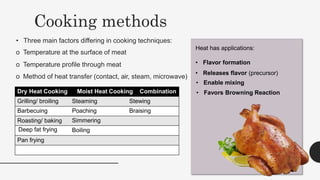
Cooking methods
• Three main factors differing in cooking techniques:
o Temperature at the surface of meat
Heat has applications:
• Flavor formationo Temperature profile through meat
o Method of heat transfer (contact, air, steam, microwave)
Dry Heat Cooking Moist Heat Cooking Combination
• Releases flavor (precursor)
Grilling/ broiling
Barbecuing
Steaming
Poaching
Simmering
Boiling
Stewing
Braising
• Enable mixing
Roasting/ baking
Pan frying
• Favors Browning Reaction
Deep fat frying
Effect of cooking on flavor
• Amino acids and reducing sugars react when heated MAILLARD REACTION
• Fatty acids get oxidized and degraded to create
volatile flavor compounds LIPID DEGRADATION
THIAMIN DEGRADATION• Thiamine is a source of meat flavor generated on heating
Maillard Reaction
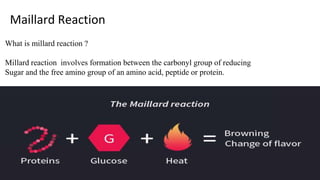
What is millard reaction ?
Millard reaction involves formation between the carbonyl group of reducing
Sugar and the free amino group of an amino acid, peptide or protein.
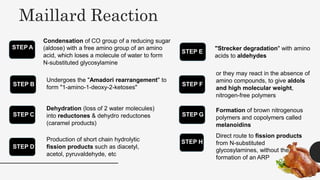
Maillard Reaction
Condensation of CO group of a reducing sugar
STEP A (aldose) with a free amino group of an amino
acid, which loses a molecule of water to form
N-substituted glycosylamine
"Strecker degradation" with amino
acids to aldehydes
STEP E
STEP F
or they may react in the absence of
amino compounds, to give aldols
and high molecular weight,
nitrogen-free polymers
Undergoes the "Amadori rearrangement" to
form "1-amino-1-deoxy-2-ketoses"
STEP B
STEP C
Dehydration (loss of 2 water molecules)
into reductones & dehydro reductones
(caramel products)
Formation of brown nitrogenous
polymers and copolymers called
melanoidins
STEP G
STEP H
Direct route to fission products
from N-substituted
Production of short chain hydrolytic
fission products such as diacetyl,
acetol, pyruvaldehyde, etc
STEP D
glycosylamines, without the
formation of an ARP
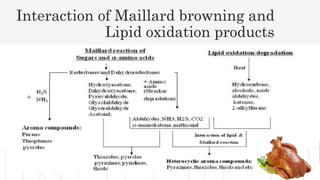
Interaction of Maillard browning and
Lipid oxidation products
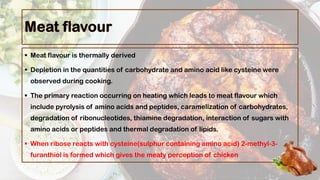
ď‚§ Meat flavour is thermally derived
ď‚§ Depletion in the quantities of carbohydrate and amino acid like cysteine were
observed during cooking.
ď‚§ The primary reaction occurring on heating which leads to meat flavour which
include pyrolysis of amino acids and peptides, caramelization of carbohydrates,
degradation of ribonucleotides, thiamine degradation, interaction of sugars with
amino acids or peptides and thermal degradation of lipids.
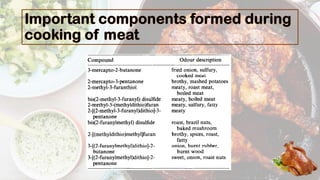
ď‚§ When ribose reacts with cysteine(sulphur containing amino acid) 2-methyl-3-
furanthiol is formed which gives the meaty perception of chicken
Non enzymatic browning reaction can produce many volatile compounds having
strong and distinctive odours depending on the reactants and reaction
condition.
The nature of the end products depends on the following:
ď‚§ The precise nature and ratio of amino acids/proteins and sugars present.
ď‚§ The time/temperature combinations of the reaction, which in turn determines
the degree of secondary reactions involved.
ď‚§ The nature of any thermal degradation reactions which contribute to the
overall profile
The highly desirable flavour of roast meat is probably a combination of the
thermal degradation products of naturally occurring sugars, amino acids and
polypeptides, the complex effects of the Maillard and related reactions coupled
with the aromatic products arising from the lipid oxidation.
ď‚§ Maillard reaction is of greatest significance in meat, heated above 90ËšC.
ď‚§ Aromatics produced by Maillard reaction enabled the flavorists to formulate
innumerable meat like flavourings having meaty, nutty, bready and roasted
characteristics which was found in roast meats.
ď‚§ The reproduction of meat-like flavors through process chemistry has been a
primary target of the flavor industry for many years. Meats are expensive, and
thus there is a strong financial incentive to develop substitute flavorings.
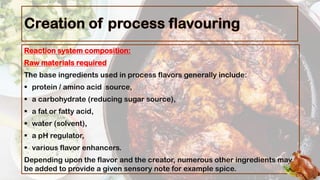
Reaction system composition:
Raw materials required
The base ingredients used in process flavors generally include:
ď‚§ protein / amino acid source,
ď‚§ a carbohydrate (reducing sugar source),
ď‚§ a fat or fatty acid,
ď‚§ water (solvent),
ď‚§ a pH regulator,
ď‚§ various flavor enhancers.
Depending upon the flavor and the creator, numerous other ingredients may
be added to provide a given sensory note for example spice.
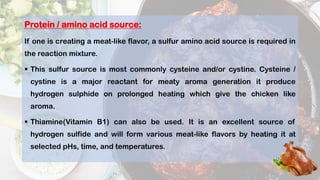
Protein / amino acid source:
If one is creating a meat-like flavor, a sulfur amino acid source is required in
the reaction mixture.
ď‚§ This sulfur source is most commonly cysteine and/or cystine. Cysteine /
cystine is a major reactant for meaty aroma generation it produce
hydrogen sulphide on prolonged heating which give the chicken like
aroma.
ď‚§ Thiamine(Vitamin B1) can also be used. It is an excellent source of
hydrogen sulfide and will form various meat-like flavors by heating it at
selected pHs, time, and temperatures.
Carbohydrate / Reducing sugar source:
ď‚§ The second critical component of meat-like flavorings is a reducing
sugar.
ď‚§ Arabinose, xylose, fructose, ribose, ribose-5-phosphate, hexose and
lactose also find application in various meat-like flavorings.
Acids/ pH regulator:
ď‚§ Acids are typically used to adjust the pH of the reaction system.
Meat-like flavorings are thermally processed at pH around 5.2,
similar to the pH of meat.
ď‚§ Phosphoric acid is most commonly used since it is known to be a
catalyst of the Maillard reaction.
Miscellaneous components:
ď‚§ Salt
ď‚§ Preservatives
ď‚§ Thickeners and emulsifiers
ď‚§ Flavorants
ď‚§ Colorants
ď‚§ Free flowing agents
ď‚§ The product temperature during processing shall not exceed
180°C.. The processing time shall not exceed ¼hour at 180°C with
correspondingly longer times at lower temperatures.
ď‚§ The pH during processing shall not exceed 8.
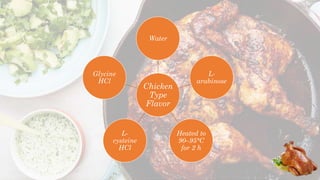
Chicken
Type
Flavor
Water
L-
arabinose
Heated to
90–95°C
for 2 h
L-
cysteine
HCl
Glycine
HCl
Chicken flavour maillard reaction

Chicken flavour maillard reaction

  • 1.
    Development Of Chicken FlavorThrough Maillard Reaction Presented By: Dinesh D.Shinde Rashmi G. Tikhe V.Sundaralaksmi
  • 2.
    Cooking methods • Threemain factors differing in cooking techniques: o Temperature at the surface of meat Heat has applications: • Flavor formationo Temperature profile through meat o Method of heat transfer (contact, air, steam, microwave) Dry Heat Cooking Moist Heat Cooking Combination • Releases flavor (precursor) Grilling/ broiling Barbecuing Steaming Poaching Simmering Boiling Stewing Braising • Enable mixing Roasting/ baking Pan frying • Favors Browning Reaction Deep fat frying
  • 3.
    Effect of cookingon flavor • Amino acids and reducing sugars react when heated MAILLARD REACTION • Fatty acids get oxidized and degraded to create volatile flavor compounds LIPID DEGRADATION THIAMIN DEGRADATION• Thiamine is a source of meat flavor generated on heating
  • 4.
    Maillard Reaction What ismillard reaction ? Millard reaction involves formation between the carbonyl group of reducing Sugar and the free amino group of an amino acid, peptide or protein.
  • 5.
    Maillard Reaction Condensation ofCO group of a reducing sugar STEP A (aldose) with a free amino group of an amino acid, which loses a molecule of water to form N-substituted glycosylamine "Strecker degradation" with amino acids to aldehydes STEP E STEP F or they may react in the absence of amino compounds, to give aldols and high molecular weight, nitrogen-free polymers Undergoes the "Amadori rearrangement" to form "1-amino-1-deoxy-2-ketoses" STEP B STEP C Dehydration (loss of 2 water molecules) into reductones & dehydro reductones (caramel products) Formation of brown nitrogenous polymers and copolymers called melanoidins STEP G STEP H Direct route to fission products from N-substituted Production of short chain hydrolytic fission products such as diacetyl, acetol, pyruvaldehyde, etc STEP D glycosylamines, without the formation of an ARP
  • 6.
    Interaction of Maillardbrowning and Lipid oxidation products
  • 7.
    ď‚§ Meat flavouris thermally derived ď‚§ Depletion in the quantities of carbohydrate and amino acid like cysteine were observed during cooking. ď‚§ The primary reaction occurring on heating which leads to meat flavour which include pyrolysis of amino acids and peptides, caramelization of carbohydrates, degradation of ribonucleotides, thiamine degradation, interaction of sugars with amino acids or peptides and thermal degradation of lipids. ď‚§ When ribose reacts with cysteine(sulphur containing amino acid) 2-methyl-3- furanthiol is formed which gives the meaty perception of chicken
  • 9.
    Non enzymatic browningreaction can produce many volatile compounds having strong and distinctive odours depending on the reactants and reaction condition. The nature of the end products depends on the following: ď‚§ The precise nature and ratio of amino acids/proteins and sugars present. ď‚§ The time/temperature combinations of the reaction, which in turn determines the degree of secondary reactions involved. ď‚§ The nature of any thermal degradation reactions which contribute to the overall profile
  • 10.
    The highly desirableflavour of roast meat is probably a combination of the thermal degradation products of naturally occurring sugars, amino acids and polypeptides, the complex effects of the Maillard and related reactions coupled with the aromatic products arising from the lipid oxidation. ď‚§ Maillard reaction is of greatest significance in meat, heated above 90ËšC. ď‚§ Aromatics produced by Maillard reaction enabled the flavorists to formulate innumerable meat like flavourings having meaty, nutty, bready and roasted characteristics which was found in roast meats. ď‚§ The reproduction of meat-like flavors through process chemistry has been a primary target of the flavor industry for many years. Meats are expensive, and thus there is a strong financial incentive to develop substitute flavorings.
  • 11.
    Reaction system composition: Rawmaterials required The base ingredients used in process flavors generally include: ď‚§ protein / amino acid source, ď‚§ a carbohydrate (reducing sugar source), ď‚§ a fat or fatty acid, ď‚§ water (solvent), ď‚§ a pH regulator, ď‚§ various flavor enhancers. Depending upon the flavor and the creator, numerous other ingredients may be added to provide a given sensory note for example spice.
  • 12.
    Protein / aminoacid source: If one is creating a meat-like flavor, a sulfur amino acid source is required in the reaction mixture. ď‚§ This sulfur source is most commonly cysteine and/or cystine. Cysteine / cystine is a major reactant for meaty aroma generation it produce hydrogen sulphide on prolonged heating which give the chicken like aroma. ď‚§ Thiamine(Vitamin B1) can also be used. It is an excellent source of hydrogen sulfide and will form various meat-like flavors by heating it at selected pHs, time, and temperatures.
  • 13.
    Carbohydrate / Reducingsugar source: ď‚§ The second critical component of meat-like flavorings is a reducing sugar. ď‚§ Arabinose, xylose, fructose, ribose, ribose-5-phosphate, hexose and lactose also find application in various meat-like flavorings. Acids/ pH regulator: ď‚§ Acids are typically used to adjust the pH of the reaction system. Meat-like flavorings are thermally processed at pH around 5.2, similar to the pH of meat. ď‚§ Phosphoric acid is most commonly used since it is known to be a catalyst of the Maillard reaction.
  • 14.
    Miscellaneous components: ď‚§ Salt ď‚§Preservatives ď‚§ Thickeners and emulsifiers ď‚§ Flavorants ď‚§ Colorants ď‚§ Free flowing agents
  • 15.
     The producttemperature during processing shall not exceed 180°C.. The processing time shall not exceed ¼hour at 180°C with correspondingly longer times at lower temperatures.  The pH during processing shall not exceed 8.
  • 16.

Editor's Notes

  • #13 Cysteine will liberate hydrogen sulphide a major reactant for meaty aroma . Generation of hydrogen sulphide occurs during prolonged heating