URL:http://wikieducator.org/leson_5:_food_habits
Food refers to anything that is eaten to provide energy and keep the body healthy. It
forms an important part of many Ghanaian customs and traditions. Whilst some foods are
not regarded as food at all by some groups, the same foods are delicacies for others. As a
caterer you need to learn about the role food plays in the life of the different people you
have to cater for. People need food especially because it keeps them healthy and offer
enjoyment. If the food you offer for sale does not do any of the above people may not
patronize your services. This is why it is important for you to learn how to make wise
food choices and provide the kinds of food your varied customers want.
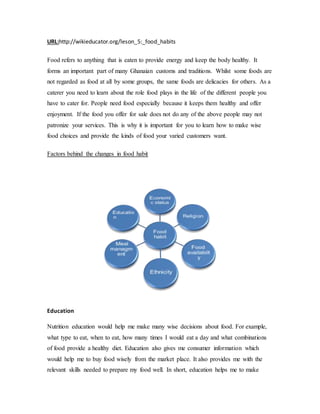
Factors behind the changes in food habit
Education
Nutrition education would help me make many wise decisions about food. For example,
what type to eat, when to eat, how many times I would eat a day and what combinations
of food provide a healthy diet. Education also gives me consumer information which
would help me to buy food wisely from the market place. It also provides me with the
relevant skills needed to prepare my food well. In short, education helps me to make
informed food choices which will provide the necessary nutrients for a healthy body at a
minimum cost. Education helps me to form certain food habits and change others. For
example, education can make me decide to eat fruits at every meal because I have learnt
about its nutritional benefits. Education can also make me decide not to eat certain foods
because of their harmful effect on my body.
Meal management practices
Meal management practices include the skills I have and the time and energy I have for
meal preparation and service. It also includes the facilities I have and how well I can use
them to my advantage. Meal management practices affect food habits because I can only
prepare and eat foods I can easily cook with the facilities and the knowledge I have.
Economic status/income
Economic status refers to the amount of money I have to spend that is whether I am rich
or poor. My economic status affects my food habits because the types of food I choose
would depend on how much money I have. When I am rich, I can afford very expensive
foods, I can eat in restaurants and I can eat as many times as I want in a day. Food chosen
by poor people is meager and monotonous. Even where nutrition knowledge is high
economic status still dictates what foods I can eat and how I eat them.
Ethnicity: All ethnic groups have their own food customs. As cultural groups
develop over the ages they formed their own living patterns which included
food customs. Each group spelt out what its members could or could not eat
how the food should be cooked and when it could be eaten.
Religion: Food patterns are influenced by religious beliefs. What foods people
can eat or cannot eat have been dictated by their religious beliefs. For example,
Moslems do not eat pork because Islam forbids them to eat it.
Availability of foods: The kinds of food available to me usually are the foods I
eat. Even though food may be imported from other countries, most people
depend on locally grown food products for their basic or staple food
Food habit

Food habit

  • 1.
    URL:http://wikieducator.org/leson_5:_food_habits Food refers toanything that is eaten to provide energy and keep the body healthy. It forms an important part of many Ghanaian customs and traditions. Whilst some foods are not regarded as food at all by some groups, the same foods are delicacies for others. As a caterer you need to learn about the role food plays in the life of the different people you have to cater for. People need food especially because it keeps them healthy and offer enjoyment. If the food you offer for sale does not do any of the above people may not patronize your services. This is why it is important for you to learn how to make wise food choices and provide the kinds of food your varied customers want. Factors behind the changes in food habit Education Nutrition education would help me make many wise decisions about food. For example, what type to eat, when to eat, how many times I would eat a day and what combinations of food provide a healthy diet. Education also gives me consumer information which would help me to buy food wisely from the market place. It also provides me with the relevant skills needed to prepare my food well. In short, education helps me to make
  • 2.
    informed food choiceswhich will provide the necessary nutrients for a healthy body at a minimum cost. Education helps me to form certain food habits and change others. For example, education can make me decide to eat fruits at every meal because I have learnt about its nutritional benefits. Education can also make me decide not to eat certain foods because of their harmful effect on my body. Meal management practices Meal management practices include the skills I have and the time and energy I have for meal preparation and service. It also includes the facilities I have and how well I can use them to my advantage. Meal management practices affect food habits because I can only prepare and eat foods I can easily cook with the facilities and the knowledge I have. Economic status/income Economic status refers to the amount of money I have to spend that is whether I am rich or poor. My economic status affects my food habits because the types of food I choose would depend on how much money I have. When I am rich, I can afford very expensive foods, I can eat in restaurants and I can eat as many times as I want in a day. Food chosen by poor people is meager and monotonous. Even where nutrition knowledge is high economic status still dictates what foods I can eat and how I eat them. Ethnicity: All ethnic groups have their own food customs. As cultural groups develop over the ages they formed their own living patterns which included food customs. Each group spelt out what its members could or could not eat how the food should be cooked and when it could be eaten. Religion: Food patterns are influenced by religious beliefs. What foods people can eat or cannot eat have been dictated by their religious beliefs. For example, Moslems do not eat pork because Islam forbids them to eat it. Availability of foods: The kinds of food available to me usually are the foods I eat. Even though food may be imported from other countries, most people depend on locally grown food products for their basic or staple food