Mendel has explained that sometimes it’s our
build that makes us a little bit “fatty” but also
eating too much or too many calories can bring
you overweight…
We can divide food in five categories: cereals,
fruit, vegetables, proteins, dairy
2
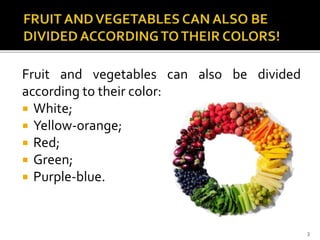
Fruit and vegetables can also be divided
according to their color:
 White;
 Yellow-orange;
 Red;
 Green;
 Purple-blue.
3
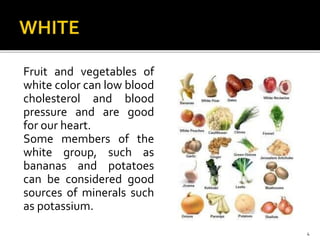
Fruit and vegetables of
white color can low blood
cholesterol and blood
pressure and are good
for our heart.
Some members of the
white group, such as
bananas and potatoes
can be considered good
sources of minerals such
as potassium.
4
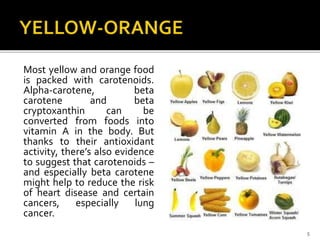
Most yellow and orange food
is packed with carotenoids.
Alpha-carotene, beta
carotene and beta
cryptoxanthin can be
converted from foods into
vitamin A in the body. But
thanks to their antioxidant
activity, there’s also evidence
to suggest that carotenoids –
and especially beta carotene
might help to reduce the risk
of heart disease and certain
cancers, especially lung
cancer.
5
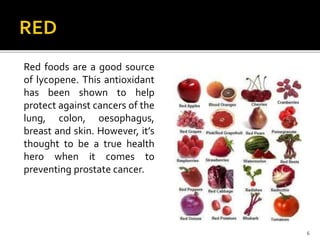
Red foods are a good source
of lycopene. This antioxidant
has been shown to help
protect against cancers of the
lung, colon, oesophagus,
breast and skin. However, it’s
thought to be a true health
hero when it comes to
preventing prostate cancer.
6
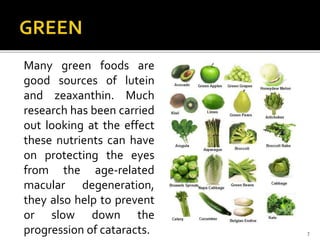
Many green foods are
good sources of lutein
and zeaxanthin. Much
research has been carried
out looking at the effect
these nutrients can have
on protecting the eyes
from the age-related
macular degeneration,
they also help to prevent
or slow down the
progression of cataracts. 7
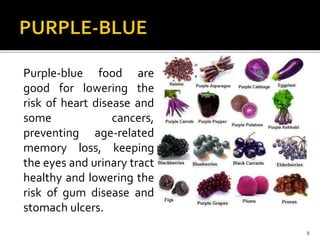
Purple-blue food are
good for lowering the
risk of heart disease and
some cancers,
preventing age-related
memory loss, keeping
the eyes and urinary tract
healthy and lowering the
risk of gum disease and
stomach ulcers.
8
Now that you’ve understood how you can divide food
you must know that there is a unit of measure called
“calorie” that is a unit of energy.
Various definitions exist but fall into two broad
categories.
 The small calorie or gram calorie (symbol: cal) is the
approximate amount of energy needed to raise the
temperature of one gram of water by one
degree Celsius at a pressure of one atmosphere.
 The large calorie or kilogram calorie (symbol: Cal),
also known as the food calorie is equal to 1000 small
calories, 1 kilocalorie (symbol: kcal).
9
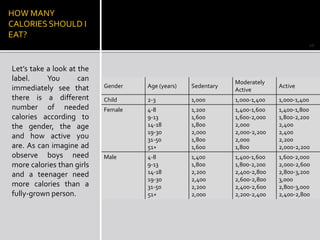
HOW MANY
CALORIES SHOULD I
EAT?
Gender Age (years) Sedentary
Moderately
Active
Active
Child 2-3 1,000 1,000-1,400 1,000-1,400
Female 4-8
9-13
14-18
19-30
31-50
51+
1,200
1,600
1,800
2,000
1,800
1,600
1,400-1,600
1,600-2,000
2,000
2,000-2,200
2,000
1,800
1,400-1,800
1,800-2,200
2,400
2,400
2,200
2,000-2,200
Male 4-8
9-13
14-18
19-30
31-50
51+
1,400
1,800
2,200
2,400
2,200
2,000
1,400-1,600
1,800-2,200
2,400-2,800
2,600-2,800
2,400-2,600
2,200-2,400
1,600-2,000
2,000-2,600
2,800-3,200
3,000
2,800-3,000
2,400-2,800
Let’s take a look at the
label. You can
immediately see that
there is a different
number of needed
calories according to
the gender, the age
and how active you
are. As can imagine ad
observe boys need
more calories than girls
and a teenager need
more calories than a
fully-grown person.
10
During the Second World War the National Socialists
would argue that the need to secure a minimum food
ration of 2,300 calories per day for ordinary Germans
justified the extermination of 30 million urban Soviets,
over 1 million Soviet P.O.W.s, and at least as many Polish
Jews.
The majority of the 100,000 Jews who died in the
Warsaw ghetto succumbed to starvation.
A proportion of the 200,000 mentally ill victims of
Germany’s euthanasia program and 2.35 million Soviet
P.O.W.s were all given so little food that they were
slowly but systematically starved to death.
11
Although the Nazis were at their most ruthless in
exporting hunger to the Soviet Union and Poland,
the plunder of foodstuffs from other occupied
countries resulted in a famine which killed 500,000
in Greece, increased death and infant mortality
rates and spread malnutrition, particularly among
children, in many other countries.
The relentless extraction of food from China in
order to feed the Japanese homeland caused
chronic hunger and malnutrition among the
Chinese population.
12

Food categories

  • 2.
    Mendel has explainedthat sometimes it’s our build that makes us a little bit “fatty” but also eating too much or too many calories can bring you overweight… We can divide food in five categories: cereals, fruit, vegetables, proteins, dairy 2
  • 3.
    Fruit and vegetablescan also be divided according to their color:  White;  Yellow-orange;  Red;  Green;  Purple-blue. 3
  • 4.
    Fruit and vegetablesof white color can low blood cholesterol and blood pressure and are good for our heart. Some members of the white group, such as bananas and potatoes can be considered good sources of minerals such as potassium. 4
  • 5.
    Most yellow andorange food is packed with carotenoids. Alpha-carotene, beta carotene and beta cryptoxanthin can be converted from foods into vitamin A in the body. But thanks to their antioxidant activity, there’s also evidence to suggest that carotenoids – and especially beta carotene might help to reduce the risk of heart disease and certain cancers, especially lung cancer. 5
  • 6.
    Red foods area good source of lycopene. This antioxidant has been shown to help protect against cancers of the lung, colon, oesophagus, breast and skin. However, it’s thought to be a true health hero when it comes to preventing prostate cancer. 6
  • 7.
    Many green foodsare good sources of lutein and zeaxanthin. Much research has been carried out looking at the effect these nutrients can have on protecting the eyes from the age-related macular degeneration, they also help to prevent or slow down the progression of cataracts. 7
  • 8.
    Purple-blue food are goodfor lowering the risk of heart disease and some cancers, preventing age-related memory loss, keeping the eyes and urinary tract healthy and lowering the risk of gum disease and stomach ulcers. 8
  • 9.
    Now that you’veunderstood how you can divide food you must know that there is a unit of measure called “calorie” that is a unit of energy. Various definitions exist but fall into two broad categories.  The small calorie or gram calorie (symbol: cal) is the approximate amount of energy needed to raise the temperature of one gram of water by one degree Celsius at a pressure of one atmosphere.  The large calorie or kilogram calorie (symbol: Cal), also known as the food calorie is equal to 1000 small calories, 1 kilocalorie (symbol: kcal). 9
  • 10.
    HOW MANY CALORIES SHOULDI EAT? Gender Age (years) Sedentary Moderately Active Active Child 2-3 1,000 1,000-1,400 1,000-1,400 Female 4-8 9-13 14-18 19-30 31-50 51+ 1,200 1,600 1,800 2,000 1,800 1,600 1,400-1,600 1,600-2,000 2,000 2,000-2,200 2,000 1,800 1,400-1,800 1,800-2,200 2,400 2,400 2,200 2,000-2,200 Male 4-8 9-13 14-18 19-30 31-50 51+ 1,400 1,800 2,200 2,400 2,200 2,000 1,400-1,600 1,800-2,200 2,400-2,800 2,600-2,800 2,400-2,600 2,200-2,400 1,600-2,000 2,000-2,600 2,800-3,200 3,000 2,800-3,000 2,400-2,800 Let’s take a look at the label. You can immediately see that there is a different number of needed calories according to the gender, the age and how active you are. As can imagine ad observe boys need more calories than girls and a teenager need more calories than a fully-grown person. 10
  • 11.
    During the SecondWorld War the National Socialists would argue that the need to secure a minimum food ration of 2,300 calories per day for ordinary Germans justified the extermination of 30 million urban Soviets, over 1 million Soviet P.O.W.s, and at least as many Polish Jews. The majority of the 100,000 Jews who died in the Warsaw ghetto succumbed to starvation. A proportion of the 200,000 mentally ill victims of Germany’s euthanasia program and 2.35 million Soviet P.O.W.s were all given so little food that they were slowly but systematically starved to death. 11
  • 12.
    Although the Naziswere at their most ruthless in exporting hunger to the Soviet Union and Poland, the plunder of foodstuffs from other occupied countries resulted in a famine which killed 500,000 in Greece, increased death and infant mortality rates and spread malnutrition, particularly among children, in many other countries. The relentless extraction of food from China in order to feed the Japanese homeland caused chronic hunger and malnutrition among the Chinese population. 12

Editor's Notes

  • #3 Mendel has explained that sometimes it’s our build that makes us a little bit “fatty” but also eating too much or too many calories can bring you overweight… To understand why you shouldn't eat chips and you should eat more fruit and vegetables, you first have to know that we can divide food in five categories: cereals, fruit, vegetables, proteins, dairy.
  • #13 Although the Nazis were at their most ruthless in exporting hunger to the Soviet Union and Poland, the plunder of foodstuffs from other occupied countries resulted in a famine which killed 500,000 in Greece, increased death and infant mortality rates and spread malnutrition, particularly among children, in Czechoslovakia, Poland, France, Belgium and Holland. During the Hunger Winter of 1944-45, 22,000 Dutch succumbed to starvation when the Germans cut off supplies to those parts of Holland which the Allies had failed to liberate. The relentless extraction of food from China in order to feed the Japanese homeland caused chronic hunger and malnutrition among the Chinese population. Despite the fact that so much has been written about the siege of Leningrad, it is less well known that the Germans regarded the death by starvation of its inhabitants as only one element in a far larger plan to eliminate as many Soviet consumers —or, rather, “useless eaters”—as possible.