ON
         T   I
       RI
    U T
N
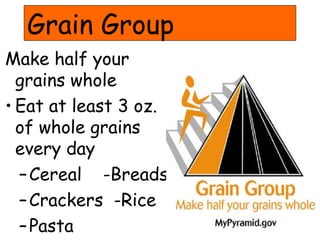
Grain Group
Make half your
  grains whole
• Eat at least 3 oz.
  of whole grains
  every day
  – Cereal -Breads
  – Crackers -Rice
  – Pasta
Vegetable Group
Vary your veggies
• Eat more dark green
  veggies like broccoli,
  spinach and other
  dark, leafy greens
• Eat more orange
  vegetables like
  carrots and sweet
  potatoes
Fruit Group
         Focus on fruits
         • Eat a variety of
           fruits
         • Choose fresh,
           frozen, canned, or
           dried fruit
         • Go easy on fruit
           juices
Milk Group
Get your calcium-rich
  foods
• Go low-fat or fat-free
  when you choose milk,
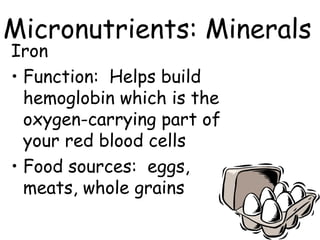
  yogurt, and other milk
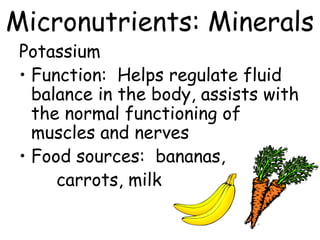
  products
• If you don’t or can’t
  consume milk, choose
  lactose free products
 or other calcium sources such as
 fortified foods and beverages
Meat & Bean Group
Go lean with protein
• Choose low-fat or
  lean meats and
  poultry
• Bake it, broil it, or
  grill it
• Vary your protein
  routine choose more
  fish, beans, peas, nuts, and seeds
Oil/Fat Group
• Make most of your fat sources from
  fish, nuts, and vegetable oils.
• Limit solid fats like butter, stick
  margarine, shortening, and lard, as well
  as foods that contain these.
• Check the Nutrition Facts label to keep
  saturated fats, trans fats, and sodium
  low.
• Choose food and beverages low in added
  sugars. Added sugars contribute
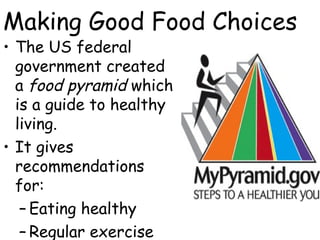
MyPyramid Anatomy
• ACTIVITY
  – Activity is represented by the steps
    and the person climbing them, as a
    reminder of the importance of daily
    physical activity
• PERSONALIZATION
  – Personalization is shown by the person
    on the steps, the slogan, and the URL.
    Find the kinds and amounts of food to
    eat each day at MyPyramid.gov
• MODERATION
 – represented by the narrowing of each
   food group from bottom to top. The
   wider the base stands for foods with
   little or no solid fats or added sugars.
     These should be selected more
   often. The narrower top area stands
   for foods containing more added
   sugars and solid fats. The more
   active you are, the more of these
   foods can fit into your diet.
• PROPORTIONALITY
  – Proportionality is shown by the
    different widths of the food
    group bands. The widths
    suggest how much food a
    person should choose from
    each group. The widths are
    just a general guide, not exact
    proportions. Check the
    website for how much is right
    for you.
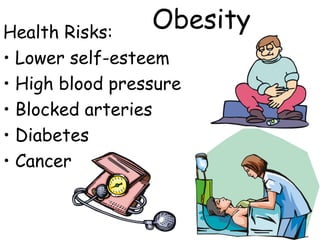
• VARIETY
  – Variety is symbolized by the 6
    color bands representing the 5
    food groups of the Pyramid
    and oils. This illustrates that
    foods from all groups are
    needed each day for good
    health
• GRADUAL IMPROVEMENT
  – Gradual improvement is
    encouraged by the slogan. It
    suggests that individuals can
    benefit from taking small
    steps to improve their diet
    and lifestyle each day.
WORKSHEET
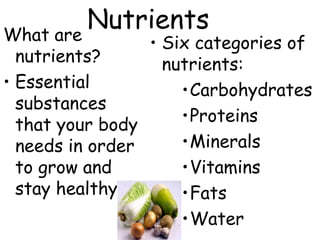
What are
         Nutrients
                 • Six categories of
  nutrients?       nutrients:
• Essential          •Carbohydrates
  substances
  that your body     •Proteins
  needs in order     •Minerals
  to grow and        •Vitamins
  stay healthy       •Fats
                     •Water
Carbohydrates
• Structure and function:
 Carbohydrates are sugars
and starches that the body
     uses for ENERGY!
 • PLANTS are the major
source of carbohydrates in
      the food we eat.

                   © 2005 JupiterImages Corporation
Simple Carbohydrates
• Sugars that are
  quickly digested
  and provide a
  BOOST of energy
  for the body
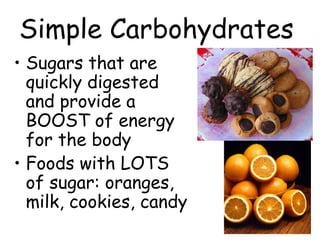
• Foods with LOTS
  of sugar: oranges,
  milk, cookies, candy
Complex Carbohydrates
Starches that are • Foods with
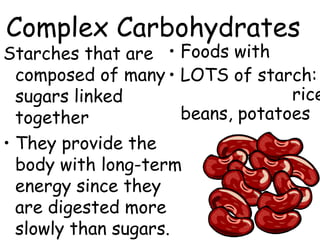
  composed of many • LOTS of starch:
  sugars linked                    rice
  together            beans, potatoes
• They provide the
  body with long-term
  energy since they
  are digested more
  slowly than sugars.
Protein
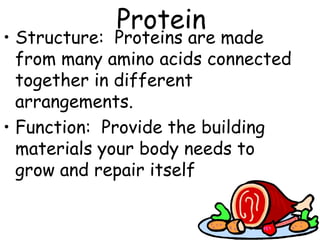
• Structure: Proteins are made
  from many amino acids connected
  together in different
  arrangements.
• Function: Provide the building
  materials your body needs to
  grow and repair itself
Essential Amino Acids
• 9 of the 20 amino acids are
  called essential amino acids
  because you must obtain
  them from the foods you
  eat since your body cannot
  make them.
Complete proteins:
• Foods containing all the essential
  amino acids Examples: fish, meat,
  eggs, milk, cheese


Incomplete proteins:
• Foods that are missing some
  essential amino acids Examples:
  Legumes, nuts, whole grains
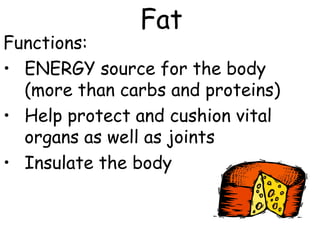
Fat
Functions:
• ENERGY source for the body
  (more than carbs and proteins)
• Help protect and cushion vital
  organs as well as joints
• Insulate the body
Fat
Structure:
• Fats belong to a group of
  organic compounds called
  lipids which are substances
  that do not dissolve in
  water.
• Fatty acids are the building
  blocks of fats.
Unsaturated fats:
                  • They are less
• Contain fatty     harmful to the
  acids that are
                    circulatory
  missing
                    system than
  hydrogen atoms
                    saturated fats.
• At room
                  • Foods with a lot
  temperature,
                    of unsaturated
  they are
                    fat: canola,
  typically in
                    safflower, and
  liquid form.
                    peanut oils
Saturated fats:
• Contain fatty acids with the
  MAXIMUM amount of hydrogen
  atoms
• At room temperature, they are
  typically in solid form.
• Diets with TOO MUCH
  saturated fat have been
  known to cause heart disease.
• Foods with a lot of saturated
  fat: beef fat, egg yolks, dairy
  products
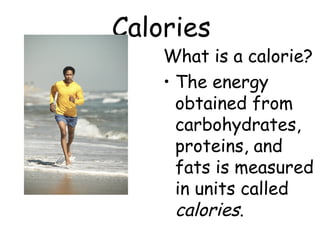
Calories
    What is a calorie?
    • The energy
      obtained from
      carbohydrates,
      proteins, and
      fats is measured
      in units called
      calories.
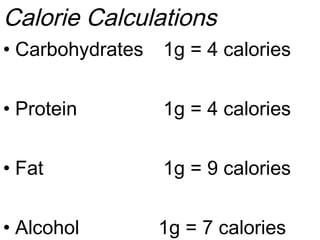
Calorie Calculations
• Carbohydrates   1g = 4 calories


• Protein         1g = 4 calories


• Fat             1g = 9 calories


• Alcohol         1g = 7 calories
Sample Calculation

• A slice of bread has 9g of
  carbohydrates, 2g of protein,
  and 1g of fat.

• Get out a piece of paper and
  see if you can do the
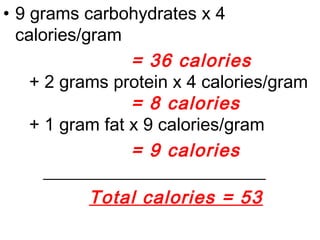
• 9 grams carbohydrates x 4
  calories/gram
                 = 36 calories
    + 2 grams protein x 4 calories/gram
                 = 8 calories
    + 1 gram fat x 9 calories/gram
                 = 9 calories
      _________________________
            Total calories = 53
Do you know the MOST
  IMPORTANT nutrient?
It’s Water!
• 60%-80% of the human
  body is WATER!
• Function: Assists with the
  transport of materials in the
  body by making up most of the
  liquid part of blood (plasma),
  helps regulate body temperature,
  and helps break down food in the
  digestive system
• Food sources: vegetables, fruit,
  milk
WORKSHEETS
Micronutrients
• Minerals and vitamins are
  called micronutrients since
  they are needed by your body
  in SMALL amounts.
The minerals and most of the
  vitamins your body needs must
  be obtained from the FOODS
  you eat since your body cannot
  make them.
Micronutrients: Minerals
• Minerals are INORGANIC
  substances that are required by
  your body in order to develop and
  grow properly.
Some Important Minerals:
• Calcium     Iron
• Potassium Magnesium
Micronutrients: Minerals
Calcium
• Function: Helps build
  strong bones and
  teeth, regulates blood
  clotting
• Food sources: dairy
  products, leafy and
  green vegetables
Micronutrients: Minerals
Iron
• Function: Helps build
  hemoglobin which is the
  oxygen-carrying part of
  your red blood cells
• Food sources: eggs,
  meats, whole grains
Micronutrients: Minerals
 Potassium
 • Function: Helps regulate fluid
   balance in the body, assists with
   the normal functioning of
   muscles and nerves
 • Food sources: bananas,
      carrots, milk
Micronutrients: Minerals
Magnesium
• Function: Involved in the
  metabolism of proteins and
  carbohydrates, assists with bone
  growth and proper muscle
  functioning
• Food sources: milk, meat, nuts
Micronutrients: Vitamins
Vitamins: Group of complex
 compounds that help your body
 maintain normal metabolism,
 growth, and development
     Two Groups of Vitamins:
         • Water-Soluble
           • Fat-Soluble
Micronutrients: Vitamins

Water-Soluble Vitamins:
• Vitamins that dissolve in water
  and are NOT stored in your body
  for future use

Vitamin B and Vitamin C
Examples of Water-Soluble
  Vitamins:
• Vitamin C: Fights against
  infection, maintains healthy
  gums, strengthens and maintains
  blood vessel structure
   – Food sources: citrus fruits,
     tomatoes, leafy vegetables
Micronutrients: Vitamins
Vitamin B Complex/Folic acid:
 Helps prevent birth defects,
 and is needed in the formation
 of red blood cells and nucleic
 acids
  – Food sources: beets, broccoli,
    avocado, turkey, bok choy,
    and lentils.
Micronutrients: Vitamins
 Fat-Soluble Vitamins:
 • Vitamins that dissolve into and
   are transported by fat

 • They can be stored in fat
   tissue, the liver, and the
   kidneys.
 • Vitamins A, D, E, and K
Examples of Fat-Soluble Vitamins:
• Vitamin A: Maintains good vision,
  promotes body cell growth, helps
  protect teeth
  – Food sources: green vegetables,
    dairy products
• Vitamin D: Promotes the
  development of healthy bones
  and teeth
  – Food sources: eggs, salmon,
    fortified breakfast cereal.
    Other sources include sunlight
WORKSHEETS
Making Good Food Choices
• The US federal
  government created
  a food pyramid which
  is a guide to healthy
  living.
• It gives
  recommendations
  for:
   – Eating healthy
   – Regular exercise
Fast Food Choices
• Fast food consumption should
  be limited since it generally
  includes foods that are high in
  calories, fat, and/or sodium.
• Try to choose smaller portions
  since larger portion sizes
  greatly increase the calorie,
  fat, and sodium content of
  your meal.
– Option #1: McDonald’s Quarter
  Pounder with Cheese, large fries,
  and a 16 oz. soda includes
1,166 calories and 51 grams of fat!


– Option #2: McDonald’s
  Hamburger, small fries, and a 16
  oz. diet soda includes
                       481 calories
  and 19 grams of fat!
Fast Food Choices

• Some fast food choices
  are healthier than others
  so try to choose the
  healthier options.
– Healthy options:    –Less healthy
  •Grilled chicken     options:
  •Regular-sized        •Chicken
   single hamburger      nuggets
  •Fruit and yogurt     •Croissant
  •Plain baked potato    breakfast
   (no butter or sour    sandwiches
   cream)               •Onion rings
  •Salad                •Large French
                         fries
Physical Activity
• Regular exercise, included as part
  of the new food pyramid, is an
  important part in maintaining a
  healthy lifestyle.
• Exercise (physical activity)
  involves any form of movement
  such as walking, jogging, climbing
  stairs, or playing basketball.
–Exercise hints:
 •Include activities you enjoy
  doing
 •Work your way up to at least 30
  min. of physical activity per day
 •Incorporate exercise into your
  social life by including your
  friends in the activity
 •Listen to music or watch TV
  while you exercise
Physical Activity
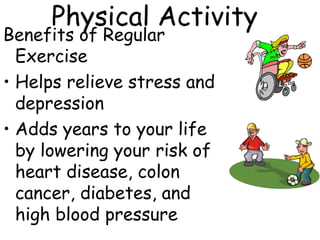
Benefits of Regular
  Exercise
• Helps relieve stress and
  depression
• Adds years to your life
  by lowering your risk of
  heart disease, colon
  cancer, diabetes, and
  high blood pressure
• Helps you maintain a normal
  weight by burning calories
  which results in a loss of
  body fat
• Tones and develops the
  muscles in your body
PORTION SIZES
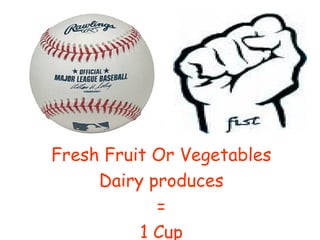
Fresh Fruit Or Vegetables
     Dairy produces
            =
          1 Cup
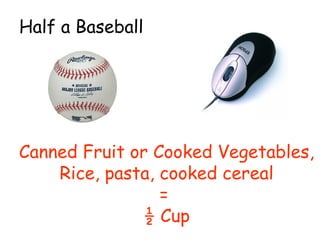
Half a Baseball


Canned Fruit or Cooked Vegetables,
    Rice, pasta, cooked cereal
                 =
              ½ Cup
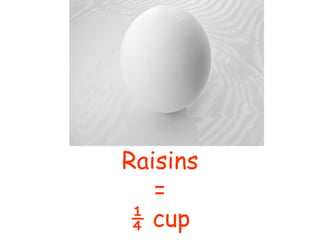
Raisins
   =
 ¼ cup
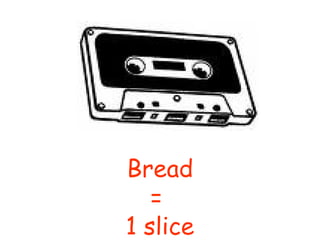
Bread
   =
1 slice
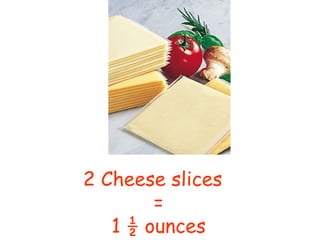
2 Cheese slices
        =
   1 ½ ounces
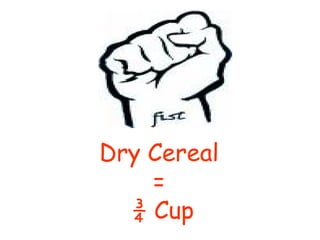
Dry Cereal
    =
  ¾ Cup
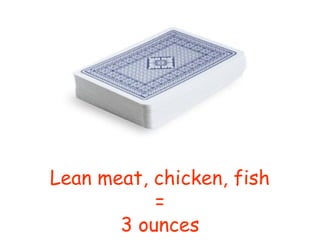
Lean meat, chicken, fish
           =
       3 ounces
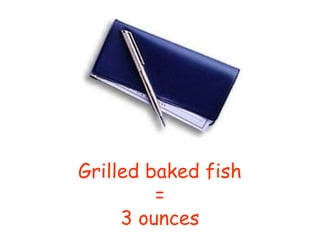
Grilled baked fish
         =
     3 ounces
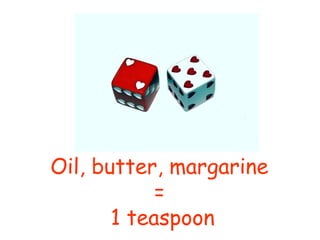
Oil, butter, margarine
            =
       1 teaspoon
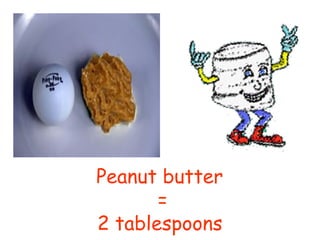
Peanut butter
       =
2 tablespoons
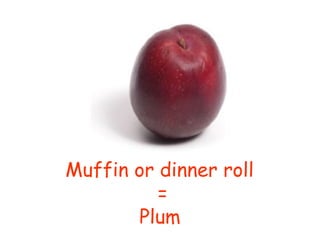
Muffin or dinner roll
          =
       Plum
SERVING SIZE HANDOUTS
Reading Food Labels
To help you make healthy food
choices, many foods have a “Nutrition
Facts” label that contains helpful
information such as:
   •serving size
   •calories per serving
   •fat/sodium/protein content
   •types and relative amounts of
    nutrients (vitamin C, iron, etc.)
Reading Food Labels
What do claims on food labels mean?
• Organic - Made from foods grown
  without pesticides, man-made
  fertilizers, or genetic engineering
• Healthy - Low in fat and saturated
  fat, contains no more than 360mg
  of sodium and cholesterol per
  serving
• Light - Contains at least one-
  third fewer calories or at least
  50% less fat or sodium
• Fresh - Raw food products that
  contain no preservatives and
  have never been frozen, heated,
  or processed in any way
• Most food products will include
  a list of ingredients that are
  listed in order from the highest
  to the lowest in amount used.
Nutrient and Health
          Claims
• Free… Fat Free = less than .5 g fat
        Sugar Free = less than .5 g
      sugar

• Low in … low in calories = less than
              40 calories
          low in sodium = less than
              140 mg
• Excellent source of … Excellent
  source of calcium = one serving
  provides 20% or more of the
  Daily Value for calcium.
• May reduce your risk of heart
  disease … can appear on fiber
  containing grain products fruits
  and vegetables that are also low
  in saturated fat and cholesterol
• High in … high in vitamins = one
  serving provides 20% or more
  of the daily value for vitamin C


• Light … contains 50% less fat or
  at least 1/3 fewer calories.
• Open Dates = These dates give you
  an idea of how ling the foods will be
  fresh and safe to eat.
  – Sell by = last date the product
    can be sold
  – Best if used by = how long the
    product will be at peak quality
  – Do not use after = date is the
    expiration date. Last day you can
    consume the product.
FOOD LABEL ACTIVITY
HEALTH FOOD CLAIMS
FOOD LABEL HANDOUTS
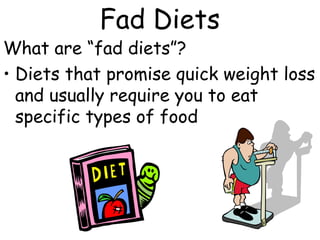
Fad Diets
What are “fad diets”?
• Diets that promise quick weight loss
  and usually require you to eat
  specific types of food
Examples of fad diets:
• Fit for Life (food combining
  diet)
• Dr. Atkins’ New Diet Revolution
  (low carbohydrate diet)
• Metabolife 356 (diet pills)
• Slim Fast (liquid diet)
Fad Diets
• The weight that you lose is usually
  water and/or lean muscle rather
  than body fat.
• Some of these diets can be harmful
  to your health.
• They sometimes do not include
  exercise which is important for
  healthy living.
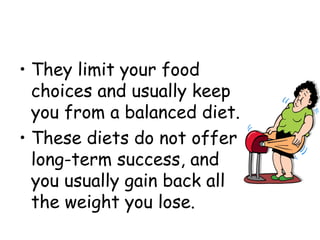
• They limit your food
  choices and usually keep
  you from a balanced diet.
• These diets do not offer
  long-term success, and
  you usually gain back all
  the weight you lose.
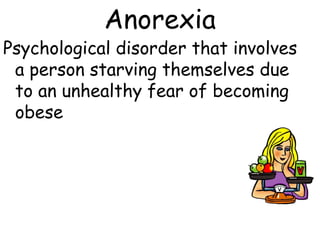
Anorexia
Psychological disorder that involves
 a person starving themselves due
 to an unhealthy fear of becoming
 obese
Warning signs:       Harmful effects:
• Eating extremely • Damage to the
  small amounts of     heart
  food per day
                     • Excessive
• False impression of
  their own body
                       weight loss
  image              • Negatively
• Obsessed with        affects the
  exercise             immune system
                   • Death
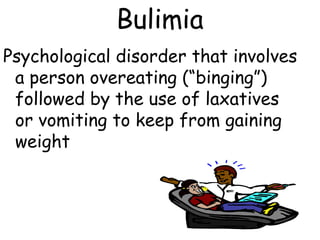
Bulimia
Psychological disorder that involves
 a person overeating (“binging”)
 followed by the use of laxatives
 or vomiting to keep from gaining
 weight
People who suffer from this disorder
  usually have a false sense of their
  body image, and they are constantly
  striving to obtain the “perfect
  body.”
Harmful effects:
• Tooth decay (from excessive
  vomiting)
• Damage to the kidneys
• Dehydration      Death
COMPULSIVE EXCERCISE
• Best defined by an exercise
  addict's frame of mind: He or she
  no longer chooses to exercise but
  feels compelled to and struggles
  with guilt/anxiety if he or she
  doesn't work out.
• Exercising takes over the
  exerciser's life because he or she
  plans life around it.
• Excessive exercise damages
  tendons, ligaments, bones, cartilage,
  and joints
• May disrupt the balance of
  hormones in their bodies.
• The combination of anorexia and
  compulsive exercise can be fatal.
• Exercise addicts are often plagued
  by anxiety and depression
COMPULSIVE OVEREATING
• Characterized as an "addiction" to
  food, using food and eating as a way
  to hide from their emotions, to fill
  a void they feel inside, and to cope
  with daily stresses and problems in
  their lives.
COMPULSIVE OVEREATING
• Words like, "just go on a
  diet" are as emotionally
  devastating to a person
  suffering Compulsive
  Overeating as "just eat" can
  be to a person suffering
  Anorexia.
COMPULSIVE OVEREATING

• At health risk for a heart
  attack, high blood-pressure
  and cholesterol, kidney
  disease and/or failure,
  arthritis and bone
  deterioration, and stroke.
Laxatives
• Laxatives move food through the
  body more rapidly.
• They relieve stomach bloating and
  pain after a binge.
• They don’t prevent the calories from
  being absorbed.
• Weight loss is caused by loss of H2O
  and minerals and only temporary.
Laxatives
• Misuse of laxatives is VERY harmful:
  – Upsets the body’s mineral balance
  – Leads to dehydration
  – Damages the lining of the digestive
    tract
  – Lets the digestive tract get lazy.
    When someone stops using them,
    they may become constipated.
Diuretics
• a.k.a. water pills-help get rid of
  excess water by increasing the
  amount of urine.
• Causes sudden weight loss
• Could cause dehydration
• Increased loss of minerals
• VERY DANGEROUS
Ipecac Syrup
• Taken to cause vomiting
• Can cause heart weakness
• Linked to several deaths
• TOXIC in large amounts or
  small amounts built up over
  time
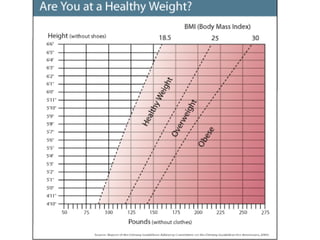
Obesity
Caused by an excess amount of body
   fat
• People are usually considered
               “obese” if their
   weight is 30%
    or more above their ideal weight.
2 main causes:
1. Unhealthy eating habits
2. Lack of physical activity
Health Risks:
                 Obesity
• Lower self-esteem
• High blood pressure
• Blocked arteries
• Diabetes
• Cancer
• Drugs do not really help
   people lose weight and
       keep it off.
 • They can be addictive,
   and lead to dangerous
    physical problems if
          misused.
This powerpoint was kindly donated to
www.worldofteaching.com


http://www.worldofteaching.com is home to over a
thousand powerpoints submitted by teachers. This is a
completely free site and requires no registration. Please
visit and I hope it will help in your teaching.

Nutrition

  • 1.
    ON T I RI U T N
  • 4.
    Grain Group Make halfyour grains whole • Eat at least 3 oz. of whole grains every day – Cereal -Breads – Crackers -Rice – Pasta
  • 5.
    Vegetable Group Vary yourveggies • Eat more dark green veggies like broccoli, spinach and other dark, leafy greens • Eat more orange vegetables like carrots and sweet potatoes
  • 6.
    Fruit Group Focus on fruits • Eat a variety of fruits • Choose fresh, frozen, canned, or dried fruit • Go easy on fruit juices
  • 7.
    Milk Group Get yourcalcium-rich foods • Go low-fat or fat-free when you choose milk, yogurt, and other milk products • If you don’t or can’t consume milk, choose lactose free products or other calcium sources such as fortified foods and beverages
  • 8.
    Meat & BeanGroup Go lean with protein • Choose low-fat or lean meats and poultry • Bake it, broil it, or grill it • Vary your protein routine choose more fish, beans, peas, nuts, and seeds
  • 9.
    Oil/Fat Group • Makemost of your fat sources from fish, nuts, and vegetable oils. • Limit solid fats like butter, stick margarine, shortening, and lard, as well as foods that contain these. • Check the Nutrition Facts label to keep saturated fats, trans fats, and sodium low. • Choose food and beverages low in added sugars. Added sugars contribute
  • 10.
    MyPyramid Anatomy • ACTIVITY – Activity is represented by the steps and the person climbing them, as a reminder of the importance of daily physical activity • PERSONALIZATION – Personalization is shown by the person on the steps, the slogan, and the URL. Find the kinds and amounts of food to eat each day at MyPyramid.gov
  • 11.
    • MODERATION –represented by the narrowing of each food group from bottom to top. The wider the base stands for foods with little or no solid fats or added sugars. These should be selected more often. The narrower top area stands for foods containing more added sugars and solid fats. The more active you are, the more of these foods can fit into your diet.
  • 12.
    • PROPORTIONALITY – Proportionality is shown by the different widths of the food group bands. The widths suggest how much food a person should choose from each group. The widths are just a general guide, not exact proportions. Check the website for how much is right for you.
  • 13.
    • VARIETY – Variety is symbolized by the 6 color bands representing the 5 food groups of the Pyramid and oils. This illustrates that foods from all groups are needed each day for good health
  • 14.
    • GRADUAL IMPROVEMENT – Gradual improvement is encouraged by the slogan. It suggests that individuals can benefit from taking small steps to improve their diet and lifestyle each day.
  • 15.
  • 16.
    What are Nutrients • Six categories of nutrients? nutrients: • Essential •Carbohydrates substances that your body •Proteins needs in order •Minerals to grow and •Vitamins stay healthy •Fats •Water
  • 17.
    Carbohydrates • Structure andfunction: Carbohydrates are sugars and starches that the body uses for ENERGY! • PLANTS are the major source of carbohydrates in the food we eat. © 2005 JupiterImages Corporation
  • 18.
    Simple Carbohydrates • Sugarsthat are quickly digested and provide a BOOST of energy for the body • Foods with LOTS of sugar: oranges, milk, cookies, candy
  • 19.
    Complex Carbohydrates Starches thatare • Foods with composed of many • LOTS of starch: sugars linked rice together beans, potatoes • They provide the body with long-term energy since they are digested more slowly than sugars.
  • 20.
    Protein • Structure: Proteinsare made from many amino acids connected together in different arrangements. • Function: Provide the building materials your body needs to grow and repair itself
  • 21.
    Essential Amino Acids •9 of the 20 amino acids are called essential amino acids because you must obtain them from the foods you eat since your body cannot make them.
  • 22.
    Complete proteins: • Foodscontaining all the essential amino acids Examples: fish, meat, eggs, milk, cheese Incomplete proteins: • Foods that are missing some essential amino acids Examples: Legumes, nuts, whole grains
  • 23.
    Fat Functions: • ENERGY sourcefor the body (more than carbs and proteins) • Help protect and cushion vital organs as well as joints • Insulate the body
  • 24.
    Fat Structure: • Fats belongto a group of organic compounds called lipids which are substances that do not dissolve in water. • Fatty acids are the building blocks of fats.
  • 25.
    Unsaturated fats: • They are less • Contain fatty harmful to the acids that are circulatory missing system than hydrogen atoms saturated fats. • At room • Foods with a lot temperature, of unsaturated they are fat: canola, typically in safflower, and liquid form. peanut oils
  • 26.
    Saturated fats: • Containfatty acids with the MAXIMUM amount of hydrogen atoms • At room temperature, they are typically in solid form.
  • 27.
    • Diets withTOO MUCH saturated fat have been known to cause heart disease. • Foods with a lot of saturated fat: beef fat, egg yolks, dairy products
  • 28.
    Calories What is a calorie? • The energy obtained from carbohydrates, proteins, and fats is measured in units called calories.
  • 29.
    Calorie Calculations • Carbohydrates 1g = 4 calories • Protein 1g = 4 calories • Fat 1g = 9 calories • Alcohol 1g = 7 calories
  • 30.
    Sample Calculation • Aslice of bread has 9g of carbohydrates, 2g of protein, and 1g of fat. • Get out a piece of paper and see if you can do the
  • 31.
    • 9 gramscarbohydrates x 4 calories/gram = 36 calories + 2 grams protein x 4 calories/gram = 8 calories + 1 gram fat x 9 calories/gram = 9 calories _________________________ Total calories = 53
  • 32.
    Do you knowthe MOST IMPORTANT nutrient? It’s Water! • 60%-80% of the human body is WATER!
  • 33.
    • Function: Assistswith the transport of materials in the body by making up most of the liquid part of blood (plasma), helps regulate body temperature, and helps break down food in the digestive system • Food sources: vegetables, fruit, milk
  • 34.
  • 35.
    Micronutrients • Minerals andvitamins are called micronutrients since they are needed by your body in SMALL amounts. The minerals and most of the vitamins your body needs must be obtained from the FOODS you eat since your body cannot make them.
  • 36.
    Micronutrients: Minerals • Mineralsare INORGANIC substances that are required by your body in order to develop and grow properly. Some Important Minerals: • Calcium Iron • Potassium Magnesium
  • 37.
    Micronutrients: Minerals Calcium • Function:Helps build strong bones and teeth, regulates blood clotting • Food sources: dairy products, leafy and green vegetables
  • 38.
    Micronutrients: Minerals Iron • Function:Helps build hemoglobin which is the oxygen-carrying part of your red blood cells • Food sources: eggs, meats, whole grains
  • 39.
    Micronutrients: Minerals Potassium • Function: Helps regulate fluid balance in the body, assists with the normal functioning of muscles and nerves • Food sources: bananas, carrots, milk
  • 40.
    Micronutrients: Minerals Magnesium • Function:Involved in the metabolism of proteins and carbohydrates, assists with bone growth and proper muscle functioning • Food sources: milk, meat, nuts
  • 41.
    Micronutrients: Vitamins Vitamins: Groupof complex compounds that help your body maintain normal metabolism, growth, and development Two Groups of Vitamins: • Water-Soluble • Fat-Soluble
  • 42.
    Micronutrients: Vitamins Water-Soluble Vitamins: •Vitamins that dissolve in water and are NOT stored in your body for future use Vitamin B and Vitamin C
  • 43.
    Examples of Water-Soluble Vitamins: • Vitamin C: Fights against infection, maintains healthy gums, strengthens and maintains blood vessel structure – Food sources: citrus fruits, tomatoes, leafy vegetables
  • 44.
    Micronutrients: Vitamins Vitamin BComplex/Folic acid: Helps prevent birth defects, and is needed in the formation of red blood cells and nucleic acids – Food sources: beets, broccoli, avocado, turkey, bok choy, and lentils.
  • 45.
    Micronutrients: Vitamins Fat-SolubleVitamins: • Vitamins that dissolve into and are transported by fat • They can be stored in fat tissue, the liver, and the kidneys. • Vitamins A, D, E, and K
  • 46.
    Examples of Fat-SolubleVitamins: • Vitamin A: Maintains good vision, promotes body cell growth, helps protect teeth – Food sources: green vegetables, dairy products
  • 47.
    • Vitamin D:Promotes the development of healthy bones and teeth – Food sources: eggs, salmon, fortified breakfast cereal. Other sources include sunlight
  • 48.
  • 49.
    Making Good FoodChoices • The US federal government created a food pyramid which is a guide to healthy living. • It gives recommendations for: – Eating healthy – Regular exercise
  • 50.
    Fast Food Choices •Fast food consumption should be limited since it generally includes foods that are high in calories, fat, and/or sodium. • Try to choose smaller portions since larger portion sizes greatly increase the calorie, fat, and sodium content of your meal.
  • 51.
    – Option #1:McDonald’s Quarter Pounder with Cheese, large fries, and a 16 oz. soda includes 1,166 calories and 51 grams of fat! – Option #2: McDonald’s Hamburger, small fries, and a 16 oz. diet soda includes 481 calories and 19 grams of fat!
  • 52.
    Fast Food Choices •Some fast food choices are healthier than others so try to choose the healthier options.
  • 53.
    – Healthy options: –Less healthy •Grilled chicken options: •Regular-sized •Chicken single hamburger nuggets •Fruit and yogurt •Croissant •Plain baked potato breakfast (no butter or sour sandwiches cream) •Onion rings •Salad •Large French fries
  • 54.
    Physical Activity • Regularexercise, included as part of the new food pyramid, is an important part in maintaining a healthy lifestyle. • Exercise (physical activity) involves any form of movement such as walking, jogging, climbing stairs, or playing basketball.
  • 55.
    –Exercise hints: •Includeactivities you enjoy doing •Work your way up to at least 30 min. of physical activity per day •Incorporate exercise into your social life by including your friends in the activity •Listen to music or watch TV while you exercise
  • 56.
    Physical Activity Benefits ofRegular Exercise • Helps relieve stress and depression • Adds years to your life by lowering your risk of heart disease, colon cancer, diabetes, and high blood pressure
  • 57.
    • Helps youmaintain a normal weight by burning calories which results in a loss of body fat • Tones and develops the muscles in your body
  • 58.
  • 59.
    Fresh Fruit OrVegetables Dairy produces = 1 Cup
  • 60.
    Half a Baseball CannedFruit or Cooked Vegetables, Rice, pasta, cooked cereal = ½ Cup
  • 61.
    Raisins = ¼ cup
  • 62.
    Bread = 1 slice
  • 63.
    2 Cheese slices = 1 ½ ounces
  • 64.
    Dry Cereal = ¾ Cup
  • 65.
    Lean meat, chicken,fish = 3 ounces
  • 66.
  • 67.
  • 68.
    Peanut butter = 2 tablespoons
  • 69.
    Muffin or dinnerroll = Plum
  • 70.
  • 71.
    Reading Food Labels Tohelp you make healthy food choices, many foods have a “Nutrition Facts” label that contains helpful information such as: •serving size •calories per serving •fat/sodium/protein content •types and relative amounts of nutrients (vitamin C, iron, etc.)
  • 72.
    Reading Food Labels Whatdo claims on food labels mean? • Organic - Made from foods grown without pesticides, man-made fertilizers, or genetic engineering • Healthy - Low in fat and saturated fat, contains no more than 360mg of sodium and cholesterol per serving
  • 73.
    • Light -Contains at least one- third fewer calories or at least 50% less fat or sodium • Fresh - Raw food products that contain no preservatives and have never been frozen, heated, or processed in any way
  • 74.
    • Most foodproducts will include a list of ingredients that are listed in order from the highest to the lowest in amount used.
  • 75.
    Nutrient and Health Claims • Free… Fat Free = less than .5 g fat Sugar Free = less than .5 g sugar • Low in … low in calories = less than 40 calories low in sodium = less than 140 mg
  • 76.
    • Excellent sourceof … Excellent source of calcium = one serving provides 20% or more of the Daily Value for calcium. • May reduce your risk of heart disease … can appear on fiber containing grain products fruits and vegetables that are also low in saturated fat and cholesterol
  • 77.
    • High in… high in vitamins = one serving provides 20% or more of the daily value for vitamin C • Light … contains 50% less fat or at least 1/3 fewer calories.
  • 78.
    • Open Dates= These dates give you an idea of how ling the foods will be fresh and safe to eat. – Sell by = last date the product can be sold – Best if used by = how long the product will be at peak quality – Do not use after = date is the expiration date. Last day you can consume the product.
  • 79.
    FOOD LABEL ACTIVITY HEALTHFOOD CLAIMS FOOD LABEL HANDOUTS
  • 81.
    Fad Diets What are“fad diets”? • Diets that promise quick weight loss and usually require you to eat specific types of food
  • 82.
    Examples of faddiets: • Fit for Life (food combining diet) • Dr. Atkins’ New Diet Revolution (low carbohydrate diet) • Metabolife 356 (diet pills) • Slim Fast (liquid diet)
  • 83.
    Fad Diets • Theweight that you lose is usually water and/or lean muscle rather than body fat. • Some of these diets can be harmful to your health. • They sometimes do not include exercise which is important for healthy living.
  • 84.
    • They limityour food choices and usually keep you from a balanced diet. • These diets do not offer long-term success, and you usually gain back all the weight you lose.
  • 85.
    Anorexia Psychological disorder thatinvolves a person starving themselves due to an unhealthy fear of becoming obese
  • 86.
    Warning signs: Harmful effects: • Eating extremely • Damage to the small amounts of heart food per day • Excessive • False impression of their own body weight loss image • Negatively • Obsessed with affects the exercise immune system • Death
  • 87.
    Bulimia Psychological disorder thatinvolves a person overeating (“binging”) followed by the use of laxatives or vomiting to keep from gaining weight
  • 88.
    People who sufferfrom this disorder usually have a false sense of their body image, and they are constantly striving to obtain the “perfect body.” Harmful effects: • Tooth decay (from excessive vomiting) • Damage to the kidneys • Dehydration Death
  • 89.
    COMPULSIVE EXCERCISE • Bestdefined by an exercise addict's frame of mind: He or she no longer chooses to exercise but feels compelled to and struggles with guilt/anxiety if he or she doesn't work out. • Exercising takes over the exerciser's life because he or she plans life around it.
  • 90.
    • Excessive exercisedamages tendons, ligaments, bones, cartilage, and joints • May disrupt the balance of hormones in their bodies. • The combination of anorexia and compulsive exercise can be fatal. • Exercise addicts are often plagued by anxiety and depression
  • 91.
    COMPULSIVE OVEREATING • Characterizedas an "addiction" to food, using food and eating as a way to hide from their emotions, to fill a void they feel inside, and to cope with daily stresses and problems in their lives.
  • 92.
    COMPULSIVE OVEREATING • Wordslike, "just go on a diet" are as emotionally devastating to a person suffering Compulsive Overeating as "just eat" can be to a person suffering Anorexia.
  • 93.
    COMPULSIVE OVEREATING • Athealth risk for a heart attack, high blood-pressure and cholesterol, kidney disease and/or failure, arthritis and bone deterioration, and stroke.
  • 94.
    Laxatives • Laxatives movefood through the body more rapidly. • They relieve stomach bloating and pain after a binge. • They don’t prevent the calories from being absorbed. • Weight loss is caused by loss of H2O and minerals and only temporary.
  • 95.
    Laxatives • Misuse oflaxatives is VERY harmful: – Upsets the body’s mineral balance – Leads to dehydration – Damages the lining of the digestive tract – Lets the digestive tract get lazy. When someone stops using them, they may become constipated.
  • 96.
    Diuretics • a.k.a. waterpills-help get rid of excess water by increasing the amount of urine. • Causes sudden weight loss • Could cause dehydration • Increased loss of minerals • VERY DANGEROUS
  • 97.
    Ipecac Syrup • Takento cause vomiting • Can cause heart weakness • Linked to several deaths • TOXIC in large amounts or small amounts built up over time
  • 98.
    Obesity Caused by anexcess amount of body fat • People are usually considered “obese” if their weight is 30% or more above their ideal weight. 2 main causes: 1. Unhealthy eating habits 2. Lack of physical activity
  • 99.
    Health Risks: Obesity • Lower self-esteem • High blood pressure • Blocked arteries • Diabetes • Cancer
  • 100.
    • Drugs donot really help people lose weight and keep it off. • They can be addictive, and lead to dangerous physical problems if misused.
  • 101.
    This powerpoint waskindly donated to www.worldofteaching.com http://www.worldofteaching.com is home to over a thousand powerpoints submitted by teachers. This is a completely free site and requires no registration. Please visit and I hope it will help in your teaching.

Editor's Notes

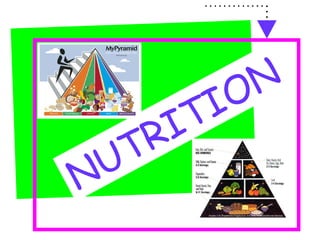
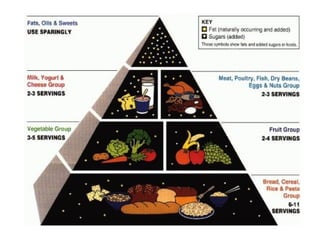
  • #2 What do we know about these 2 pyramids? Old one-specific servings for everyone-no physical activity incorporated New one- no serving sizes-activity is emphasized Handout-Anatomy of mypyramid
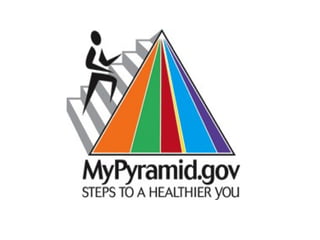
  • #4 Shows acitivity-moderation-proportions-personalized Visit mypyramid.gov to make your own personalized pyramid
  • #5 Look for the word whole in front of the word grain on a product -whole wheat
  • #6 Starchy vegetables-potatoes, corn, lima beans Dry beans and peas Orange vegetables- carrots, squash, sweet potatoes Dark green vegetables- spinach, collard greens, broccoli
  • #7 Variety of fruits- apples, bananas, mangoes, oranges, papayas, grapes, pineapples
  • #8 3-A-DAY CAMPAIGN -not adding milk products, it’s replacing things that aren’t as healthy, like soda, tea, coffee, and snacks. -choosing yogurt, low-fat cheese, etc. instead will help you become healthier
  • #11 ACTIVITY -3 levels -sedentary, moderate, active -different serving sizes for boys and girls and also different servings sizes for boys and girls at each activity level. PERSONALIZATION -this is making your own pyramid using their guidelines based on your age, sex, and activity level
  • #12 By looking at the new pyramid which groups shouldn’t be chosen very often? -oils, fruits Why??
  • #13 By looking at the new pyramid which groups should make up most of our diet? -grains, vegetables, milk
  • #15 What kinds of things can we do to improve our lifestyle each day??
  • #16 Worksheet 10
  • #17 -Substances that the body needs to regulate body functions, promote growth, repair body tissues, and obtain energy. -Your body requires more than 40 different nutrients for these tasks but only 6 are essential. -define what essential means
  • #18 -Made up of carbon, hydrogen, and oxygen -2 different types we are going to talk about -simple -complex -45-65% of a persons daily caloric intake should be from carbohydrates -foods rich in complex carbs are better than simple carbs.
  • #19 -Added to manufactured foods like cookies, candies, and soft drinks -occurs naturally in fruits, vegetables, and milk -all sugars are converted to glucose for the body to use.
  • #20 -Found in many plant foods such as potatoes -grains-rice, cereals, and wheat -when you eat complex carbohydrates your body (digests) breaks the starch into simple sugars that can be absorbed into your bloodstream. That’s why its slower to digest. -FIBER -is a complex carbohydrate but is not considered a nutrient because its not broken down and absorbed into your bloodstream. -still necessary for the proper functioning of your digestive system. -helps prevent constipation -may reduce risk of colon cancer -may help prevent heart disease
  • #21 -High protein foods -meats, eggs, poultry, milk and milk products -Nuts, dried beans, dried peas, and lentils contain a lot of protein also. -10-35% of diet needs to be protein
  • #23 COMPLETE PROTEINS- animal sources INCOMPLETE PROTEINS-plant sources
  • #24 -Helps maintain body temperature, protect your nerves, and form your cells. -20-35% of daily intake -primarily unsaturated fat
  • #26 -MONOUNSATURATED FATS- olive oil, peanut oil, and canola oil -POLYUNSATURATED FATS- corn oil, soybean oil, and seafood. -balancing of the 2 is important for cardiovascular health
  • #27 -ANIMAL FATS -lard and dairy products -too much can lead to heart disease -TRANS FAT -when manufacturers add hydrogen to the fat molecules in vegetables oils. -foods that contain these stay fresher longer
  • #28 -CHOLESTEROL -waxy-fatlike substance that is only found in animal products. Your body needs a certain amount of cholesterol to make cell membranes and nerve tissue, certain hormones and substances that aid in the digestion of fat. -your liver can make all of the cholesterol your body needs, so its not a necessary part of your diet. -when to much cholesterol is in the bloodstream it causes plaque to form on the walls of arteries. Heavy build up causes blockages which in turn causes heart attack
  • #30 -Write this down in the notes box!!
  • #31 SAMPLE CALCULATIONS WORKSHEET
  • #34 -Dehydration -very heavy perspiring or severe diarrhea -a serious reduction in the body’s water content -Symptoms of dehydration -weakness -rapid breathing -weak heartbeat -dizzy, lathargic -Female teen -at least 10, 8oz glasses of water a day -Male teen -at least 14, 8oz glasses of water a day -A person can lose 4 cups of water during every hour of exercise
  • #35 WORKSHEET 5 WORKSHEET 6
  • #37 -Minerals occur naturally in rocks and soil. Plants absorb these minerals through the soil and animals obtain these nutrients by eating these plants or eating an animal that has eaten these plants, then we eat these plants and animals. -24 different minerals have been shown to be essential for good health. There are 7 you need in significant amounts- Ca, Na, K, Mg, P, Cl, S. The others are only needed in trace amounts.
  • #38 Helps with functioning of your nervous system. Good sources of Calcium-Dairy products of course but some people cannot digest dairy products so what can they eat to get Ca? -Beet greens, collard greens, broccoli, and tofu A lack of Ca can lead to osteoporosis-bones gradually weaken usually a disease of older people but what you do now can affect what happens as you get older. 85% of girls do not get enough Ca in their diet.
  • #39 -Necessary for healthy red blood cells -Women need extra iron because they lose iron during menstruation -Boys and girls need iron to build muscle mass -Not getting enough iron may cause anemia. -a condition in which the red blood cells do not contain enough hemoglobin -anemics are often weak and tired, may become sick easily.
  • #40 Potassium and Sodium work together to maintain water balance in the body People who consume enough potassium each day generally have lower blood pressure than people who do not Foods rich in potassium: baked potatoes, spinach, bananas, dried fruits, oranges, soybeans, tomato products, milk, and carrots.
  • #41 -Helps build bones and proteins -Helps with energy metabolism -Muscle contraction Sources: -leafy green vegetables -legumes -nuts -whole-grain food Another Mineral -Sodium: most people consume to much sodium. Table salt or NaCl is a major source of sodium. Helps functioning of the heart. Aids in water balance. Too much sodium can cause blood pressure problems. Can raise blood pressure. -Fluoride: helps form strong teeth and bones can get it from fish and water. -Chlorine: Helps maintain water balance and aids with digestion. Can get it from table salt, soy sauce and processed foods.
  • #42 -required in small amounts -assists in many chemical reactions in the body -Vitamins do not directly provide the body with energy -Instead vitamins help with various processes in the body including the use of other nutrients.
  • #43 Not stored in the body for future use. Must eat foods with these vitamins everyday
  • #44 Aids in bone, teeth, and skin formation resistance to infection Sources: citrus fruits, green vegetables, melons, potatoes, and tomatoes.
  • #45 B1-Thiamin- aids in nervous system function B2-Riboflavin- aids in metabolism of carbs, proteins, and fats B3- Niacin- aids in metabolism B6-Pyridoxine- aids in metabolism of carbs, proteins, and fats B12-Cobalamin- maintains healthy nervous system and red blood cells Pantothenic acid-aids in metabolism Folic Acid (folate)- aids in formation of red blood cells and protein Biotin- aids in metabolism
  • #47 Maintains healthy skin, bones, teeth and hair Aids in vision in dim light Sources: liver, eggs, cheese, milk, and yellow, orange and dark green vegetables and fruit
  • #48 Maintains bones and teeth Helps in the use of Ca and phophorous Sources: milk, eggs, liver, and sunlight Vitamin E -aids in maintenance of red blood cells, vitamin A and fats -Sources: margarine, vegetable oil, whole grains, legumes, green leafy vegetables Vitamin K -aids in blood clotting -Sources: green leafy vegetables, potatoes, liver
  • #54 What can make the healthy choices unhealthy? What can make the unhealthy choices healthy? Mayo, cheese, loaded baked potato, salad dressing, toppings Baked instead of fried
  • #80 PORTION DISTORTION HANDOUT