HERMENEUTICS: FOLKLORE FORMS
AND FOLKLORE LITERATURE
Elena Shapa, PhD, Associate Professor
FOLKLORE ETYMOLOGY
The word folklore, a compound of folk and lore, was
coined in 1846 by the British writer William John
Thoms, who contrived the term as a replacement for the
contemporary terminology of "popular antiquities" or
"popular literature". The second half of the word, lore ,
comes from Old English lār 'instruction’.
(Oxford Dictionaries)
It is the knowledge and traditions of a particular group,
frequently passed along by word of mouth.
FOLKLORE DEFINITIONS
Folklore /ˈfəʊklɔː/
 Definitions of folklore
 1: traditional customs, tales, sayings, dances, or art
forms preserved among a people. Ex: The coyote
appears in Native American folklore. Paul Bunyan is a
figure from folklore.
 2: a branch of knowledge that deals with folklorea
specialist in folklore
 3: an often unsupported notion, story, or saying that is
widely circulated, for ex. the folklore about the health
risks of computers
(Merriam-Webster Dictionary: https://www.merriam-webster.com/dictionary/folklore)
FOLKLORE FUNCTIONS
According to William Bascom there are four basic
functions to folklore:
 Folklore lets people escape from repressions
imposed upon them by society.
 Folklore validates culture, justifying its rituals and
institutions to those who perform and observe them.
 Folklore is a pedagogic device which reinforces
morals and values and builds wit.
 Folklore is a means of applying social pressure and
exercising social control.
(Bascom, William R. (1954). "Four Functions of Folklore". The Journal
of American Folklore. American Folklore Society. 67 (266): 333–349.)
FOLKLORE TYPES
Folk literature is but a part of what is
generally known as folklore: customs and beliefs, ritualistic
behaviour, folk dances, folk music, and other nonliterary
manifestations.
These are often considered a part of the larger study of
ethnology, but they are also the business of the folklorist.
Hence the following types of folklore artifacts:
 Material / non-verbal folklore (various physical objects),
 Verbal folklore (proverbs, sayings, legends, myths, charms,
songs),
 Children’s folklore/ Childlore (tales, nursery rhymes, tongue-
twisters, lullabies, playground songs, games)
 Customary folklore (traditions, customs, beliefs, rituals,
dances).
MATERIAL FOLKLORE
 Material folklore is the technology of folk cultures.
The design of houses, barns, spring houses, and
other structures as well as toys, costumes, musical
instruments, furniture items, cutlery and dishes,
specific clothes, headwear and footwear, etc, if
learned from traditional sources are folklore.
 In this issue, various traditional types of houses in
the English, Romanian and Russian cultures (hut,
cocioaba, изба) represent respective folklore
features.
VERBAL FOLKLORE
 Verbal folklore includes everything from simple
language to complex texts such as proverbs,
sayings, riddles, ballads, rhymes, myths, legends,
and folk tale.
 The first evidence of folk culture is dialect. Ex. to
drink a bottle of pop = sodie = fizz.
 Proverbs and sayings Sayings are pithy
statements that express a universal value. Proverb
is mostly common sense wisdom while saying can
be broader to contain maxim and adage too. So, all
proverbs are basically sayings, but not all sayings
are proverbs.
Proverb: A stitch in time saves nine.
Saying: "If you judge people, you have no time to love
them.” (Mother Teresa)
VERBAL FOLKLORE
 Verbal folklore :
 Riddles: What walks on four legs in the morning,
two through the day and three in the evening?
(Humans crawl, walk, and use a cane through life.)
 Rhymes are sung or chanted to small children for
didactic purposes
This little piggy went to market,
This little piggy stayed home,
This little piggy had roast beef,
This little piggy had none.
This little piggy went ...
Wee, wee, wee,
all the way home!
VERBAL FOLKLORE
 Verbal folklore :
 Folksong and ballad Ballads could be either
dramatic or humorous, dealing with the topics of the
time. Folk songs, on the other hand, were shorter,
lyrical and personal.
 Folksong: Should auld acquaintance be forgot
And never brought to mind?
Should auld acquaintance be forgot
And days of auld lang syne? Etc…
 Ballad: Come in, come in, my old true love,
Come in, come in, said she,
It's been three-fourths of a long, long year,
Since together we have been. etc.
VERBAL FOLKLORE
 Verbal folklore :
 Myths and legends are believed to be true but
they differ in the time and place of setting and in
characters.
 Folktales are fictional story that have been orally
passed down over hundreds of years. They are
stories for all people, usually simple, easily-
understood stories told in straightforward language.
They often teach a lesson or explain why things
(such as the sun, moon, and stars) exist as they do.
Many folktales have humans, animals or objects as
characters and have magical elements.
CHILDREN’S FOLKLORE/CHILDLORE
 Childlore is a distinct branch of folklore that deals
with activities passed on by children to other
children, away from the influence or supervision of
an adult.
 Children's folklore contains artifacts from all the
standard folklore genres of verbal, material, and
customary lore.
 Customary childlore may include: counting and
dandling rhymes, finger and toe rhymes, ball-
bouncing rhymes, jump-rope rhymes, macabre
rhymes, nursery rhymes.
CHILDREN’S FOLKLORE/CHILDLORE
 Some childlore forms serve the function of learning
and practicing skills needed for growth. Bouncing and
swinging rhythms and rhymes encourage development
of balance and coordination in infants and kids. Verbal
rhymes serve to increase both the oral and aural
acuity of children. Songs and chants, accessing a
different part of the brain, are used to memorize series
(Alphabet songs). They also provide the beat to
complex physical rhythms and movements, be it hand-
clapping, jump roping, or ball bouncing. Many physical
games are used to develop strength and endurance of
the players. For some team games, negotiations about
the rules can run on longer than the game itself as
social skills are rehearsed.
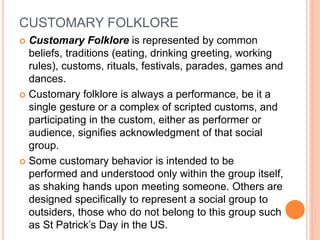
CUSTOMARY FOLKLORE
 Customary Folklore is represented by common
beliefs, traditions (eating, drinking greeting, working
rules), customs, rituals, festivals, parades, games and
dances.
 Customary folklore is always a performance, be it a
single gesture or a complex of scripted customs, and
participating in the custom, either as performer or
audience, signifies acknowledgment of that social
group.
 Some customary behavior is intended to be
performed and understood only within the group itself,
as shaking hands upon meeting someone. Others are
designed specifically to represent a social group to
outsiders, those who do not belong to this group such
as St Patrick’s Day in the US.
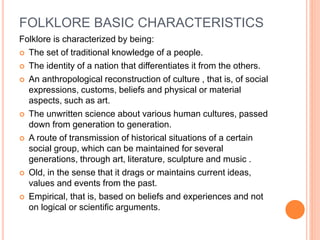
FOLKLORE BASIC CHARACTERISTICS
Folklore is characterized by being:
 The set of traditional knowledge of a people.
 The identity of a nation that differentiates it from the others.
 An anthropological reconstruction of culture , that is, of social
expressions, customs, beliefs and physical or material
aspects, such as art.
 The unwritten science about various human cultures, passed
down from generation to generation.
 A route of transmission of historical situations of a certain
social group, which can be maintained for several
generations, through art, literature, sculpture and music .
 Old, in the sense that it drags or maintains current ideas,
values and events from the past.
 Empirical, that is, based on beliefs and experiences and not
on logical or scientific arguments.
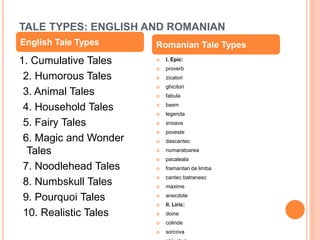
TALE TYPES: ENGLISH AND ROMANIAN
1. Cumulative Tales
2. Humorous Tales
3. Animal Tales
4. Household Tales
5. Fairy Tales
6. Magic and Wonder
Tales
7. Noodlehead Tales
8. Numbskull Tales
9. Pourquoi Tales
10. Realistic Tales
 I. Epic:
 proverb
 zicatori
 ghicitori
 fabula
 basm
 legenda
 snoava
 poveste
 dascantec
 numaratoarea
 pacaleala
 framantari de limba
 cantec batranesc
 maxime
 anecdote
 II. Liric:
 doine
 colinde
 sorcova
English Tale Types Romanian Tale Types
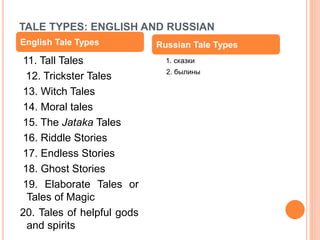
TALE TYPES: ENGLISH AND RUSSIAN
11. Tall Tales
12. Trickster Tales
13. Witch Tales
14. Moral tales
15. The Jataka Tales
16. Riddle Stories
17. Endless Stories
18. Ghost Stories
19. Elaborate Tales or
Tales of Magic
20. Tales of helpful gods
and spirits
1. сказки
2. былины
English Tale Types Russian Tale Types

Folklore_Hermeneutics.ppt

  • 1.
    HERMENEUTICS: FOLKLORE FORMS ANDFOLKLORE LITERATURE Elena Shapa, PhD, Associate Professor
  • 2.
    FOLKLORE ETYMOLOGY The wordfolklore, a compound of folk and lore, was coined in 1846 by the British writer William John Thoms, who contrived the term as a replacement for the contemporary terminology of "popular antiquities" or "popular literature". The second half of the word, lore , comes from Old English lār 'instruction’. (Oxford Dictionaries) It is the knowledge and traditions of a particular group, frequently passed along by word of mouth.
  • 3.
    FOLKLORE DEFINITIONS Folklore /ˈfəʊklɔː/ Definitions of folklore  1: traditional customs, tales, sayings, dances, or art forms preserved among a people. Ex: The coyote appears in Native American folklore. Paul Bunyan is a figure from folklore.  2: a branch of knowledge that deals with folklorea specialist in folklore  3: an often unsupported notion, story, or saying that is widely circulated, for ex. the folklore about the health risks of computers (Merriam-Webster Dictionary: https://www.merriam-webster.com/dictionary/folklore)
  • 4.
    FOLKLORE FUNCTIONS According toWilliam Bascom there are four basic functions to folklore:  Folklore lets people escape from repressions imposed upon them by society.  Folklore validates culture, justifying its rituals and institutions to those who perform and observe them.  Folklore is a pedagogic device which reinforces morals and values and builds wit.  Folklore is a means of applying social pressure and exercising social control. (Bascom, William R. (1954). "Four Functions of Folklore". The Journal of American Folklore. American Folklore Society. 67 (266): 333–349.)
  • 5.
    FOLKLORE TYPES Folk literatureis but a part of what is generally known as folklore: customs and beliefs, ritualistic behaviour, folk dances, folk music, and other nonliterary manifestations. These are often considered a part of the larger study of ethnology, but they are also the business of the folklorist. Hence the following types of folklore artifacts:  Material / non-verbal folklore (various physical objects),  Verbal folklore (proverbs, sayings, legends, myths, charms, songs),  Children’s folklore/ Childlore (tales, nursery rhymes, tongue- twisters, lullabies, playground songs, games)  Customary folklore (traditions, customs, beliefs, rituals, dances).
  • 6.
    MATERIAL FOLKLORE  Materialfolklore is the technology of folk cultures. The design of houses, barns, spring houses, and other structures as well as toys, costumes, musical instruments, furniture items, cutlery and dishes, specific clothes, headwear and footwear, etc, if learned from traditional sources are folklore.  In this issue, various traditional types of houses in the English, Romanian and Russian cultures (hut, cocioaba, изба) represent respective folklore features.
  • 7.
    VERBAL FOLKLORE  Verbalfolklore includes everything from simple language to complex texts such as proverbs, sayings, riddles, ballads, rhymes, myths, legends, and folk tale.  The first evidence of folk culture is dialect. Ex. to drink a bottle of pop = sodie = fizz.  Proverbs and sayings Sayings are pithy statements that express a universal value. Proverb is mostly common sense wisdom while saying can be broader to contain maxim and adage too. So, all proverbs are basically sayings, but not all sayings are proverbs. Proverb: A stitch in time saves nine. Saying: "If you judge people, you have no time to love them.” (Mother Teresa)
  • 8.
    VERBAL FOLKLORE  Verbalfolklore :  Riddles: What walks on four legs in the morning, two through the day and three in the evening? (Humans crawl, walk, and use a cane through life.)  Rhymes are sung or chanted to small children for didactic purposes This little piggy went to market, This little piggy stayed home, This little piggy had roast beef, This little piggy had none. This little piggy went ... Wee, wee, wee, all the way home!
  • 9.
    VERBAL FOLKLORE  Verbalfolklore :  Folksong and ballad Ballads could be either dramatic or humorous, dealing with the topics of the time. Folk songs, on the other hand, were shorter, lyrical and personal.  Folksong: Should auld acquaintance be forgot And never brought to mind? Should auld acquaintance be forgot And days of auld lang syne? Etc…  Ballad: Come in, come in, my old true love, Come in, come in, said she, It's been three-fourths of a long, long year, Since together we have been. etc.
  • 10.
    VERBAL FOLKLORE  Verbalfolklore :  Myths and legends are believed to be true but they differ in the time and place of setting and in characters.  Folktales are fictional story that have been orally passed down over hundreds of years. They are stories for all people, usually simple, easily- understood stories told in straightforward language. They often teach a lesson or explain why things (such as the sun, moon, and stars) exist as they do. Many folktales have humans, animals or objects as characters and have magical elements.
  • 11.
    CHILDREN’S FOLKLORE/CHILDLORE  Childloreis a distinct branch of folklore that deals with activities passed on by children to other children, away from the influence or supervision of an adult.  Children's folklore contains artifacts from all the standard folklore genres of verbal, material, and customary lore.  Customary childlore may include: counting and dandling rhymes, finger and toe rhymes, ball- bouncing rhymes, jump-rope rhymes, macabre rhymes, nursery rhymes.
  • 12.
    CHILDREN’S FOLKLORE/CHILDLORE  Somechildlore forms serve the function of learning and practicing skills needed for growth. Bouncing and swinging rhythms and rhymes encourage development of balance and coordination in infants and kids. Verbal rhymes serve to increase both the oral and aural acuity of children. Songs and chants, accessing a different part of the brain, are used to memorize series (Alphabet songs). They also provide the beat to complex physical rhythms and movements, be it hand- clapping, jump roping, or ball bouncing. Many physical games are used to develop strength and endurance of the players. For some team games, negotiations about the rules can run on longer than the game itself as social skills are rehearsed.
  • 13.
    CUSTOMARY FOLKLORE  CustomaryFolklore is represented by common beliefs, traditions (eating, drinking greeting, working rules), customs, rituals, festivals, parades, games and dances.  Customary folklore is always a performance, be it a single gesture or a complex of scripted customs, and participating in the custom, either as performer or audience, signifies acknowledgment of that social group.  Some customary behavior is intended to be performed and understood only within the group itself, as shaking hands upon meeting someone. Others are designed specifically to represent a social group to outsiders, those who do not belong to this group such as St Patrick’s Day in the US.
  • 14.
    FOLKLORE BASIC CHARACTERISTICS Folkloreis characterized by being:  The set of traditional knowledge of a people.  The identity of a nation that differentiates it from the others.  An anthropological reconstruction of culture , that is, of social expressions, customs, beliefs and physical or material aspects, such as art.  The unwritten science about various human cultures, passed down from generation to generation.  A route of transmission of historical situations of a certain social group, which can be maintained for several generations, through art, literature, sculpture and music .  Old, in the sense that it drags or maintains current ideas, values and events from the past.  Empirical, that is, based on beliefs and experiences and not on logical or scientific arguments.
  • 15.
    TALE TYPES: ENGLISHAND ROMANIAN 1. Cumulative Tales 2. Humorous Tales 3. Animal Tales 4. Household Tales 5. Fairy Tales 6. Magic and Wonder Tales 7. Noodlehead Tales 8. Numbskull Tales 9. Pourquoi Tales 10. Realistic Tales  I. Epic:  proverb  zicatori  ghicitori  fabula  basm  legenda  snoava  poveste  dascantec  numaratoarea  pacaleala  framantari de limba  cantec batranesc  maxime  anecdote  II. Liric:  doine  colinde  sorcova English Tale Types Romanian Tale Types
  • 16.
    TALE TYPES: ENGLISHAND RUSSIAN 11. Tall Tales 12. Trickster Tales 13. Witch Tales 14. Moral tales 15. The Jataka Tales 16. Riddle Stories 17. Endless Stories 18. Ghost Stories 19. Elaborate Tales or Tales of Magic 20. Tales of helpful gods and spirits 1. сказки 2. былины English Tale Types Russian Tale Types