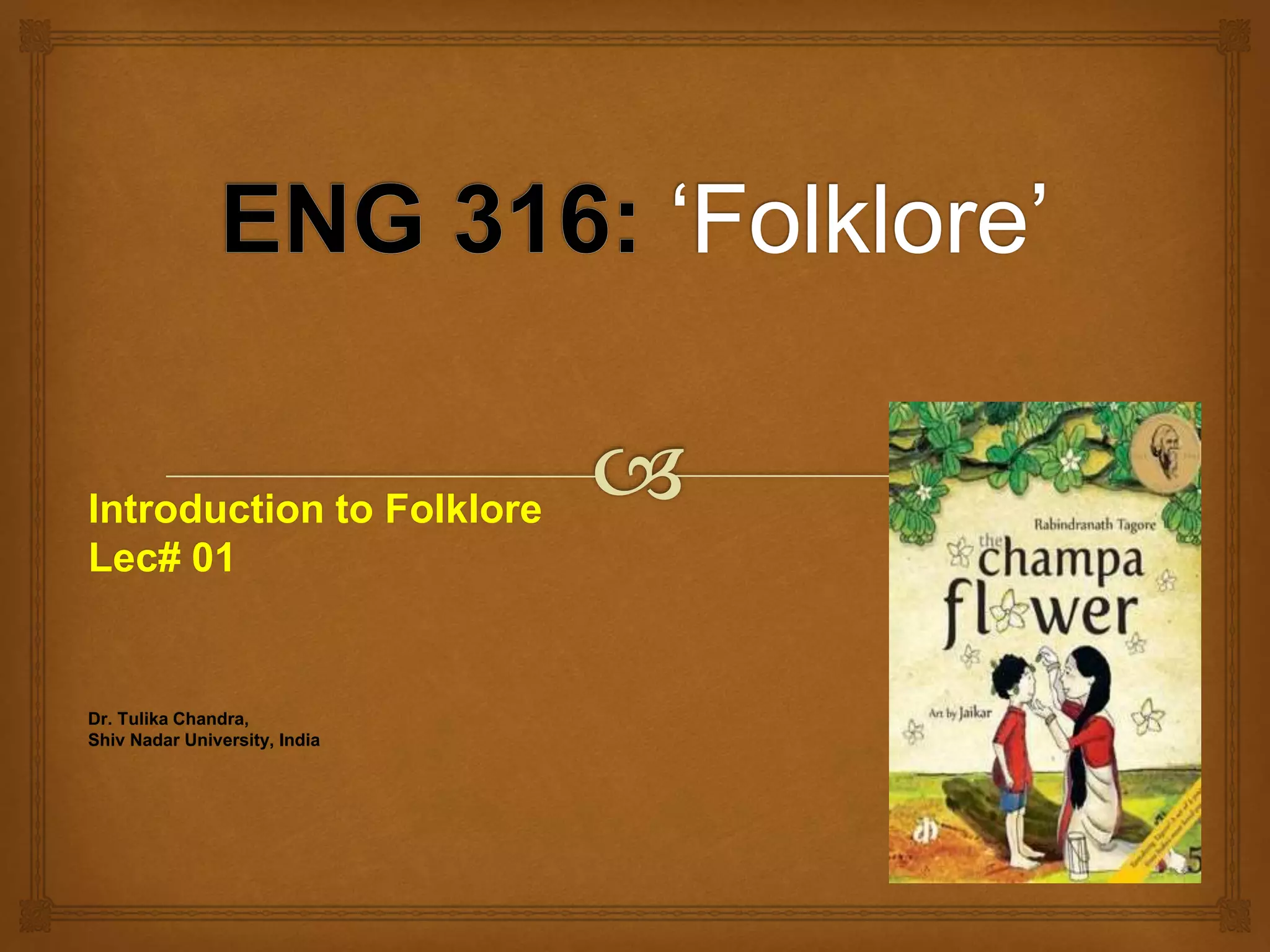
Introduction to Folklore 
Lec# 01 
Dr. Tulika Chandra, 
Shiv Nadar University, India
Introduction 
 
 The term "folk" suggests people belonging to different groups 
which shared a common factor, language, religion, culture and 
traditions. 
 The knowledge of such kind of traditions and culture is known as 
folklore. 
 The very notion of "folk" raises up the feeling that it belongs to the 
field of illiterate and marginalised people. It is a fact that the oral 
tradition, on which the folklore is based, is often used as a tool by 
the subaltern groups as a voice to their difficulties & dilemmas. 
 Somehow people could not decipher the implicit meanings in the 
stories, proverbs, jokes and riddles. The folklore theories 
endeavour to delve into the deep rooted meaning of folklore and 
attempt to find out the origin of the tales. Folklore studies can also 
be taken as a way to raise one's awareness of the culture that one 
is coming from. 
Tulika Chandra _ 'Folklore' 2
Introduction 
 
 Folklore is often defined as an expression through a medium 
like: tale or legend that begins from and is traditional among a 
people or folk. Folktales are different from myths and legends 
because they do not always have religious leanings, and are 
not based on historical truths. 
 Folklore especially form a part of the tradition of the common 
people, an expression that springs from the shared history of a 
particular community. This history is then passed down to the 
next generation. 
 Traditional folklore doesn’t have an individual author; instead it 
is owned by the community. The folklore contains the entire 
culture of the community, which also differentiates it from other 
groups. There is a collective conscious stored within the 
folklore. 
Tulika Chandra _ 'Folklore' 3
Why Study Folklore? 
 
 Because it's pervasive, informative, and fun. What do 
you think when someone sneezes? What do you do 
when a cat crosses your path? Why do we put lights on 
the Christmas tree? Why are popular jokes created 
about the Rajnikanth and Alok Nath? 
We will together discovered that folklore can stimulate 
our intellectual, creative, and aesthetic desires. It has 
much to tell us about people's attitudes, beliefs, and 
concerns. 
Tulika Chandra _ 'Folklore' 4
What have some of the scholars 
said: 
 
 Jan Brunvand. The Study of American Folklore: An 
Introduction, 2nd edition. New 
York: W.W. Norton, 1978. 
 “Folklore comprises the unrecorded traditions of a people; 
it includes both the form and content of these traditions 
and their style or technique of communication from 
person to person. 
 Folklore is the traditional, unofficial, non-institutional part 
of culture. It encompasses all knowledge, understandings, 
values, attitudes, assumptions, feelings, and beliefs 
transmitted in traditional forms by word of mouth or by 
customary examples.” 
Tulika Chandra _ 'Folklore' 5
There really is no putative settlement as 
to exactly what the boundaries of folklore 
encompass. 
A simple definition of folklore offered by Archer 
Taylor (1946): " What, then, is folklore? We 
might reply with such a dictionary definition as 
"Material that has been handed on by tradition." 
It is, in other words, the lore of the folk and not 
the learning in books. We have not come very 
far. Let us ask, then: What material? We might 
answer: Things, words, music, ideas (that is, 
customs and beliefs). “ 
Tulika Chandra _ 'Folklore' 6
 Definition of Folklore: 
“It is possible...…..to define both folk and lore 
in such a way that even the beginner can 
understand what folklore is. The term "folk" 
can refer to any group of people whatsoever 
who share at least one common factor. It does 
not matter what the linking factor is--it could be 
a common occupation, language or religion-- 
but what is important is that a group formed for 
whatever reason will have some traditions 
which it calls its own.” (Alan Dundes, 1965) 
Tulika Chandra _ 'Folklore' 7
Dundes provides a list of various types of folklore 
to demonstrate the large range of the field of study. 
 
 The list includes both: Expected folklore & ‘not so obvious’ 
folktales. 
 The expected subjects of folktales, legends, myths, 
ballads, festivals, folk dance and song. 
 Folklore that may not be as obvious, such as children's 
counting out rhymes, food recipes, house, barn and fence 
types, latrinalia (informal writings in public restrooms), as 
well as the sounds traditionally used to call specific 
animals. 
 Dundes says, “that this list is not exhaustive, but merely a 
sampling of the subjects that folklore scholarship can 
address, and which merit study for the insight that they 
provide into specific cultures” (Dundes, 1965: 3) 
Tulika Chandra _ 'Folklore' 8
 When William Thoms coined the term "folklore" in 1846 in 
England, "the folk," were considered the illiterate peasantry of a 
given region: "European peasants specifically, and no one else" 
(Dundes 1980, 4). 
 For centuries intellectuals have been collecting and recording 
folktales throughout Europe. Straparola first collected fairy tales 
in 16th century Italy, a practice taken up by Salon culture of 
18th century France and then academics like Jacob and 
Wilhelm Grimm in 19th century Germany. Educated, "civilized" 
people studying the folk did not consider themselves part of the 
folk, but instead believed themselves "above" the folk, civilized, 
more rational, more adult. 
 We are talking about those scholars who often exaggerated the 
folk, well-regarded their lore, and sometimes grieved the loss of 
folklore in their own "enlightened" lives. By the middle of the 
19th century, evolutionary perspectives from science influenced 
social scientists as well, leading to explicit notions of primitive 
versus civilized within and among societies. 
Tulika Chandra _ 'Folklore' 9
The previously judgmental notions 
 
 In the early 1900’s, a number of scholars in folklore and 
anthropology actually spent time in the field. 
 They stayed & lived with the cultures and people they studied. 
 This led to long term interaction. 
 Their observations and first-hand experiences taught them that 
our similarities as humans are greater than our differences. 
 Many of the defined notions got washed-out. 
 Scholars, researchers found the cultures and people who had 
literally been referred to as "others" or "primitives" were, in fact 
same as they were. 
 The researchers found them to be as complex, humane, 
technically smart, artistically inspired and enriching, 
philosophically profound, morally deep, and as fully mature as 
their own. 
Tulika Chandra _ 'Folklore' 10
Transition 
 
 Finally in the 1960's and 70's scholars officially 
casted-off the evolutionary perspective of early 
folklorists 
 Re-shaped the term folklore to reflect a more 
inclusive and accurate definition, 
 Cotemporary age recognizes as ‘folk’ as any 
collectivity (a group or a culture): "Who are the folk? 
Among others, we are!" Alan Dundes proclaimed in 
1977 (1980, 19). 
Tulika Chandra _ 'Folklore' 11
Thank you 
Tulika Chandra _ 'Folklore' 12

Introduction to folklore tulika chandra

  • 1.
    Introduction to Folklore Lec# 01 Dr. Tulika Chandra, Shiv Nadar University, India
  • 2.
    Introduction  The term "folk" suggests people belonging to different groups which shared a common factor, language, religion, culture and traditions.  The knowledge of such kind of traditions and culture is known as folklore.  The very notion of "folk" raises up the feeling that it belongs to the field of illiterate and marginalised people. It is a fact that the oral tradition, on which the folklore is based, is often used as a tool by the subaltern groups as a voice to their difficulties & dilemmas.  Somehow people could not decipher the implicit meanings in the stories, proverbs, jokes and riddles. The folklore theories endeavour to delve into the deep rooted meaning of folklore and attempt to find out the origin of the tales. Folklore studies can also be taken as a way to raise one's awareness of the culture that one is coming from. Tulika Chandra _ 'Folklore' 2
  • 3.
    Introduction  Folklore is often defined as an expression through a medium like: tale or legend that begins from and is traditional among a people or folk. Folktales are different from myths and legends because they do not always have religious leanings, and are not based on historical truths.  Folklore especially form a part of the tradition of the common people, an expression that springs from the shared history of a particular community. This history is then passed down to the next generation.  Traditional folklore doesn’t have an individual author; instead it is owned by the community. The folklore contains the entire culture of the community, which also differentiates it from other groups. There is a collective conscious stored within the folklore. Tulika Chandra _ 'Folklore' 3
  • 4.
    Why Study Folklore?   Because it's pervasive, informative, and fun. What do you think when someone sneezes? What do you do when a cat crosses your path? Why do we put lights on the Christmas tree? Why are popular jokes created about the Rajnikanth and Alok Nath? We will together discovered that folklore can stimulate our intellectual, creative, and aesthetic desires. It has much to tell us about people's attitudes, beliefs, and concerns. Tulika Chandra _ 'Folklore' 4
  • 5.
    What have someof the scholars said:   Jan Brunvand. The Study of American Folklore: An Introduction, 2nd edition. New York: W.W. Norton, 1978.  “Folklore comprises the unrecorded traditions of a people; it includes both the form and content of these traditions and their style or technique of communication from person to person.  Folklore is the traditional, unofficial, non-institutional part of culture. It encompasses all knowledge, understandings, values, attitudes, assumptions, feelings, and beliefs transmitted in traditional forms by word of mouth or by customary examples.” Tulika Chandra _ 'Folklore' 5
  • 6.
    There really isno putative settlement as to exactly what the boundaries of folklore encompass. A simple definition of folklore offered by Archer Taylor (1946): " What, then, is folklore? We might reply with such a dictionary definition as "Material that has been handed on by tradition." It is, in other words, the lore of the folk and not the learning in books. We have not come very far. Let us ask, then: What material? We might answer: Things, words, music, ideas (that is, customs and beliefs). “ Tulika Chandra _ 'Folklore' 6
  • 7.
     Definition ofFolklore: “It is possible...…..to define both folk and lore in such a way that even the beginner can understand what folklore is. The term "folk" can refer to any group of people whatsoever who share at least one common factor. It does not matter what the linking factor is--it could be a common occupation, language or religion-- but what is important is that a group formed for whatever reason will have some traditions which it calls its own.” (Alan Dundes, 1965) Tulika Chandra _ 'Folklore' 7
  • 8.
    Dundes provides alist of various types of folklore to demonstrate the large range of the field of study.   The list includes both: Expected folklore & ‘not so obvious’ folktales.  The expected subjects of folktales, legends, myths, ballads, festivals, folk dance and song.  Folklore that may not be as obvious, such as children's counting out rhymes, food recipes, house, barn and fence types, latrinalia (informal writings in public restrooms), as well as the sounds traditionally used to call specific animals.  Dundes says, “that this list is not exhaustive, but merely a sampling of the subjects that folklore scholarship can address, and which merit study for the insight that they provide into specific cultures” (Dundes, 1965: 3) Tulika Chandra _ 'Folklore' 8
  • 9.
     When WilliamThoms coined the term "folklore" in 1846 in England, "the folk," were considered the illiterate peasantry of a given region: "European peasants specifically, and no one else" (Dundes 1980, 4).  For centuries intellectuals have been collecting and recording folktales throughout Europe. Straparola first collected fairy tales in 16th century Italy, a practice taken up by Salon culture of 18th century France and then academics like Jacob and Wilhelm Grimm in 19th century Germany. Educated, "civilized" people studying the folk did not consider themselves part of the folk, but instead believed themselves "above" the folk, civilized, more rational, more adult.  We are talking about those scholars who often exaggerated the folk, well-regarded their lore, and sometimes grieved the loss of folklore in their own "enlightened" lives. By the middle of the 19th century, evolutionary perspectives from science influenced social scientists as well, leading to explicit notions of primitive versus civilized within and among societies. Tulika Chandra _ 'Folklore' 9
  • 10.
    The previously judgmentalnotions   In the early 1900’s, a number of scholars in folklore and anthropology actually spent time in the field.  They stayed & lived with the cultures and people they studied.  This led to long term interaction.  Their observations and first-hand experiences taught them that our similarities as humans are greater than our differences.  Many of the defined notions got washed-out.  Scholars, researchers found the cultures and people who had literally been referred to as "others" or "primitives" were, in fact same as they were.  The researchers found them to be as complex, humane, technically smart, artistically inspired and enriching, philosophically profound, morally deep, and as fully mature as their own. Tulika Chandra _ 'Folklore' 10
  • 11.
    Transition  Finally in the 1960's and 70's scholars officially casted-off the evolutionary perspective of early folklorists  Re-shaped the term folklore to reflect a more inclusive and accurate definition,  Cotemporary age recognizes as ‘folk’ as any collectivity (a group or a culture): "Who are the folk? Among others, we are!" Alan Dundes proclaimed in 1977 (1980, 19). Tulika Chandra _ 'Folklore' 11
  • 12.
    Thank you TulikaChandra _ 'Folklore' 12