1
Dr Udai Bhan Yadav
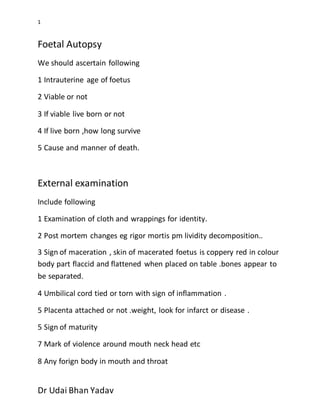
Foetal Autopsy
We should ascertain following
1 Intrauterine age of foetus
2 Viable or not
3 If viable live born or not
4 If live born ,how long survive
5 Cause and manner of death.
External examination
Include following
1 Examination of cloth and wrappings for identity.
2 Post mortem changes eg rigor mortis pm lividity decomposition..
3 Sign of maceration , skin of macerated foetus is coppery red in colour
body part flaccid and flattened when placed on table .bones appear to
be separated.
4 Umbilical cord tied or torn with sign of inflammation .
5 Placenta attached or not .weight, look for infarct or disease .
5 Sign of maturity
7 Mark of violence around mouth neck head etc
8 Any forign body in mouth and throat
2
Dr Udai Bhan Yadav
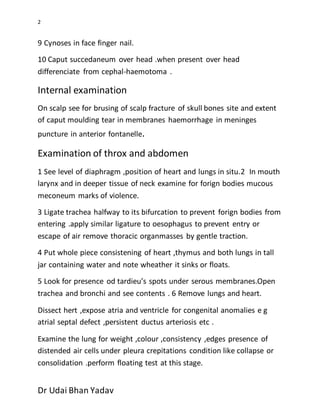
9 Cynoses in face finger nail.
10 Caput succedaneum over head .when present over head
differenciate from cephal-haemotoma .
Internal examination
On scalp see for brusing of scalp fracture of skull bones site and extent
of caput moulding tear in membranes haemorrhage in meninges
puncture in anterior fontanelle.
Examination of throx and abdomen
1 See level of diaphragm ,position of heart and lungs in situ.2 In mouth
larynx and in deeper tissue of neck examine for forign bodies mucous
meconeum marks of violence.
3 Ligate trachea halfway to its bifurcation to prevent forign bodies from
entering .apply similar ligature to oesophagus to prevent entry or
escape of air remove thoracic organmasses by gentle traction.
4 Put whole piece consistening of heart ,thymus and both lungs in tall
jar containing water and note wheather it sinks or floats.
5 Look for presence od tardieu’s spots under serous membranes.Open
trachea and bronchi and see contents . 6 Remove lungs and heart.
Dissect hert ,expose atria and ventricle for congenital anomalies e g
atrial septal defect ,persistent ductus arteriosis etc .
Examine the lung for weight ,colour ,consistency ,edges presence of
distended air cells under pleura crepitations condition like collapse or
consolidation .perform floating test at this stage.
3
Dr Udai Bhan Yadav
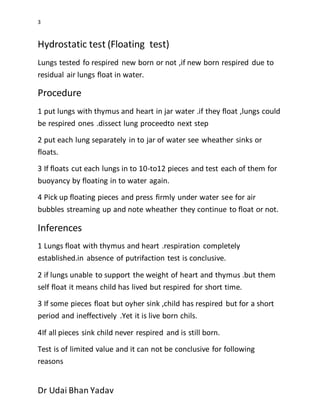
Hydrostatic test (Floating test)
Lungs tested fo respired new born or not ,if new born respired due to
residual air lungs float in water.
Procedure
1 put lungs with thymus and heart in jar water .if they float ,lungs could
be respired ones .dissect lung proceedto next step
2 put each lung separately in to jar of water see wheather sinks or
floats.
3 If floats cut each lungs in to 10-to12 pieces and test each of them for
buoyancy by floating in to water again.
4 Pick up floating pieces and press firmly under water see for air
bubbles streaming up and note wheather they continue to float or not.
Inferences
1 Lungs float with thymus and heart .respiration completely
established.in absence of putrifaction test is conclusive.
2 if lungs unable to support the weight of heart and thymus .but them
self float it means child has lived but respired for short time.
3 If some pieces float but oyher sink ,child has respired but for a short
period and ineffectively .Yet it is live born chils.
4If all pieces sink child never respired and is still born.
Test is of limited value and it can not be conclusive for following
reasons
4
Dr Udai Bhan Yadav
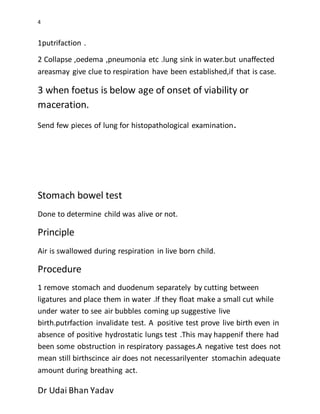
1putrifaction .
2 Collapse ,oedema ,pneumonia etc .lung sink in water.but unaffected
areasmay give clue to respiration have been established,if that is case.
3 when foetus is below age of onset of viability or
maceration.
Send few pieces of lung for histopathological examination.
Stomach bowel test
Done to determine child was alive or not.
Principle
Air is swallowed during respiration in live born child.
Procedure
1 remove stomach and duodenum separately by cutting between
ligatures and place them in water .If they float make a small cut while
under water to see air bubbles coming up suggestive live
birth.putrfaction invalidate test. A positive test prove live birth even in
absence of positive hydrostatic lungs test .This may happenif there had
been some obstruction in respiratory passages.A negative test does not
mean still birthscince air does not necessarilyenter stomachin adequate
amount during breathing act.
5
Dr Udai Bhan Yadav
Other findings of live birth
1 Examine mucus and milk in stomach
2 examine large bowel for meconium and urinary bldder for urine.
3Umbillical vessels examined and preserved for histology.
4 Other organ examined for diseases or injury or asphaxia.
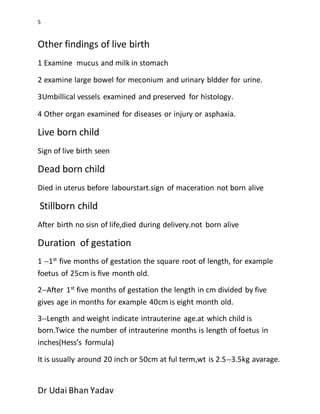
Live born child
Sign of live birth seen
Dead born child
Died in uterus before labourstart.sign of maceration not born alive
Stillborn child
After birth no sisn of life,died during delivery.not born alive
Duration of gestation
1 --1st five months of gestation the square root of length, for example
foetus of 25cm is five month old.
2--After 1st
five months of gestation the length in cm divided by five
gives age in months for example 40cm is eight month old.
3--Length and weight indicate intrauterine age.at which child is
born.Twice the number of intrauterine months is length of foetus in
inches(Hess’s formula)
It is usually around 20 inch or 50cm at ful term,wt is 2.5--3.5kg avarage.
6
Dr Udai Bhan Yadav
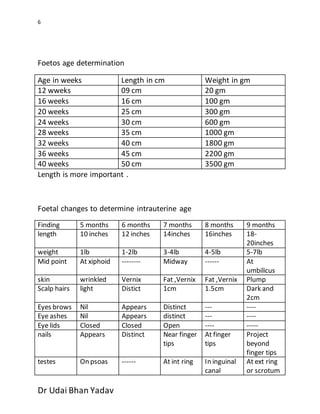
Foetos age determination
Age in weeks Length in cm Weight in gm
12 wweks 09 cm 20 gm
16 weeks 16 cm 100 gm
20 weeks 25 cm 300 gm
24 weeks 30 cm 600 gm
28 weeks 35 cm 1000 gm
32 weeks 40 cm 1800 gm
36 weeks 45 cm 2200 gm
40 weeks 50 cm 3500 gm
Length is more important .
Foetal changes to determine intrauterine age
Finding 5 months 6 months 7 months 8 months 9 months
length 10 inches 12 inches 14inches 16inches 18-
20inches
weight 1lb 1-2lb 3-4lb 4-5lb 5-7lb
Mid point At xiphoid -------- Midway ------ At
umbilicus
skin wrinkled Vernix Fat ,Vernix Fat ,Vernix Plump
Scalp hairs light Distict 1cm 1.5cm Dark and
2cm
Eyes brows Nil Appears Distinct --- ----
Eye ashes Nil Appears distinct --- ----
Eye lids Closed Closed Open ---- -----
nails Appears Distinct Near finger
tips
At finger
tips
Project
beyond
finger tips
testes On psoas ------ At int ring In inguinal
canal
At ext ring
or scrotum
7
Dr Udai Bhan Yadav
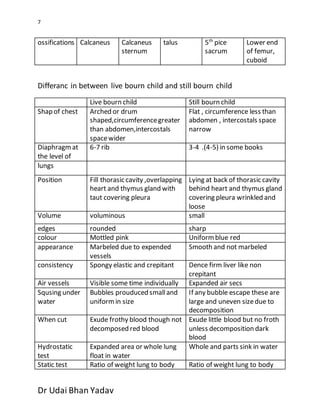
ossifications Calcaneus Calcaneus
sternum
talus 5th
pice
sacrum
Lower end
of femur,
cuboid
Differanc in between live bourn child and still bourn child
Live bourn child Still bourn child
Shap of chest Arched or drum
shaped,circumferencegreater
than abdomen,intercostals
spacewider
Flat , circumference less than
abdomen , intercostals space
narrow
Diaphragm at
the level of
6-7 rib 3-4 .(4-5) in some books
lungs
Position Fill thorasic cavity ,overlapping
heart and thymus gland with
taut covering pleura
Lying at back of thorasic cavity
behind heart and thymus gland
covering pleura wrinkled and
loose
Volume voluminous small
edges rounded sharp
colour Mottled pink Uniformblue red
appearance Marbeled due to expended
vessels
Smooth and not marbeled
consistency Spongy elastic and crepitant Dence firm liver like non
crepitant
Air vessels Visible some time individually Expanded air secs
Squsing under
water
Bubbles prouduced smalland
uniformin size
If any bubble escape these are
large and uneven sizedue to
decomposition
When cut Exude frothy blood though not
decomposed red blood
Exude little blood but no froth
unless decomposition dark
blood
Hydrostatic
test
Expanded area or whole lung
float in water
Whole and parts sink in water
Static test Ratio of weight lung to body Ratio of weight lung to body
8
Dr Udai Bhan Yadav
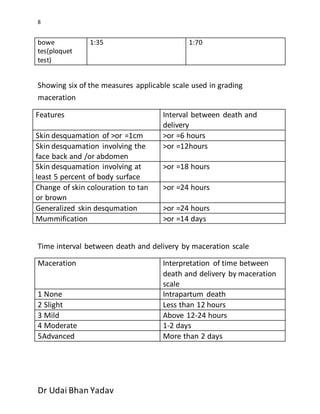
bowe
tes(ploquet
test)
1:35 1:70
Showing six of the measures applicable scale used in grading
maceration
Features Interval between death and
delivery
Skin desquamation of >or =1cm >or =6 hours
Skin desquamation involving the
face back and /or abdomen
>or =12hours
Skin desquamation involving at
least 5 percent of body surface
>or =18 hours
Change of skin colouration to tan
or brown
>or =24 hours
Generalized skin desqumation >or =24 hours
Mummification >or =14 days
Time interval between death and delivery by maceration scale
Maceration Interpretation of time between
death and delivery by maceration
scale
1 None Intrapartum death
2 Slight Less than 12 hours
3 Mild Above 12-24 hours
4 Moderate 1-2 days
5Advanced More than 2 days
9
Dr Udai Bhan Yadav
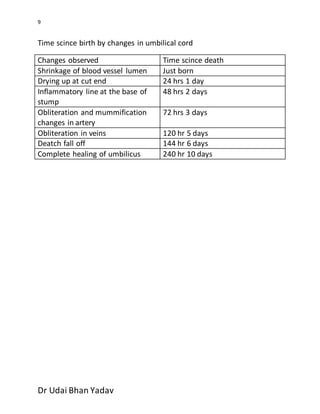
Time scince birth by changes in umbilical cord
Changes observed Time scince death
Shrinkage of blood vessel lumen Just born
Drying up at cut end 24 hrs 1 day
Inflammatory line at the base of
stump
48 hrs 2 days
Obliteration and mummification
changes in artery
72 hrs 3 days
Obliteration in veins 120 hr 5 days
Deatch fall off 144 hr 6 days
Complete healing of umbilicus 240 hr 10 days

Foetal autopsy

  • 1.
    1 Dr Udai BhanYadav Foetal Autopsy We should ascertain following 1 Intrauterine age of foetus 2 Viable or not 3 If viable live born or not 4 If live born ,how long survive 5 Cause and manner of death. External examination Include following 1 Examination of cloth and wrappings for identity. 2 Post mortem changes eg rigor mortis pm lividity decomposition.. 3 Sign of maceration , skin of macerated foetus is coppery red in colour body part flaccid and flattened when placed on table .bones appear to be separated. 4 Umbilical cord tied or torn with sign of inflammation . 5 Placenta attached or not .weight, look for infarct or disease . 5 Sign of maturity 7 Mark of violence around mouth neck head etc 8 Any forign body in mouth and throat
  • 2.
    2 Dr Udai BhanYadav 9 Cynoses in face finger nail. 10 Caput succedaneum over head .when present over head differenciate from cephal-haemotoma . Internal examination On scalp see for brusing of scalp fracture of skull bones site and extent of caput moulding tear in membranes haemorrhage in meninges puncture in anterior fontanelle. Examination of throx and abdomen 1 See level of diaphragm ,position of heart and lungs in situ.2 In mouth larynx and in deeper tissue of neck examine for forign bodies mucous meconeum marks of violence. 3 Ligate trachea halfway to its bifurcation to prevent forign bodies from entering .apply similar ligature to oesophagus to prevent entry or escape of air remove thoracic organmasses by gentle traction. 4 Put whole piece consistening of heart ,thymus and both lungs in tall jar containing water and note wheather it sinks or floats. 5 Look for presence od tardieu’s spots under serous membranes.Open trachea and bronchi and see contents . 6 Remove lungs and heart. Dissect hert ,expose atria and ventricle for congenital anomalies e g atrial septal defect ,persistent ductus arteriosis etc . Examine the lung for weight ,colour ,consistency ,edges presence of distended air cells under pleura crepitations condition like collapse or consolidation .perform floating test at this stage.
  • 3.
    3 Dr Udai BhanYadav Hydrostatic test (Floating test) Lungs tested fo respired new born or not ,if new born respired due to residual air lungs float in water. Procedure 1 put lungs with thymus and heart in jar water .if they float ,lungs could be respired ones .dissect lung proceedto next step 2 put each lung separately in to jar of water see wheather sinks or floats. 3 If floats cut each lungs in to 10-to12 pieces and test each of them for buoyancy by floating in to water again. 4 Pick up floating pieces and press firmly under water see for air bubbles streaming up and note wheather they continue to float or not. Inferences 1 Lungs float with thymus and heart .respiration completely established.in absence of putrifaction test is conclusive. 2 if lungs unable to support the weight of heart and thymus .but them self float it means child has lived but respired for short time. 3 If some pieces float but oyher sink ,child has respired but for a short period and ineffectively .Yet it is live born chils. 4If all pieces sink child never respired and is still born. Test is of limited value and it can not be conclusive for following reasons
  • 4.
    4 Dr Udai BhanYadav 1putrifaction . 2 Collapse ,oedema ,pneumonia etc .lung sink in water.but unaffected areasmay give clue to respiration have been established,if that is case. 3 when foetus is below age of onset of viability or maceration. Send few pieces of lung for histopathological examination. Stomach bowel test Done to determine child was alive or not. Principle Air is swallowed during respiration in live born child. Procedure 1 remove stomach and duodenum separately by cutting between ligatures and place them in water .If they float make a small cut while under water to see air bubbles coming up suggestive live birth.putrfaction invalidate test. A positive test prove live birth even in absence of positive hydrostatic lungs test .This may happenif there had been some obstruction in respiratory passages.A negative test does not mean still birthscince air does not necessarilyenter stomachin adequate amount during breathing act.
  • 5.
    5 Dr Udai BhanYadav Other findings of live birth 1 Examine mucus and milk in stomach 2 examine large bowel for meconium and urinary bldder for urine. 3Umbillical vessels examined and preserved for histology. 4 Other organ examined for diseases or injury or asphaxia. Live born child Sign of live birth seen Dead born child Died in uterus before labourstart.sign of maceration not born alive Stillborn child After birth no sisn of life,died during delivery.not born alive Duration of gestation 1 --1st five months of gestation the square root of length, for example foetus of 25cm is five month old. 2--After 1st five months of gestation the length in cm divided by five gives age in months for example 40cm is eight month old. 3--Length and weight indicate intrauterine age.at which child is born.Twice the number of intrauterine months is length of foetus in inches(Hess’s formula) It is usually around 20 inch or 50cm at ful term,wt is 2.5--3.5kg avarage.
  • 6.
    6 Dr Udai BhanYadav Foetos age determination Age in weeks Length in cm Weight in gm 12 wweks 09 cm 20 gm 16 weeks 16 cm 100 gm 20 weeks 25 cm 300 gm 24 weeks 30 cm 600 gm 28 weeks 35 cm 1000 gm 32 weeks 40 cm 1800 gm 36 weeks 45 cm 2200 gm 40 weeks 50 cm 3500 gm Length is more important . Foetal changes to determine intrauterine age Finding 5 months 6 months 7 months 8 months 9 months length 10 inches 12 inches 14inches 16inches 18- 20inches weight 1lb 1-2lb 3-4lb 4-5lb 5-7lb Mid point At xiphoid -------- Midway ------ At umbilicus skin wrinkled Vernix Fat ,Vernix Fat ,Vernix Plump Scalp hairs light Distict 1cm 1.5cm Dark and 2cm Eyes brows Nil Appears Distinct --- ---- Eye ashes Nil Appears distinct --- ---- Eye lids Closed Closed Open ---- ----- nails Appears Distinct Near finger tips At finger tips Project beyond finger tips testes On psoas ------ At int ring In inguinal canal At ext ring or scrotum
  • 7.
    7 Dr Udai BhanYadav ossifications Calcaneus Calcaneus sternum talus 5th pice sacrum Lower end of femur, cuboid Differanc in between live bourn child and still bourn child Live bourn child Still bourn child Shap of chest Arched or drum shaped,circumferencegreater than abdomen,intercostals spacewider Flat , circumference less than abdomen , intercostals space narrow Diaphragm at the level of 6-7 rib 3-4 .(4-5) in some books lungs Position Fill thorasic cavity ,overlapping heart and thymus gland with taut covering pleura Lying at back of thorasic cavity behind heart and thymus gland covering pleura wrinkled and loose Volume voluminous small edges rounded sharp colour Mottled pink Uniformblue red appearance Marbeled due to expended vessels Smooth and not marbeled consistency Spongy elastic and crepitant Dence firm liver like non crepitant Air vessels Visible some time individually Expanded air secs Squsing under water Bubbles prouduced smalland uniformin size If any bubble escape these are large and uneven sizedue to decomposition When cut Exude frothy blood though not decomposed red blood Exude little blood but no froth unless decomposition dark blood Hydrostatic test Expanded area or whole lung float in water Whole and parts sink in water Static test Ratio of weight lung to body Ratio of weight lung to body
  • 8.
    8 Dr Udai BhanYadav bowe tes(ploquet test) 1:35 1:70 Showing six of the measures applicable scale used in grading maceration Features Interval between death and delivery Skin desquamation of >or =1cm >or =6 hours Skin desquamation involving the face back and /or abdomen >or =12hours Skin desquamation involving at least 5 percent of body surface >or =18 hours Change of skin colouration to tan or brown >or =24 hours Generalized skin desqumation >or =24 hours Mummification >or =14 days Time interval between death and delivery by maceration scale Maceration Interpretation of time between death and delivery by maceration scale 1 None Intrapartum death 2 Slight Less than 12 hours 3 Mild Above 12-24 hours 4 Moderate 1-2 days 5Advanced More than 2 days
  • 9.
    9 Dr Udai BhanYadav Time scince birth by changes in umbilical cord Changes observed Time scince death Shrinkage of blood vessel lumen Just born Drying up at cut end 24 hrs 1 day Inflammatory line at the base of stump 48 hrs 2 days Obliteration and mummification changes in artery 72 hrs 3 days Obliteration in veins 120 hr 5 days Deatch fall off 144 hr 6 days Complete healing of umbilicus 240 hr 10 days