Month: JUNE
ICAO: INTERNATIONAL CIVIL
AVIATION ORGANISATION.
ICAO Rules and Regulations in Airline Industry
And ICAO Annexes.
2020
Aviation Assignment No: 1
Made and Presented By: Pournima Patil
“76 Years of
Connecting the World”
ICAO
2
• ICAO stands for International Civil Aviation Organization.
• ICAO is a specialized agency of the United Nations. It changes the principles and techniques of
international air navigation and fosters the planning and development of international air
transport to ensure safe and orderly growth.
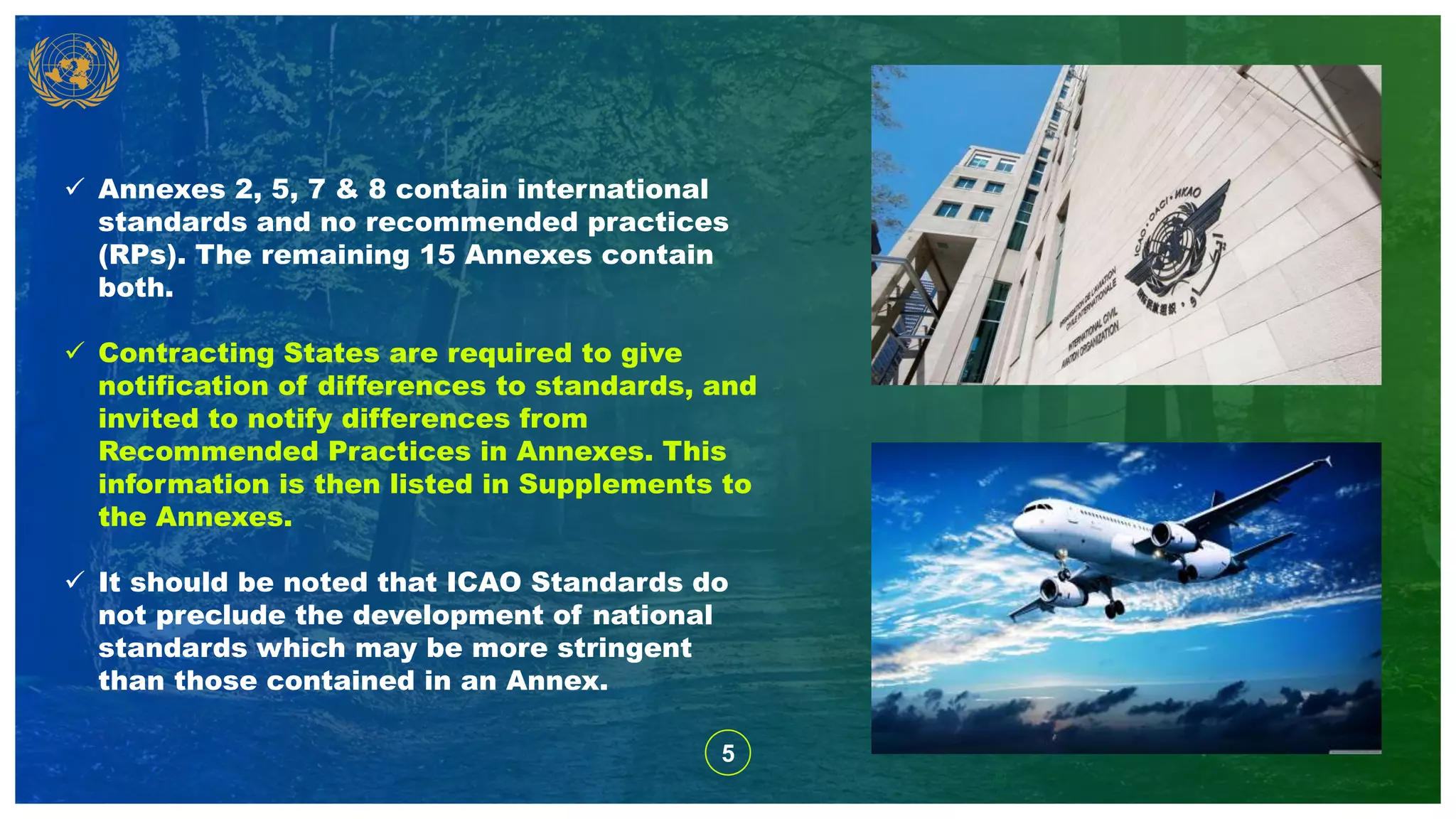
• Its headquarters is located in the Quartier International of Montreal, Quebec, Canada.
• The ICAO Council adopts standards and recommended practices concerning air navigation, its
infrastructure, flight inspection, prevention of unlawful interference, and facilitation of border-
crossing procedures for international civil aviation.
• ICAO defines the protocols for air accident investigation that are followed by transport safety
authorities in countries signatory to the Chicago Convention on International Civil Aviation.
INTRODUCTION TO ICAO.
Before moving on to the topic lets Understand who or what is ICAO.
Now as we have
known about ICAO
let's move on to
the topic.
ICAO: Annexes.
Introduction
• ICAO SARPS (Standards and
Recommended Practices) for each
area of ICAO responsibility are
contained in 19 Annexes.
• Each Annex deals with a particular
subject area. All are subject to regular
amendment and the detail in respect
of many of them is contained in
publications in the numbered ICAO
Document Series.
ADD A FOOTER 3
4
The ICAO
Annexes.
• Annex 1 - Personnel Licensing
• Annex 2 - Rules of the Air
• Annex 3 - Meteorological Services
• Annex 4 - Aeronautical Charts
• Annex 5 - Units of Measurement
• Annex 6 - Operation of Aircraft
• Annex 7 - Aircraft Nationality and
Registration Marks
• Annex 8 - Airworthiness of Aircraft
• Annex 9 - Facilitation
• Annex 10 - Aeronautical Telecommunications
• Annex 11 - Air Traffic Services
• Annex 12 - Search and Rescue
• Annex 13 - Aircraft Accident and Incident
Investigation
• Annex 14 - Aerodromes
Now taking about the ICAO annexes there are a Total of 19
Annexes and they are as follows-
• Annex 15 - Aeronautical Information Services
• Annex 16 - Environmental Protection
• Annex 17 - Security
• Annex 18 - The Safe Transportation of Dangerous
Goods by Air
• Annex 19 - Safety Management
5
 Annexes 2, 5, 7 & 8 contain international
standards and no recommended practices
(RPs). The remaining 15 Annexes contain
both.
 Contracting States are required to give
notification of differences to standards, and
invited to notify differences from
Recommended Practices in Annexes. This
information is then listed in Supplements to
the Annexes.
 It should be noted that ICAO Standards do
not preclude the development of national
standards which may be more stringent
than those contained in an Annex.
ICAO: RULES AND
REGULATIONS IN AIRLINE
INDUSTRY
6
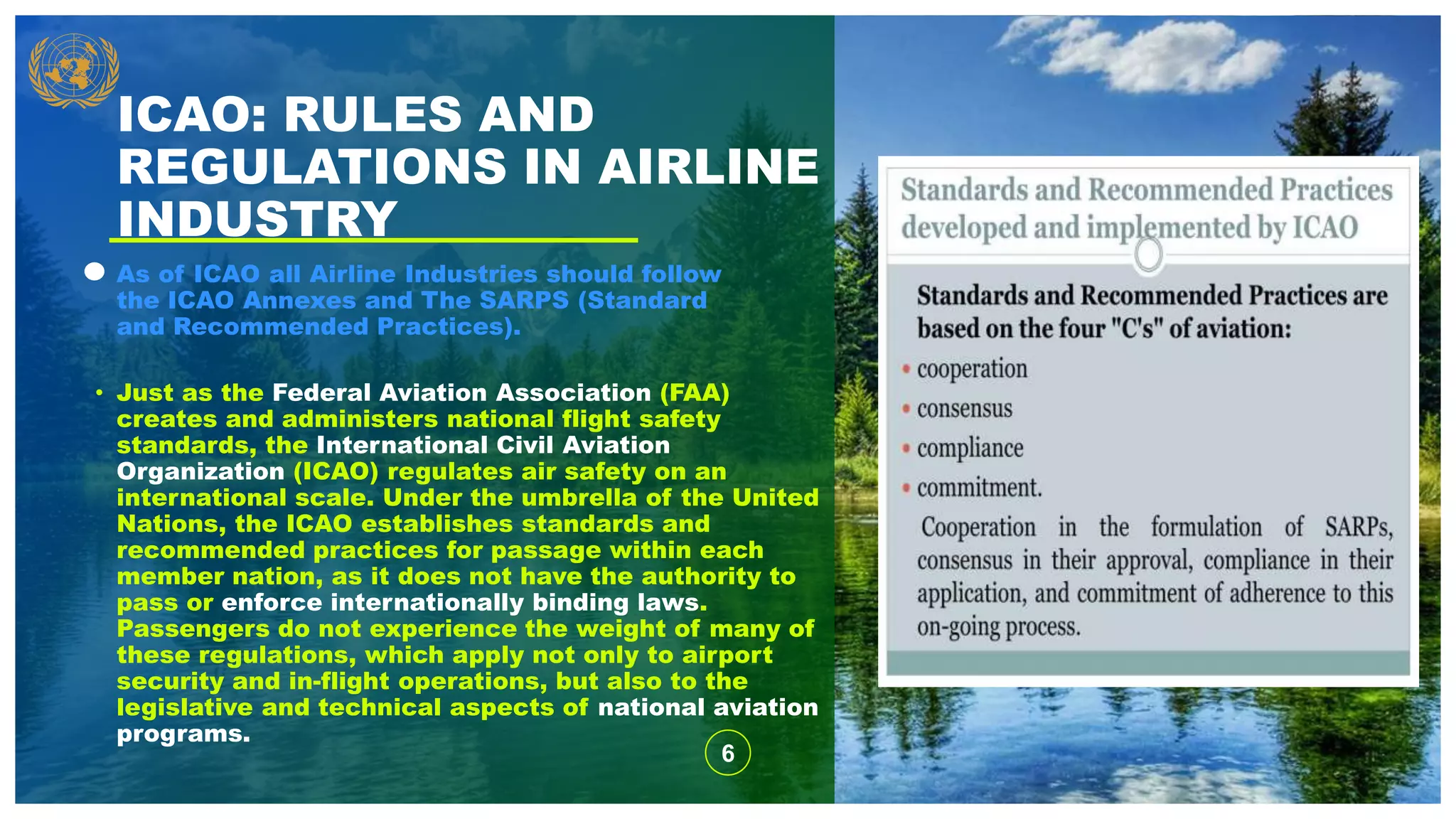
As of ICAO all Airline Industries should follow
the ICAO Annexes and The SARPS (Standard
and Recommended Practices).
• Just as the Federal Aviation Association (FAA)
creates and administers national flight safety
standards, the International Civil Aviation
Organization (ICAO) regulates air safety on an
international scale. Under the umbrella of the United
Nations, the ICAO establishes standards and
recommended practices for passage within each
member nation, as it does not have the authority to
pass or enforce internationally binding laws.
Passengers do not experience the weight of many of
these regulations, which apply not only to airport
security and in-flight operations, but also to the
legislative and technical aspects of national aviation
programs.
7
The Earliest International Aviation Regulations
The ICAO and many rudimentary international
aviation regulations grew out of the 1944
Convention on International Civil Aviation,
commonly called the Chicago Convention. Before
this accord, no unified guidelines regulated air
travel; each country followed its own set of
security and operating procedures. Most
importantly, this accord allowed member nations
to pass through one another's airspace and bound
aircraft to comply with the flight and customs
regulations of the nations they passed through.
These wide-reaching provisions covered issues
ranging from effective disease contamination
measures to radio navigation practices to
airplane marking procedures.
8
The international flight regulations that garner the
attention of press and passengers primarily revolve
around security concerns, particularly following the
events of September 11, 2001 in New York City.
Though security procedures can vary to some
degree from airport to airport, certain airport
security regulations are enforced throughout the
world. While metal detectors have become
overshadowed by increasingly invasive body-
scanning techniques in parts of the Western world,
at time of publication, the basic metal detector
remains a requirement for international aviation
compliance, whether you are flying from Dallas,
Texas or Dhaka, Bangladesh. In the same manner,
the restrictions on liquid items in carry-ons
instituted following an foiled terrorist plot in 2005,
are carried out in internationally compliant airports
throughout the world.
International Security
Regulations
Legislative and Licensing
Rules
9
Passengers do not experience the weight of many
of the international aviation regulations, which go
on behind the scenes of the consumer aviation
industry.
• Safety is one of the three prime occupations
of the ICAO, along with security
and environmental protection. To ensure the
world-wide airline industry operates as
safely and sustainable as possible, the
organization sets standards for the legal
aspects of air travel, including requirements
for pilot, technician and airline licensing,
and the engineering and operation of
aircraft, from emission standards to
maintenance requirements.
International Aviation Safety
Assessments Program
10
• When you hear that a particular country's airlines
have been blacklisted or prohibited from flying into
Europe or the U.S., they have most likely failed
their International Aviation Safety Assessment
(IASA).
• Decided on a country-wide level, not an individual
airline basis, IASAs grade a nation's aviation
program on a wide variety of levels, ranging from
certification requirements and oversight, civilian
aviation authority organization and safety record,
technical training and guidance and national
aviation legislation.
• As the ICAO primarily sets industry standards, as
opposed to enforcing them, the International
Aviation Safety Assessments are actually
administered by the American FAA.
11
CONCLUSION
• If we talk about the ICAO rules and
regulation to airline industries there are
an end no. Of rules and regulations that an
airline or airline industry should follow.
• The primary motive of ICAO is to ensure a
safe and secure air transportation. Every
airline or airline industry should
mandatorily follow the 19 annexes as well
as the SARPS.
• ICAOs structure supports its mission
and objectives.
• Articles 28 and 28 are the backbone
of ICAO works.
• ICAO documents are extensive and
includes Annexes, PANS, manuals and
circulars.
• ICAO coordinates the definition of
safety metrics and identity related
data requirements.
12
Bibliography
PAGE NO: 2 https://en.wikipedia.org/wiki/International_Civil_Aviation_Organization
PAGE NO: 3 https://www.skybrary.aero/index.php/ICAO_Annexes_and_Doc_Series
PAGE NO: 4 https://www.skybrary.aero/index.php/ICAO_Annexes_and_Doc_Series
PAGE NO: 5 https://www.skybrary.aero/index.php/ICAO_Annexes_and_Doc_Series
PAGE NO: 6 https://traveltips.usatoday.com/international-flight-rules-regulations-
100658.html
PAGE NO: 7 https://traveltips.usatoday.com/international-flight-rules-regulations-
100658.html
PAGE NO: 8 https://traveltips.usatoday.com/international-flight-rules-regulations-
100658.html
PAGE NO: 9 https://traveltips.usatoday.com/international-flight-rules-regulations-
100658.html
PAGE NO: 10 https://traveltips.usatoday.com/international-flight-rules-regulations-
100658.html
PAGE
NO: 11 https://www.google.com/search? q=CONCLUSION+ON+ICAO&rlz=1C1CHBF_enIN8
29IN829&source=lnms&tbm=isch&sa=X&ved=2ahUKEwjGkryPq5PqAhU47HMBHcJ8AwMQ_
AUoAnoECAwQBA&biw=1366&bih=608#imgrc=pTkLxS2K5H5mCM
THANK YOU...
# LET'S HAVE FUN WITH AVIATION.
# STAY HOME! STAY STRONG! STAY SAFE!
Made and Presented By: Pournima Patil

ICAO Rules and Regulations in Airline Industry And ICAO Annexes

  • 1.
    Month: JUNE ICAO: INTERNATIONALCIVIL AVIATION ORGANISATION. ICAO Rules and Regulations in Airline Industry And ICAO Annexes. 2020 Aviation Assignment No: 1 Made and Presented By: Pournima Patil “76 Years of Connecting the World” ICAO
  • 2.
    2 • ICAO standsfor International Civil Aviation Organization. • ICAO is a specialized agency of the United Nations. It changes the principles and techniques of international air navigation and fosters the planning and development of international air transport to ensure safe and orderly growth. • Its headquarters is located in the Quartier International of Montreal, Quebec, Canada. • The ICAO Council adopts standards and recommended practices concerning air navigation, its infrastructure, flight inspection, prevention of unlawful interference, and facilitation of border- crossing procedures for international civil aviation. • ICAO defines the protocols for air accident investigation that are followed by transport safety authorities in countries signatory to the Chicago Convention on International Civil Aviation. INTRODUCTION TO ICAO. Before moving on to the topic lets Understand who or what is ICAO. Now as we have known about ICAO let's move on to the topic.
  • 3.
    ICAO: Annexes. Introduction • ICAOSARPS (Standards and Recommended Practices) for each area of ICAO responsibility are contained in 19 Annexes. • Each Annex deals with a particular subject area. All are subject to regular amendment and the detail in respect of many of them is contained in publications in the numbered ICAO Document Series. ADD A FOOTER 3
  • 4.
    4 The ICAO Annexes. • Annex1 - Personnel Licensing • Annex 2 - Rules of the Air • Annex 3 - Meteorological Services • Annex 4 - Aeronautical Charts • Annex 5 - Units of Measurement • Annex 6 - Operation of Aircraft • Annex 7 - Aircraft Nationality and Registration Marks • Annex 8 - Airworthiness of Aircraft • Annex 9 - Facilitation • Annex 10 - Aeronautical Telecommunications • Annex 11 - Air Traffic Services • Annex 12 - Search and Rescue • Annex 13 - Aircraft Accident and Incident Investigation • Annex 14 - Aerodromes Now taking about the ICAO annexes there are a Total of 19 Annexes and they are as follows- • Annex 15 - Aeronautical Information Services • Annex 16 - Environmental Protection • Annex 17 - Security • Annex 18 - The Safe Transportation of Dangerous Goods by Air • Annex 19 - Safety Management
  • 5.
    5  Annexes 2,5, 7 & 8 contain international standards and no recommended practices (RPs). The remaining 15 Annexes contain both.  Contracting States are required to give notification of differences to standards, and invited to notify differences from Recommended Practices in Annexes. This information is then listed in Supplements to the Annexes.  It should be noted that ICAO Standards do not preclude the development of national standards which may be more stringent than those contained in an Annex.
  • 6.
    ICAO: RULES AND REGULATIONSIN AIRLINE INDUSTRY 6 As of ICAO all Airline Industries should follow the ICAO Annexes and The SARPS (Standard and Recommended Practices). • Just as the Federal Aviation Association (FAA) creates and administers national flight safety standards, the International Civil Aviation Organization (ICAO) regulates air safety on an international scale. Under the umbrella of the United Nations, the ICAO establishes standards and recommended practices for passage within each member nation, as it does not have the authority to pass or enforce internationally binding laws. Passengers do not experience the weight of many of these regulations, which apply not only to airport security and in-flight operations, but also to the legislative and technical aspects of national aviation programs.
  • 7.
    7 The Earliest InternationalAviation Regulations The ICAO and many rudimentary international aviation regulations grew out of the 1944 Convention on International Civil Aviation, commonly called the Chicago Convention. Before this accord, no unified guidelines regulated air travel; each country followed its own set of security and operating procedures. Most importantly, this accord allowed member nations to pass through one another's airspace and bound aircraft to comply with the flight and customs regulations of the nations they passed through. These wide-reaching provisions covered issues ranging from effective disease contamination measures to radio navigation practices to airplane marking procedures.
  • 8.
    8 The international flightregulations that garner the attention of press and passengers primarily revolve around security concerns, particularly following the events of September 11, 2001 in New York City. Though security procedures can vary to some degree from airport to airport, certain airport security regulations are enforced throughout the world. While metal detectors have become overshadowed by increasingly invasive body- scanning techniques in parts of the Western world, at time of publication, the basic metal detector remains a requirement for international aviation compliance, whether you are flying from Dallas, Texas or Dhaka, Bangladesh. In the same manner, the restrictions on liquid items in carry-ons instituted following an foiled terrorist plot in 2005, are carried out in internationally compliant airports throughout the world. International Security Regulations
  • 9.
    Legislative and Licensing Rules 9 Passengersdo not experience the weight of many of the international aviation regulations, which go on behind the scenes of the consumer aviation industry. • Safety is one of the three prime occupations of the ICAO, along with security and environmental protection. To ensure the world-wide airline industry operates as safely and sustainable as possible, the organization sets standards for the legal aspects of air travel, including requirements for pilot, technician and airline licensing, and the engineering and operation of aircraft, from emission standards to maintenance requirements.
  • 10.
    International Aviation Safety AssessmentsProgram 10 • When you hear that a particular country's airlines have been blacklisted or prohibited from flying into Europe or the U.S., they have most likely failed their International Aviation Safety Assessment (IASA). • Decided on a country-wide level, not an individual airline basis, IASAs grade a nation's aviation program on a wide variety of levels, ranging from certification requirements and oversight, civilian aviation authority organization and safety record, technical training and guidance and national aviation legislation. • As the ICAO primarily sets industry standards, as opposed to enforcing them, the International Aviation Safety Assessments are actually administered by the American FAA.
  • 11.
    11 CONCLUSION • If wetalk about the ICAO rules and regulation to airline industries there are an end no. Of rules and regulations that an airline or airline industry should follow. • The primary motive of ICAO is to ensure a safe and secure air transportation. Every airline or airline industry should mandatorily follow the 19 annexes as well as the SARPS. • ICAOs structure supports its mission and objectives. • Articles 28 and 28 are the backbone of ICAO works. • ICAO documents are extensive and includes Annexes, PANS, manuals and circulars. • ICAO coordinates the definition of safety metrics and identity related data requirements.
  • 12.
    12 Bibliography PAGE NO: 2https://en.wikipedia.org/wiki/International_Civil_Aviation_Organization PAGE NO: 3 https://www.skybrary.aero/index.php/ICAO_Annexes_and_Doc_Series PAGE NO: 4 https://www.skybrary.aero/index.php/ICAO_Annexes_and_Doc_Series PAGE NO: 5 https://www.skybrary.aero/index.php/ICAO_Annexes_and_Doc_Series PAGE NO: 6 https://traveltips.usatoday.com/international-flight-rules-regulations- 100658.html PAGE NO: 7 https://traveltips.usatoday.com/international-flight-rules-regulations- 100658.html PAGE NO: 8 https://traveltips.usatoday.com/international-flight-rules-regulations- 100658.html PAGE NO: 9 https://traveltips.usatoday.com/international-flight-rules-regulations- 100658.html PAGE NO: 10 https://traveltips.usatoday.com/international-flight-rules-regulations- 100658.html PAGE NO: 11 https://www.google.com/search? q=CONCLUSION+ON+ICAO&rlz=1C1CHBF_enIN8 29IN829&source=lnms&tbm=isch&sa=X&ved=2ahUKEwjGkryPq5PqAhU47HMBHcJ8AwMQ_ AUoAnoECAwQBA&biw=1366&bih=608#imgrc=pTkLxS2K5H5mCM
  • 13.
    THANK YOU... # LET'SHAVE FUN WITH AVIATION. # STAY HOME! STAY STRONG! STAY SAFE! Made and Presented By: Pournima Patil