Presentation on:
Mergers and Acquisitions
1
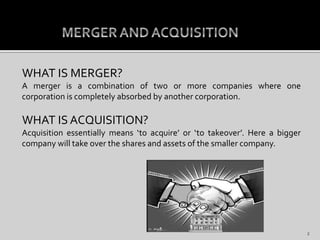
WHAT IS MERGER?
A merger is a combination of two or more companies where one
corporation is completely absorbed by another corporation.
WHAT IS ACQUISITION?
Acquisition essentially means ‘to acquire’ or ‘to takeover’. Here a bigger
company will take over the shares and assets of the smaller company.
2
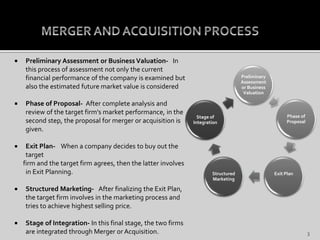
 Preliminary Assessment or Business Valuation- In
this process of assessment not only the current
financial performance of the company is examined but
also the estimated future market value is considered
 Phase of Proposal- After complete analysis and
review of the target firm's market performance, in the
second step, the proposal for merger or acquisition is
given.
 Exit Plan- When a company decides to buy out the
target
firm and the target firm agrees, then the latter involves
in Exit Planning.
 Structured Marketing- After finalizing the Exit Plan,
the target firm involves in the marketing process and
tries to achieve highest selling price.
 Stage of Integration- In this final stage, the two firms
are integrated through Merger or Acquisition.
Preliminary
Assessment
or Business
Valuation
Phase of
Proposal
Exit PlanStructured
Marketing
Stage of
Integration
3
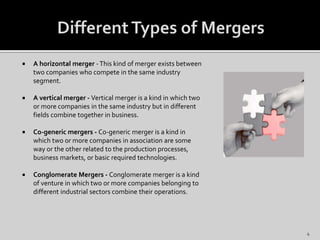
 A horizontal merger -This kind of merger exists between
two companies who compete in the same industry
segment.
 A vertical merger - Vertical merger is a kind in which two
or more companies in the same industry but in different
fields combine together in business.
 Co-generic mergers - Co-generic merger is a kind in
which two or more companies in association are some
way or the other related to the production processes,
business markets, or basic required technologies.
 Conglomerate Mergers - Conglomerate merger is a kind
of venture in which two or more companies belonging to
different industrial sectors combine their operations.
4
 Friendly acquisition - Both the companies approve of
the acquisition under friendly terms.
 Reverse acquisition - A private company takes over a
public company.
 Back flip acquisition- A very rare case of acquisition in
which, the purchasing company becomes a subsidiary of
the purchased company.
 Hostile acquisition - Here, as the name suggests, the
entire process is done by force.
5
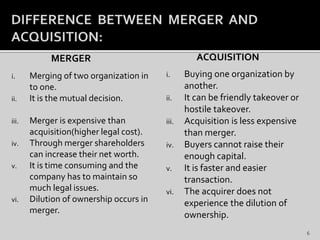
MERGER
i. Merging of two organization in
to one.
ii. It is the mutual decision.
iii. Merger is expensive than
acquisition(higher legal cost).
iv. Through merger shareholders
can increase their net worth.
v. It is time consuming and the
company has to maintain so
much legal issues.
vi. Dilution of ownership occurs in
merger.
ACQUISITION
i. Buying one organization by
another.
ii. It can be friendly takeover or
hostile takeover.
iii. Acquisition is less expensive
than merger.
iv. Buyers cannot raise their
enough capital.
v. It is faster and easier
transaction.
vi. The acquirer does not
experience the dilution of
ownership.
6
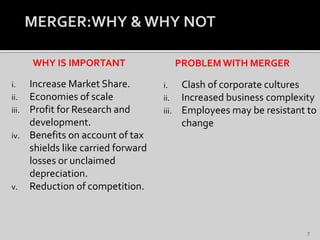
WHY IS IMPORTANT
i. Increase Market Share.
ii. Economies of scale
iii. Profit for Research and
development.
iv. Benefits on account of tax
shields like carried forward
losses or unclaimed
depreciation.
v. Reduction of competition.
PROBLEMWITH MERGER
i. Clash of corporate cultures
ii. Increased business complexity
iii. Employees may be resistant to
change
7
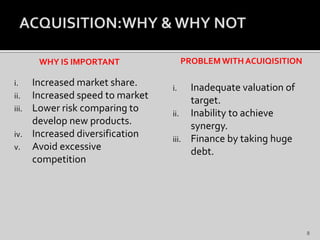
WHY IS IMPORTANT
i. Increased market share.
ii. Increased speed to market
iii. Lower risk comparing to
develop new products.
iv. Increased diversification
v. Avoid excessive
competition
PROBLEMWITH ACUIQISITION
i. Inadequate valuation of
target.
ii. Inability to achieve
synergy.
iii. Finance by taking huge
debt.
8
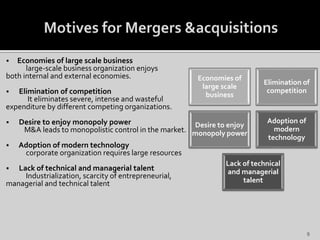
 Economies of large scale business
large-scale business organization enjoys
both internal and external economies.
 Elimination of competition
It eliminates severe, intense and wasteful
expenditure by different competing organizations.
 Desire to enjoy monopoly power
M&A leads to monopolistic control in the market.
 Adoption of modern technology
corporate organization requires large resources
 Lack of technical and managerial talent
Industrialization, scarcity of entrepreneurial,
managerial and technical talent
Economies of
large scale
business
Elimination of
competition
Desire to enjoy
monopoly power
Adoption of
modern
technology
Lack of technical
and managerial
talent
9
 GreaterValue Generation.
Mergers and acquisitions generally succeed in generating cost efficiency through the
implementation of economies of scale. It is expected that the shareholder value of a firm after
mergers or acquisitions.
 Gaining Cost Efficiency.
When two companies come together by merger or acquisition, the joint company benefits
in terms of cost efficiency.As the two firms form a new and bigger company, the production is
done on a much larger scale.
 Increase in market share - An increase in market share is one of the plausible benefits of
mergers and acquisitions.
 Gain higher competitiveness -The new firm is usually
more cost-efficient and competitive as compared to its
financially weak parent organization.
10
 Integration difficulties
 Large or extraordinary debt
 Managers overly focused on acquisitions
 Overly Diversified
11
 Employees:
Mergers and acquisitions impact the employees or the workers the most. It is a well known fact that
whenever there is a merger or an acquisition, there are bound to be lay offs.
 Impact of mergers and acquisitions on top level management
Impact of mergers and acquisitions on top level management may actually involve a "clash of the
egos".There might be variations in the cultures of the two organizations.
 Shareholders of the acquired firm:
The shareholders of the acquired company benefit the most.The reason being, it is seen in majority of
the cases that the acquiring company usually pays a little excess than it what should. Unless a man
lives in a house he has recently bought, he will not be able to know its drawbacks.
 Shareholders of the acquiring firm: hey are most affected. If we measure the benefits enjoyed by the
shareholders of the acquired company in degrees, the degree to which they were benefited, by the
same degree, these shareholders are harmed
12
 Then there is an important need to assess the market by deciding
the growth factors through future market opportunities, recent
trends, and customer's feedback.
 The integration process should be taken in line with consent of the
management from both the companies venturing into the merger.
 Restructuring plans and future parameters should be decided with
exchange of information and knowledge from both ends.
13
14
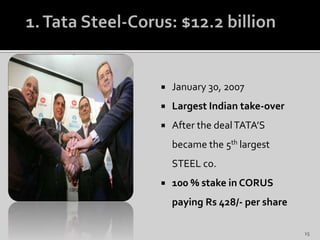
 January 30, 2007
 Largest Indian take-over
 After the dealTATA’S
became the 5th largest
STEEL co.
 100 % stake in CORUS
paying Rs 428/- per share
15
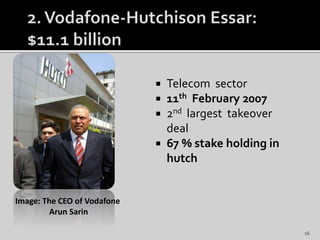
 Telecom sector
 11th February 2007
 2nd largest takeover
deal
 67 % stake holding in
hutch
Image: The CEO of Vodafone
Arun Sarin
16
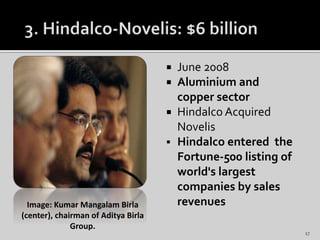
 June 2008
 Aluminium and
copper sector
 Hindalco Acquired
Novelis
 Hindalco entered the
Fortune-500 listing of
world's largest
companies by sales
revenuesImage: Kumar Mangalam Birla
(center), chairman of Aditya Birla
Group.
17
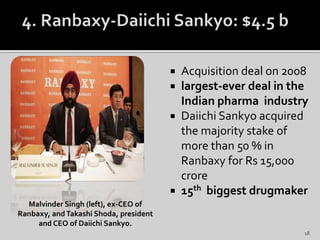
 Acquisition deal on 2008
 largest-ever deal in the
Indian pharma industry
 Daiichi Sankyo acquired
the majority stake of
more than 50 % in
Ranbaxy for Rs 15,000
crore
 15th biggest drugmaker
Malvinder Singh (left), ex-CEO of
Ranbaxy, andTakashi Shoda, president
and CEO of Daiichi Sankyo.
18
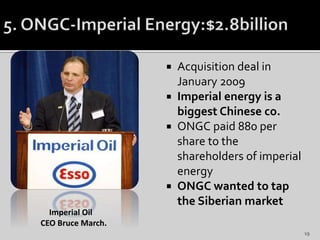
 Acquisition deal in
January 2009
 Imperial energy is a
biggest Chinese co.
 ONGC paid 880 per
share to the
shareholders of imperial
energy
 ONGC wanted to tap
the Siberian market
Imperial Oil
CEO Bruce March.
19
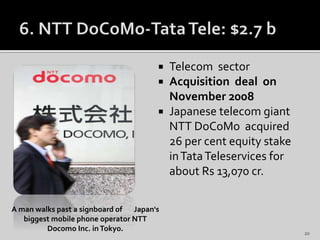
 Telecom sector
 Acquisition deal on
November 2008
 Japanese telecom giant
NTT DoCoMo acquired
26 per cent equity stake
inTataTeleservices for
about Rs 13,070 cr.
A man walks past a signboard of Japan's
biggest mobile phone operator NTT
Docomo Inc. inTokyo. 20
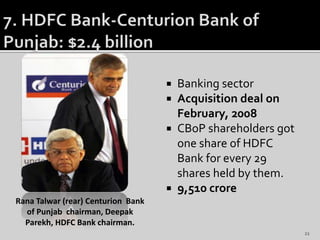
 Banking sector
 Acquisition deal on
February, 2008
 CBoP shareholders got
one share of HDFC
Bank for every 29
shares held by them.
 9,510 crore
Rana Talwar (rear) Centurion Bank
of Punjab chairman, Deepak
Parekh, HDFC Bank chairman.
21
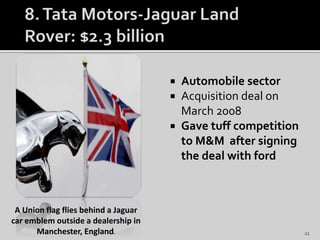
 Automobile sector
 Acquisition deal on
March 2008
 Gave tuff competition
to M&M after signing
the deal with ford
A Union flag flies behind a Jaguar
car emblem outside a dealership in
Manchester, England. 22
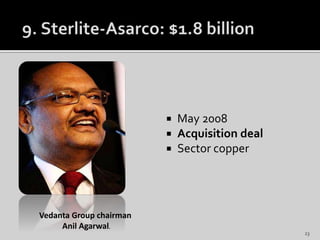
 May 2008
 Acquisition deal
 Sector copper
Vedanta Group chairman
Anil Agarwal.
23
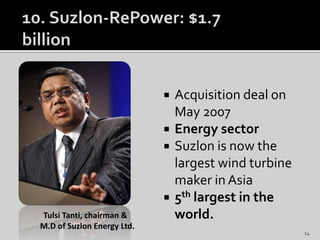
 Acquisition deal on
May 2007
 Energy sector
 Suzlon is now the
largest wind turbine
maker in Asia
 5th largest in the
world.Tulsi Tanti, chairman &
M.D of Suzlon Energy Ltd.
24
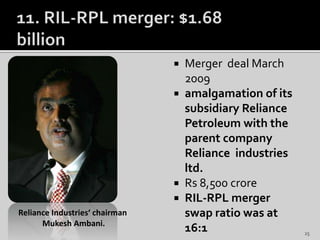
 Merger deal March
2009
 amalgamation of its
subsidiary Reliance
Petroleum with the
parent company
Reliance industries
ltd.
 Rs 8,500 crore
 RIL-RPL merger
swap ratio was at
16:1
Reliance Industries‘ chairman
Mukesh Ambani.
25
 Dynamic government policies
 Corporate investments in industry
 Economic stability
 “Ready to experiment” attitude of
Indian industrialists
26
27
28
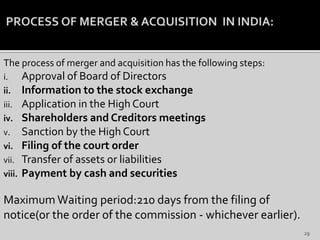
The process of merger and acquisition has the following steps:
i. Approval of Board of Directors
ii. Information to the stock exchange
iii. Application in the High Court
iv. Shareholders and Creditors meetings
v. Sanction by the High Court
vi. Filing of the court order
vii. Transfer of assets or liabilities
viii. Payment by cash and securities
Maximum Waiting period:210 days from the filing of
notice(or the order of the commission - whichever earlier).
29
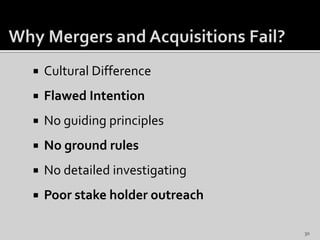
 Cultural Difference
 Flawed Intention
 No guiding principles
 No ground rules
 No detailed investigating
 Poor stake holder outreach
30
 Continuous communication – employees, stakeholders,
customers, suppliers and government leaders.
 Transparency in managers operations
 Capacity to meet new culture higher management
professionals must be ready to greet a new or modified
culture.
 Talent management by the management
31
 The merger coincided with a flurry of increased domestic and international
competition.
 Weak management and organization structure.
 More attention to non-core issues such as long term fleet acquisitions and
establishing subsidiaries for ground handling and maintenance, than to
addressing the state of the flying business.
 Bloated workforce
 Unproductive work practices
 Political impediments to shedding staff
32
 Learn from mistakes of others
 Define your objectives clearly
 Complete strategy to achieve goal.
 SWOT analysis for the merged business - a must
 Conservative attitude necessary at evaluation deskstrong arguments to support
project
 Pick holes in strategy to get the best
 Will merged units be able to work at efficient / ideal level?
 Acquire expertise to interpret changes
33
Thank you for your
patience…
34

Merger and acquisition

  • 1.
  • 2.
    WHAT IS MERGER? Amerger is a combination of two or more companies where one corporation is completely absorbed by another corporation. WHAT IS ACQUISITION? Acquisition essentially means ‘to acquire’ or ‘to takeover’. Here a bigger company will take over the shares and assets of the smaller company. 2
  • 3.
     Preliminary Assessmentor Business Valuation- In this process of assessment not only the current financial performance of the company is examined but also the estimated future market value is considered  Phase of Proposal- After complete analysis and review of the target firm's market performance, in the second step, the proposal for merger or acquisition is given.  Exit Plan- When a company decides to buy out the target firm and the target firm agrees, then the latter involves in Exit Planning.  Structured Marketing- After finalizing the Exit Plan, the target firm involves in the marketing process and tries to achieve highest selling price.  Stage of Integration- In this final stage, the two firms are integrated through Merger or Acquisition. Preliminary Assessment or Business Valuation Phase of Proposal Exit PlanStructured Marketing Stage of Integration 3
  • 4.
     A horizontalmerger -This kind of merger exists between two companies who compete in the same industry segment.  A vertical merger - Vertical merger is a kind in which two or more companies in the same industry but in different fields combine together in business.  Co-generic mergers - Co-generic merger is a kind in which two or more companies in association are some way or the other related to the production processes, business markets, or basic required technologies.  Conglomerate Mergers - Conglomerate merger is a kind of venture in which two or more companies belonging to different industrial sectors combine their operations. 4
  • 5.
     Friendly acquisition- Both the companies approve of the acquisition under friendly terms.  Reverse acquisition - A private company takes over a public company.  Back flip acquisition- A very rare case of acquisition in which, the purchasing company becomes a subsidiary of the purchased company.  Hostile acquisition - Here, as the name suggests, the entire process is done by force. 5
  • 6.
    MERGER i. Merging oftwo organization in to one. ii. It is the mutual decision. iii. Merger is expensive than acquisition(higher legal cost). iv. Through merger shareholders can increase their net worth. v. It is time consuming and the company has to maintain so much legal issues. vi. Dilution of ownership occurs in merger. ACQUISITION i. Buying one organization by another. ii. It can be friendly takeover or hostile takeover. iii. Acquisition is less expensive than merger. iv. Buyers cannot raise their enough capital. v. It is faster and easier transaction. vi. The acquirer does not experience the dilution of ownership. 6
  • 7.
    WHY IS IMPORTANT i.Increase Market Share. ii. Economies of scale iii. Profit for Research and development. iv. Benefits on account of tax shields like carried forward losses or unclaimed depreciation. v. Reduction of competition. PROBLEMWITH MERGER i. Clash of corporate cultures ii. Increased business complexity iii. Employees may be resistant to change 7
  • 8.
    WHY IS IMPORTANT i.Increased market share. ii. Increased speed to market iii. Lower risk comparing to develop new products. iv. Increased diversification v. Avoid excessive competition PROBLEMWITH ACUIQISITION i. Inadequate valuation of target. ii. Inability to achieve synergy. iii. Finance by taking huge debt. 8
  • 9.
     Economies oflarge scale business large-scale business organization enjoys both internal and external economies.  Elimination of competition It eliminates severe, intense and wasteful expenditure by different competing organizations.  Desire to enjoy monopoly power M&A leads to monopolistic control in the market.  Adoption of modern technology corporate organization requires large resources  Lack of technical and managerial talent Industrialization, scarcity of entrepreneurial, managerial and technical talent Economies of large scale business Elimination of competition Desire to enjoy monopoly power Adoption of modern technology Lack of technical and managerial talent 9
  • 10.
     GreaterValue Generation. Mergersand acquisitions generally succeed in generating cost efficiency through the implementation of economies of scale. It is expected that the shareholder value of a firm after mergers or acquisitions.  Gaining Cost Efficiency. When two companies come together by merger or acquisition, the joint company benefits in terms of cost efficiency.As the two firms form a new and bigger company, the production is done on a much larger scale.  Increase in market share - An increase in market share is one of the plausible benefits of mergers and acquisitions.  Gain higher competitiveness -The new firm is usually more cost-efficient and competitive as compared to its financially weak parent organization. 10
  • 11.
     Integration difficulties Large or extraordinary debt  Managers overly focused on acquisitions  Overly Diversified 11
  • 12.
     Employees: Mergers andacquisitions impact the employees or the workers the most. It is a well known fact that whenever there is a merger or an acquisition, there are bound to be lay offs.  Impact of mergers and acquisitions on top level management Impact of mergers and acquisitions on top level management may actually involve a "clash of the egos".There might be variations in the cultures of the two organizations.  Shareholders of the acquired firm: The shareholders of the acquired company benefit the most.The reason being, it is seen in majority of the cases that the acquiring company usually pays a little excess than it what should. Unless a man lives in a house he has recently bought, he will not be able to know its drawbacks.  Shareholders of the acquiring firm: hey are most affected. If we measure the benefits enjoyed by the shareholders of the acquired company in degrees, the degree to which they were benefited, by the same degree, these shareholders are harmed 12
  • 13.
     Then thereis an important need to assess the market by deciding the growth factors through future market opportunities, recent trends, and customer's feedback.  The integration process should be taken in line with consent of the management from both the companies venturing into the merger.  Restructuring plans and future parameters should be decided with exchange of information and knowledge from both ends. 13
  • 14.
  • 15.
     January 30,2007  Largest Indian take-over  After the dealTATA’S became the 5th largest STEEL co.  100 % stake in CORUS paying Rs 428/- per share 15
  • 16.
     Telecom sector 11th February 2007  2nd largest takeover deal  67 % stake holding in hutch Image: The CEO of Vodafone Arun Sarin 16
  • 17.
     June 2008 Aluminium and copper sector  Hindalco Acquired Novelis  Hindalco entered the Fortune-500 listing of world's largest companies by sales revenuesImage: Kumar Mangalam Birla (center), chairman of Aditya Birla Group. 17
  • 18.
     Acquisition dealon 2008  largest-ever deal in the Indian pharma industry  Daiichi Sankyo acquired the majority stake of more than 50 % in Ranbaxy for Rs 15,000 crore  15th biggest drugmaker Malvinder Singh (left), ex-CEO of Ranbaxy, andTakashi Shoda, president and CEO of Daiichi Sankyo. 18
  • 19.
     Acquisition dealin January 2009  Imperial energy is a biggest Chinese co.  ONGC paid 880 per share to the shareholders of imperial energy  ONGC wanted to tap the Siberian market Imperial Oil CEO Bruce March. 19
  • 20.
     Telecom sector Acquisition deal on November 2008  Japanese telecom giant NTT DoCoMo acquired 26 per cent equity stake inTataTeleservices for about Rs 13,070 cr. A man walks past a signboard of Japan's biggest mobile phone operator NTT Docomo Inc. inTokyo. 20
  • 21.
     Banking sector Acquisition deal on February, 2008  CBoP shareholders got one share of HDFC Bank for every 29 shares held by them.  9,510 crore Rana Talwar (rear) Centurion Bank of Punjab chairman, Deepak Parekh, HDFC Bank chairman. 21
  • 22.
     Automobile sector Acquisition deal on March 2008  Gave tuff competition to M&M after signing the deal with ford A Union flag flies behind a Jaguar car emblem outside a dealership in Manchester, England. 22
  • 23.
     May 2008 Acquisition deal  Sector copper Vedanta Group chairman Anil Agarwal. 23
  • 24.
     Acquisition dealon May 2007  Energy sector  Suzlon is now the largest wind turbine maker in Asia  5th largest in the world.Tulsi Tanti, chairman & M.D of Suzlon Energy Ltd. 24
  • 25.
     Merger dealMarch 2009  amalgamation of its subsidiary Reliance Petroleum with the parent company Reliance industries ltd.  Rs 8,500 crore  RIL-RPL merger swap ratio was at 16:1 Reliance Industries‘ chairman Mukesh Ambani. 25
  • 26.
     Dynamic governmentpolicies  Corporate investments in industry  Economic stability  “Ready to experiment” attitude of Indian industrialists 26
  • 27.
  • 28.
  • 29.
    The process ofmerger and acquisition has the following steps: i. Approval of Board of Directors ii. Information to the stock exchange iii. Application in the High Court iv. Shareholders and Creditors meetings v. Sanction by the High Court vi. Filing of the court order vii. Transfer of assets or liabilities viii. Payment by cash and securities Maximum Waiting period:210 days from the filing of notice(or the order of the commission - whichever earlier). 29
  • 30.
     Cultural Difference Flawed Intention  No guiding principles  No ground rules  No detailed investigating  Poor stake holder outreach 30
  • 31.
     Continuous communication– employees, stakeholders, customers, suppliers and government leaders.  Transparency in managers operations  Capacity to meet new culture higher management professionals must be ready to greet a new or modified culture.  Talent management by the management 31
  • 32.
     The mergercoincided with a flurry of increased domestic and international competition.  Weak management and organization structure.  More attention to non-core issues such as long term fleet acquisitions and establishing subsidiaries for ground handling and maintenance, than to addressing the state of the flying business.  Bloated workforce  Unproductive work practices  Political impediments to shedding staff 32
  • 33.
     Learn frommistakes of others  Define your objectives clearly  Complete strategy to achieve goal.  SWOT analysis for the merged business - a must  Conservative attitude necessary at evaluation deskstrong arguments to support project  Pick holes in strategy to get the best  Will merged units be able to work at efficient / ideal level?  Acquire expertise to interpret changes 33
  • 34.
    Thank you foryour patience… 34