Multi-Vision
Consultancy
Kristina Rocha Mello
Giovanna Hsu
Ei May Htaik
Kelly To
Jonathan Lloyd
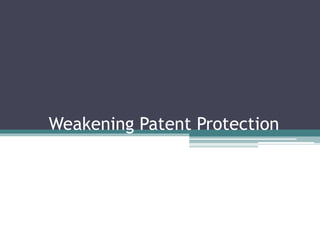
Negative Implied Value of Growth
Pharma 1.0: The Blockbuster Model
• Blockbuster drug: Revenue>$1 billion per year
• Traditional Blockbuster model:
 High sunk cost i.e. Research & Development
 Charge a high premium, as a reward
 Patents provide a crucial period of exclusivity and protection
J, Gordon et al, JP Morgan
Weakening Patent Protection
Weakening Patent protection Challenges
• Widespread availability and issuance of generics
Cheaper, due to absence of R&D costs
• Increase in patents being challenged by
1. generic manufacturers
Due to increase in demand for generics from cost
constrained healthcare providers.
2. developing countries
Struggle to afford the prices, and therefore exert pressure
on pharmaceutical companies
• There isn’t an inexhaustible supply of potential
blockbusters to sustain revenue streams once
existing patents expire.
GSK’s Patent strategy
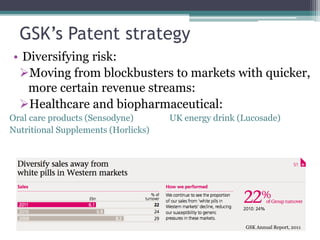
• Diversifying risk:
Moving from blockbusters to markets with quicker,
more certain revenue streams:
Healthcare and biopharmaceutical:
Oral care products (Sensodyne) UK energy drink (Lucosade)
Nutritional Supplements (Horlicks)
GSK Annual Report, 2011
• Entering new markets:
Countering the impact of loss of patent by making
their products more available in the less developed
countries
 flexible pricing model providing GSK patented
drugs according to the countries ability to pay.
 Kept at no more than 25% of original price
• Taking a closer interest in generic firms:
Acquiring generic brands
 establishing their own generic drugs
• GSK:
2008- acquired 16% stake of South Africa – based
Aspen
2009-licensing and selling agreement of
Dr.Reddys generics
2009- acquisition of Bristol Myers Squibb (BMS)
in Lebanon, Jordan, Syria, Libya and Yemen
• Licensing patent drugs to generic firms before its
patent expire
 Get royalties in exchange for know-hows
-2002- GSK licensed Augmentin to three generic
firms 6 months before it expired.
• Using an open innovation strategy:
Give access to patents they have no interest in
researching on in exchange for royalties.
• Increasing efficiency and the in the time taken
to develop a new innovation.
GSK introduced in 2008 a restructuring
program- Operational Excellence
• Focus on brand alliance & heritage for existing
medicines
Regulatory Challenges
• Different Environments
Have to satisfy a different set of regulations in
each market
Need for harmonization of regulatory
requirements
• Changing Regulations
 Stricter rules in US & EU
 Patient Protection and Affordable Care
Act (2010):
Impacts:
1.Annual Fee
2.Generic Drug Approval
3.Advertisement
Global Warming & Animal Rights Groups
Restructuring & Cost Savings
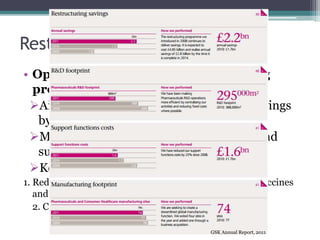
• Operational Excellence restructuring
program (2008)
Aimed at delivering £2.8 bn in annual savings
by end of 2014.
Main focus areas: R&D, manufacturing and
support functions
Key points:
1. Redirect savings to expansions in emerging markets, vaccines
and consumer healthcare.
2. Cover loss in sales to generics
GSK Annual Report, 2011
• Core Business Services (2011)
Standardization of support functions aimed at
maximization of economies of scale and
increased productivity.
Challenges Beyond the US Market
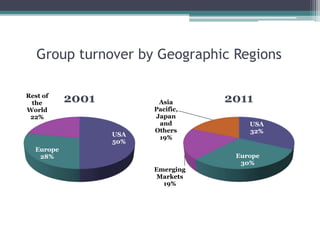
Group turnover by Geographic Regions
USA
50%
Europe
28%
Rest of
the
World
22%
2001
USA
32%
Europe
30%
Emerging
Markets
19%
Asia
Pacific,
Japan
and
Others
19%
2011
Europe
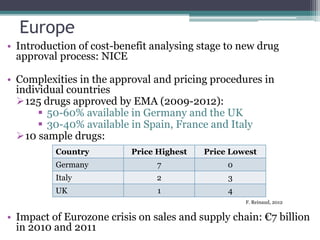
• Introduction of cost-benefit analysing stage to new drug
approval process: NICE
• Complexities in the approval and pricing procedures in
individual countries
125 drugs approved by EMA (2009-2012):
 50-60% available in Germany and the UK
 30-40% available in Spain, France and Italy
10 sample drugs:
• Impact of Eurozone crisis on sales and supply chain: €7 billion
in 2010 and 2011
Country Price Highest Price Lowest
Germany 7 0
Italy 2 3
UK 1 4
F. Reinaud, 2012
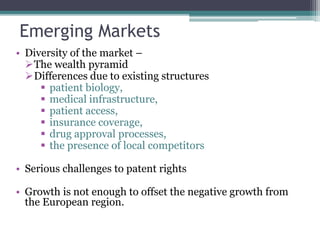
Emerging Markets
• Diversity of the market –
The wealth pyramid
Differences due to existing structures
 patient biology,
 medical infrastructure,
 patient access,
 insurance coverage,
 drug approval processes,
 the presence of local competitors
• Serious challenges to patent rights
• Growth is not enough to offset the negative growth from
the European region.
GSK’s strategy
• Asia Pacific, Japan, and Emerging Markets (APJEM) R&D group (2009).
 Branded generics – Dividing the R&D process between GSK and Dr
Reddy’s Laboratories in India
 Intra-regional business development – partnership with Amgen to take
over the complete process of development of denosumab in emerging
markets
 And local regional development – medical need or commercial
opportunity
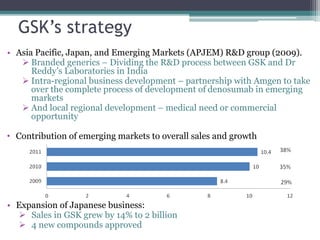
• Contribution of emerging markets to overall sales and growth
• Expansion of Japanese business:
 Sales in GSK grew by 14% to 2 billion
 4 new compounds approved
Challenges in Research & Development
• Pipeline
Patients expiring
Insufficient drugs to fill current pipeline
Pressure for scientist developed
• Shifting R&D towards new innovation
Change in focus to developing new drugs
Exhausted incrementally modified drugs (IME)
• Time lag to an output gap
Average of 10-15 years to develop new drugs from
discovery to approval
Increase in average R&D cost $800m - $1bn due to
many failure of drugs during clinical trials
Rigorous testing for safety and effectiveness
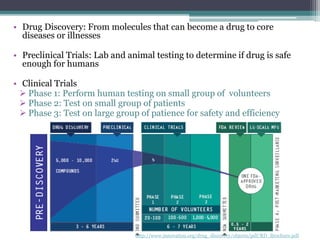
• Drug Discovery: From molecules that can become a drug to core
diseases or illnesses
• Preclinical Trials: Lab and animal testing to determine if drug is safe
enough for humans
• Clinical Trials
 Phase 1: Perform human testing on small group of volunteers
 Phase 2: Test on small group of patients
 Phase 3: Test on large group of patience for safety and efficiency
http://www.innovation.org/drug_discovery/objects/pdf/RD_Brochure.pdf
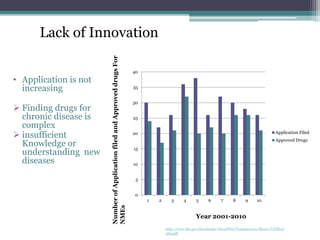
NumberofApplicationfiledandApproveddrugsFor
NMEs
Year 2001-2010
http://www.fda.gov/downloads/AboutFDA/Transparency/Basics/UCM247
465.pdf
• Application is not
increasing
 Finding drugs for
chronic disease is
complex
 insufficient
Knowledge or
understanding new
diseases
Lack of Innovation
0
5
10
15
20
25
30
35
40
1 2 3 4 5 6 7 8 9 10
Application Filed
Approved Drugs
• Focus on delivering product of value and best
science to the R&D organisation
• Collaboration with Academia and external
organisation that support GSK strategies
• Deliver new drugs in current pipeline and
maintain productivity
• Maintaining investors appetite through positive
IRR
GSK’s Strategy
GSK’s Strategy
•Collaboration with academies
Increasing GSK knowledge base enhancing the ability to
discover
Bringing in the best minds to stimulate innovation and
entrepreneurship and speed drug discovery
collaborated with University of Cambridge to develop
treatment for liver diseases
GSK’s strategy
• Externalisation
GSK acquires Cellzome to enhance science capabilities and
bring medicines into patient faster
Cellzome technology provided GSK with screening
capability: Identify compounds with drug targets
Reduce attrition rate in early phases of development
Cutting cost of failures
New Entrants: Changing The Market
New Entrants: Changing the Market
• Biotech companies provide the scientific breakthroughs.
• Venture Capitalists provide the financial backing
• Rational Drug Design.
• They make the medical ‘keys’ to fit the biological ‘locks.’
• Amgen, shares appreciated 16,000% since 1983 IPO
• They are increasingly holding the rights to the most marketable
drugs.
• Challenge for existing pharmaceutical firms is how to benefit from
these advances and accrue a share of the revenue.
Strategy: Collaboration and Control
• Amgen: worlds largest independent Biotech company
• Collaboration with GSK on commercializing antibody
denosumab.
Amgen: USA and Canada
Joint commercialization: Europe, Australia, New
Zealand and Mexico
GSK: China, Brazil, India, South Korea
• $120m + royalties to Amgen in return for shared profits in
Europe and full sales rights in emerging markets.
• “Bring denosumab to patients ... more effectively than if we
commercialized the drug globally on our own” – Amgen
• “A strong addition to our biopharmaceuticals portfolio” -
GSK
New Entrants: Healthcare Technology
• Investments by non-pharmaceutical companies in healthcare
technology (apps, internet) are massively outpacing those of
pharmaceutical companies.
 Patient empowerment
 Data driven
 Outcome focused approach
• Pharmaceutical companies should be indispensable in providing
content with their unique knowledge.
• But e-companies are quick growers and quick learners.
• Challenge for pharmaceutical companies is in staying relevant
and ensuring their products and knowledge are being shared.
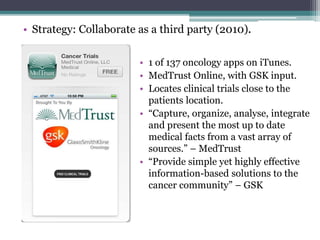
• Strategy: Collaborate as a third party (2010).
• 1 of 137 oncology apps on iTunes.
• MedTrust Online, with GSK input.
• Locates clinical trials close to the
patients location.
• “Capture, organize, analyse, integrate
and present the most up to date
medical facts from a vast array of
sources.” – MedTrust
• “Provide simple yet highly effective
information-based solutions to the
cancer community” – GSK
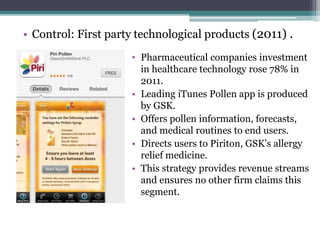
• Control: First party technological products (2011) .
• Pharmaceutical companies investment
in healthcare technology rose 78% in
2011.
• Leading iTunes Pollen app is produced
by GSK.
• Offers pollen information, forecasts,
and medical routines to end users.
• Directs users to Piriton, GSK’s allergy
relief medicine.
• This strategy provides revenue streams
and ensures no other firm claims this
segment.
The Changing Market
• Pharma 1.0 - Blockbuster Industry was a ‘rewarding place to play.’
 High barriers to entry; the reward of high revenue streams.
• Pharma 2.0 - Changed the industry from within
 Age of weakening patent protection, regulation, the need to enter
emerging markets, and challenges in research and development.
• Pharma 3.0 – The digital environment
 GSK need to ensure they remain relevant and secure a prime place
in these new product and information channels.
References
Patent Protection:
•Ehrhardt, M (spring 2012), Five steps towards a revitalized pharmaceutical supply
chain, http://www.strategy-business.com/media/file/00094-Five-Steps-Revitalized-Pharma-Supply-
Chain.pdf
Pinset Mansons (October, 2001),Threat to international patent protection: the pharmaceutical industry's
perspective,http://www.out-law.com/page-382
•GlaxoSmithLine (2011), Horlicks http://www.horlicks.co.uk/health/
•The Pharmaletter (October 16, 2006) GSK to buy CNS Inc for $566
million, http://www.thepharmaletter.com/file/20671/gsk-to-buy-cns-inc-for-566-million.html
•My news desk (Nov 07, 2012)UK energy drinks market dominated by GSK's Lucozade
brand, http://www.mynewsdesk.com/uk/view/pressrelease/uk-energy-drinks-market-dominated-by-
gsk-s-lucozade-brand-810651
•Industry week (Dec. 13, 2010) Drugmaker GSK Buys Sports Specialist Maxinutrition, Company is
expanding its consumer healthcare businesshttp://www.industryweek.com/industry-
clusters/drugmaker-gsk-buys-sports-specialist-maxinutrition
•Pilmmer,G (June15, 2009) GSK in generic drug alliance Glaxosmithkline (July 02, 2009) GSK further
extends its product portfolio in the Middle East and North
Africa,http://www.ft.com/cms/s/0/b228c9d8-59df-11de-b687-00144feabdc0.html#axzz2D8zkuskw
•GlaxoSmithKleine (July 02, 2009) GSK further extends its product portfolio in the Middle East and North
Africa (http://www.gsk.com/media/press-releases/2009/gsk-further-extends-its-product-portfolio-in-
the-middle-east-and-north-africa.html
•Chandon,P.(2003) Innovative marketing strategies after patent expiry: The case of GSK’s antibiotic
Clamoxyl in France 7th August. International journal of medical marketing vol 4 174-177 pg 75
•http://www.strategy-business.com/media/file/00094-Five-Steps-Revitalized-Pharma-
Supply-Chain.pdf
Introduction:
J.Gordon et al, (November 5, 2012), GlaxoSmithKline Plc, JP Morgan.
Regulation:
•Baines, Donald.A, Problems Facing the Pharmaceutical Industry and Approaches to Ensure Long
Term Viability, at
http://repository.upenn.edu/cgi/viewcontent.cgi?article=1032&context=od_theses_msod&sei-
redir=1&referer=http%3A%2F%2Fwww.google.com%2Furl%3Fsa%3Dt&rct=j&q=pharmaceutical+in
dustry+challenges&source=web&cd=2&ved=0CDYQFjAB&url=http%3A%2F%2Frepository.upenn.e
du%2Fcgi%2Fviewcontent.cgi%3Farticle%3D1032%26context%3Dod_theses_msod&ei=96WnUNu
RO-W00QXKwoHgAw&usg=AFQjCNFqI7pkpnhSgOh3zpNfLPiAztvfzQ#search
•Morgan Lewis (April 15, 2010), Healthcare Reform Law: Impact on Pharmaceutical Manufacturers,
http://www.morganlewis.com/pubs/WashGRPP_ImpactOnPharmaManufacturers_LF_15apr10.pdf
•Joice Tait, Pressures for Changes in the Pharmaceutical Industry, available at:
http://www.genomicsnetwork.ac.uk/media/Innogen%20Review%20Making%20New%20Medicines.
pdf
Karim, Nicha (June 20, 2012) Challenges and Opportunities for Pharma Industries, available at
http://pharmabiz.com/ArticleDetails.aspx?aid=69654&sid=9
•http://repository.upenn.edu/cgi/viewcontent.cgi?article=1032&context=od_theses_m
sod&sei-redir=1&refe
•repository.upenn.edu
Beyond the US:
•Evolving R&D for Emerging Markets, June 2010, Nature Reviews Drug Discovery 9, 417-420, Box 1.
•F. Reinaud, June 2012, Time to Market for New Pharmaceuticals Increasing in Europe While Prices
Continue Downward Pressure, http://healthcare.blogs.ihs.com/2012/06/19/time-to-market-for-new-
pharmaceuticals-increasing-in-europe-while-prices-continue-downward-pressure-2/
•J Whalen and S. Stovall, June 2012, Drug Firms Urge Price Action, The Wall Street Journal Online,
http://online.wsj.com/article/SB10001424052702304870304577488041346373860.html
•Cancer Research UK, http://www.cancerresearchuk.org/cancer-help/about-cancer/cancer-
questions/how-are-drugs-licensed-in-the-uk
•H. Parmar, Pharmaceutical direct-to-consumer advertising in Europe, Pharmacerutical Field,
http://www.pharmafield.co.uk/features/2005/12/Pharmaceutical-direct-to-consumer-advertising-in-
Europe
Research and Development:
•http://www.ungs.edu.ar/globelics/wp-content/uploads/2011/12/ID-246-Correa-Privatization-of-
knowledge-Intellectual-Property-Right.pdf
•http://www.fda.gov/downloads/AboutFDA/Transparency/Basics/UCM247465.pdf
•http://www.fda.gov/Drugs/DevelopmentApprovalProcess/default.htm
•http://www.innovation.org/drug_discovery/objects/pdf/RD_Brochure.pdf
•http://www.telegraph.co.uk/finance/newsbysector/pharmaceuticalsandchemicals/9266958/GlaxoSmi
thKline-to-buy-Cellzome-for-61m.html
•http://www.bmj.com/content/345/bmj.e4348
New Entrants: Changing the Market:
•Pharmaceutical industry rapidly expanding partnerships with new entrants in
health care space, Ernst & Young, 15th Feb 2011,
http://www.ey.com/GL/en/Newsroom/News-releases/Pharmaceutical-industry-
rapidly-expanding-partnerships-with-new-entrants-in-health-care-space
•A Recent History Of The Pharmaceutical Industry - Based On All Five Forces,
Venture Navigator, August 2007, http://www.venturenavigator.co.uk/content/154
•Roche seals $47bn Genentech deal, BBC, March 2009,
http://news.bbc.co.uk/1/hi/business/7938938.stm
•Amgen to Collaborate With GlaxoSmithKline to Commercialize Denosumab in
Europe for Postmenopausal Osteoporosis (PMO), Amgen, July 2009,
http://www.amgen.com/media/media_pr_detail.jsp?releaseID=1312524
•MedTrust Online app, available at https://itunes.apple.com/gb/app/cancer-
trials/id376117391?mt=8
•GlaxoSmithKline and MedTrust Online Team to Provide Cancer Doctors Better
Mobile Access to Clinical Cancer Trials, MedTrust Online, http://medtrust-
online.com/about-medtrust-online/mtol-in-the-news/53-gsk-pressrelease
•GSK Piri Pollen app, available at https://itunes.apple.com/gb/app/piri-
pollen/id433740845?mt=8

Problems facing the pharmaceutical industry

  • 1.
    Multi-Vision Consultancy Kristina Rocha Mello GiovannaHsu Ei May Htaik Kelly To Jonathan Lloyd
  • 2.
    Negative Implied Valueof Growth Pharma 1.0: The Blockbuster Model • Blockbuster drug: Revenue>$1 billion per year • Traditional Blockbuster model:  High sunk cost i.e. Research & Development  Charge a high premium, as a reward  Patents provide a crucial period of exclusivity and protection J, Gordon et al, JP Morgan
  • 3.
  • 4.
    Weakening Patent protectionChallenges • Widespread availability and issuance of generics Cheaper, due to absence of R&D costs • Increase in patents being challenged by 1. generic manufacturers Due to increase in demand for generics from cost constrained healthcare providers. 2. developing countries Struggle to afford the prices, and therefore exert pressure on pharmaceutical companies • There isn’t an inexhaustible supply of potential blockbusters to sustain revenue streams once existing patents expire.
  • 5.
    GSK’s Patent strategy •Diversifying risk: Moving from blockbusters to markets with quicker, more certain revenue streams: Healthcare and biopharmaceutical: Oral care products (Sensodyne) UK energy drink (Lucosade) Nutritional Supplements (Horlicks) GSK Annual Report, 2011
  • 6.
    • Entering newmarkets: Countering the impact of loss of patent by making their products more available in the less developed countries  flexible pricing model providing GSK patented drugs according to the countries ability to pay.  Kept at no more than 25% of original price
  • 7.
    • Taking acloser interest in generic firms: Acquiring generic brands  establishing their own generic drugs • GSK: 2008- acquired 16% stake of South Africa – based Aspen 2009-licensing and selling agreement of Dr.Reddys generics 2009- acquisition of Bristol Myers Squibb (BMS) in Lebanon, Jordan, Syria, Libya and Yemen
  • 8.
    • Licensing patentdrugs to generic firms before its patent expire  Get royalties in exchange for know-hows -2002- GSK licensed Augmentin to three generic firms 6 months before it expired. • Using an open innovation strategy: Give access to patents they have no interest in researching on in exchange for royalties.
  • 9.
    • Increasing efficiencyand the in the time taken to develop a new innovation. GSK introduced in 2008 a restructuring program- Operational Excellence • Focus on brand alliance & heritage for existing medicines
  • 10.
  • 11.
    Regulatory Challenges • DifferentEnvironments Have to satisfy a different set of regulations in each market Need for harmonization of regulatory requirements
  • 12.
    • Changing Regulations Stricter rules in US & EU  Patient Protection and Affordable Care Act (2010): Impacts: 1.Annual Fee 2.Generic Drug Approval 3.Advertisement Global Warming & Animal Rights Groups
  • 13.
    Restructuring & CostSavings • Operational Excellence restructuring program (2008) Aimed at delivering £2.8 bn in annual savings by end of 2014. Main focus areas: R&D, manufacturing and support functions Key points: 1. Redirect savings to expansions in emerging markets, vaccines and consumer healthcare. 2. Cover loss in sales to generics GSK Annual Report, 2011
  • 14.
    • Core BusinessServices (2011) Standardization of support functions aimed at maximization of economies of scale and increased productivity.
  • 15.
  • 16.
    Group turnover byGeographic Regions USA 50% Europe 28% Rest of the World 22% 2001 USA 32% Europe 30% Emerging Markets 19% Asia Pacific, Japan and Others 19% 2011
  • 17.
    Europe • Introduction ofcost-benefit analysing stage to new drug approval process: NICE • Complexities in the approval and pricing procedures in individual countries 125 drugs approved by EMA (2009-2012):  50-60% available in Germany and the UK  30-40% available in Spain, France and Italy 10 sample drugs: • Impact of Eurozone crisis on sales and supply chain: €7 billion in 2010 and 2011 Country Price Highest Price Lowest Germany 7 0 Italy 2 3 UK 1 4 F. Reinaud, 2012
  • 18.
    Emerging Markets • Diversityof the market – The wealth pyramid Differences due to existing structures  patient biology,  medical infrastructure,  patient access,  insurance coverage,  drug approval processes,  the presence of local competitors • Serious challenges to patent rights • Growth is not enough to offset the negative growth from the European region.
  • 19.
    GSK’s strategy • AsiaPacific, Japan, and Emerging Markets (APJEM) R&D group (2009).  Branded generics – Dividing the R&D process between GSK and Dr Reddy’s Laboratories in India  Intra-regional business development – partnership with Amgen to take over the complete process of development of denosumab in emerging markets  And local regional development – medical need or commercial opportunity • Contribution of emerging markets to overall sales and growth • Expansion of Japanese business:  Sales in GSK grew by 14% to 2 billion  4 new compounds approved
  • 20.
  • 21.
    Challenges in Research& Development • Pipeline Patients expiring Insufficient drugs to fill current pipeline Pressure for scientist developed • Shifting R&D towards new innovation Change in focus to developing new drugs Exhausted incrementally modified drugs (IME) • Time lag to an output gap Average of 10-15 years to develop new drugs from discovery to approval Increase in average R&D cost $800m - $1bn due to many failure of drugs during clinical trials Rigorous testing for safety and effectiveness
  • 22.
    • Drug Discovery:From molecules that can become a drug to core diseases or illnesses • Preclinical Trials: Lab and animal testing to determine if drug is safe enough for humans • Clinical Trials  Phase 1: Perform human testing on small group of volunteers  Phase 2: Test on small group of patients  Phase 3: Test on large group of patience for safety and efficiency http://www.innovation.org/drug_discovery/objects/pdf/RD_Brochure.pdf
  • 23.
    NumberofApplicationfiledandApproveddrugsFor NMEs Year 2001-2010 http://www.fda.gov/downloads/AboutFDA/Transparency/Basics/UCM247 465.pdf • Applicationis not increasing  Finding drugs for chronic disease is complex  insufficient Knowledge or understanding new diseases Lack of Innovation 0 5 10 15 20 25 30 35 40 1 2 3 4 5 6 7 8 9 10 Application Filed Approved Drugs
  • 24.
    • Focus ondelivering product of value and best science to the R&D organisation • Collaboration with Academia and external organisation that support GSK strategies • Deliver new drugs in current pipeline and maintain productivity • Maintaining investors appetite through positive IRR GSK’s Strategy
  • 25.
    GSK’s Strategy •Collaboration withacademies Increasing GSK knowledge base enhancing the ability to discover Bringing in the best minds to stimulate innovation and entrepreneurship and speed drug discovery collaborated with University of Cambridge to develop treatment for liver diseases
  • 26.
    GSK’s strategy • Externalisation GSKacquires Cellzome to enhance science capabilities and bring medicines into patient faster Cellzome technology provided GSK with screening capability: Identify compounds with drug targets Reduce attrition rate in early phases of development Cutting cost of failures
  • 27.
  • 28.
    New Entrants: Changingthe Market • Biotech companies provide the scientific breakthroughs. • Venture Capitalists provide the financial backing • Rational Drug Design. • They make the medical ‘keys’ to fit the biological ‘locks.’ • Amgen, shares appreciated 16,000% since 1983 IPO • They are increasingly holding the rights to the most marketable drugs. • Challenge for existing pharmaceutical firms is how to benefit from these advances and accrue a share of the revenue.
  • 29.
    Strategy: Collaboration andControl • Amgen: worlds largest independent Biotech company • Collaboration with GSK on commercializing antibody denosumab. Amgen: USA and Canada Joint commercialization: Europe, Australia, New Zealand and Mexico GSK: China, Brazil, India, South Korea • $120m + royalties to Amgen in return for shared profits in Europe and full sales rights in emerging markets. • “Bring denosumab to patients ... more effectively than if we commercialized the drug globally on our own” – Amgen • “A strong addition to our biopharmaceuticals portfolio” - GSK
  • 30.
    New Entrants: HealthcareTechnology • Investments by non-pharmaceutical companies in healthcare technology (apps, internet) are massively outpacing those of pharmaceutical companies.  Patient empowerment  Data driven  Outcome focused approach • Pharmaceutical companies should be indispensable in providing content with their unique knowledge. • But e-companies are quick growers and quick learners. • Challenge for pharmaceutical companies is in staying relevant and ensuring their products and knowledge are being shared.
  • 31.
    • Strategy: Collaborateas a third party (2010). • 1 of 137 oncology apps on iTunes. • MedTrust Online, with GSK input. • Locates clinical trials close to the patients location. • “Capture, organize, analyse, integrate and present the most up to date medical facts from a vast array of sources.” – MedTrust • “Provide simple yet highly effective information-based solutions to the cancer community” – GSK
  • 32.
    • Control: Firstparty technological products (2011) . • Pharmaceutical companies investment in healthcare technology rose 78% in 2011. • Leading iTunes Pollen app is produced by GSK. • Offers pollen information, forecasts, and medical routines to end users. • Directs users to Piriton, GSK’s allergy relief medicine. • This strategy provides revenue streams and ensures no other firm claims this segment.
  • 33.
    The Changing Market •Pharma 1.0 - Blockbuster Industry was a ‘rewarding place to play.’  High barriers to entry; the reward of high revenue streams. • Pharma 2.0 - Changed the industry from within  Age of weakening patent protection, regulation, the need to enter emerging markets, and challenges in research and development. • Pharma 3.0 – The digital environment  GSK need to ensure they remain relevant and secure a prime place in these new product and information channels.
  • 34.
    References Patent Protection: •Ehrhardt, M(spring 2012), Five steps towards a revitalized pharmaceutical supply chain, http://www.strategy-business.com/media/file/00094-Five-Steps-Revitalized-Pharma-Supply- Chain.pdf Pinset Mansons (October, 2001),Threat to international patent protection: the pharmaceutical industry's perspective,http://www.out-law.com/page-382 •GlaxoSmithLine (2011), Horlicks http://www.horlicks.co.uk/health/ •The Pharmaletter (October 16, 2006) GSK to buy CNS Inc for $566 million, http://www.thepharmaletter.com/file/20671/gsk-to-buy-cns-inc-for-566-million.html •My news desk (Nov 07, 2012)UK energy drinks market dominated by GSK's Lucozade brand, http://www.mynewsdesk.com/uk/view/pressrelease/uk-energy-drinks-market-dominated-by- gsk-s-lucozade-brand-810651 •Industry week (Dec. 13, 2010) Drugmaker GSK Buys Sports Specialist Maxinutrition, Company is expanding its consumer healthcare businesshttp://www.industryweek.com/industry- clusters/drugmaker-gsk-buys-sports-specialist-maxinutrition •Pilmmer,G (June15, 2009) GSK in generic drug alliance Glaxosmithkline (July 02, 2009) GSK further extends its product portfolio in the Middle East and North Africa,http://www.ft.com/cms/s/0/b228c9d8-59df-11de-b687-00144feabdc0.html#axzz2D8zkuskw •GlaxoSmithKleine (July 02, 2009) GSK further extends its product portfolio in the Middle East and North Africa (http://www.gsk.com/media/press-releases/2009/gsk-further-extends-its-product-portfolio-in- the-middle-east-and-north-africa.html •Chandon,P.(2003) Innovative marketing strategies after patent expiry: The case of GSK’s antibiotic Clamoxyl in France 7th August. International journal of medical marketing vol 4 174-177 pg 75 •http://www.strategy-business.com/media/file/00094-Five-Steps-Revitalized-Pharma- Supply-Chain.pdf
  • 35.
    Introduction: J.Gordon et al,(November 5, 2012), GlaxoSmithKline Plc, JP Morgan. Regulation: •Baines, Donald.A, Problems Facing the Pharmaceutical Industry and Approaches to Ensure Long Term Viability, at http://repository.upenn.edu/cgi/viewcontent.cgi?article=1032&context=od_theses_msod&sei- redir=1&referer=http%3A%2F%2Fwww.google.com%2Furl%3Fsa%3Dt&rct=j&q=pharmaceutical+in dustry+challenges&source=web&cd=2&ved=0CDYQFjAB&url=http%3A%2F%2Frepository.upenn.e du%2Fcgi%2Fviewcontent.cgi%3Farticle%3D1032%26context%3Dod_theses_msod&ei=96WnUNu RO-W00QXKwoHgAw&usg=AFQjCNFqI7pkpnhSgOh3zpNfLPiAztvfzQ#search •Morgan Lewis (April 15, 2010), Healthcare Reform Law: Impact on Pharmaceutical Manufacturers, http://www.morganlewis.com/pubs/WashGRPP_ImpactOnPharmaManufacturers_LF_15apr10.pdf •Joice Tait, Pressures for Changes in the Pharmaceutical Industry, available at: http://www.genomicsnetwork.ac.uk/media/Innogen%20Review%20Making%20New%20Medicines. pdf Karim, Nicha (June 20, 2012) Challenges and Opportunities for Pharma Industries, available at http://pharmabiz.com/ArticleDetails.aspx?aid=69654&sid=9 •http://repository.upenn.edu/cgi/viewcontent.cgi?article=1032&context=od_theses_m sod&sei-redir=1&refe •repository.upenn.edu
  • 36.
    Beyond the US: •EvolvingR&D for Emerging Markets, June 2010, Nature Reviews Drug Discovery 9, 417-420, Box 1. •F. Reinaud, June 2012, Time to Market for New Pharmaceuticals Increasing in Europe While Prices Continue Downward Pressure, http://healthcare.blogs.ihs.com/2012/06/19/time-to-market-for-new- pharmaceuticals-increasing-in-europe-while-prices-continue-downward-pressure-2/ •J Whalen and S. Stovall, June 2012, Drug Firms Urge Price Action, The Wall Street Journal Online, http://online.wsj.com/article/SB10001424052702304870304577488041346373860.html •Cancer Research UK, http://www.cancerresearchuk.org/cancer-help/about-cancer/cancer- questions/how-are-drugs-licensed-in-the-uk •H. Parmar, Pharmaceutical direct-to-consumer advertising in Europe, Pharmacerutical Field, http://www.pharmafield.co.uk/features/2005/12/Pharmaceutical-direct-to-consumer-advertising-in- Europe Research and Development: •http://www.ungs.edu.ar/globelics/wp-content/uploads/2011/12/ID-246-Correa-Privatization-of- knowledge-Intellectual-Property-Right.pdf •http://www.fda.gov/downloads/AboutFDA/Transparency/Basics/UCM247465.pdf •http://www.fda.gov/Drugs/DevelopmentApprovalProcess/default.htm •http://www.innovation.org/drug_discovery/objects/pdf/RD_Brochure.pdf •http://www.telegraph.co.uk/finance/newsbysector/pharmaceuticalsandchemicals/9266958/GlaxoSmi thKline-to-buy-Cellzome-for-61m.html •http://www.bmj.com/content/345/bmj.e4348
  • 37.
    New Entrants: Changingthe Market: •Pharmaceutical industry rapidly expanding partnerships with new entrants in health care space, Ernst & Young, 15th Feb 2011, http://www.ey.com/GL/en/Newsroom/News-releases/Pharmaceutical-industry- rapidly-expanding-partnerships-with-new-entrants-in-health-care-space •A Recent History Of The Pharmaceutical Industry - Based On All Five Forces, Venture Navigator, August 2007, http://www.venturenavigator.co.uk/content/154 •Roche seals $47bn Genentech deal, BBC, March 2009, http://news.bbc.co.uk/1/hi/business/7938938.stm •Amgen to Collaborate With GlaxoSmithKline to Commercialize Denosumab in Europe for Postmenopausal Osteoporosis (PMO), Amgen, July 2009, http://www.amgen.com/media/media_pr_detail.jsp?releaseID=1312524 •MedTrust Online app, available at https://itunes.apple.com/gb/app/cancer- trials/id376117391?mt=8 •GlaxoSmithKline and MedTrust Online Team to Provide Cancer Doctors Better Mobile Access to Clinical Cancer Trials, MedTrust Online, http://medtrust- online.com/about-medtrust-online/mtol-in-the-news/53-gsk-pressrelease •GSK Piri Pollen app, available at https://itunes.apple.com/gb/app/piri- pollen/id433740845?mt=8